Saturday, April 16, 2022

COMMENTARY UNIONS & ORGANIZING
Worker-to-Worker Organizing May Finally Have Its Moment


APRIL 07, 2022
STEVEN GREENHOUSE
SENIOR FELLOW


For years, many worker advocates have said there’s a simple, straightforward answer for reversing organized labor’s decline: worker-to-worker organizing. Nonetheless, there was very little worker-to-worker organizing going on in the United States—what organizing there was, was overwhelmingly done by union staff organizers. Despite all the wishing, worker-to-worker organizing remained a far-away dream that just wasn’t happening.

But now with the historic union victory at Amazon in Staten Island and the string of union wins at Starbucks, we are finally seeing true worker-to-worker organizing in action—and how powerful and successful it can be. We are also, at least in Starbucks’ case, seeing how contagious worker-to-worker organizing can be, how it can spread like wildfire, with workers at more than 170 Starbucks in nearly thirty states petitioning for union elections.

Initially many labor leaders pooh-poohed the idea of worker-to-worker organizing at Amazon and Starbucks, saying that it’s forbidding enough to organize those anti-union behemoths, and that there’s no way amateur worker-to-worker organizers could pull off victories there. I should perhaps note that many union leaders have little love for worker-to-worker organizing because—unlike in typical organizing drives that rely on union staff—they don’t have close control over it.

In recent days, we have seen highly publicized successes in worker-to-worker organizing: the tremendous upset win at Amazon’s 8,000-employee Staten Island warehouse and victories at ten of the eleven Starbucks where workers have voted thus far whether to unionize. After years of talk about the need for worker-to-worker organizing and little of it happening, over the past year, many frontline workers are now plunging into it. They’re feeling angry and emboldened because of how poorly their employers treated them during the pandemic. They have gotten used to speaking out and standing up to authority because of the Black Lives Matter, MeToo, and immigrant rights movements. They are feeling less scared about sticking their necks out and perhaps being fired if they seek to unionize because they know it’s easy to find another job thanks to the very low jobless rate.

It is little understood that worker-to-worker organizing has several big advantages over traditional organizing with staff union organizers—who, I want to make clear, are often excellent and highly dedicated. One tremendous advantage is that worker-to-worker organizing overcomes one of the most important ways that America’s labor laws are tilted so heavily in favor of corporations and against unions. It is legal for corporations to prohibit outside (that is, non-employee) union organizers from setting foot on company property, even the parking lots, while companies are allowed to propagandize against the union 24/7, showing anti-union videos in breakrooms and lunchrooms and requiring all employees to attend meetings where union-busting consultants hold forth about the supposed evils of unions. But with worker-to-worker organizing, unlike with union staff organizers, the main organizers—rank-and-file workers like Amazon warehouse workers and Starbucks baristas—have regular access to company property, the shop floor, and their fellow employees.

Take Amazon’s JFK8 warehouse in Staten Island: a fired Amazon employee, Christian Smalls, and his best friend, Derrick Palmer, an Amazon worker in Staten Island, founded an independent union that had a shoestring budget and relied overwhelmingly on two dozen workers at the Staten Island warehouse to reach out to the 8,000 workers there. Those worker-organizers plunged into talking-up coworkers in breakrooms, talking to coworkers during lunch and at the entrance as people left work and at the nearby bus stop so many workers used.

Another huge advantage of worker-to-worker organizing is it emphatically puts the lie to what is perhaps corporate America’s most frequently used anti-union argument: that unions are a third party, a greedy group of outsiders who only want workers’ dues money. When workers hear this “third-party” refrain and then see their coworkers—often their friends, their lunchmates—bravely sticking their necks out and urging others to unionize, often taking time before work and after work and away from their families to explain the advantages of unionizing, many workers realize, “Hey, the union is us, it’s me and my coworkers,”; they realize the union is not some aloof third-party based in Washington.

Worker-to-worker organizing helps unions win in another way: by altering how workers frame what’s happening. With traditional organizing efforts, workers—when they are casting their ballots on whether to unionize—often ask, “Do I vote for my employer whom I don’t really like, or for this somewhat distant, big bureaucratic union I don’t really know and to which I’ll have to pay dues money (at least in non-right-to-work states)?” But in a worker-to-worker organizing effort, the calculus changes—when workers are voting, they ask, “Do I cast my vote for my employer whom I don’t really like, or do I cast my vote for my coworkers, whom I know and like and who have bravely challenged management and fought for a union in order to make this a better workplace so that all of us can get paid more and treated better?” For many workers, the answer is a no-brainer. You vote for your coworkers.

Another major advantage: worker-to-worker organizing is far less expensive than the traditional organizing model, which relies on paid staff organizers, who of course often also try to mobilize many rank-and-file workers to help organize. Smalls said the Staten Island campaign, relying overwhelmingly on twenty-four warehouse workers, spent just $120,000 to organize the more than 8,000 workers there. That comes to less than $15 per worker. But if a union dispatched twenty-four paid organizers for six months to organize those workers—to speak to them outside the warehouse, to knock on their doors at home, to phone them at home, to hold meetings at a local hotel—all that might easily cost the union $3 million: for staff salaries, staff benefits, hotel rooms, food, per diems, rental cars, gas, cell phone bills, airline flights from where the organizers live, not to mention the cost of T-shirts flyers, and renting an office.

A little-discussed reason for organized labor’s decline in membership is that many union leaders have balked at undertaking ambitious organizing drives because they don’t want to spend hundreds of thousands or millions of dollars on such campaigns when they know there’s a good chance they will lose. (They will rightly complain that the nation’s labor laws are stacked against unions and that’s why the PRO Act should be enacted.) Therefore, a big reason union leaders should embrace worker-to-worker organizing and agree to bankroll it is that it’s not just a frugal way to organize large numbers of workers, but a way to make the most out of this very promising moment for labor.

There’s a final reason that worker-to-worker organizing is such a good idea. Many workers, especially young workers, talk and think a lot about the importance of agency, of taking charge of one’s life. Self-organizing—that is, joining together with one’s coworkers, with one’s buddies at work, to unionize—is agency in action. Self-organizing can be an exciting, even exuberant exercise of agency, of self-help.

Worker-to-worker organizing can make workers feel good and feel proud that they’re not just fighting to improve pay and conditions at their own workplace. They’re also helping build worker power overall that could create a fairer U.S. economy with less income inequality and higher standards for all workers.


Steven Greenhouse, Senior Fellow
Steven Greenhouse is a senior fellow at The Century Foundation, where he writes about wages and working conditions, labor organizing, and other workplace issues.
AMERIKA
What Self-Managed Abortion Care Means for Abortion Bans in 2022


APRIL 12, 2022
ANNA BERNSTEIN
FELLOW

Within the next few months, the U.S. Supreme Court will issue a ruling in Dobbs v. Jackson Women’s Health Organization, a decision that could gut or overturn entirely the right to abortion secured in Roe v. Wade. If Roe is overturned, half of states are likely to ban access to abortion. The urgency of this moment has heightened public awareness and media coverage of the state of abortion access in the country.

Along with this renewed attention, there has also been a resurgence of coathanger imagery and narratives that rely on the threat of a return to “back alley abortions.” Of course, before Roe (and, even more recently, since the Hyde Amendment), this was often the reality for those that could not afford or access safe and legal abortion care. My own great-grandmother lost her life as a result of complications from an unsafe abortion—a tragic loss that too many families experienced.

The reality of abortion care in 2022, though, is vastly different: safe methods of self-managed abortion care can help ensure pregnant people today do not suffer the same fate as my great-grandmother. The availability of medication abortion care means that abortion accessed outside of the health care system can be safe, and often more affordable, than in-clinic care. Not only does framing this care as inherently unsafe fail to capture the reality of present-day self-managed abortion care: it also further stigmatizes the practice.

It is possible—and necessary—to comprehend the gravity of this crisis in abortion access and know that people can self-manage their abortions safely.

We must acknowledge the tragedy of lives lost to unsafe abortion without perpetuating misunderstanding of what self-managed abortion care looks like today. It is possible—and necessary—to comprehend the gravity of this crisis in abortion access and know that people can self-manage their abortions safely. Understanding the current implications of abortion bans requires understanding the landscape of abortion access and self-managed abortion care in 2022; this commentary aims to support that understanding.

A Further Fracturing of Current Access

The potential fall of federal protections for abortion access will not result in changes to abortion laws across the country. Rather, without Roe in place, access to abortion care will become even more dependent on states. This is a continuation of a trend that has been on the rise in the past several decades, with some states passing increasingly restrictive laws and others legislating to proactively expand and safeguard access to abortion.

Because of the patchwork of laws restricting access to abortion care, it is already difficult for a great many patients to get the care they need. These medically unnecessary restrictions include TRAP laws, which often force clinics to close; policies restricting insurance coverage of abortion care; and waiting periods and two-visit requirements, which double travel time and missed work for patients. Bearing the brunt of this crisis are communities of color, people living with low incomes, undocumented individuals, young people, and other oppressed groups that may be unable to travel for their care. For those that are able to overcome barriers to abortion access, costs compound. And, unsurprisingly, for those whom abortion care remains out of reach, abortion denial has detrimental emotional, social, and economic effects.

With the abortion access landscape dependent on state legislation, it is common for patients to travel out-of-state for their care. The ability to do so, however, is limited to those with the financial means for transportation, often in addition to costs for lodging, time off from work, child care, and other expenses. These costs add up: one study found that over a quarter of abortion patients surveyed lost nearly $200 in wages, two-thirds spent close to $50 on transportation, and a small portion had to spend an average of $140 for lodging and related travel costs. These expenses are in addition to the median cost of over $500 paid for the abortion care itself—costs which are increasing and often paid entirely out-of-pocket because of restrictions on insurance coverage for abortion care. Abortion funds often step in to assist patients with these travel costs, but they should not have to: just like any other form of health care, individuals should be able to access abortion care in the communities where they live and work.

In the case of Texas—where meaningful access to abortion care has been virtually nonexistent since the implementation of a six-week ban in September—many residents have travelled to other states for their care. Since the law (SB8) has gone into effect, thousands of patients have been forced to seek care out-of-state each month. The more states that adopt abortion bans—as Oklahoma and Idaho have just moved to do—the more strain is put on states with greater access, and the farther patients have to travel to receive care. It is not feasible for clinics in “friendly” states to provide care to everyone who needs it, and neither is it feasible for patients to travel for care as those distances increase.

Legislators are now going so far as to attempt to prohibit abortions beyond their states’ borders. Disturbingly, a Missouri lawmaker has just introduced legislation that stops patients from seeking care out-of-state and penalizes individuals that help patients do so. Self-managed abortion care allows individuals to access care without the potentially prohibitive burdens of travel.

The Reality of Self-Managed Care


The availability of medication abortion has changed the landscape of self-managed abortion care, particularly over the last fifteen years. Medication abortion care, with the most common regimen in the United States being comprised of two drugs (mifepristone and misoprostol), is overwhelmingly safe and effective. It is also growing in popularity: medication abortion care now accounts for over half of all abortions in the country.

Medication abortion can be administered safely via telehealth and with varying levels of involvement from the formal health system, including through self-management. Notably, the World Health Organization recently released new abortion care guidelines that note the following:

“…from the perspective of the health system, self-management should not be considered a ‘last resort’ option or a substitute for a non-functioning health system. Self-management must be recognized as a potentially empowering and active extension of the health system and task-sharing approaches.”

In response to the severe limitations on access to abortion in Texas, there has been a corresponding surge in demand for self-managed care. After SB8 went into effect, Aid Access (a non-profit that provides self-managed medication abortion care) saw a substantial increase in requests for their services. In the week after the law went into effect, the average number of daily requests surged from around eleven to over 135, and even after this initial peak, requests for the next three weeks were still nearly 2.5 times higher than before the law was implemented. It has even been suggested that out-of-state care and requests for medication abortion care combined may have offsest the decrease seen in abortions provided to Texas residents. However, as noted by Dr. Daniel Grossman (a clinical and public health researcher and director of the research organization ANSIRH), orders for abortion pills do not necessarily translate to receipt of abortion care—and, regardless, patients should not have to go outside the health system to receive this basic health care.

No one should be prosecuted for their pregnancy outcomes, including self-managed abortion care, and these laws pose a particular threat to communities of color.

Although self-managed abortion care is safe in terms of health risks, it can unfortunately carry legal dangers. The many laws that have been used to criminalize pregnancy outcomes include those that directly target self-managed abortion care, as well as laws criminalizing harm to fetuses; these are often arcane laws that have been on the books for decades, but are used in modern efforts to prosecute self-managed care. Moreover, archaic policies that criminalize individuals who provide abortion care have been used in attempts to prosecute the pregnant individuals themselves when abortion care is self-managed.1 These laws are not only dangerous to the people who have been—and will be—prosecuted, but may also deter individuals from seeking necessary care after experiencing miscarriages and stillbirths. No one should be prosecuted for their pregnancy outcomes, including self-managed abortion care, and these laws pose a particular threat to communities of color, who are already over-policed and overcriminalized.

What Can Be Done Now


Abortion care is already out of reach for too many people in the United States, and if Roe is overturned, access will be vastly more limited. As the dire situation in Texas has taught us, addressing access to medication abortion care and self-managed care in particular will become even more urgent.

It is crucial that people who self-manage their abortions are supported and not criminalized. State legislatures should repeal laws criminalizing pregnancy outcomes, and pass legislation that protects individuals from prosecution based on suspected self-managed abortion care; the Department of Justice (DOJ) should support these efforts. Medically accurate information should also be made available for those who are considering self-managed care: the Department of Health and Human Services (HHS) can develop these materials and provide guidance to clarify that mandatory reporting laws do not apply to people who self-manage their abortion care. Agencies like DOJ and HHS must be involved in the whole-of-government efforts to safeguard abortion access that President Biden called for last September in response to Texas’ SB8—a call the administration recently reiterated after Idaho adopted a similar law.

Medication abortion care, self-managed or not, should also be made more accessible: in particular, the policies that govern the provision of mifepristone must align with its robust record of safety. The recent removal of the in-person dispensation requirement for mifepristone is an important step toward making medication abortion care more widely accessible. However, it will not help individuals living in the nineteen states where telemedicine use for medication abortion care is banned. More must be done to remove all of the unnecessary restrictions on medication abortion care, and to ensure its availability in all states. This must go hand-in-hand with maintaining access to procedural care for patients who require or prefer in-clinic care.

Federal legislation such as the Equal Access to Abortion Coverage in Health Insurance (EACH) Act, which would allow for coverage of abortion care under federal insurance programs and facilities, and the Women’s Health Protection Act (WHPA), which would prohibit medically unnecesary restrictions on abortion care, are necessary to make abortion affordable and accessible. Although unsuccessful, the Senate’s recent vote on WHPA was historic. The chamber should follow the lead of the House of Representatives and pass EACH and WHPA.

As we await the Supreme Court’s decision in Dobbs v. Jackson Women’s Health Organization, acting on these policy recommendations is crucial—but these are not the only tools we have. Now more than ever, abortion funds need support: both funds within the states that are restricting abortion and those in states receiving an influx of patients. Abortion funds and other practical support networks have already been assisting patients in traveling for abortion care, and this need will only increase.

Further, we must actively work towards destigmatizing self-managed abortion care—and this can be as simple as using the right language when we talk and write about abortion. As we consider a post-Roe future, it is past time to understand self-managed abortion care as a safe and legitimate option, and support those who choose it.


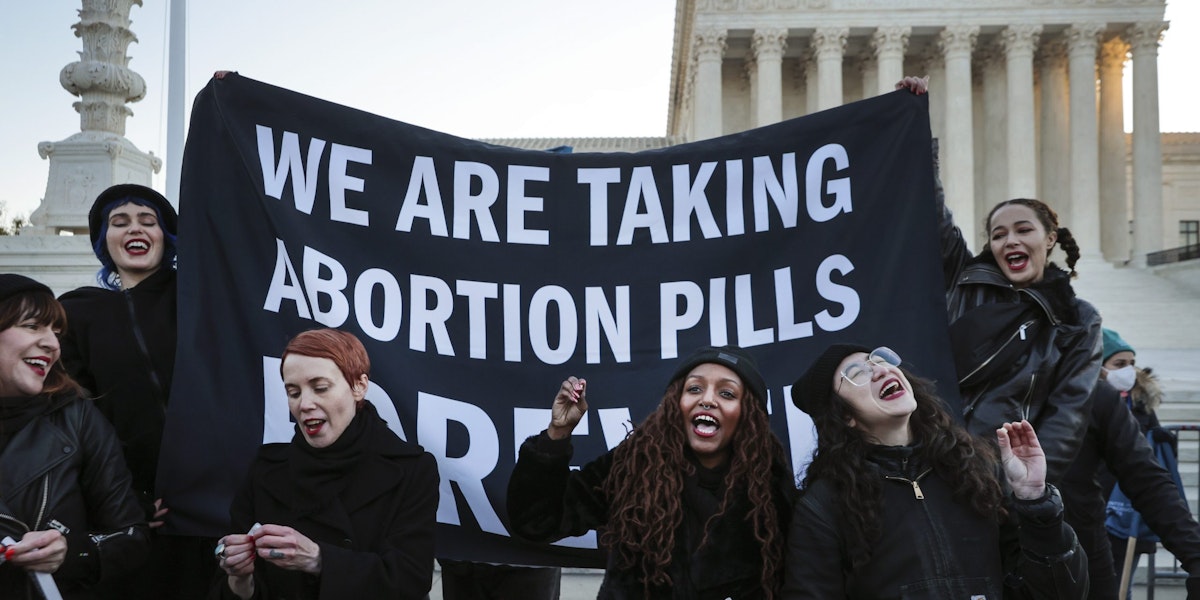
HEADER PHOTO: PROTESTERS, DEMONSTRATORS AND ACTIVISTS GATHER IN FRONT OF THE U.S. SUPREME COURT AS THE JUSTICES HEAR ARGUMENTS IN DOBBS V. JACKSON WOMEN’S HEALTH, A CASE ABOUT A MISSISSIPPI LAW THAT BANS MOST ABORTIONS AFTER 15 WEEKS IN WASHINGTON, DC. SOURCE: CHIP SOMODEVILLA/GETTY IMAGES

Notes
If/When/How has resources available for those in need of legal assistance, including a legal defense fund and a confidential helpline.


Anna Bernstein, Fellow
Anna Bernstein is a health care policy fellow at The Century Foundation, where she works on issues related to maternal and reproductive health.


COMMENTARY HEALTH CARE
JANUARY 21, 2022
DECEMBER 3, 2021
NOVEMBER 30, 2021
SEPTEMBER 28, 2021
Economic vulnerability to the Russia–Ukraine War: which low- and middle-income countries are most vulnerable?

Written by Sherillyn Raga, Laetitia Pettinotti


Key Messages

The global economy is still recovering – modestly – from the pandemic and is now facing significant uncertainty over the Russia– Ukraine war. Initial estimates suggest that the war will cost the global economy up to $950 billion in 2022.

Countries remotely situated from Russia and Ukraine are also likely to be affected. Mostly commodity importers in East Asia Pacific can lose up to $29 billion, while most net commodity exporters in Africa may gain $6 billion in the short-term. Costs would be higher and broad-based across regions if second round of effects of the war on inflation, financial flows and energy policy shifts are incorporated.

The vulnerability index developed in this paper quantifies the vulnerabilities of 118 low and middle-income countries (L&MICs) to the impact of the war based on individual countries’ direct economic links to Russia and Ukraine, indirect exposure to global effects of the war, and resilience of macroeconomic fundamentals. The top seven most vulnerable countries are Belarus, Armenia, Kyrgyz Republic, Lebanon, Maldives, Montenegro and Uzbekistan.

The channels of impact of the war to L&MICs highlight the need for targeted and coordinated domestic policy and international donor interventions to increase the resilience of growth and economic transformation in L&MICs against future crises. There is also a need to address limited adoption of climate and sustainability policy considerations, which can compound L&MICs’ vulnerabilities in times of economic shocks.
The Guardian view on returning a Sámi shaman’s drum: a sign of hope

As a venerated artefact returns to northern Norway, a people take ownership of their own history


‘The Sámi people have long been the victims of internal colonialism’: 
rune drum in the museum at Karasjok, Norway. 
Photograph: Interfoto/Alamy

Fri 15 Apr 2022 

This week the Indigenous Sámi people of Norway celebrated a historic event: the return to the village of Karasjok (Kárášjohka in the northern Sámi language) of a rune drum that had been confiscated in 1691 from a Sámi man who was tried for witchcraft. At the time, the Nordic colonisers of the Arctic were energetically Christianising the Sámi population, whose animist spirituality depended on a sense of connectedness with the lands they inhabited and the animals with which they interacted. Rune drums, made from birchwood and reindeer skin, helped a noaidi, or shaman, to enter a trance and walk among spirits. They could also be used to divine future events: insight was gained by noting where, when the drum was struck, a ring moved in relation to the symbols painted on its surface.

This particular noaidi drum – there are many examples in museums in Sweden, Germany, the UK and elsewhere – happens to be particularly well documented. The court transcripts survive, including a detailed account given by its owner, Poala-Ánde, of its uses. He claimed, poignantly, that “he wanted to help people in distress, and with his art he wanted to do good”. A verdict was never reached in the trial since, before it could be handed down, Poala-Ánde was brutally murdered. The confiscated drum was sent to the authorities in Copenhagen and passed into the royal collection, becoming part of the National Museum of Denmark. Over the past 40 years, during which time the drum has been on loan to the Sámi Museum in Karasjok, the Sámi people have been arguing for ownership to be formally handed over to the institution. After an appeal to Queen Margrethe of Denmark, that has at last happened. “I feel,” said Silje Karine Muotka, president of the Sámi parliament in Norway, “that [Poala-Ánde’s] power is with us as we continue to take ownership of our own history for future generations.”

The Sámi people – whose population of 60-70,000 is scattered through Sweden, Norway, Finland and Russia’s Kola peninsula – have long been the victims of internal colonialism, their views sidelined in the rush for natural resources, whether timber, nickel or even wind power. Now they find themselves on the frontline of climate crisis, with rising temperatures affecting Arctic weather patterns, ecosystems, and traditional ways of living such as reindeer herding. But, with a revival in political self-consciousness, and a young generation taking back the dwindling Sámi languages and taking pride in their culture, the people of the Sápmi nation are taking their place among a network of Indigenous peoples from around the world, notably those from the Amazon, who are increasingly being recognised as holders of knowledge that may yet help the wider world tackle climate crisis. Later this month, too, Sámi artists will step on to the global stage when they exhibit in the Nordic pavilion – renamed this year the Sámi pavilion – at the world’s most celebrated international art event, the Venice Biennale. The Sámi drum is a powerful symbol of a people insisting on the validity of their belief systems – systems that tell us that humans, animals and land are intimately connected, and that harm to one means harm to all.

THE SOCIAL (JUSTICE) GOSPEL
Religious groups that follow Jesus must push to end the exploitation of others for power and profit


Leaders whose driving purpose is centred in the pursuit of solidarity, inclusion, equity and the common good are those we should celebrate

‘At the centre of every major world religion is a concept similar to the example of Jesus – that is, true life is found in living for others, or, “love others as yourself”.
 Photograph: Brendon Thorne/AAP

Brad Chilcott
Fri 15 Apr 2022 

Recently, my psychologist asked me to consider her assertion that “there is no true altruism” – in other words, no one is truly selfless. All of us are acting in our own interest no matter whether one has dedicated themselves to causes of equality, social justice and solidarity.

My psychologist suggests, as many have, that a sense of living for something greater than oneself has significant mental health benefits and the recognition, respect and influence that comes from peers and society from serving others is – in fact – self-serving.

It’s a paradox that the cost of utilising your power and privilege in support or standing with those with less – both against attacks from the ideological police on your own side and those who profit from the systems and structures you’re fighting to bring down – buys significant benefits for your own wellbeing and status.

The story of Jesus that is central to the Christian celebration of Easter is interesting to consider in light of this concept. One with ultimate power and privilege – Jesus, called the Christ, spends his adult life serving the excluded, oppressed and marginalised people of his society, challenging the corrupt political and religious hierarchies that entrench inequality, poverty and exploitation, and then sacrifices his life through crucifixion at the hands of those authorities, only to rise from the dead to be worshipped as the glorified son of God and saviour of the world.

Does the “no true altruism” analysis mean that this is then the ultimate act of self-interest?

All the lateral and oppositional violence is worth it if you end up with your name in lights, crowned in eternal glory? Some iterations of the Christian religion – like the “prosperity doctrine” that teaches adherents that giving both financially and in “selfless” service to the church and community will lead to wealth on Earth followed by riches in heaven – suggest so.

There is, perhaps, a deeper reading.

Wellbeing is found in a sense of purpose; in being truly seen by others and validated as having worth to others and a community of people. It’s found in having the opportunity to be fully welcomed and accepted for who you are.

Our society and the messages it communicates about what is celebrated and rejected impacts on our understanding of our self-worth; our families, religious institutions and the communities likewise communicate validation or rejection based on whether our lives meet their various expectations and standards.
Wellbeing is found in a sense of purpose; in being truly seen by others and validated as having worth to others and a community of people

If we learn that power, wealth, status, body image or living according to social or religious norms are the measures of success as a human then the absence of those assaults our sense of self. If our agency to achieve those things is reduced due to systemic social and economic exclusion – patriarchy, racism, structurally maintained poverty, homophobia, transphobia and ableism – is exacerbated.

Granted, we are all pursuing our own wellbeing. It is more important, then, to ask ourselves and others – those who have the ability to make choices about the communities and societies they live in – how their pursuit of wellbeing will impact others.

If their path to self-worth is paved by the accumulation of wealth while exploiting workers and environment; if their sense of importance is built on denigrating and excluding those who they see as different or “less than” themselves, or if they are willing to sacrifice the collective good of humanity or the communities that comprise it then we should reject their vision of the future and their leadership outright.

To put it more plainly – if your strategy for political victory is turning voters against their neighbour, if you see spending on universal quality child care, public education, mental health or raising the rate of income support for people without jobs as a burden rather than an investment, or if low wages and growing inequality are built in to your policy design and intrinsic to your political ideology then your driving purpose is not the wellbeing of the human collective. Your leadership will not make the well-being of most people better most of the time – because, simply, that is not what you are about.

At the centre of every major world religion is a concept similar to the example of Jesus – that is, true life is found in living for others, or, “love others as yourself”.

This is not a denial of the concept that we all have an intrinsic need to find security, wellbeing and acceptance for our individual selves – but rather that we’re all better off when anyone finds this through solidarity, generosity, inclusion and the pursuit of equality than through individualism, greed, exclusion and the use of coercive power.

This concept should be at the heart of religious communities that follow the example of Jesus – that true “prosperity” is an end to economic, social, political and religious structures that enable one group of people to exploit others for their own power and profit; an end to the idea that one group of people are more worthy of inclusion in faith communities or society that gives them an advantage for personal, social and economic advancement – and at the heart of our decision making about who controls the levers of power that impact on all of us.

“True altruism” may be impossible to find. But leaders whose driving purpose and individual wellbeing is centred in the pursuit of solidarity, inclusion, equity and the common good are those we should celebrate, support – and vote for when we have the chance.

Brad Chilcott is founder of Welcoming Australia
The Guardian view on ending rape in war: endemic but largely unpunished
Editorial

Harrowing accounts of sexual violence by Russian troops in Ukraine are increasing. Impunity must end

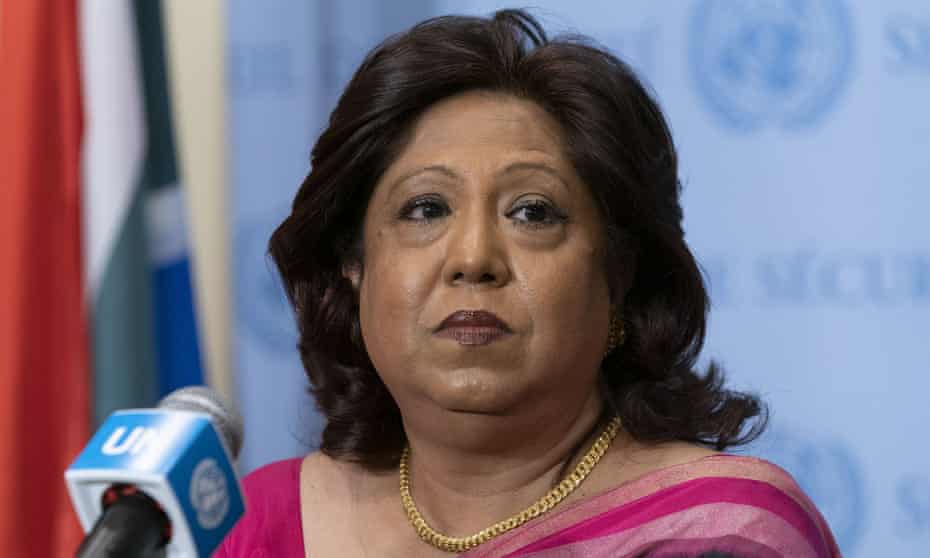
Pramila Patten warned that reports of attacks in Ukraine were increasing exponentially. Photograph: Pacific Press/Zuma/Rex/Shutterstock

Fri 15 Apr 2022 

The bodies of women and girls have long been a battlefield in war. This week, the UN’s high representative on sexual violence in conflict, Pramila Patten, warned that reports of attacks in Ukraine were increasing exponentially, while Sima Bahous, executive director of UN Women, called for an independent investigation into sexual violence there. The brutal accounts of assaults by Russian troops have chilling echoes of wars elsewhere. According to the UN, there were heightened levels of conflict-related sexual violence last year.

Rape is one of the most common atrocities in wartime, though in some wars it is particularly widespread and even systematic. The vulnerable – such as disabled people – are often targeted. And war puts women at increased risk even when they have fled the conflict zone, or when a conflict has ended. Ms Patten fears that a humanitarian crisis is turning into a trafficking crisis, and the UN refugee agency has urged the UK not to allow single men to host lone Ukrainian women following predatory approaches.

Yet despite its prevalence, sexual violence is one of the least understood, reported and punished crimes in conflict. Stigma and fear – including of the reaction of their own families and communities – prevent victims from coming forward. Men and boys are attacked too and may be even more reluctant to disclose what has happened to them. Survivors know that their attackers are unlikely to suffer any consequences, while they must live with trauma, punitive social costs and often long-term damage to their health.

The broader difficulties of pursuing perpetrators in what some have termed an “age of impunity” – so visible in Russia’s actions from Grozny to Aleppo – are well documented. But it is also true that rape has not been treated with the same gravity as other offences. It was not listed in the indictments for the Nuremberg trials, and the Tokyo tribunals never addressed the Chinese and Korean women forced into sexual slavery by Japanese troops. There was no justice for the estimated 2 million German women raped by Soviet soldiers after the country’s defeat. The hundreds of thousands of Bangladeshi women held in rape camps by Pakistani troops in the 1971 war never saw their attackers punished.

The 1949 Geneva conventions specify that “Women shall be especially protected against any attack on their honour, in particular against rape, enforced prostitution, or any form of indecent assault.” But it is only relatively recently that a fuller understanding of the crime has emerged, treating it not as the “spoils of war” or extension of an existing culture of sexual violence, but as a weapon used to terrify, dehumanise and even destroy the enemy.

In the 1990s, the horror of the systematic rape of Bosnian women and Rwandan women led to the successful prosecution of rape as a crime against humanity and then as an act of genocide, at the international criminal tribunals for the former Yugoslavia and Rwanda. But members of Islamic State have yet to be punished for systematic sexual violence towards Yazidi women. Prosecutions for rape in conflict remain extremely rare. As foreign secretary, William Hague launched a high-profile initiative to prevent sexual violence in war zones, but attention – and funding – ebbed after his departure. Liz Truss was right to renew the UK’s commitment.

Experts have called for specialist training of lawyers and psychologists at all tribunals. The Global Survivors Fund, launched by Nobel peace laureates Dr Denis Mukwege and Nadia Murad, seeks to improve reparations. But above all, what is needed is the international will to address the issue, with increased financial and political backing for bodies such as the international criminal court, and a determination to prioritise tackling sexual violence.


SEE 


AGAINST OUR WILL; MEN, WOMEN AND RAPE
SUSAN BROWNMILLER


Philosophical Divagations


15 April 2022

Athens put Socrates to death for leading its youth astray, and ever since some who aspire to the title “philosopher” have sought to demonstrate their worthiness to be Socrates’ successors by making a show of their hostility to the traditional doxa of their nominal communities. But defiance of doxa is a practice common to sophists as well as philosophers. In France, where “philosophy” offers a few fortunate souls in every generation a shot at both ample media exposure and a seat in the Académie Française, the temptation to achieve notoriety by shocking rather than instructing conventional wisdom is therefore not always resisted as fiercely as it might be.

The current election battle has brought to light two cases in point. Alain Finkielkraut, it seems, felt compelled to use his platform on CNews, France’s answer to Fox, to praise Eric Zemmour for his “extreme sincerity” in pointing out to the French that the chief issue in the election is to decide what kind of country they wish to have, one that maintains continuity with its roots in “Judeo-Christian” civilization or surrenders to the adulteration of foreign influences not comparably blessed.

CNews is owned by the billionaire Vincent Bolloré, the would-be French Rupert Murdoch. Another philosopher, Marcel Gauchet, has also availed himself of yet another Bolloré media property, Europe1, to exculpate Marine Le Pen of the charge of representing the extreme right. Rather, she “represents something very different,” something akin to the “popular, national, authoritarian right,” which “reminds [Gauchet] of nothing so much as the early days of the Fifth Republic.”

Modern Paris is not ancient Athens. Neither Finkielkraut nor Gauchet will be required to drink hemlock for expressing these no doubt deeply pondered views. Both will continue to instruct their fellow citizens as to the true meaning of the events of the day, which French men and women locked in the infernal round of métro-boulot-dodo can but dimly perceive as fleeting shadows on the walls of their cave. Much better to replace those shadows with the luminous images of the Idea as transmitted via the antennas of le Groupe Bolloré.


How Global Is the North Korean Economy?

North Korea may be one of the most autarkic economies in the world, but it is far from isolated from global fluctuations. Market price data suggests that North Korea faces much more volatile fluctuations and often much more extreme price swings than those on international markets. At the same time, market prices in North Korea do tend to move in a relatively similar direction as global price trends most of the time, although sometimes in a delayed fashion. This demonstrates that while the North Korean economy is often guided by factors other than global markets, it is far from insulated and isolated from global economic trends.[1]

Global Food Prices

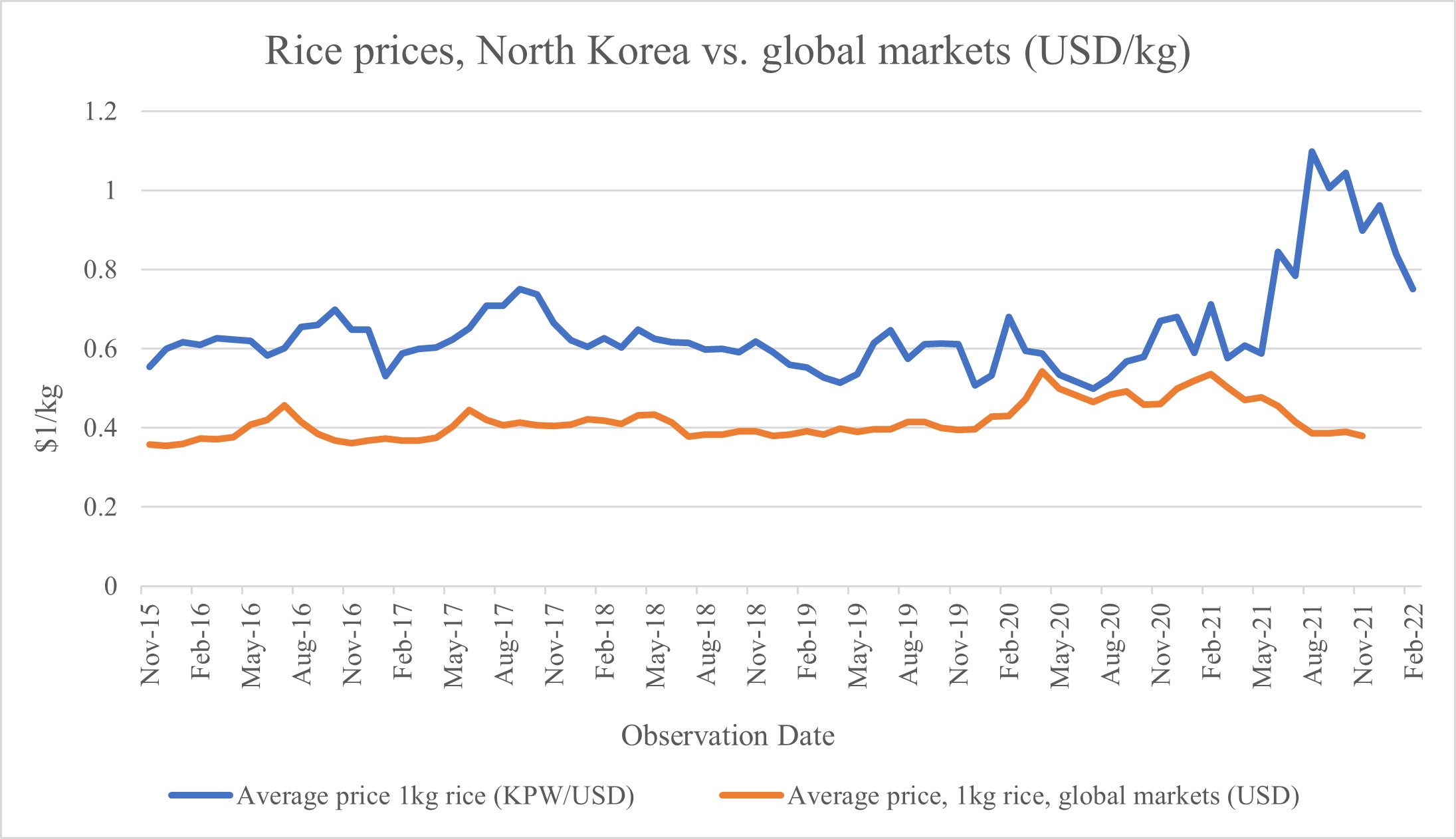
To understand how domestic food prices are impacted by international market swings, consider the graph below (Graph 1) that shows a comparison of rice prices in North Korea with global markets:

Graph 1. Rice prices, North Korea vs. global markets (USD/kg)

Graph by author. Data sources: Daily NK for North Korean data, St Louis Federal Reserve Bank for global prices.

Rice prices in North Korea tend to move in tandem with global markets, but with some time variation. For example, global rice prices increased from 0.38 USD in April 2016 by 21 percent to 0.46 USD that July. North Korea similarly experienced a price rise of almost 21 percent around the same time but in a delayed manner. Prices began rising from 0.58 USD in June 2016 to 0.66 USD that September and plateaued at a total increase of 20.7 percent in October of that same year at 0.70 USD.

Prices also often fluctuate more strongly in North Korea. For example, global market prices rose from 0.36 USD in November 2016 by 22 percent to 0.44 USD in June 2017. North Korea experienced a similar price rise from 0.52 USD in January 2017 by twice the global increase at 44 percent to 0.75 USD that September.

Despite North Korea’s COVID-19 border closure, domestic rice prices have moved in conjunction with international ones. In July 2020, the global market price for 1 kg of rice was 0.46 USD, and the price in North Korea was very close at 0.50 USD. Until February 2021, prices rose on both global markets and in North Korea, but much more drastically in the latter. The global price increased by 17 percent to 0.54 USD, and North Korean prices went up by 42 percent to 0.71 USD.

The more drastic price swings are likely, at least in part, caused by a lack of information on North Korean markets. While price changes in North Korea are often more drastic, they tend to move in parallel with global market prices.

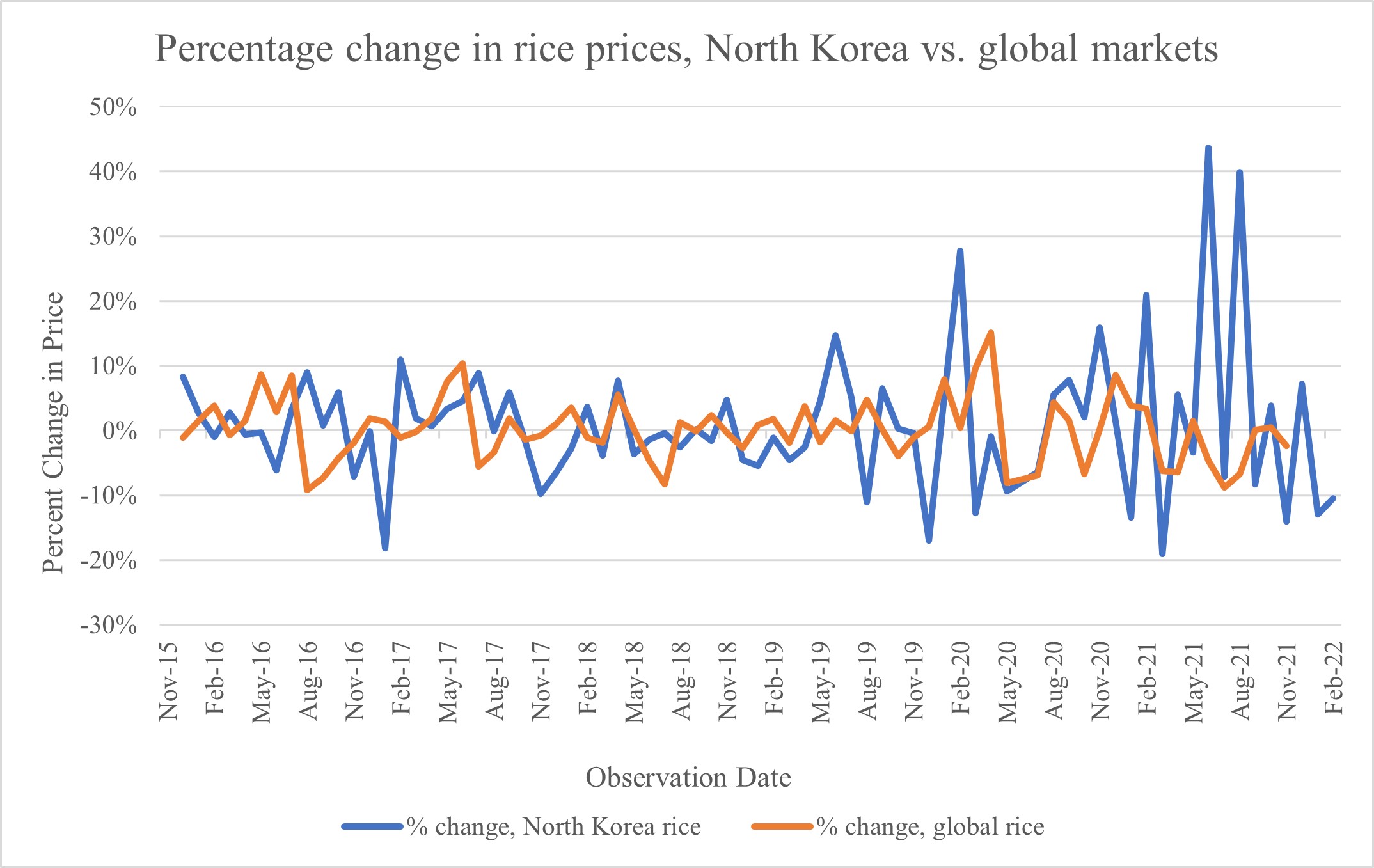
Graph 2. Percentage change in rice prices, North Korea vs. global markets.

Graph by author. Data sources: Daily NK for North Korean data, St. Louis Federal Reserve Bank for global prices.

Information from the outside world about supply conditions takes longer to reach North Korea than other countries. Furthermore, poor infrastructure and communication inside the country means price information travels more slowly domestically. Thus, rice prices in North Korea may change more drastically to indications of lower supply or increased demand, leading to large temporary price spikes. As Graph 2 shows, for example, in January 2020, global prices increased by 7.94 percent. In the following month, prices in North Korea spiked by 27.74 percent. Global market prices rose again by 0.22 percent in November 2020, while they increased by 15.86 percent in North Korea. As prices are already consistently higher in North Korea, these fluctuations likely caused significant hardships.

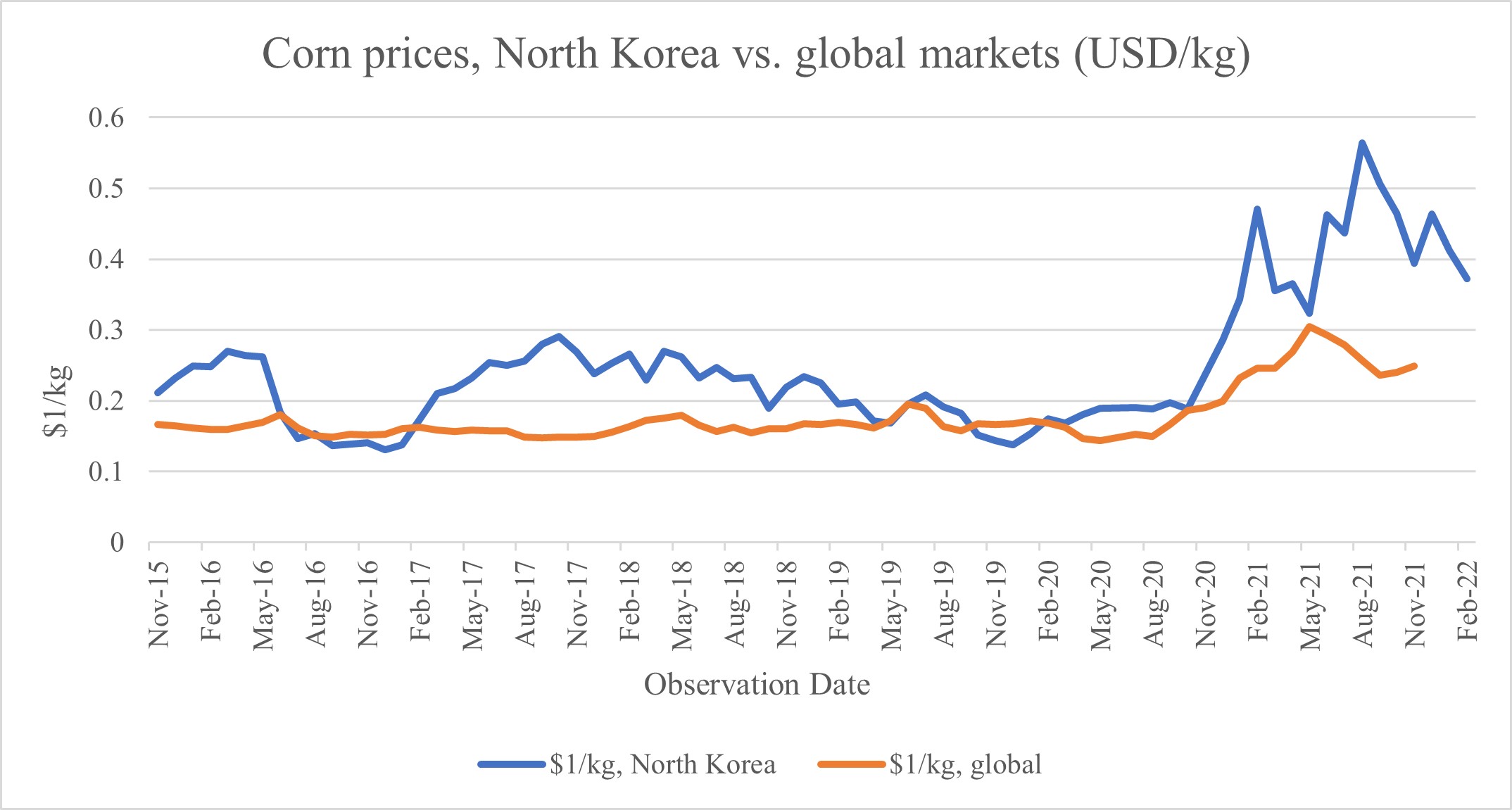
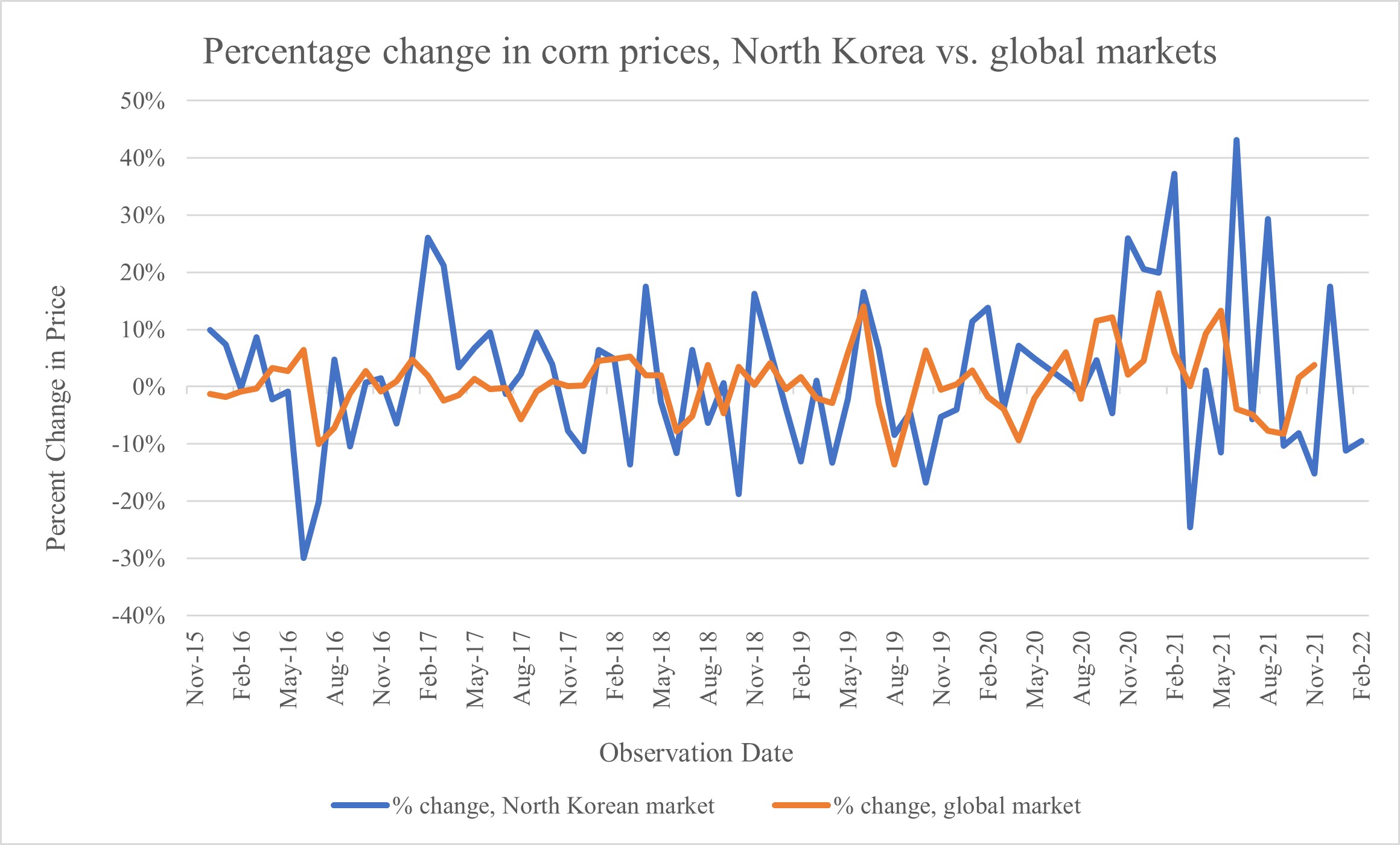
This pattern is similar for corn prices, which are almost consistently higher in North Korea and fluctuate more drastically than on global markets.

Graph 3. Corn prices, North Korea vs. global markets (USD/kg).

Graph by author. Data sources: Daily NK for North Korean data, St Louis Federal Reserve Bank for global prices.

Graph 4. Percentage change in corn prices, North Korea vs. gobal markets.

Graph by author. Data sources: Daily NK for North Korean data, St Louis Federal Reserve Bank for global prices.

The data both on rice and corn shows that global price movements generally impact food prices in North Korea. At the same time, they can also significantly differ, highlighting the still relatively closed nature of North Korea’s economy. For example, the drastic price rise from November 2020 most likely stemmed from an increase in domestic demand due to food shortages following the country’s COVID-19 border closure.

Oil and Fuel Prices

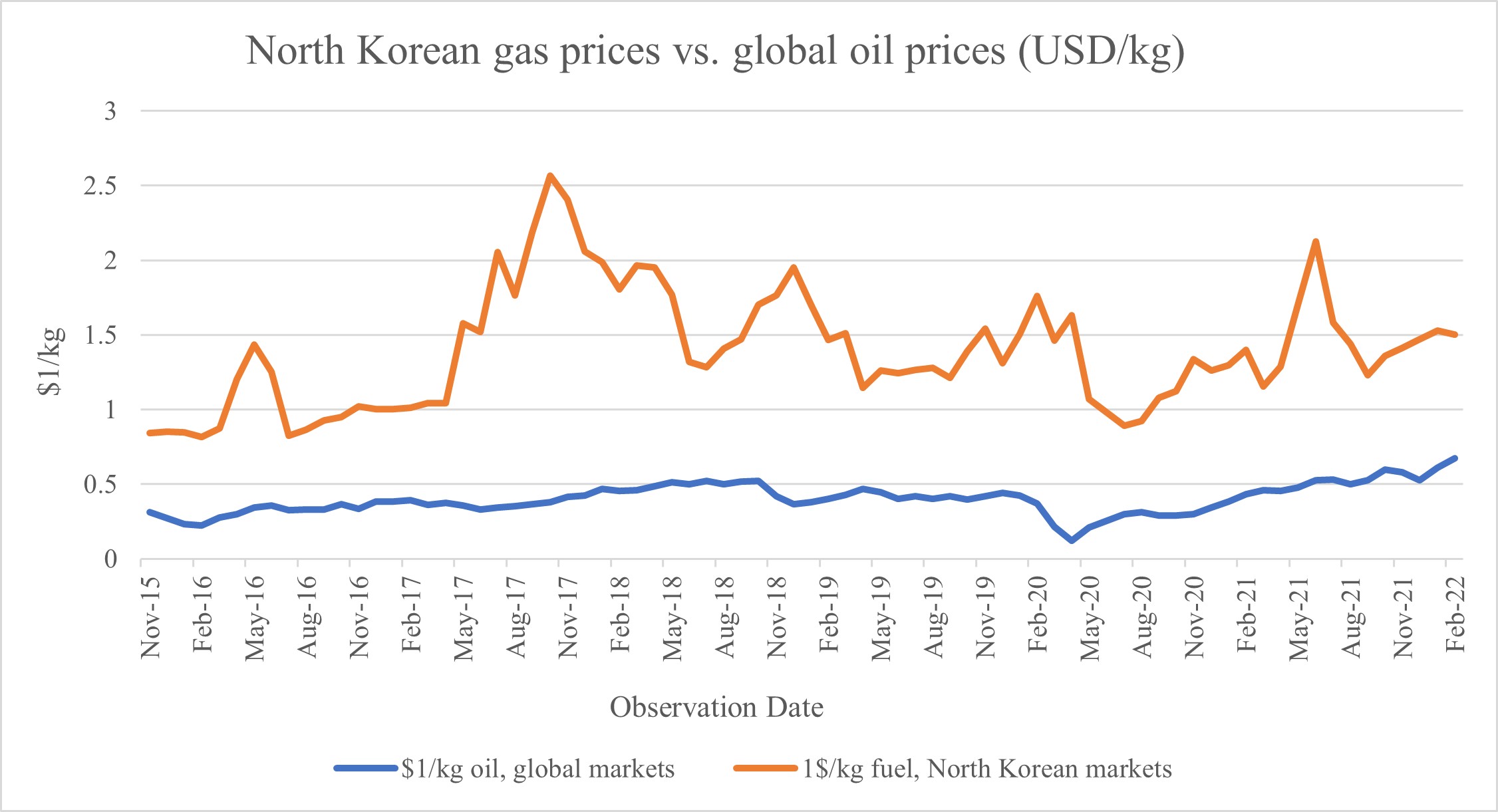
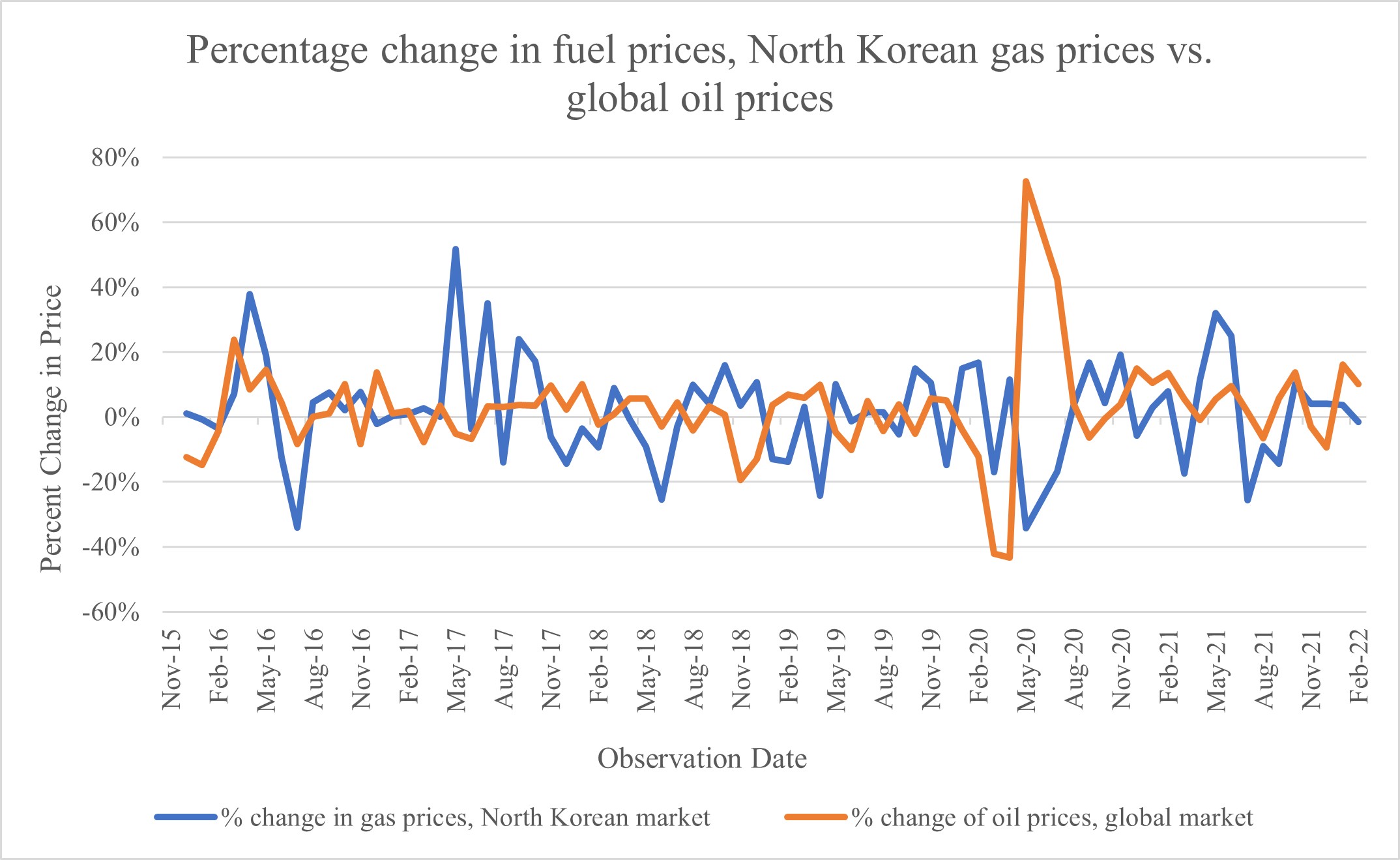
Gasoline prices appear to be less influenced by global oil prices.

Graph 5. North Korean gas prices vs. global oil prices (USD/kg).

Graph by author. Data sources: Daily NK for North Korean data, St Louis Federal Reserve Bank for global prices.

As this comparison above clearly demonstrates, the rate of price changes for oil in North Korea appears to be heavily influenced by other factors other than global price trends.

Graph 6. Percentage change in fuel prices, North Korean gas prices vs. global oil prices.

Graph by author. Data sources: Daily NK for North Korean data, St Louis Federal Reserve Bank for global prices.

While there may be occasional periods where the global price and North Korean prices move in tandem, such as in the first few months of 2016, this is not usually the case. North Korean gas prices tend to be strongly impacted by the state of North Korea-China relations, as China supplies the overwhelming majority of oil and fuel to North Korea. It is possible that the impact of global oil prices on gas inside North Korea comes exclusively from the share of oil and fuel imports that are private rather than what North Korea receives from China on a non-commercial basis.

Foreign Exchange Rates

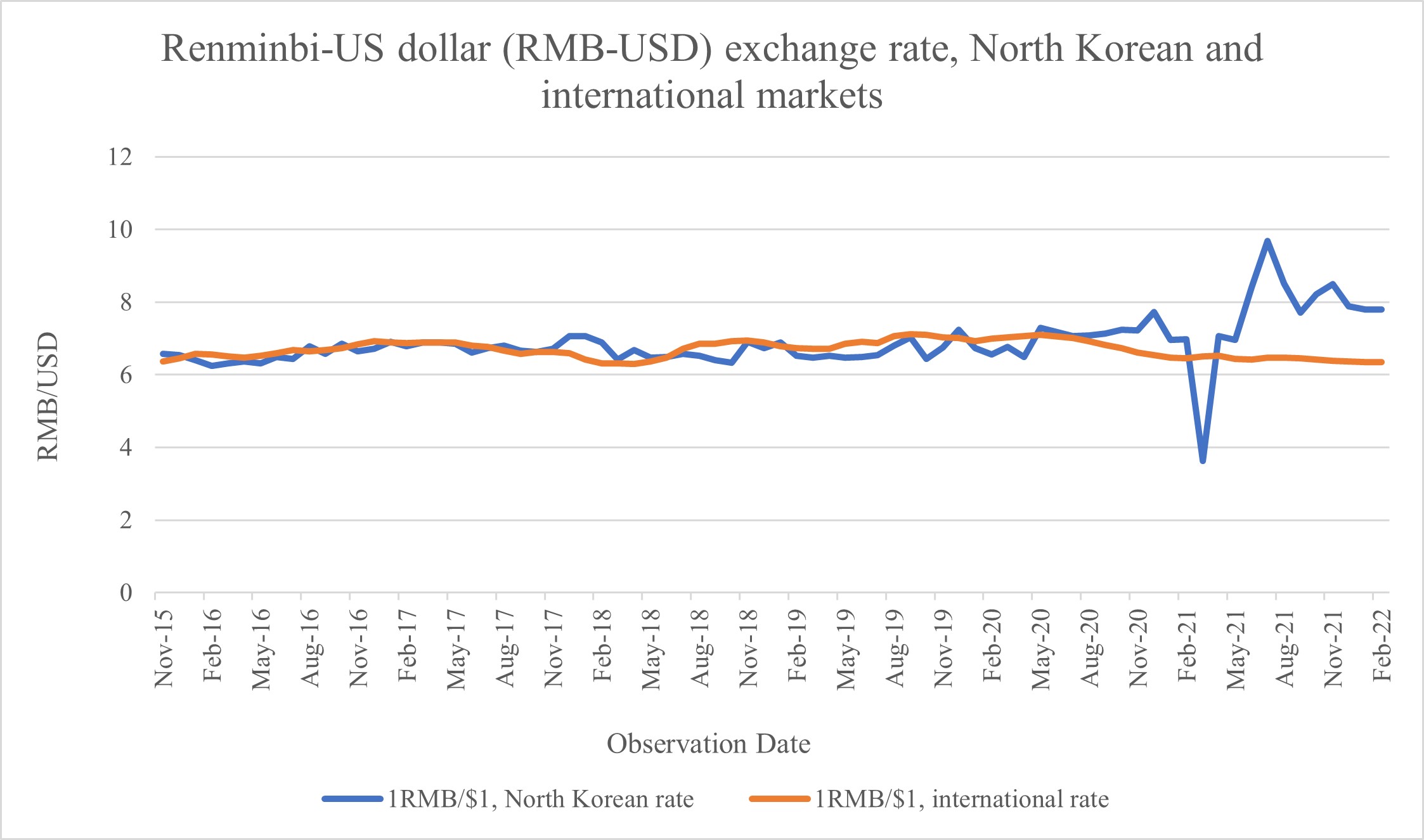
Foreign exchange rates are the market prices in North Korea that move in closest tandem with global markets. This is not surprising since the supply of these currencies is entirely controlled by international governments and markets.

Graph 7. Renminbi-US dollar (RMB-USD) exchange rate, North Korean and international markets.

Graph by author. Data sources: Daily NK for North Korean data, St Louis Federal Reserve Bank for global prices.

However, as made evident in the graph above (Graph 7), conditions specific to North Korea clearly have a strong impact as well. For example, exchange rates have been lower in North Korea than in the rest of the world for most of the COVID-19 period. This is because foreign currency lost much of its economic utility during the border shutdown. The somewhat higher volatility of exchange rates in North Korea can probably be explained, too, by the lack of trustworthy and adequate market information inside the country.

Conclusion

The North Korean economy may be more internationally disconnected than most, but, as this analysis shows, it is not insulated from global price changes. Through both legal imports and smuggling, price changes on global markets usually find their way to North Korea, too, albeit with some delay. Price fluctuations in North Korea are more volatile than in global markets, which reflects the lack of transparent and easily available information on North Korean markets. Thus, although we cannot specify precisely to what extent, even the supposedly autarkic North Korean economy is solidly connected to the rest of the world.


  1. [1]

    When using price data from North Korea to study complex issues, a caveat is necessary. I use data from the Daily NK’s market price index, which uses information from sources inside North Korea that cannot be verified. Moreover, I compare the average of price data observations for each month with monthly global price data. Since data for domestic prices in North Korea and global prices are not reported in the same time format, there may be some irregularities.