Thursday, January 30, 2025


Yemen’s Ansar Allah: On the Houthi movement’s roots, governance and resistance


Published 

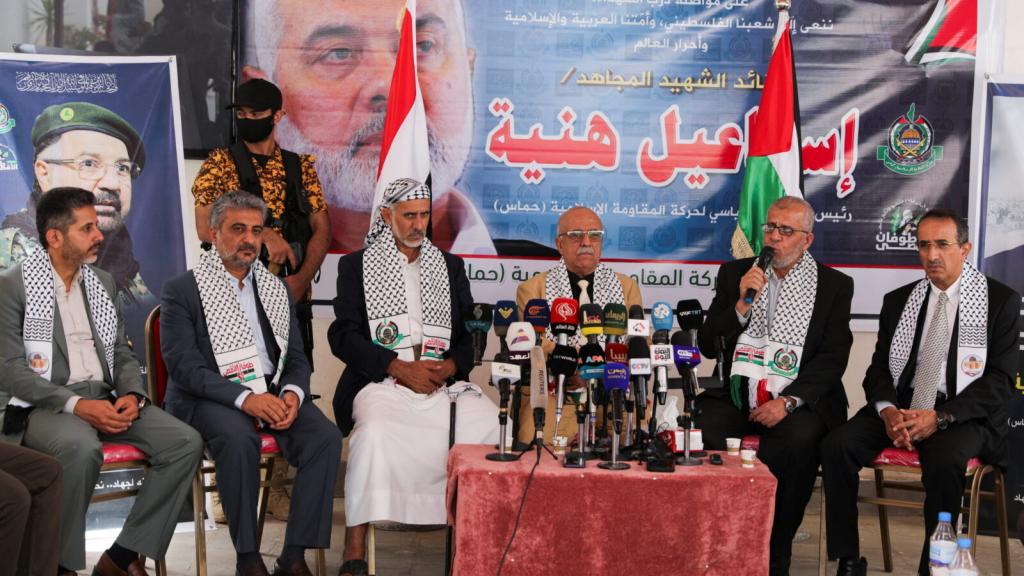
Head of the Houthi-led government Ahmad al-Rahawi (3rd from right) and members of his government listen to the representative of Hamas in Yemen, Muadh Abu Shammalah, during their visit to the Hamas office in Sanaa, Yemen on August 19, 2024.

First published at MERIP.

Until it fired missiles and drones against Israel in October 2023, the Yemeni Houthi movement, officially known as Ansar Allah, remained largely unknown in the Global North.

Head of the Houthi-led government Ahmad al-Rahawi (3rd from right) and members of his government listen to the representative of Hamas in Yemen, Muadh Abu Shammalah, during their visit to the Hamas office in Sanaa, Yemen on August 19, 2024. Khaled Abdullah/Reuters

In the year since, in support of the Palestinians under siege and genocide in Gaza, Ansar Allah have fired multiple projectiles against Israel, one of which successfully evaded Israeli air defenses in July 2024 and reached Tel Aviv, killing one person. Later attacks wounded some and damaged infrastructure, including Ben Gurion airport on September 15. The majority of their attacks have been on maritime trade in the Gulf and the Red Sea, significantly impacting international trade through the Suez Canal as well as traffic in Israel’s ports: Eilat has almost ceased operations, and in July 2024, the port declared bankruptcy.

Their actions contrast sharply with the passivity, not to say complicity, of the Arab states in the Arabian Peninsula and beyond, which, although making various tepid statements about Israel’s war, are helping get imports to Israel by facilitating overland transit from UAE ports through Saudi Arabia, Egypt and Jordan.

The Houthi movement has achieved worldwide prominence (and significant global popularity) as a key actor in the resistance to Israeli aggression and a member of the Axis of Resistance. Ansar Allah’s relationship with Iran, meanwhile, has been subject to widespread disinformation by international media and US and British policymakers, who tend to deny Houthi agency by describing them as mere Iranian proxies, in the narrowest sense of that word.

Both international support for and opposition to Houthi interventions in the Red Sea are largely based on ignorance of the nature of their rule in Yemen. Writing in these pages in 2023, Stacey Philbrick Yadav noted this tendency toward oversimplification in discussions of the Houthis and offered a short analysis of Ansar Allah’s relationship to Palestine. Below is a more detailed outline of the movement’s roots, the nature of their governance over millions of Yemenis and an analysis of Ansar Allah’s developing role in the Resistance Axis in light of shifting regional dynamics over the last year.

The Houthi movement’s oppositional roots

Ansar Allah has its roots in the Sa‘ada governorate in the northwest of Yemen.

The region is the heartland of the Zaydi branch of Shi’a Islam, which historically dominated politics in northern Yemen. Until the 1962 revolution that created the Yemen Arab Republic, the ruling imams were Zaydis, who claimed descent from the Prophet and are part of the social group that Yemenis call sada. After the revolution, tribesmen dominated, and the sada — though retaining social status and influence — were politically marginalized.

When President Ali Abdullah Salih came to power in July 1978, one of the mechanisms he used to control the country was to encourage social and political conflict at the local level. In Sa’ada, these efforts took the form of allowing the rise of Sunni Salafism. Muqbil al-Wadi’i, a Zaydi who converted to Salafism during his years in Saudi Arabia, established the Dar al-Hadith (House of Hadith) religious community in the early 1980s in a village close to Sa’ada city, the regional capital.1 The community attracted thousands of Yemenis and foreigners who lived there and proselytized, building a strong Salafi movement which remains politically significant throughout Yemen today.

In response to this threat, Hussain al-Houthi started the Zaydi al-Shabab al-Mu’min (Believing Youth) movement in 1992. Al-Houthi’s movement was a “catalyst which could unite the interests of all those in Sa‘ada and beyond who felt economically neglected, politically ostracized and religiously marginalized.”2 In the following decade, the revivalist movement grew, forming an active opposition to the rising Salafi movement in the same area. While Hussain al-Houthi was a member of the Yemeni Parliament from 1993 to 1997, later disagreements with the Salih government led to the first military uprising in 2004.

The Believing Youth formed the core of the movement opposing the Salih government. It increased in strength and membership during the six wars that followed between Salih and the opposition — in part due to Salih’s indiscriminate destructive tactics and generalized aggression against the northwest, which alienated thousands of tribesmen and others who did not necessarily support Houthi ideology but were infuriated by the exactions of the regime. By the time a shaky ceasefire was reached in early 2010, the Houthis controlled an area well beyond the original heartland around Sa‘ada. The fighting would probably have resumed had the 2011 uprisings not taken place at the national level.

The Houthis joined the 2011 uprisings, though they acted largely independently, maintaining tents in Sana’a’s Change Square for two years, even when most others had left. They were not a party to the 2011 GCC Agreement that created a two-year transitional government, prompting them to begin cooperating with former president Salih to undermine the transition.

In September 2014 — as a result of the weakness of the transitional regime and their earlier expansion of territorial control southwards — the Houthis were able to take over the national capital, Sana’a. By early 2015 the transitional government was on the run. Over the following two years, the Houthi movement, which had gradually gained strength at the expense of its alliance with Salih, assassinated him in December 2017, thus achieving full control of about a third of the country’s land and two-thirds of its population.

From 2015 to 2022, the civil war was aggravated by the involvement of a Saudi-led coalition of nine states, including all GCC states except Oman. The key decision-makers in this coalition were Saudi Arabia and the UAE, and their increasing rivalry and support for competing factions within the internationally recognized government of Yemen (IRG) contributed to its weakness and inability to effectively confront Houthi forces.

With the 2022 UN mediated truce, lasting from April to October of that year, Saudi Arabia and the UAE stopped their airstrikes, which had caused massive destruction throughout the country. Since then, small-scale fighting between the different Yemeni forces has taken place on most fronts, though clashes increased in significance in 2024.

Houthi governance

Politically, the Houthis exercise a highly authoritarian and oppressive rule. Their control of the capital has enabled them to take over all government ministries, where they have ensured that Ansar Allah loyalists determine decision making and control funds. Ansar Allah claims not to want to re-instate the Imamate, but its political actions suggest a vision close to that prevailing in Iran, with a religious leader dominating a government that claims to be democratic. The sada currently hold the majority of senior positions in all institutions.

Although the Ansar Allah government formally includes sections of the General People’s Congress (GPC) — Salih’s former ruling organization — as well as other smaller parties, signs of dissent or of alternative positions have been met with imprisonment and torture. Journalists and civil society activists have been heavily targeted. In June 2024, the Houthis arrested and imprisoned more than 60 humanitarian workers, including 13 United Nations staff, accusing them of being US and Israeli spies. The movement has been particularly combative toward the UN Office of the High Commissioner for Human Rights, briefly occupying its Sana’a office in early August 2024 after having held a senior staff member in detention since 2021.

Socially, the Houthi government has instituted policies severely restricting women’s mobility and other freedoms, forcing them to be escorted by a mahram (a male relative) when moving within and outside of the country and imposing strict conservative dress codes.

Among Ansar Allah’s problems when it comes to governance is finance. Before the war, Yemen was dependent on two primary sources of income: hydrocarbon exports and international assistance. The first has completely dried up since October 2022, when the Houthis prevented oil and gas exports by attacking the relevant ports. Meanwhile, limited international development aid has been replaced by far larger amounts of humanitarian aid, which is a major source of friction: On the one hand, humanitarian agencies try to prevent Ansar Allah’s influence over distribution mechanisms and the selection of beneficiaries. On the other, the Houthis impose restrictive rules governing the activities of international and national humanitarian organizations. This tug of war between Ansar Allah and the UN unfolds in the absence of representatives of the funding states, as most embassies closed in 2015.

Houthi finances also depend on taxation, port fees and customs duties on imports. Given that most basic commodities — wheat and other staples, medication, etc. — are imported, Houthi success in diverting most shipping to the Red Sea ports under its authority in 2023 was significant. Recently, however, this success has been partly undermined by the reduction in Red Sea maritime traffic since their intervention in Israel’s war.

Moreover, the reduction of humanitarian aid since the blockade began has also affected Houthi finances. The World Food Programme ceased its distributions in the areas under Houthi control in December 2023, with only two minor exceptional distributions in some areas benefiting 1.4 million people — a drastic reduction when compared with the 9.5 million who received regular support up to that time. In addition, the UN’s annual Humanitarian Response Plan in 2024 was 60 percent smaller than the previous year and, by the end of the year, had only been financed at 50 percent — worsening the humanitarian crisis throughout the country.

Houthi foreign policy

The Houthi’s basic slogan, “al-Sarkha” (the Scream), points to how issues beyond Yemen are at the core of Ansar Allah’s ideology. “Death to America, Death to Israel, Curse on the Jews” are three of its five points, the other two being “God is the greatest” and “Victory to Islam.” Palestine is mentioned frequently at all levels, with the movement’s opposition to Israel, at times, taking the form of antisemitic slogans and chants. But until Israel’s war on Gaza started in October 2023, the scream was an ideological assertion without much practical implementation. Even the signing of the Abraham Accords in 2020 provoked little response beyond accusations of betrayal of the Palestinian cause.

The current war in Gaza has given the Houthis an opportunity to live up to their slogan by engaging in direct military action against Israel. Within Yemen, their prestige has risen dramatically as the overwhelming majority of Yemenis, whether under IRG or Houthi rule, are sympathetic to Palestinians, horrified by the ongoing genocide and willing to tolerate the consequences of this support, at least up to now. In Houthi-controlled areas, their actions against Israel have boosted the movement’s popularity, which was deteriorating as their oppressive rule had alienated the majority, who were frustrated by the exactions and other demands on their household finances.

The maritime war has also increased Ansar Allah’s public image worldwide, in particular in majority Arab and Muslim states, where most of the population supports the Palestinian people and deplores what they see as their own leaders’ shameful inaction. In the Global North, Houthi actions in support of Palestinians have given them a positive image among many, particularly on the left.

Moreover, as a result of the US and British attacks on Yemen this past year, Houthis can now claim to be directly fighting the United States, the main imperialist enemy. To date, while these strikes have been limited and have degraded Houthi ability to attack shipping, they have not had a significant impact. Between the launch of Operation Poseidon Archer in January and November 2024, the United States and Britain have used 601 munitions in 279 air strikes to minimal effect. In that period the Houthis successfully sunk two ships and damaged more than 80 others.

Relationship with Iran and the Axis of Resistance

Houthis have had meaningful relations with Iranian religious leaders for decades, with many members of Ansar Allah having spent time studying in Iranian religious institutions.3 Badr al-Din al Houthi, father of Hussain al-Houthi and the current leader, Abdul Malik al-Houthi, studied in Iran’s Qom. He was deeply influenced by Ayatollah Khomeini — an influence evident in the Scream. He returned home with political ambitions and reforms intended to create a body of followers distinct from mainstream Zaydism. Though the movement remains Zaydi, it has institutionalized a number of religious and secular ritual celebrations, which were previously largely ignored in Yemen, including Scream Day, Popular Revolution Day, Resilience Day, Martyr’s Day and the Prophet’s birthday.

Salih accused Iran of supporting the Houthis as early as the Sa’ada wars (2004–2010), a claim the United States dismissed at the time as a “disingenuous attempt to garner Western and Sunni Arab support.”4 But since 2015, with the internationalization of the civil war, Iranian practical support for the Houthis has become more active and increased. It now includes political and financial support in the form of free fuel deliveries to the Houthis.

Militarily, in recent years the Houthis have exhibited a greater competence, in terms of strategy, tactics and equipment. Much of the latter is now manufactured locally. In September 2022, for instance, they held a three hour military parade in Sana’a, with tens of thousands of soldiers and a wide variety of missiles and other weapons.

The most sophisticated drone and missile components undoubtedly come from Iran, either directly or indirectly. Most smuggled items land in the far east of Yemen, in al-Mahra governorate, and then must cross more than a thousand kilometers of IRG-controlled territory before reaching Houthi territory across multiple checkpoints that cover the country (indicating either incompetence, corruption or both among the internationally recognized government). Some components also arrive by sea, thanks to assistance from smugglers and others in the Horn of Africa, who access the Yemeni Red Sea coast, despite the vast deployment of naval forces in the area. There have also been rumors of a few advisors from the Iranian Islamic Revolutionary Guard Corps and from Lebanon’s Hizballah helping to train Ansar Allah’s armed forces. But reliable publicly available evidence for these claims is largely absent.

With its numerous successful interventions in the Red Sea and attacks on Israel, Ansar Allah, over the past 15 months, has become a leading member of the Axis of Resistance, whose main participants are Hamas and Hizballah. Its other members, various Iraqi and Syrian militias, play a lesser role. In June 2024, Houthi military spokesperson, Yahya Saree, claimed the first joint operation with the Islamic Resistance of Iraq, which hit two cement tankers and two cargo ships in Israel’s Haifa port. Other attacks have followed.

Looking ahead

Ansar Allah has been clear that its attacks on Israel and shipping are in support of Gazan, Palestinian and now Lebanese resistance and would stop when Israel ceases its genocide and opens Gaza to humanitarian aid. Following the implementation of the first phase of the ceasefire between Israel and Hamas, agreed to in January 2025, the Houthis have released the crew of a siezed ship and halted their campaign. But they have been clear that they will resume their actions if Israel reneges on the ceasefire.

At the same time, however, support for the Houthis in Yemen over their domestic policy is dwindling, as living conditions continue to deteriorate.

The impact of Houthi actions on the Arabian Peninsula is particularly notable, evidenced by the deafening Saudi silence: In the face of its population’s support for Palestinians, and as a side-effect of Houthi actions, the Saudi regime has bowed to Houthi demands in its financial war against Yemen’s internationally recognized government. In July 2024, Saudi Arabia pressured the IRG to withdraw its attempt to cut off Sana’a based banks from the international SWIFT system. This step further weakened an already weak and divided entity. These developments are unwelcome for many Yemenis, for whom a stronger Houthi rule means increased repression of the population and a closing down of civil society and dissent.

Helen Lackner is the author of Yemen in Crisis (Saqi Books, 2023).

  • 1

    Laurent Bonnefoy, Salafism in Yemen, Transnationalism and Religious Identity (London: Hurst, 2011).

  • 2

    Marieke Brandt, Tribes and Politics in Yemen, a History of the Houthi Conflict (London: Hurst, 2017), p. 37.

  • 3

    Walter Posch, “Iran’s relations with Yemen; Ideological and strategic aspects,” in Stephan Reiner, Alexander Weissenburger, eds., Yemen at a crossroads, What remains of Arabia Felix?  (Vienna: National Defence Academy, 2024), pp. 90–91.

  • 4

    Quoted in Helen Lackner, Yemen in Crisis, Devastating Conflict, Fragile Hope (London: Saqi Books, 2023), p. 188.


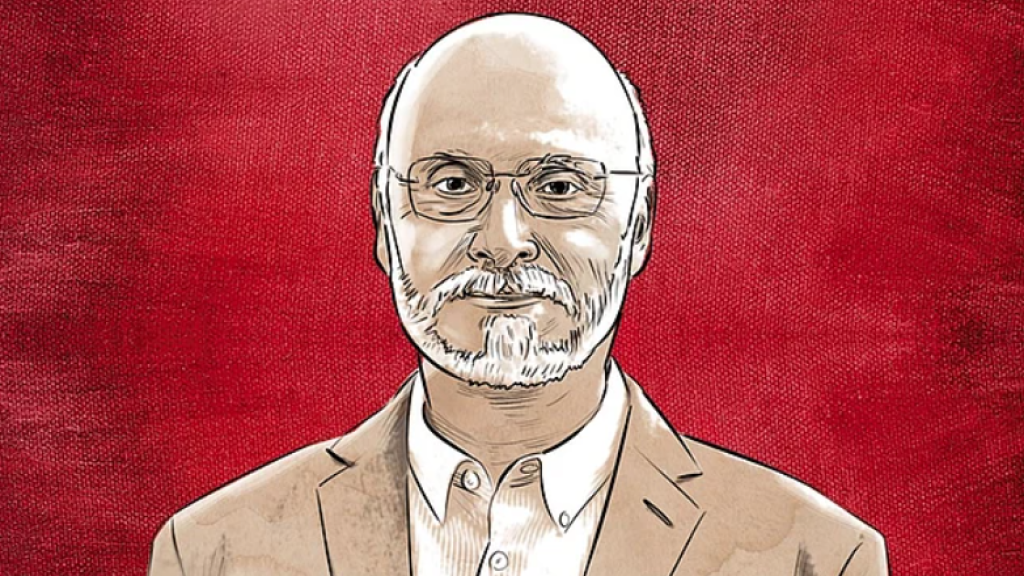
‘We have witnessed the final nail in the coffin of Western liberal pretence’: An interview With Gilbert Achcar


Published 

Gilbert Achcar graphic

First published at Outlook.

On October 7, 2023, Gaza-based armed group Hamas launched a surprise attack on Israel, killing approximately 1,200. They demanded that Israel free Palestinian prisoners from its jails and withdraw its settlers from Palestinian land. This flare-up in a chain of decades-long conflict led to another chain of reactions, with Israel’s all-out war on Gaza killing more than 50,000 Palestinians, mostly civilians, including an overwhelming number of women and children from October 2023 to December 2024.

The conflict has gone beyond the borders of these two countries and the cry of the Gazan people has emerged as the biggest question mark rising on the horizon of the global community and the so-called civilisational conscience.

Gilbert Achcar, a Lebanese professor at the School of Oriental and African Studies, University of London, is known for his deep understanding of West Asia’s geopolitics and the international interferences that often drive them. Speaking to Snigdhendu Bhattacharya on the current state of turmoil and uncertainty that the region is passing through, Achcar discusses issues ranging from the fall of the al-Assad dynasty in Syria and its implications on the Palestinians’ struggle to the hypocrisy of Western powers reflected by their contrasting role vis-a-vis the Russia-Ukraine war.

How do you see the implications of the regime change in Syria?

I wouldn’t call that a regime change because regime change is an expression that has taken a very specific meaning, especially since the US-led invasion of Iraq. It now means some external force working to change a regime. In Syria’s case, I would rather call it a real collapse of the regime in the same way as the collapse of the Kabul regime in 2021, when the US forces started leaving the country.

It is, of course, an event of huge importance because of the role that Syria played as a major platform for Iran, in particular, and also some other countries. You had five foreign forces on Syrian soil. The first of them is Israel, which has occupied the Golan Heights in the south of the country since 1967. The Iranian and Russian forces intervened in 2013 and 2015, respectively. The Turkish troops invaded in 2016 in some parts of the north. The American troops are in the northeast, the Kurdish region in particular.

Therefore, it is obvious that the collapse of the Assad regime, which Russia and Iran shored up, has a major strategic significance. That is why it is also a stunning event.

The day after Assad’s exit, Syrians, including refugees, celebrated in every single city. But the very event pushed Palestinians into deeper anxieties as they feared Assad’s fall could embolden Israel. Then, the Syrian celebration was cut short by Israel. Of course, Turkey and the US also bombed Syria but mostly it was the Israel factor that spoiled their celebration. Can you elaborate on the complexity of this geopolitical situation?

The humanitarian crisis was already there. In the last few years, Syria already witnessed an economic collapse before the political collapse. A mafia-like economy, controlled by the regime, developed around drugs. For the rest of the population, the economic situation was extremely dire. The local currency collapsed and people’s purchasing power collapsed with it. The average civil servant would get something like the equivalent of $25 or $30 per month. Even in the poorest countries, this is extremely low. So, you had a humanitarian situation already developing.

The collapse of the Syrian regime has been a huge relief. Hundreds of thousands of people had been incarcerated and tens of thousands disappeared and were killed in the jails during the brutal, tyrannical regime of the Assad family. But as happens frequently in such cases, when you have such a quasi-totalitarian regime collapsing, in the absence of a readily present alternative, you have a lot of anxiety about how things will go. Several forces are still active in Syria, including local and foreign ones. We more or less know the projects of each force but no one knows who is going to prevail. However, at the very least, people can breathe free for now. They are trying to organise. Civil society is trying to get alive again. And that’s the most positive element in the present situation.

Israel has seized this occasion to grab more Syrian land in the Golan Heights. But even more importantly, Israel launched hundreds of air raids in a very few days, destroying, according to Israeli sources themselves, 80 per cent of the Syrian military potential. It is the country’s official or regular military potential, not of fringe rebel groups. Israel destroyed the Syrian naval force, the air force, anti-aircraft machines, and so on. This is a total destruction of the military capability of one country by another in almost complete global indifference. It is amazing that this drew very little objection or protest.

Israel is continuing on a very aggressive course that it has embarked on, especially since October 2023, first with the war on Gaza, followed by attacks on Lebanon and Syria. The Israeli armed forces are now in the business of destroying three territories to a certain extent, including two supposedly sovereign countries — Lebanon and Syria.

For Palestine, Hamas looked at the Syrian regime as part of the so-called Axis of Resistance dominated by Iran. Even though Hamas had been at odds with the Assad regime for several years because they supported the anti-Assad uprising of 2011, they ended up mending fences with the regime. This was also part of their bid to re-establish the alliance with Iran. When they launched their operation on Israel on October 7, 2023, they appealed to Iran and the so-called Axis of Resistance to join them in the battle to liberate Palestine.

Now, with the collapse of the Assad regime, we have seen Hamas congratulating the Syrian people. So, they are changing tack again. They are now betting on the Islamic forces that played a key role in Assad’s downfall. Some of these groups are linked to the Muslim Brotherhood. Hamas itself is the Palestinian branch of the Muslim Brotherhood, which is a regional organisation. At this level, we don’t know what kind of political power will emerge in Syria and what would be its position on Palestine. But one thing is sure, the destruction of the military potential of the Syrian State weakens very much all opposition to the Israeli state.

What about the Lebanon-based Hezbollah?

Hezbollah is a major casualty. Israel dealt them very severe blows since launching its offensive in September 2024. Until late November, for about a couple of months, there have been intensive attacks by the Israeli forces on Hezbollah, which went far beyond anything that we have seen in Lebanon before, far beyond the 2006 Israeli onslaught on Hezbollah. This time, unlike 2006, the Israeli attack managed to deal a very heavy blow to Hezbollah. They completely decapitated the organisation. The secretary-general was assassinated.

Practically, the vast majority of the key leaders of the organisation were killed and the military capacity has been destroyed to a large extent. Now, with the downfall of the Syrian regime, which was the conduit through which Iran could send weapons to Hezbollah, the prospect of Hezbollah being rearmed, as happened after 2006, is practically thin, if not impossible. I can’t see or imagine how Iran could rearm Hezbollah. Iran has lost a lot in all this.

How is Iran impacted?

This happened just when Donald Trump was elected for a second term in the US. We know how hostile Trump was to Iran during his first term. We know that he is surrounded by people who are very much anti-Iran. Therefore, Iran has good reason to fear an attack, either a US-Israel combined attack or of the US alone under Trump, targeting its nuclear installations in particular. This has become very possible, very likely. Benjamin Netanyahu, the Israeli prime minister, will push hard, very hard, for an attack on Iran. This is something that he has been wishing for long. He can’t do it alone. Israel needs the US for that. And now is the time for that in the mind of Netanyahu, with his friend Donald Trump back at the White House.

Do you see the possibility of the emergence of any other Axis of Resistance, or whatever that may be called, developing against the US-Israel alliance?

There are only two Iranian allies that are still there with some capacities. One is the pro-Iran Shia militia in Iraq. However, their effectiveness regarding Israel or the US is very limited. Every time they tried to strike at US forces, they faced powerful retaliation. And then you have the Houthis in Yemen. They have been launching missiles in the Red Sea and also on Israel. Now, most of these missiles, especially those launched on Israel, are intercepted. But every now and then something goes through. Israel very recently escalated its retaliation against the Houthis in Yemen. And, they would probably go beyond that if this carries on. So, I mean, the militias in Iraq or the area of the Houthis in Yemen, or to the Hezbollah, which is very weakened—none of this represents any strong deterrence for Israel or the US. Iran stands strategically weakened. It’s a strategic defeat. And, they are now in a much weaker position at a time of heightened danger for them.

We, therefore, find the Palestinians all the more vulnerable right now, much more vulnerable than they already were. Despite Iran, Israel could launch and wage a genocidal war in Gaza for over a year, with impunity. They destroyed Gaza. They committed a real genocide, as is now exposed and denounced by all human rights organisations like Human Rights Watch, Amnesty International and Doctors Without Borders, besides the International Court of Justice, and the International Criminal Court. Yet, they have been carrying on for 14 months. The Palestinian Authority in the West Bank is reviving its role as kind of a proxy for the (Israeli) occupation. And that is quite dangerous for the future of the Palestinian people.

You mentioned the possibility of the US under Donald Trump trying to destroy Iran’s nuclear facilities. This reminds me of the George Bush-led US invasion of Iraq on the false charge that Iraq had weapons of mass destruction. To many observers, that was the point that pushed West Asia into chaos. Who will hold America responsible for what they did to Iraq?

There is a major difference between the cases of Iraq and Iran. Iraq had zero weapons of mass destruction when the US led the invasion of the country in 2003. They searched everything and couldn’t find any trace of those weapons of mass destruction. The Bush administration blatantly lied. However, in the case of Iran, first of all, there are nuclear installations. There is an important nuclear production potential in the country. There have been agreements with the International Atomic Energy Agency for some control of these facilities. That was part of the nuclear deal the US under the Barack Obama administration cut with Iran in 2015.

However, Trump, during his first term, repudiated this agreement. So, Iran felt freed from its commitment not to enrich uranium beyond a certain limit. And they have been producing highly enriched uranium, which, of course, normally can serve only one thing, which is the production of nuclear weapons. Even the International Atomic Energy Agency has been pointing to that and warning Iran about it. We might see something like a race in Iran now, prompted to accelerate the production of a nuclear weapon as a deterrent against an attack. And the attack we are talking about is not a matter of years. It’s a matter of maybe months. Either the Iranian leadership completely capitulates and allows real inspection of its facilities, or it is quite possible that the US would strike at these facilities.

From that perspective, this is much more dangerous than the invasion of Iraq. You won’t have an invasion of Iran. It would be just an airstrike. But it has the potential of igniting the whole region, which is a powder keg already, and then an oil barrel. It’s like sending a rocket into a huge oil barrel. All huge oil reserves. And that’s what you could get.

How do you see the role of the Western powers?

The Western powers are an integral part of the Israeli onslaught on Gaza. This is the first joint US-Israeli war ever. If you take all the wars in the history of the Israeli State since 1948, when it was founded, this is the first one that can be described as a fully joint war by the US and Israel. The only thing that is missing is the troops on the ground.

The United States is not part of the attack on Gaza but it has armed them, especially by providing the bombs that destroyed the Gaza Strip. It has funded, condoned and defended Israel politically. It has defended Israel militarily by deploying its troops in the region against any potential action by any enemy of Israel. And, it has blocked any calls for a ceasefire. That is a full endorsement combined with a full participation, materially, in the war.

Recently, some of the European states took what could be described as relatively righteous positions — just positions. Ireland went to the point of cutting its diplomatic relations with Israel. Countries like Spain and Belgium took positions closer to the international laws. But for most others, especially Germany, the position has been one of full endorsement, unconditional. And the US attitude has completely shattered the Western pretence of rules based on liberal international order, as they call it. When you compare their reaction to the Russian invasion of Ukraine and the Israeli invasion of Gaza, the huge difference destroys all pretence of respect for international laws, equity, human rights, and all of that.

In that sense, I believe that what we have seen is the final nail in the coffin of the Western liberal pretence. That’s not to say that the alternative is better. It is just to say that the world in which we are is more and more, unfortunately, a world ruled by the law of the jungle, that is, the law of the strongest.

Do you have any message for people in general?

A global catastrophe has begun. It reminds us of what happened a century ago over Nazism and Fascism. Now, we additionally have a climate disaster looming large. If the people do not rise up and fight for the defence of democracy against the far-right trends that we see worldwide, and for peace, for reviving a world based on the UN charter on international law and a world where instead of spending trillions of dollars on weapons, the money could be spent on the fight against climate change and poverty, then our humanity is facing a terrible, terrible fate.

The world is on the brink of a major, major disaster. The journey has begun. We are hearing more about the use of nuclear weapons than we used to hear even during the Cold War — I mean, aside from the Cuban Missile Crisis of 1962. We are hearing this regarding the Russia-Ukraine conflict and the possible US-Iran conflict. We are facing a catastrophe and I’m not exaggerating at all.

KURDISTAN

The revolution in North and East Syria after the fall of Assad


Published 

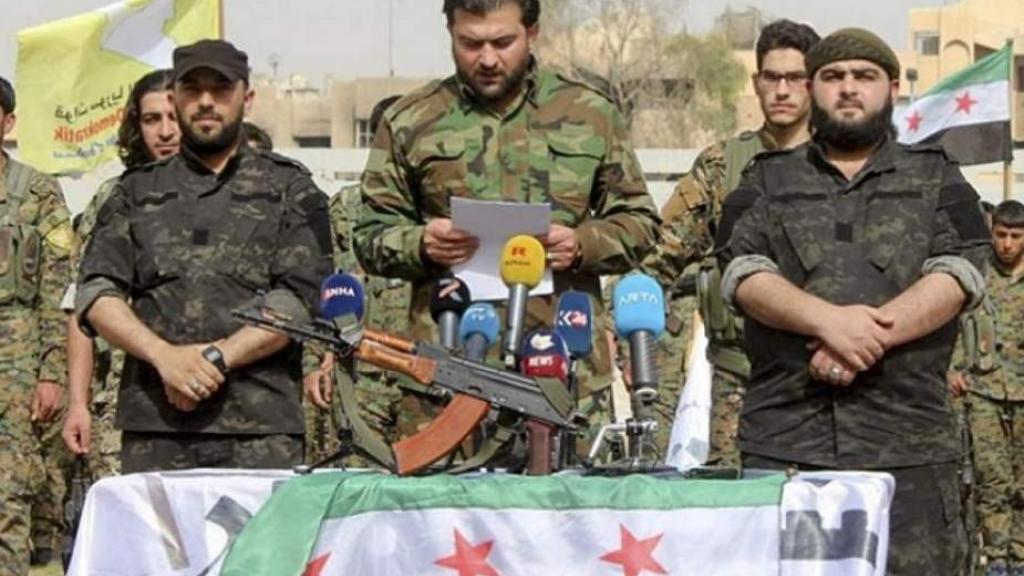
SDF and Free Syria flag

The revolution in North and Eastern Syria began in 2012 among Kurds living there, but spread to involve other nationalities in the area.

The Kurds were oppressed under the Bashar al-Assad regime. Many were denied Syrian citizenship. Land was taken from Kurds and given to Arab settlers. The Kurdish language was discriminated against. Kurdish political organisations were repressed.

The outbreak of the revolution in other parts of Syria in 2011 weakened the regime and allowed Kurdish political organisations to operate more freely.

In July 2012 there was an uprising in Kurdish areas, led by the Democratic Union Party (PYD). There was little resistance from Assad regime troops, most of whom surrendered without a fight.

In Kobani, for example, a mass of people assembled outside the army base as a delegation informed soldiers that if they gave up their weapons, their safety would be guaranteed. The soldiers agreed. Some returned to their homes in other parts of Syria, while others stayed in Kobani.1

Rojava revolution

The Kurdish area of North and East Syria is known as Rojava (meaning western Kurdistan). The uprising came to be referred to as the “Rojava revolution”.

The PYD initiated the creation of democratic structures. Base level organisations were called communes. In the countryside, a commune might be a village. In the cities, a commune might comprise a few hundred households on the same street. Each commune elected representatives to a higher level body.2

The PYD promotes equality for men and women. For example, communes and other organisations were required to have male and female co-chairs. The PYD also promotes the inclusion of all ethnic and religious groups in the democratic structures.

The PYD led in the creation of armed forces to defend the revolution. They created the People’s Protection Units (YPG) and Women’s Protection Units (YPJ). The latter is an all-women armed force.

In the rest of Syria, the popular uprising turned into a civil war. Peaceful protests were violently repressed. So, many opponents of the regime took up arms.

The problem was that weapons and money for the rebels came from Turkey and the Gulf States, who tended to support the most reactionary rebel groups, including Arab chauvinists hostile to Kurdish rights and Islamist groups hostile to religious minorities and the secular PYD. Turkey was particularly opposed to Kurdish self-determination and supported groups that were hostile to Rojava.

Daesh

The PYD distrusted both the Assad regime and many of the rebel groups. It tried to stay out of the fighting between the regime and the rebels. However, Rojava came under attack from some Turkish-backed groups. In 2014 Rojava was attacked by Daesh, or the so-called Islamic State.

Daesh captured large areas of Iraq and Syria, including Mosul, Iraq’s second largest city, after the Iraqi army collapsed there. Daesh also attempted to capture Kobane, but was driven back by Kurdish fighters and some Arab Free Syrian Army fighters.

Worried about the rise of Daesh, the United States formed an alliance with the YPG and YPJ to fight against Daesh. This was paradoxical, because the US was also supporting Turkey in its war against the Kurdistan Workers’ Party (PKK) in Turkey and northern Iraq.

The PYD follows the ideas of imprisoned PKK leader Abdullah Ocalan. The Turkish government views the PYD and PKK as essentially the same. Yet the US was supporting Turkey against the PKK while supporting the YPG and YPJ against Daesh.

Over the next few years Daesh was driven out of North and East Syria. The alliance between the YPG and YPJ and some Arab groups led to the formation of the Syrian Democratic Forces (SDF). As the war against Daesh continued, more Arabs joined the SDF. With each successful push against Daesh, more areas populated by Arabs came under SDF control.

To highlight the multi-ethnic character of North and East Syria, the Kurdish name Rojava was replaced by Democratic Autonomous Administration of North and East Syria (AANES). On the other hand, Turkey named its Syrian proxies the Syrian National Army.

In 2018, Turkey invaded Afrin, a predominantly Kurdish area in northern Syria. The SDF resisted the Turkish invasion of Afrin for more than two months, but the light weapons of the SDF were no match for the aircraft and tanks of the Turkish armed forces.

Although helping the SDF fight Daesh, the US did not help the SDF fight the Turkish invasion of Afrin. This showed the limitations of the alliance: the US has no interest in defending the revolution.

In 2019, Turkey invaded a strip of land along the border in northern Syria. Since then, Turkey and its SNA proxy have continued their attacks on AANES-controlled areas.

Syria’s future

Hay’at Tahrir al-Sham (HTS) became the dominant force in Idlib province, in north-western Syria. HTS was allied with Turkey, but not totally under Turkey’s control; it was relatively independent. In November 2024, HTS launched an offensive against the Assad regime, leading to its rapid collapse.

At the same time, Turkey and the SNA stepped up their attacks on AANES. They captured some areas west of the Euphrates river, including the towns of Tal Rifaat and Manbij. These forces are currently trying to cross the Euphrates, but the SDF is resisting this offensive. There is a battle for control of the Tishrin dam.

Meanwhile, AANES is putting forward its ideas for the future of Syria as a whole. They call for a National Dialogue Congress, which would involve “political and social organizations, as well as ethnic, religious and cultural groups” that could develop a “common social contract”.3

They also call for the liberation of the areas under Turkish occupation and for the new government in Damascus to join them in this struggle.

HTS is unlikely to agree to AANES’s proposals, but there is hope that they will gain an audience among the Syrian people beyond the north and east.

Based on a talk given to an online discussion about Syria organised by the moderators of the Marxmail discussion list.

  • 1

    Revolution in Rojava, by Michael Knapp, Anja Flach, and Ercan Ayboga, Pluto Press, 2016, page 54

  • 2

    Revolution in Rojava, p.87

  • 3

    “Peoples’ Assembly of North-East Syria presents six principles for Syrian Constitution”, ANF English https://anfenglishmobile.com/rojava-syria/peoples-assembly-of-north-east-syria-presents-six-principles-for-syrian-constitution-77461


Mazloum Abdi (Syrian Democratic Forces): ‘The HTS administration and those seeking a solution to the Syrian crisis must work to stop the attacks on North and East Syria’


Published 

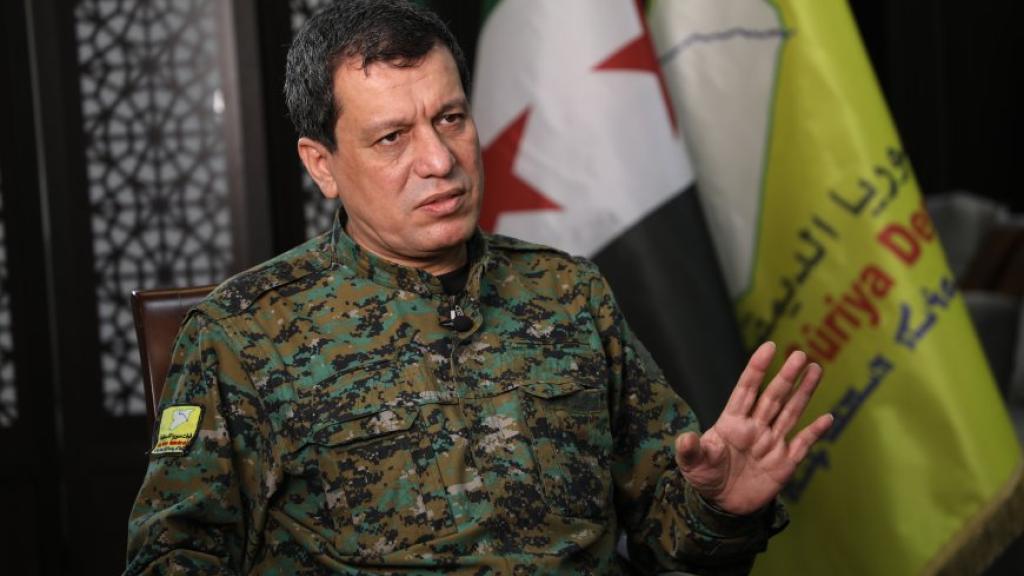
Mazloum Abdi

First published at Hawar News Agency. Slightly abridged and edited for clarity.

In this interview, Syrian Democratic Forces (SDF) Commander-in-Chief Mazloum Abdi assessed the rapid developments and changes on the military, security, and political fronts since the fall of the Assad regime in Syria. Abdi also discussed the continuous attacks launched by the Turkish occupation state and its mercenaries and the latest developments in the dialogue with the Hay’at Tahrir al-Sham administration and between Kurdish political parties.

He praised the role of the people and youth in resisting the attacks and strengthening their forces, noting the continuation of dialogue with the HTS administration. He emphasized the importance of political dialogue to end the Syrian crisis, calling on the international community to put pressure on the Turkish occupation to stop its attacks as a first step towards building a new Syria.

A month and a half have passed since the fall of the previous Syrian regime. During this period, Syria has witnessed significant military and diplomatic developments. How do you assess this phase? What is the current reality in Syria from your perspective?

In fact, more than a month and a half have passed since the fall of the Ba’athist regime and the historic change in Syria. The Syrian people, regardless of their different components, are generally pleased and happy with this change, especially the coexisting components in the regions of North and East Syria, including the Kurds. This is because, with the start of the Syrian revolution in 2011, the people of the region were among the first to participate in the protests and sit-ins against the regime. Therefore, they, more than any other parties, are happy with the fall of the Assad regime.

Today, gradually, the situation is becoming clearer and more evident, but the situation has not yet taken a clear direction for everyone in Syria. Syria has entered a new phase, and there will be no turning back; the country will not return to previous stages. All parties, starting from the Syrian people, through the regional countries, and up to the international powers, no longer wish to see the country experience a civil war or any disturbances and tensions again. All parties are striving to benefit from this current change and seize the opportunity to build a new Syria.

At first, the international powers were apprehensive about the phase and the change and who had reached Damascus, but the situation and positions of those parties have become clearer and more evident. Now, those parties want to continue with the new administration in Damascus, but at the same time, they want to push that administration to change some of its aspects.

We, in the SDF, and also the representatives of the components of North and East Syria, want the current change to be a foundation for a new phase in Syria.

The new phase in Syria is met with significant challenges that generate concerns among the general Syrian population. The most important of these is the existing and evident security vacuum. We hear about violations by parties seeking to destabilize the security of Syrian regions. The economic situation remains deteriorating and continues to worsen. 

Syria is still under sanctions. Economic sanctions have not yet been lifted from the country, and international powers have not reached a complete consensus to lift those sanctions, because the country has not yet reached the new administrative form required by the Syrians, and the responsible parties have not yet reached a stable position. Additionally, there are challenges and concerns such as how the new administration will politically approach the future of the country, and foremost among all this is the continuation of external attacks on Syrian territory.

All these matters are considered challenges facing the Syrian people and hindering the country’s return. However, in general, we can say that we are going through a historic and new phase, and it is necessary for everyone, whether the Syrian community or international and regional powers, to cooperate and work together to build a Syria based on acceptance of others.

Over the course of approximately 14 years of the Syrian revolution, three administrations have emerged on the ground. One of them collapsed, which was the previous Ba’ath regime, and it has now been replaced by HTS. There are also two existing administrations known as the Euphrates Region and the West Euphrates Region. The West Euphrates Region is managed by the interim government, which is not favored in its form and system, and it is interim in name based on past experiences and its reality. 

Our current administration [the Autonomous Administration of North and East Syria, AANES] has produced results in our regions, whether on the institutional, political or military level. We have an administration that works to empower the principles of democracy, and we certainly wish to play an effective and significant role in the new Syria.

In light of calls for dialogue as a path to achieving sustainable peace in Syria and the approach to building Syria, the region of North and East Syria are subjected to intense attacks by the Turkish occupying state and its mercenaries, especially in the Tishrin and Qaraquzak dams. What are the objectives of these attacks, and what are the most significant field developments related to them?

This is a significant and obvious contradiction, as the majority of Syria is witnessing a phase of war cessation. There may be some minor skirmishes, but there is relative stability, and there is no ongoing war or battles. There are only attacks on areas in North and East Syria. As you mentioned, there are attacks on our areas such as Qaraquzaq and the Tishrin Dam, and our other areas are still subjected to daily bombardment by Turkish warplanes and artillery. 

This is a major contradiction from Turkey and does not align with the situation of Syria that is currently being discussed, which suggests that Syria has entered a phase of crisis resolution. At such a time, the groups linked to Turkey, called or referred to as the “[Syrian] National Army” [SNA], supported by Turkish air and artillery, continue to attack our areas.

With the fall of the Assad regime, and in order to stop these attacks and the war, so that our people, like the rest of the Syrian people, can enjoy a state of stability and the cessation of war, we have proposed many initiatives and suggestions. As you know, for example, what we proposed to stop the attack on Kobani, and we are still proposing, and now to stop these attacks on the Tishrin Dam and the Qaraquzaq Bridge, there are suggestions we are making and work is being done on that through intermediaries, foremost among them the United States of America. There are also other parties working on that, and we have efforts, and we approach any proposal that comes to us to stop these attacks with all positivity.

I want to emphasize that these attacks contradict and hinder both domestic and international efforts to resolve the Syrian crisis. Therefore, the administration in Syria and the parties seeking to find a solution to the Syrian crisis must, above all, work to stop the attacks on the region of North and East Syria. Without this, we, as the peoples of North and East Syria, cannot work effectively in the upcoming political phase for Syria. Thus, our support and efforts for Syria are conditional upon stopping the attacks on our regions.

What are the latest field developments in the Qaraquzaq and Tishrin Dam fronts. Why is there such insistence from Turkey and its mercenaries to attack and escalate specifically in those two fronts, despite all the proposals?

The Tishrin Dam and the Qaraquzak area are geographically located between Manbij and Kobani. In order to prevent the continuation of attacks and war, and to completely stop the war, we reached an agreement with the other party to withdraw our forces from Manbij. However, what we have witnessed are attempts to cross the agreed-upon borders, move to the east of the Euphrates, and continue the attacks.

The borders where it was agreed that the attacks would stop are the natural geographical borders. We left Manbij based on an agreement that ensured the war would stop at the banks of the Euphrates River from the west of the Euphrates, and we were open to the Turkish army reaching the site of the Tomb of Suleiman Shah. On the other hand, the agreement extended to the countryside of Manbij but it extended to the area of the Tishrin Dam, which was not among the areas that the SNA would reach.

But we have witnessed that they tried to reach the eastern Euphrates and control the region by crossing either from the Qaraquzaq Bridge or the Tishrin Dam to besiege Kobani. However, the resistance of the local people thwarted that and pushed them back to the western Euphrates after some of their groups crossed to the eastern Euphrates from the Qaraquzaq Bridge. They are still trying to reach the eastern Euphrates from that front. If the goal is to return the tomb of Suleiman Shah to its location, we are open to that. But if it is a prelude to a new war on the region, we will certainly not allow it and we will continue to confront those attempts.

As for the Tishrin Dam area, they tried to advance and seize the Tishrin Dam and cross to the east of the Euphrates and to the Serrin area to complete the siege of Kobani. The battles and their attacks are still ongoing, and since their plan is exposed to us, we repelled those attacks. Our defense in the Tishrin Dam area is part of protecting Kobani from that plan.

Our decision is summarized in not allowing the implementation of that plan and the forceful entry into our areas. We know that until a general and comprehensive ceasefire is reached with Turkey and the armed groups associated with it, the plan to occupy other areas of the region will continue. Therefore, our resistance and confrontation will also continue. Our forces’ decision is clear and we reaffirm it once again: we will not allow the crossing of the dam and reaching the eastern Euphrates, no matter the cost.

Are there any surprises in terms of military developments that will be revealed in the upcoming stages of confronting the Turkish occupation and its mercenaries? Just as we have recently seen the emergence of aerial units within your forces?

I mentioned in previous meetings that the SDF are not what they used to be. For about four years now, our forces have been working on developing their military capabilities and resorting to various military tactics, all within the context of defense, because we are a force formed for self-defense, not for attack. Among these are protection methods, tunnel warfare and trenches, as well as measures to protect against aerial bombardment. There are many significant measures that have been implemented across all our regions. In the context of these measures, everyone should know that any attack on our regions will not be a walk in the park. At this stage, we have proven this through the methods of protecting our forces from Turkish aerial bombardment.

And also on the technical front, we have measures that have proven successful in thwarting and failing attacks launched against our regions, whether they are ground attacks as we witness today in the Tishrin Dam area, or aerial attacks, including what we have demonstrated by downing several Turkish drones. We have many other new methods that are being worked on more extensively to thwart aerial and ground attacks on our regions. What has been revealed so far is just a part of those measures to protect our areas, and they are local products with local names that will be known later.

After the announcement of general mobilization and recruitment by the SDF and the AANES, the residents responded widely. What is your message to them in this critical phase?

We have entered a historical phase, as I mentioned, and the general mobilization was necessary to align with this phase, as the region is in the process of consolidating and ensuring the achieved gains. All peoples in such phases resort to this, and it is essential. There is an aspect of this general mobilization that pertains to the entire people of North and East Syria, and we witness this general mobilization today among the entire population. 

Everyone is mobilized to protect their areas in various ways and methods. We see the protection of neighborhoods, villages, and towns being carried out voluntarily, ensuring security and stability alongside their security and military forces. These are efforts we highly appreciate, and this is what we have come to expect from the peoples of the region in such types of attacks and phases that we have witnessed throughout our revolution within the Syrian crisis.

The other aspect is related to the youth within the community and their involvement in the military forces to confront external attacks and strengthen the SDF. Yes, our SDF has significant strength, but it needs to be reinforced to become even stronger because we are heading towards a future beyond just achieving gains. This phase requires greater involvement in these forces, whether temporarily or in the long term, in terms of volunteering and engagement.

It is the responsibility of the youth at this stage to strengthen the SDF, because strengthening these forces will enhance the position of the Syrian DDF in the upcoming stages, whether in negotiations with the HTS administration in Damascus or in repelling external attacks on the region. Therefore, everyone must fulfill their national duty.

Since late November, the SDF and the people of the region have resisted the attacks of the Turkish occupation and its mercenaries, starting from Afrin and al-Shahba to Kobani and the Tishrin Dam. How do you assess the resistance shown by the fighters and the people? What is its impact on Syrian and international public opinion?

The decision to resist and confront is not just the decision of our fighters or a specific military leadership, but rather a popular decision that our people in North and East Syria believe in, because they are certain and aware of the Turkish plans and those connected to them. This is evident in what we see with our people heading to the Tishrin Dam and protesting there.

On this occasion, we highly appreciate and evaluate the moral support and the protests of our people against these attacks, and we consider it a historical resistance. It is an expression of their deep connection to their forces and their achieved gains, and we commend their continuous resistance. Our people desire nothing but the cessation of attacks on their regions, facilities, and forces, and to live in security and stability within the upcoming Syria after the fall of Assad.

What is your assessment of the international stance on the recent Turkish attacks? What is your message to the United Nations and the international community regarding the Turkish attacks and the situation in North and East Syria?

From the beginning, there have been attempts and endeavors to stop these attacks, most notably the Global Coalition and the US, and this popular resistance from the people of the region, with its various components, has the greatest influence that pushes these parties to these positions, and these endeavors are still ongoing. An example of this is what we witnessed regarding Kobani, and what we are witnessing today with the region remaining in a kind of stability and in the rest of the regions of the region, is the result of the continuous support of these parties for our forces and the peoples of the region. 

The popular resistance and the resistance of the SDF fighters in the Qaraquzak area, as well as the ongoing resistance in Tishrin Dam, contributed to pushing all parties to increase support for our forces and increased the efforts of international parties to mediate for a permanent ceasefire, so just as there was a move for Kobani, there are efforts to cease fire in the Tishrin Dam area, the efforts have limited the expansion of these attacks, but have not yet yielded results to stop the attacks in the Tishrin Dam and Qaraquzak area.

Therefore, we believe that we must continue our historic resistance, and the attacking parties must be certain that they will not be able to enter the dam and cross it by force and with such ease. Our decision is clear, which is not to allow the occupation and to confront it, and our forces have always proven that they are capable of implementing the pledges and decisions that they make to themselves. Our military resistance on the one hand, and our diplomatic efforts on the other hand, will continue, and we believe that in this way we will ensure that the stage ends with victory.

The resistance of our fighters and the resistance of our people in the Tishrin Dam area will direct us to a new stage that begins with a comprehensive ceasefire and entering the post-war, dialogue and construction stage. Therefore, all parties, primarily the international powers and the Global Coalition, must be aware of the demands of our people and stand by them and pressure all parties, primarily Turkey, to stop these attacks. I am confident that stopping these attacks will turn into the beginning of political dialogue in Syria.

There are repeated allegations of tension and clashes between the SDF and HTS. Which parties are pushing for this? Who benefits from fueling a conflict between the two parties? What is the impact of this on the Syrian people and their future?

So far, no clashes have occurred between us. When the “Deterrence of Aggression” operation [by HTS] began, they contacted me and explained that their target was the Syrian regime, and that they were not targeting areas of the SDF, and that they were not seeking to cause clashes or clashes between us and them. To this day, with the help of mediators, there is coordination between us militarily in Raqqa, Deir-ez-Zor, and even in the city of Aleppo. 

Many parties spread these allegations with the aim of destabilizing the security and stability of the region and pushing the two parties to clash in order to exploit it for other agendas, but we in the SDF and the other party, HTS, are aware of these plans and who is behind them, so we will only say that their plans will fail.

Do you mean to say that there is a third party trying to drag you into a fight with HTS? If that happens, what are its repercussions and which of those parties will benefit from that?

Of course there is a third party, there are local parties, and some countries are trying hard and by all means to cause a fight between us, and there are also Syrian figures, in addition to some groups that spread discord, and this is happening openly and not in secret. Sometimes we see them go out in Umayyad Square in Damascus and talk about clashes and fighting, and they call for that. But in general all parties, including the SDF, HTS and international powers, while there is dialogue and a national project, believe the fighting should not return.

Certainly with the return of the fighting, all parties will be harmed by it, and before everyone else, the Syrian forces are the ones who will receive the greatest harm, and the interests of the international powers present in the region will be harmed. I believe that everyone is aware of this matter, and that is why no one seeks to resolve the Syrian crisis through armed conflict. Resuming the internal Syrian conflict again will not be in the interest of any party.

There is ongoing talk about negotiations between you and the leadership of HTS. What is the nature of the relationship between the two parties currently? What are the most prominent points that you are discussing in these discussions, what have you agreed upon and what are the points of disagreement between the two parties?

I believe that our people and all components of North and East Syria are seeking to know the nature of the relationship between us, what we have reached, what we are discussing. Currently, the discussions are ongoing. 

First, we went to Damascus to know their opinions and point of view, and they were also trying to know our point of view. We held a long meeting with the leadership of HTS, Mr. Ahmed al-Sharaa, and common points emerged between us and we agree on them, regarding the future and nature of the SDF within the Syrian army in the future, the unity of Syrian lands, the rejection of division, and the necessity of activating dialogue and a political solution.

We think about Syria as a whole, we want a unified Syria, and we have no intention of separatism. Many are promoting that we are working to build two armies in Syria and establish a state within a state. We have no intention in this direction. Our goal and political plan are clear. In the basic lines, there is no disagreement between the two parties.

But there are ongoing discussions and negotiations about the mechanism, how and the content of implementing these points, and the timing of translating these matters. We agree that Syria should have one army and the SDF should be part of it, but in what way will the SDF be integrated with the Syrian Ministry of Defense? The SDF has been present for ten years and consists of all the components of North and East Syria, and it has many military institutions affiliated with it. There are also preparations underway to build a new force, not a previously unified force, and we must join it.

Having a new army requires a lot of time and work. There is a disagreement between us and them about the timing of the period in which this army should be formed, and about how to activate the closed crossings within the areas of the Autonomous Administration, and for this reason the meetings will continue.

Currently, there are clashes and fighting in the Tishrin Dam, and the dam is a national institution and concerns Syria in general, and for this reason this problem must be resolved with the Damascus administration. As I said, previously in the basic lines we agree and there is no disagreement between us, and most importantly there is the intention of dialogue between the two parties. For this reason things must proceed slowly and with complete patience. There are some parties trying to rush the matter, but we see that any action that is done in a hurry can have negative results. We say that matters must be resolved step by step without thinking about time in order to have a solid foundation and not be a reason for problems to appear again.

Also, we are currently working on how to include this region in the political process, and they must also be clear in this context: how we will join the national dialogue that will be held or the transitional government that they say will be formed within two or three months? What is our place in this government? These points must be clarified. Also, on what principles will the future Syria be built, whether it is democratic or not, and what is the form of the state, as it concerns all Syrians.

In the end, I can say that we agree that the Syrian situation should be resolved through dialogue, and blocking the way for parties that are trying to spread discord. There is encouragement from the parties and international powers to work in the context of the dialogue, and for us to be present in Damascus. They also, as the Damascus government, have representatives in our regions.

A few days ago, a meeting was held, we shared our point of view with them, and they also presented some demands, and in turn, we sent them our demands, and I believe that we will be responded to, and when some points are clarified, we can hold meetings at the level of the General Command between us and them, in order to work on implementing some practical steps, but the steps that will be implemented must be discussed and clarified between us.

I am confident that from now on we can work on some points, including the issue of fighting terrorism and ISIS. There is al-Hol Camp where thousands of people from inside Syria are held, and for this reason a delegation or a committee from Damascus must go to our areas to coordinate between us and al-Hol Camp administration and clarify how to return them to their areas, and study opening the crossings, including Qamishlo and Tal Kocher, since the crossings are linked to the government in Damascus.

Could you please tell us about the demands you received from the HTS administration, if it is possible to disclose them of course?

We have previously explained some of them in the context of our dialogue, and since those demands are under discussion and dialogue, I do not want to go into detail about those demands. Now I would like to apologize, and I believe that the information we have provided about our relationship is sufficient for this moment.

Conflicting statements have been issued by HTS administration officials regarding the SDF, some of which talk about an ongoing dialogue and others call for the dissolution of the forces and the surrender of weapons. How do you evaluate these statements? What can you conclude from that?

There are many reasons for this contradiction in the statements. There is pressure being exerted on them and there are demands from international powers and regional countries, and there are challenges on the ground. For us, the most important are the statements of the HTS leadership, Mr. Ahmed al-Sharaa. We have direct channels of communication with the HTS leadership and the Damascus administration, and there are parties moving between us and they are present in Damascus and come to us. Our relations are conducted at the leadership level. In this context, I do not believe that there is any disagreement between us regarding the dialogue and its continuation.

Regarding the unity of the Kurdish ranks in the region, especially after your recent visit to Erbil and meeting with the leadership of the Kurdistan Democratic Party, have you met with other Kurdish parties? What is the position of those parties? What are the latest developments in this area (the unity of the Kurdish parties in Syria)?

The visit we made to Hewler was private, no other meetings took place outside the framework of this visit, but a phone call took place between us and the President of the Kurdistan Region, Nechirvan Barzani, and as you know we have relations with the President of the Patriotic Union of Kurdistan, Pavel Talabani, and we are in constant contact with him. In general, this is a new stage for everyone and for the Kurds as well, and therefore steps must be taken, as achieving Kurdish unity at this stage is more important than ever.

We in the SDF are not only concerned with the Kurdish people, but with all the components of North and East Syria. There are some parties that systematically seek to limit the issue of North and East Syria to the Kurds only, this is not true. All components of the region have been fighting for ten years in one trench, and the blood of all components has been shed in the same trench. The SDF are made up of the sons of all components of North and East Syria.

We will continue our struggle to ensure the rights of the components of North and East Syria in the future Syria, and our efforts in this regard will continue, but this does not mean that we put the Kurdish issue on the sidelines; on the contrary, the more the Kurds show strength at this stage and unite their ranks and voices, we will achieve our goals and protect our gains. There is an urgent and greater need than before to achieve Kurdish unity.

The position of the Kurdistan Region is positive, and they want to provide assistance to Rojava and North and East Syria in our dialogue and negotiations with Damascus. In my opinion this is a positive and important position at this stage, and all Kurdish forces must stand by Rojava so that Rojava can guarantee its rights. The support and assistance of the Kurdistan Region to Rojava at this stage is very important and what is happening in this regard so far is good.

It is necessary in the coming days for the Kurdish political parties in Rojava to meet. For our part, we discussed this issue during our visit to Erbil and it was one of the main topics and it also enjoys support from Hewler as well.

As part of what we have learned from our visit, we will meet with the Kurdish forces in Rojava in the coming days, and we will try to unify their position and political program regarding the Kurds in Rojava, and form a unified body in the name of the Kurds to go to Damascus to conduct negotiations. This will support the position of the AANES and the SDF on the issue of North and East Syria. The communication channels between us are continuous and have not been interrupted, there is a positive atmosphere, everyone is ready for that. We are waiting for a meeting program to be set, to meet with all parties, and to gather them at one table to discuss the issues.

Earlier in 2020, there were meetings between them and they had common political visions, and according to the situation, they should meet again to make some adjustments. They should unify their demands and determine what they want. 

The main goal of the dialogues is to form a unified body called Rojava to go to Damascus and demand their rights. First, they should agree on a unified program and go to Damascus to present their demands to the Damascus administration. I believe that this is urgent and necessary on the one hand, and on the other hand, the conditions are favorable for the Kurdish forces to agree, and we will help them in this matter until the end.

Yes, as soon as possible, in the next few days, I think we may start holding these meetings tomorrow.