It’s possible that I shall make an ass of myself. But in that case one can always get out of it with a little dialectic. I have, of course, so worded my proposition as to be right either way (K.Marx, Letter to F.Engels on the Indian Mutiny)
Saturday, May 17, 2025
PHYTOLOGY
Europe’s forest plants thrive best in light-rich, semi-open woodlands – kept open by large herbivores
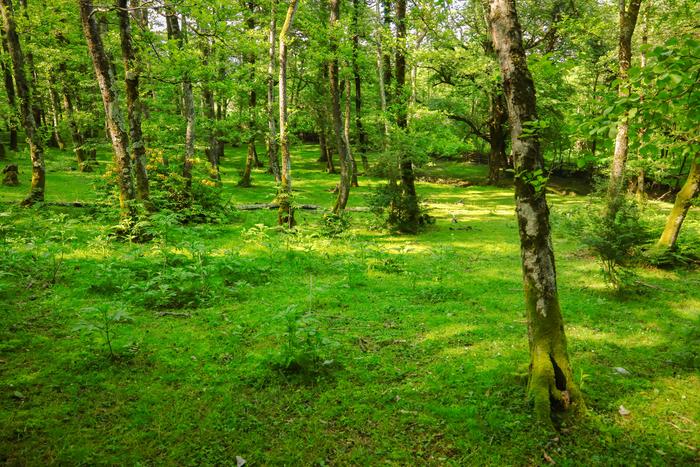
Where traditional livestock grazing in forests hasn't been abandoned, like on this woodpasture in Georgia, forests likely still resemble their pre-human state shaped by large herbivores. In such forests high diversity of forest plants still can be found.
Before Homo sapiens arrived, Europe’s forests were not dense and dark but shaped by open and light-rich woodland landscapes. A new study from Aarhus University shows that most native forest plants are adapted to semi-open, light-filled woodlands – formed over millions of years by the influence of large, free-ranging herbivores such as bison, elk, and wild horses.
The study adds another chapter to a growing body of research challenging the traditional idea of Europe’s forests as closed-canopy wilderness.
The researchers analyzed 917 native forest plant species in Central and Western Europe and found that more than 80 percent prefer high-light conditions – environments traditionally created by large herbivores. This suggests that dense forests only became widespread after humans eliminated the large herbivores.
“Our results provide strong evidence that the closed-forest model commonly used in restoration does not match the evolutionary history or ecological preferences of most temperate forest plants,” says lead author Szymon Czyżewski, a PhD student at the Center for Ecological Dynamics in a Novel Biosphere (ECONOVO) at Aarhus University.
He conducted the study together with the center’s director, Professor Jens-Christian Svenning, and their findings are published in Nature Plants.
The evidence is mounting
The new study builds on a series of earlier ECONOVO results that, based on different data, point in the same direction. Together, the research paints a picture of a Europe where large herbivores, for millions of years, created light-rich woodland landscapes that have now largely disappeared.
The researchers also uncovered a worrying link between herbivore decline and the extinction risk of plants. Forest plants that are most strongly adapted to heavy grazing pressure are significantly more threatened today.
According to Jens-Christian Svenning, this development has had serious consequences for biodiversity:
“Our study shows that the plants most dependent on grazing are also the ones most at risk today. When large herbivores disappear, the forest closes in, and many light-demanding plants struggle to survive.”
Implications for forest management
The study has far-reaching implications for conservation, forest management, and reforestation across Europe. It challenges the prevailing “closed forest paradigm” and supports a shift toward restoring or maintaining heterogeneous, semi-open woodlands through trophic rewilding and low-intensity grazing.
The researchers thus call for a new approach to ecological restoration that actively includes large herbivores – either through rewilding or extensive woodland grazing – to recreate the varied, light-rich woodland landscapes.
“We should be cautious about simply planting trees everywhere and thinking that will promote biodiversity. It can actually be harmful if we don’t also preserve and restore the natural dynamics that large herbivores have maintained for millions of years,” says Szymon Czyżewski.
Temperate forest plants are associated with heterogeneous semi-open canopy conditions shaped by large herbivores
Should we protect non-native species? A new study says maybe
What happens when plants thrive outside their native range but struggle in their original habitat? A new study puts numbers to a growing conservation dilemma.
German Centre for Integrative Biodiversity Research (iDiv) Halle-Jena-Leipzig
When a plant species spreads beyond its habitat, it is usually seen as a threat to native flora and fauna. But what happens when that same species is struggling to survive in its original range? A new study published in New Phytologist and led by researchers at the German Centre for Integrative Biodiversity Research (iDiv), Leipzig University and the Helmholtz Centre for Environmental Research - UFZ found that over a quarter of the world’s naturalised plant species are threatened in parts of their native range — raising questions about the role non-native populations may play in global conservation efforts.
“I initially assumed that plant species expanding into non-native ranges were global winners, benefiting from range gains. However, our results show that many species with range gains also experience range contractions, complicating how we assess non-native populations”, explains lead author Dr Ingmar Staude of iDiv and Leipzig University.
The finding that 27% of all naturalised species worldwide are considered threatened somewhere in their native range is the result of a global synthesis that links sub-global Red Lists of vascular plants from 103 countries with the Global Naturalized Alien Flora (GloNAF) database.
An extreme example of this conservation dilemma is the species Agave vera-cruz, which is globally classified by the International Union for the Conservation of Nature (IUCN) as extinct in the wild (referring to its native range), but survives in multiple self-sustaining, non-native populations. However, most plant species that have expanded beyond their non-native range and face native-range threats are not globally threatened, highlighting the dynamic nature of species ranges.
While non-native species are often evaluated in terms of their ecological impact or eradication, the study advocates for a more nuanced approach. The findings suggest that some species colonising new regions may provide conservation value, though each case requires careful evaluation.
The researchers underscore the importance of reassessing a too rigid distinction between “native” and “non-native” species in the context of global biodiversity change. As species distributions increasingly shift due to climate change and land use, ever more such conservation dilemmas will emerge. The researchers call for a balanced perspective that acknowledges both risks and potential conservation opportunities.
They are the transition zones between forest and open landscape and serve as habitats and retreats for various animal species. This refers to scrub fringes, the proportion of which is very low in Central Europe due to forestry and agriculture. This is detrimental to animals and plants that depend on these shrubby landscape elements.
A research team led by Professor Jochen Krauss, Chair of Animal Ecology and Tropical Biology at the Julius-Maximilians-Universität Würzburg, has examined the affected animal and plant species in the first comprehensive study of its kind. The researchers have shown that a mosaic of open and semi-open shrub fringes is needed to maximize biodiversity. These fringe types can be distinguished by how densely the shrubbery is overgrown.
To generate positive effects for biodiversity, active and well-thought-out fringe management is required: "We recommend that landowners, foresters, landscape conservation associations and nature conservation authorities give shrub fringes sufficient space. These habitats provide rare and endangered animal and plant species with habitats that are otherwise rarely found in our intensively used cultivated landscape," says Krauss.
The results were produced in cooperation with the Ebern Institute for Biodiversity Information. They have been published in the Journal of Applied Ecology.
Determining Diversity in the Shrub Fringes
The researchers examined a total of 45 shrub edges in Bavaria - including habitats near the Lower Franconian towns of Höchberg, Retzstadt and Güntersleben. They were particularly interested in herbaceous plants, grasshoppers, bugs, ground beetles and spiders. Ground traps and other trapping methods were used to count and identify the animals.
The zoologists differentiated between open and semi-open shrub fringes. Within these two categories, the researchers tested the influence of three other parameters on biodiversity: the size of the area, the proportion of near-natural habitats in the surrounding landscape and the habitat quality. The latter is made up of, among other things, the number of species of shrubs and their structural richness.
Fringe Management Necessary at Landscape Level
The most important influences on diversity are the quality of the habitat and the degree of shrub cover. "We realized that across all groups, the open edges with high quality were the most species-rich: They had the highest species richness of herbaceous plants, grasshoppers and bugs. We also found many different spider species in these habitats, while the species richness of ground beetles was highest in semi-open fringes of lower habitat quality," says Fabian Klimm, first author of the study.
The appeal is clear: "We need a fringe management at landscape level. Both open and semi-open fringes should be promoted to maximize diversity," says the doctoral student. Biodiversity ensures essential ecosystem services for humans, such as the pollination of crops or ecological pest control.
Life at the (h)edge – Multidiversity in shrub ecotones is driven by habitat and shrub foliage cover
Article Publication Date
13-May-2025
COI Statement
The authors declare that they have no competing interests and there was no financial support for this work that could have influenced the outcome of this paper. Fabian A. Boetzl is an Associate Editor of the Journal of Applied Ecology, but took no part in the peer review and decision-making processes for this paper.
Scientists wash away mystery behind why foams are leakier than expected
Bubble rearrangements determine how much liquid can be held in foams
Tokyo, Japan – Researchers from Tokyo Metropolitan University have solved a long-standing mystery behind the drainage of liquid from foams. Standard physics models wildly overestimate the height of foams required for liquid to drain out the bottom. Through careful observation, the team found that the limits are set by the pressure required to rearrange bubbles, not simply push liquid through a static set of obstacles. Their approach highlights the importance of dynamics to understanding soft materials.
When you spray a foam on a wall, you will often see droplets of liquid trailing out the bottom. That is because foams are a dense collection of bubbles connected by walls of liquid, forming a complex labyrinth of interconnected paths. It is possible for liquid to travel along these paths, either leaving the foam or sucking in liquid which is brought into contact with the foam. This “absorptive limit” is determined by a quantity known as “osmotic pressure”, which reflects the energy change when bubbles are squished together, changing the contact area between liquid and gas.
Or so people thought. Throughout the years, scientists have been perplexed by simple calculations which show how much height a certain foam needs to be for this limit to be met. While the osmotic pressure alone, determined from bubble sizes and surface tension, might show that you need a meter or so of foam height before this limit is met, researchers could see that a foam tens of centimeters high will easily allow leakage of liquid. From cleaning products to pharmaceuticals, foams are a part of everyday life; to design products optimized for specific applications e.g. foams which resist drainage, it is vital that we understand the physical mechanisms at work.
A team led by Professor Rei Kurita of Tokyo Metropolitan University has been looking at drainage in simple foams. The team used various surfactants to create a library of different foams with different properties, sandwich them between transparent plates and stand them upright to reveal what is going on inside while they drain, if at all. Firstly, they discovered a universal behavior where the height at which drainage starts is inversely proportional to the liquid fraction of the foam, independent of surfactant type or bubble size. Their analysis of the limit yields an “effective osmotic pressure” at which the absorptive limit is met significantly lower than what is expected from bubble sizes and surface tension.
Going back to the drawing board, the team looked directly inside the foam with a video camera. For foams which have just made it to the drainage point, they discovered that liquid wasn’t simply pushing through the maze of connections but causing the bubbles themselves to rearrange. They found that the limit where drainage occurs is determined not by surface tension but “yield stress,” the amount of pressure required to rearrange bubbles. Importantly, this model gives heights for draining foams which match up with reality.
This result upends the fundamental picture of how we look at foam drainage, from a static picture of liquid moving through gaps, to a dynamic one where the gaps themselves can move. The team hopes their findings inspire new insights into the behavior of soft materials, as well as approaches to designing better foam products.
This work was supported by JSPS KAKENHI Grant Number 20H01874.
Simple foams to observe drainage and bubble structure.
Foams are sandwiched between transparent plates before being set vertically to allow imaging during drainage.
Drainage points for different surfactants follow a universal law.
The point at which foams start draining seems to be inversely proportional to liquid fraction
A drop of methanol is distorted to form a cup of hot plasma. Plasma waves are driven in this cup by an intense laser, releasing hot electrons, followed by accelerated protons.
Laser Ion acceleration uses intense laser flashes to heat electrons of a solid to enormous temperatures and propel these charged particles to extreme speeds. These have recently gained traction for applications in selectively destroying cancerous tumor cells, in processing semiconductor materials, and due to their excellent properties - for imaging and fusion relevant conditions.
Massive laser systems with several Joules of light energy are needed to irradiate solids for the purpose. This produces a flash of ions which are accelerated to extreme speeds. Thus, emulating large million volt accelerators is possible within the thickness of a hair strand.
Such lasers are typically limited to a few flashes per second to prevent overheating and damage to laser components. Thus laser driven ion accelerators are limited to demonstrative applications in large experimental facilities. This is far from real world applications that desire that the flashes of high velocity ions are available much more frequently.
Small lasers supplying several thousands of flashes are routinely present in small university laboratories, operating at a thousandth of a Joule of laser pulse energy. Known mechanisms of laser driven ion acceleration would predict that ion acceleration by a few kilovolts is possible in these conditions. This is far below the MeV range ions driven by large scale lasers. This trade-off poses a fundamental challenge in developing ion sources with a high rate of repetition.
In a recent study published in Physical Review Research, S.V. Rahul and Ratul Sabui from TIFR Hyderabad, led by Prof. M Krishnamurthy, have bridged this gap - producing Megavolt energy protons using few millijoule lasers, repeating a thousand times a second. They leverage a well known impediment to laser ion acceleration schemes - namely pre-pulses to their advantage. Pre-pulses are small bursts of laser energy preceding an intense laser pulse. They originate in laser systems due to various imperfections. The ion acceleration process relies on the premise of a single intense laser pulse heating a target. However, pre-pulses prematurely alter the surface of the solid, often even destroying the fine features present on them. Dedicated systems are often necessary to suppress pre-pulses, adding to complexity and limiting the scalability. Instead of removing the pre-pulse, the TIFRH group demonstrate a method to harness its effects.
In their experiments, the pre-pulse sculpts a hollow cavity in a liquid microdroplet, creating a low-density plasma. This becomes a fertile ground where laser pulses are absorbed to drive a pair of gigantic waves in the plasma. These waves tend to rapidly collapse as they travel, releasing bursts of energetic electrons. These electrons are eventually responsible to drive efficient acceleration of protons to hundreds of kilovolts. Operating at a thousand times per second and employing millijoule energy laser pulses, approach enables efficient ion acceleration. Without requiring extreme laser intensities or suppression of parasitic pre-pulse, this approach paves the way for high-repetition-rate laser-driven ion accelerators on university lab table tops.