Saturday, May 17, 2025

GENERAL STRIKE AGAINST SEPARATION!

Onion Lake Cree Nation files lawsuit against Alberta Sovereignty Act
By Jeremy Appel

(ANNews) – Onion Lake Cree Nation is proceeding with its constitutional challenge against Alberta Premier Danielle Smith’s signature Alberta Sovereignty within a United Canada Act. 

On May 14, the First Nation requested that the Alberta government file its statement of defence for the lawsuit that was first launched in December 2022

Okimaw (Chief) Henry Lewis emphasized in a news release that Onion Lake is advancing its litigation in direct response to Smith’s escalating legitimization of separatist forces. 

“Onion Lake Cree Nation will not stand by and allow the Premier to fuel ongoing rhetoric of Alberta separation,” Okimaw Lewis said.

After the April 28 federal election returned a minority Liberal government to power, Premier Smith’s government introduced legislation lowering the number of signatures required to launch a constitutional referendum to 10 per cent of the number of people who voted in the last provincial election from 20 per cent of all eligible voters. 

If a separatist group is able to pass this threshold, Smith promised that there will be a referendum on Alberta independence in 2026.

Smith’s introduction of this legislation on top of the Sovereignty Act “sends a clear signal that her government is willing to manipulate laws, intimidate First Nations and control public opinion to push the separatist agenda,” Lewis said at a May 15 news conference in Edmonton. 

Before the legislation, known as Bill 54, was passed on Wednesday, Justice Minister Mickey Amery amended it to say that no referendum can undermine Indigenous Treaty rights, 

Onion Lake First Nation, which straddles the border between Alberta and Saskatchewan, is a signatory to Treaty 6, which was signed with the Crown in 1876—almost 30 years before Alberta became a province. 

“Onion Lake is prepared to defend our Treaty, our People and Lands to ensure that our constitutionally recognized and protected rights are not trampled on by a separatist agenda,” said Lewis. 

“Our Treaty and the Constitution take precedence over any idea of Alberta Sovereignty or separation. This divisive separatist talk further fuels and undermines the Treaty relationship we have with the Crown and the constitutional order in Canada.”

Alberta government efforts “to assert exclusive control over these Lands is a violation of international law, Canadian Constitutional law, and of Treaty,” he added. 

The Sovereignty Act, which was the first piece of legislation Smith introduced as premier, empowers the provincial government to challenge federal legislation it doesn’t deem to be in Alberta’s interests. 

The UCP government was widely criticized by Treaty 6, 7 and 8 First Nations leaders for failing to consult with them on legislation that impacts their covenants with the federal government. 

Onion Lake’s lawsuit alleges that the Sovereignty Act interferes with its members’ traditional activities, including ceremonies, hunting, fishing and trapping, because it circumvents the Treaty that enshrines its rights. 

In 2023, the Saskatchewan government passed similar legislation, the Saskatchewan First Act, which affirms the provincial government’s jurisdiction over natural resources. 

The Federation of Sovereign Indigenous Nations, which represents 74 First Nations in Saskatchewan, launched a constitutional challenge against the Saskatchewan First Act, as well as the federal Natural Resources Transfer Agreement, which gave Manitoba, Saskatchewan and Alberta jurisdiction over Crown lands and natural resources. 

On May 12, Assembly of First Nations National Chief Cindy Woodhouse Nepinak asked the federal government to review the transfer agreement, which was passed in 1930, arguing that it contradicts Treaty rights.

“The numbered Treaties, including 6, 7 and 8, did not surrender First Nations title to natural resources,” the Woodhouse Nepinak said. 

“On the contrary, these agreements recognize the inherent rights of First Nations to manage and benefit from lands and waters within their territories. Unilateral imposition of the NRTA undermines the solemn promises of these treaties and stands in direct conflict with the Honour of the Crown.”

First Nations unity displayed at rally against separatism at Legislature
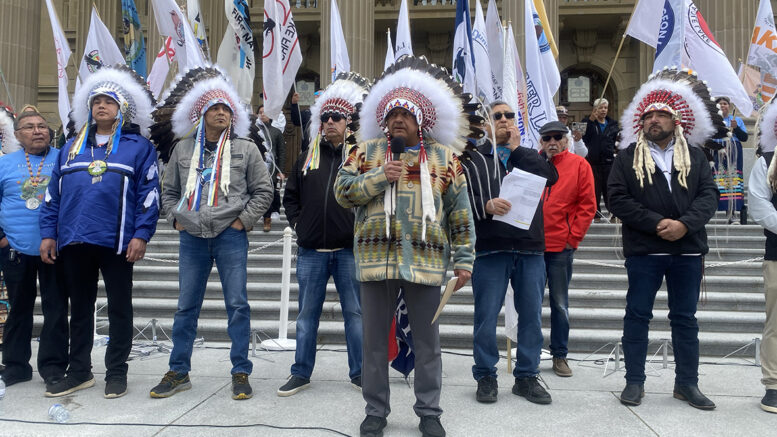
Chief Greg Desjarlais speaking at the First Nations Unity Rally held in Edmonton.

By Jeremy Appel, Local Journalism Initiative Reporter 

(ANNews) – Hundreds of people attended a rally that First Nations leaders from across Alberta organized at the Legislature in Edmonton to protest the premier’s ongoing separatist threats, which every speaker agreed would run roughshod over Treaty rights.

The May 15 event opened with drumming and a grand entry while Elders burned sacred herbs for smudging, followed by remarks from leaders representing Treaty 6, 7 and 8.

The protest was a way for Treaty First Nations in Alberta to present a united front in the face of Bill 54, which lowers the threshold for bringing forward a referendum. 

Premier Danielle Smith has said that she will hold a referendum on independence in 2026 if a petition in support of one gets enough signatures.
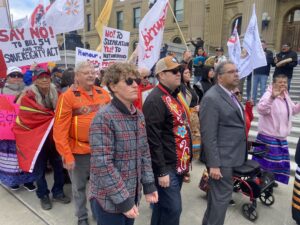
“Let us stand loud and clear and concise that no provincial government can hold a referendum to overturn our treaty,” Confederacy of Treaty 6 First Nations Grand Chief Greg Desjarlais told attendees. “We do not answer to the provincial government.”

Desjarlais, who is also the elected chief of Frog Lake First Nation, said he “took many arrows and many bullets, many from my own people” for meeting with Premier Smith about Bill 54, which he said was part of the confederacy’s “diplomatic” and “patient” approach to the separatist threat.

The meeting resulted in Justice Minister Mickey Amery amending the bill to say that no separation referendum question can threaten First Nations Treaty rights, which First Nations leaders dismissed as meaningless.

“Let me be clear, this push for Alberta separation is not just dangerous, it’s a violation of Treaty, natural law and the land itself,” said Desjarlais. 

Treaties 6, 7 and 8 were signed in 1876, 1877 and 1899, respectively, all before Alberta was established as a province in 1905. 

Treaty 8 Grand Chief Trevor Mercredi commented that the day’s display of unity “is what we’ve needed for a long time.”

“When our nations and our Treaty are threatened, we need to come together,” he added. 

“There’s no separation between the chiefs and the councils and our people. We are all Treaty people when it comes to our Treaty. Each and every meeting that we are attending is to protect our children.”

Grand Chief Mercredi emphasized that this includes non-Indigenous people as well. “If you’re in Alberta, in Canada, you are recognized as [part of the] Treaty,” he said. 

Representing Treaty 7 was Tsuut’ina Minor Chief Regena Crowchild, who spoke on behalf of Chief Roy Whitney. 

“Any attempt to undermine or infringe on our Treaty rights will be met with unwavering resistance,” said Crowchild, who emphasized that she hasn’t had any discussion “whatsoever” with the premier on Bill 54. 

“Defending our Treaty rights has always been a priority for me, and there are numerous examples of Tsuut’ina taking a strong stand against both federal and provincial actions that threaten those rights.”

Saddle Lake Cree Nation Chief Jason Whiskeyjack said it’s important to take the message “that we are stronger together” to the Legislature. 

“We have to celebrate who we are as a people, and when we do that the people are going to hear, not only here in this building but every Albertan in this Treaty 6, 7 and 8 territory. They need to be reminded that this is Treaty land. Everywhere they go is Treaty land,” he said. 

“There’s a lot of people wanting to separate. That’s fine. They could just leave.”

Chief Wilfred Hooka-Nooza of Dene Tha’ First Nation in Treaty 8 said that attendees were gathered “not as protesters, but as guardians of a promise older than the province of Alberta itself.”

“Our Treaties are not relics. They are not documents to be shelved and forgotten,” Chief Hooka-Nooza added. “They are living, breathing commitments. They are a promise of coexistence, mutual respect and shared responsibility to this land we call home.”

In addition to band leaders, Indigenous NDP MLAs Brooks Arcand-Paul of Alexander First Nation and Jodi Calahoo Stonehouse of Michel First Nation were at the event, as was independent MLA Scott Sinclair, who is non-status First Nation.

Also in attendance were Alberta NDP Leader Naheed Nenshi and several other NDP MLAs, Edmonton Mayor Amarjeet Sohi, and former deputy premier Thomas Lukaszuk, as well as Alberta Federation of Labour president Gil McGowan and secretary treasurer Cori Longo.

First Nations criticism of Danielle Smith goes national
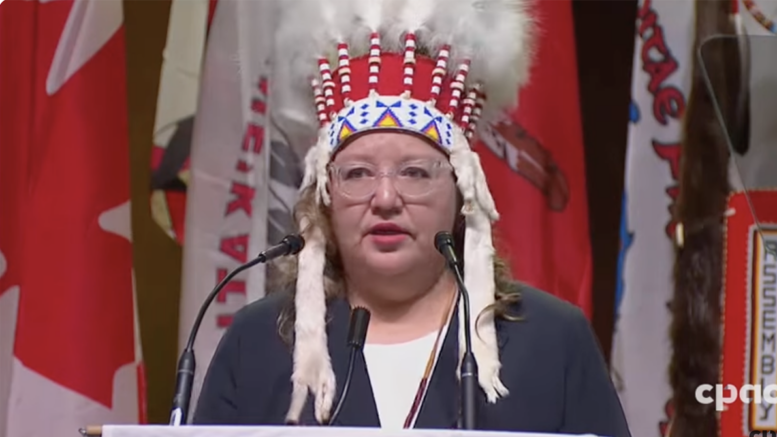
AFN National Chief Cindy Woodhouse Nepinak.

By Jeremy Appel, Local Journalism Initiative Reporter

(ANNews) – The national advocacy organization for Treaty First Nations has joined the chorus of First Nations telling Alberta premier Danielle Smith that a referendum on Alberta independence would be illegitimate without consulting the land’s original inhabitants.

“Any proposed separation of Alberta from Canada would be fundamentally illegitimate and unconstitutional without the explicit, prior, informed and collective consent of the First Nations whose lands and rights predate the formation of the province and of Canada,” Assembly of First Nations (AFN) National Chief Woodhouse Nepinak said in a May 12 news release.

 “The time has come for Alberta and Canada to move beyond colonial frameworks and honour the truth of their history by restoring justice and self-determination to First Nations.”

On May 5, Smith announced that she will chair a panel that will develop proposed policies to increase Alberta’s economic independence from Ottawa, which she promised will be put to a referendum next year. 

She added that she has no intention of initiating an independence referendum, but that if a group of citizens get the required number of signatures, it will also be on the ballot in 2026. 

A week earlier, Justice Minister Mickey Amery introduced legislation that will lower the number of signatures required for a citizen-initiated referendum, in addition to extending the amount of time organizers have to collect the signatures.

In response to these gestures, the AFN is asking the federal government to review the Natural Resources Transfer Agreement (NRTA)—a nearly century-old arrangement that transferred possession of Crown lands and natural resources to Alberta, Saskatchewan and Manitoba without First Nations’ consent. 

Woodhouse Nepinak emphasized that the NRTA violates the Treaties the federal government signed with First Nations in the three Prairie provinces, as well as sec. 35 of the Canadian Charter of Rights and Freedoms, which upholds “existing aboriginal and treaty rights of the aboriginal peoples of Canada,” including First Nations, Métis and Inuit Peoples. 

“The numbered Treaties, including 6, 7 and 8, did not surrender First Nations title to natural resources,” the national chief added. 

“On the contrary, these agreements recognize the inherent rights of First Nations to manage and benefit from lands and waters within their territories. Unilateral imposition of the NRTA undermines the solemn promises of these treaties and stands in direct conflict with the Honour of the Crown.”

The chiefs of Treaty 8 First Nations of Alberta left the AFN in 2022, opting to advocate for their Treaty rights directly with the federal government.

On April 30, Chief Sheldon Sunshine of Sturgeon Lake Cree Nation in Treaty 6 and Chief Billy-Joe Tuccaro of Mikisew Cree Nation in Treaty 8 co-wrote a cease-and-desist letter to Smith calling on her to stop making “separatist threats.”

“The province has no right to supersede or interfere with our Treaties, even indirectly by passing the buck to a ‘citizen’ referendum,” wrote chiefs Sunshine and Tuccaro.

The chiefs wrote an additional letter to Prime Minister Mark Carney asking him to “get the province of Alberta in line.”

Chiefs from Treaty 6, 7 and 8 First Nations in Alberta held a joint May 6 emergency meeting in Edmonton to discuss a unified response to Smith stoking the fires of separatism. 

At the meeting, Chief Ouray Crowfoot of Siksika First Nation in Treaty 7 said that the premier’s “rhetoric is not just an attack on First Nations, it is an attack on the people who call Alberta home.”

“You only have to look south of the border, at the chaos and uncertainty that is going on in the world. This time, more than any time, we should be bonding together and talking about how we are going to unite as a nation versus separation as a province,” said Chief Crowfoot. 

Speaking at a May 1 meeting with the Assembly of Manitoba Chiefs, AFN National Chief Woodhouse Nepinak noted that this isn’t the first time First Nations leaders have had to assert their rights in the face of separatist threats, referring to Quebec’s 1995 succession referendum, which narrowly failed. 

“You can’t do it. All of Canada is Treaty territory,” she said. “First Nations were here first. We welcomed people to our shores. We welcomed people with open arms.”

“But at the same time, if people aren’t happy in this beautiful country that we’re building together, then you’re free to go and live wherever you want,” Woodhouse Nepinak added to applause from the Manitoba chiefs. 

“You can take the dirt that maybe your ancestors brought with them when they came over here from other places. That’s the only piece of land that you’re going to take. You’re not going to take any Treaty land.”


RFK Jr. Calls Ultra-Processed Foods a “Genocide” Against Native Americans in Congressional Testimony

You can’t impose solutions on us and call it support,” Haaland said. “Real partnership starts with listening.”

Yahoo News


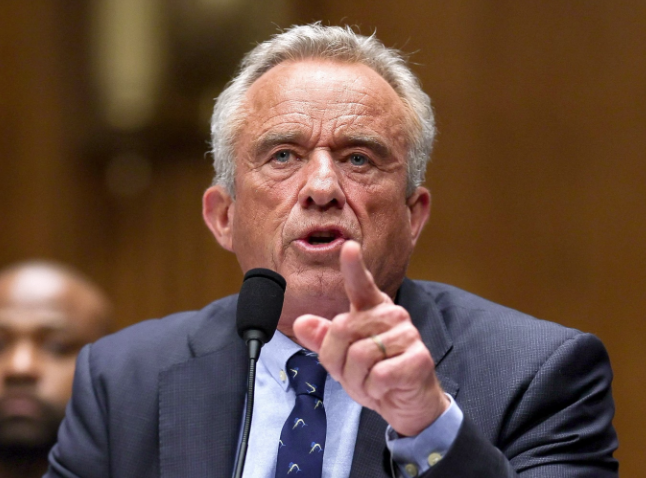
U.S. Health and Humans Services Secretary Robert F. Kennedy, Jr. making testimony before the House Appropriations Committee on May 14. (Photo/Screenshot)


By Levi Rickert
 May 16, 2025

During a May 14 hearing before the House Appropriations Committee, Health and Human Services Secretary Robert F. Kennedy Jr. described the widespread distribution of ultra-processed foods in Native American communities as a form of “genocide,” drawing national attention to long-standing health disparities affecting Indigenous populations.

Kennedy’s remarks centered on the health crisis linked to federal food assistance programs on tribal lands—programs that often prioritize cheap, processed items over nutritious, culturally appropriate foods. Citing the dramatic health decline among the Pima people of Arizona, Kennedy underscored the connection between poor nutrition and chronic diseases devastating Native communities.

“We’re feeding people food that we know causes obesity, diabetes, kidney failure, and heart disease,” Kennedy said. “And we continue doing it decade after decade. That is genocide.”

Kennedy referenced the Pima as a case study. Once known for their robust health and active lifestyles, the Pima who reside on U.S. reservations now face a life expectancy between just 47 and 53 years—decades shorter than the national average of 74.8 years. In contrast, Pima communities across the border in Mexico, who maintain more traditional diets, experience longer lives and significantly lower rates of diabetes and obesity.

This stark difference, Kennedy argued, illustrates the devastating health impact of industrialized food systems imposed on Native communities.

During his testimony, Kennedy called for comprehensive reforms. These include revamping federal nutrition programs, increasing access to traditional and locally grown foods, and strengthening support for Indigenous-led health initiatives. He also committed to prioritizing funding for the Indian Health Service (IHS), which remains chronically underfunded and understaffed.

“If we want to talk about justice, we must start by returning autonomy over health and food back to Native people,” Kennedy said.

Despite his promises, Kennedy has come under fire from tribal leaders and Native health advocates for contradictory actions. The administration recently cut $32.5 million in funding for the CDC’s Healthy Tribes program, which supported chronic disease prevention and traditional medicine. Over 30 positions were eliminated, including 11 directly linked to tribal initiatives.

For many Native leaders, these cuts undermine Kennedy’s words and raise questions about the federal government’s commitment to fulfilling its trust and treaty obligations.

Kennedy’s strong rhetoric has sparked a range of reactions across Indian Country. Some welcome the attention to long-ignored health disparities, while others remain skeptical. Former Interior Secretary Deb Haaland, a tribal citizen of the Laguna Pueblo, criticized the decision to reassign top HHS officials to tribal areas without consultation, calling it a failure of government-to-government respect.

“You can’t impose solutions on us and call it support,” Haaland said. “Real partnership starts with listening.”


A 250-year plan is in the works to protect Okanagan-Similkameen watersheds

A quarter-millennium is a long way into the future — but for syilx Okanagan leaders, it’s essential to protecting everyone’s siwɬkw (water) for generations
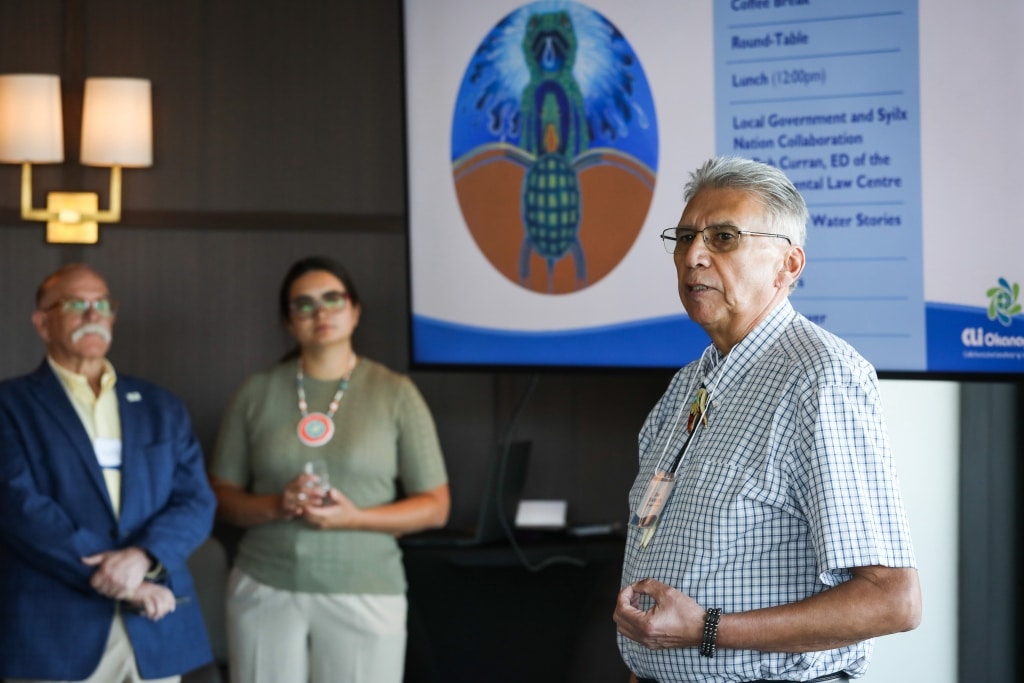
y̓ilmixÊ·m (Chief) Dan Wilson, of Okanagan Indian Band (right), speaks during the Okanagan Similkameen Collaborative Leadership Table’s April 24 meeting in the District of Lake Country, in syilx territory. Photo by Aaron Hemens
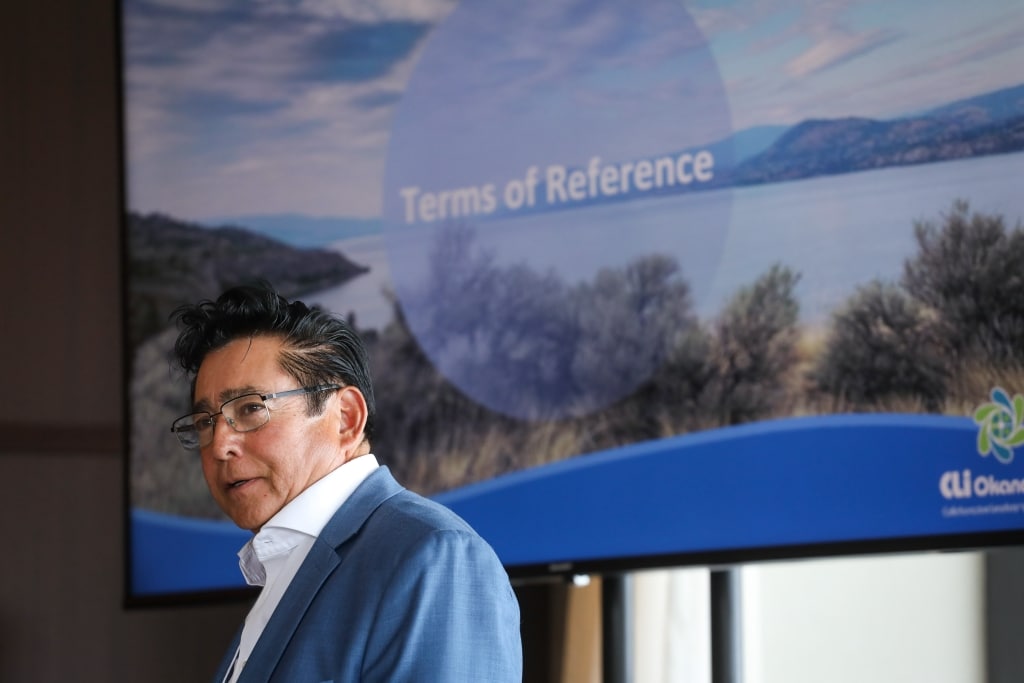
y̓ilmixÊ·m (Chief) Dan Wilson, of Okanagan Indian Band, speaks during the Okanagan Similkameen Collaborative Leadership Table’s April 24 meeting in the District of Lake Country, in syilx territory. Photo by Aaron Hemens

Early discussions have started about a quarter-millennium-long plan to protect siwɬkw (water) in the Okanagan-Similkameen region’s watersheds.

The early steps to creating a 250-year, multigenerational roadmap comes months after syilx Okanagan leaders and local government officials formally pledged to increase their water protection advocacy.

“The biggest thing will be communicating to our constituents that it’s about the fish, it’s about this place, it’s about us, it’s about our future,” said Tim Lezard, a councillor with the Penticton Indian Band.

“With the 250-year plan, those will be the goals … Some people don’t have that worldview.”

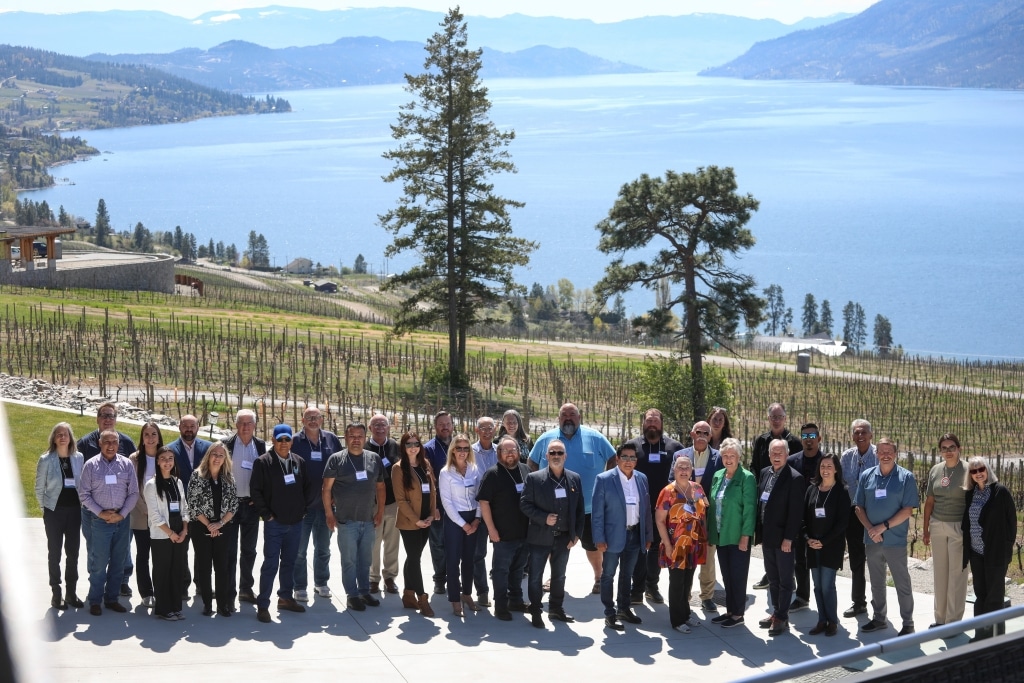
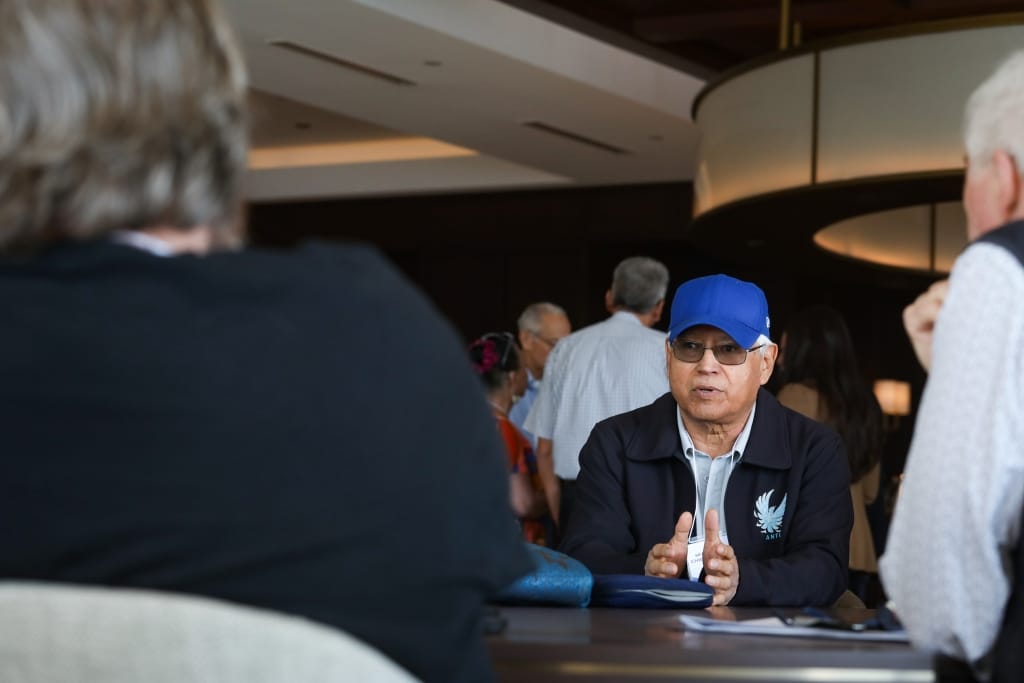
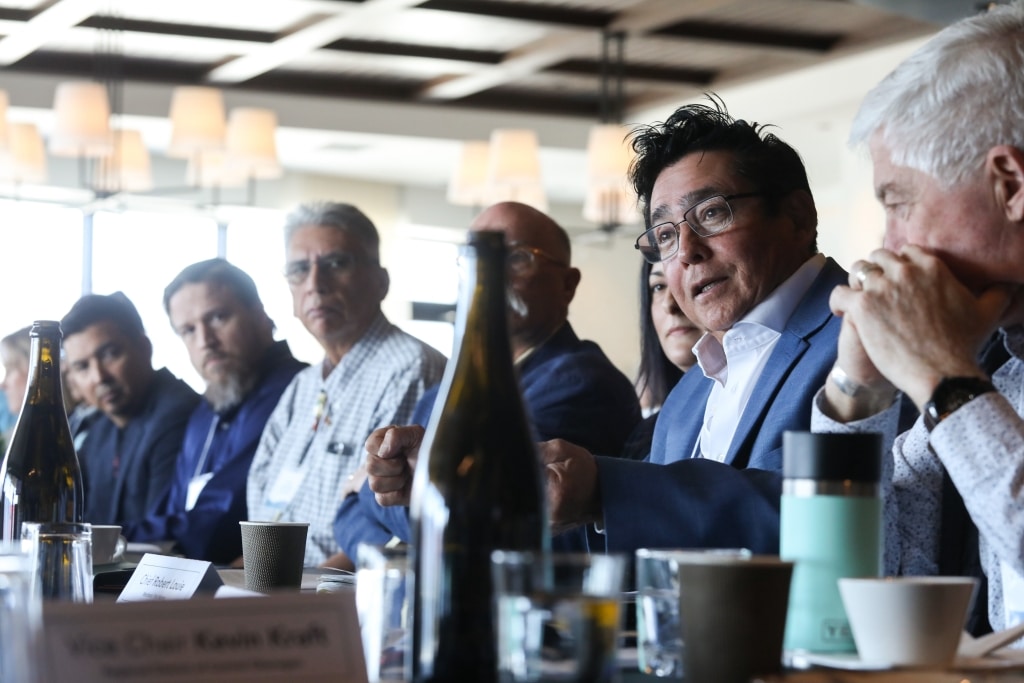
More than 20 members of the Okanagan Similkameen Collaborative Leadership Table gathered for a meeting in the District of Lake Country on April 24. The meeting brought together elected leaders from the syilx Okanagan Nation, municipal governments, and regional districts.

Members of Okanagan Similkameen Collaborative Leadership Table during their April 24 meeting in the District of Lake Country, in syilx territory. Photo by Aaron Hemens

Protecting watersheds, protecting everyone’s future

It was the group’s fifth formal meeting since 2023, and their first since signing a memorandum of agreement (MOA) last November, which solidified their commitment to protecting the regional watersheds.

While the meeting aimed its sights seven generations into the future, leaders with leadership table also discussed immediate actions they could take as a collective to address ongoing water issues across their jurisdictions.

They hope a collaborative approach will lead to policies and legal structures towards the group’s long-term vision: to restore and conserve both regional waterways and the ecosystems that depend on them.

y̓ilmixÊ·m (Chief) simo Robert Louie, of Westbank First Nation, described the ambitious 250-year vision as “real” and “significant.”

“History is being made every time we meet,” he said during the April 24 meeting. “Every time we meet, we’re discussing the context of collaboration.

“How do we protect our watersheds? How do we protect our future? The only way we can do that is to work together.”

A view of kɬúsx̌nítkÊ· (Okanagan Lake) during the Okanagan Similkameen Collaborative Leadership Table’s April 24 meeting in the District of Lake Country, in syilx territory. Photo by Aaron Hemens

Various concerns about threats to siwɬkw in the region were raised during the meeting.

Okanagan Indian Band Chief Dan Wilson spoke about drinking water wells on reserve at Okanagan Lake’s north end — Inkumupulux (head of the lake) — that were “perfectly fine for generations” but are failing due to arsenic contamination.

The source of the highly toxic heavy metal in the contaminated wells remains unknown. 

Arsenic, which can cause cancer in people and wildlife, can be naturally occurring in groundwater, but normally in trace amounts — however, it can be deadly when released from industrial activities. 

It’s a concern that emerged after the 2021 White Rock Lake wildfire, which impacted the community.

“We find that really concerning,” Wilson said. “Because if it’s getting into the groundwater, it’s certainly getting into the lake as well.”

(According to the World Health Organization, “Contaminated water used for drinking, food preparation and irrigation of food crops poses the greatest threat to public health from arsenic.”)

Chief simo Robert Louie, of Westbank First Nation, speaks during the Okanagan Similkameen Collaborative Leadership Table’s April 24 meeting in the District of Lake Country, in syilx territory. Photo by Aaron Hemens

Meanwhile, multiple officials raised concerns about algae blooms threatening drinking water and the region’s waterways — from Kalamalka to Okanagan lakes. 

Blooms of blue-green algae, known as cyanobacteria, can produce harmful toxins that disrupt aquatic ecosystems and pose a risk to water quality — impacting the health of humans, wildlife and aquatic beings, according to Watersheds Canada

The Okanagan Basin Water Board said increased development and ingredients in products such as fertilizers can contribute to excessive algae growth.

“Wood Lake is really suffering, which flows into Kal Lake, and Kal Lake goes into Okanagan Lake,” said Blair Ireland, the mayor of the District of Lake Country.

He said in kiÊ”láwnaÊ” (Kelowna), “they’re already having algae problems there, when they thought that wasn’t going to happen.”

Hopes for improved farming practices

Other concerns officials raised in the meeting included harmful agricultural practices such as over-irrigation and the use of toxic chemicals.

The degradation of both waterways and fish habitats, as well as the loss of lake foreshore and stream ecosystems due to development, were also identified as regional issues.

Fifty-nine per cent of natural shoreline along Okanagan Lake has been lost, according to a 2016 Foreshore Inventory and Mapping (FIM) update report of the lake

Continued disturbances to the lake’s natural shoreline — caused by an increase in density and land use around the lake — could result in the direct loss of fish habitats, wildlife, ecosystem functions, and even risks to clean drinking water, the report concludes.

And since natural shorelines help filter runoff into the ground, losing more of them could increase both peak water flow and the likelihood of flooding.

Blair Ireland, the Mayor of the District of Lake Country, speaks during the Okanagan Similkameen Collaborative Leadership Table’s April 24 meeting in the District of Lake Country, in syilx territory. Photo by Aaron Hemens

“All you have to do is look along this foreshore in the Okanagan Valley — Kal Lake, Wood Lake, or anywhere,” Ireland said. “We are not doing a very good job of protecting our environment.”

Citing the example of Okanagan Lake — the area’s largest reservoir — Ireland added that every day, “someone is interfering with that in a way that’s not good for that lake.”

“If we really truly want to do something about it,” he added, “we gotta protect the foreshores.”

‘Multiple generations of messaging’ needed for plan to work

All members of the leadership table agreed there must be a public education campaign on the purpose of the group.

Such a campaign, they agreed, needs to include awareness-raising messages explaining why protecting and conserving water is more important than ever, given the threats. 

And it’s even more urgent because of more frequent droughts linked to climate change.

Officials agreed there must be ongoing educational discussions, relationship building, and policy changes within the agricultural sector to promote environmentally-friendly farming practices including water conservation. 

“All of the pesticides they put into the ground go into the water,” Lezard said. “We have to talk about those things.”

Meeting participants also stressed the need for a specific focus on Youth in the leadership table’s public messaging — so there can be opportunities for them to be involved in their educational and advocacy efforts.

“I think we need to start the educating of our children, and let them know we’re doing this for them,” Lazard said, “for their children, their grandchildren and great-grandchildren.”

Amanda Shatzko, director of the Regional District of North Okanagan, called for “multiple generations of messaging.”

“As much as we’re educating ourselves and educating the other adults, we’re trying to protect this area for future generations,” Shatzko said. 

“If you want people to buy in, you often need to get children involved — you need them to understand, because they’re really good influences to their parents and families.”

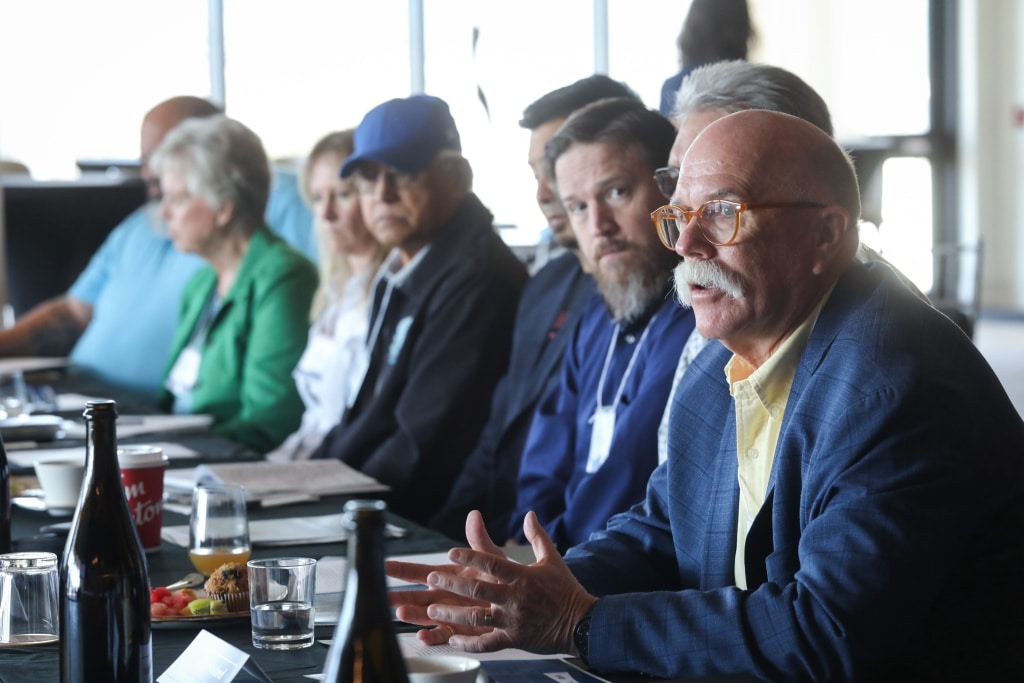
Members of the Okanagan-Similkameen Collaborative Leadership Table participate in discussions during the group’s April 24 meeting in the District of Lake Country, in syilx territory. From left to right: Tim Roberts, regional district of Okanagan-Similkameen; Jason Wiebe (background), Mayor of Keremeos; Tim Lezard (foreground), Penticton Indian Band councillor; Petra Veintimilla, Town of Oliver councillor; and Julius Bloomfield, Mayor of Penticton. Photo by Aaron Hemens

‘Traditional knowledge can help all of our ways of being’

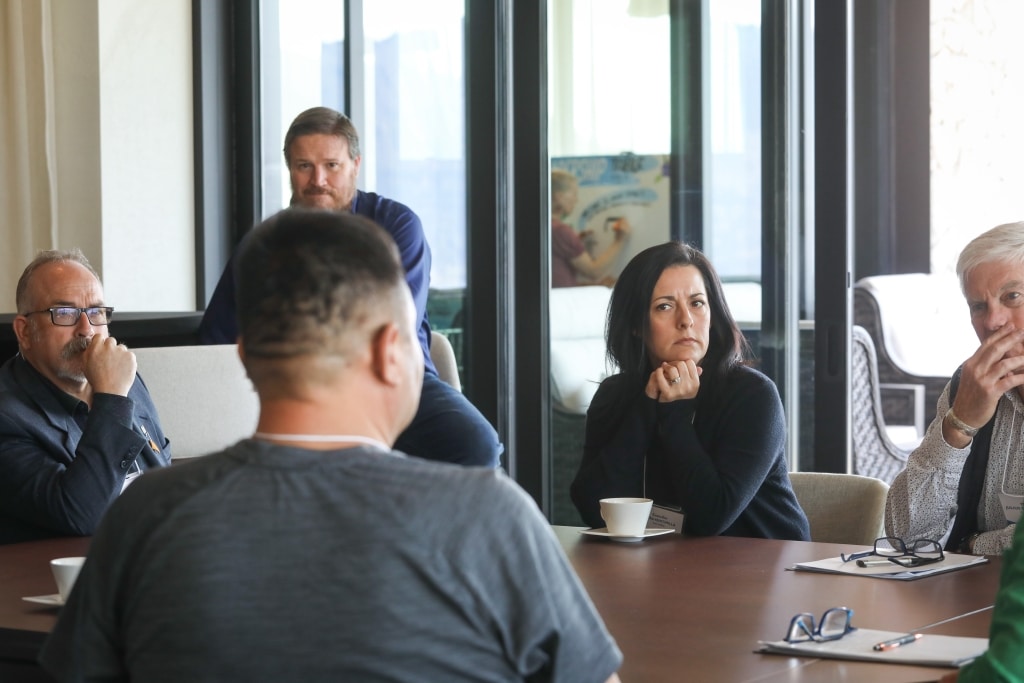
During the meeting, members split off into smaller groups based on their regions — North Okanagan, Central Okanagan and South Okanagan-Similkameen — to brainstorm different collaborative strategies each would work on.

In addition to more public education about the importance of clean water, other action items from the meeting included collecting water samples and developing a water quality database; inviting graduate students to participate in water data research; restoring creeks and fish habitats; and educating based on syilx knowledge and values around water. 

Jordan Coble, a councillor with Westbank First Nation, said it’s crucial the leadership table develop relationships and build trust with syilx Knowledge Keepers.

That way, they can come to a place where Knowledge Keepers are more comfortable educating others and helping to “dispel the reluctance, help dispel the denialism” among the public.

“Understanding that traditional knowledge can help all of our ways of being,” Coble said. “It isn’t just for us as Okanagan people — it’s for everybody to be able to live, breathe, work and play in the same area.”

He made his comments after another participant shared an anecdote about a farmer in the Similkameen whose peach trees washed away when a creek flooded in 2018. 

The farmer had removed black cottonwood trees and shrubs along the creek — which in the natural ecosystem maintain the integrity of the creek banks and absorb potential flood waters — and instead planted peach trees in the cottonwoods’ place.

Coble said that, according to syilx traditional knowledge, the cottonwood “in and of itself can help bring water” to dry landscapes — and help retain that water, too.

He cautioned others planting orchards to reconsider removing trees along riverbanks.

“It might be in your best interest — because water’s gonna cost a lot of money these days — to actually keep those trees,” he said, “to help maintain that water preservation that you need for food growth.”

Chief Greg Gabriel, of the Penticton Indian Band, speaks during the Okanagan Similkameen Collaborative Leadership Table’s April 24 meeting in the District of Lake Country, in syilx territory. Photo by Aaron Hemens

Working together to balance economy with ecology

Participants suggested the group use the syilx Nation’s Four Food Chiefs as a guiding model in their approach to internal consensus-building and decision-making — a model Westbank First Nation already uses across their governance structures, Louie said.

He said Chief skÉ™mixst (Black Bear) represents governance; Chief ntyxtix (Spring Salmon) represents the economy; Chief spʼiÆ›̕É™m (Bitter Root) represents the land; and Chief siyaÊ” (Saskatoon Berry) represents the community.

“You have to be mindful of the land — which includes the waters,” Louie explained. “We have to be mindful of the economic aspects of it.”

And while it’s important to have governance processes clearly designated to achieve results, he said, all members of the broader community must also be front of mind.

”We’ve got to be mindful of the community — all of the constituents, the people who live in this valley and who we represent.”

One of the challenges, he said, will be striking a balance between the four values, particularly between protecting water and maintaining the economy.

“We need education, we need acceptance of the need for protecting the water and conservation,” he said. “But you have to balance it with the right to survive and make money in some cases with agriculture.

“That’s the mindset that we’ve gotta be respectful of and mindful of — sometimes, it may simply take education and understanding, and then you’ve got acceptance. Then you work together to find solutions.”

A duty and responsibility to plan ahead

Meeting attendees agreed to gather three times a year, with the next meeting scheduled for November in the Similkameen Valley.

Deborah Curran, of the University of Victoria’s Environmental Law Centre, shared with participants several examples of long-term planning and collaboration between Indigenous nations and municipalities in “B.C.”

She encouraged local governments to “think about their existing operations, planning and approvals processes in the context of syilx authority.”

West Kelowna Mayor Gord Milsom attended the meeting as an observer, as the city’s council has yet to fully commit to the leadership table. He said his council “needs more time to understand” the group’s terms of reference “and get educated.”

y̓ilmixÊ·m (Chief) simo Robert Louie, of Westbank First Nation (right), speaks during the Okanagan Similkameen Collaborative Leadership Table’s April 24 meeting in the District of Lake Country, in syilx territory. Photo by Aaron Hemens

As was the case with the MOA signing, there was no representation from the City of Kelowna at the leadership table’s latest meeting, despite the municipality being the largest in the Okanagan-Similkameen.

Louie said the leadership table has more work to do in providing support and information to municipalities like Kelowna to encourage them to join.

“We’re not giving up one or the other’s jurisdiction,” he emphasized. “We’re not treading on issues of the other.

“That’s not the purpose of why we’re here; we’re here because we have to be here. It’s our duty — it’s our responsibility to be here.”

Chief Greg Gabriel, of Penticton Indian Band, reminded the leadership table that the group “carries a lot of influence,” and that “they can make a change.”

“That message needs to go out to the ones that are not here,” said Gabriel.

syilx Nation member qÊ·É™qÊ·im̓cxn Tessa Terbasket — one of main leads on the leadership table’s co-ordination team and watershed responsibility planning process — said from now until November, they will focus on community-engagement, relationship-building, educating, and getting more Youth involved. 

Along with co-lead Scott Boswell, of Okanagan Collaborative Conservation program, Terbasket said they’ll be preparing an outline for the 250-year watershed responsibility plan to be shared with the rest of the leadership table in November. 

She said she has “so much hope” for the leadership table as it moves forward, too.

“Water really moves — it’s interconnected. It’s ancient,” said Terbasket, head of the Okanagan Nation Alliance’s Water Strategy. “It connects us through the generations, it’s always moving forward.”


Author

AARON HEMENS, LOCAL JOURNALISM INITIATIVE REPORTER


Aaron Hemens is an award-winning photographer, journalist and visitor in unceded syilx Okanagan territory. He is Filipino on his mom’s side, and has both French and British roots on his dad’s. As a settler, he is committed to learning and unlearning in his role as Storyteller for the Okanagan region, and to accurately and respectfully tell stories of Indigenous Peoples throughout the area. Aaron’s work is supported in part with funding from the Local Journalism Initiative in partnership with The Discourse and APTN.