Saturday, May 17, 2025


Borsa Istanbul leads world markets in dollar-basis losses

Borsa Istanbul leads world markets in dollar-basis losses
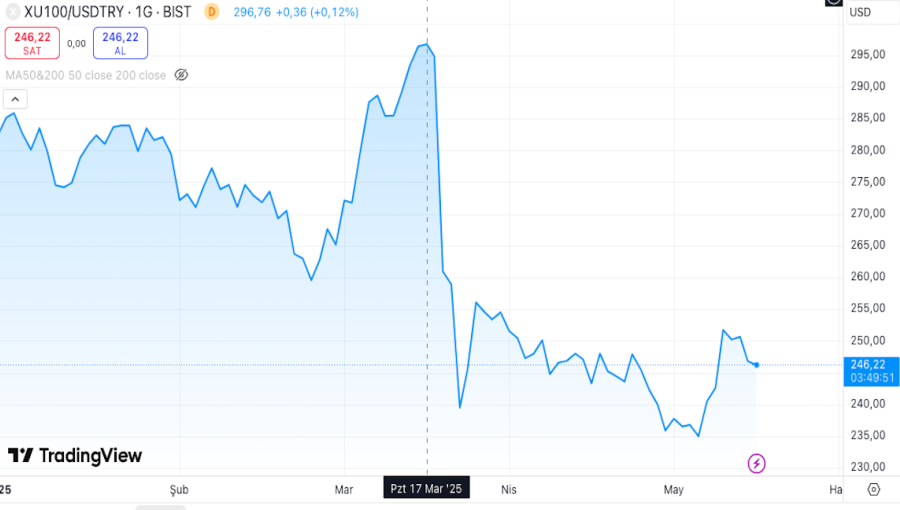
Turkey disqualified the university degree of Istanbul mayor Ekrem Imamoglu on March 18 and jailed him on March 19. The graph shows Borsa Istanbul’s benchmark BIST-100 index, USD-denominated. / TradingView
By Akin Nazli in Belgrade May 16, 2025

Turkey’s exchange-traded fund (ETF) was down 9.5% in the year-to-date on a USD-basis as of May 13, according to data compiled by Charlie Bilello (@charliebilello) of Creative Planning.

So far this year, only four equity markets have posted a loss on a USD-basis. Thailand's stock exchange was closest to Borsa Istanbul for poor performance with a loss of 6.5%, followed by Indonesia with a 5.1% loss and Saudi Arabia with 1.3%.

Table: Global equity ETF returns, USD-basis, y-t-d, as of May 13.

Trump, the loser

The US continues to have one of the worst performing markets in the world, while out in front are Eurozone stocks with a 22% y-t-d return, Bilello noted in a blog post.

Due to the tariffs noise and disruption created by Donald Trump, the US Federal Reserve is expected to keep its key rate on hold on June 18. Such an outcome would be its fourth consecutive decision to hold since December.

The European Central Bank (ECB) looks set, meanwhile, to deliver another 25-bp cut at its next rate-setting meeting to be held on June 5.

Turkey, the outlier

Prior to its May 2023 elections, Turkey employed an ultra-loose monetary policy, while the world, at the same time, was tightening rates to overcome inflationary impacts of the COVID-19 easing.

Since after the elections, Turkey has been tightening while the world has been easing.

Foreign investors, meanwhile, show almost zero interest in the Borsa Istanbul.

Chart: So far this year, foreign investors have sold $182mn worth of Turkish stocks online.


Slow Kazakhification of Russianised lands falls flat in Kazakhstan’s north

Slow Kazakhification of Russianised lands falls flat in Kazakhstan’s north
Big welcome, meagre reward. / Faizulin Rustam Faritovich, cc-by-sa 4.0]]]Feedly
By Emma Collet in Petropavlovsk May 15, 2025

In the city centre of Petropavlovsk, Qasym Amangeldi cuts his customer's hair in his second barbershop, which he opened several months ago in this North Kazakhstan Region city. Originally from Shymkent, in the very south of the country, he moved to Petropavlovsk, the regional capital located 20 kilometres (12 miles) from the Russian border, seven years ago. “It's easy to start a business here: there's almost no competition! And the government can even provide financial assistance,” says the young entrepreneur, who now employs around a dozen people. 

Just like him, about 10,000 Kazakhs from the south of the country are encouraged to migrate to the north every year. Originally from the Almaty, Zhambyl, Mangistau, Turkestan and Kyzylorda regions, they are eligible for state financial assistance if they choose to settle in one of the northern regions of North Kazakhstan, Kostanai, Pavlodar, Karaganda, Akmola and East Kazakhstan.

Initiated in 2017, the programme, known as “Enbek” ( “Work” in Kazakh), issues “economic mobility certificates”. A certificate entitles the holder to 270,000 tenge (around $510) per person and housing support for the first five years of up to 50% of rent. “Enbek” supplanted the first state scheme, “Serpin”. Set up in 2014, it was specifically designed to encourage students from the south to study in the north.

Officials need people to help revitalise the economy in the north. It is collapsing year by year. “The northern regions of Kazakhstan have a low birth rate and a high death rate,” writes Kairat Bodauhan, associate professor at the Kazakh S. Seifullin Agro-Technical University in Astana, and head of a demographic study of the country's northern regions.

Petropavlovsk, sometimes called Petropavl, is located just 20 kilometres (12 miles) from the Russian border (Credit: NordNordWest, cc-by-sa 3.0 de).

On the contrary, the southern regions are overpopulated, with high unemployment. Bodauhan points to Turkestan region, which has over two million inhabitants, i.e four times as many as North Kazakhstan. 

“According to demographic forecasts, by the 2050s, the population of northern Kazakhstan could fall by as much as 30%,” notes Bodaukhan. 

In North Kazakhstan region, 5,000 people leave the territory every year. Young people there generally prefer to study in the big Kazakh cities of Almaty and Astana, or in the higher-income Russian cities of Tyumen, Omsk and Chelyabinsk, located near the border.

In 2024, the programme permitted 3,144 Kazakhs to resettle in the north, including 175 “qandas”, ethnic Kazakhs from abroad. They, too, are targeted by the government for priority settlement in northern locations.

Such was the case of Najib and Makhtap Gazak, an ethnic Kazakh couple from Iran. They settled in a village an hour and a half's drive from Petropavlovsk. With their four children, they now live through -30 degree winters and raise livestock. 

“We'd rather have gone to Mangystau, the historic land of my ancestors [in southwest Kazakhstan]. But there, relocation assistance programmes were less advantageous”, says Najib Gazak, in his small living room in a home on a housing estate built especially for new arrivals in the north, where all the houses look alike.

Despite somr slight year-on-year gains, in over 10 years, the programmes have failed to reverse the north’s demographic trend. “We have to admit that the voluntary resettlement programme from the south to the north has not produced the expected results,” acknowledges President of the Senate Maulen Ashimbaev. “We hope that the new law on migration will provide new incentives to increase labour mobility”.

Local administrations are trying to redouble their efforts. They are carrying out precise communication operations in the south, such as an offer of “bus tours for 500 people from Zhambyl region to visit tourist attractions in northern Kazakhstan made last summer,” says Arman Turegeldin, director of the “Enbek” programme in North Kazakhstan. “The aim is to show them that it's beautiful here too!”

To the settler, the north is often not short on beauty, but it is short on opportunity. A scene in Kokshetau National Park, an "island" of forests, lakes, and mountains surrounded by steppe, in North Kazakhstan and Aqmola Regions (Credit: Natgeokz, cc-by-sa 4.0).

Nature may be beautiful in the north, but the climate, and mentality, are a big change on what is encountered in the south.

Petropavlovsk, with its harsh winter climate and tsarist architecture, is a radical change of atmosphere for southerners. As is the composition of the population: here, 40% of people are ethnic Russians, who are descended from the Russians who settled in Kazakhstan at the time of colonisation. Three regions in the north have a near-majority of Russian-Kazakhstanis, even though they represent only 15% of the country’s overall population.

View of Petropavlovsk's Podgora district (Credit: Euro monitor lizard, cc-by-sa 4.0).

The Kazakhification of these regions with Kazakh-speaking arrivals appears to be an implicit objective of the relocation programmes. “The government knows it's not good to have a Russian-speaking population on its border with Russia,” observes Rustem Armanov. Working as a doctor, he also heads a project documenting the lives of relocatees in his native region, where the Kazakh language is least mastered in terms of the national population.

Armanov notes that the spread of pro-Russian opinions and actions in the north has accelerated since the full-scale invasion of Ukraine that Russia went ahead with in February 2022. In March 2023, a group of Russians from Petropavlovsk declared “their sovereignty and independence from the Republic of Kazakhstan”. This was reminiscent of the emergence of separatist movements of Russian origin in eastern Ukraine in 2014.

The  authorities try to nip in the bud any strong desire for pro-Russian separatism, aware that the northern regions are largely economically dependent on Russia. The construction of three thermal power plants in northern Kazakhstan signed for in 2023 will accentuate Kazakhstan's energy ties with Moscow for many years to come, while the Kremlin is also pushing for the supply of Russian gas to northern Kazakhstan, most of which would ultimately be routed to China.

However, local authorities deny any “politicisation of this resettlement programme”. “We don't discriminate against participants in the relocation programme: they can be ethnic Russians, Polonia, Ukrainians, Kazakhs..,” insists Turegeldin.

But from the relocatees' point of view, the Russian-speaking world of the north is a real obstacle to integration. “Many don't speak Russian when they arrive,” explains Qasym Amengeldi. He, however, has managed well with the language.  “And I learned how to drink!” he jokes.

Enbek state work and skills programmes and various NGOs haven't given up yet on making a go of the "great migration to the north", but the odds on a successful outcome are very long (Credit: government handout).

A Kazakh influencer, Burahan Daqanov, is campaigning for more people from the south to populate the northern plains. “These are our ancestral lands,” says this native of the Almaty region, who decided to settle in Petropavlovsk in 2021 with his family. To his hundreds of thousands of subscribers on TikTok and Instagram, he extols the merits of Kazakh-style living in the north, which he sees as unjustly dying out.

With his NGO “Tauqel”, the long-bearded influencer knows how integration is difficult, and would like to open a centre so that relocated people can live together and better fit into local life, without leaving just a few months after settling in, as is common. About 10% leave before the end of their resettlement contract, says Turegeldin, who sees such people as not having made enough effort.

But for social workers working with relocatees, that lack of effort is not for lack of will. Anuar Tokpanov, coordinator of the Rukh Til Zhangyru center, an organisation that helps qandas integrate, remarks that he “wouldn't say we give them a lot of money. At the centre, we have to provide them with warm clothes so they can survive the winter”.

The houses in villages reserved for arrivals are often prefabs, sometimes not resistant enough to the freezing temperatures of the long winter that takes a hold on northern Kazakhstan, as several Kazakh media have reported.

 “It has to be said that our region has the lowest wages in the republic,” says Tokpanov. The average wage is 262,248 Kazakh tenge (almost $500).

For Aiman Zhussupova, project coordinator on social studies at the Institute of World Economics and Politics in Almaty, the very essence of the programmes doesn't work. The sociologist, who last year conducted a large-scale study on south-north migration, says: “We're moving poor people who are unemployed, to regions where they'll be poor. We don't listen enough to the reasons why they leave.”

The great remigration to the north of the country has yet to prove itself. 
 

Banksy Famed Warehouse Wall Heart Art To Support Heart Health

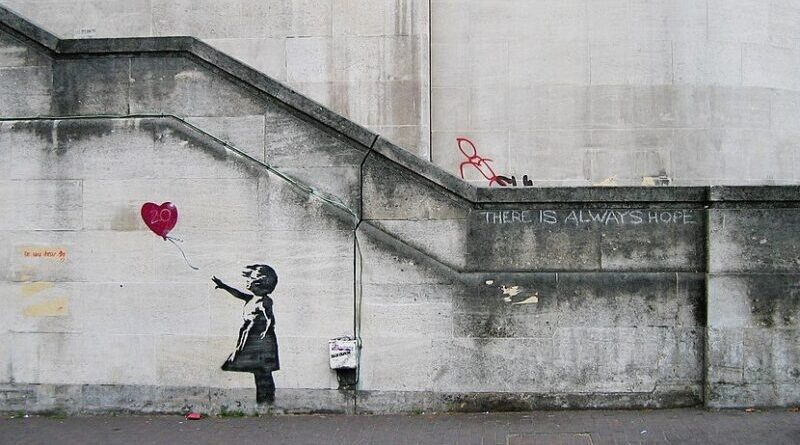
Original mural of "Balloon Girl" by Banksy on Waterloo Bridge in South Bank in 2004. Photo Credit: Dominic Robinson, Wikipedia Commons.


By 

A striking Banksy artwork—a red heart-shaped balloon covered in bandages—will soon find a new home. This unique Banksy, a famed street artist known for stenciled works that blend dark humor with political and social commentary, is a 7,500-pound section of a Brooklyn warehouse wall. Following a public viewing the wall will be auctioned by Guernsey’s, an auction house for extraordinary properties, on May 21, with proceeds benefiting the American Heart Association, devoted to changing the future to a world of healthier lives for all.


The piece was created in the fall of 2013. The then 59-year-old Vassilios Georgiadis, a Brooklyn warehouse owner, offered helpful advice to a passing van driver who later turned out to be Banksy. The elusive artist returned in the middle of the night to create the mural depicting a floating Mylar balloon on Georgiadis’ warehouse wall in the Brooklyn neighborhood, Red Hook. Shortly after its creation, rival artist “Omar NYC” defaced the piece by spray-painting over the heart and scrawling his own name in front of a live crowd. Countering that – and the only time he has ever been known to re-work his art – Banksy revisited the wall at the corner of King and Van Brunt streets and embellished it further.

“To me this powerful artwork is more than just street art—it’s a symbol of the millions of lives impacted by heart disease, our nation’s leading cause of death”, said Nancy Brown, chief executive officer of the American Heart Association. “As we continue our diligent and dedicated work to improve health for everyone, everywhere, we appreciate the support and generosity of the Georgiadis family. This donation will fund life-saving research, help us advocate for healthier communities and improve patient care.”

With Banksy’s bright red, heart-shaped balloon as the wall’s centerpiece, it was a sad coincidence when, just a few years later, Georgiadis passed away from heart disease. Honoring his memory, his family is generously donating a significant portion of the auction’s proceeds to the American Heart Association.

The Banksy artwork will be on public display at the Winter Garden at Brookfield Place, lower Manhattan at 230 Vesey St, New York, through May 21, culminating in the live auction. Guernsey’s will hold the auction live on location at the Winter Garden Atrium and online via LiveAuctioneers.com with proceeds benefitting the American Heart Association.


Eurasia Review

Eurasia Review is an independent Journal that provides a venue for analysts and experts to disseminate content on a wide-range of subjects that are often overlooked or under-represented by Western dominated media.


Tuning Light With Organoaluminium Chemistry

A new type of aluminum-based compounds that emit the light have been discovered. Compounds of this type have potential applications in optical electronics, such as in OLEDs by achieving maximum quantum efficiency. CREDIT: Source IPC PAS, Grzegorz Krzyzewski


By 

Artificial light, once a luxury, has become central to modern life, with its evolution spanning from fire to LEDs.

Now, researchers from the Institute of Physical Chemistry, Polish Academy of Sciences in Warsaw and Warsaw University of Technology led by Prof. Janusz LewiÅ„ski in collaboration with Prof. Andrew E. H. Wheatley from Cambridge University have developed a new class of efficient light-emitting materials as the promising candidates to be applied to lighten the darkness. They demonstrated easily accessible aluminium-based organometallic complexes that have the potential to be applied in optoelectronic devices. Let’s take a look closer at their recent studies. 

Growing demand for artificial light spurred the development of energy-efficient solutions like fluorescent lamps and, later, light-emitting diodes (LEDs). Once production costs dropped, LEDs became ubiquitous in homes and portable devices. Today, researchers pursue even more efficient technologies such as organic LEDs (OLEDs) and novel fluorescent materials. Fluorophores based on main-group metal complexes have attracted considerable interest in recent years, where their development is driven by the possibility of the practical potential application in optoelectronic devices, chemosensors or bioimaging. Aluminium, being abundant, lightweight, and conductive, is gaining attention as an alternative to rare or toxic metals. Since the breakthrough use of Alq3 (tris(8-hydroxyquinolinato)aluminium) in LEDs in 1987, aluminium-based complexes have been explored for their promising photophysical properties, particularly in OLEDs and light-emitting sensors. Nowadays, researchers are actively seeking novel and more efficient materials to enhance lighting technologies, and here the story begins…

Recently, researchers from the Institute of Physical Chemistry, Polish Academy of Sciences (IPC PAS) and Warsaw University of Technology led by prof. Janusz LewiÅ„ski in collaboration with Prof. Andrew E. H. Wheatley from Cambridge University, have developed a new class of highly-luminescent organoaluminium complexes. Drawing inspiration from earlier work and benchmark materials like Alq3, the researchers synthesized a new series unique tetrameric chiral-at-metal alkylaluminium anthranilates [(R′-anth)AlR]4 incorporating common anthranilates as a core ligand. These aluminium-based complexes demonstrate promising optoelectronic properties due to the coordination between the metal core and tailored ligands. “In this work, we focus on commercially available anthranilic acid (anth-H2) and its N- methyl (Me-anth-H2) and N-phenyl (Ph-anth-H2) derivatives, as model proligands. The reaction between each of these acids and appropriate R3Al compound in toluene has resulted in the formation of a series of aluminium-stereogenic tetranuclear complexes that happen to have unique properties.” – claims Vadim Szejko – the first author of presented work.

Comprehensive physicochemical studies, including detailed analysis of photoactivity, revealed that the aluminium-based anthranilates exhibit photoluminescence quantum yields of up to 100% in the solid state, enabled by their unique electronic structure and non-covalent interactions that stabilize excited states. Subtle ligand modifications were shown to significantly boost emission efficiency, opening new pathways for designing advanced photoactive materials. These findings contribute valuable insight into the still underexplored photochemistry of multinuclear complexes and their potential applications in optoelectronics.

“By changing the N-substituents from H to Me and Ph, we have developed a series of luminophores that exhibit poor-to-excellent performance, providing a [(Ph-anth)AlEt]4 derivative that achieves a unity photoluminescence quantum yield in the condensed phase, which is unprecedented foraluminium complexes.” – remarks Dr. Iwona Justyniak.

Quantum-chemical calculations provided insights into the nature of electronic transitions and identified specific fragments at the molecule level that most strongly contribute to the material’s photophysical properties. Ligand modifications suppressed unwanted relaxation pathways, enhancing emission efficiency. In the solid state, non-covalent intra- and intermolecular interactions help preserve structural integrity during excitation, minimizing distortions that would otherwise reduce fluorescence. Moderate molecular aggregation adds rigidity, supporting high luminescence.

The presented work is an important step forward the design of the novel, easily accessible effective fluorescent materials. The simplicity of the ligand framework modification offers the possibility of further upgrading of the system to achieve greater chemical stability and enables modulation of the optical properties which brings us closer to make it useful in practical applications, especially in technologies like OLEDs, display screens, and sensors.


Eurasia Review

Eurasia Review is an independent Journal that provides a venue for analysts and experts to disseminate content on a wide-range of subjects that are often overlooked or under-represented by Western dominated media.

By 

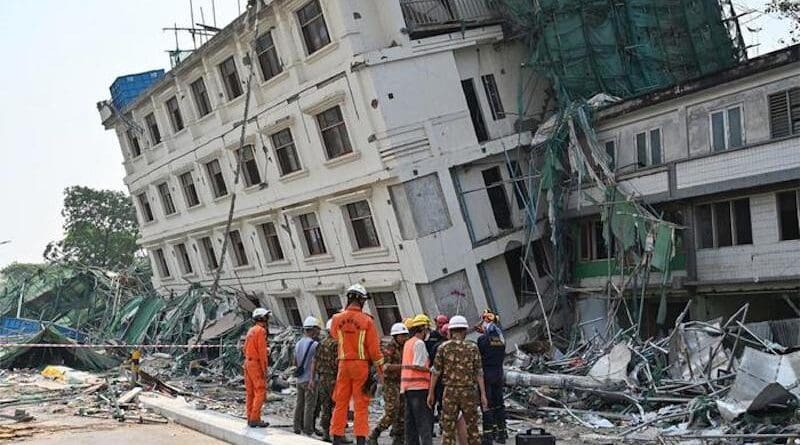
On March 28, 2025, a catastrophic earthquake of magnitude 7.7 struck central Myanmar, marking the most devastating seismic event in the region since 1912.


Originating along the Sagaing Fault — a 1,400-km-long dextral strike-slip boundary separating the Burma Microplate and Sunda Plate — the earthquake propagated a supershear rupture over 460 km with surface displacements exceeding 6 meters. The shallow (10 km depth) strike-slip mechanism unleashed violent shaking (Modified Mercalli Intensity IX) across densely populated urban centers, including Mandalay, Sagaing and Naypyidaw, while amplifying seismic energy in distant locations such as Bangkok, Thailand. The human toll was staggering over 4,900 fatalities and 6,000 injuries. Furthermore, widespread destruction of residential, governmental and religious infrastructure occurred.

Beyond immediate physical devastation, the event exposed systemic vulnerabilities in urban planning, historical preservation and transboundary disaster preparedness, underscoring the urgent need to reconcile rapid urbanization with seismic resilience.

In a multidisciplinary study published in the Journal of Dynamic Disasters, a team of researchers integrated seismic, geological and socio-economic analyses to examine the event’s mechanisms and consequences.

“Myanmar’s tectonic framework, shaped by the oblique convergence of the Indian Plate beneath the Burma Microplate at ∼35 mm/year, has long positioned the region as a hotspot for seismic hazard,” noted first author Khan Shahzada. “The Sagaing Fault, accommodating ∼20 mm/year of right-lateral motion, has generated recurrent large-magnitude earthquakes, including the 1930 (M 7.3), 1946 (M 7.7) and 1956 (M 7.0) events. However, the 2025 rupture uniquely highlighted cascading risks: its supershear velocity and extensive surface deformation triggered secondary disasters, from infrastructure collapse in Myanmar to high-rise failures in Bangkok’s soft-soil basins.”

Notably, a 33-story skyscraper in Bangkok collapsed, claiming 29 lives. These transboundary impacts underscore the interconnectedness of geophysical processes and human systems in South and Southeast Asia.

“By integrating fault models, historical seismicity records and on-ground impact assessments, we elucidated the relationship between tectonic dynamics and anthropogenic vulnerabilities,” adds Shahzada.

The report also critiques existing building codes, emergency response frameworks and heritage conservation practices. Based on the findings, the authors advocate for enhanced seismic monitoring, retrofitting of critical infrastructure and international collaboration in disaster risk reduction.

“As climate change and urbanization intensify exposure to natural hazards, the lessons from Myanmar’s catastrophe offer a critical blueprint for fostering resilience in tectonically active, rapidly developing regions worldwide,” says Shazda.


Eurasia Review

Eurasia Review is an independent Journal that provides a venue for analysts and experts to disseminate content on a wide-range of subjects that are often overlooked or under-represented by Western dominated media.


30 Years On, Rights Groups Press China For Word Of Tibet’s Missing Panchen Lama

Picture of Gedhun Choekyi Nyima before his abduction at 6 years of age (left), and a forensic image of him at 30 years of age (right), by Tim Widden. Credit: Wikipedia Commons


By 

By Tenzin Pema 


The Tibetan government-in-exile and rights groups have called on China to free the Panchen Lama, the second-highest spiritual leader in the largest sect of Tibetan Buddhism, who was kidnapped 30 years ago and has remained missing ever since.

“At just six years old, he was abducted by Chinese authorities — an act that remains one of the starkest examples of China’s grave human rights violations,” Tenzin Lekshay, spokesperson for the Dharamsala, India-based Tibetan exile government, known as the Central Tibetan Administration, told Radio Free Asia.

“We urgently call on the Chinese government to reveal the Panchen Lama’s whereabouts and ensure his well-being. As a spiritual leader and as a human being, he has the fundamental right to live freely and fulfill his spiritual responsibilities without fear or restriction,” Lekshay said. 

On May 17, 1995, just days after the Tibetan spiritual leader, the Dalai Lama, officially recognized Gedhun Choekyi Nyima as the 11th Panchen Lama, Beijing abducted the then-6-year-old boy with his family and teacher. 

Their whereabouts have remained unknown, despite repeated calls by global leaders for China to disclose information about the fate of the Panchen Lama who turned 36 last month


“30 years ago China disappeared a 6-year old boy because he represented freedom to Tibetan Buddhists facing brutal oppression. Today, we call for this horrible injustice to end and for China to free Gedhun Choekyi Nyima, the 11th Panchen Lama,” said Asif Mahmood, Commissioner at the U.S. Commission on International Religious Freedom (USCIRF).

The Washington-based International Campaign for Tibet (ICT) called on global governments and the international community to demand China free the Panchen Lama and reveal his whereabouts and well-being.

“The disappearance of the Panchen Lama and his family are the rule and not the exception in Tibet, where the Chinese government resorts to disappearance, torture, imprisonment … expulsion of monks and nuns from monasteries and nunneries,” said Tencho Gyatso, President of ICT.

“China’s actions of disappearing the rightful Panchen Lama and installing a fake Panchen, show they don’t respect religious freedoms or human rights in Tibet,” she told RFA.

Succession of the Dalai Lama

Rights groups say the Panchen Lama’s continued disappearance and China’s installation of another boy, Gyaltsen (in Chinese, Gyaincain) Norbu, in his place, highlights Beijing’s plan to control the succession of the Dalai Lama, given the two lamas have historically recognized the other’s successive reincarnations and served as the other’s teacher.

“The Chinese government kidnapped a 6-year-old and his family and have disappeared them for 30 years to control the selection of the next Dalai Lama and thus Tibetan Buddhism itself,” said Yalkun Uluyol, China researcher at New York-based Human Rights Watch. 

China says it can appoint the successor under Chinese law. In 2007, it decreed that the Chinese government would begin overseeing the recognition of all reincarnate Tibetan lamas, or “living Buddhas,” including the next incarnation of the Dalai Lama, for which China plans to use its own Beijing-appointed Panchen Lama to endorse.

“As the current 14th Dalai Lama will celebrate his 90th birthday on July 6, the question of his succession — and the future of Tibetan Buddhism and the Tibetan people — is becoming increasingly urgent,” Human Rights Watch said in a statement.

The Dalai Lama has said in a new book, that his reincarnation will be born in the “free world,” which he described as outside China. 

Experts say China’s appointment of Gyaincain Norbu as Panchen Lama underscores Beijing’s attempts to not only interfere in the selection of the next Dalai Lama, but also to project its soft power across Buddhist nations worldwide and gain control and legitimacy among Tibetans, both inside Tibet and in exile. 

“Abductions, surveillance, imprisonments and torture are standard tactics in China’s playbook of religious persecution,” said USCIRF’s Maureen Ferguson. She urged the U.S. Congress to prioritize religious freedom and ban any paid lobbying in the U.S. on behalf of the Chinese Communist Party.

The Chinese embassy in Washington did not immediately respond to RFA request for comment. 

Cultural and religious suppression

China annexed Tibet in the early 1950s and has since governed the territory with an oppressively heavy-hand while seeking to suppress expressions of their Buddhist faith, and erase Tibetan culture and language. 

“At a time when Chinese authorities are intensifying efforts to annihilate Tibetan culture and identity, the absence of the Panchen Lama is deeply felt. The 10th Panchen Lama played a vital role in safeguarding the Tibetan language, religion, and cultural heritage under Chinese rule,” said the exile government spokesperson Lekshay, referring to the previous Panchen Lama.

As a vocal critic of Chinese government policies in Tibet and their impact on Tibetan culture and language, the 10th Panchen Lama was subjected to house arrest in the 1960s and subsequent imprisonment for more than a decade, and torture in prison. He died in 1989 under mysterious circumstances.

One of the charges against him was that he had written, in 1962, a 70,000-character petition describing the destruction of Tibetan monasteries and suppression of the Tibetan people during and after the Chinese invasion of Tibet in 1950. The document had remained secret until obtained by Tibet scholar Robert Barnett, who revealed that Chinese leader Mao Zedong had condemned it as a “poisoned arrow shot at the party.” 

“His (the 10th Panchen Lama’s) voice and vision are profoundly missed in today’s Tibet,” Lekshay said.


RFA

Radio Free Asia’s mission is to provide accurate and timely news and information to Asian countries whose governments prohibit access to a free press. Content used with the permission of Radio Free Asia, 2025 M St. NW, Suite 300, Washington DC 20036.