Saturday, May 17, 2025


‘Inequality and infinite growth’: Canary Islands anti-tourism protests reignite amid record arrivals

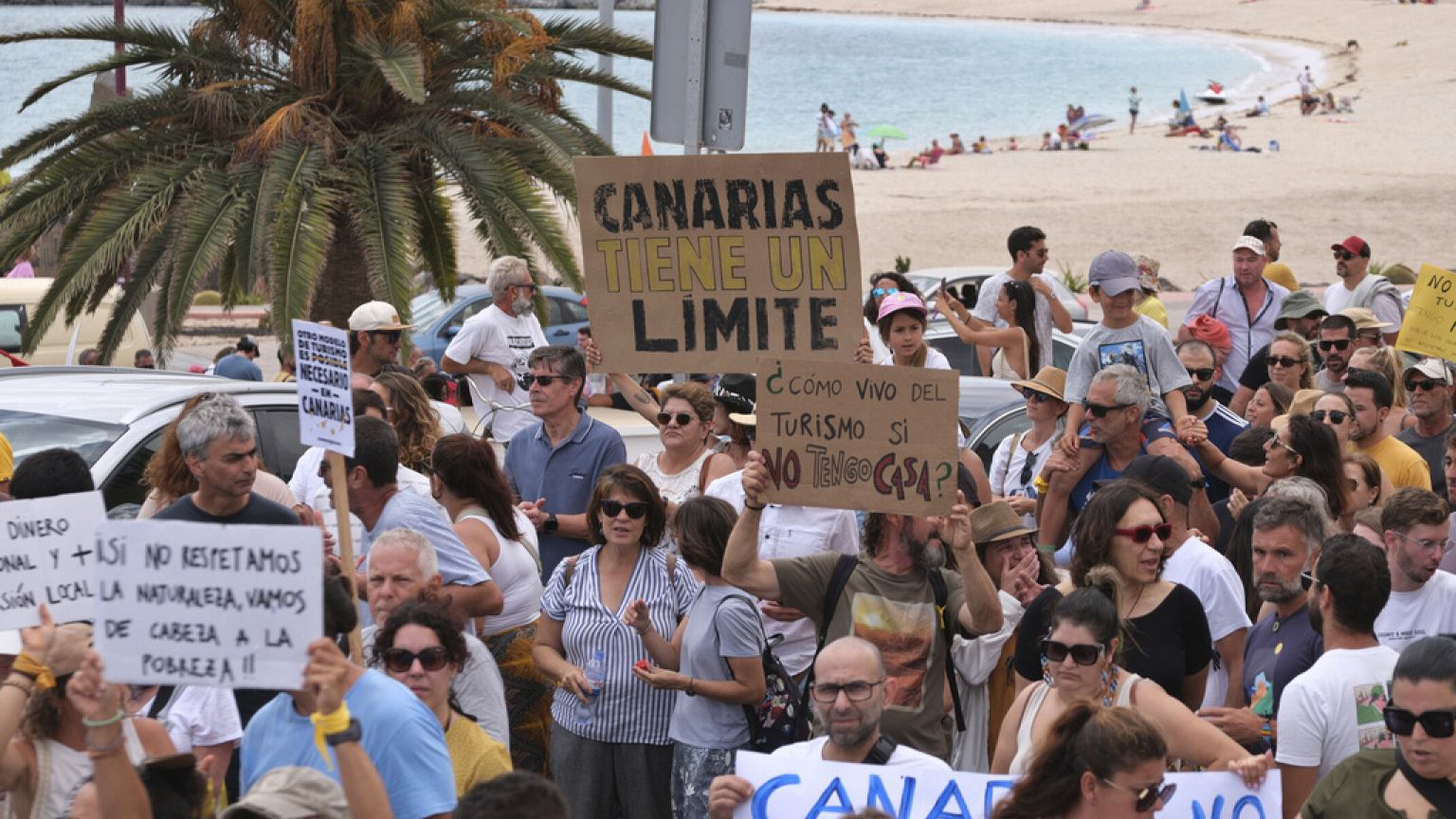
Last year, locals held multiple protests to highlight overtourism’s strain on local infrastructure and housing availability.
Copyright Europa Press via AP
By Rebecca Ann Hughes
Published on 

Last year, locals held multiple protests to highlight overtourism’s strain on local infrastructure and housing availability.

This weekend, residents of Spain’s Canary Islands are coming out in force to protest against mass tourism. 

People on the archipelago have been growing increasingly vocal about its struggles with visitor numbers. 

Last year, locals held multiple protests to highlight overtourism’s strain on local infrastructure and housing availability. They look set to continue again this summer as residents say little has been done to tackle the problem. 

Protests planned across Spain against overtourism

On Sunday, 18 May, residents of the Canary Islands will take to the streets to join protests organised by campaign group Canarias tiene un límite (The Canary Islands have a limit). 

Demonstrations will be held on all the islands of the archipelago as well as in several cities across Spain. 

Protests will begin at 11 am on the seven main Canary Islands - El Hierro, La Palma, La gomera, Tenerife, Gran Canaria, Lanzarote and Fuerteventura - and at 12pm on mainland cities including Barcelona, Madrid and Valencia. 

Residents in the German capital of Berlin are also planning to take to the streets in solidarity. 

Why are residents of the Canary Islands protesting?

The organisers say they are protesting to oppose the current economic model "based on overtourism, speculation, inequality and the infinite growth on very limited land”.

Instead, they want a transition to a people-centred, environmentally responsible model that respects the archipelago’s ecological and social needs. 

Specifically, they are calling for a halt to destructive hotel projects across the islands and the building of a motor circuit on Tenerife; a moratorium on new tourist developments; guaranteed access for residents to healthcare and housing; and a functional ecological tourist tax.

The group also wants the immediate introduction of measures to curb marine pollution and the creation of an environmental restoration law. 

Canary Islands receive record number of tourists in March

Earlier this month, authorities announced that the Canary Islands received more than 1.55 million foreign visitors in March, up 0.9 per cent on the record set in the same month last year.

The figures were released by the Canary Islands National Statistics Institute (INE), which added that the total number of international tourists for the first quarter of 2025 was 4.36 million, an increase of 2.1 per cent year-on-year.

The tourist influx comes despite dozens of protests staged last year by Canary Island residents against mass tourism.

Similar demonstrations have already taken place this year. Over Easter, around 80,000 hospitality workers in Tenerife, La Palma, La Gomera and El Hierro walked out in a dispute with unions over pay.

Trump administration proposes 5% tax on migrant remittances amid Latin American outcry

HUGE IMPACT ON THE PHILIPPINES

Trump administration proposes 5% tax on migrant remittances amid Latin American outcry
In small Central American countries such as Nicaragua, Honduras, and El Salvador, remittances represent between 23% and 27% of GDP. Any reduction in these vital flows could have a catastrophic impact on local economies. / unsplash
By Alek Buttermann May 16, 2025

The US administration has introduced a legislative proposal to impose a 5% tax on remittances sent abroad by non-citizens living in the United States. Strongly backed by President Donald Trump, the measure has drawn sharp criticism from several Latin American governments and raised concerns about its potential economic and humanitarian impact.

Though framed as a border security measure, the so-called “One, Big, Beautiful Bill”, unveiled by Republican lawmakers, is part of a broader package tied to tax cuts, immigration restrictions, and funding for border infrastructure. Central to this proposal is the idea of taxing money transfers — remittances — made by immigrants without US citizenship, including those holding legal work visas, green cards, and undocumented individuals. US citizens would be exempt.

According to AP and Infobae, the measure is aimed at discouraging unauthorised migration and raising revenue for Trump’s policy agenda. Yet experts argue that the move risks disproportionately affecting already vulnerable communities. Latin American countries are likely to bear the brunt of such a policy, as they are among the largest recipients of US remittances.

Data from the World Bank shows that in 2023, remittances from the US amounted to over $656bn globally. Mexico alone received more than $63bn — a 7.6% year-on-year increase — making it the second-largest recipient worldwide after India. In small Central American countries such as Nicaragua, Honduras, and El Salvador, remittances represent between 23% and 27% of GDP. Any reduction in these vital flows could have a catastrophic impact on local economies, where remittances fund everything from housing and education to small businesses and healthcare.

Claudia Sheinbaum, President of Mexico, has categorically rejected the proposal, calling it “unacceptable” and “unconstitutional,” arguing that many migrants already pay taxes in the US, regardless of their immigration status. “It would mean double taxation,” she said during a press conference. Mexico has since begun lobbying in Washington alongside other Latin American governments.

While this proposal may seem unprecedented, similar measures have been introduced at US state level. Oklahoma, for example, has imposed a fee on remittances since 2009. Seventeen other US states have considered comparable legislation over the past decade, though most efforts were unsuccessful, according to the National Conference of State Legislatures (NCSL). Still, the renewed push for a federal tax, tied explicitly to immigration control, marks an escalation in strategy.

A separate bill currently in Congress, known as S.3516, also targets remittances, proposing they be used to fund border security. However, as of now, it lacks specific details and has not yet been debated.

Critics warn that taxing remittances could backfire. Manuel Orozco, Director of the Migration, Remittances and Development Programme at the Inter-American Dialogue, told AP that such taxes are likely to drive migrants toward informal or unregulated channels. “This undermines transparency and raises risks for money laundering,” he said.

Similarly, Fintech México, a leading association of digital financial companies, has condemned the measure. In a statement, it warned that the tax would harm millions of families and encourage the use of unsafe transfer methods. The group also criticised the proposal to create a category of “qualified remittance providers” who would be allowed to verify the citizenship of senders in coordination with the US Treasury. According to the association, this would stifle competition and raise costs for users, irrespective of their legal status.

Some analysts argue that the economic resilience of migrant communities might blunt the impact. Jesús Cervantes of CEMLA (Centro de Estudios Monetarios Latinoamericanos), as quoted by El Financiero, believes migrants may absorb the additional cost or simply increase the amount they send, rather than reduce remittances. Economist Gerónimo Ugarte concurs: “They could cut back their own consumption in the US in order to maintain the support they provide to families back home.”

Others see danger in normalising such a tax and setting a blueprint for other countries to follow. Juan José Gutiérrez, director of the US-based Coalition for Full Immigrant Rights, warns that even a “modest” tax opens the door to future increases. “This is not about economics,” he told EFE, “it’s about weaponising policy against immigrants.”

Critics also note that the measure could exacerbate migration, rather than deter it. By restricting access to financial support, families in impoverished regions may feel compelled to send more relatives abroad. 

There are also technical limitations. While proponents argue that the tax could be deducted for those who file tax returns with a Social Security Number (SSN), many undocumented migrants use an ITIN (Individual Taxpayer Identification Number), which makes them ineligible. As José Iván Rodríguez-Sánchez of Rice University is quoted by El País, “the goal seems to be to leave undocumented migrants with no escape route.”

In the end, the proposal’s fate remains uncertain. It still requires passage in both chambers of Congress and would not take effect until 2026. But even in its current form, the 5% tax has already ignited a fierce debate. Not only about immigration, but about the very ethics of taxing survival.


Malaysia’s chip sector navigates tariff turmoil and rising regional competition

Malaysia’s chip sector navigates tariff turmoil and rising regional competition
/ Unsplash - BoliviaInteligente
By bno - Surabaya Office May 15, 2025

Malaysia’s semiconductor industry, a key pillar of its export economy, is grappling with renewed uncertainty amid US-imposed tariffs and intensifying competition from regional peers, Channel News Asia reported. The Southeast Asian nation, the world’s sixth-largest semiconductor exporter, faces mounting pressure to retain investment and relevance in a fast-evolving global tech landscape.

Last month, the US slapped a 24% tariff on Malaysian exports, sparing semiconductors and a handful of electronics, as part of a sweeping trade policy under President Donald Trump. Although the tariffs were temporarily suspended for 90 days, the grace period is set to expire soon, leaving Malaysia with little time to negotiate a deal with Washington. Semiconductors and electronic goods make up 60% of Malaysia’s exports to the US, making the industry especially vulnerable.

In response, Malaysia has accelerated efforts to upgrade its capabilities. The government’s National Semiconductor Strategy, launched last year, aims to move the sector beyond its traditional role in outsourced assembly and testing towards high-end chip design, advanced manufacturing, and R&D. Yet, policy experts caution that trade uncertainty has cooled investor sentiment. “There will be a lot of wait-and-see,” said Sharmila Suntherasegarun of think tank IDEAS, noting that greenfield investments and R&D spending are particularly at risk.

Smaller firms are feeling the pressure too. “We don’t invest in uncertainty,” said William Ng, president of the SME Association of Malaysia, advising against speculative moves until policy clarity emerges.

Major US multinationals with Malaysian operations, such as Intel, now face pressure from the Trump administration to reshore production. Any future tariffs on Malaysian semiconductors could jeopardise their cost structures and local employment. “These are the exact jobs the US wants to bring home,” noted Dr Tricia Yeoh of the University of Nottingham Malaysia.

Despite the headwinds, industry leaders remain hopeful. Wong Siew Hai, president of the Malaysia Semiconductor Industry Association, urged continued engagement with US stakeholders. “We’ve played a critical role in the growth of firms like Intel, AMD, and HP. That legacy matters,” he said.

Still, Malaysia must contend with fierce competition across Southeast Asia. Experts warn that the country’s chipmakers must boost productivity and transition up the value chain to stay ahead. Austrian electronics firm AT&S, which is expanding in Kulim, pointed to workforce development as a key factor. “It’s crucial to have a talent pipeline ready,” said AT&S executive vice-president Ingolf Schroeder.

While geopolitical tensions cast a shadow, many remain confident in Malaysia’s long-term potential. “There will be an end to these tariff discussions,” Schroeder added. “Malaysia will be in a strong position when that happens."

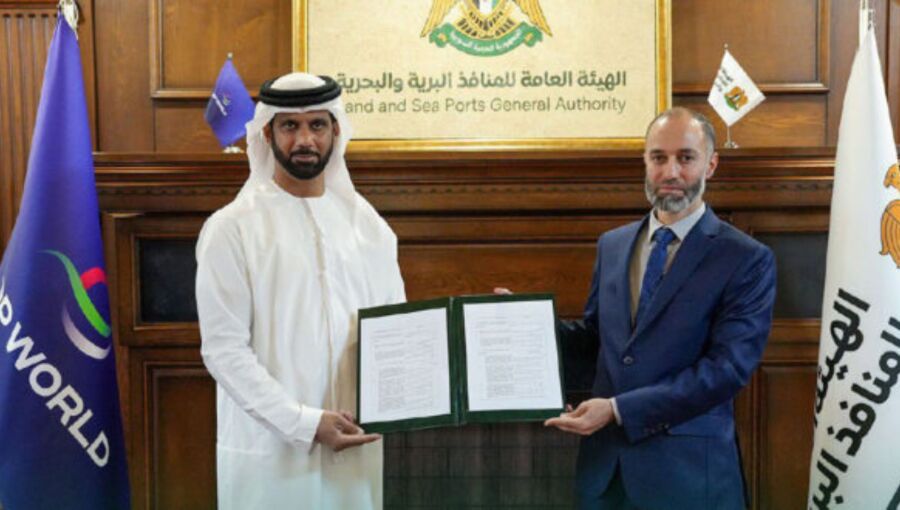
Syria and DP World sign $800mn MoU to develop Tartus Port

Syria and DP World sign $800mn MoU to develop Tartus Port

Syria and DP World sign $800mn MoU to develop Tartus Port / CC: SANA

By bnm Gulf bureau May 16, 2025

Syria's General Authority for Land and Sea Ports has signed a memorandum of understanding with Dubai Ports World (DP World) worth $800mn to rebuild Tartus port, SANA reported on May 16.

DP World is a multinational logistics company based in Dubai, United Arab Emirates. It specialises in cargo logistics, port terminal operations, maritime services and free trade zones.

The agreement marks a historic step to rebuilding port infrastructure and logistics services in Syria through investment in the development, management, and operation of a multi-purpose terminal at Tartus Port, which has been heavily damaged in recent years due to the country's civil war. 

The Tartus project aims to raise the port's efficiency, increase its operational capacity, and enhance its role as a pivotal hub for regional and international trade after years of damage and sanctions on the country.

Both parties have agreed to cooperate in establishing industrial zones and free zones, as well as dry ports and freight transit stations in strategic locations throughout Syria, reflecting their commitment to supporting economic development and facilitating trade and transport.

Syria concluded this deal during US President Donald Trump's visit to the Middle East as part of efforts to attract foreign investments to revitalise its struggling economy.

DP World, a leading global logistics and port operator, has been actively expanding its footprint in the Middle East through various initiatives aimed at enhancing trade and logistics capabilities in the region.

In early 2025, DP World announced significant investments in expanding its port facilities in the UAE and Oman to increase cargo handling capacity and improve operational efficiency, catering to growing demand for logistics services in the Gulf region.

The company has also signed an MoU with the Saudi Arabian government to develop integrated logistics zones across the Kingdom, aiming to facilitate trade and improve supply chain efficiency to support Saudi Arabia's Vision 2030 objectives.


HRW Says US Lifting Sanctions On Syria Will Bolster Rights, Recovery

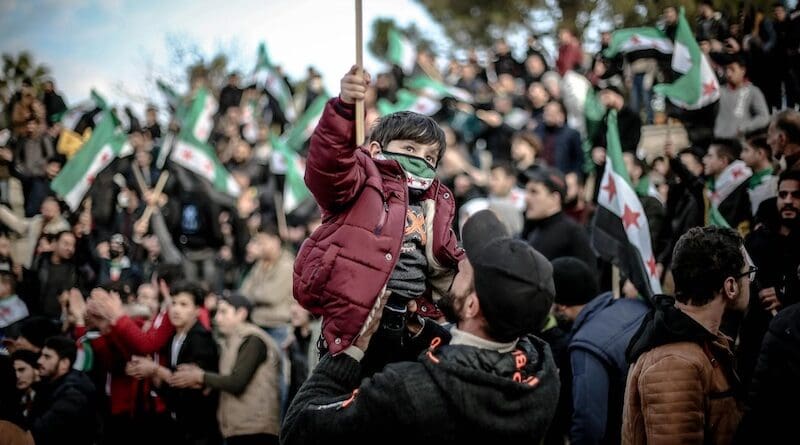
syria people flag


By 

US President Donald Trump’s announcement that the United States will remove longstanding sanctions on Syria is a critical step toward improving Syrians’ access to fundamental economic rights and encouraging efforts to rebuild a country devastated by years of grueling conflict, Human Rights Watch said Friday. The announcement should be followed by concrete executive or legislative measures that remove financial and other sanctions hampering access to rights, including the right to electricity and an adequate standard of living.

Broad sanctions, which remained in place despite the ouster of the government of Bashar al-Assad in December 2024, have greatly hindered reconstruction efforts and exacerbated the suffering of millions of Syrians. The European Union and the United Kingdom have already taken steps to ease sanctions on Syria, but the EU should go further by lifting other financial sanctions, including those imposed on Syria’s Central Bank.

“Syria’s economic collapse – due, in part, to US sanctions – has pushed millions into poverty. Now there’s a glimmer of hope,” said Sarah Yager, Washington director at Human Rights Watch. “President Trump’s recent statements offer Syrians a sense that rebuilding and recovery might be possible, but only if he backs these words with quick, concrete, meaningful actions.”

Thirteen years of conflict and displacement have left much of Syria’s infrastructure in ruins, with entire towns uninhabitable; schools, hospitals, roads, water facilities, and electrical grids damaged; public services barely functioning; and the economy in freefall. Over 90 percent of Syrians live below the poverty line, with at least 9 million unable to access enough quality food; nationwide, an estimated 16.5 million Syrians require some form of humanitarian aid to meet their basic needs. Human Rights Watch previously found that broad sanctions imposed by the US and other nations hindered aid delivery in Syria, despite humanitarian exemptions.

The United States enforced the most severe measures, prohibiting nearly all trade and financial transactions with Syria.

Now, to ensure that sanctions relief meaningfully improves Syrians’ wellbeing and fundamental economic rights, the US and other governments should take measures to:


  • Restore Syria’s access to global financial systems, including removing sanctions imposed on the Syrian Central Bank;
  • End trade restrictions on essential goods;
  • Remove energy sanctions to ensure access to fuel and electricity.

Additionally, sanctions should be lifted in good faith: relief efforts will fall short if they are conditioned on vague, shifting, or politically motivated demands. The failure to lift sanctions and the continued use of sanctions to pressure Syria into fulfilling unrelated foreign policy goals – such as security cooperation or diplomatic concessions – risk turning economic measures into tools of unlawful coercion. Any remaining conditions for sanctions removal should be narrowly tailored, clearly articulated, and rooted in international legal obligations, especially those related to human rights and humanitarian access.


Eurasia Review

Eurasia Review is an independent Journal that provides a venue for analysts and experts to disseminate content on a wide-range of subjects that are often overlooked or under-represented by Western dominated media.


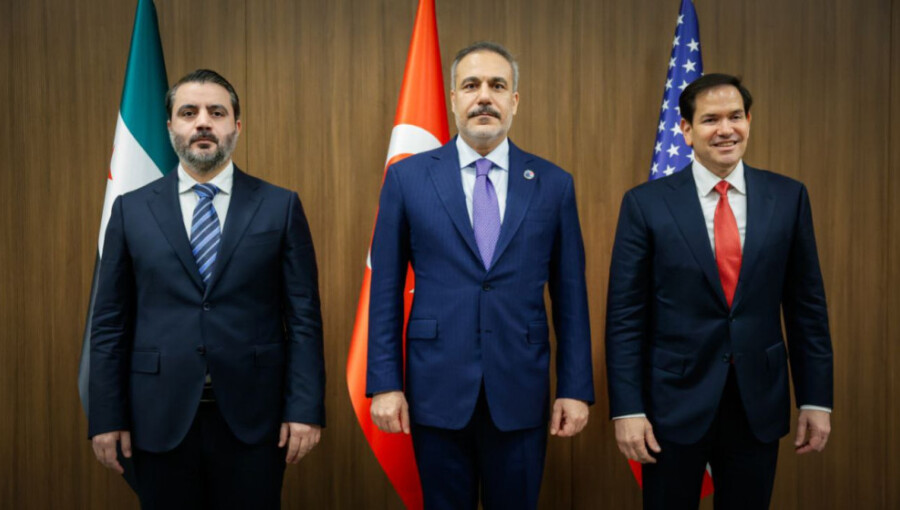
Syria’s Foreign Minister al-Shaibani meets US Secretary Rubio in Antalya amid sanctions lift announcement

Syria’s Foreign Minister al-Shaibani meets US Secretary Rubio in Antalya amid sanctions lift announcement
Syria’s Foreign Minister al-Shaibani meets US Secretary Rubio in Antalya amid sanctions lift announcement. / bne IntelliNews
By bna Cairo Bureau May 15, 2025

The Syrian Ministry of Foreign Affairs announced on May 15 that Foreign Minister Asaad al-Shaibani met with his American counterpart, Marco Rubio, to discuss the details of lifting sanctions on Syria.

According to the ministry, “Minister al-Shaibani met with his American counterpart Rubio in Antalya, in the presence of their Turkish counterpart, Hakan Fidan.”

The statement added: “Minister al-Shaibani discussed with Secretary Rubio the details of lifting sanctions on Syria and improving bilateral relations. They also explored ways to build a strategic partnership.”

Speaking to reporters in Antalya, US Secretary Rubio said: “Washington will issue preliminary exemptions from the legal sanctions imposed on Syria, following President Donald Trump’s announcement to lift all sanctions on the country.”

“The US wants to do everything possible to help achieve peace and stability in Syria as it emerges from a 13-year conflict,” Rubio added.

Following talks with the Syrian foreign minister, Rubio confirmed that Syria’s new leadership has shown a desire for peace with Israel and committed to working towards a pluralistic society.

“They expressed interest in peace with all their neighbours, including Israel.” Rubio added.

A Trump administration official indicated that the US Treasury Department is likely to issue general licences covering a broad range of key sectors in the Syrian economy critical for reconstruction, referring to the sanctions currently in place on Syria.

This follows US President Donald Trump’s announcement from Saudi Arabia of his intention to lift all sanctions imposed on Syria.

The initiative marked a major shift in US policy just before Trump’s meeting on May 14 with Syria’s Islamist President Ahmed al-Sharaa, the Saudi Crown Prince and Erdogan, who joined virtually.

The White House confirmed that Trump had put forward a list of demands to al-Sharaa during their meeting. He also indicated that Rubio would go over additional aspects of the plan to normalise relations with Damascus in his talks with the Syrian Foreign Minister.

The removal of sanctions has been a long-standing goal for Saudi Arabia and Turkey, which have emerged as key foreign allies of Syria’s new leadership since al-Assad was ousted in December.

Erdogan has repeatedly urged Trump to rescind US sanctions on Syria since the president returned to the White House in January.

Speaking to state broadcaster TRT Haber ahead of an informal NATO foreign ministers’ meeting in Antalya, Fidan described the leaders’ gathering as “of historic importance.”

He added that lifting sanctions would allow financial flows, investment, and infrastructure development in Syria, a country left politically fractured and devastated by war.

A day earlier, Fidan said, “Now tomorrow, we, as the three foreign ministers – Rubio, al-Shaibani, and myself – will come together after the NATO meeting in Antalya, and we will work on how to carry forward the details of the agreement that the leaders set the framework for and agreed upon.” 

“Of course, there is a (congressional) leg to this matter in the US; there is an administration leg, but there is a will that Trump has put forth from the start. Within the framework of this will and the work we will do, we hope the majority of these sanctions will be lifted as soon as possible,” he added.

The High Human Cost of Syria Sanctions


On May 13, U.S. President Trump announced he is ordering the removal of sanctions on Syria.

Some of the U.S. sanctions can be quickly terminated because they were issued by Executive Order. Other sanctions, including the extremely damaging 2019 “Caesar” sanctions, were imposed by Congressional legislation and may require Congressional action to terminate.

The Syrian people are joyous at the prospect of the end of their country’s economic nightmare. In 2010, before the conflict began, Syria was a middle-income country with free education, free healthcare, and no national debt. It was largely self-sufficient in energy and food. After fourteen years of war, occupation, and strangulating Western sanctions, the U.N. reports that “nine out of ten Syrians live in poverty and face food insecurity”.

Why Syria Was Targeted

In 2007, the former Supreme Allied Commander of NATO, General Wesley Clark, publicly revealed that Washington neo-cons had a hit list of seven countries to be overthrown in the wake of 9-11. The list included Iraq, Libya, Somalia, Sudan, Lebanon, Syria, Iran.

The list is essentially the same as that identified by Benjamin Netanyahu in his 1995 book Fighting Terrorism: How Democracies Can Defeat the International Terrorist Network. The premise of this book is that Palestinian and Lebanese resistance movements are “terrorist,” and any nation that supports them should be overthrown. He targets Iran, Libya, Syria, and Sudan for supporting Palestinian rights and says. “Take away all this state support, and the entire scaffolding of international terrorism will collapse into dust.”

In 2007, Democratic Party leader Nancy Pelosi visited Syria and tried to persuade Assad to end Syria’s support of the Palestinian and Lebanese resistance movements. When Assad would not comply with US and Israeli wishes, Syria was marked for regime change. The Netanyahu and neo-conservative hit list had somehow been adopted by the Western foreign policy establishment. This was confirmed by the former French Foreign Minister Roland Dumas. In a 2013 interview he says, “I went to England almost two years before the start of hostilities (2011). I met British officials, some of whom are friends of mine. They confessed, while trying to persuade me, that preparations for something were underway in Syria. This was in England, not the US. Britain was preparing gunmen to invade Syria…. This operation goes way back. It was prepared, conceived, and planned for the purpose of overthrowing the Syrian government because … this regime has an anti-Israeli stance.”

Hybrid Warfare against Syria

The overthrow of the Syrian government was not easy. It involved massive funding from seven countries (USA, UK, France, Turkey, Saudi Arabia, Qatar, UAE). In the early years, the CIA budget alone was $1 billion per year. The campaign included military, diplomatic, media/information and economic warfare.

The regime change operation began in March 2011. While part of the population was hostile to the Assad dynasty, the majority supported the government and a secular Syria. The opposition came largely from sectarian jihadist elements, including the Muslim Brotherhood. Hundreds of factions and cells were supplied and funded by a host of countries, including Qatar, Saudi Arabia, Turkey, the U.S., and the UK. Thousands of foreigners were recruited and provided access to Syria.

The political and media war on the Assad government was intense. Historian Stephen Kinzer wrote, “Coverage of the Syrian war will be remembered as one of the most shameful episodes in the history of the American press.”

Accusations that the Assad government used chemical weapons against civilians were widely broadcast in the West. They were used to justify Western bombing attacks on Syria. Acclaimed U.S. investigative journalist Seymour Hersh uncovered evidence that the chemical weapons attacks were by the opposition, aided by Turkey, NOT by the Assad government. He had to go abroad to have the explosive article published.
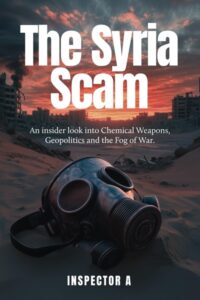
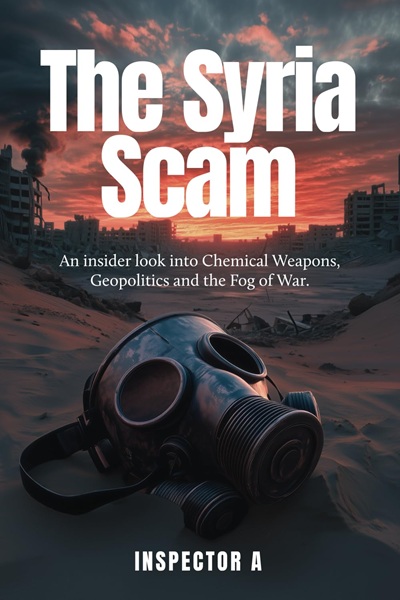
The dubious chemical weapons accusations and US driven political corruption of the Organization for the Prohibition of Chemical Weapons (OPCW) are now exposed in a February 2025 book by one of the technical professionals from the OPCW. The book is titled The Syria Scam: An insider look into Chemical Weapons, Geopolitics and the Fog of War.

By the end of 2018, the Syrian army had largely defeated the diverse jihadists. However, instead of conquering or expelling the opposition, Syria allowed them to have a safe haven in Idlib province on the border with Turkey. With Turkey, Iran and Russia seeking to find a solution through the Astana Accords, the conflict was frozen, and the jihadists were allowed to regain strength. Hayat Tahrir al Sham (HTS) became the de facto leader of the opposition factions and the government of Idlib.

The Frozen Conflict

In 2019, the U.S. turned the screws on Syria and escalated attacks on Lebanon. The extreme Caesar sanctions did what they were intended to do. They crushed the Syrian currency and economy, made it impossible to rebuild, and impoverished the vast majority of Syrians. The spreading poverty and inability to counteract it led to widespread demoralization and dissatisfaction. With consummate cynicism, the “Caesar” sanctions were named the “Caesar Civilian Protection Act”.

Meanwhile, in the HTS safe haven of Idlib province on the Turkish border to the north, conditions were very different. Although HTS was designated a terrorist organization in the U.S. and the West, they were helped economically. The HTS fighters were trained and supplied with modern military weaponry, including drones, sophisticated communications equipment, etc.. Very recently, when people from Damascus traveled to Idlib, they were shocked to find new highways, Wi-Fi widely available, and electricity 24 hours a day. Teacher salaries are ten times higher in Idlib than in Damascus.

The Fall of Damascus

With a demoralized population and Syrian army, the Assad government fell in a few weeks, and HTS, led by Ahmad Al Sharaa, took power on 8 December 2024. The new leader of Syria has been greeted and endorsed by the Gulf monarchies and Western countries that paid for and promoted the overthrow in Syria: the UK, Germany, France, Saudi Arabia, Qatar, and of course, Turkey.

Since the change, there have been numerous sectarian massacres of Alawites and Christians along the coast.

There have been attacks on Druze in Damascus. To date, there have been no punishments for the massacres of civilians. A nun reports, “there is no security” in Damascus or elsewhere in Syria.

Meanwhile, Israel has invaded and occupied all of the Golan and parts of southern Syria. They have built military bases in Quneitra and other strategic locations. Israel has carried out a bombing blitzkrieg, destroying all known Syrian ammunition depots. Israel can now fly over any part of Syria at will.

Instead of condemning the Israeli violation of Syrian land and airspace, Ahmad al Sharaa has criticized Iran and Hezbollah. In recent weeks, the new Syrian regime has arrested Palestinian leaders and closed their offices in Damascus. The normalization of relations with the Zionist state has begun.

Lifting Sanctions on Syria

Of course, the sanctions on Syria should be lifted. They never should have been imposed.

U.S. sanctions, known officially as “unilateral coercive measures”, are condemned by the vast majority of world nations. Over 70% of the world’ nations say that US sanctions are “contrary to international law, international humanitarian law, the Charter of the UN and the norms and principles governing peaceful relations among States.”

Without exaggeration, the West and their allies sponsored terrorism in Syria through Al Qaeda and other fanatical violent terrorist groups. They destroyed a once prosperous and independent nation. With a diverse Syrian population ruled by a sectarian leadership prone to violence, there may be more dark days ahead. While Israel, Turkey and the Gulf monarchies are pleased with the removal of the Assad government, a very heavy price has been paid by the majority of Syrians. And the cost is ongoing.
Rick Sterling is an investigative journalist in the SF Bay Area. He can be reached at rsterling1@protonmail.comRead other articles by Rick.


BYD moves European HQ to Hungary, sets up €250mn business and development


PUTIN'S PALS
BYD moves European HQ to Hungary, sets up €250mn business and development
Hungary and Chinese BYD sign strategic cooperation agreement. / bne IntelliNews
By bne IntelliNews May 16, 2025

Chinese electric vehicle giant BYD will relocate its European headquarters from the Netherlands to Hungary as part of a newly signed strategic cooperation agreement with the Hungarian government on May 15.

BYD will set up a business and development centre in Budapest from an investment of HUF100bn (€250mn) and the government is providing a HUF20bn grant, Minister of Foreign Affairs and Trade Peter Szijjarto announced.

The first project focuses on the integration of intelligent technologies into modern mobility and the second serves to develop next-generation electromobility technologies. BYD founder and head Wang Chuanfu said.

The new centre will create 2,000 jobs and around 90% of those will be for people with university degrees, mainly engineers. At least 50% of the patents the centre produces will be registered in Hungary, and commitments were made to partner with as many local businesses and suppliers as possible, he added.

The move cements Hungary’s status as BYD’s European hub and is expected to create 2,000 new jobs. It follows the company’s decision last year to build its first European manufacturing plant in Szeged, southern Hungary, a €3.6-4.1bn investment aimed at producing up to 200,000 vehicles annually in the first phase, with capacity potentially rising to 350,000.

Industry sources had indicated as early as late 2024 that Hungary was in line to become BYD’s regional headquarters, reflecting the government’s aggressive courtship of Chinese industrial investors. The company also plans to open a second factory in Turkey and is scouting a third European site, with a final decision expected within 18 months.

BYD opened its first continental European electric bus factory in Hungary in 2017 from an investment of €16mn. The company assembles 400 vehicles annually at its plant in Komarom, on the border with Slovakia. 

The company also operates two bases in the outskirts of the capital.

Hungary’s deepening relationship with BYD underscores Prime Minister Viktor Orban’s eastward pivot in foreign and economic policy, as Budapest positions itself as a key bridge between China and the EU amid growing geopolitical tensions.

At the signing ceremony, followed by a press conference, Orban praised China as the global leader in electromobility and reaffirmed Hungary’s commitment to "intensive and pragmatic" relations with Beijing, citing major joint infrastructure projects and rising bilateral trade. He also reiterated opposition to EU tariffs on Chinese goods, calling instead for economic cooperation based on mutual respect.


Brazil and Russia edge closer on nuclear deal

Brazil and Russia edge closer on nuclear deal
The announcement follows meetings last week between Lula and Russian President Vladimir Putin, where energy was a central topic. / unsplash   By Victor Alves May 15, 2025


Brazil and Russia are expected to advance cooperation on small modular reactor (SMR) technology, Brazil’s Minister of Mines and Energy Alexandre Silveira said after a visit to Moscow with President Luiz Inácio Lula da Silva.

“Rosatom will begin engaging with the Brazilian government shortly so we can move toward the development of small nuclear reactors, which will be vital for our energy future,” Silveira told Estadão.

The statement follows meetings last week between Lula and Russian President Vladimir Putin, where energy was a central topic. Russia already supplies enriched uranium to Brazil’s Angra nuclear plant, and discussions on SMR deployment, including floating units, have been ongoing since mid-2024.

During the talks, Lula presented draft agreements covering defence, energy and scientific collaboration during his first Moscow visit in 15 years, even as several European leaders staged a surprise show of unity with Ukraine's President Volodymyr Zelensky in Kyiv.

Russia’s state-owned nuclear energy giant Rosatom has long been developing SMR projects abroad, including a six-reactor facility in Uzbekistan and a land-based unit in Yakutia.

Silveira also met with Rosatom subsidiary Tenex, writing on Facebook: “The aim of our meeting was to establish partnerships to both increase Brazilian uranium production and expand cooperation in the nuclear sector.”

Brazil operates two reactors — Angra 1 and 2 — supplying 3% of national electricity. The Angra 3 project remains stalled after years of delays and corruption investigations.

A working group between Brazil and Russia is expected to finalise details of their nuclear cooperation by the end of 2025.