The fight for democracy, social justice and equality in the Caucasus: An interview with Georgia’s Movement for Social Democracy
First published at Tempest.
The country of Georgia, a small nation of 3.8 million people in the Caucasus, has been thrown into a profound crisis. Its people have risen up against the ruling party, Georgian Dream, over the passage of its Russia-style “foreign influence law,” homophobic anti-LGBTQ propaganda law, rigging of the recent election, and suspension of accession talks for membership in the EU.
The billionaire Bidzina Ivanishvili pulls the strings behind Georgian Dream. He is the country’s richest oligarch and possesses a fortune of $6.4 billion, which is more than half of the size of the government’s entire budget and a fifth of the country’s GDP. He and his party, whatever their clashes with the West and their tilt toward Russia, collaborate with all the imperialist powers and multinational corporations in the plunder and exploitation of the country’s people, wealth, and resources.
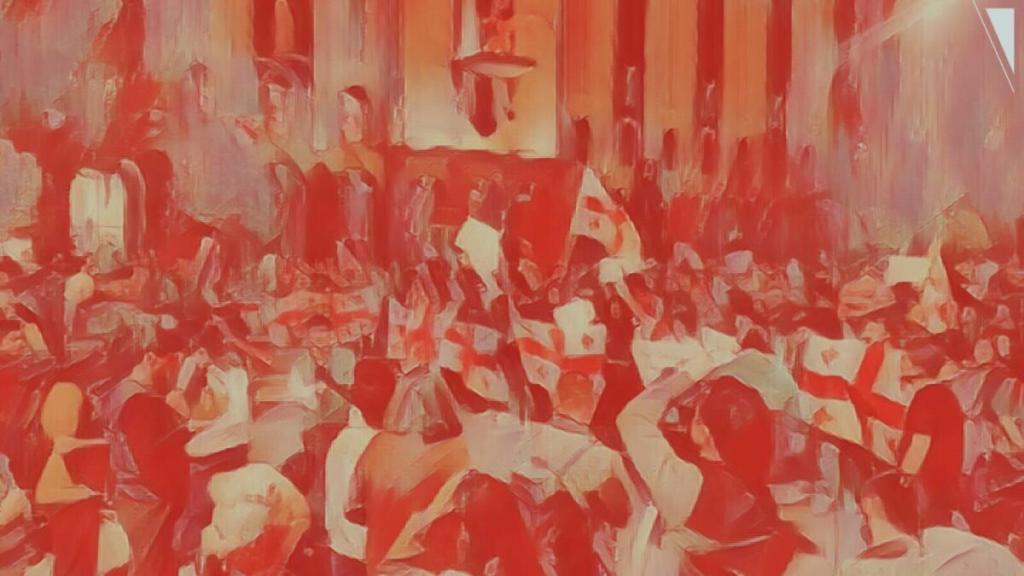
Fed up with such authoritarianism and exploitation, the Georgian people have erupted in one of largest and most sustained mass protests in their country’s history. They are fighting for democracy and equality. Georgian Dream has responded with utmost brutality, repressing protests and arresting protestors. But the movement shows no signs of backing down. The country stands on a knife edge.
In the midst of this unprecedented struggle, socialists in Georgia have come together to form the Movement for Social Democracy to attempt to fill the vacuum on the left. Here, Tempest’s Ashley Smith interviews Vano Abramashvili, Maia Barkaia, Ia Eradze, Sopho Verdzueli, who are all activists in the struggle and leading members of the new organization.
The Georgian people have been in the midst of sustained struggle against the Georgian Dream government now for months. What triggered the protests? What are its main demands?
Sopho Verdzueli: The roots of the intense, ongoing, mass protests lie in the October 26 elections and subsequent events, including the Georgian Dream’s (GD) decision to suspend the EU accession process. GD manipulated the election to secure a monopoly control over the government. That precipitated a crisis in our political system, which has in fact been in crisis for a long period of time.
It is plagued by serious problems, including an unfair electoral system that guarantees concentration of power. It lacks independent institutions to guard against fixing results or other forms of abuse of power. That corrupt system is the product of all our other political and economic problems — elite control of a propaganda-driven media system, poverty and inequality, no democratic checks on power and migration out of the country.
GD is controlled by our country’s oligarch Bidzina Ivanishvili, who is one of the richest people in the world. GD used various forms of manipulation to guarantee its reelection, including widespread propaganda, oppression, vote buying and bullying of employees.
There was a strong hope that the Parliamentary election would resolve the political crisis triggered by the foreign agent law and other undemocratic laws GD enacted prior to the election. Instead it deepened our political crisis. Despite the official electoral commission certifying the results, there is legitimate doubt that the results do not express the will of the Georgian people. The opposition parties boycotted parliament, an institution that was viewed by the people as illegitimate. The parliament’s election of a new president only compounded the GD government’s legitimacy crisis.
GD’s decision to postpone accession talks with the EU, which are written into our constitution, then detonated mass opposition. Masses of people have been mobilized in protest ever since. These protests were not just in the capital, Tbilisi, but throughout the country in smaller cities and towns. This is unprecedented.
The GD government’s response to unceasing mass protests has been increasingly brutal repression. They have deployed police to attack peaceful protests, arrested countless activists, and subjected them to torture and inhumane treatment. Police brutality has become normalized today.
Predictably, the government does not investigate let alone charge police with crimes but instead brings charges against protestors. As a result, the government holds over 50 activists as political prisoners. This is unprecedented.
This situation has shaped the political demands of the movement. We are calling not only for new free and fair elections, but also the release of political prisoners. But GD has totally ignored those demands. It is intent to consolidate power with more and more repressive and authoritarian laws against peaceful protest, independent media outlets, and civil society organizations. So, since October, GD has turned into an authoritarian regime that rules through force, not the consent of the people.
Maia Barkaia: I want to emphasize that we see the current political crisis not in isolation, but as part of an ongoing crisis of democracy, which characterized not only GD’s rule, but also previous governments, including the UNM. The existing political parties, the rigged system they oversee, and the class inequality they enforce are all to blame for our current predicament.
Georgia has served as a site of neoliberal experiments, particularly since the early 2000s. So, the current crisis is the product of the last 30 years. But today’s crisis is still very different. GD is carrying out an assault on what passes as democracy in our country. Our fundamental rights are under attack. That gives an existential feeling to the current moment.
In addition to the immediate demands for release of prisoners and free and fair election, we in the Movement for Georgian Social Democracy raise long term demands. We want to reverse all the reactionary legislation the GD regime has imposed as well as advance demands to address the deep-rooted socio-economic inequality in Georgia.
What are the politics of the movement? What are the debates? Have coherent political currents with programs formed? If so, what are they?
Sopho Verdzueli: This current movement is completely different from previous ones. First of all, in scale and longevity. It is massive. It is in most cities and towns throughout the country. We have over three months of daily mass actions.
The movement is politically diverse as you would expect when such numbers turn out on demonstrations. These express a broad array of grievances, not just on the issue of geopolitics, EU accession, and the threat of Russia.
Of course, these issues get projected broadly, but what’s driving the movement is much deeper and involves multiple political, social, and economic grievances. But those grievances have not been expressed in the movement’s demands. But sometimes they breakthrough. So here and there, you can hear quite leftist slogans especially on the marches at night.
Unlike the past, this movement is a grassroots movement. Previously, opportunist politicians and parties positioned themselves as the leaders of the struggle. Not this time. They have not put themselves at the front of the movement, because the people would have opposed them doing so. People are fed up with the entire political establishment.
In their absence, people discovered we can build and lead the struggle ourselves. Political opposition try to assert themselves through the President Salome Zourabichvili’s Common Coordination Front as representatives to the media and international actors. But they do not lead in the actual movement in the streets.
Of course, that does not mean the movement can continue without clear political strategy and organization. But it must come from the movement and be for the movement. Although many of us feared the movement would lose momentum, we are witnessing the resilience of the people — as well as the missteps of GD, which continue to push people back into the struggle.
We are in a pivotal moment though, because we are on our own. Great Britain has imposed sanctions recently, however we need a more consistent and coordinated international response towards GD’s authoritarian steps.
Maia Barkaia: Exactly. The current protest is unique in our history. It is massive, independent, and more horizontal and self-organized. And it is beginning to go beyond calls just for democracy and include demands for social and economic justice.
Since the introduction of the first foreign agent law in 2023, the protest has come in waves, surging and subsiding. But since November 28th, this movement has not ebbed for a moment. Every day, every night people are out in the streets.
Another key development is on the Left. In the past, we were always hesitant to join mainstream moments because ideologically we were never aligned with them. But we have joined this one because we are united with its fundamental demand for democracy. At the same time, we have not compromised our values and principles.
In the past, we were afraid we would be subsumed by larger forces and the mainstream parties. But this time, our new group, Movement for Social Democracy has joined the movement, found a way to express demands for social justice and economic equality alongside the overarching call for democracy, and ensured that our voice remains loud and prominent in the struggle.
How have you intervened in the struggle? What kinds of people have joined the protest movement? Have workers joined?
Maia Barkaia: The nationwide protest movement and its ideology are quite diverse. The organized forces have been competing with each other over politics, but now they’re together in this new movement.The Movement for Social Democracy is part of the struggle, building it in every way we can. But we put forward an alternative from within it. We are a very ideologically grounded organization. Even though we come from various backgrounds politically, we have a common commitment to social justice, economic equality, and democracy.
The question of democracy is very important to us, because in Georgia, we have experienced socialism without democracy in the past. And in the last few decades democracy itself has been narrowly defined, leaving out without social and economic justice. So, for us, it’s important to emphasize that social justice, economic equality, and democracy are inseparable.
The main trade union in Georgia mainly acts in favor of the government and companies. So, it does not represent workers’ interests and demands. But there are newly emerging independent trade unions. These are all very important for building genuine working class organization at work and in the protest movement. Many in the Movement for Social Democracy are members of these unions and some are part of their leadership.
One of our aims is to build strong ties between our group, unions, and various grassroots organizations. In particular, we have tried to forge ties with the student movement at different universities.
One of the most important struggles is going on in Chiatura. The city has a mono-industrial economy built around a mining company. It was privatized in 2006, recently went out of business, and laid off 3,500 workers. The miners have launched a campaign that has been going on now for months. Recently, four miners on hunger strike were taken from their protest tents at 3am and arrested.
We are witnessing the crisis of democracy that suppresses dissenting voices and leaves workers powerless in the face of political and economic elites. Our movement has tried to help support their struggle and stand in solidarity with them. We believe that struggles for a collective purpose require collective action and engagement of organized collectives.
Vano Abramashvili: Our goal is to link to the miner’s struggle and other social and labor struggles with the bigger protests. We want to overcome the separation between different groups of society and the separation between democratic and economic demands.
These really are inseparable, especially in Chiatura where the government and the company have collaborated in the exploitation of the miners and now their layoff. They are facing a humanitarian crisis. They are demanding that the government address their demands for compensation, medical care, even food, and alternative employment.
So, the struggle of the miners is with not only their company but with the government. The GD government is reluctant to concede anything to the miners, because it knows that one concession opens the door for other groups of workers to make more economic, social, and democratic demands on it. So, GD has not conceded anything to the miners or to the whole movement.
The government’s hostile response to everyone opens up space to overcome the isolation between different struggles. It allows us to build bridges of solidarity between the struggle of the miners and the democratic movement. Doing that will help us forge a genuine movement of working people of Georgia.
One of the challenges the struggle in Georgia faces is the neoliberal development model — extractivist, transit capitalism — imposed on the country by the US, Russia, China, and the EU. What exactly is that model? What are the problems with it? Is it being challenged in the struggle?
Ia Eradze: All the governments we have had for the last few decades have been committed to this neoliberal development model. It is the root of all our democratic, social, and economic grievances. So, our Movement for Social Democracy aims to expose this fact to the whole protest movement.
Whether you are a miner, a teacher, a lecturer, or whatever, you feel insecure in this country. We don’t have a welfare system. Basic social economic rights are not guaranteed. And, like the miners in Chiatura, we are all in debt. The level of household debt is very high in Georgia.
The issue of debt has been dramatically exposed to the whole country by the miners. Once they lost their jobs, they have not been able to repay their loans. Public servants who have been fired by the government because of their political positions and participation in the movement also face unpayable debt.
Fear of household debt is one of the key reasons people cite for their reluctance to go on strike. This experience of debt unites everyone in a shared precarity. We all face pretty much similar vulnerabilities. That both makes people fearful of struggle but also drives them into it because life as we have known it politically and economically is no longer sustainable.
The neoliberal development model is the structural reason for our collective experience of debt. Essentially, under the influence of great powers, foreign capital, and domestic capital, Georgian governments have subordinated all economic policies to attracting investment, ensuring corporate profitability, building infrastructure for transporting commodities through the country, and plundering our natural resources with mines and damming our waterways.
This model has concentrated capital in the hands of our oligarchs, transformed old patterns of employment, and stripped away the welfare state. As a result, we face systematic socio economic insecurity and have to take out loans to pay for basic necessities. If we lose our jobs, we have no benefits to fall back on and face unpayable debt. If you have a job, you face terrible conditions.
This whole economic model has not changed one bit with elections. The old United National Movement government enforced this neoliberal model. So has Georgian Dream. They have all put foreign and private capital’s concerns first and workers last.
Chiatura is one example of the overall pattern. After it was privatized, the company subjected the miners to terrible workplace conditions, disregarded basic safety measures, and violated their rights. Despite the company being fined multiple times by the Ministry of Environment for polluting the city’s main river and the air, nothing changed except that now the workers are fired.
That demonstrates how the elites, especially oligarchs like Ivanishvili, control the government. So regardless of who’s elected, the oligarchic structure of the economy compels the state to act in the interests of the rich and against those of the people.
The economic elite and their multinational partners have used their control of the state to implement various so-called development projects. They’ve turned Georgia into a transit hub for the transport of commodities, a crypto currency haven, and a site for mining. The “developmental” infrastructure projects (such as dams, highways, or ports) are usually financed through foreign credit from multilateral development banks.
All of this is further distorted by our oligarch’s interests. Ivanishvili warps this entire neoliberal model to serve his private interests. So, this is neoliberalism with oligarchic characteristics.
Our job in the Movement for Social Democracy is to raise all the problems with this neoliberal model in the struggle. We have to explain to people how oligarchic neoliberalism is the reason that our state is so undemocratic. For us to win the better society we all want requires transforming the whole existing economic model.
How has the EU been dealt with in struggle, since it is complicit with the neoliberal program?
Maia Barkaia: Several waves of protest in 2024 preceded the current protest, which was triggered f by GD’s announcement of its suspension of the EU accession talks. That was the last straw that broke the camel’s back. The defense of democracy is the overarching goal that unites the movement.
In the movement there are various positions on the EU. Old parties that have implemented the neoliberal plan and are therefore part of the problem are also pro-EU. We in the Movement for Social Democracy have our own position about the European Union. But we are all united in the fight to defend democracy.
But there are differences even on the question of what democracy means. For us, we see democracy as inseparable from social and economic justice. And we strive for a more radical, participatory form of democracy — direct democracy. Representative democracy is not enough. We advocate democratic control of society, institutions, and workplaces.
We look to our past history in Georgia for precedents. Our First Republic, established in 1918 and survived until 1921, was a short lived period during which we had a very interesting experience with democracy. It was established by a coalition government led by social democrats.
They went beyond representative democracy. They did not implement direct democracy, but what they called non-intermediary democracy, which was a hybrid version of representative and direct democracy. That precedent is important for us to prove that democracy is not something imported or alien to our history, but something we have experimented with by the Left in our past. We want to build on that tradition to eventually build participatory, decentralized democracy in Georgia.
We have different views on the EU than UNM and other mainstream parties, which portray the EU as a paradise and suggest that Georgia’s problems will be solved simply by joining it. Instead, we view the EU as a garden that if we joined we would still have a great deal of work to do to make the country serve the interests of the people. We see accession as an existential question to protect us from Russian imperialism. In reality, the EU is the only space where we can physically exist in order to fight against neoliberalism in Georgia and build an equal and just society.
We have a two-pronged fight on our hands — first for survival from the immediate threat of Russian imperialism and second for democracy, social justice, and economic equality. We can’t do that by copying and pasting reforms from the West or anywhere else but engaging in our own struggle from below.
UNM sold the country off to the oligarchs through privatization of national assets. And since GD has little left to sell, it has focused privatization of natural resources to extractivist corporations. We have an utterly deregulated labor code that enables corporations to maintain terrible working conditions, long working hours, and workplace discrimination. And the ruling parties have enforced this and brooked no opposition. That has taken extreme form now under GD.
So, for us, accession to the EU gives us breathing space to carry out class struggle for democracy, social justice, and economic equality. That would be nearly impossible under the constant threat of intervention coming from Moscow.
The election of Donald Trump has scrambled Eurasian politics in a fundamental fashion. Trump has formed an explicit pact with Putin’s Russia for the partition of Ukraine. How has Trump’s election impacted the struggle and its politics?
Vano Abramashvili: Trump’s geopolitical games in Eastern Europe are a major concern for Georgia. GD has reacted initially by trying to diversify its relations with all sorts of governments from Russia to Iran to find support. Indeed, GD was one of the few governments to attend the inauguration of Iran’s new president.
But that blew up in its face. GD found itself alongside groups chanting “Death to America.” Of course, Trump and the rest of the US political elite were not happy with that. That was a big mistake for GD. It will retreat from that approach to placate Trump.
Already, GD has begun to mimic Trump’s discourse about fighting the deep state and the global war party. They even shared JD Vance’s speech in Munich denouncing the EU for repressing far right parties. But that too has blown up in its face, as GD is actually a far right party in power and it’s repressing everyone. People called attention to that hypocrisy. So, their mimicry of Trump and Vance boomeranged back on them.
Such craziness aside, GD is clearly aware that Georgia is caught up in Trump’s reshuffling of geopolitics between the US, the EU, Russia, and China. Ukraine is a dangerous precedent for what Trump may do with Georgia. The US was trying to get Russia to agree to a partition plan for the plunder of Ukraine.
Trump might treat Georgia in the same way, offering us to Russia as part of its sphere of influence. As a small country caught between various great and regional powers we are caught in a classic trap Thucydides described as “the strong do what they can and the weak suffer what they must.”
Our biggest concern is the implications for us in what happens between the US and Russia over Ukraine. Here’s one nightmare scenario. Say the pact between the US and Russia falls apart. We could get in the crossfire of a larger war.
Russia has military bases and even a naval port in Ochamchire, Abkhazia, a section of Georgia it has occupied since its war on us in 2008. It uses the port for its operation in the Black Sea. If Ukraine targets that port, Georgia could become a new theater for the war..
Regardless of whether this happens or not, the image of the US in Georgia has been fundamentally damaged. Not even the craziest pro-US people can support Trump’s neocolonial proposal to Russia to partition and plunder the country.
Ia Eradze: Precisely. Trump’s presidency has had an enormous impact on people in the popular movement. Until January this year, everyone considered the US democracy that whatever its many problems at least was some kind of model for Georgia. Now almost everyone sees the US as an example of the spreading crisis of democracy in the world.
Now more and more people realize that we are part of a global struggle against the far right and oligarchs. That is a shock for many in Georgia who had trust/belief in the US. But it has underlined our point that we have to rely on our agency. There is no savior outside of Georgia coming to save us from our authoritarian government. We have to free ourselves.
We cannot solely depend on outside powers to do that for us. That said, we cannot do it alone either, since we are a small country. So, our hope depends on popular movements in other countries against their far right, their oligarchs, and their authoritarian governments.
You recently established the Movement for Social Democracy to begin to fill the political vacuum on the Left. How did that come about? What are its core political positions? What kind of forces has it attracted? How do you operate in the movement?
Sopho Verdzueli: Georgia has a tradition of social democracy established by the first Republic of Georgia in the early 20th century. But it has been marginalized and forgotten. The Movement for Social Democracy is trying to revive that tradition in the midst of today’s protests.
In the midst of the mass movement, we realized that we needed to create an alternative that was both value-based and sustainable. Last year’s election in October made this clear. No one was satisfied with the so-called lesser evil. A large portion of the political opposition remains associated with neoliberal and undemocratic policies due to their past actions, while GD’s well-funded and wide-spread propaganda manages to portray all opponents as allies of the UNM.
When a lot of us complained about this situation, people said to us “why don’t you create an alternative?” We rose to the challenge and started talking about building a new organization.
This is not the first time something like this has been attempted; people have tried to create a social democratic movement and even a political party in the past. This time we think we have a better chance of success. The combination of the political crisis, the struggle, and widespread frustration with the absence of any genuine political alternative pushed those on the Left, despite secondary differences, to come together and build the Movement for Social Democracy.
This is a movement not a political party. GD has already denied our application to register us as a non-profit organization, a single legal form we have in the legislation for the movements. Regardless, we are forging ahead.
The Movement for Social Democracy has clear points of ideological agreement summarized in our manifesto of values. These can be broadly summarized as participatory democracy, social justice, and economic equality. We do not have some charismatic leader with huge money or social capital.
We are a membership organization with a very horizontal, democratic structure. That is one of our political values. In the movement, we do not compromise our values or engage in strategic silence on this or that topic in an opportunist fashion. We will stand for and advocate for positions on all sorts of issues that are not yet popular with the aim of convincing wider and wider layers in the protests.
One of those is our stance on the European Union. We see that a pro-European foreign policy is of vital importance for Georgia. We also see how loyalty to Russia is closely linked with anti-democratic and authoritarian actions within our country. Therefore, we hold a firm and unwavering position regarding our foreign policy direction. Naturally, this does not mean that we do not have critical views on certain EU policies, including many of its mistaken political and social policies.
We are a new organization, but we are growing in numbers and influence in a small country. Right now, we have more than 150 members, we have many different working groups, and we are actively engaged in building the broader struggle on various fronts. Our main goal right now is to create a political program. We want to demonstrate what a real and valuable political alternative should look like. We aim to challenge the mainstream political discourse and agendas on both sides.
Maia Barkaia: We have started our organization in a moment of emergency. The vacuum is immense, but we are determined to accumulate forces to fill it. For now, we must build a sustainable organization prepared for any political scenario, including being forced underground.
This is a long term struggle not just in Georgie but throughout the world. We all face increasingly similar challenges. In these dark times, we must prioritize the fight for democracy in everything from our own movements to our entire society. In the broader struggle, we must agitate for democracy, social justice, and economic equality.
Finally, what can the international Left do to help the Georgian movement?
Ia Eradze: The starting point for the international Left is to talk with those of us in the struggle and find out what is actually happening on the ground. Don’t fit us into pre established narratives. Try and grasp the nuances of our situation.
Work to understand why people would carry the EU or US flag. Don’t rush to label people and movements. The Left must recognize that in peripheral countries like ours, we do have limited options and room for maneuver. We have Russia on our border, occupying 20% of our country, and it poses a threat as to whether we can exist as an independent country.
The Left has to take a step back and see what we on the Left in Georgia are actually doing — trying to find breathing space to fight for the kind of society everyone on the Left wants. But we are doing that in very, very difficult circumstances.
I also think that the Left must not minimize or relativise what GD is doing to people in this country. We all know people in the struggle who have been brutalized and imprisoned only because of their struggle for democracy..
The international Left should listen to us in the struggle. Understand the nuances of our predicament as a country with very few options, far fewer than richer and more powerful powers. And most of all treat us with respect and build solidarity with our movement.
We want to establish relationships with sympathetic forces on the international Left. We have just started to reach out by sending letters to progressive figures, academics, and organizations in the US and internationally. We need to build connections in our common struggle.
Our main problem is, of course, with the far right and oligarchs in this country and internationally. But we do have criticism of the Left globally. Too often people on the Left only think analytically, not politically and strategically about Georgia, our region, and even their own country. As Sopho mentioned, being analytical and criticizing everything and everyone is a luxury.
I think there are two traps that people on the Left fall into — one, thinking only politically, and two, thinking only strategically. One without the other will lead to mistakes of all sorts. We need to do both if we are going to build a Left capable of intervening in the real world.
Above all else we need to build solidarity internationally. We are in a common struggle against authoritarianism, oligarchy, neoliberalism, climate change, and many other systemic crises. We are all in this fight together.
Vano Abramashvili is a founding member of the Movement for Social Democracy in Georgia. His professional focus is on researching the conflicts in South Caucasus. He is an author of various analytical publications dealing with peace and security in the region and is a contributor to several Georgian online magazines on South Caucasus affairs. He holds a MA degree in Peace Studies, Diplomacy and International Politics from Tbilisi State University and has studied EU-Russia studies at the University of Tartu, Estonia.
Maia Barkaia is a founding member of the Movement for Social Democracy and an associate professor at the Georgian Institute of Public Affairs (GIPA). She holds a B.A. in Oriental Studies, an M.A. in Modern Indian History, and a Ph.D. in Gender Studies. These academic backgrounds have shaped her research and teaching interests, which center on Postcolonial and Gender Studies. Her work explores themes such as Imperial Entanglements, Modernity, and Inequalities in the Caucasus and Asia during the 19th and 20th centuries. She is also the co-editor with Alisse Waterston of Gender in Georgia: Feminist Perspectives on Culture, Nation, and History in the South Caucasus, published by Berghahn Books (2017, 2021).
Ia Eradze is a founding member of the Movement for Social Democracy. She is a political economist, with a research focus on finance in the post-socialist space. She is currently an associate professor at the Georgian Institute for Public Affairs (GIPA) and a CERGE-EI Foundation teaching fellow. She is also a researcher at the Institute for Social and Cultural Research, Ilia State University.
Sopho Verdzeuli is a founding member of the Movement for Social Democracy. She holds a Master's degree in Constitutional Politics, Law, and Theory. She is currently a researcher in judicial politics and the editor of the platform 'Komentari.' She has worked for over ten years in human rights organizations, including serving as the Director of the Justice and Democracy Program at the Center for Social Justice. She is the author of several published studies on the judiciary, law enforcement systems, and security policy. Her research interests focus on the issue of juridification in institutional reforms, as well as the interaction between law and politics from a critical legal perspective.
Ashley Smith is a member of the Tempest Collective in Burlington, Vermont. He has written in numerous publications including Spectre, Truthout, Jacobin, New Politics, and many other online and print publications.