Wednesday, June 04, 2025


Trump tariffs and US imperialism
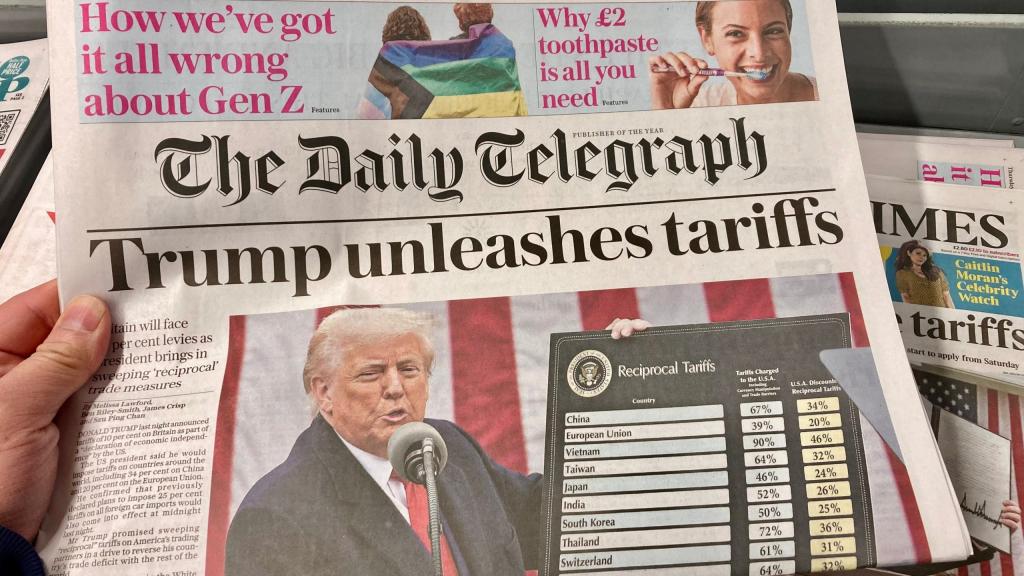
Newsapaper stand in Nottinghamshire, UK April 2025.

First published at Africa Is a Country.

On April 2, 2025, Donald Trump declared a “Day of Liberation” and slapped massive tariffs on most countries — excluding Russia but including a 50% tariff on Lesotho. The standard Left argument is that Trump’s tariffs represent capital’s warfare against the working class in response to the crisis of global capitalism. Of course, there’s some validity to that view, but it tends to operate at an excessively high level of abstraction.

More immediately, it doesn’t explain the ferocious backlash to tariffs from multiple fractions of capital, both within and beyond the Trump coalition. After the tariff tsunami, Elon Musk called Trump’s economic advisor Peter Navarro “a moron and dumber than a sack of bricks.” Meanwhile, liberal mainstream media outlets screamed bloody murder, portraying Trump not only as dumb but deranged. The frenzy only intensified when the stock market meltdown carried over into the bond market, which, as financial orthodoxy tells us, isn’t supposed to happen.

Trump responded by postponing most of the tariffs for 90 days, even as he ramped up the trade war with China. In just over a week, Wall Street went ballistic, the dollar rapidly devalued, Trump’s approval ratings tanked, and much of the Republican Party — and key fractions of capital — went into panic mode, even as they remained terrified of crossing him. These dynamics remain ongoing.

Trump’s tariffs are not merely erratic protectionist gestures. Rather, they form part of a blunt and confused arsenal aimed at dismantling post-Second World War US imperialism and replacing it with a brutal new form of nationalist global domination — one stripped of the trappings of “soft power” such as USAID. This multi-sided project emerges from factions within the New MAGA Coalition, and takes different — and often contradictory — forms.

Understanding these contradictions in their specificity is essential, not just for critique but for posing questions about new possibilities for organizing and alliance-building — not only in South Africa, but working towards a concrete internationalism, a topic to which we’ll return later.

The new MAGA coalition

So, what is this New MAGA Coalition behind Trump 2.0? First, it includes fractions of capital that extend well beyond those who underwrote Trump 1.0 — most notably Elon Musk and the South African “PayPal mafia,” along with the tech broligarchy so grotesquely on display at the inauguration: Zuckerberg, Bezos, and other billionaires.

It also encompasses elements of the petty bourgeoisie and working class that go beyond Trump’s earlier mostly white cross-class base, as the late Mike Davis described in Catalyst in 2017. Most notably, sizable Latino communities in some US regions have come to identify with MAGA — vividly documented by Paola Ramos in her recent book on the Latino far right. Another notable addition in 2024: disaffected, mainly young Black men who joined the MAGA coalition.

What knits this awkward coalition together is a powerful anti-woke sentiment and a ferocious opposition to liberal DEI (Diversity, Equity, Inclusion) initiatives that proliferated after the nationwide Black Lives Matter uprisings of 2020. David Walsh describes “woke” as a “catch-all specter that could variously connote the ravages of state planning, the anarchism of street protests, or the godlessness of modern secular society — not an empty vessel, exactly, but a foil and common enemy against which a political coalition of often diametrically opposed interests could congeal,” as he writes in Boston Review.

Also traveling under the anti-woke banner is unfiltered racism, patriarchy, and vicious heteronormativity — especially targeting trans people — all of which underscore the limits of elitist liberalism, as discussed on The Dig. These brutalities are now wrapped in a (mostly white) Christian Nationalist package that stretches back to Trump 1.0, but is being significantly re-elaborated in Trump 2.0.

What also distinguishes Trump 2.0 is its rooting in a far more coordinated and organized project of dismantling and privatizing the state, one that’s been in formation for several years. Its blueprint is a 920-page document titled “Mandate for Leadership: The Conservative Promise,” published in 2023 by the Heritage Foundation. It has come to be known as Project 2025: Presidential Transition Project.

During the campaign, Trump denied having read it (probably true), but the steaming pile of executive orders he gleefully signed post-inauguration came straight out of it and continues to do so. Unlike Trump 1.0, Trump 2.0 has determined and coherent operatives behind it. They’re driving the juggernaut of destruction — most notably Russell Vought, head of the powerful Office of Management and Budget — despite the clown-car nature of most of Trump’s cabinet. Even if Musk were to depart for Mars brandishing his chainsaw, the scaffolding of Project 2025 appears firmly in place, at least on the surface.

But look a little closer and you’ll find that this scaffolding had a fatal weakness from the start. Scroll down to Chapter 26 on trade, and two sharply opposed visions emerge.

In the section on “fair trade,” Navarro — Trump’s key pro-tariff advisor in both administrations — concludes that “America gets fleeced every day in the global marketplace, both by a predatory Communist China and by an institutionally unfair and nonreciprocal WTO.” Focusing on the large trade deficit by which the US imports significantly more than it exports, he asks: “Might America even lose a broader hot war because it sent its defense industrial base abroad on the wings of a persistent trade deficit?” The answer, for Navarro, is clear: tariffs are imperative to “restore American greatness, both economically and militarily,” by bringing manufacturing back home.

In the opposing section, “The Case for Free Trade,” Kent Lassman presents the classic conservative argument against protectionism. Declaring that “American manufacturing is currently at an all-time high,” he slams tariffs as a lose-lose-lose scenario: the tariff raiser loses access to affordable goods, the target country loses export markets, and retaliatory tariffs punish the instigator yet again. He also warns of the hidden costs of tariff dodging. For Lassman, recent departures from free trade have damaged the US economy and “weakened alliances that are necessary to contain threats from Russia and China.” He calls for reaffirming “openness, dynamism, and free trade” as the pillars of continued US dominance into the next century.

These splits and contradictions have carried over into the tariff wars erupting within the MAGA coalition itself. There are now two distinct pro-tariff projects, both aimed at reconfiguring US imperialism. One is the so-called Mar-a-Lago Accord, led by Treasury Secretary Scott Bessent. The other is a far more radical vision pursued by Steve Bannon and the wide array of popular forces he continues to mobilize.

Before unpacking these competing projects and their wider implications, it’s important to sketch briefly the key contours of US imperialism. The main pillars of American global power are a specific configuration of finance capital — with the US dollar as global reserve currency — backed by overwhelming military force.

Because key commodities such as oil and gold are priced in US dollars, all countries must hold dollars. Small open economies like South Africa operate at a distinct disadvantage. Meanwhile, the US can accumulate massive debt by issuing Treasury Bonds — a privilege no other country enjoys. Since the end of the Cold War, the US has spent over $30 trillion more than it has taken in.

China has played a key role in underwriting this system, using export earnings to purchase US debt, thereby lowering the cost of borrowing. At the same time, shrinking employment, stagnant wages, and rising inequality since the 1980s pushed much of the US population into a frenzy of consumption and spiraling personal debt. This dynamic relies on large trade deficits — precisely what significant factions of the MAGA coalition see as the greatest threat to American power.

Back in 2019, historian Adam Tooze asked, “Is this the end of the American Century?” His answer: not quite. Financial and military power remained intact. But what had collapsed was any claim that American democracy could serve as a political model. What we were facing, he wrote, was “a radical disjunction between the continuity of basic structures of power and their political legitimation.” When Joe Biden took office in 2021, he sought to resuscitate the liberal international order—an order whose cruel hypocrisies are now starkly exposed in US support for Israel’s war on Gaza, as Adam Hanieh has brilliantly analyzed. Trump 2.0, through its tariffs and trade wars, is in effect attacking the financial pillar of US global power with a sledgehammer — even if this is not quite what some of his pro-tariff advisors intended.

Tariffing the end of empire?

Unlike Navarro and others who see the trade deficit as the central existential threat to the US, the authors of the so-called Mar-a-Lago Accord are primarily concerned with what they regard as the gross overvaluation of the dollar. Their aim, per a New York Times report, is to use:

tariffs and other strong-arm tactics to force the world to take a radical step: weakening the dollar via currency agreements. This devaluation, the theory goes, would make US exports more competitive, put pressure on China, and increase manufacturing in the United States.

In addition to Treasury Secretary Bessent, a key figure is Stephen Miran, who Trump appointed as Chair of the Council of Economic Advisors in March 2025. Just after the 2024 election, Miran published “A User’s Guide to Restructuring the Global Trading System.” In dense, economistic language that Trump has almost certainly never read, the 41-page document lays out the justifications and strategies for devaluing the dollar using threats of tariffs and defense pact withdrawals — country by country.

In short, Bessent and Miran envisage tariffs as part of a coercive negotiation strategy: to pressure countries into raising their currency values relative to the dollar, and to relocate key industries to the US. These include sectors deemed vital to national security, such as semiconductors, pharmaceuticals, and military equipment. While the “User’s Guide” insists the dollar must remain the dominant currency, it also acknowledges growing efforts to find alternatives,  such as the Chinese renminbi or a potential BRICS currency. Though such efforts are deemed doomed to fail, Miran asserts, “alternative reserve assets like gold or cryptocurrencies will likely benefit.”

The Mar-a-Lago Accord, when read alongside the “User’s Guide,” affirms the substantial advantages of the US’s reserve currency status — cheap borrowing and global power projection among them. But it argues that the costs are now outweighing the benefits. “As the economic burdens on America grow with global GDP outpacing American GDP,” Miran writes, “America finds it more difficult to underwrite global security, because the current account deficit grows and our ability to produce equipment becomes hollowed out.” Hence, the push for policies that “recapture some of the benefit our reserve provision conveys to trading partners and connect this economic burden sharing with defense burden sharing.”

Even so, the “User’s Guide” issues a sharp warning against disruption and volatility: “There is a path by which the Trump Administration can reconfigure the global trading and financial systems to America’s benefit, but it is narrow, and will require careful planning, precise execution, and attention to steps to minimize adverse consequences.”

Naturally, the preposterous tariffs that Trump unveiled on April 2 (reputedly dreamed up by Navarro) run directly counter to these cautious recommendations — leaving Bessent and Miran to bluster about the President’s “extraordinary negotiating skills.” As the markets melted down and Trump threatened to sack the chair of the Federal Reserve while ramping up attacks on China, Bessent increasingly found himself in the awkward position of having to leash the rampaging orange bulldog.

In the ensuing economic, political, and military chaos, the technocratic pipe dream of an orderly reconfiguration of US imperial power has imploded, leaving the remains of the Mar-a-Lago Accord scattered across the manicured grounds of the White House. What persists, however, is a hard core of MAGA support for a far more radical popular project: one aimed at dismantling US imperialism as we’ve known it.

Nationalist-populist opposition to US Empire

In a striking profile from October 2024, James Pogue shows how Stephen Bannon “has turned his immensely influential War Room show … into a cross between a daily troop muster and a policy training school, which he uses to tutor millions of “peasants,” as he likes to phrase his target demographic, on how this global power structure actually functions.”

He quotes Bannon insisting, “To be serious, you’ve got to be anti-imperial.” People are waking up, he claims: “Once you talk about how the system is financed, they are fucking furious. A working-class audience can understand that something’s not right with the system, but they can’t put their finger on it.” Calling his listeners “the army of the awakened,” Bannon has made it his mission to lay it all bare, Pogue reports.

Before unpacking the substance of this anti-imperialism, some context matters. Bannon is not best understood as a singular “great man” but as a figurehead within a global network of right-wing Christian nationalist forces, rooted in the US and deeply embedded in the MAGA bloc. He’s also closely allied with Peter Navarro — both were jailed in 2024 for contempt after refusing to testify in the January 6 congressional inquiry. While Navarro maintains Trump’s ear despite mockery from parts of MAGA, Bannon is far more articulate and intellectually potent, and actively shapes the movement’s populist base.

In an article from 2020, I outlined how Bannon was instrumental in constructing the popular forces that helped propel Trump’s 2016 victory. First, he hijacked the anti-Obama Tea Party from the Koch brothers and delivered it to Trump. Second, he played a major role in stoking backlash to bipartisan immigration reform efforts in 2013 — linking xenophobia to anti-trade sentiment and mobilizing it before these issues had fully entered the political mainstream. In a 2017 interview, Bannon recalled saying:

I said, look, trade is number 100 on the list of issues, nobody ever talks about it, and immigration is like two or three, but if we ran a campaign that really focused on the economic issues in this country and really got people to understand how trade is so important, and immigration are inextricably linked … we could really set this thing on fire.

Trump, he claims, became the mouthpiece for these ideas by “[deploying] a very plain-spoken vernacular.”

Third, Bannon seized control of key media outlets — including Breitbart News, massively funded by the Mercer family — which he used to destroy enemies both inside and outside the GOP, while pushing his conservative, anti-globalist, traditionalist nationalism. By the 2016 election, Breitbart had far outstripped Fox News, dominating the right-wing media ecosystem. Today, Bannon reportedly believes he wields more power through War Room than he ever did as Trump’s campaign architect or White House strategist.

The “anti-imperial common sense” Bannon communicates to his “peasant” audience includes — but far exceeds — Navarro’s tariffs, which he supports. It also goes well beyond the Mar-a-Lago Accord. Rather than merely twisting global systems of finance and military power in America’s favor, Bannon and his fellow hyper-nationalists seek to obliterate altogether the post-1980s form of US imperialism.

What exactly does this anti-imperialism consist of? It has a solid — and glittering — material base. Bannon’s worldview is reportedly detailed in a multi-volume report titled The End of the Dollar Empire, available only via the Birch Gold Group, a firm that offers not just a gold-backed ETF but actual physical gold. Downloading the report requires entanglement with Birch Gold, so I passed. But listening to War Room podcasts, one can’t miss the constant exhortations to secure your IRA with Birch Gold in anticipation of a dollar collapse.

Bannon isn’t focused on trade deficits or dollar valuation alone. He’s obsessed with the entire dollar-based global order. As Pogue notes, it creates a perverse military incentive: “It lets us finance huge expenditures on hypercomplex weapons and allows us to toss off hundreds of billions of dollars to support Ukraine’s and Israel’s wars” — even as it hollows out America’s ability to manufacture basic war matériel. Biden’s attempt to weaponize the dollar during the Ukraine war failed to crush the ruble, and raised a new alarm: that others might now see it’s possible to abandon the dollar entirely.

Pogue also interviews Samuel Finlay of the IM-1776 project, whose views align with Bannon’s. Finlay emphasizes “rootedness” and “tradition,” which he connects to a hatred of global capital and resistance to the military-industrial complex — a position that directly contradicts decades of Republican orthodoxy. People like Finlay, Pogue writes, have come to the same “awakening” Bannon is fomenting: that the system has betrayed those who believed in and served it — leaving them with NAFTA, fentanyl, and an elite that views their values as backward and dangerous.

War Room weaves these insights into a broader narrative. Disaffected veterans and others are fed a critique of “the lords of Wall Street” and “the apartheid state of Silicon Valley.” The message: elites own everything and have sold out to the Chinese Communist Party — thus funding the very forces attacking America. According to Bannon, we are now in a “Time of War,” one that dwarfs debates over trade, inflation, or price hikes.

So, how do the wild gyrations of post–Liberation Day fit into the Bannon-Navarro worldview? From their perspective, the unraveling of the “Dollar Empire” since April 2 looks like progress. As Pogue notes, Bannon and fellow populists across the West have come to embrace a multipolar world modeled on Russia’s strategic vision — one that displaces the American-led order Bannon believes has ravaged the US. On an April 25 episode of War Room Battleground, Bannon claimed that we are “moving toward a new geopolitics of blocs.”

Yet the very Americans Bannon sees as crushed by the Dollar Empire are also most exposed to its chaotic dismantling. First, prices for the cheap imports that sustain the US economy — and low-income Americans in particular — are spiking. Second, as the dollar declines as reserve currency, government spending will be slashed. And who bears that burden? Early signs include proposals to gut Medicaid to help fund tax breaks for the rich. Third, rising automation will sharply undermine promises that reindustrialization will yield secure, high-wage jobs and revive devastated regions.

In short, the idea that a protectionist, isolationist, national capitalism — mashing up xenophobia, anti-globalism, Christian nationalism, and anti-elite rage — can deliver liberation is just as much of a pipedream as the Mar-a-Lago Accord.

Which brings me back to the central claim: understanding Trump’s tariffs as blunt weapons aimed at either reconfiguring or shattering US empire matters deeply for the Left, both in the US and globally. What we need is not nostalgia for the collapsing liberal order, nor Kamala-style “politics of joy” in the face of atrocities in Gaza. Instead, we need what Stefan Kipfer calls “concrete internationalism.” He develops the analysis with reference to current conditions in Canada, but with much broader transnational relevance. Distinguishing between nationalism and national-popular democratic projects, he insists that “left national-popular projects can offer alternatives to nationalism only if they are components within larger internationalist strategies” that reject the tendency of all nationalisms “to demote emancipatory social questions of class, gender, and race.” In South Africa, we are, of course, sharply aware of these dangers.

Trump’s tariff debacle and the ensuing meltdown have exposed the fragilities of the liberal international order, the absurdities and devastations of global capitalist dynamics, and the dangers of resurgent nationalisms and forms of fascism. Grappling with the limits and contradictions of a Bannonite “anti-imperial common sense” can help, I hope, to make space not only for protest and resistance, but also for envisaging and building toward a very different project of concrete socialist internationalism.

This is a revised version of a presentation that was given during the Zabalaza for Socialism Conference on Coming to Terms with Trumpism: What Should the Global South Do? from April 13, 2025. Gillian Hart is Professor Emerita, Professor of the Graduate School in Geography at the University of California, Berkeley, and Distinguished Professor in the Humanities Graduate Centre at the University of the Witwatersrand.

EU condemns Trump’s 50 percent metal tariffs as ministers gather in Paris

The European Union has said it "strongly regrets" a fresh move by US president Donald Trump to double import tariffs on steel and aluminium to 50 percent, warning the decision risks derailing efforts to resolve an escalating trade dispute with the United States. The new tariffs took effect on Wednesday.


Issued on: 04/06/2025 - RFI


US President Donald Trump announces a new raft of global tariffs during an event in the Rose Garden entitled "Make America Wealthy Again" at the White House on 2 April 2025. AFP - BRENDAN SMIALOWSKI


Trump signed the order on Tuesday evening, raising the import taxes from the 25 percent rate first introduced in March. The metals sector was the first to face these targeted tariffs, part of Trump’s stated aim to boost domestic investment.

The European Commission said the bloc was ready to respond if needed. A €21 billion package of counter-tariffs, approved earlier this year, remains on standby.

Trade talks in Paris

The move has added pressure to a ministerial meeting underway in Paris, hosted by the Organisation for Economic Cooperation and Development (OECD). EU trade commissioner Maros Sefcovic is due to meet US trade representative Jamieson Greer on Thursday.

EU officials hope the bloc can still secure an exemption from the higher tariffs. Brussels is not expected to retaliate immediately, to avoid disrupting other ongoing trade discussions with Washington.

“We have to keep our cool and always show that the introduction of these tariffs is in no one's interest,” said French Trade Minister Laurent Saint-Martin, speaking on the sidelines of the OECD meeting.

Meanwhile German Economy Minister Katherina Reiche stressed the urgency of reaching a deal. “We need to come up with negotiated solutions as quickly as possible, because time is running out," she said.

Jobs at risk in Europe

Europe’s steel industry has already been hit by falling demand and cheap imports, especially from China. The sector lost 18,000 jobs in 2024, with producers such as Germany’s ThyssenKrupp Steel cutting staff.

A 50 percent tariff could make European metal exports to the US unviable, putting more jobs at risk.

Industry sources told RFI they would not comment publicly until measures were officially confirmed, citing the unpredictable nature of recent US trade decisions.

In late May, Trump threatened to impose an additional 20 percent tariff on all European imports, before delaying the move after a phone call with European Commission president Ursula von der Leyen.

Canada hit hardest

Canada, the top supplier of steel and aluminium to the US, responded sharply. The office of prime minister Mark Carney called the tariffs “illegal and unjustified”.

“A tariff wall came down at midnight between Canada and the US, and the industry is taking it full force,” steelworkers union representative Nicolas Lapierre told RFI's Montreal correspondent.

“There are no businesses with profit margins of 25 to 50 percent. That doesn’t exist. We are very impacted.”

Canada exported more than 25 billion dollars in steel and aluminium last year, most of it to the United States.


After talks in Washington on Tuesday, Canada’s minister for US relations, Dominic LeBlanc, said: “We expressed our concerns about the increase, the tariffs are unacceptable. We explained how this will be harmful for Canada and the United States.”

Ripple effects worldwide

Mexico is also seeking an exemption. “It makes no sense,” said Economy Minister Marcelo Ebrard, arguing that the US exports more steel to Mexico than it imports.

The UK will keep its current 25 percent rate for now while trade pact talks with Washington continue. A government readout said both sides aim to implement agreed terms “as soon as possible”.

The OECD has lowered its global growth forecast, citing the impact of US trade measures.

Chief economist Alvaro Pereira told the French news agency AFP that trade, investment and consumption have already slowed, with the US economy likely to be hit hardest.

(with newswires)


By 

By Peter C. Earle


In 2020, government officials around the world locked down economies in the name of public health. Small businesses were shuttered, livelihoods wrecked, and personal freedoms suspended based on the belief that central planners knew better than individuals how to respond to risk. A small handful of libertarians rightly pushed back, warning not only of the specious basis for clamping down on commercial and social activity, but also that concentrated power and coercion would do more harm than good.

Yet today, some of those same people are cheering for a different kind of lockdown: protectionist trade policies. The justifications may differ, but the structure remains the same—top-down economic intervention, paternalistic rhetoric, and a deep distrust of free people making voluntary decisions in open markets.

The protectionist argument echoes the lockdown logic. “We’re not against trade,” the line goes. “We just want fair trade that protects American jobs.” That’s no different from “We’re not shutting down the economy; we’re just pausing it to save lives.” In both cases, the effect is the same: coercive policies imposed on millions and unintended consequences as far as the eye can see, all grounded in the disprovable idea that governments know best.

In 2002, President George W. Bush imposed tariffs on imported steel to “save” the domestic industry. The result? Nearly 200,000 jobs were lost in steel-consuming industries—more than the total number of steelworkers those tariffs aimed to protect. Tariffs raise input costs, squeeze small businesses, distort investment, and invite retaliation. They are not “pro-America.” They are anti-consumer, anti-market, and ultimately anti-prosperity.

Today’s tariff advocates claim they’re defending national strength or reviving domestic manufacturing. But this too is eerily reminiscent of the lockdowners, who insisted they were simply buying time or saving the vulnerable. What they actually did was sacrifice broad swaths of the population to satisfy a theoretical model of centralized control.


F.A. Hayek warned us of this impulse: “The more the state ‘plans,’ the more difficult planning becomes for the individual.” Tariffs are planning. They are government-imposed price distortions that reduce our flexibility and limit the decentralized problem-solving that makes markets resilient.

Markets, like societies, are messy. Factories open and close. Trade flows shift. But that dynamic nature is not a bug—it’s a feature. Protectionists, like lockdowners, fear the chaos of freedom more than the destruction of control. They assume that if a politician or bureaucrat doesn’t steer the wheel, the system will crash. In reality, the opposite is true: freedom is not the absence of structure; it is the presence of rules that emerge from voluntary cooperation, not state compulsion.

Globalization isn’t perfect. There are dependencies and vulnerabilities. But just as the best defense against a virus wasn’t authoritarian shutdowns but individual judgment and innovation, the best response to trade challenges is adaptability and openness—not economic quarantine.

Tariffs, quotas, and other forms of protectionism don’t just target foreign producers; they penalize every American family or business that depends on global inputs. They also empower lobbyists and politically-connected industries while leaving small businesses behind. They erode our economic liberties in the name of national interest, just as lockdowns eroded civil liberties in the name of public health.

And make no mistake: protectionism, like lockdowns and stay-at-home orders, breeds mission creep. Once tariffs are in place, they don’t just “protect” steel or chips. They expand. Industries learn to lobby. Politicians learn to promise. Soon, the bottom-up invisible hand is thrust aside for the ascendant iron fist of top-down industrial policy.

Those who fought lockdowns should recognize the pattern. Tariff-driven industrial policy is not a departure from the logic of command-and-control—it’s a natural extension of it. The pandemic showed us what happens when officials believe they can freeze a complex system, redesign it, and restart it with no loss. The same hubris drives today’s trade protectionists.

Liberty is indivisible. One cannot oppose forced closures in one context and support them in another. If you reject the idea that the government should decide who can open a barbershop or serve a meal in a restaurant, you must also reject the idea that it should decide where a carmaker buys its steel or how balanced trade should be between US citizens and a foreign nation.

The Covid era should have taught us that central planning is brittle and destructive. Tariffs, like lockdowns, are born of fear and enforced by force. They trade resilience for rigidity, prosperity for politics, and freedom for false security.

We’ve seen this movie before. Let’s not applaud the sequel.

  • About the author: Pete C. Earle is an economist and writer who joined AIER in 2018. Prior to that he spent over 20 years as a trader and analyst at a number of securities firms and hedge funds in the New York metropolitan area, as well as running a gaming and cryptocurrency consultancy.

FEE

The Foundation for Economic Education's (FEE) mission is to inspire, educate, and connect future leaders with the economic, ethical, and legal principles of a free society. These principles include: individual liberty, free-market economics, entrepreneurship, private property, high moral character, and limited government. FEE is a tax-exempt, 501(c)3 educational foundation

https://www.marxists.org/archive/marx/works/1848/free-trade/free-trade.pdf


\


 ANTIWAR.COM

Celebrate Our Namesake’s Birthday: The Brilliance of Randolph Bourne


Today is the 139th anniversary of Randolph Bourne’s birthday. Antiwar.com named its parent institute for this early 20th century antiwar activist. Read Jeff Riggenbach’s biography of Bourne.

[Transcribed from the Libertarian Tradition podcast episode “Randolph Bourne (1886–1918)”]

Randolph Bourne was an American intellectual journalist who flourished for a few years in the second decade of the 20th century – in the Teens, the decade that ran from 1910 to 1920. Bourne wrote mostly for magazines during this period. His byline was particularly familiar to readers of The New Republic – until his radically antiwar views on the eve of the US government’s intervention in World War I got him fired.

He moved over to The Seven Arts, a newly launched magazine with a smaller circulation than The New Republic and one less well suited to Bourne’s particular talents and interests, since its primary focus was the arts, rather than social and political issues. He was able to publish only six antiwar articles in The Seven Arts before its doors were closed by an owner fearful of the Wilson administration and its Sedition Act of 1918, which made it a crime to criticize the Constitution, the government, the military, or the flag.

Only a few months after The Seven Arts ceased publication, Randolph Bourne died, a victim of the flu epidemic that killed more than 25 million people in 1918 and 1919, nearly a million of them in the United States. That was 1 percent of the population 90 years ago. One percent of the present US population would be more than 3 million Americans. Imagine what it would be like to live through a flu epidemic that killed more than 3 million people in the space of little more than a year. That’s what it was like for Americans living 90 years ago, at the end of World War I.

Most of the people that flu virus killed have long been forgotten – except, of course, by members of their own families. But Randolph Bourne has not been forgotten, not completely. People are still reading his work. They’re still talking about his ideas and about his memorable phrases. The most famous of these has gradually become so widely quoted in our culture that millions of people have heard it, even heard it repeatedly, without ever learning who originally wrote or said it: “War is the health of the State.”

Randolph Silliman Bourne first emerged into the light of day on May 30, 1886 in Bloomfield, New Jersey, a small town fewer than 20 miles from Manhattan. His family was comfortably middle-class, and he was the grandson of a respected Congregational minister. But he seems to have been born unlucky all the same. First, his head and face were deformed at birth in a bungled forceps delivery. Then, at the age of four, after a battle with spinal tuberculosis, he became a hunchback. Then, when he was seven, his parents lost everything in the Panic of 1893, and he and his mother were abandoned by his father and left to live in genteel poverty on the charity of his mother’s prosperous (if somewhat tightfisted) brother. Meanwhile, his growth had been permanently stunted by the spinal tuberculosis of a few years before, so that by the time he graduated from high school at the age of 17, in 1903, he had attained his full adult height of five feet.

Bourne was an exemplary student. His academic record in high school earned him a place in the class of 1907 at Princeton, but by the time he was supposed to appear on campus to register for classes in the fall of 1903, it was evident that he couldn’t afford to attend. He could barely afford books. He was flat broke. And his mother needed his financial help if she was going to go on living the decent, middle-class lifestyle to which she had become accustomed. So Bourne postponed college and went to work. He knew his way around a piano, so for the next six years he worked as a piano teacher, a piano tuner, and a piano player (accompanying singers in a recording studio in Carnegie Hall). He also cut piano rolls. On the side he freelanced for book publishers as a proofreader. Now and then, when musical work was harder to find, he did secretarial work.

By 1909, when he was 23 years old, Bourne had saved enough to cut back on his working hours and try to catch up on the college experience he’d been putting off. He enrolled at Columbia, where he fell under the sway of historian and political scientist Charles Beard and philosopher John Dewey, and began publishing essays in the Dial, the Atlantic Monthly, and other magazines. His first book, Youth and Life, a collection of his magazine essays, was published the year he graduated from Columbia, 1913. And that fall, the now 27-year-old Bourne set out for Europe. In his senior year he had been awarded the Gilder Fellowship for travel abroad, which the historian Louis Filler has called “Columbia’s most distinguished honor” during that period. Bourne spent a year travelling around Europe and pursuing such independent study as interested him.

Then, in August 1914, he returned to America, took up residence in Greenwich Village, and resumed writing for the Dial and the Atlantic Monthly, along with a new, upstart weekly called The New Republic. Actually, it might be more accurate to say that Bourne fled Europe in August 1914 than to say that he merely “returned to America” at that time. For it was in late July and early August of 1914 that Europe – virtually all of Europe – embarked upon the conflict we know today as World War I. Bourne opposed this conflict, and he was especially worried that his own country, the United States, would choose to enter it before long.

Bourne wrote about many subjects over the next four years; he wrote enough about education, for example, that he was able to fill two books with his magazine pieces on the subject – The Gary Schools in 1916 and Education and Living in 1917. But his main subject during the last four years of his life was the new world war and the urgent need that the United States stay out of it.

Bourne made few friends by adopting this stance. It brought him, as the journalist Ben Reiner later put it, “into sharp conflict with the rising pro-war hysteria that preceded America’s entry into World War I.” In the view of yet another journalistic commentator, Christopher Phelps,

few 20th-century American dissenters have… suffered the wrath of their targets as greatly as Bourne did. By 1917, The New Republic stopped publishing his political pieces. The Seven Arts … collapsed when its financial angel refused further support because of Bourne’s antiwar articles.

According to Reiner, the problem was that once Bourne’s “biting attacks on government repression began to appear in The Seven Arts,” this gave “birth to rumors that the publisher… was supporting a pro-German magazine. She… withdrew her support, which closed the magazine down.”

Nor was the demise of The Seven Arts the end of the punishment Bourne had to bear for speaking his mind. Phelps notes that “even at the Dial… he was stripped from editorial power in 1918 – the result of an uncharacteristically underhanded intervention by his former mentor John Dewey, one of the objects of Bourne’s disillusioned antiwar pen.” Phelps quotes a letter Bourne sent to a friend shortly thereafter, in which he laments that “I feel very much secluded from the world, very much out of touch with my times. … The magazines I write for die violent deaths, and all my thoughts are unprintable.” The historian Robert Westbrook put the matter as memorably and eloquently as anyone when he said in 2004 that “Bourne disturbed the peace of John Dewey and other intellectuals supporting Woodrow Wilson’s crusade to make the world safe for democracy, and they made him pay for it.”

Yet the ruination of his career was far from the only price he had to pay. Westbrook quotes John Dos Passos’s claim, from his novel 1919, that, in addition to his professional setbacks, “friends didn’t like to be seen with Bourne,” and that “his father” – who had walked out of his life a quarter-century before – “wrote him begging him not to disgrace the family name.” A few weeks later, he was dead. Several friends, going through his apartment after his death, found an unpublished manuscript in the wastebasket next to his desk. It was entitled “The State.”

“War is the health of the State,” Randolph Bourne wrote in that discarded essay, which he probably died believing would never see print, “and it is during war that one best understands the nature of that institution.” For

it cannot be too firmly realized that war is … the chief function of States. … War cannot exist without a military establishment, and a military establishment cannot exist without a State organization. War has an immemorial tradition and heredity only because the State has a long tradition and heredity. But they are inseparably and functionally joined.

Moreover, Bourne argued,

it is not too much to say that the normal relation of States is war. Diplomacy is a disguised war, in which States seek to gain by barter and intrigue, by the cleverness of wits, the objectives which they would have to gain more clumsily by means of war. Diplomacy is used while the States are recuperating from conflicts in which they have exhausted themselves. It is the wheedling and the bargaining of the worn-out bullies as they rise from the ground and slowly restore their strength to begin fighting again.

Randolph Bourne believed that informed citizens needed to realize the implications of what he was saying. For

if the State’s chief function is war, then the State must suck out of the nation a large part of its energy for its purely sterile purposes of defense and aggression. It devotes to waste or to actual destruction as much as it can of the vitality of the nation. No one will deny that war is a vast complex of life-destroying and life-crippling forces. If the State’s chief function is war, then it is chiefly concerned with coordinating and developing the powers and techniques which make for destruction. And this means not only the actual and potential destruction of the enemy, but of the nation at home as well. For the … calling away of energy into military pursuits means a crippling of the productive and life-enhancing processes of the national life.

Randolph Bourne believed that “we cannot crusade against war without crusading implicitly against the State. And we cannot expect … to end war, unless at the same time we take measures to end the State in its traditional form.” Bourne had reason to be wary when writing sentences like those in 1918. People were being imprisoned and, in some cases, deported for writing things like that. There was a particular prejudice against anarchists and against people who sounded as though they might be anarchists. Perhaps this is why Bourne added the following caveat to his call for ending the State: “The State is not the nation, and the State can be modified and even abolished in its present form, without harming the nation. On the contrary, with the passing of the dominance of the State, the genuine life-enhancing forces of the nation will be liberated.”

Randolph Bourne was an idealist. He hoped for a world free of war, a world in which what he called “the productive and life-enhancing processes” were the dominant processes in our national life. It is appropriate, then, that in the Internet age, he is perhaps best known to the general public, not only for his immortal phrase “War is the health of the State,” but also as the namesake of a nonprofit foundation that runs a popular website. The nonprofit foundation is the Randolph Bourne Institute. And the website is Antiwar.com. The folks who run Antiwar.com would have us believe that their site should not be construed as libertarian in its essence. As Development Director Angela Keaton put it recently, “Antiwar.com is not a libertarian site. Antiwar.com is a foreign policy site operated by libertarians which seeks a broad based coalition in educating about the dangers of Empire.”

I’m inclined to think Randolph Bourne cut through to the heart of the matter more effectively, however, when he wrote that “we cannot crusade against war without crusading implicitly against the State.” In effect, you can’t be consistently and intelligently antiwar, unless you’re libertarian. The folks at Antiwar.com are, of course, aware of this. They quote that very same sentence of Bourne’s on the “Who We Are” page on their website and state further that their own “dedication to libertarian principles” is “inspired in large part by the works and example of the late Murray N. Rothbard.” The work that’s being done 24/7 at Antiwar.com not only honors Randolph Bourne’s contribution to the libertarian tradition; it also helps to assure that that tradition will continue and grow.

This article is transcribed from the Libertarian Tradition podcast episode “Randolph Bourne (1886–1918).”

Jeff Riggenbach (1947-2020) was a journalist, author, editor, broadcaster, and educator. A member of the Organization of American Historians and a senior fellow at the Randolph Bourne Institute, he wrote for such newspapers as the New York Times, USA Today, the Los Angeles Times, and the San Francisco Chronicle; such magazines as Reason, Inquiry, and Liberty; and such websites as LewRockwell.com, AntiWar.com, and RationalReview.com. His books include In Praise of Decadence (1998), Why American History Is Not What They Say: An Introduction to Revisionism (2009), and Persuaded by Reason: Joan Kennedy Taylor & the Rebirth of American Individualism (2014).


Riyadh and Khartoum Heading Toward a Deal That Will Anger Cairo


In the final days of Ramadan, and just days before Eid al-Fitr, Sudan’s de facto president and army chief, General Abdel Fattah al-Burhan, knelt in prayer beside Saudi Crown Prince Mohammed Bin Salman at the Grand Mosque in Mecca. Al-Burhan had arrived in the kingdom only two days before the Sudanese civil war entered its third year – a striking gesture that underlined the growing ties between al-Burhan and Saudi Arabia.

This clear signal of Saudi-Sudanese rapprochement perfectly aligns with Riyadh’s broader strategic shift towards controlling ports across the Red Sea, which is directly linked to the kingdom’s ambitious Vision 2030 economic overhaul – especially its crown-jewel projects like NEOM, the massive Red Sea tourism developments along its western coastline, and the expansion of the Yanbu terminal, designed to diversify oil export routes away from the Strait of Hormuz.

Al-Burhan’s latest visit to the kingdom and its timing underscored Saudi Arabia’s long-term commitment to the Red Sea and its significance within Riyadh’s vision. Within this context, it appears that Saudi Arabia has moved beyond its neutral arbiter role in the Sudanese civil war and is instead leaning toward supporting the Sudanese Armed Forces (SAF) to secure geopolitical gains tied to Red Sea control.

Saudi Arabia’s move regarding Sudan began directly after the fall of Omar al-Bashir’s regime in 2021, when Riyadh started pushing for maritime border delineation talks with Sudan, taking advantage of the country’s marginalization and instability. Joint committees were quietly formed with the aim of reaching an agreement between the two countries. These negotiations were conducted in complete secrecy under the direction of Sudanese army chief Abdel Fattah al-Burhan, as any Saudi-Sudanese negotiation on maritime borders cannot be separated from the fate of the Hala’ib Triangle, including Shalateen and Abu Ramad. This is because such an agreement would directly affect the starting points of the maritime borders, the division of the continental shelf and natural resources, and control over the vital Red Sea shipping lanes.

Since maritime delimitation would determine which country legally and practically controls the coastline, and given that the Hala’ib, Shalateen, and Abu Ramad areas would fall within the scope of the agreement, this would amount to Saudi Arabia implicitly recognizing the triangle as Sudanese territory under Egyptian occupation. For this reason, the process was kept secret to avoid escalating tensions with Egypt – especially since Cairo is a backer of the Sudanese army while also maintaining strong ties with Riyadh.

When the civil war erupted in Sudan, the maritime border delineation committee’s work was suspended. However, after the Rapid Support Forces (RSF) formed a parallel government, Saudi Arabia pushed to resume the committee’s work in order to formalize the maritime border agreement and preempt any new developments that might emerge on the ground in Sudan.

Notably, the resumption of the committee’s work coincided with a high-level Saudi delegation’s visit to Port Sudan just days earlier, which focused primarily on Red Sea cooperation and on preventing Khartoum from providing military bases to Russia or Turkey along its 853-kilometer Red Sea coastline.

It appears that Saudi Arabia is seeking to sign a maritime border agreement with Sudan similar to the Tiran and Sanafir Islands agreement signed with Egypt in 2016, at a time when Egypt was facing a severe economic crisis.

The ongoing negotiations between Saudi Arabia and Sudan over maritime borders and the eventual signing of an agreement will inevitably ignite tensions with Egypt, as the Hala’ib, Shalateen, and Abu Ramad areas are at the heart of Sudan’s dispute with Cairo. Additionally, the revelation of such an agreement could affect the Sudanese army’s military alliances, given Egypt’s strategic interests in the region.

It is worth noting that the Hala’ib, Shalateen, and Abu Ramad triangle has been under Cairo’s full military control since the mid-1990s, following an assassination attempt on former Egyptian President Hosni Mubarak, which was supported by Sudan. Egypt has consistently rejected Sudan’s repeated calls to refer the dispute to international arbitration, as international law requires both parties’ consent to bring a dispute before an arbitration tribunal.

Rabah Filali is an accomplished multimedia journalist, senior correspondent, andpolitical analyst with over 33 years of experience in television, radio, and digital media.Throughout his career, he has covered five U.S. presidential elections, ten congressional elections, and numerous global political events, solidifying his reputation as a trustedvoice in political and crisis reporting. His work has spanned major media networks, including the Middle East Broadcasting Network (MBN), Al-Hurra TV, MBC, and Al-Arabiya, where he hasled coverage of international affairs, breaking news, and investigative journalism.


Why Iran Can’t Be ‘Allowed’ To Enrich Uranium


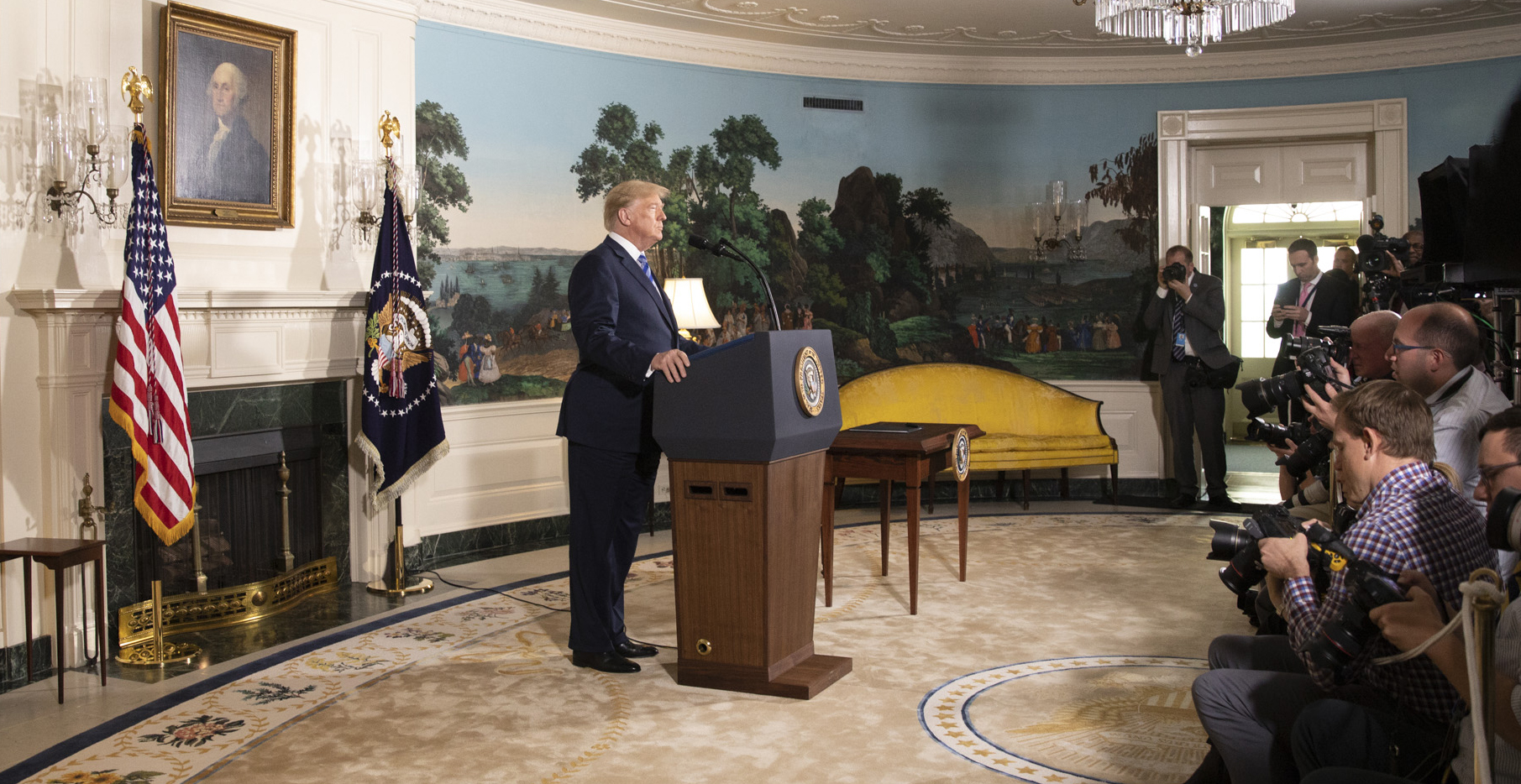
US president Donald Trump announces that the US doesn’t keep its agreements or abide by international law – May 8, 2018. Public domain.

“The AUTOPEN,” US president Donald Trump wrote on his “Truth Social” platform on June 2 (referring to Joe Biden), “should have stopped Iran a long time ago from ‘enriching.’ Under our potential Agreement – WE WILL NOT ALLOW ANY ENRICHMENT OF URANIUM!”

Trump’s absolutely right, but only in three ways that don’t reflect the pomposity of his post:

Firstly, the Iranian regime has made clear that there is no “potential agreement” under which it will give up its ability and prerogative to enrich uranium.

Secondly, the US regime never has been, and is not now, in any position to “allow” or “not allow” the Iranian regime to enrich uranium. Nor could it put itself in any such position short of winning a major war against a much bigger and more powerful opponent  than it faced – and lost to – in Afghanistan.

And thirdly, there’s already an agreement. Not a “potential” agreement, an actual one.

It’s called the Joint Comprehensive Plan of Action, aka the “Iran nuclear deal,” and although Trump claims to have “withdrawn” the US from it since 2018, he hasn’t.

The JCPOA is codified as a United Nations Security Council Resolution and is binding on all member states.  The only ways for Trump to “withdraw” the US from it are to “withdraw” the US from its UN membership entirely, or get the Security Council to repeal it (that’s not gonna happen). The US regime hasn’t left the JCPOA. The US is just in continuous violation of the JCPOA. There’s a difference.

Iran began enriching uranium to higher levels of purity – slowly moving toward “weapons grade” – after the US started violating that agreement and pressuring its allies to do likewise.

The Iranians have also been clear and consistent: They’ll be happy to stop enriching to those higher levels of purity, and mix the more highly enriched uranium into less pure uranium, when and if the US starts holding up its end of the agreement, which happens to be binding international law.

The JCPOA represented the culmination of a decade of negotiations consisting of US demands, Iranian acceptances, more US demands, more Iranian acceptances, rinse and repeat ad nauseam, until the US finally took “yes” for an answer.

After which, under Trump, the US defaulted on its own obligations while demanding even MORE from the Iranians. All this, it should be mentioned, in the absence of evidence that the Iranians were interested in developing, or attempting to develop, a nuclear weapon in the first place.

To which the Iranian response was, understandably, “OK, we’ll start enriching to higher levels than we were attempting even before we agreed to the deal – but we’ll stop if you’ll start holding up YOUR end.”

Trump’s powerless to “allow” or “not allow” the Iranians to do anything. Rage-posting on Truth Social won’t change that. He should instead offer them a “new” deal that’s just a freshly printed copy of the JCPOA, then declare “victory” when they accept. His supporters are probably gullible enough to consider that a Trump masterstroke.

Thomas L. Knapp (X: @thomaslknapp | Bluesky: @knappster.bsky.social | Mastodon: @knappster) is director and senior news analyst at the William Lloyd Garrison Center for Libertarian Advocacy Journalism (thegarrisoncenter.org). He lives and works in north central Florida.


Thieves in the Kitchen: The Stealing of Recipes


Recipe author Nagi Maehashi, unmoved by her own numbing banality, is peeved. Her target: Penguin books and author Brooke Bellamy. Her accusation: the apparent copying of recipes for caramel slice and baklava from Maehashi’s RecipeTin Eats website, released in Bellamy’s Bake with Brooki, published in October last year. “Profiting from plagiarised recipes is unethical,” she huffed, “even if it is not copyright infringement – and undermines the integrity of the entire book.” Rather indulgently, Maehashi goes on to decry this as a “slap in the face to every author who puts in the hard work to create original content rather than cutting corners.” The question left begging is whether this is ever possible for a cookbook.

Bellamy, who has the combined weight of 3 million followers on TikTok and Instagram, has flatly denied the accusation. “I did not plagiarise any recipes in my book which consists of 100 recipes I have created over many years,” she claims on Instagram. “In 2016, I opened my first bakery. I have been creating my recipes and selling them commercially since October 2016.” The social media figure is candid in admitting that she did not invent any of the recipes listed in her book dealing with cookies, cupcakes, brownies or cakes.

On the issue of the caramel slice, Bellamy merely observes that the RecipeTin Eats recipe, published in March 2020, “uses the same ingredients as my recipe, which I have been making and selling since four years prior.” Evidently not a pugilist, Bellamy has even offered to remove the caramel slice and baklava recipes from any future reprints of her book, a point “communicated to Nagi swiftly through discussions”.

Another author from cookbook land, Adam Liaw, abandons his kitchen implements briefly to explain the finer points of intellectual property in light of this dispute. As an intellectual property lawyer in his previous non-cooking life, he suggests that the copyright “doesn’t protect the recipe itself. It protects the publication of the exact same written form of that recipe. None of the recipes written in the world would reach the standards necessary to obtain patent protection.”

A closer look at the claim is one of plagiarism. This is an interesting point, given the multitude of borrowings, replications and, along the way, adjustments, that come along with the use of recipes. Professor John Swinson from the University of Queensland adds insult to injury to Maehashi’s case by simply stating that the steps involved in making the recipe were “not very expressive”. When looking at a comparison between the two recipes in question, one is left with a similar impression. “You can’t protect a cake or cookie,” Swinson clarifies. “You can only protect how it\s expressed, not the end result, and most recipes are just factual instructions”.

A sticking point here is the issue of attribution. Under the Australian Copyright Act 1968 (Cth), there are various described moral rights, as distinct from economic rights. These include the right of attribution (that the author be identified and named as the author of that work); the right against false attribution (the right of the author to prevent someone else from being credited as the author of their work; and the right of integrity (the right of an author to ensure that the work is not subjected to derogatory treatment harmful to the author’s honour or reputation).

Historically speaking, the publication of recipes drawn from the vast archive of cookery is more than standard. We find Isabella Beeton in October 1861, a co-editor of the Englishwoman’s Domestic Magazine pillaging at will any number of recipes for The Book of Household Management. As food boffin and author Helana Brigman points out, this book of revelation for Victorian readers, one that allayed fears about “how much should a family of five spend on groceries”, had nothing that was her own. In writing her book, Beeton made generous use of readers’ submissions.

The fact remains that, however murky one might assume the laws on copyright were on the subject, neither US nor British copyright laws (ditto Australia’s equivalent) protect a listing of ingredients, even those found in formulas, compounds, or prescriptions. Broadly speaking, claiming some ownership over a dish is much like asserting control over the air and its vapours.

An iconoclastic Jonathan Meades takes the torch to such proprietary assertions in his The Plagiarist in the Kitchen: A Lifetime of Culinary Thefts. His work eschews “culinary originality”, being an “anti-cookbook” favouring “the daylight robbery of recipes, to hijacking techniques and methods, to the notion that in the kitchen there is nothing new and nor can there be anything new.”

Meades rightly notes that the pathology of originality arises from the emergence of the cult chef, the God creator in the kitchen. In an interview, he notes how it began “in upscale restaurants in Spain and then in Britain with Heston Blumenthal.”

The entire grievance on Maehashi’s part has given Bellamy even more oxygen for her enterprise, with the latter preferring to repair back to the bakery. Two new stores are set to open in Queensland in July. An international pop-up store in the United Arab Emirates is planned to open by the end of the year, adding to existing ones in the Middle East. If Bellamy was ever a thief in the kitchen, the enterprise is doing quite nicely.

Binoy Kampmark was a Commonwealth Scholar at Selwyn College, Cambridge. He lectures at RMIT University, Melbourne. Email: bkampmark@gmail.comRead other articles by Binoy.