It’s possible that I shall make an ass of myself. But in that case one can always get out of it with a little dialectic. I have, of course, so worded my proposition as to be right either way (K.Marx, Letter to F.Engels on the Indian Mutiny)
Friday, October 10, 2025
Shipyards Line Up for New USCG Arctic Security Cutter Construction
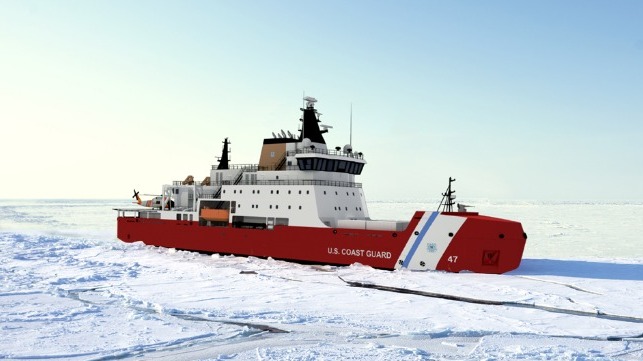
Rendering of the Seaspan-Aker design that will be used for the USCG medium-duty Arctic Security Cutter (Seaspan)
Shipyards representing the partnership between Finland, Canada, and the United States quickly lined up to announce their roles in the new Arctic Security Cutter program. Two multinational partnerships based on the 2024 trilateral ICE Pact launched by the Biden administration are positioned to benefit from the newly announced Trump program.
One of the partnerships was developed by Canada’s Seaspan Shipyards, which has already developed one of the designs with Finland’s Aker Arctic Technology, and which will be built by Rauma Marine Construction in Finland and Bollinger Shipyards in Louisiana in the United States. The other group that will participate was developed by Canada’s Davie, which acquired Helsinki Shipyard and recently purchased a yard in Texas.
The groundwork was set through an agreement signed by U.S. President Donald Trump and Finnish President Alexander Stubb. Trump is invoking national security interests so that the United States can build icebreakers in Finland. The deal is designed to leverage Finland’s broad experience and established networks to speed the development of the vessels.
“This Memorandum of Understanding marks the beginning of a Western shipbuilding project the likes of which has not been seen since World War II,” said Davie co-owner and CEO James Davies, commenting on the agreement between Finland and the United States. “It represents a revival of Western industrial power led by the United States, and is powered by Finland’s world-leading icebreaking expertise. We will work tirelessly with the United States Coast Guard to get the ships into the water by 2028.”
Davie says it has entered into commercial negotiations with the U.S. Coast Guard to finalize the agreement. It said the number of ships to be built and the economic impact will be determined in future negotiations. Trump directed the U.S. Coast Guard to develop the final plan, but it is understood the program will involve a total of 11 icebreakers, with the Seaspan group saying it is in line to build a total of six.
Helsinki Shipyard highlights that it has built half of the world’s icebreakers and all the icebreakers built in Finland in the 21st century. It will be using a fourth-generation design for Arctic icebreakers in the program for the United States. The plan calls for medium-duty Arctic Security cutters. Currently, working with Davie, the yard is building the heavy Polar Max icebreaker for the Canadian government.
Speed is one of the priorities for the new program, with Helsinki Shipyard highlighting that it is able to build several icebreakers simultaneously. In addition to the acquisition in Texas, Davie also strengthened its steel production with the acquisition of Enersense Offshore in Finland. The yard in Mantyluoto is currently supplying steel blocks for the Polar Max icebreaker and will also participate in the U.S. shipbuilding program.
"The United States Coast Guard is placing its trust in Rauma Marine Constructions’ proven shipbuilding capability. With a hot production line and our ice-class experience, we are ready to deliver the Arctic Security Cutters on an accelerated timeline in close cooperation with our U.S. partner and allied industry,” said Mika Nieminen, CEO of Rauma Marine Constructions.
It will be building vessels using the Seaspan-Aker MPI design, which they note has already undergone significant engineering, testing, and integration work, which will enable it to proceed quickly into production. The design is for a vessel that can break four feet of ice, travel 12,000 miles, and operate for over 60 days. It will be able to maintain year-round access to the Arctic, and as a shared multi-mission design with the Canadian Coast Guard, it will have interoperability and create the largest class of icebreaking capability in the world.
The first three vessels will be built simultaneously by Rauma in Finland and Bollinger in the United States, with the parallel construction enabling accelerated delivery. The group says delivery of the first three vessels is expected within 36 months of the contract award. The three additional vessels will be built in the United States.
Finland’s Minister of Economic Affairs, Sakari Puisto, called the agreements “great news” for the country. He highlighted that Finland has an extensive network of subcontractors and partners available to quickly execute on the construction program.
Sanctioned Iranian Bulker Spotted Offloading Cargo in Brazil
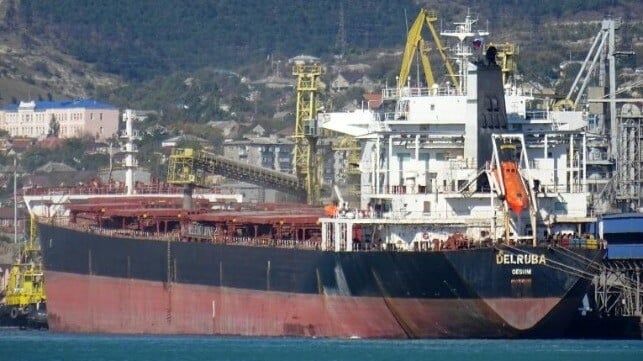
Delruba at Novorossiysk, Russia, 2016 (VesselFinder)
A blacklisted Iranian bulker has arrived at a port in Brazilian state of Santa Catarina and reportedly offloaded a cargo of fertilizer, a double violation of U.S. sanctions on Tehran's industrial enterprises. The vessel in question, the Delruba (IMO 9305207), is said to be carrying urea made from Iranian natural gas, which is - like the ship itself - subject to U.S. sanctions.
Conservative investigative journalist Claudio Dantas first reported the matter on Wednesday and alleged that it was part of a pattern of shipments. Dantas sourced customs documents that purport to show the origin of the shipment as Pardis Petrochemical, which is covered by U.S. sanctions on Iranian state-owned companies and on Iran's oil and gas industry.
Delruba is a named entity on the U.S. secondary sanctions list, meaning that foreign entities that transact with the ship or her owner risk serious penalties - like getting named to the same sanctions list. U.S. sanctions bring serious reputational challenges, deter business partners and clients, and lock the affected company out of the dollar-based financial system.
Despite her status, Delruba made no secret of her voyage. Her AIS transmission declared her port of origin as Asaluyeh anchorage, off Iran in the Arabian Gulf, and her destination as Brazil. She openly flies the Iranian flag. As of Thursday evening, Delruba was still located at Sao Francisco do Sul.
Sanctioned Iranian vessels are unwelcome in many ports, but under President Ignacio Lula da Silva, Brazil has maintained cordial relations with Iran. His administration even sparked a minor diplomatic incident in 2023 by allowing Iranian naval vessels to dock in Rio de Janiero. More recently, Lula spoke up in Iran's defense after combined U.S.-Israeli strikes on Iranian nuclear facilities earlier this year.
The nature of the cargo is also noteworthy: Brazil is heavily dependent upon imports for fertilizer, and it needs cargoes like the one aboard Delruba. Petrobras is planning to restart a large nitrogen fertilizer complex in the northeastern Parana region early next year in order to reduce the country's reliance on foreign suppliers.
ALT.FUEL
Oman Pioneers Green Hydrogen Maritime Corridor to Europe
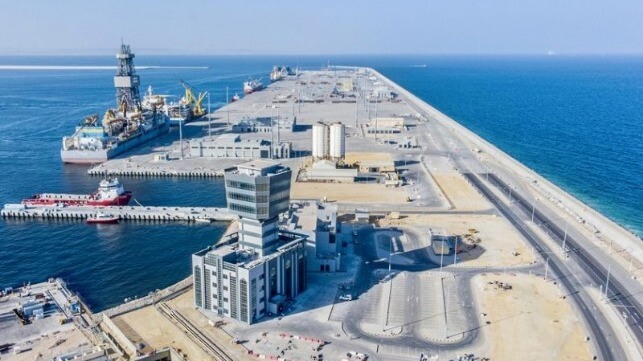
Port of Duqm and site of the hydrogen export terminal (Foreign Ministry of Oman)
Oman is promoting the adoption of a green hydrogen maritime corridor from a loading terminal in Duqm through to the port of Amsterdam as an initiative to support the International Maritime Organisation achieve its Net Zero greenhouse gas targets by 2050. Green hydrogen is to be produced on a net-zero basis using energy from solar and wind farms in the hinterland of Duqm, and processed in the port area.
Development of a pioneering transmission corridor to take the fuel through to Europe will necessitate the solution of a number of regulatory and technical problems associated with the adoption of hydrogen for bunkering. It is anticipated that it will, in turn, prepare the way for the rollout of hydrogen supply chains as an integral element of critical maritime infrastructure.
The green hydrogen maritime corridor initiative was the subject of an agreement between the Netherlands and the Sultanate of Oman made in May, when Sultan Haitham visited the Netherlands on a state visit. Sultan Haitham made a similar agreement when visiting Belgium last year, and the corridor concept thus also embraces offload points in the Port of Antwerp, with an onward shipment network to the Port of Duisburg on the Rhine. A similar green hydrogen maritime corridor is under development to link Algeciras in Spain with Rotterdam.
For the concept to be realized, and then utilized across the whole of the global maritime community, the project will need to create a harmonized safety regulation regime for hydrogen bunkering. Technical standards and solutions also need to be developed to support hydrogen-fueled ship operations, and the handling of hydrogen terminal operations in port. These issues, and the current lack of international standards, are already being considered by the Maritime Technologies Forum. A project management framework also needs to be developed to support the launch of port infrastructure development projects, the lack of which, from a financial and engineering perspective, is a hindrance to efficient progress.
In August, BP upped its stake in one of the green hydrogen consortia awarded contracts to operate through Duqm, increasing its share in the Hyport Duqm green hydrogen project to 49 percent, with Belgium’s DEME and the Omani sovereign wealth fund OQ each retaining a 25.5 percent stake.
The Hydrom Duqm project is in the pre-engineering design phase, and commercial operations utilizing the green hydrogen maritime corridor to Europe are scheduled to commence in 2030. It is too early to estimate which of the consortia awarded green hydrogen mandates will be the first into production, but BP’s move underlines the oil major’s confidence in Oman’s overall green hydrogen strategy.
Molgas Completes Full Acquisition of Titan Clean Fuels
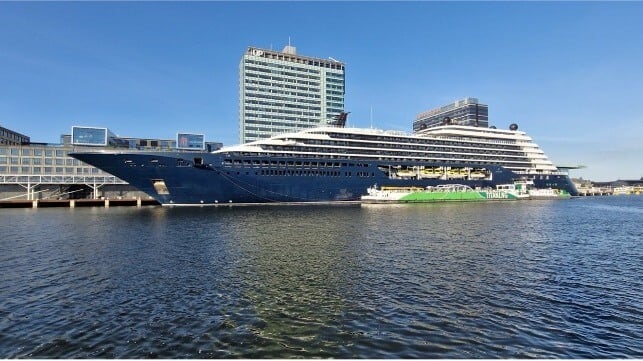
Titan ship-to-ship bunkering of Ritz-Carlton Yacht Collection's Ilma
Molgas Energy Group (“Molgas”), backed by infrastructure investor InfraVia, has finalized the full acquisition of Titan Energy Holding, parent company of Titan Clean Fuels (“Titan”). The transaction, which follows Molgas’ initial 45% minority stake, marks a major step forward in the Group’s strategic growth in the clean marine fuels sector.
Titan is a leading independent supplier of liquefied biomethane (LBM/bio-LNG) and LNG, serving both maritime and industrial customers. Its fleet of small-scale bunkering vessels operates across key global markets, with a strong base in the Northwest European region. Titan’s LNG bunkering operations will merge with Molgas’ existing operations in Norway and all truck-to-ship supply across Norway and continental Europe will now be combined.
With the integration of Titan, the Molgas Energy Group now operates a fleet of seven LNG bunkering vessels and manages a proprietary network of over 70 road-fuelling stations, with more than 200 points of sale including associated partner stations. This expanded footprint positions Molgas as a pan-European leader in downstream LNG and bio-LNG solutions for industrial, road transport, and marine customers.
The acquisition comes at a time of accelerating momentum for clean fuels. LNG and bio-LNG are increasingly recognized as scalable, low-emission alternatives that can play a vital role in decarbonizing both shipping and heavy-duty road transport. With tightening regulations, like EU ETS and FuelEU Maritime, and therefore growing demand for sustainable energy, Molgas and Titan are well-positioned to lead the transition toward cleaner mobility and logistics.
Following the transaction, Niels den Nijs will lead Molgas’ Marine Business as Executive Vice President, Marine. He will oversee all marine activities, delivering integrated end-to-end ship-to-ship and truck-to-ship bunkering services across Europe.
Sofoklis Papanikolaou, CEO of Molgas, commented: “Niels and the Titan team started as true pioneers, showing remarkable innovation and have grown Titan into one of the sector’s most reliable LNG bunkering operators. The success of our initial collaboration laid the groundwork for this acquisition, which significantly extends our reach and capabilities. We are welcoming to the group a very experienced team, with leading specific expertise in marine fuels and decarbonisation. Together, we will build a robust platform to deliver LNG and bio-LNG solutions across Europe and beyond.”
Niels den Nijs, CEO of Titan, added: “From the start, our partnership with Molgas was a strong strategic fit and I’m very happy to join their board. By joining forces fully, we substantially strengthen our balance sheet and joint commercial reach. Together, we will scale our clean fuel solutions for the maritime sector at a time of accelerating demand and regulatory tail winds. This integration allows us to better serve our long-term customers with an unrelenting focus on our mission: to deliver economical fuel at scale to help decarbonize shipping.”
Athanasios Zoulovits, Partner at InfraVia Capital Partners, said: “As the maritime industry undergoes a major transformation, Titan’s expertise positions Molgas to lead in delivering scalable clean marine fuel solutions. We are proud to support Molgas in its mission to accelerate the energy transition across industrial, mobility, and maritime markets.”
Jogchum Brinksma, Chairman of the board, Titan concluded: “It has been a pleasure to oversee the steep growth of Titan as chairman of the board and I am extremely pleased with these partners for Titan. This move will help propel the company towards a globally important strategic position, rising to the scale needed to lead the alternative fuels transition.”
While Titan is open to supplying customers with any alternative fuels that can realistically deliver towards decarbonization today, it recognises the practical route to net-zero shipping emissions that LNG, LBM and e-methane offer right now. It collaborates with shipowners and operators to create clean fuel delivery programs that are flexible, safe, and cost-effective today.
The products and services herein described in this press release are not endorsed by The Maritime Executive.
Maersk Tests Adding Ethanol to Methanol to Enlarge Fuel Availability
Laura Maersk, a smaller feeder ship, provides a test ground for Maersk now with the ethanol-methanol blend (Maersh)
Maersk reports it is continuing to test new steps that it can use to address issues within the supply of alternative fuels. The latest trial is using a blend called E10 (10 percent ethanol mixed into the methanol supplied to its dual-fuel vessel) as a possible means of enlarging the availability and sourcing pool of methanol for its dual-fuel fleet.
The company reports the test has recently begun on the Laura Maersk, its smaller (2,100 TEU) methanol dual-fuel feeder ship operating in the Baltic region. The company says that for three years the vessel has operated on methanol with no problems. The smaller ship provides them a test ground to explore new concepts that might be applied to the larger 16,000 TEU dual-fuel vessels in the future.
The trial of E10 involves mixing 10 percent ethanol into the fuel being loaded onto the Laura Maersk with 90 percent methanol. The current bunkering with E10 they report will provide a month to a month and a half of operating data.
They will be looking at a range of issues to see if the ethanol mix creates differences versus the operating experience over the past three years. Specifically, they will look at ignition quality, the way the fuel is burning, and if there are issues or differences in corrosion and lubricity (friction).
A critical area they will also be looking at is the emissions. Are there differences versus pure methanol combustion? The impact of the E10 on NOx emissions, the company also says, is critical.
Maersk and others in the industry have confirmed that the availability of methanol remains one of the key challenges in the adoption of the alternative fuel. Operating a shorter route within the Baltic and Scandinavia has permitted Maersk to use the Laura Maersk for tests.
The company will study the data from the E10 trial. They will consider how it might impact the operation of the larger vessels as Maersk continues the introduction of the big dual-fuel methanol containerships. It completed the introduction of the first series in May 2025 with a dozen large vessels, and it has also converted one large vessel to methanol capabilities.
Philippines: Minervagracht Crew Wasn't Given Chance to Avoid Gulf of Aden
MLC provides seafarers a right to disembark before entering high risk and warlike operations areas
Damage to the Minervagracht after the Houthi missile strike (Armee Francaise)
The Filipino seafarer who lost his life in the Houthi attack on the freighter Minervagracht was never advised of his right to disembark before coming within range of the terrorist group's missiles, according to the head of the Philippines' Department of Migrant Workers (DMW).
The Maritime Labor Convention (MLC) gives seafarers the right to be repatriated if "the ship is bound for a war zone to which the seafarer does not consent to go." The International Bargaining Forum (IBF) of the MLC has recognized the southern Red Sea, Bab el-Mandeb and all of the Gulf of Aden as a "warlike operations area," where this right to repatriation applies.
The Philippines - a leading seafarer source country - has enacted domestic regulations that implement this section of the MLC for Filipino seafarers, with additional reporting requirements. The DMW has recognized MLC's right to "refuse to sail," protecting Filipinos from being penalized if they ask to be repatriated instead of sailing into a high-risk zone. It also provides for two months' of salary and free transport home. On top of the MLC standards, it also requires maritime employers to report to DMW any planned transits of high risk or warlike zones, with a complete list of the Filipino seafarers aboard and an explanation of why the ship couldn't avoid the area.
The policy was created in response to the Red Sea crisis in 2024, and DMW followed up with several circulars advising shipowners to avoid the region and reminding them of the order's requirements, the most recent of which was published in July.
Migrant Workers Secretary Hans Leo Cacdac told Global Filipino Magazine that the Filipino members of Minervagracht's crew were not informed of their right to refuse ahead of the ship's entry into the Yemen warlike operations area. Nor, he alleged, did the vessel operator follow Philippine rules requiring a report to DMW about the planned transit ahead of time.
"They were ordered to pass through there without observing the procedure that required them to be questioned and given the opportunity not to board the ship that would pass through the Gulf of Aden," he told the outlet.
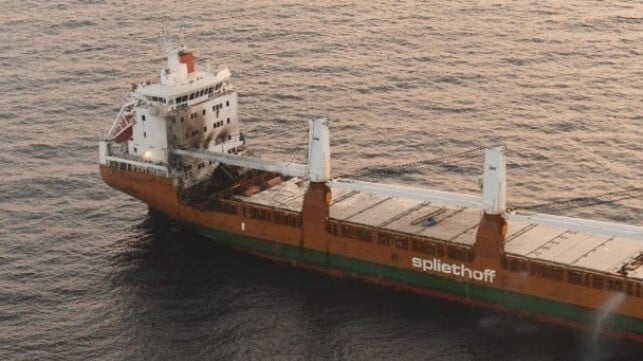
Cacdac has traveled to Djibouti with the victim's family in order to accompany the crewmembers' remains home. Operator Spliethoff has extended its condolences to the family of the seafarer, and said it was assisting the family.
TAKE THAT TRUMP!
California Approves $42.75M for Port Development to Support Offshore Wind
rendering of the proposed Pier Wind project at the Port of Long Beach
The California Energy Commission approved $42.75 million in grants to five of the state's ports to support the development of port facilities for the staging, assembly, and maintenance of offshore wind farms. The monies are coming from a climate bond measure approved by the state's voters and is part of a total of $136 million in new clean energy technology investments approved by the commission while highlighting that it was bucking the Trump administration’s efforts to derail clean energy initiatives in favor of fossil fuel.
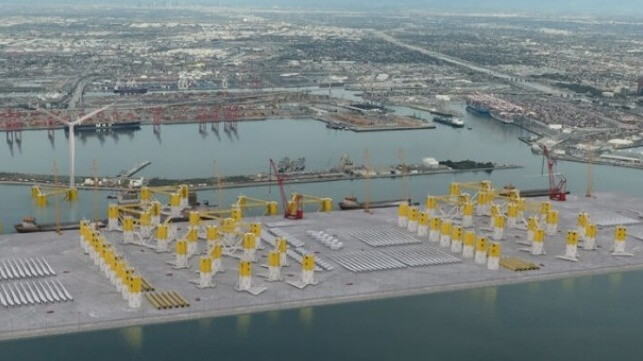
The largest of the awards, $20 million, is going to the Port of Long Beach, which has proposed devoting 400 acres within the port to Pier Wind, a staging, storage, and assembly facility for floating offshore wind turbines. Other grants were awarded to Oakland, Richmond, Port San Luis, and Humboldt Bay.
Six weeks ago, the U.S. Department of Transportation announced that it had withdrawn or terminated a total of $679 million in funding for 12 offshore wind projects across America. Calling the grants “wasteful,” DOT said it would redirect federal monies to other projects. Among the ones it withdrew was nearly $427 million previously awarded to Humboldt Bay Offshore Wind.
“California’s offshore wind energy goals cannot be achieved without onshore development at port facilities like Pier Wind, which will create thousands of manufacturing jobs across the U.S.,” said Long Beach Harbor Commission President Frank Colonna. “We are grateful for this state funding to make offshore wind a part of California’s energy portfolio.”
The Port of Long Beach has been pushing forward with environmental reviews and soliciting community input for its proposed Pier Wind. With news of the state grant, the Port of Long Beach announced it would match $11 million to complete engineering, environmental, business planning, and community outreach for Pier Wind. The proposed facility, which would cost $4.7 billion, is seen as a critical part of the state’s plan to generate 25 GW of offshore wind energy by 2045.
Construction on Pier Wind could start, the port said, as soon as 2027. The first 200 acres could be completed by 2031, and the final 200 acres would come online by 2035.
The state is also awarding $18.25 million in grants to Humboldt Bay. The grant will help to advance the design of the Humboldt Bay Offshore Wind Heavy Lift Terminal. Humboldt Bay is near one of the two wind areas leased by the Biden administration.
Another $3 million was awarded to the Port San Luis Harbor District. The project will build upon the feasibility efforts already undertaken to develop an operation and maintenance terminal for offshore wind.
The cities of Oakland and Richmond are each receiving grants of $750,000. The Port of Oakland will conduct a technical feasibility assessment to identify, evaluate, and design a project to redevelop an underutilized area. The goal is to improve site readiness for the offshore wind supply chain and logistics operations. Richmond will conduct conceptual design and preliminary engineering to evaluate, plan, and design purpose-built offshore wind infrastructure.
California is pushing forward with its strategy, ignoring what it calls Trump’s focus on the past for energy. The state is seeing rapid growth in solar and battery storage projects and is devoting money to developing more EV charging and expanding battery storage and next-generation clean energy technologies. The state highlights that it is on the verge of eliminating coal from its power supply.
The new grants are the first release of money from the Proposition 4 climate bond, and the state plans to release more funding in the future. The Port of Long Beach said it will seek additional proceeds from the bonds as it works to push forward with Pier Wind.
Wind Turbine Installation Vessel
Seatrium Considers Legal Action After Maersk Terminates Order for WTIV
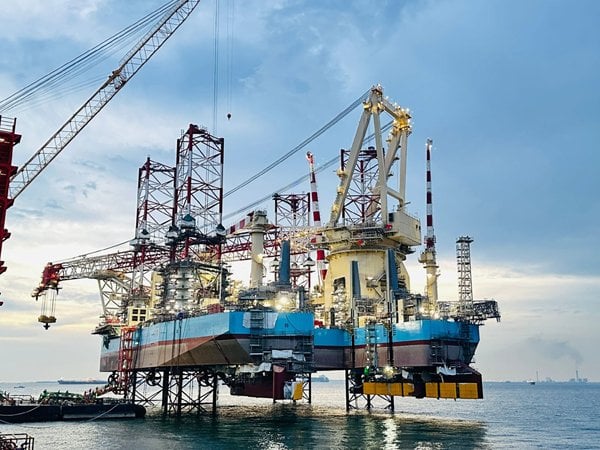
Maersk Offshore Wind's WTIV during May 2025 float out in Singapore (Maersk Offshore Wind)
Singapore shipyard group Seatrium has been hit with a surprising contract termination notice for Maersk Offshore Wind's nearly completed wind turbine installation vessel. The companies had been hailing the vessel, which uses an innovative design, reporting that it is nearly 99 percent complete.
Seatrium announced that it had received a notice of termination on October 9 from Maersk Offshore Wind, nearly three and a half years after the vessel was contracted. It said the contract is valued at approximately $475 million and that it would be reviewing the terms of the contract and “allegations” in the notice of termination. Maersk Offshore Wind, which is owned by A.P. Moller Holdings, is reportedly citing delays and "construction issues."
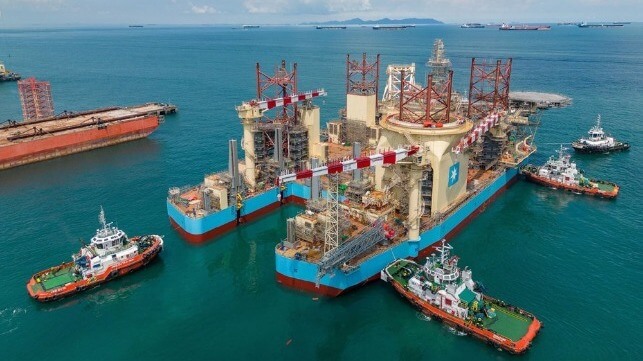
Maersk terminated the contract five months after celebrating the float out of the vessel at Seatrium yard in Singapore. The vessel, which is approximately 475 feet (145 meters) in length, was floated from the building dock and repositioned to the outfitting berth in May, where it was being prepared for its crane installation. Last month, Maersk Offshore Wind released photos showing the vessel in its jack-up position and reported the “pioneering locking system” had been installed.
The vessel has been described as futuristic with capabilities to meet the needs of the U.S. offshore wind industry, including handling the largest offshore wind turbines and improving installation efficiency by up to 30 percent. It is designed to “dock” feeder barges carrying equipment from the staging sites and ensure stability during the loading using the locking system.
Vessel with its locking system installed (Maersk Offshore Wind)
Maersk Offshore Wind has also partnered with Edison Chouest Offshore for the construction of a purpose-built windfarm feeder spread, specifically designed for pairing with the Maersk Wind Installation Vessel. This custom-built feeder spread includes two tugs and two barges, both U.S.-flagged, that will be owned and operated by Edison Chouest and constructed by Bollinger Shipyards.
The vessel is under contract to Equinor to deploy at the Empire Wind offshore wind farm. The project, which is located 15 to 30 miles south of Long Island, New York, started offshore work in May after resolving a stop work order from the Trump administration. The installation calls for 54 15MW turbines and was due to start in 2026, with first power before the end of the year, and completion in 2027.
“Seatrium is currently reviewing the validity of the notice of termination, as well as the allegations set out therein. Seatrium is also evaluating its legal and commercial options in respect of the contract, including the right to contest the notice of termination, and/or to commence legal proceedings to seek all available remedies for wrongful termination,” the company said in a notice of the termination.
Seatrium said it now intends to “explore viable solutions,” including raising the matter with the end-customer, Empire Offshore Wind.
Discovery of WWII-Era Bomb Stops Operations at Port of Long Beach Terminal
World War II-era shell was found a Pier G on the lower right of the photo (Port of Long Beach)
Construction workers digging at the Port of Long Beach made a surprising discovery on Wednesday, October 8, of what was later determined to be a World War II-era shell buried in the port. The discovery caused a temporary suspension of work at one of the terminals located on Pier G.
According to the Long Beach Post, the discovery was made near the southern edge of the port complex, where crews had been digging as part of an ongoing construction project in the port complex. The Los Angeles County Sheriff’s Office Bomb Squad was called in to investigate, and they were aided by a unit from the U.S. Marine Corps.
The police evacuated the terminal and set up a safety perimeter. All work was suspended at one of the six terminals in the port during the investigation.
The Long Beach Post highlighted that the area had once been a U.S. Navy base, which operated from 1919 to 1997. The Navy used the port for its aircraft carriers, battleships, and other vessels. The Port of Long Beach later redeveloped the area as it expanded its container operations.
The bomb square reported that it appeared to be a World War II-era shell that had been buried in the complex. They determined that the device was safe to transport, and the U.S. Marine Corps unit moved the device out of the port.
Work at the terminal resumed on Wednesday evening.
Finnish Prosecutors Appeal Court Ruling on Eagle S Cable-Damage Case
Finnish authorities retrieve Eagle S' lost anchor from the bottom of the Gulf of Finland
Prosecutors in Finland are appealing a lower court ruling that found that the nation does not have any legal jurisdiction over subsea infrastructure sabotage within its exclusive economic zone. The ruling brought a halt to the trial of three officers from the shadow fleet tanker Eagle S, which severed multiple Finnish-owned subsea cables in the Baltic last December.
The court found that proper jurisdiction over incidents in international waters belongs to the seafarers' state of citizenship or to the flag state - in this case, the Cook Islands, a Paris MOU gray list registry with a commercial manager and a reputation for Russian "shadow fleet" services. So far, the registry has not taken any public action against Eagle S in connection with the case.
The court's decision means that Finland is on the hook for the defendants' legal fees of about $200,000. Further, the shipowner is considering a multimillion-dollar civil suit against Finnish authorities for the diversion, boarding and detention of the vessel.
The circumstances of the case have many maritime legal observers concerned that there is a dangerous loophole in the UN Convention on the Law of the Sea. If the coastal state has no jurisdiction over subsea infrastructure outside of the 12-mile line, and a ship can flag with a highly permissive open registry, there is no legal means of prosecuting sabotage in international waters.
"As long as you have a flag state that doesn't care, you can now count on the freedom of navigation to continue to break cables without consequences. This means that no one can do anything about it. This is completely unreasonable," Henrik Ringbom, professor of maritime law at Åbo Akademi University, told YLE.
Australia Reports on Bulker’s Engine Shut Down in Busy Port Hedland
Fast action by the pilot and tugs prevented the massive bulker from grounding (ATSB photo)
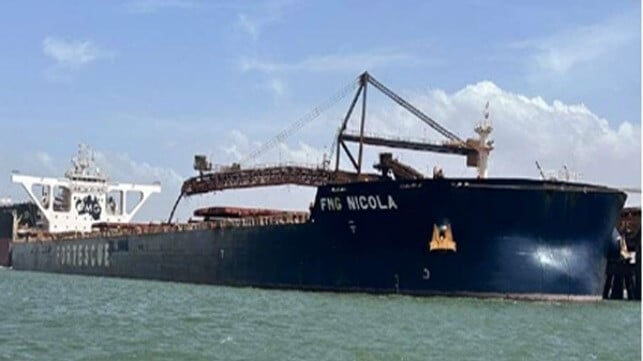
The Australian Transport Safety Bureau (ATSB) has released its interim report on the incident involving bulk carrier FMG Nicola (260,840 dwt) while departing Port Hedland in Western Australia in February this year. It details how an iron ore carrier nearly caused a major blockade of a busy shipping channel that provides access to the world’s largest bulk export port, and the quick response.
The 327-meter (1,073-foot) Singapore-flagged vessel lost propulsion after her engine shut down due to what investigators have established was a faulty switch monitoring the main engine’s lubricating oil pressure. The ship, fully laden with iron ore, was saved from grounding by tugs and the fast response of the pilot overseeing the outbound trip.
The massive vessel, which was built in 2016 and operates for Australia’s Fortescue Metals Group, could easily have blocked the busy channel that provides access to Port Hedland. It is the world’s largest bulk export port by tonnage, handling over 500 million tonnes of cargo annually. While more than 95 percent of the volume is iron ore, the port also handles exports of salt, manganese, copper concentrates, lithium minerals, and livestock, with more than 6,000 ship movements each year.
Access to Hedland is through the single 22?mile dredged channel that allows only one large ship to pass at a time. For most laden ships, particularly capesize ships such as FMG Nicola, the use of the channel is restricted by tidal conditions. The incident, which happened on February 7, took place within the 10?mile section of the channel that is closest to the port, an area prone to strong tidal flows and with particularly confined spaces.
“A disabled ship can strand on a receding tide as well as blocking the passage of other ships. Depending on departure times, separation between ships and the location of an incident, up to three additional ships could be committed to, or within, the channel and exposed to this hazard at a given time,” said Angus Mitchell, ATSB Chief Commissioner.
Though the investigation is ongoing, ATSB’s interim report provides the details of the incident involving Nicola and a well-organized response. At 0832 local time, the bulker completed loading over 237,000 tonnes of iron ore at its berth in Hedland and was due to depart for Dongjiakou, China, that same afternoon.
By 1348, the ship’s main engine and steering had been tested, and the master-pilot information exchange was completed in preparation for the departure. Four tugs were secured to assist the ship through the port’s single shipping channel. The ship departed at 1412, and 30 minutes later, she was progressing along the channel as planned.
At about 1516, FMG Nicola’s main engine suddenly shut down while she was moving at a speed of 8.3 knots. The pilot quickly informed the tug masters that the ship had lost propulsion and directed them to help keep it in the channel. Luckily, two tugs were still secured, and a third was nearby.
The report highlights that the engine had shut down due to a faulty switch monitoring the main engine’s lubricating oil pressure. Over the next half hour, the ship neared the western and then the eastern side of the channel, before travelling along the channel’s eastern edge as it slowed gradually. The efforts by four tugs prevented the ship from grounding, something that would have resulted in blocking the channel.
The ship’s engineers identified that the engine had shut down as the “main bearing and thrust bearing lubricating oil pressure low” non?cancellable trip had activated. They determined that it had activated due to the faulty operation of the pressure switch. After confirming all engine systems were operating normally, the engine trip lockout system was reset and, at 1523, the engine was restarted at dead slow ahead.
About 35 minutes after the shutdown, the ship had been moved away from the channel side, and its main engine speed had progressively been increased to full ahead, enabling the ship to continue her voyage to China. No damage or injuries occurred during the incident.
ATSB will publish its final report detailing the analysis and findings upon the conclusion of the investigation.
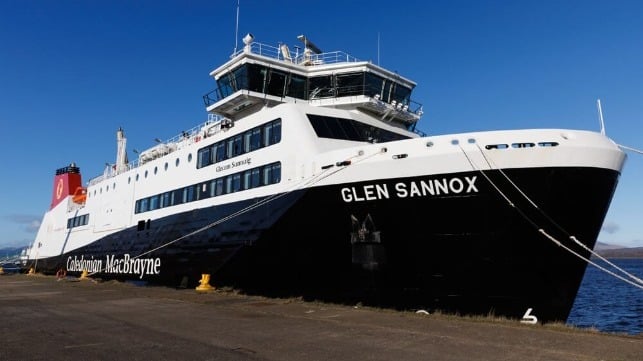
Troubled Ferry Glen Sannox Pulled From Service Over Repeated Cracking
CalMac's ill-starred ferry Glen Sannox is suffering repeated hull cracking issues just eight months after delivery, and the problem is related to an unresolved and severe vibration issue in her propulsion system, according to Scottish paper The Herald.
It has been a long road for the Glen Sannox project, and an illustration of the difficulties of starting a national shipbuilding program. Shipyard Ferguson Marine started work on the CalMac ferry in 2015, went bankrupt after serious design flaws emerged, and was nationalized in 2019. After a long saga of rework, budget hikes and personnel changes, the ferry finally entered service in January 2025, six years behind schedule and four times over budget. It has been in and out of repair status ever since.
In March, Glen Sannox was pulled from service after a five-inch-long hairline crack was discovered in a weld seam on the hull, in way of the steering gear compartment near the waterline. Repairs were completed shortly after, and following a dive inspection the ferry was cleared to sail again.
Last week, a new crack was discovered in the same area, and the Glen Sannox has been pulled from service through at least October 13. The Herald reports that CalMac is consulting with marine engineering experts at home and abroad in search of a permanent solution. The crack is believed to be caused by a vibration issue in the same specific area.
Passengers confirmed that the ship had severe vibration at the stern during certain evolutions. "Anyone who has been on the ship, particularly in the aft end of passenger space while maneuvering, could have worked that out," commented passenger Sam Bourne, a local resident, in a social media post. "It was vibrating so badly it would literally shake the coffee out of your cup."
One passenger video shows the rails of a ladderway visibly shaking from heavy vibration near the stern.
The source of the vibration has not been published, but the Herald reports that it is related to a propeller issue. Glen Sannox is fitted with a stern thruster to help handle strong currents and winds on the beam, and she has twin controllable pitch propellers.
TSB: Barge Stability Drops Off Dangerously When Overloaded
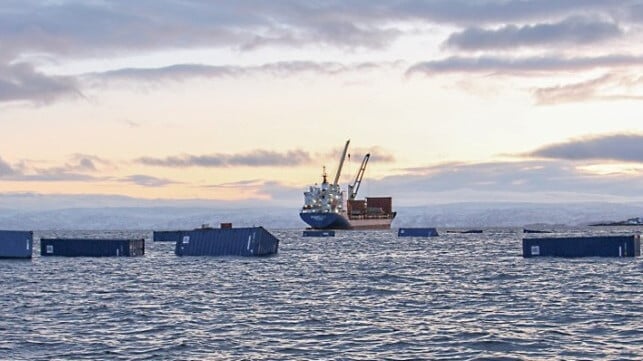
Barges adrift in frigid water off Iqaluit, Nunavut, Oct. 2023 (TSB)
Canada's Transportation Safety Board is advising mariners to keep in mind the differences in stability between flatbottomed barges and seagoing hull shapes. A properly-loaded barge is highly stable at low angles of heel, but its righting moment tails off sooner and more abruptly than a ship's, leaving it vulnerable to capsizing once tipped - as experienced by the crew of the Arctic sealift ship Sivumut at Iqaluit, Nunavut two years ago.
The Sivumut is a geared freighter used to serve outposts in the Canadian Arctic. It carries two deck barges, Tasijuaq I and II, which are used for lightering off cargo for delivery to coastal villages. Upon deployment, the two barges are lashed together into a single unit with rods, hooks and cleats, and used as a single vessel throughout the operating season. The cargo is loaded towards the center of the barge and is not secured before making a gentle tow to shore, where the barges are beached and the cargo removed.
On October 27, Sivumut's crew were offloading cargo in Frobisher Bay, a sheltered inlet near Iqaluit. The shipowning company's CEO was on board for a visit.
At about 1430, in a routine evolution, they laid down 12 containers on the barge Tasijuaq's deck alongside the ship, then another tier of 12 on top. At this point, the barge was carrying about 340 tonnes and listing slightly to port. When the tug came alongside and took the barge on the hip for transit to shore, the tug's bow bumped into the barge's starboard side. Tasijuaq heeled to port; swayed back; then slowly heeled to port again and kept going.
As the unsecured cargo on deck slid to port, the barge began to capsize. The lines connecting it to the tug parted, and 23 out of 24 containers went into the water, along with a deckhand from the tug. As the barge's load lightened, it righted itself and returned to upright.
The tug master cast off the remains of the lines and went searching for the deckhand, who was drifting in ice-cold water along with the containers. He was found unconscious within about five minutes, floating with his PFD inflated. The tug master jumped atop a floating container to reach and retrieve him, and with the assistance of other crewmembers, he hauled the deckhand up onto the container. The victim was injured and suffering from hypothermia, and was treated by local physicians before a medevac to Ottawa for higher care.
The barge was retrieved promptly after the deckhand was recovered, and the crew immediately went after the lost cargo. Ultimately 10 boxes were recovered in a dynamic operation over several days; the remainder had to be left because the navigation season was ending and winter conditions were coming.
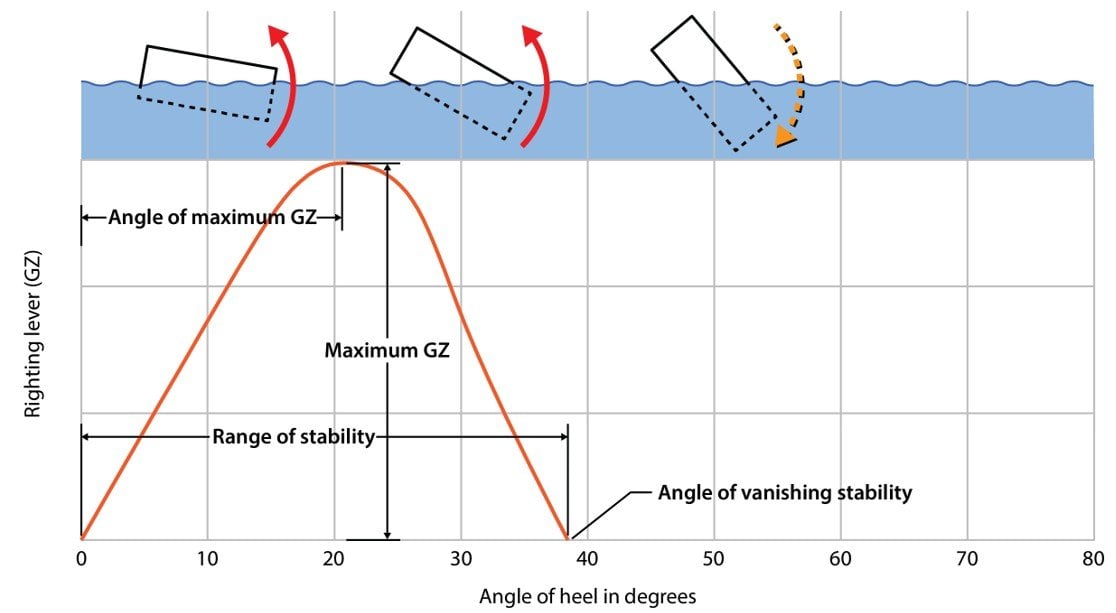
After the casualty, TSB calculated that the barge (as laden) had a positive GM of about two feet, and an angle of vanishing stability of less than three degrees of heel - after which it would likely capsize. This is a fraction of the 20-degree international code requirement for small barges, even if the barge's GM was positive.
Tasijuaq was carrying about 130 tonnes more than it was rated for in its structural arrangement plan, a copy of which was not carried aboard (carriage is not required by Canadian law). The crew and the master were not aware of the barge's limitations as described in the plan.
"Vessels with relatively wide hulls and flat bottoms, such as barges, typically have a higher initial GM and a steep righting lever (GZ) curve (peaks at smaller angles), and the range of stability is much less than a traditionally shaped vessel," TSB cautioned. "It is therefore important to ensure that the stability characteristics and loading limits are established and that the cargo crew are familiar with them."
GZ versus angle of heel for a typical flat-bottomed barge (TSB)