Monday, December 08, 2025


RSS Research Award for new lidar technology for cloud research


Leipzig researcher honoured for dissertation on new remote sensing technology

\


Leibniz Institute for Tropospheric Research (TROPOS)

Reinhard Süring Foundation Research Award 2025 

image: 

Presentation of the Reinhard Süring Foundation Research Award 2025 to Dr. Cristofer Andrés Jiménez from TROPOS.

view more 

Credit: Martin Radenz, TROPOS


Potsdam/Leipzig. The Reinhard Süring Foundation's 2025 Research Award goes to Leipzig-based atmospheric researcher Dr. Cristofer Jiménez for his contributions to a remote sensing technology that makes it possible to study the interactions between particles and clouds much better than ever before. The so-called dual-field-of-view polarisation lidar is based on two different aperture angles, which are used to observe and compare the reflections of laser beams in the atmosphere. Every three years, the Reinhard Süring Foundation Research Prize honours young scientists for outstanding work in a subfield of meteorology. In 2025, the prize was awarded for "New techniques, methods and applications of remote sensing of the atmosphere".


Dual-field-of-view polarisation lidar technology is comparable to a camera with two lenses with different aperture angles (fields of view). This allows the reflections of the laser light to be received from different angles, enabling the multiple scattering process to be investigated. These measurements can then be used to determine, for example, the size of the water droplets in the lowest areas of the cloud.

"The new dual-FOV lidar technology provides robust and accurate microphysical information on the liquid phase in clouds through active remote sensing for the first time," emphasises Dr Albert Ansmann from the Leibniz Institute for Tropospheric Research (TROPOS), who supervised the work. The innovative technology has already motivated other groups in Europe, America and, above all, China to adopt this method.


While still a doctoral student, Cristofer Jiménez retrofitted five of the TROPOS lidar devices used worldwide with dual-FOV lidar technology, thereby playing a major role in enabling the institute to carry out cloud measurements in very different regions: Punta Arenas in southern Chile (in the very clean southern hemisphere), Dushanbe in Tajikistan (in the dust-laden and anthropogenically polluted atmosphere of Central Asia), Limassol in Cyprus (in a maritime atmosphere with high levels of Saharan dust and anthropogenic pollution) and Mindelo in Cape Verde (in the exhaust air area of West Africa with high levels of desert dust and biomass combustion aerosols). Continuous measurements in very different regions provide new insights into the interactions between aerosols and clouds. In addition, measurements are taken with several instruments on the research icebreaker Polarstern in the Atlantic, in the Arctic (MOSAiC expedition) and in the Antarctic (Neumayer III Station). "This now enables us to document the life cycles of mixed-phase clouds as a function of the ice and liquid phases and the interaction between the two phases on the basis of real measurements. These new insights into stratiform mixed-phase clouds help us to model our atmosphere more accurately and to better understand climate development," Ansmann praises.


Cristofer Andrés Jiménez studied physics at the Universidad de Concepción and wrote his master's thesis at the Centre for Optics and Photonics in Concepción, Chile. In 2014, he received a scholarship from the German Academic Exchange Service (DAAD) and Becas Chile to pursue his doctorate at the University of Leipzig and TROPOS, where he has been conducting research ever since. After modernising the portable lidar devices, Jimenez recently turned his attention to expanding the stationary lidar device at TROPOS in Leipzig: MARTHA ("Multiwavelength Atmospheric Raman Lidar for Temperature, Humidity, and Aerosol Profiling") was equipped with an additional channel that can observe fluorescence, enabling the reliable detection of forest fire particles in the atmosphere.


After more than 10 years in Leipzig, Cristofer Andrés Jiménez will soon return to his native Chile, where he will set up a TROPOS lidar device at the Universidad de Concepcion to study smoke-cloud interactions.  The unique location in central Chile promises important insights into the effects of forest fires in South America on the atmosphere and climate.


Since 2008, the Reinhard Süring Foundation (RSS) has been sup

porting young researchers in the field of meteorology in collaboration with the German Meteorological Society (DMG). Reinhard Joachim Süring (1866-1950) was one of the most important German meteorologists in the first half of the 20th century. Under his leadership, the Potsdam Meteorological Observatory became a cloud research centre of international renown. His record-breaking free balloon flight in 1901 paved the way for the discovery of the stratosphere by Aßmann and Teisserenc de Bort in 1902. The "Lehrbuch der Meteorologie" (Textbook of Meteorology), co-edited by Süring, was the standard work for generations of German-speaking meteorology students.

Tilo Arnh


MARTHA 

MARTHA ("Multiwavelength Atmospheric Raman Lidar for Temperature, Humidity, and Aerosol Profiling") is the largest and oldest lidar at TROPOS in Leipzig. It emits laser light at three wavelengths (355, 532 and 1064 nanometres) and collects the backscattered light with a large main mirror measuring 80 centimetres in diameter.

Credit

Cristofer Jiménez, TROPOS


AI advances robot navigation on the International Space Station


Stanford University
Astrobee 

image: 

Astrobee is NASA’s free-flying robotic system. Using Astrobee, Stanford researchers became the first to test AI-based robotic control aboard the International Space Station. | NASA

view more 

Credit: NASA


I


Imagine a robot about the size of a toaster floating through the tight corridors of the International Space Station, quietly moving supplies or checking for leaks – all without an astronaut at the controls. Such technology could free up valuable time for astronauts and open new opportunities for robotics-based exploration. That sci-fi vision is coming closer to reality now that Stanford researchers have become the first to show that machine-learning-based control can operate aboard the ISS.

New research, published in and presented at the 2025 International Conference on Space Robotics (iSpaRo), introduces a system designed to help Astrobee, a cube-shaped, fan-powered robot, autonomously navigate the International Space Station. The ISS is a complex environment made up of interconnected modules filled with computers, storage, wiring, and experiment hardware. This makes planning safe motion for Astrobee far from trivial, said Somrita Banerjee, lead researcher who conducted this work as part of her Stanford PhD.

The traditional autonomous planning approaches that have gained traction on Earth are largely impractical for space-rated hardware. “The flight computers to run these algorithms are often more resource-constrained than ones on terrestrial robots. Additionally, in a space environment, uncertainty, disturbances, and safety requirements are often more demanding than in terrestrial applications,” said senior author Marco Pavone, associate professor of aeronautics and astronautics in the School of Engineering and director of Stanford’s Autonomous Systems Laboratory.

Despite these challenges, the team pushed the field forward with a noteworthy space research achievement. “This is the first time AI has been used to help control a robot on the ISS,” said Banerjee. “It shows that robots can move faster and more efficiently without sacrificing safety, which is essential for future missions where humans won’t always be able to guide them.”

Training AI for space

Banerjee compares the challenge of optimizing Astrobee’s routes through the ISS to planning a road trip from San Francisco to Los Angeles: You want the fastest path, the most energy-efficient one, and, above all, a safe one.

To tackle that task in the ISS’s compact environment, the team’s route planning system relies on a traditionally used optimization method called sequential convex programming, which breaks a difficult planning problem into a series of smaller, simpler steps. This process is designed to produce a final trajectory that is safe and feasible. However, solving each step from scratch can be demanding for Astrobee’s onboard computer and can slow the process – one of the key limitations of conventional techniques.

With the aim of speeding things up, the team enhanced their system with a machine-learning-based model that they trained on thousands of past path solutions. The model can reveal patterns such as where a corridor always exists and where obstacles tend to be. Providing the robot with foundational knowledge before further refinements is known as a “warm start.” The optimization technique still enforces all the safety constraints; the machine learning model just helps it reach the answer much faster.

“Using a warm start is like planning a road trip by starting with a route that real people have driven before, rather than drawing a straight line across the map,” Banerjee said. “You start with something informed by experience and then optimize from there.”

A milestone for AI in space

Before sending their AI to space, the team applied the system to a special testbed at NASA Ames Research Center. There, they had the AI model operate a robot similar to Astrobee, as it floated just above the surface of a granite table, buoyed by compressed air that mimics partial microgravity. “It’s like a puck on an air-hockey table,” Banerjee said.

When the real test day arrived, the Stanford team joined by video call while astronauts on the ISS completed what NASA calls a “crew-minimal” setup. The astronauts handled only preparation and cleanup, then stepped aside. For the next four hours, Banerjee sent instructions to ground operators at NASA’s Johnson Space Center in Houston. Then, the NASA team relayed the commands to Astrobee, specifying its starting point and destination, simulating obstacles to avoid, and trying both warm and cold starts. Multiple safety measures kept the experiment secure, including replacing physical obstacles with virtual ones to eliminate collision risk, maintaining a backup robot, and allowing operators to abort a run if necessary.

This is the first time AI has been used to help control a robot on the ISS. It shows that robots can move faster and more efficiently without sacrificing safety, which is essential for future missions where humans won’t always be able to guide them.

Somrita BanerjeeLead Researcher

The team tested 18 trajectories, each lasting more than a minute. Each was run twice: first with a cold start using the standard planning method, and then with a warm start, where the AI provided a first draft of the path that the system could quickly adjust.

The tests showed that giving Astrobee a warm start significantly sped up motion planning. “We showed that it’s 50 to 60% faster, especially in more challenging situations,” Banerjee said. Those harder cases included cluttered areas, tight corridors, and maneuvers requiring rotation instead of a straight path.

Watching Astrobee in orbit was a deeply personal experience for Banerjee. “The coolest part was having astronauts float past during the experiment,” she said. “One of them was one of my childhood heroes, Sunita Williams. Seeing years of work actually perform in space and watching her there while the robot moved around was incredible.”

The future of robots in orbit

After their experiment on the ISS, the team’s warm start system reached Technology Readiness Level 5, a NASA designation indicating successful testing in a real operational environment. The upgrade indicates that this technology is low risk, which is important for proposing new experiments or future missions.

Looking ahead, Banerjee said this type of mathematically grounded, safety-focused AI will be crucial as robots take on more tasks independently, and as NASA sends crewed missions to the moon and Mars. “As robots travel farther from Earth and as missions become more frequent and lower cost, we won’t always be able to teleoperate them from the ground,” she said. Such technologies will allow astronauts to focus on higher-priority work and use their time more effectively. “Autonomy with built-in guarantees isn’t just helpful; it’s essential for the future of space robotics,” she said.

Pavone highlighted that his lab will continue to research and advance warm starting techniques. “As part of the Center for Aerospace Autonomy Research (CAESAR), we are collaborating with the Stanford Space Rendezvous Lab to explore more powerful AI models – the same kinds used in modern language tools and self-driving systems. With stronger generalization capabilities, these models would enable robots to navigate even more challenging situations in future space missions.”


For more information

Abhishek Cauligi, PhD ’21, is also a co-author of the paper. Pavone is also an associate professor, by courtesy, of electrical engineering and of computer science in the School of Engineering. He is also a senior fellow of the Precourt Institute for Energy, faculty affiliate of the Institute for Human-Centered Artificial Intelligence, and a member of the Institute for Computational and Mathematical Engineering.

This work was funded by the Office of Naval Research, a NASA Early Stage Innovation grant, and a NASA Space Technology Graduate Fellowship grant.

Friday, December 05, 2025

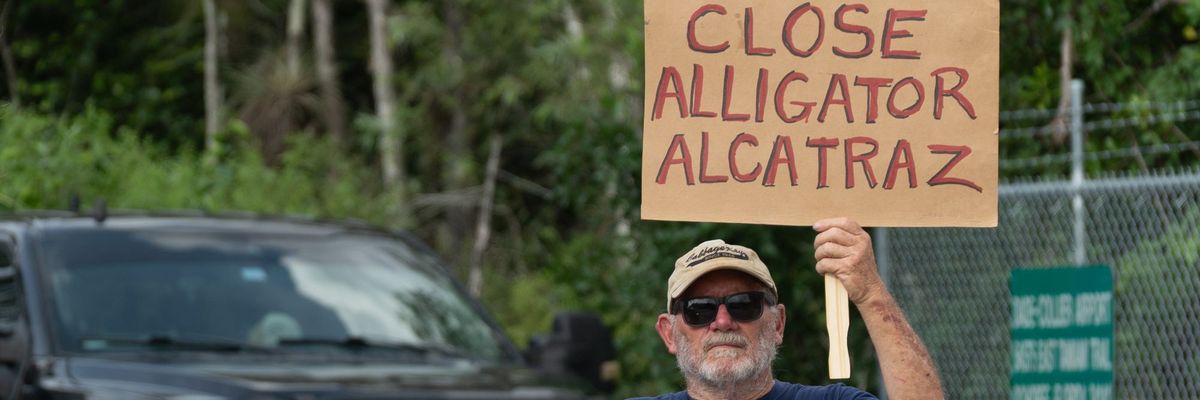
‘A Human Rights Disaster’: Report Details Torture and Chaos at ‘Alligator Alcatraz’

Conditions at Florida detention facilities “represent a deliberate system of cruelty designed to punish people seeking to build a new life in the US,” said an official at Amnesty International.


A protester holds a sign against “Alligator Alcatraz” during a rally at the entrance to the detention center in the Everglades, Florida, United States, on August 24, 2025.
(Photo by Jesus Olarte/Anadolu via Getty Images)


Julia Conley
Dec 04, 2025
COMMON DREAMS


Two immigration detention centers in Florida have gained notoriety for inhumane conditions since Republican Gov. Ron DeSantis, in close alignment with President Donald Trump’s anti-immigrant agenda, has rapidly scaled up mass detention in the state, and a report released Thursday detailed how human rights violations at the two facilities amount to torture in some cases.

Amnesty International published the report, Torture and Enforced Disappearances in the Sunshine State, with a focus on Krome North Service Processing Center and the Everglades Detention Facility, also known by its nickname, “Alligator Alcatraz.”

As Common Dreams has reported, many of the people detained at the facilities have been arbitrarily rounded up by immigration agents, with a majority of the roughly 1,000 people being held at Alligator Alcatraz having been convicted of no criminal offense as of July.

Amnesty’s report described unsanitary conditions, with fecal matter overflowing from toilets in detainees’ sleeping areas, authorities granting only limited access to showers, and poor quality food and water.

Some of the treatment amounts to torture, the report says, including Alligator Alcatraz’s use of “the box”—a 2x2 foot “cage-like structure people are put in as punishment—which inmates have been placed in for hours at a time with their hands and feet attached to restraints on the ground.


“These despicable and nauseating conditions at Alligator Alcatraz reflect a pattern of deliberate neglect designed to dehumanize and punish those detained there,” said Amy Fischer, director of refugee and migrant rights with Amnesty International USA. “This is unreal—where’s the oversight?”

At Krome, detainees have been arbitrarily placed in prolonged solitary confinement—defined as lasting longer than 15 days—which is prohibited under international law.

“The use of prolonged solitary confinement at Krome and the use of the ‘box’ at ‘Alligator Alcatraz’ amount to torture or other ill-treatment,” said Amnesty.

The report elevates concerns raised in September by immigrant rights advocates regarding the lack of federal oversight at Alligator Alcatraz, with nearly 1,000 men detained at the prison having been “administratively disappeared”—their names absent from US Immigration and Customs Enforcement’s detainee locator system.

“The absence of registration or tracking mechanisms for those detained at Alligator Alcatraz facilitates incommunicado detention and constitutes enforced disappearances when the whereabouts of a person being detained there is denied to their family, and they are not allowed to contact their lawyer,” said Amnesty.

The state of Florida has not publicly confirmed the number of people detained at Alligator Alcatraz.

One man told Amnesty, “My lawyers tried to visit me, but they weren’t let in. They were told that they had to fill out a form, which they did, but nothing happened. I was never able to speak with them confidentially.”

At Krome, detainees described overcrowding, medical neglect, and abuse by guards when Amnesty researchers visited in September. ICE has constructed tents and other semi-permanent structures to hold more people than the facility is designed to detain.

The Amnesty researchers were given a tour of relatively extensive medical facilities at Krome, including a dialysis clinic, dental clinic, and a “state-of-the-art” mental health facility—but despite these resources, detainees described officials’ failure to provide medical treatment and delays in health assessments. Four people—Ramesh Amechand, Genry Ruiz Guillen, Maksym Chernyak, and Isidro Pérez—have died this year while detained at Krome.

“It’s a disaster if you want to see the doctor,” one man told Amnesty. “I once asked to see the doctor, and it took two weeks for me to finally see him. It’s very slow.”

Researchers with the organization witnessed “a guard violently slam a metal flap of a door to a solitary confinement room against a man’s injured hand,” and people reported being “hit and punched” by officials at Krome.

In line with the Trump administration, DeSantis and Republican state lawmakers have sought to make Florida “a testing ground for abusive immigration enforcement policies,” said Amnesty, with the state deputizing local law enforcement to make immigration arrests and issuing 34 no-bid contracts totaling more than $360 million for the operation of Alligator Alcatraz—while slashing spending on healthcare, food assistance, and disaster relief. Florida has increased the number of people in immigration detention by more than 50% since Trump took office in January.

The organization called on Florida to redirect detention funding toward healthcare, housing, and other public spending, and to ban “shackling, solitary confinement, and punitive outdoor confinement” in line with international standards.

“At the federal level, the US government must end its cruel mass immigration detention machine, stop the criminalization of migration, and bar the use of state-owned facilities for federal immigration custody,” said Amnesty.

Fischer emphasized that the chaotic and abusive conditions Amnesty observed at Alligator Alcatraz and Krome “are not isolated.”

“They represent a deliberate system of cruelty designed to punish people seeking to build a new life in the US,” said Fischer. “We must stop detaining our immigrant community members and people seeking safety and instead work toward humane, rights-respecting migration policies.”
‘Intellexa Leaks’ Reveal Wider Reach of Predator Spyware

“This investigation provides one of the clearest and most damning views yet into Intellexa’s internal operations and technology,” said Amnesty International Security Lab technologist Jurre van Bergen.


A digital eye spies on a device’s user in this stylized stock image.
(Image by Sean Gladwell/Getty Images)


Brett Wilkins
Dec 04, 2025
COMMON DREAMS

Highly invasive spyware from consortium led by a former senior Israeli intelligence official and sanctioned by the US government is still being used to target people in multiple countries, a joint investigation published Thursday revealed.

Inside Story in Greece, Haaretz in Israel, Swiss-based WAV Research Collective, and Amnesty International collaborated on the investigation into Intellexa Consortium, maker of Predator commercial spyware. The “Intellexa Leaks” show that clients in Pakistan—and likely also in other countries—are using Predator to spy on people, including a featured Pakistani human rights lawyer.

“This investigation provides one of the clearest and most damning views yet into Intellexa’s internal operations and technology,” said Amnesty International Security Lab technologist Jurre van Bergen.

Predator works by sending malicious links to a targeted phone or other hardware. When the victim clicks the link, the spyware infects and provide access to the targeted device, including its encrypted instant messages on applications such as Signal and WhatsApp, as well as stored passwords, emails, contact lists, call logs, microphones, audio recordings, and more. The spyware then uploads gleaned data to a Predator back-end server.

The new investigation also revealed that in addition to the aforementioned “one-click” attacks, Intellexa has developed “zero-click” capabilities in which devices are infected via malicious advertising.

In March 2024, the US Treasury Department sanctioned two people and five entities associated with Intellexa for their alleged role “in developing, operating, and distributing commercial spyware technology used to target Americans, including US government officials, journalists, and policy experts.”

“The proliferation of commercial spyware poses distinct and growing security risks to the United States and has been misused by foreign actors to enable human rights abuses and the targeting of dissidents around the world for repression and reprisal,” the department said at the time.


Those sanctioned include Intellexa, its founder Tal Jonathan Dilian—a former chief commander of the Israel Defense Forces’ top-secret Technological Unit—his wife and business partner Sara Aleksandra Fayssal Hamou; and three companies within the Intellexa Consortium based in North Macedonia, Hungary, and Ireland.

In September 2024, Treasury sanctioned five more people and one more entity associated with the Intellexa Consortium, including Felix Bitzios, owner of an Intellexa consortium company accused of selling Predator to an unnamed foreign government, for alleged activities likely posing “a significant threat to the national security, foreign policy, or economic health or financial stability of the United States.”

The Intellexa Leaks reveal that new consortium employees were trained using a video demonstrating Predator capabilities on live clients. raising serious questions regarding clients’ understanding of or consent to such access.

“The fact that, at least in some cases, Intellexa appears to have retained the capability to remotely access Predator customer logs—allowing company staff to see details of surveillance operations and targeted individuals raises questions about its own human rights due diligence processes,” said van Bergen.

“If a mercenary spyware company is found to be directly involved in the operation of its product, then by human rights standards, it could potentially leave them open to claims of liability in cases of misuse and if any human rights abuses are caused by the use of spyware,” he added.

Dilian, Hamou, Bitzios, and Giannis Lavranos—whose company Krikel purchased Predator spyware—are currently on trial in Greece for allegedly violating the privacy of Greek journalist Thanasis Koukakis and Artemis Seaford, a Greek-American woman who worked for tech giant Meta. Dilian denies any wrongdoing or involvement in the case.

Earlier this week, former Intellexa pre-sale engineer Panagiotis Koutsios testified about traveling to countries including Colombia, Kazakhstan, Kenya, Mexico, Mongolia, the United Kingdom, and Uzbekistan, where he pitched Predator to public, intelligence, and state security agencies.

The new joint investigation follows Amnesty International’s “Predator Files,” a 2023 report detailing “how a suite of highly invasive surveillance technologies supplied by the Intellexa alliance is being sold and transferred around the world with impunity.”

The Predator case has drawn comparisons with Pegasus, the zero-click spyware made by the Israeli firm NSO Group that has been used by governments, spy agencies, and others to invade the privacy of targeted world leaders, political opponents, dissidents, journalists, and others.


America Needs To Tax Its Own ‘Second Estate’: Billionaires

The United States has no nobility, according to our Constitution. But our tax code does protect the very rich.


Google CEO Sundar Pichai and Elon Musk attend the inauguration of Donald Trump at the US Capitol Rotunda on January 20, 2025 in Washington, DC.
(Photo by Julia Demaree Nikhinson - Pool/Getty Images)
Common Dreams

Pre-revolutionary French aristocrats—the “Second Estate”—didn’t pay taxes. Amazingly, America too has a second estate, billionaires who pay virtually no taxes. In her very outstanding recent book, law professor Ray D. Madoff shows how they get away with this.

The United States has no nobility, according to our Constitution. But our tax code does protect the very rich.

Federal taxes on income and estates—intended to fund government and prevent development of a hereditary financial aristocracy—were enacted early in the 20th century and originally worked well.

But since about 1980, the estate tax—infested with loopholes—has been nearly abolished for practical purposes and now produces trivial income.

Madoff wants to get rid of the ability of ultra-rich people—billionaires—to avoid having any taxable income in the first place.

Madoff suggests that the estate tax should be completely eliminated because its existence deceives the public about what is really going on. People falsely think that billionaires who pay no federal income tax will at least pay the estate tax when they die. In fact, they are paying neither kind of tax.

Billionaires avoid the income tax by arranging to have no taxable income.

Before 1982 ultra-rich people could not avoid paying income tax. Their income consisted of dividends and capital gains harvested by selling shares of stock, the price of which had increased. Dividends and capital gains are taxable income.

But in 1982 federal regulators weakened a rule prohibiting corporations from buying back their own stock. Since then, many corporations have used profits to buy back stock shares instead of issuing dividends. With fewer shares of stock outstanding and the value of the corporation increasing, the value of each share of stock began increasing dramatically.

What used to be taxable dividends turned into large capital gains benefiting the stock owners, including very rich ones. If shareholders need cash and sell appreciated stock, of course they would owe income taxes on the capital gains (selling price of the stock minus how much the shares cost them). But capital gains are taxed at a much lower rate than normal income like salaries, bank interest, and returns on bonds.

As Madoff points out, however, billionaires need not sell any stock to get cash to live on. Instead, they can borrow the money, using their stock as collateral. Borrowed money is not taxable income, so they owe no tax while living extravagantly.

And when they die, the stock they bequest to their heirs gets a stepped up “basis,” so if their heirs sell the stock they will owe no taxes because the stepped up basis leaves no taxable capital gains.

And inherited money is not considered taxable income. Someone who earns $50,000 pays significant income (and payroll) taxes on it, while someone who inherits $1 billion pays no income or payroll tax on it.

Madoff rightly objects to this situation, but she is not arguing that we should “soak the rich” with higher income tax rates at the top. She points out that there are two kinds of “rich” people. One is the working rich, skilled professionals earning high salaries and, usually, already paying very high taxes. A high percentage of all income tax receipts come from these people.

Increasing the high tax rates these “rich” people are already paying would produce insignificant extra revenue for the government.

Instead, Madoff wants to get rid of the ability of ultra-rich people—billionaires—to avoid having any taxable income in the first place. She wouldn’t tax them while they are alive, but would tax whoever inherits from them.

Rather than trying to fix the estate tax, Madoff would abolish it, eliminate the stepped up basis for inherited stock, and make inherited money and other gifts received taxable income for the recipients.

Assuming an exemption for small gifts (to allow birthday presents and the like), this could be a reasonable reform. It would bring in very large amounts of taxes while reducing today’s extreme economic inequality.

For further details, see Ray D. Madoff, The Second Estate: How The Tax Code Made An American Aristocracy. This is one of the two best books I have read since retiring in 2000.


Let’s Be Very Clear: There’s No Legal Basis for Trump to Attack Venezeula

Regardless of the reasons, the US has no right to intervene.


Canadians rally to demand an end to American attempts at a “regime change” in Venezuela and to denounce Canada’s complicity to overthrow the government of Venezuela in Toronto, Canada, on September 16, 2017.
(Photo by Creative Touch Imaging Ltd./NurPhoto via Getty Images)

Farrah Hassen
Dec 04, 2025
OtherWords

President Donald Trump promised “no new wars,” but his aggression against Venezuela is the exact opposite.

The US military has been blowing up alleged “drug boats” near Venezuela that have killed at least 83 people. The United Nations has condemned these unprovoked strikes as unlawful extrajudicial executions. Yet President Trump has said the US may “very soon” expand this campaign to Venezuelan territory.

Meanwhile, the USS Gerald R. Ford is stationed off the coast of Venezuela and Trump has ordered the CIA to conduct covert operations inside the country. And he declared on November 29 that the airspace “above and surrounding” Venezuela is “to be closed in its entirety.”

It’s unclear if that means Trump plans to impose a no-fly zone on Venezuela. But if so, that would be an act of war—and under the Constitution, illegal without congressional authorization.

Trump’s pressure campaign against Venezuela isn’t about countering traffickers or “bringing democracy” to Venezuela.

We saw this playbook before the 2003 invasion of Iraq. President George W. Bush lied about Iraq’s possession of weapons of destruction and its ties to al-Qaeda in order to sell his regime change war to the American public.

Similarly, the Trump administration is relying on unsupported allegations against Venezuela. Only this time, the allegations are even more bogus and easily disproven.

The US has claimed that it attacked the small boats because they were carrying drugs, despite offering no proof. Even if the boats did carry drugs, the appropriate response would be to lawfully intercept and detain the suspects and afford them due process of law.

Under international law, force is only permitted in self-defense from an armed attack or if authorized by the UN Security Council, neither of which applies here. Congress hasn’t approved military force against alleged traffickers either.

A secret Department of Justice memo has gone so far as to name fentanyl as a “chemical weapon threat” from these “drug boats.” But neither US nor international assessments have found that Venezuela is a primary producer or international shipment point of narcotics, including fentanyl.

Trump has also accused Venezuelan President Nicolás Maduro of controlling the Tren de Aragua criminal gang, a claim contradicted by a US intelligence memo, as well as the “Cartel of the Suns”—an organization many experts doubt even exists but which Trump’s State Department now lists as a “terrorist organization.”

And while Trump alleges that Maduro is flooding the US with drugs, he just pardoned one of the biggest cocaine traffickers—former Honduran president Juan Orlando Hernández, who was sentenced to 45 years last year for creating “a cocaine superhighway to the United States.”

Trump’s pressure campaign against Venezuela isn’t about countering traffickers or “bringing democracy” to Venezuela.

Instead, it’s a continuation of treating Latin America as part of the US “sphere of influence” to justify interventions, as seen with past CIA-orchestrated coups in Guatemala and Chile that ousted democratically elected governments in favor of more US-compliant authoritarian regimes.

The US has been waging economic warfare since 2005 by imposing a range of sanctions on Venezuela under the guise of “promoting democracy.” But far from resolving the country’s political crisis, these sanctions have devastated the economy and increased the suffering of ordinary Venezuelans, forcing nearly 8 million to flee since 2014.

Venezuela also has the world’s largest proven oil reserves—something Trump knows well. “When I left” office in 2021, “Venezuela was ready to collapse,” Trump said in 2023. “We would have taken it over—we would have gotten all that oil.”

Regardless of the reasons, the US has no right to intervene in Venezuela. A war would unleash untold suffering on the Venezuelan people. It’s also the last thing Americans want, as several polls have shown. A November CBS/YouGov poll found that 70% of Americans across party lines oppose the US taking military action against Venezuela.

The evidence is clear. There’s no legal basis for a war and the majority of Americans don’t want it.


This column was distributed by OtherWords.

Farrah Hassen
Farrah Hassen, J.D., is a writer, policy analyst, and adjunct professor in the Department of Political Science at Cal Poly Pomona
Full Bio >