Thursday, January 22, 2026

Martin Luther King: A Revolutionary, Not A Saint
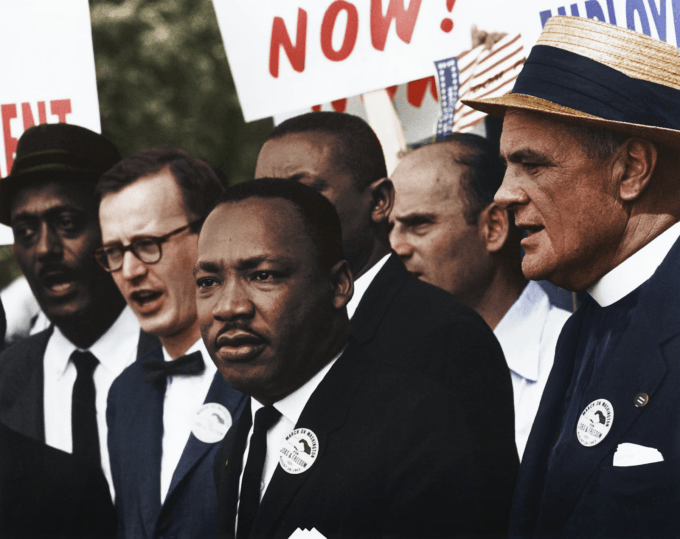


 January 22, 2026

“When I say poor, I don’t just mean black people.”

–Martin Luther King Jr.

“The true enemy is war itself.”

–Martin Luther King Jr.

For thirteen years he lived and worked with the knowledge that a violent death awaited him, that it might come at any moment from a knife thrust out of a crowd, a sudden gunshot, a bomb tearing him to pieces. His wife was plagued with nightmares about it.

Reminders were frequent: a shotgun blast through his front door, the bombing of his home, a dozen sticks of dynamite found smoldering on his porch, a razor-sharp Japanese letter-opener plunged into his chest by a crazy woman, and, of course, the regular late-night phone threats that began with, “Nigger . . . .”

Prayer and a deep Christian faith dissipated his paralyzing fear, giving him the strength to act. His eloquence, soaring idealism, and amazing composure under relentless pressure inspired millions to act with him, leading to the fall of Jim Crow, and contributing to the collapse of public support for the Vietnam War, the most criminal military intervention in U.S. history.

Unfortunately, the public image of Dr. King handed down to us by our mind-managers bears only the faintest resemblance to the impassioned rebel he was in real life. These days Dr. King tends to be remembered as a reformist, African-American preacher who went to college to better himself, believed in God and his fellow man, and won a Nobel Prize for Peace, along with the admiration of both whites and blacks for his decency and non-violent reminders of the nation’s essential goodness. Lost completely are his feverish intensity, tactical brilliance, and anguished incomprehension of a society permeated by racism, exploitation, and deceit.

From the very beginning King was a political radical whose aspirations went far beyond reform, a Christian revolutionary who dedicated himself to creating a culture of social justice that would give substance to the freedom and equality the U.S. political system merely talked about. He opposed in principle “systems of oppression” like colonialism, imperialism, and segregation, and denounced capitalism for being “predicated on exploitation.” He saw racism not as a feudal anachronism of the Old South, but as anational problem implicating all Americans. He found all those isms incompatible with “the natural goodness of man and the natural power of human reason.”

Though he had gone to school in the North and only with reluctance returned to the South, he was never naive about the informal apartheid that characterized life above the Mason-Dixon line. (No one had wanted to rent to him during his student years in Boston.) As a pastor, he regularly traveled to the North years before the ghetto rebellions of the 1960s, plugging into activist structures pushing back against racist exclusion and police brutality.

One such visit was to Los Angeles in the wake of the police killing of Ron Stokes outside a Muslim mosque in 1962 (an event usually associated only with Malcolm X), where King supported locals calling for the ousting of openly racist Police Chief William Parker,* expressed zero tolerance for police brutality, and talked of the need to build black power, by which he meant blacks organizing themselves into a force for real democracy.

The year after the Stokes killing he visited Los Angeles multiple times to protest segregation, and did so again right before the Watts rebellion (1965), when he declared that Los Angeles schools were as segregated as those in Birmingham. In all, he made more than fifteen visits to the area prior to the black uprising, and followed up with another visit in the wake of that event, calling for a Civilian Complaint and Review Board to deal with police brutality, which proposal was angrily shot down by Mayor Sam Yorty, whose racial instincts weren’t all that different from Bull Connor’s.

King understood that blacks being manhandled by police was related to their being corralled into ghettos. Thus, he was deeply critical of California’s Proposition 14, passed in 1964 (supported by 75% of whites), which he called the “vote for ghettos” initiative, since it re-affirmed the practice of deeded covenants mandating that homes remain exclusively in the hands of white owners. Such deeds were common in the North, and King criticized Northern liberals for their hypocrisy in applauding the end of official segregation in the South while perpetuating an informal apartheid in the North.

When the Watts powder keg inevitably exploded, King was devastated by the destruction (thirty-four people were killed) and shocked at the attitude of residents, who cheered on the destruction of “their” communities.

“Burn, baby, burn,” they chanted, as store after store, building after building, was put to the torch and consumed by flames. In a sea of police roadblocks, broken plate glass, and strewn rubble, they cut the hoses of firemen battling the blaze and lobbed Molotov cocktails into the expanding inferno.

Though it may have looked like they were destroying their communities, in fact the residents were fighting for the resources to maintain them, and were, in any case, ironically conforming to the logic of their degraded capitalist environment: Looters loaded up cars with as much merchandise as they could carry off, surrounded by signs celebrating instant acquisition on easy terms.

According to Bayard Rustin, King was deeply affected by Watts, realizing more acutely than ever before the real depth of economic oppression, which overlapped with racism, but also went beyond it.  Having the right to sit at a lunch counter and order a hamburger, for example, meant little to those who lacked the money to pay for one.

With his usual amazing patience, King put himself to the task of explaining to those who thought that black grievances should have ended once civil rights legislation passed, that the urban uprisings in Harlem (1964), Watts (1965), and Newark and Detroit (1967), were caused by longstanding socially-sanctioned crimes committed against blacks, not by them. Building and housing codes were routinely violated to perpetuate slums, meager social allotments owed blacks were often slashed or denied them, and black civil rights didn’t even rise to a theoretical concern for police who brutalized them.

After seeing the devastation of Watts, King moved on to a fair housing campaign in Chicago with a renewed sense of urgency in 1966. He didn’t call the slums there “neglected areas,” nor did he describe its residents as “deprived” or “left behind,” code words the professional servant class uses to imply that mass poverty is somehow incidental to capitalism, when, in fact, it is characteristic of the system, since profit-takers are encouraged to “externalize” costs (i.e., make the public absorb them), among which mass poverty is especially prominent. King called the wretched Chicago ghettos a system of “internal colonialism,” comparing it to the exploitation of the Congo by Belgium. In charge of the system was Mayor Richard Daley and his corrupt regime, who loathed King for shining a public spotlight on their activities, at the same time finding it incomprehensible that he couldn’t be bought off.

Crazed mobs repeatedly turned out to scream racist obscenities and pelt Dr. King and his fellow marchers with bottles, rocks, cherry bombs, and lumps of coal. On a Sunday march a nun was struck in the head by a rock, and the crowd cheered when her wound began to bleed visibly. On a march through Marquette Park and Chicago Lawn Dr. King himself was felled by a fist-sized stone that slammed into his temple. A hurled knife missed him but struck another marcher. Stunned by the depravity, King confessed to reporters that he had “never seen – even in Mississippi and Alabama – mobs as hostile and hate-filled as I’ve seen in Chicago.”

Except for Operation Breadbasket, most people involved in the Chicago campaign ended up writing it off as a failure. Nevertheless, King was impressive, even convincing gang members to lay down their arms and peacefully march for change, but the massive resources needed to end slums in Chicago were being allocated to obliterate Vietnam, not deal with the tragic legacy of slavery at home. Meanwhile, King’s sincerity and eloquence were as powerful as ever. On a trip to rural Mississippi he spoke so movingly that a five-year-old-girl started sobbing and repeating over and over, “I want to go with him.”

After Watts and Chicago, King publicly stated the need for revolution: “I think you’ve got to have a reconstruction of the entire society, a revolution of values.”

More clearly than any other civil rights leader, King saw that racism abroad was related to racism at home, that freedom for American blacks was tied to self-determination for the Vietnamese people, then fighting to expel the United States from their country. He had already begun speaking out against the war starting in 1965, continuing to do so until his death, in spite of strong criticism from other leaders, a hostile press, and harassment by the FBI. When told he was alienating friends and supporters with his stance, King remained unmoved: “I am not a consensus leader.” “I don’t care who doesn’t like what I say about it.” “This madness must stop.”

He was especially gripped by the suffering of the children, but also protested that twice as many black soldiers as whites were dying as cannon fodder in an imperial war whose crimes rivaled those of the Nazis. Water and land were poisoned, harvests destroyed, and people tortured and murdered in staggering numbers, using funding that should have been allocated to ending poverty at home.

In his 1967 “Beyond Vietnam” speech, Dr. King called out the U.S. for being, “the greatest purveyor of violence in the world today,” and did not mince words about the form that violence was taking in Vietnam:

The peasants watched as we supported a ruthless dictatorship in South Vietnam which aligned itself with extortionist landlords and executed its political opponents. The peasants watched as we poisoned their water, bombed and machine-gunned their huts, annihilated their crops, and sent them wandering into the towns, where thousands of homeless children roamed the streets like animals, begging for food and selling their mothers and sisters to American soldiers. What do the peasants think as we test our latest weapons on them, as the Germans tested new medicine and tortures in Europe’s concentration camps? Where are the roots of the independent Vietnam we claim to be building? Is it among these voiceless ones? We have destroyed two of their most cherished institutions: the village and the family. We have inflicted twenty times as many casualties on them as have the Vietcong. We have destroyed their land and crushed their only non-Communist revolutionary political force – the Unified Buddhist Church. We have corrupted their women and children and killed their men. What liberators!

A year later he was cut-down by a bullet full in the face at the age of 39, leaving behind an astonishing list of achievements, all attained against the pressure of barbaric segregation in the South, horrendously complex racism in the North, a prolonged vilification campaign waged against him by the FBI, considerable jealousy on the part of other civil rights leaders, a savage imperial war that devoured the resources needed for social transformation, and a vengeful Lyndon Johnson.

In spite of such formidable obstacles, Dr. King reached more blacks, more Americans, and more citizens of the world, than any U.S. reform leader of the 20th century, and at a depth of understanding few leaders ever even entertain. Referring to King’s “Beyond Vietnam” speech, John C. Bennett, then president of the Union Theological Seminary, said that “there is no one who can speak to the conscience of the American people as powerfully as Martin Luther King.”

January 19 is the fortieth anniversary of the U.S. national holiday for Dr. King. This remembrance is a nice gesture, but if we are to truly honor him, we’ll have to establish the culture of social justice he struggled to create, in order to reign in a lawless U.S. government carrying us to utter destruction.

*Chief Parker explained the 1965 Watts uprising this way: “One person threw a rock and then, like monkeys in a zoo, others started throwing rocks.” (italics added) Taylor Branch, At Canaan’s Edge: America In The King Years 1965-68, (Simon and Schuster, p. 399)

Notes

MLK visits to Los Angeles, Theoharis interview

Racist housing covenants, see (Branch, p. 637)

Watts rebellion, description of . . . (Conot pps. 40, 99, 219, 239, 362, 364)

MLK can’t be bought . . . (Oates, p. 408)

Sobbing five-year-old girl wanting to go with MLK, (Oates, pps. 399-400)

MLK on Chicago mobs being most hate-filled he had ever seen, (Oates, p. 413)

MLK on the need for revolution .. . (Cone, p. 257)

MLK, “This madness must stop” . . .(Cone, p. 297)

MLK, “greatest purveyor of violence in the world today” (Cone, p. 237)

“Beyond Vietnam” excerpt (Oates, p. 435)

John C. Bennett quote, (Cone, p. 294)

Sources

Jeanne Theoharis, MLK Jr.’s Life of Struggle Outside The South, Counterpunch Radio, www.counterpunch.org

Conot, Robert E., Rivers of Blood, Years of Darkness, (Bantam, 1967)

James R. Ralph Jr., Northern Protest – Martin Luther King, Jr., Chicago, and the Civil Rights Movement,” (Harvard, 1993)

David J. Garrow, Bearing The Cross, (William Morrow, 1986)

Stephen B. Oates, Let The Trumpet Sound – The Life of Martin Luther King, Jr., (Harper & Row, 1982)

James H. Cone, Martin & Malcolm & America – A Dream or a Nightmare, (Orbis, 1991)

Taylor Branch, At Canaan’s Edge – America In The King Years 1965-68 (Simon & Schuster, 2006)

Michael K. Smith is the author of  The Madness of King George, and Portraits of Empire


Portugal

New neofascist advance in presidential elections

Wednesday 21 January 2026, by Jorge Costa


A former leader of the PS and the head of the neo-fascists will contest the second round of presidential elections that confirm Portugal’s shift to the right. The concentration of votes on the PS has relegated the left to new historic lows.

The combined votes for the right-wing government and the ultra-liberal and neo-fascist parties exceed half of the votes cast. Despite this, the highet-scoring candidate was António José Seguro (31%, 1.7 million votes). Seguro led the Socialist Party between 2011 and 2014, years in which the PS, outside the government, collaborated in the implementation of the austerity programme under the troika.

Luis Marques Mendes, supported by the PSD and CDS, the governing parties, came in sixth place (11%), surpassed by André Ventura, leader of the neo-fascist Chega party (23.5%), and also by Cotrim Figueiredo, an ultra-liberal MEP (16%). On election night – and to the surprise of many on both the left and the right – the PSD candidate and the prime minister Luís Montenegro, as well as the Liberal Initiative, declared that they would not give any voting guidance in the second round, scheduled for 8 February.

Despite being the favourite in the initial polls, military man Gouveia e Melo, former head of the Navy, finished fifth with 12% of the vote. On election night, this outsider with no political background - who became famous as the person responsible for the Covid-19 vaccine distribution programme and who positions himself as “neither left nor right” - said nothing about the second round.

Despite the large vote for the radical right-wing candidates, the result of the first round was received with relief by those on the left: the latest polls pointed to a technical tie between Seguro, Ventura and Cotrim. To avoid a second round between the ultra-liberal and the neo-fascist, there was a desperate concentration of votes on the Socialist Party. As a result, the candidates of the three left-wing parties – which had won 9% of the vote in last May’s legislative elections – now stand at 4.5%. The Livre party (European Greens, 4% in the parliamentary elections) saw its candidate, Jorge Pinto, relegated to 0.7%. The Communist Party candidate (3% in the parliamentary elections) stood at 1.6%. The candidate who fared best was Catarina Martins (former party coordinator and current MEP) from the Left Bloc, who managed to maintain the 2% obtained by the Bloc in May.

This result is due to the exceptional performance of Catarina Martins, who had emerged from the cycle of televised debates with over 5% in the polls. The only woman among eleven candidates, she spoke for social issues and supported the December general strike, focusing on the cost of living and property speculation, as well as the international situation, and was the only candidate to openly advocate Portugal’s withdrawal from NATO.
Neo-fascists steering the right

In any case, this is already a major victory for the far right: maintaining the percentage it won in the parliamentary elections was enough to secure a place in the second round. Now, everything it can add will contribute to Ventura being able to proclaim himself leader of the “non-socialist camp”, an expression popularized on television to designate a right wing that, in its discourse and in government practice, has abolished all boundaries with neo-fascism. The prime minister himself promoted his candidate by attacking “extremism”, both Ventura’s and... Seguro’s! In this general Trumpization of right-wing discourse, the original always has an advantage over the copies.

All polls point to a comfortable lead for António José Seguro over Ventura in the second round. Rejection of the neo-fascist is still widespread, including among many right-wing voters. But it is difficult to predict with certainty how voters will respond to this unprecedented equidistance from the parties of the “democratic right”, both traditional and ultra-liberal, even though several members of the government and leaders of the IL have already spoken out in favour of the moderate Seguro. What is certain is that in this second round, Ventura will win thousands of votes from right-wing voters who will be undertaking neo-fascist voting for the first time.

His goal will be to exceed the percentage obtained by Luís Montenegro’s PSD last May and thus become the most voted right-wing leader and a definitive candidate for prime minister. The current minority government - supported by Chega in approving its laws and backed by the PS in the implementation of the State Budget - may emerge in an even more precarious situation from this presidential election.
The left at historic lows

The reduction in the electoral strength of the left is an invitation for activists to reflect on the fragmentation of this camp. In the downward spiral of the last three years, the only time the left has made its mark on the public debate to contest popular opinion was during last December’s general strike, called jointly by the CGTP and UGT against the new labour laws that the government wants to impose. The success of the general strike put Ventura on the defensive - he stopped accusing the strike of being the work of the far left and began to offer to engage in dialogue with the strikers’ just causes - and forced Seguro to promise that, if elected President, he would veto the new labour law.

With or without a political crisis on the horizon, the left must, within the framework of social resistance, work towards dialogues that enable it to avoid political marginalization. The experience of the strike is a sign of the way forward: greater participation in struggles and in the extra-party arena, greater commitment to solidarity against fascism, more common ground for understanding the tasks of this period and seeking common platforms – these are the essential conditions for the emergence, in the next electoral cycle, of a united alternative that offers credibility and not dispersion.

20 January 2025

Translated by International Viewpoint.


Attached documentsnew-neofascist-advance-in-presidential-elections_a9374.pdf (PDF - 1015.7 KiB)
Extraction PDF [->article9374]

Portugal
Portugal ‘doesn’t need to wait for Europe’ to condemn attack on Venezuela
Big success for general strike in Portugal
The general strike demonstrates that struggle can open up paths for the left
Towards the General Strike in Portugal - Only the strength of those who work can halt the labour package
The bromance between André Ventura and Luis Montenegro in Portugal

Far Right
Academic freedom under attack
Feminist struggles against the far right and repression
Rise of the Far Right in Chile
What is left of the Chinese Left?
Notes on the historic rise of the far right in Britain

Jorge Costa is a member of the full-time leadership of the Bloco de Esquerda and of the Executive Bureau of the Fourth International. He is co-author of The Owners of Portugal - One hundred years of economic power (1910-2010) and The Bourgeoisie – who they are, how they live and how they rule (2014) with Francisco Louçã and João Teixeira Lopes.


Why Are Chronically Low-performing Charter Schools Renewed?

The easy answer is greed, profit, and kickbacks. But how are such actions undertaken so frequently?

One of the most fundamental rationales put forward decades ago by charter school advocates for why charter schools should exist is the so-called “accountability-for-results” bargain. The basic “logic” here is that traditional public schools are “unaccountable failing monopolies” controlled by “self-serving unions” and, as such, families deserve “more accountable school options (charter schools) that deliver better results.” And, if a charter school fails to “deliver results” (i.e., high scores on standardized tests produced by corporations), then it should be shut down so that a smarter entrepreneur can open up a more successful charter school. This is why charter school proponents are obsessed with test scores, which are nothing more than a proxy for a family’s socio-economic status.

Given the staggering profits made by non-profit and for-profit charter schools, it should come as no surprise that charter school authorizing entities have frequently renewed contracts for charter schools across the country even when “results” are poor year after year. This is nothing new. The fact that this is done with great regularity and for the flimsiest reasons speaks to the economic and political power wielded by charter school promoters.

Over the past 35 years these forces have usurped significant state power in order to privilege private interests over the public interest. It is not every day that an entity can do an end-run around the law, reason, standards, and public. To operate with impunity against the general interests of society requires considerable state power.

In this connection, the creation of unelected charter school “Review Boards” or “Commissions” in many states is a crucial top-down mechanism to subordinate reason, standards, the law, and the public interest to narrow private interests. The majority of the appointed members of such boards are pro-privatization. They see students as commodities and have no patience for anything that contravenes their interests. At the end of the day, “results” do not matter that much to them because there is too much profit at stake.

It should be noted, however, that the creation of top-down mechanisms such as appointed boards is not always needed for private interests to override standards and the public interest. Oftentimes the political and economic connections charter school owners, operators, and trustees have is enough to supersede reason, standards, contract provisions, and public authority. They can even reverse decisions by elected officials that do not favor them and unduly influence the courts.

An illustrative example of a flawed charter school renewal process is provided in a January 13, 2026 article from the News & ObserverNC renews two low-performing virtual charter schools. See how long and why, from North Carolina. Before proceeding, it is important to appreciate that, while poor academic performance is widespread in brick-and-mortar charter schools, virtual charter schools nationwide are notorious for abysmal academic performance year after year. Online charter schools are well-known for being extra subpar.

The news article starts by openly admitting that, “North Carolina’s original two virtual charter schools will be allowed to stay open for another five years despite being among the lower academic performing schools in the state.” It further clarifies that, “The N.C. Charter Schools Review Board voted 7-3 on Monday to extend the charters for North Carolina Cyber Academy and the North Carolina Virtual Academy through June 2031.” The news article then claims that even though these privately-operated cyber charter schools have “been labelled by the state as continually low-performing since they opened in 2015,” they have supposedly “been popular with families.”

Does this make sense? “Popular” according to whom? What family wants their child in a deregulated virtual charter school that performs poorly year after year? Both schools have historically received a “D” grade and are classified as “continually low-performing.” Are there any thorough surveys or interviews with parents about what they really know and think about these privately-operated online schools? Can “popularity” be considered a compelling reason for renewing the contract of a chronically low-performing charter school, especially when charter school advocates insist that strong academic performance is critical to the operation of a high-quality charter school?

Rita Haire, a North Carolina Charter Schools Review Board member, stated, “We’re renewing two schools for five years that have been continually low performing for all 10 years and have not met growth, except one school for one year, and yet the enrollment is almost 2,500 in one and 4,000…. Do they not understand the quality of education that’s being delivered?”

Another Review Board member, Hilda Parlér, said, “Looking at these grades, that’s not acceptable.”

The News & Observer also informs us that both privately-operated schools have millions of public dollars saved in “rainy day funds,” a fact that prompted Todd Godbey, another Review Board member, to ask, “Their academic performance isn’t grand…. If they’ve truly got $16 million in the bank, why aren’t they using that to make academic performance better for their students?” Indeed, how can schools perform so poorly for so many years when they have lots of money? So much for accountability-for-results. Ten years of failure. If this were a traditional public school, charter school advocates would be howling their derision from the rooftop.

To add insult to injury it appears that virtual charter schools in North Carolina can only be approved or rejected for a five-year renewal, while brick-and-mortar charter schools may be renewed for 3-10 years or not renewed at all. Such a set-up alters decision-making dynamics for virtual charter schools.

Privatization can only live and expand by negating rights, democracy, reason, transparency, and the public interest, that is, by dragging society backward. In The Privatization of Everything (2021), Donald Cohen and Allen Mikaelian remind us that privatization “undermines the public’s civil rights and limits access to democratic institutions and policymaking” (p. 116). Private interests simply do not align with the public interest.

If the public had a real say in the affairs of education and society, harmful arrangements would be swiftly blocked. Financial waste, corruption, and profiteering would be reined in as well. Importantly, parents and students would be treated as humans with rights and not as commodities or consumers.

Without democratic renewal, private interests will seize even more state power and exercise greater police powers, resulting in more destruction of all the arrangements required by a modern society. Reject all forms of privatization. Defend public education and the public interest.

Shawgi Tell (PhD) is author of the book Charter School Report Card. He can be reached at stell5@naz.eduRead other articles by Shawgi.

Resist and Build Alternatives to the Trump Regime Now

Part 1/5 — Media, Culture and Information Sovereignty

This is the first of 4+1 TFF-created idea portfolios designed to curb the global reach of the United States and, in both the short and long term, help catalyse a worldwide nonviolent resistance to what many observers describe as the Trump administration’s uniquely confrontational, destructive and world-threatening policies.

These portfolios outline what governments and citizens across the world can do through dynamic diplomacy, creative initiatives, and strictly nonviolent means.

It seems painfully clear to me that the current political dynamics in Washington increasingly resemble the most dangerous pattern that ended in 1945 and was supposed to never happen again.

If that assessment holds, then passivity is no longer an option. A coordinated, global, nonviolent mobilisation is essential — not least because nonviolence is the one type of power and language a heavily militarised superpower is least prepared to counter.

All power rests on others accepting and carrying out its orders. Even the strongest leader in the world cannot round up criminals or fight wars with his own hands. Power is always dependent – dependent on someone who finds it legitimate, and do the dirty job on the strongman’s order. If young people were not brainwashed to accept warfare, there would be no wars. This is why nonviolence can be extremely effective and make an overarmed country look morally weak. That’s what Gandhi taught the world when using this theory to rid India not of the British as people but of the British Empire’s dominance structure.

The global mobilisation suggested here and in three coming thematic peace idea portfolios would also allow the rest of the world to deprive Trump of setting the international agenda. When Trump says something crazy, geopolitical experts, the media and the rest of the world, it seems, scrutinise his words in minute detail and waste all the time and energy that should be devoted to constructive alternatives and action.

If all this sounds “unrealistic,” consider the alternative: a world in which Trump’s Personal Occidental Empire is allowed to take shape — one that intimidates, coerces, and disregards established norms, continuing unchecked for the next three years as it has begun.

The proposals in this first portfolio are not limited to preventing the attempted acquisition of Greenland, though Greenland naturally occupies a central place here. Many fear that, without meaningful global resistance, such an acquisition could be carried out with little more than verbal protest from the international community — emboldening further unilateral ventures.

Think also of the so-called Gaza Peace Board that does not even mention Gaza. It is a cynical vehicle for establishing a new, personalised global “peace” structure intended to replace the United Nations with Trump himself as lifetime leader and the man who appoints his successor. Further, it is built on money, deals, and favours.

Only fools believe this is anything but Empire-building disguised as peace-making. Beyond any doubt, it is world-threatening.

It should now be evident that the ability to shape global perceptions — to persuade people of the inherent benevolence of U.S. power and of the current administration in particular — relies heavily on information dominance: narratives, propaganda, disinformation, and outright falsehoods. The Greenland argument, framed as a defensive move against China’s and Russia’s intention to take it, is one such example. It is also a psycho-political projection of the US/Trump’s own dark sides.

For these reasons, curbing U.S. information power is essential, as is countering its cultural and intellectual influence platforms. Therefore, this first Nonviolent U.S. Resistance Portfolio focuses on these domains. The succeeding portfolios will address additional forms of power that must be challenged and replaced through peaceful, principled means.

A. Media Transparency & Accountability Measures

These don’t censor anything, they expose dependency and deception and aim at creating an alternative global information and media structure after the US monopoly.

Immediate Measures (within a week)

Mandatory disclosure labels
Every news story must state the origin of its primary source (AP, Reuters, AFP, NYT, etc.). This alone would shock audiences into seeing how much comes from U.S. pipelines.

Publish a “Media Dependency Index”
A weekly ranking of outlets by percentage of U.S.-sourced content.

Announce parliamentary hearings
Transparent, non-accusatory hearings on foreign influence in national media ecosystems.

Longer-Term Measures

European or Global South–Europe newswire alliance
A structural alternative to U.S. news dominance.

Media Sovereignty Observatory
A permanent body tracking narrative dependency and foreign influence.

Open source, federated news distribution systems
Infrastructure that reduces reliance on U.S. platforms and algorithms. Boycott or at least reduce your reliance on US media platforms that censor and de-rank even peace voices and voices critical of the US, NATO, interventionism and genocide. That is – Google, Google-owned YouTube, Facebook, LinkedIn, X and more.

B. Diversification of Global News Inputs

Plurality of sources is the alternative to narrative dominance. Stop following mainstream Western media and follow non-Western media. The Internet is a wonderful invention. Spend 75% of your media time on non-Western media online or you will be fooled about what the world actually looks like.

Immediate Measures (within a week)

Emergency subscription packages to non-U.S. news agencies
AFP, Kyodo, Al Jazeera, African newswires, Chinese and Russian media — instant diversification. Use the internet and see everybody else’s much more open-minded news coverage, editorials and discussions.

Temporary European Arctic Correspondent Network
Reporters in Nuuk, Reykjavik, Tromsø to counter U.S. framing of Greenland.

Partnerships with Greenlandic media
Ensures that Greenlandic voices define Greenland’s story and are heard worldwide.

Longer-Term Measures

Permanent European Arctic Desk
A sustained reporting presence across the Arctic region. It may be more important to have them there in the future than all over the West itself.

Support for Indigenous media networks
Strengthening local voices across the Arctic and beyond.

Cross-regional multilingual reporting hubs
Shared editorial teams linking Europe, Africa, Asia, and Latin America.

C. Citizens’ Media Resistance

Citizens can shift the media ecosystem faster than governments.

Immediate Measures (within a week)

Boycott outlets with >40% U.S. newswire dependency
A voluntary, global, nonviolent pressure tool.

“Switch Off America Week”
A symbolic week where citizens consume only non-U.S. news.

Crowdsourced monitoring of U.S. narrative dominance
Publicly track how often outlets rely on U.S. sources (and tell you they are free, diverse and public service…

Longer-Term Measures

Global media literacy networks
Teaching citizens how narratives are constructed and by whom. And use existing non-Western ones.

Public Sphere Charter
A global commitment to pluralistic information flows.

Global public-interest search engine
A non-corporate, non-U.S. alternative for accessing information.

D. Cultural & Academic Sovereignty

Cultural exchange must be mutual, not a one-way projection of power and a de facto grooming of pro-US personalities and murky associations.

Immediate Measures (within a week)

Pause new academic partnerships with U.S. institutions
A cooling-off period to reassess influence.

Suspend U.S.–EU cultural festivals and cultural cooperation
A symbolic but powerful signal of recalibration. Of course, you can enjoy the incredible works of US cultural workers over time, but stop formalised cooperation.

Prioritise Indigenous Greenlandic cultural voices.
Shift the cultural centre of gravity toward those directly affected.

Longer-Term Measures

EU–Global South academic networks
Diversifying knowledge production beyond U.S. institutions. Send your students to up-and-coming countries, not to the declining US. Stop filling you university reading lists with US literature; these books silently convey only a US perspective on the world.

European Arctic Cultural Institute
A hub for Greenlandic and Arctic cultural expression.

Ethical guidelines for cultural diplomacy
Ensuring reciprocity and preventing one-way influence.

E. Public Sphere & Civil Society Mobilisation

Nonviolent resistance begins with public consciousness and challenges military arrogance with countermeasures that set a constructive agenda.

Immediate Measures (within a week)

Global demonstrations at U.S. embassies
A peaceful, visible expression of global resistance: Enough is more than enough, Trump!

“Greenland Solidarity Week”
Events in 100+ cities to raise awareness.

People’s Tribunal on violations of international law
A moral forum documenting actions and giving voice to the affected.

Longer-Term Measures

Documentary series (“Greenland And Arctic Reality Check”)
A sustained narrative counter-campaign.

Global civil society coalitions
Networks linking NGOs, Indigenous groups, and peace organisations, for instanced the global movement against US bases in 130 countries.

World Forum on Nonviolent Power
A permanent platform for developing peaceful resistance strategies. There is a desperate need for solution-oriented thinking and global peace visions, for pro-peace and not just anti-war.

Part 1 Summary

Media and cultural sovereignty are the foundations of nonviolent resistance. Massive, immediate actions worldwide can disrupt narrative dominance within days; long-term measures build a pluralistic global information order in which no single state monopolises the definition of reality for the rest of the world.

Jan Oberg is a peace researcher, art photographer, and Director of The Transnational (TFF) where this article first appeared. Reach him at: oberg@transnational.orgRead other articles by Jan.

Bondi Beach Massacre

Keeping the deaths alive

The aftermath of a crime has five objectives — define the crime and its extent, find out who did it, learn the motive, convict the assailant(s), and ascertain a method to prevent similar crimes. The Bondi Beach massacre has been defined and the assailants identified. Similar to other instances when Jews are victims, speculation replaces actuality, and the motive, which is usually a complex mixture of economic, political, psychological, and emotional, is replaced by one word ─ anti-Semitism, and with one objective ─ stifle dissent to Israel’s genocidal policies.

A segment of the public is aware of the exploitation of the killings of Jews to shape minds and favor Israel’s extermination policies, but the exploitation is not sufficiently recognized and not well attended. Israel’s military demolishes those who confront it at its doors; Israel’s worldwide army of dedicated followers demolishes those who confront Israel at external public and government levels. Inciting hatred of the Jewish people and using the expressions of hatred to rationalize Zionist policies and convince others of their necessity is the principal tool in the toolbox of those who advocate Israel above all. In order to subdue the criminal enterprise known as Israel and prevent the genocide portrayed as defense of the Israel state, highest priority should be given to a careful study of the terrifying “hatred” tactic and determine how to combat it. Start with examination of the latest atrocity to Jews and the compounding of atrocity to the victims ─ keeping their deaths alive to satisfy Zionist plans.

The perpetrators of the Bond Beach massacre have been linked to supporters of the notorious ISIS, equal haters of all peoples — Christians, Shi’a, Yazidis, Mandaeans, Zoroastrians, Atheists, Jews, and all non-believers. As heirs to al-Qaeda, ISIS members reflect Osama bin Laden’s’ trenchant views on Israel, expressed in his Letter to the American People, where he explains, “Why are we fighting and opposing you? The answer is very simple: (a) You attacked us in Palestine.” This significant piece of history has been ardently suppressed, disappearing from original Internet sources and only available from those who maintain copies of the original.

Israel has identified itself as the spokesperson for Jewish people and linked world Jewry to its genocide of the Palestinians. Unable to attack the Israel mainland directly, ISIS extremists, who have no relation to or contact with those who endeavor to prevent Israel’s genocide of the Palestinian people, attacked what it perceived as Israel’s external population.

Australia’s Special Envoy to Combat Antisemitism, Jillian Segal, immediately claimed, “there was an obvious link (ED: Obvious link????) between Bondi and the three hundred thousand people who marched across the Sydney Harbour Bridge against the genocide in Gaza.” The Premier of New South Wales, Chris Minns, said his state, “is moving to block mass protests from going ahead in the wake of the Bondi massacre.” Israeli Prime Minister Benjamin Netanyahu attacked Australian Prime Minister Anthony Albanese with these words, “”You took no action. You let the disease (ED: anti-Semitism) spread and the result is the horrific attacks on Jews we saw today.” A less gracious Anthony Albanese would have responded, “Prime Minister Benjamin Netanyahu, the horrific attack on Jews worldwide, and not only on Bondi Beach, are directly due to your genocidal policies and incorrect efforts of linking all Jews with your apartheid state, which provoke hatred of Jews.”

What happens in Australia and elsewhere deserves mention in the United States, but the happenings should remain in Australia and elsewhere. When Jewish life is involved, the usual course of events is misappropriated. Happenings to Jews all over the word, especially unfortunate occurrences, become everyday reading in America, adding to a recurring list of victimhood, as if the happenings were to neighbors. They remain in the public conscience forever. The Holocaust, which occurred in Europe, by Europeans, and to Europeans, is a daily part of American life. This does not occur for the Armenian genocide, the Rohingya genocide, the Rwanda genocide, and the many other atrocities committed upon ethnicities. Their victimhood barely enters the extensive U.S. media’s attention. How many Americans are aware of the atrocities committed by ISIS against Americans and their religious institutions?

NEW ORLEANS (AP), Jan1, 2025: “Shamsud-Din Jabbar drove a pickup truck down Bourbon Street, plowing into crowds celebrating New Year’s Day, killing 14 people and injuring dozens of others. Police shot and killed Jabbar, a U.S. citizen and Army veteran who had proclaimed his support for the Islamic State militant group on social media.

Homeland Security News Wire:

On Sept. 28, 2025, at least four people were killed and eight others injured during a Sunday service at a Church of Jesus Christ of Latter-day Saints chapel in Grand Blanc, Michigan. Just a month earlier, two people died and 21 were injured during a Mass for students at the Catholic Church of the Annunciation in Minneapolis….From 2000 to 2024, the dataset records 379 incidents and 487 deaths at religious congregations and religious community centers

American Faith

A report from the Family Research Council found that there have been at least 915 attacks against churches in the United States since 2018. More than 436 hostile acts occurred against churches between January and November 2023, a number more than double the hostilities against churches in 2020 and eight times greater than in 2018. The hostile actions covered in the report included vandalism, arson, bomb threats, gun-related instances, and other deeds.

While researching attacks on religious institutions in the United States, the 2018 attack on the Tree of Life synagogue in Pittsburgh, where eleven Jews attending services were fatally shot, constantly appeared. Its prominence bothered me, and more rattling was the date – seven years ago. From the number of times, this atrocity is voiced in the media, my mind kept assuming it happened recently, two or three years ago. Haven’t read anything concerning the 10-year old shootings at the Emanuel African Methodist Episcopal Church in Charleston, S.C., where nine worshippers were shot.

Violations of Jewish life are given prominence over violations of other lives, and, no matter the cause — animosity to Israel or Zionism, severe hatred of Jews, triviality, accident, or misinterpretation — the violation is given a special designation ─ anti-Semitism. The word anti-Semitism daily bombards the senses, carries with it images of pogroms, holocaust, and Jew-hatred, and enters the psyche similar to the word Jihadist, provoking a Pavlovian response that immediately protects the supposed victim and lashes out at the designated accused. Hopefully, times are changing.

After organizers of an Adelaide Writers’ Festival announced it was “removing from its program Randa Abdel-Fattah, a lawyer, academic and writer who has been a fervent critic of Israel,” saying, “her presence was not ‘culturally sensitive’ after a mass shooting that targeted Jewish Australians,” almost 200 writers protested and withdrew from the festival. Soon, half of the festival’s eight-member board, including its chair, resigned. Later, the board cancelled the event and apologized for its decision to disinvite Ms. Abdel-Fattah.

This noteworthy response, numero uno priority for defeating Israel among our midst, is encouraging. Knowing that the movement to dislodge the Zionists from their grips on the cultural, political, and information institutions is growing and is active should encourage mass desertions from events that exclude those who express aversion to Israel and its extermination policies. Extending the desertions to all groups and persons that hint at support for apartheid Israel, so that these groups and persons are sidetracked, left to dwell alone in their fantasies, has rewards. Shunning, effective with Amish communities, can be effective with the worldwide community; why should the inhuman, those who approve tanks rolling over Palestinians lying in their tents and soldiers shooting children in their heads, be allowed to spread inhumanity? This might satisfy the fifth objective that appears after a crime; ascertain the method to prevent similar crimes and enable the Jews who faithfully follow the Ten Commandments to lead the other Jews out of their slavish devotion to the demented Zionists.

All well and good, but Israel’s supporters principal and most effective strategy has been, as explained previously, “have the word anti-Semitism daily bombard the senses, carry with it the images of pogroms, holocaust, and Jew-hatred, and enter the psyche similar to the word Jihadist, provoking a Pavlovian response that immediately protects the supposed victim and lashes out at the designated accused.” Defeating that strategy is essential to defeating genocidal Israel. One effective means is to use a similar strategy.

The Zionists capture contemporary generations by using incidents of “anti-Semitism” from past generations, you know — Captain Dreyfuss, Russian pogroms, False Protocols of the Elders of Zion (ED: Not so sure if it was false.), Holocaust, Leo Frank, etc. The latter person is still being well played and is an example of the manner in which a spurious charge of anti-Semitism is used to advance a cause. A short study reveals a lot.

Although convicted in 1913 by a jury of his peers for murder of a thirteen year old girl, after indictment by a Grand Jury that contained four Jews, Leo Frank has been portrayed as a wrongfully convicted victim of anti-Semitism. Not unique that defendants might be wrongfully convicted, thousands of examples; not unique that prejudice may drive the conviction, thousands of examples. In this case, we have one Jewish person in centuries of U.S. history, who has not been definitely proven to be either innocent or convicted by a prejudiced jury. Compare Frank’s case to hundreds of African Americans, who were proven not guilty and convicted solely by prejudice. Does the case warrant attention the person is still receiving in the year 2025?

We learn of the centuries old Leo Frank trial through the testimony of Leo Frank’s contemporary supporters and not from those who participated in the events of the era, Many legal experts at the trial, and many of those who have read the newspapers and records of the trial, agree with the jury verdict. One person’s well-researched opinion, who concluded Leo Frank was guilty, can be found at Leo Frank Papers, edited by a descendant relation of the murdered Mary Phagan, who, coincidentally, has the same name. It might be true that Frank was unfairly convicted; it is not true that evidence, mostly circumstantial, did not tend to a guilty verdict. Frank was one of the only persons in the factory where Mary Phagan was killed and was in position to commit the crime. It is true that Frank was unjustly lynched by a mob that believed his commuted death sentence was due to bribery. It is not authenticated that hostility to his Jewish religion played any role in the conviction — Jews, as the chosen people, have never been persecuted in the bible thumping South and no credible evidence of hostility to Jews among the jury has been proven.

The manner in which diabolical Zionists use a disputable past to capture each generation is apparent. A 1999 lugubrious opera, Parade, staged 86 years after Frank’s conviction (ED: Why was this event important in 1999?), eerily uses the murder of a young girl, the real victim, to portray the innocence of her convicted murderer. Twenty five years after its premiere, and 112 years after the trial, the play was revived at the Kennedy Center in Washington, D.C. Why? To capture the present generation in the contrived world of the anti-Semites who have spanned history and caused Jews continuous pain and sorrow, almost infinitesimal in the fifty states when compared to the afflicted Native Americans, Asiatic, Blacks, Amish, Mennonites, Catholics, Mormons, and gays.

Turn it around, take charge of the brainwashing, and instead of having the word anti-Semite conjure images of brutal gentiles lashing innocent Jews, have it portrayed as a Zionist lashing out at the Semitic Arab. Aren’t Arabs Semites? The image shows and the caption reads, “Anti-Semitic Israelis oppressing the Semitic Palestinians.” Making a mockery of anti-Semitism does not have to be done in a specific manner; stories, articles and press releases can display the anti-Semitic Zionists harming the Semitic Palestinians. New generations will be confused and the word anti-Semite will be diffused. It will lose its meaning and become superfluous.

Attach a group, an institution, or a person to a blasphemous word and repeat, and repeat, and repeat, and soon the group, institution, or person will be automatically identified with the blasphemous word. This has been the modus operandi of the Zionists and their followers — terrorist Hamas, terrorist Hezbollah, Nazi Mufti and tens of others, anti-Semite Martin Luther and hundreds of others, self-hating Jew George Soros and tens of others. Demagogues make use of this technique to manipulate audiences, and for the Zionists, it has worked effectively. Why permit them to gain advantage with lies; why not gain advantage with truths?

The word Israel does not stand alone. Either of the adjectives genocidal, apartheid or oppressive should always precede the country word, forming a new name for the state without borders. Organizations, such as AIPAC and Anti-Defamation League (ADL) are now “apartheid Israel’s AIPAC” and “apartheid Israel’s ADL.” Individuals who support Israel are, as one example, “Israel above all Miriam Adelson.”

These recommendations to counter the brainwashing performed by Zionists on the entire world might appear rash, simple minded, and disorderly. I’ll be blunt. Nothing has advanced the genocidal Zionist cause as much as creating a Pavlovian response in the innocents who favor Israel. Nothing has been more detrimental to the Palestinian cause than incompletely recognizing the power of this brainwashing and inadequately responding to it. Revelations of the horrific genocide committed upon the Palestinians are meaningful, prominent and widely distributed. Revelations of strategies to halt the genocide are meaningful, not sufficiently prominent, and not widely distributed. The unending and daily toll of the helpless Palestinians tells the story.

Dan Lieberman publishes commentaries on foreign policy, economics, and politics at substack.com.  He is author of the non-fiction books A Third Party Can Succeed in AmericaNot until They Were GoneThink Tanks of DCThe Artistry of a Dog, and a novel: The Victory (under a pen name, David L. McWellan). Read other articles by Dan.