Sunday, March 22, 2026


The Coup, the Nakba, and the Black Rain


Tehran’s rain turned black the other day, a fitting weather report for a civilization still drunk on the very fossil fuels it’s now setting on fire. After the first week of US–Israeli strikes on refineries and oil depots, the Iranian Red Crescent warned residents that the downpour sluicing off balconies and satellite dishes was “highly acidic,” laced with burned hydrocarbons, sulfur dioxide, and nitrogen oxides from the great fire rings encircling the capital. People were told not to go outside, not to run their air conditioners, not to breathe too deeply beneath a sky their enemies had decided to weaponize. The footage that did leak past censors—streets running with flaming fuel, smoke columns punching into low clouds, umbrellas useless under the toxic drizzle—looked less like a modern air war than the planet trying to cough its lungs out.

America did not arrive at this moment by accident, nor did Israel. A country whose secret government learned in the 1950s how to topple elected leaders over oil now targets the petroleum infrastructure of the same nation it “saved” from democracy three generations ago. And a state built on the ethnic cleansing of one people under the banner of “security” now exports that operating logic into another country’s airspace, treating a foreign capital the way it once treated the villages of the Galilee. The black rain over Tehran is more than a war crime in progress; it is blowback vaporized and condensed, falling on the city we remade and then declared irredeemable.

And this new war does not start on a blank slate. It comes directly after Israel’s genocidal campaign in Gaza, where the official ministry tallies of tens of thousands killed—many of them children and women—are now understood as only a fraction of the dead, and conservative analyses drawing on Lancet studies and UN data point to at least 115,000 people killed directly by bombs, bullets, and collapsing buildings, and more than 400,000 Palestinians dead overall1 once you count those killed by hunger, disease, and the destruction of every system that kept 2.3 million people alive. UN officials described the 2024 siege of northern Gaza as “apocalyptic,” and by August 2025 Israeli siege policies had produced a man‑made famine, with images of starving children becoming commonplace worldwide. Israel has spent an estimated 352 billion shekels (around 112 billion dollars) on the Gaza war, including roughly 243 billion shekels (around 77 billion dollars) in direct defense costs, while the US has poured roughly 31–34 billion dollars into military aid and regional support operations for Israel’s wars since 2023. The UN now estimates that rebuilding Gaza’s blasted cities and infrastructure will cost around 70 billion dollars and take decades, after a campaign that has “significantly undermined every pillar of survival” for its remaining population. The techniques perfected there—prolonged bombardment of dense civilian areas, siege by hunger, deliberate infrastructural annihilation—are the immediate prelude to what is now unfolding over Iran.

The Coup That Wrote the Script

David Talbot’s The Devil‘s Chessboard follows Allen Dulles from his days as a Wall Street lawyer for banks and oil companies to his reign as CIA director, where he engineered coups, backed dictators, and helped build an unaccountable “secret government” that often ran ahead of, or against, elected presidents. Nowhere is that clearer than in Iran in 1953.

In Talbot’s account, Dulles arrives at Rome’s Hotel Excelsior just as Mohammad Reza Pahlavi, the young shah of Iran, flees there in fear that his dynasty is finished. Back in Tehran, Prime Minister Mohammad Mossadegh has nationalized the Anglo‑Iranian Oil Company, the British state‑backed giant that controlled Iran’s oil for much of the first half of the 20th century (later becoming BP), and taken his case to the Iranian public; his government rides a wave of popular legitimacy and a simple conviction that 20th‑century Persians should not live as sharecroppers to a British oil monopoly. MI6 and the British establishment see the move as an existential threat, but their embassy has been shut and their networks crippled, so they turn to Washington and the newly empowered CIA.

The Dulles brothers barely bother to disguise their motives. Through Sullivan & Cromwell, a powerful New York–based corporate law firm, they have long represented US oil majors; Allen sits on the board of the J. Henry Schroder Bank, financial agent for the Anglo‑Iranian Oil Company. Both brothers had helped quietly kill a US antitrust case that threatened the giant “Seven Sisters” oil cartel. Mossadegh’s offense is not ideological—it is commercial. He has interrupted a flow of rents from Iranian ground to Western balance sheets. To sell the coup to Eisenhower, Allen and John Foster simply launder oil politics through Cold War language: if Iran falls to nationalism, they warn, it will fall to Communism next; if the Tudeh Party gains, Moscow will control 60 percent of the “free world’s” oil.

The plan they present, drawn up by CIA operative Kermit Roosevelt, becomes a template for a generation of coups. CIA money hires mobs and muscle, corrupts senior officers, and underwrites a campaign of intimidation and murder against those loyal to Mossadegh. General Mahmoud Afshartous, tasked with purging the military of conspirators, is kidnapped and found dumped on a roadside; other loyalists turn up in the mountains with their throats cut. When CIA‑paid crowds finally surge through Tehran and pro‑shah units move, Mossadegh is undone not only by brute force but by his fatal belief that Washington will accept an independent Iran. Ambassador Loy Henderson threatens to withdraw US recognition and evacuate all Americans if Mossadegh does not clear his own supporters from the streets; when he does, Roosevelt’s mobs take their place and tanks drive on his home.

It works. Mossadegh is overthrown, the shah returns on a KLM flight Dulles himself may have helped arrange, and CIA cash ensures there are staged, ecstatic crowds waiting at the airport. The “man of destiny” is restored to his throne; in reality he is now a client monarch, his security apparatus rebuilt and trained by Americans, his country’s oil opened to a new cartel that includes US firms. For Allen Dulles, this is one of his two “greatest triumphs,” alongside Guatemala the next year; for Iranians, it is the moment when a fragile parliamentary experiment is replaced with a police state whose tools—torture, disappearances, one‑party rule—will define their lives for a quarter century.

The blowback is not a mystery. A US‑installed shah rules through SAVAK, jails and kills his opponents, and deepens the perception that sovereignty itself has been outsourced. When the revolution comes in 1979, it is not a polite turnover of elites; it is a volcanic rejection of the 1953 settlement and of the Western powers behind it. The Islamic Republic, with its Revolutionary Guards and anti‑imperialist theology, is the regime that grows in the crater left by Allen Dulles’s “victory.” Every drone flight, every missile launch, every entrenched IRGC network that Washington now condemns is a branch on the tree Dulles planted.

The Ethnic Cleansing Operating System

Ilan Pappé’s The Ethnic Cleansing of Palestine uses Israeli archival material to show that the 1948 expulsions of Palestinians were not chaotic wartime accidents but the implementation of a coordinated plan—what he and others link to Plan Dalet—to permanently remove most of the Arab population from the new Jewish state. He traces how a small inner circle around David Ben‑Gurion, known as the Consultancy, shifted from retaliatory actions to a doctrine of initiative and intimidation aimed at making Palestinian life untenable.

The Consultancy listens in December 1947 as intelligence officer Ezra Danin explains that Palestinian rural life is still largely normal; villages greet him as a customer, not an occupier, and there is no general mobilization or offensive intent. If left alone, these people will simply go on living where they are, within the borders of the future Jewish state. This is the problem. The solution, Danin argues, is violent action designed not to answer aggression but to change the mood entirely: destroy lorries carrying produce, sink fishing boats from Jaffa, shut shops, starve factories of raw materials, “terrify” the population so that outside help is meaningless. Ben‑Gurion likes the idea. In a letter to Moshe Sharett, he writes that the goal is to put the Palestinian community entirely “at our mercy,” able to do with them “anything the Jews wanted,” including starving them to death.

What follows is not an accidental fog of war but a campaign of calibrated brutality. Night “violent reconnaissance” raids on undefended villages—Deir Ayyub, Beit Affa—where troops enter after dark, fire on houses, distribute threats, and leave corpses behind. The assault on Khisas, where Palmach units blow up homes at night, killing fifteen people, and Ben‑Gurion later classifies the “unauthorized” operation as a success. In Haifa, Jewish forces use their high ground above Arab neighborhoods to roll down oil‑soaked, burning rivers, ignite streets, and machine‑gun residents as they run out to extinguish the flames. Haganah intelligence officers compile detailed “village files” and, once communities are captured, select men for execution or long detention while others are expelled or packed into camps.

This is not restrained reprisal; it is ethnic cleansing, backed by legal and bureaucratic follow‑through. When refugees try to return in 1949 to harvest fields or retrieve possessions, they are labeled “infiltrators” and frequently shot; homes are demolished to prevent repatriation; a “Minority Unit” of Druze, Circassian, and Bedouin soldiers is tasked explicitly with blocking Palestinian return. In some cases, such as the Christian villages of Iqrit and Kfar Birim, courts briefly side with displaced residents, only for the army to respond by leveling the villages under cover of “military exercises” and fabricating retroactive expulsion orders. The pattern is clear: terrorize, expel, destroy the physical basis of return, then legislate the new demographic reality into permanence.

If the CIA in Talbot’s book is the hand that topples governments for oil and empire, Pappé’s Consultancy is the hand that learns to erase communities and call it security. Both are schools in which today’s war planners were implicitly educated, even if they have never read a page of either book.

Gaza, Then Iran: A Single Arc

The Gaza genocide is the recent culmination of that Nakba logic. As Al Jazeera’s accounting shows, Israel has used an immense share of its national wealth to “level” Gaza and destroy its institutions, killing tens of thousands outright and, on conservative estimates, ultimately hundreds of thousands of Palestinians through direct violence and siege‑induced deprivation, and pushing the survivors into engineered starvation. The Bank of Israel puts the war’s economic toll at around 352 billion shekels (around 112 billion dollars), with roughly 243 billion shekels (around 77 billion dollars) in direct defense costs, while daily spending estimates in early 2025 imply a mechanized routine where, on average, around 100 Palestinians were killed each day for months. The UN’s projection of 70 billion dollars and decades to rebuild only scratches at what it means to strip an entire population of housing, water, sanitation, and schools.

For Washington, the Gaza operation has been an investment as well as a crime: Brown University’s Costs of War project estimates that the US has spent over 21.7 billion dollars in military aid to Israel since October 2023 and another roughly 10–12 billion on its own regional military operations in support of Israel, including in Yemen and Iran. That is the same US polity now underwriting “Epic Fury” in Iran, with the same industrial base profiting from the munitions and the same political class insisting that this is how “civilization” defends itself.

The step from Gaza’s pulverized neighborhoods to Tehran’s black rain is not conceptual; it is logistical. Israel’s army has already normalized the total destruction of dense urban environments, the use of siege to induce famine, and the long‑term crippling of a society’s “pillars of survival.” Extending that logic to the refineries, depots, and industrial plants of a sovereign state—and to the atmospheric consequences that follow—is an escalation of scale, not kind. The Nakba, Gaza, and now Iran form a continuous line of experimentation in how far a settler‑colonial and imperial alliance can go in making other people’s territories uninhabitable.

Two Traditions Converge Over Iran

Fast‑forward to 2026, and those two operating systems—the Dulles coup logic and the Nakba/genocide logic—have fused into a single project.

On the US side, the pattern is recognizably Dullesian: a national security elite steeped in the idea that certain countries are too important to be left to their own politics, especially when hydrocarbons are involved. The immediate pretext today is Iran’s drones, missiles, and nuclear program; the structural fact is that the Strait of Hormuz carries a fifth of global oil and a large share of gas and refined products, and that the region hosts irreplaceable LNG capacity. When war disrupts shipping, Qatar declares force majeure on gas exports after Iranian drone attacks, and Saudi’s Ras Tanura complex goes dark under missile fire, global prices spike and storage tanks back up; the same logic that made Dulles panic about Mossadegh now drives planners to treat Iranian military capacity as an intolerable threat to world commerce.

On the Israeli side, the 1948 template has been portable for decades. Gaza’s repeated pulverizations, the destruction of Lebanese infrastructure in 2006 and again in this war, and the casual talk among ministers about “voluntary migration” for Palestinians all follow the line Pappé traces from Haifa and Safsaf to the Galilee “mopping up” operations. What is new is the geographic ambition. With Tehran’s depots, refineries, and oil docks now deliberately targeted, the tools once used to empty villages and pressure a stateless people are aimed at a regional state of nearly ninety million. Acid rain over a capital is ethnic‑cleansing logic upgraded to atmospheric scale.

The succession in Tehran underscores the perversity of the project. US–Israeli strikes kill Ali Khamenei and much of the senior leadership; Donald Trump and his allies sell the decapitation as an opening for moderation or even regime change. Instead, Iran’s Assembly of Experts elevates Mojtaba Khamenei, the dead leader’s son, a man long entwined with the IRGC’s networks and hardline clerical currents. A revolution that once swore it had ended dynastic rule now becomes a family inheritance precisely because an external shock tips the balance in favor of the security organs and the war party. The pattern is familiar: relentless external pressure cements the most intransigent forces inside a system, in Tehran as surely as in Gaza or Moscow. It is also a specific echo of 1953: American and allied forces once again snuff out a constrained but real space for political contestation and midwife an even more openly authoritarian successor.

Meanwhile, US domestic politics repeats another old script. An interagency bulletin warning of elevated homeland terror risk linked to the Iran war is drafted by the FBI, DHS, and the National Counterterrorism Center, only to be blocked or chilled by the White House, which insists that anything “concerning Iran” be cleared before dissemination. Local law enforcement is kept in the dark so that the administration can avoid admitting that its distant war is raising the threat level at home. The intelligence community is told to mute the connection between an aggressive foreign operation and domestic vulnerability—just as earlier generations were told to ignore or downplay the role of US policy in triggering anti‑American militancy elsewhere. Blowback, once again, is not a lesson to be learned but a reality to be managed through censorship.

War as a Symptom of Civilizational Breakdown

All of this would be grim enough if it were “only” about Iran and the Middle East. But this war sits atop, and accelerates, a broader unraveling of modern industrial civilization.

First, the energy system that underwrites everything else is being weaponized against itself. The same tankers and pipelines that built the post‑war boom are now targets; the Iran war has already suspended around a fifth of global crude and gas supply, as ships avoid Hormuz and producers shut in fields while storage fills. Oil and gas prices jump; power futures for cities like Tokyo spike; import‑dependent economies across Asia and Europe scramble for alternatives in markets already distorted by earlier crises.

Second, the food system that lets eight billion humans stay fed is chained to the same machinery. Modern agriculture runs on nitrogen and phosphate fertilizers made from natural gas and sulfur, much of it sourced, processed, or shipped through the Gulf. Iran is the world’s third‑largest producer of ammonia, and the wider region supplies a large share of global urea and sulfur exports. When war knocks out LNG terminals, disrupts gas flows, and chokes off Hormuz, it does more than raise input prices for a season; it quietly shrinks the amount of food the world can grow months and years down the line. Today’s “global fertilizer supply shock” is tomorrow’s unrest in import‑dependent states from North Africa to South Asia, another round of blowback seeded in fields far from the front. The pattern is familiar from 2008 and the Arab Spring: when global food prices spike, brittle regimes do not just face higher subsidy bills, they face angrier streets. Today’s disruption of Gulf‑linked fertilizer flows is thus not only an agronomic problem but the seeding of future political crises far from the Strait of Hormuz.

This is what collapse looks like from the inside: key subsystems—energy, food, finance—becoming so tightly coupled and so brittle that a single regional war threatens to “bring down the economies of the world,” as Qatar’s energy minister bluntly put it. The war does not create fragility from nothing; it reveals and amplifies fragility that decades of just‑in‑time efficiency, deregulation, and geopolitical gambling have baked in.

Third, the political and informational organs meant to detect and correct danger are themselves compromised. In the US, intelligence about rising domestic terror risk linked to the war is suppressed for political convenience. In Iran, external attack helps install a dynastic hardliner with deep ties to the security apparatus. At the global level, institutions that might once have mediated or constrained this kind of conflict are sidelined. States that solemnly pledge to phase down fossil fuels at climate summits are, within months, using those same fuels and their transit routes as instruments of coercion and siege.

Finally, the ecological base that sustains any complex society is being treated as just another theater of operations. Acid rain over Tehran is not just an environmental accident; it is the direct result of deliberate strikes on oil depots and industrial plants whose combustion products seed toxic precipitation. Historical analogues—from Kuwaiti oil fires to Ukrainian chemical depot explosions—show that such “war weather” leaves long‑lived scars in soils, water, and human bodies. Launching a campaign that knowingly produces black, acidic rain over a megacity is a choice to trade long‑term habitability for short‑term military signaling.

In earlier work I argued that an empire staring down climate chaos and financial exhaustion chose not to slow but to gamble—on carbon capture schemes, militarized borders, and ever more extractive finance. This war is simply that same wager placed in real time. It assumes that the system can absorb: a prolonged interruption of energy flows through its most vital maritime artery; a fertilizer shock that ripples through global harvests; a new hardening of regimes in Tehran and Jerusalem; a further erosion of political trust and institutional competence in Washington and beyond.

The histories Talbot and Pappé excavate show how we got here: by normalizing coups and ethnic cleansing as tools of order, by treating other people’s sovereignty as a tweakable setting in a larger game, by externalizing the costs of “civilization” onto peripheries we assumed would never speak back. Gaza’s genocide and Iran’s black rain mark the point where those peripheries vanish. The atmosphere is shared; the choke points are global; the feedbacks—whether in the form of soot‑laden storms, spiking food prices, or panicked energy markets—arrive everywhere at once.

The black rain over Tehran, in other words, is not just the weather over someone else’s catastrophe. It is civilizational weather, written in the language of blowback. It marks the moment when an order built on fossil extraction, covert empire, and demographic engineering and ethnic cleansing discovers that there is no outside left to dump its consequences into.

The men who ordered this war will tell you it was an emergency, a deviation, a tragic necessity. They will not say that it is the logical expression of the world they built: a world where energy is extracted, markets are sacralized, people are sorted and sacrificed, and any tremor in the periphery is met with airstrikes. They will not say that the missiles over Shiraz and the oil slick in the Strait are the same policy as the eviction notice in Phoenix or the closed clinic in Ohio, just written in a different dialect.

We live, still, as though there were somewhere else to send the costs. For two centuries, the rich world pushed its carbon into the sky, its waste into the sea, its coups and debt and demographic projects into other people’s homelands. The promise at home was that the check would always be mailed to someone else. But the sky is a single system. The food chain is a single system. The weapons supply chain is a single system. There is no longer any “over there” sturdy enough to carry what this order needs to throw away.

The black rain over Tehran is one expression of that closure. The flooded subdivision, the burned town, the empty grocery aisle are others. They are not aberrations. They are how a system this large, this brittle, and this unaccountable keeps its books. The only real decision left is whether we continue to let the same people roll the dice with larger and hotter stakes, or whether we treat this as a final credit‑limit notice from physics and from history.

When power finds itself cornered, it does not reform; it digs in. It narrows the circle of those who decide, expands the list of those who can be sacrificed, and treats each new disaster as proof that harsher measures are required. The question that remains is not just what everyone else is prepared to do, but how much they are prepared to lose, and how late, before they decide that doing nothing costs more.

Note:

  • 1
    Conservative excess‑mortality estimates that correct Gaza Ministry of Health body counts for under‑reporting and add indirect deaths from hunger, disease, and infrastructural collapse now put the toll well into the hundreds of thousands; see Adam Rzepka, “The Real Gaza Death Toll is Impossible to Know Today, But the Minimum Isn’t,” CounterPunch, August 19, 2025, building on recent Lancet analyses and UN data, and Ralph Nader, “The Vast Gaza Death Undercount,” CounterPunch, March 31, 2025.
Michael Longenecker is an independent writer, activist and healthcare worker in Arizona, chronicling U.S. empire, endless war and the slow collapse of industrial civilization. Read other articles by Michael.


Tulsi Gabbard and Joe Kent

Career versus Integrity

Frank had just finished listening to online news about how US government officials viewed the Israel-United States war of aggression launched against Iran. Israel first and the US second, in that order since US secretary-of-state Marco Rubio had made it clear that the US joined in the warring after it learned that Israel was about to attack Iran.

Frank, a graduate student in chemistry, was well-rounded. He played sports, dabbled in art, and was also well-informed about geopolitical and economic issues. He often studied together with his classmate, Sunny, a teacher who was curious about current events in the world.

*****

“Frank why are you so frustrated by the news?” asked Sunny.

Sunny had noticed how Frank had rolled his eyes at the recent testimony of Tulsi Gabbard, the US director of National Intelligence. “Is it because of what Gabbard said?”

Frank replied with a question: “What do you think is the most important criterion for a politician?”

Sunny raised her chin. Her brown pupils veered upward. “Well, to serve the people.”

“Yes. And of course you mean the masses of people,” said Frank, sure that that was what Sunny meant.

Sunny nodded her raven-haired head.

“And what most important virtue must a politician have in order to serve the people?” continued Frank.

Sunny paused in thought. “Hmmm. There are many important virtues. Honesty, morality, truth-telling, doing the right thing.”

“Those are all fine virtues,” agreed Frank, “but how about integrity because integrity embodies all those things you just mentioned.”

“Yes, that seems like a good number one virtue,” she answered. “But what has this got to do with Gabbard?”

Sunny and Frank had both been supportive of Gabbard ever since she eviscerated Kamala Harris as a flawed presidential wannabe during a presidential debate, effectively ending Harris’ campaign.

“Look, I give Gabbard credit for sinking Harris and abandoning the senile Biden team. And I was fine with her joining the Trump cabinet because that was about as close to a progressive voice that the Trump team would take on. But I expected her to stand by what she had said she stood for. And when you go against your own principles, then that shows a lack of integrity.”

“You mean like when she presented the findings of the 18 intelligence agencies that Iran was not building a nuclear weapon and Trump said he didn’t care what Gabbard said?” asked Sunny, staring at Frank.

“Exactly, Trump threw her under the bus and her response was to try and gain his good graces again. It was humiliating. Was Tulsi serving the people with her climb down? Or was she trying to hang on to a cabinet position from which her views were rendered nugatory.”

Sunny flinched. “You mean she should have resigned?”

Frank stood up and stretched his arms. “When your boss tells you basically that what you say is worthless to him, what should you do? Should you hold on to your prestigious position? Or should you resign?”

“Well, George Galloway thinks she is hot and would make the best president in the next election.” Sunny stood and walked to the laminated counter and leaned on it.

“She is hot, but that should not be a criterion for a president. And as good as Galloway usually is, he can also get it wrong sometimes.”

Frank returned to the main topic. “Anyway, after Gabbard had confirmed that Iran’s nuclear technology had been obliterated, she refused to answer a question from that senator Ossoff about whether Iran posed an imminent threat to the US. It is pathetic. She is compromising herself, apparently to hang on to a cabinet post. Terrorism head Joe Kent said Iran posed no imminent threat, and he had the dignity and integrity to resign.”

“Well, resigning would pretty much end Tulsi’s political career. She is persona non grata in the Democratic Party and would be the same for Republicans if she resigned,” reasoned Sunny.

“Probably, but what price do you put on maintaining your own integrity?”

Image creditBluesky Embed.

Kim Petersen is an independent writer. He can be emailed at: kimohp at gmail.com. Read other articles by Kim. 


Tremors in MAGA: Joe Kent, the War on Iran, and the Antisemitism Smear


Joe Kent, the now former US Director of the National Counterterrorism Center, always seemed a bit off, especially to liberals. As a combat veteran of MAGA pedigree, he found favour with President Donald J. Trump, who rewarded him for his conspiracy blustering in a manner befitting other nominees baptised in the truth repelling River of Fox News. But the mindless adventurism in attacking Iran in league with Israel was a step too far.

In his resignation letter, Kent asserted that he could not “in good conscience support the ongoing war in Iran. Iran posed no imminent threat to our nation, and it is clear that we started this war due to pressure from Israel and its powerful American lobby.” Till June 2025, the President had “understood that the wars in the Middle East were a trap that robbed America of the precious lives of our patriots and depleted the wealth and prosperity of our nation.”

Then came the machinations of “high-ranking Israeli officials and influential members of the American media” with their “misinformation campaign that wholly undermined your America First platform and sowed pro-war sentiments to encourage a war with Iran.” From there came the “echo chamber” that deceived Trump “into believing Iran posed an imminent threat to the United States, and that should you strike now, there was a clear path to a swift victory.” The same tactics had been used by Israel in drawing the US “into the disastrous Iraq War that cost our nation the lives of thousands of our best men and women.”

Israel comes in for a further lashing for having left its personal mark on Kent’s life. “As a veteran who deployed to combat 11 times and as a Gold Star husband who lost my beloved wife Shannon in a war manufactured by Israel, I cannot support sending the next generation off to die in a war that serves no benefit to the American people nor justifies the cost of American lives.”

The portrait of Kent is an unremittingly spiky and jarring one. Even before the resignation, he was already under investigation by the FBI’s criminal division for alleged leaks of classified information, which should commend him to the fifth estate. (Such leaks in any administration, and most certainly one like the Trump administration, should be treasured, not abominated.) Former deputy White House chief of staff Taylor Budowich was of the view that Kent was “often at the centre of national security leaks” and “spent all his time working to subvert the chain of command and undermine the President of the United States”.

The language of the resignation note was also bound to stir the blood of those willing to see antisemitism rearing its vast, deformed head. This was made easier given Kent’s checkered history, a point made by the Anti-Defamation League (ADL) and the Southern Poverty Law Center (SPLC) during last year’s confirmation hearings on Capitol Hill. In a February 2025 statement, the ADL noted his tendency to promote “multiple conspiracy theories” and forge links “with individuals who have extremist ties, including to groups such as the Proud Boys, Groypers and Three Percenters, some of which have a history of violence.”

In a June 2025 joint letter authored with the Western States Center, the SPLC similarly noted a past heavily salted with conspiracy theorising and links to right wing extremism and white supremacists. Kent had not only “embraced discredited anti-government conspiracy theories – including that the FBI and the intelligence community were involved in the January 6, 2021 deadly attacks at the US Capitol” but had “connections with bigoted individuals, far right violent extremists, and anti-democratic movements”. He had, for instance, discussed social media strategy with the white nationalist and antisemite Nick Fuentes and conducted an interview with Greyson Arnold, a live streamer who thought Hitler “a complicated historical figure which many people misunderstand”.

The ADL and the American Israel Public Affairs Committee (AIPAC) who nakedly operate as open fronts of Israeli opinion, were bound to play the ad hominem game in attacking the man over opinion. According to the ADL, Kent’s letter trafficked “in old-age antisemitic tropes”. It was hardly a “surprise that he would blame Israel and the media for pushing the President into war against the Iranian regime.” Refusing to consider the pathological lunacy underlying the pre-emptive war on Iran, Ilan Goldenberg of the liberal pro-Israel advocacy group J Street could only see “ugly stuff that plays on the worst antisemitic tropes”.

These inane airings are unsurprising. The ADL refuses to acknowledge the sheer depth of Israeli involvement and support in the US political and religious establishment, much of it unhealthy and a good deal of it undemocratic. Suggestions that Israel might be distorting the perspective of US strategists and policy makers are shouted down in frothing fury. The organisation can barely stomach the term “Israel lobby”, something evidenced in the organisation’s travesty of a review of a work bearing that name by John J. Mearsheimer and Stephen M. Walt. Here was, in the words of the ADL’s unlettered hatchet job, “a classical conspiratorial anti-Semitic analysis invoking the canards of Jewish power and Jewish control.” Unmissable here is that Mearsheimer and Walt had, like Kent, also noted the poisonous hold Israel had exerted over the Washington establishment in encouraging the pre-emptive, illegal war waged against Iraq in 2003. The lie of the imminent threat has some form.

Kent also had another handicap from the past that was bound to be exploited by the administration. On that platform of handy bile and venom called Truth Social, Trump posted a tweet from January 2020 in which Kent encouraged attacking Iran. “We should not sit and wait for the next attack, wipe Iran’s ballistic capability out and get our troops out of Iraq – they are only targets now.” The post on what was then Twitter was made in the aftermath of Trump’s order to assassinate the Iranian commander of the Quds force, General Qassem Soleimani. “No US WIA/KIA is a tribute to the professionalism of our military and intel professionals not Iranian restraint.”

As the letter itself indicates, Kent may have changed his mind. He even acknowledged that Soleimani’s assassination was a decisive application “of military power without getting us drawn into never ending wars.” (MAGA is for slaying foreign officials, as long as the operation is scrupulously limited.) For the dogmatist followers of the Trump MAGA brand, something deeper is underfoot. The prospects for conscientious objections to the war by service members reluctant to serve in the conflict have also improved. Prolonging the absurd, illegal, and increasingly catastrophic war against Iran will prove telling in that regard. And just because it is deemed such by a person as sketchy as Kent is hardly a reason to ignore the premise.

Binoy Kampmark was a Commonwealth Scholar at Selwyn College, Cambridge. He lectures at RMIT University, Melbourne. Email: bkampmark@gmail.comRead other articles by Binoy.
Trump throws 'vulnerable' retired Warthog back in action

March 22, 2026
ALTERNET

President Donald Trump may not have the resources to finish what he started in Iran, judging by how deep down into the military’s pocket he’s having to dig for change.

Stars and Stripes reports Trump’s military administration is now recommissioning a discontinued slate of planes that were grounded after high expenses and vulnerabilities in the evolving landscape of modern combat.

“The Air Force has been trying to divest the aircraft for years, citing maintenance costs and its vulnerability to modern air defense systems,” reports Stars and Stripes.

Nevertheless, the chairman of the Joint Chiefs of Staff mentioned the A-10C Thunderbolt II at a Pentagon briefing Thursday three weeks into the war in Iran.


“The A-10 Warthog is now in the fight across the southern flank and is hunting and killing fast attack watercraft in the Strait of Hormuz,” said Air Force Gen. Dan Caine.

But the planes are big and loud, and particularly vulnerable to high-resolution radar and surface-to-air missiles due to its lack of stealth features. Sources report the aircraft's “simplistic design … [is lacking] some features necessary to compete against other modern forces.”

“The A-10 Warthog is anything but stealthy or quick, which is a problem when sending this aircraft against an adversary utilizing state-of-the-art air defenses,” reports Jalopnik, adding thatthe cost of maintaining the bird was “eye-watering.”

“There aren't enough dollars left over to keep the Warthog going, with cost per flight hour sitting between $19,000 and $22,000, per National Security Journal,” said Jalopnik.


Raw milk sold by RFK Jr. supporter emerges as possible source of e. coli outbreak


Photo by Kylee Alons on Unsplash
March 22, 2026 
ALTERNET


When President Donald Trump appointed Robert Kennedy Jr. as his Secretary of Health and Human Services, the presidential nephew was criticized for his many pseudoscientific beliefs, among them his support for raw milk.

Now an e. coli outbreak in California has been linked to the raw milk-based products made by one of Kennedy’s own allies.

“As of March 13, 2026, seven individuals from three states have been infected with the outbreak strain of Shiga toxin-producing E. coli (STEC) O157, including five California residents,” reported the California Department of Public Health on Sunday. “Four illnesses are in children under the age of five. Two individuals have been hospitalized, including one from California. No deaths or cases of hemolytic uremic syndrome (HUS), a severe complication of STEC infection that can cause organ failure and even death, have been reported.”

The press release added that the people infected with e. coli all indicate “that RAW FARM brand raw cheddar cheese is the likely source of recent infections. A voluntary recall of RAW FARM brand raw cheddar cheese has been recommended by the U.S. Food and Drug Administration (FDA). However, as of March 18, 2026, RAW FARM has not voluntarily removed the cheese from the market.”

Indeed, Raw Farm president Aaron McAfee posted an Instagram video on Friday in which he declared “this has been a great week. This is the necessary steps we have to take to show the FDA, CDC, CDPH and CDPA that we are not linked to the outbreak they are alleging. And I’m really happy with how things are going.”

He also claimed that his company is cooperating with FDA investigators, insisting that “all the tests are negative” for E. coli in their products such as the raw cheese.

Last year, when Kennedy was being appointed and confirmed to his Cabinet post, his relationship with McAfee garnered increased attention. Critics pointed out that raw milk can contain bird flu virus and other pathogens linked to serious diseases like e. coli and others that cause miscarriages, kidney diseases and even death. Despite these concerns, Kennedy asked McAfee to apply for a job as the FDA’s raw milk standards and policy adviser as well as draft proposals to federally certify raw dairy farms.

“If the FDA says raw milk is now legal and the CDC comes through and says it advises drinking raw milk, that’s a recipe for mass infection,” warned Angela Rasmussen, a virologist and co-editor-in-chief of the medical journal Vaccine and an adjunct professor at Stony Brook University in New York, at the time.

By May of last year, after Kennedy had already assumed office, Sen. Patty Murray (D-Wa.) accused Kennedy in a statement of being dishonest and irresponsible with the public’s health.

“RFK Jr. is a shameless liar and, candidly, an insane conspiracy theorist,” Murray wrote on X at the time. “He’s fired the people who monitor bird flu. He’s fired food safety inspectors. He’s firing NIH clinical staff—and he’s cutting cancer research. This grifter is making America LESS healthy & LESS safe.”

Kennedy’s is also a well-known critic of vaccines, including the polio vaccine, a position that baffled that vaccine manufacturer’s son when he spoke with this journalist for Salon Magazine in 2024.

Dr. Peter Salk said his father would be "really puzzled" by anti-vaxxer ideology, especially as his father gave away his vaccine for free because he believed vaccines were a beneficial technology that people should embrace.

"His whole commitment was protecting the population from infectious diseases," Salk told this journalist at the time.
Watchdog says they know why Trump fired key personnel at Social Security


U.S. President Donald Trump in the East Room at the White House in Washington, D.C., U.S. March 17, 2026. REUTERS/Kylie Cooper

March 22, 2026 

A Social Security advocacy organization on Thursday blasted the Trump administration for covering up damaging information contained in an inspector general report released in December.

According to The Washington Post, a report from the Social Security Administration’s (SSA) inspector general (IG) about call wait times for beneficiaries was altered to make it seem as though wait times to speak to representatives had been reduced to under 10 minutes per call.

“An unpublished draft of the report... showed that the inspector general had planned to report another metric—called the ‘total wait time’—to measure the overall time it takes for callers to be connected with an SSA employee,” the Post explained. “According to that draft report, in 2025 total wait time averaged 46 minutes to over two hours.”

The Post added that this “information was deleted from the draft after the agency reviewed it before publication.”

Nancy Altman, president of Social Security Works, responded to the report by saying that “now we know why [President Donald] Trump fired the inspector general at Social Security,” noting that the SSA IG was one of several fired across multiple agencies at the start of Trump’s second term.

Altman then argued that the attack on inspectors general was part of a broader effort by the Trump administration to dismantle government transparency all together.

“Inspectors general are the American peoples’ eyes and ears in these agencies,” said Altman. “The Trump administration is undermining that oversight at every turn. Under this administration, the IG has no ability to conduct independent oversight. There is no meaningful check on the Trump administration’s Social Security sabotage.”

Democratic communications consultant Jesse Lee linked the damage to the SSA documented in the draft IG report to efforts by Elon Musk’s Department of Government Efficiency (DOGE), which went on a firing spree of federal workers last year.


“So DOGE did a smash and grab at the Social Security Administration, breaking into the most sensitive data, firing phone and in-person case workers,” Lee wrote. “Trump appointee waved around an IG report claiming wait times were fine—after burying the real report saying they were up to two hours.”
‘One Person Cannot Tear Our Movement Down,’ Farmworkers Say of César Chávez Revelations

“The labor movement was organized not only to protect workers’ paychecks and benefits, but also to ensure they are safe from any form of harassment, inappropriate conduct, or assault.”


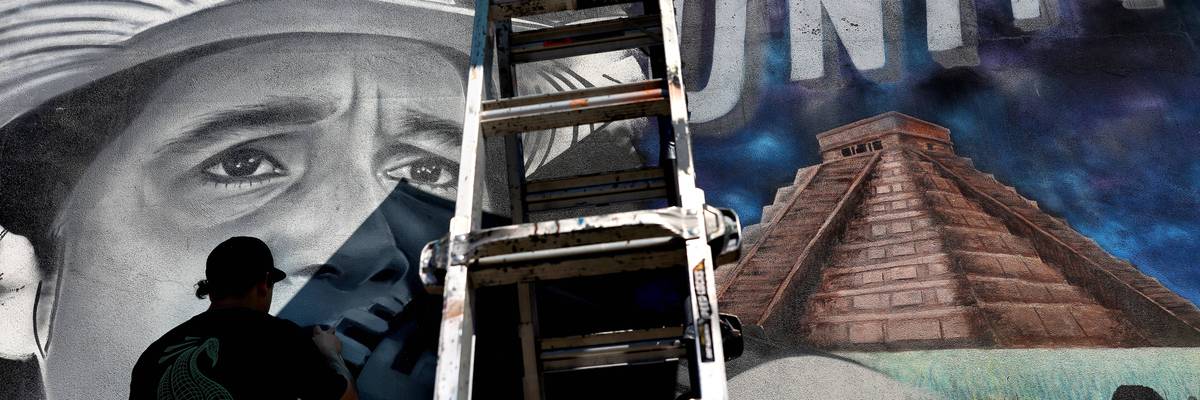
Artist MisterAlek replaces a portrait of César Chávez, in a mural that he created in 2021, with a portrait of Delores Huerta, at the Watts/Century Latino Organization in Los Angeles, California on March 20, 2026.

(Photo Christina House/Los Angeles Times via Getty Images)

Jessica Corbett
Mar 21, 2026
COMMON DREAMS

“Our collective power is what defines us and is our movement, and one person cannot tear our movement down,” Alianza Nacional De Campesinas said in the wake of The New York Times reporting Wednesday on multiple sexual abuse allegations against late Mexican-American labor leader César Chávez.

“As a farmworker women’s organization, many of us have experienced or witnessed the sexual abuse and silence women endure in many aspects of our lives,” the group continued, adding that “we are deeply troubled and devastated” to learn about the reporting, and “we stand with Dolores Huerta, Ana Murguía, and Debra Rojas, who have bravely shared their painful stories.”
RECOMMENDED...


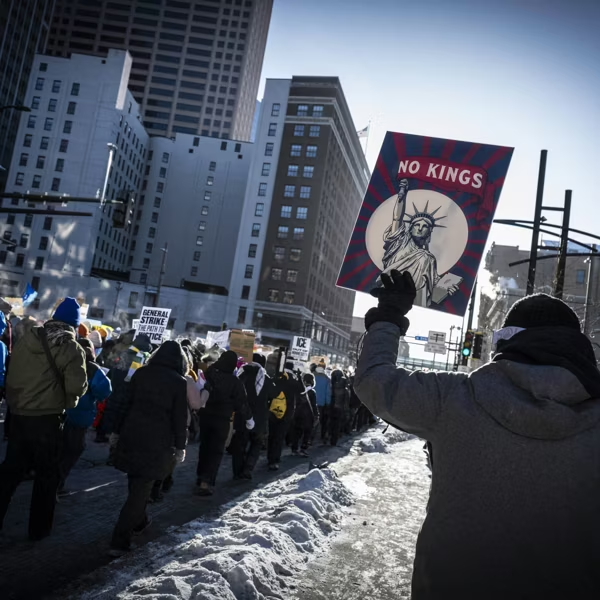
3,000+ No Kings Protests to ‘Reject Corruption, Senseless War, and Division’ on March 28

Huerta, cofounded with Chávez a group that went on to become the labor union United Farm Workers (UFW). In her comments to the Times and a separate statement, the 95-year-old described two separate encounters with Chávez that led to pregnancies: “The first time I was manipulated and pressured into having sex with him... The second time I was forced, against my will, and in an environment where I felt trapped.”


Murguía told the Times that Chávez molested her for four years, beginning when she was 13. Rojas said she was 12 when Chávez first groped her breasts in the same office where abused Murguía. When Rojas was 15, the newspaper reported, “he arranged to have her stay at a motel during a weekslong march through California, she said, and had sexual intercourse with her—rape, under state law, because she was not old enough to consent.”

The reporting has sparked a wave of responses from labor groups, elected officials, and others who have expressed support for survivors and stressed, as Guardian US columnist Moira Donegan wrote Friday, that “the rightness of the movement for the dignity of workers, for the rights and respect of Latinos, and for a future in which there is more freedom and possibility for poor people... cannot be tarnished by Chávez’s behavior.”

UFW Foundation said this week that “as a women-led organization that exists to empower communities, the allegations about abusive behavior by César Chávez go against everything that we stand for.”

Describing the alleged abuse as “shocking, indefensible and something we are taking seriously,” the UFW Foundation also announced that it “has cancelled all César Chávez Day activities this month.”

California lawmakers are planning to rename César Chávez Day, a state holiday celebrated on March 31, Farmworkers Day. Artists and officials have begun removing plaques, murals, and other memorials.


American Federation of Labor and Congress of Industrial Organizations president Liz Shuler and secretary-treasurer Fred Redmond said Wednesday that in light of “these horrific, disturbing allegations,” the AFL-CIO “will not participate or endorse any upcoming activities for César Chávez Day.”

“The AFL-CIO will always stand in solidarity with farmworkers who have fought for and won critical rights over generations through collective action, resilience, and extraordinary determination—a history that cannot be erased by the horrific actions of one person.” said the pair. “The labor movement was organized not only to protect workers’ paychecks and benefits, but also to ensure they are safe from any form of harassment, inappropriate conduct, or assault. Our commitment to safety and justice for farmworkers, immigrant workers, and all in our workplaces will never waver.”

Advocacy and labor leaders also emphasized the importance of ensuring movements are save for their members. GreenLatinos founding president and CEO Mark Magaña told the survivors that “we stand with you and take this opportunity to recommit to our work supporting the farmworker community who toil in dangerous conditions, including extended exposure to extreme heat and deadly pesticides, while women farmworkers also continue to suffer from disturbingly high rates of sexual assault.”

“To our community, the movement for justice and dignity for farmworkers is much bigger than one person,” Magaña continued. “At a time when our communities are under serious attack, GreenLatinos remains committed to that movement. ¡Sí, Se Puede!”


Monica Simpson, executive director of SisterSong: Women of Color Reproductive Justice Collective, said that “Dolores Huerta, Ana Murguía, and Debra Rojas are showing us what real courage looks like. For decades, they kept secret the sexual abuse they experienced because of the power César Chávez held and his legacy within the labor and civil rights movements.”

“That kind of silence doesn’t just come from one person, it comes from systems and people in power who make women feel like speaking out will cost too much or threaten the very movement they helped build,” Simpson argued. “We stand with Dolores Huerta, Ana Murguía, Debra Rojas, and all survivors. We’re committed to building movements where no one has to carry harm or abuse in silence just to keep the work going. Our movements are bigger than one person, they belong to the people who build and sustain them. We have a responsibility to protect each other so everyone can be safe within them. That means choosing people over power and legacy, and creating spaces where safety, care, accountability, and dignity are the foundation of the work.”

The revelations about Chávez come as President Donald Trump’s administration pursues its mass deportation agenda and amid a fight for justice for survivors of Trump’s former friend, convicted sex offender Jeffrey Epstein. Members in Congress continue to call out the US Department of Justice for the Epstein files it has withheld or heavily redacted.


US Sen. Ruben Gallego (D-Ariz.) said that the reports on Chávez “are shocking and disappointing about a leader that I for many years had looked up to, like so many Latinos growing up in the US. But as I have said many times this year—no one, no matter how powerful, is above accountability, especially when it comes to abusing young women.”

“The farmworkers’ movement has always been bigger than any one man,” declared Gallego, who represents the state where Chávez was born. “It belongs to the thousands of hardworking people who have spent decades on the front lines fighting for the dignity of agricultural workers. We have to keep that fight going, especially now, when our community is under constant attack.”

Gallego also recognized “the incredible bravery of the women who came forward,” as did Sen. Alex Padilla (D-Calif.), who asserted that “there must be zero tolerance for abuse, exploitation, and the silencing of victims, no matter who is involved.”

“Confronting painful truths and ensuring accountability is essential to honoring the very values the greater farmworker movement stands for—values rooted in dignity and justice for all,” added Padilla.


Democratic Women’s Caucus Chair Teresa Leger Fernández (D-NM) said that “the farmworker and civil rights movement was built by countless people—especially women and families who sacrificed everything for a better future. That history is bigger than any one person. Honoring that legacy means facing painful truths and continuing the work for justice with honesty and humanity.”

The Congressional Hispanic Caucus said that “while it’s heartbreaking when leaders are exposed as flawed beyond absolution, a just society has a duty to hold abusers accountable without exception.”

“A movement stands on its values, not the misconduct of an individual.The strength of a movement is defined by its constituency, by its achievements and, yes, by its willingness to hold its leaders accountable,” the CHC said. “We will always support the farmworkers who feed this nation, enrich our culture, and elevate our values. We commend the UFW’s courage in standing by its constituency.”

“We stand committed to work toward renaming streets, post offices, vessels, and holidays that bear Chávez’s name to instead honor our community and the farmworkers whose struggle defined the movement,” the caucus added, noting that this March 31, it will “recognize and honor farmworkers and their arduous, essential work, and reaffirm our unequivocal commitment to survivor.”


The US National Domestic Violence Hotline can be reached at 1-800-799-SAFE (7233), by texting “START” to 88788, or through chat at thehotline.org. It offers 24/7, free, and confidential support. DomesticShelters.org has a list of global and national resources.