Saturday, May 02, 2026

How Pax Silica Could Multiply Philippines’s Economic Risks

The Philippines is no longer struggling with just huge corruption scandals and economic pressures. Pax Silica could turn it into a frontline state – like Taiwan.

by  | Apr 30, 2026 | 

With the U.S.-led Pax Silica framework, the Philippines is becoming a dual-use platform where military strategy and supply-chain restructuring are converging.

Over the past year, the Philippines has moved decisively into the front line of US–China friction, thanks to expanded access under the bilateral Enhanced Defense Cooperation Agreement (EDCA), large-scale military exercises near Taiwan-adjacent waters, and growing interoperability with U.S. forces.

The Philippines is transitioning toward a logistics hub in a possible regional contingency. What is new is that this military alignment is now paired with an economic architecture: Pax Silica.

Pax Silica, a risk multiplier

In April 2026, the Philippines joined the U.S.-led coalition designed to secure supply chains in semiconductors, AI infrastructure, and critical minerals. The centerpiece is the planned 4,000-acre “Economic Security Zone” in the Luzon Economic Corridor, intended as a hub for allied manufacturing and resource processing.

In the Philippines, Pax Silica is sold as an opportunity; a chance to climb the value chain, attract investment, and leverage mineral endowments. The country’s large nickel and cobalt reserves, its workforce, and its strategic location make it an attractive node in this emerging network. That’s the pitch.

In isolation, this could be a development breakthrough. But Pax Silica does not operate in isolation. It is explicitly designed to decouple supply chains from China and consolidate them within a U.S.-aligned bloc.

That means participation in a geoeconomic divide that could reshape trade flows, investment patterns, and political risk for decades.

Investment and trade risks         

The economic implications follow through several channels. First, investment. The Philippines will likely see targeted inflows tied to Pax Silica – particularly in minerals processing, electronics, and logistics.

But these inflows will be conditional and politically anchored. Meanwhile, broader investment will face rising risk premiums as the country is reclassified from a conventional emerging market to a geopolitical frontline state.

Investors will not ignore the fact that key infrastructure now serves both commercial and strategic purposes.

Second, trade. The Philippines’ economic structure is deeply entangled with China, which absorbs the majority of its raw nickel exports and remains a major trading partner.

Pax Silica’s goal of rerouting supply chains away from China is likely to amplify trade diversion and friction.

Corruption and militarization of infrastructure        

Third, energy and supply vulnerability. In a gray-zone escalation, even limited economic leverage by an adversary could trigger inflation shocks in the import-dependent economy.

In the short term, Pax Silica increases exposure to retaliatory pressure.

In the Philippines, the Iran crisis has caused a severe crisis and national energy emergency. But it pales in comparison to the possible long-term implications of Pax Silica.

Fourth, and most critically, the Philippines enters this transition with weak state capacity, as evidenced by large-scale corruption in infrastructure projects.

This matters because Pax Silica and military alignment both depend on the same foundations: ports, logistics corridors, energy systems, and procurement processes. Since these are known to be compromised by corruption and inefficiency, the risks are magnified.

Bases, ports, and industrial zones linked to Pax Silica are no longer just economic assets. They are now potential strategic targets in an escalation scenario.

Economic backbone as a dual-use target      

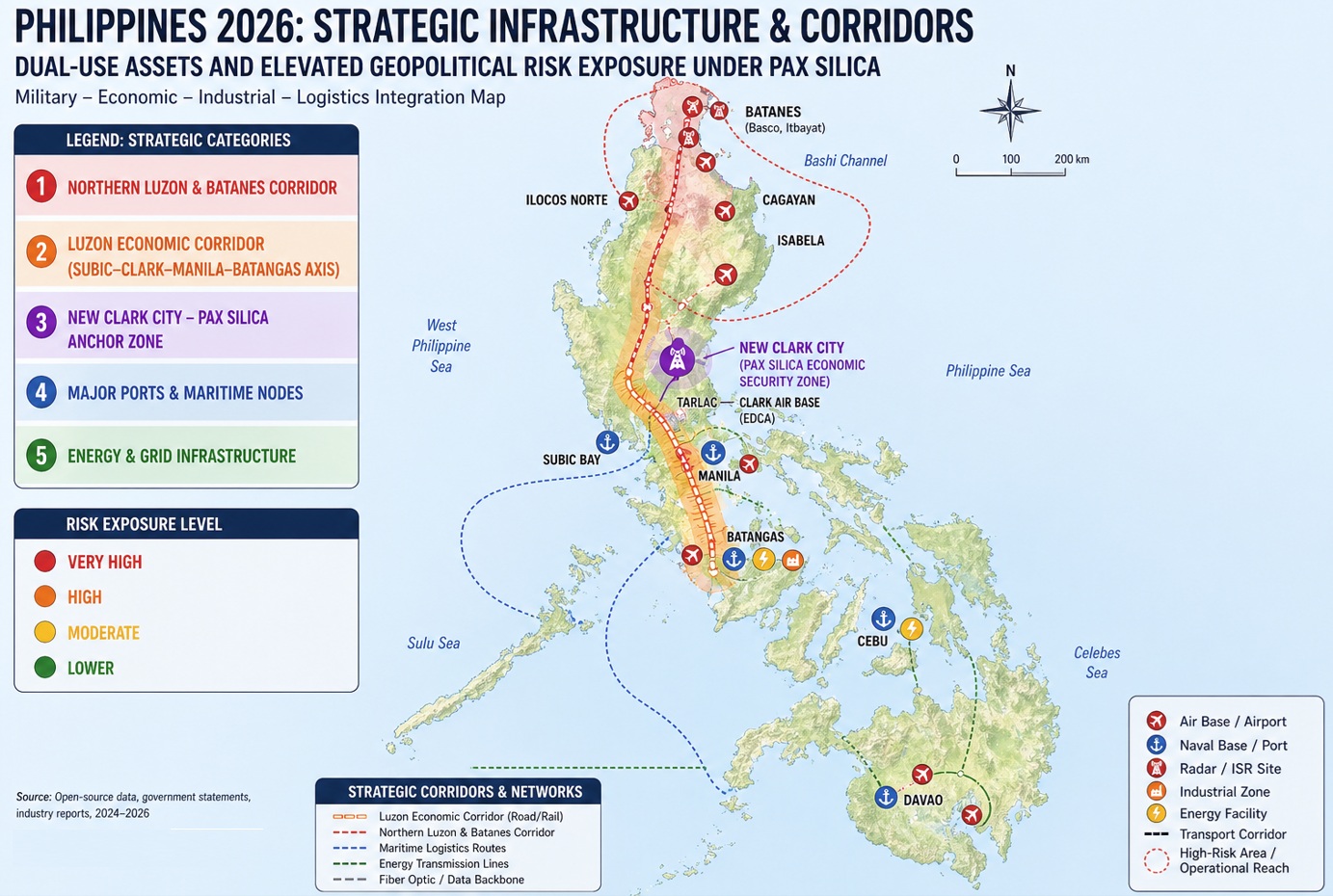
In light of Pax Silica, the Philippine map of expanding military targets no longer consists only of traditional bases like EDCA sites. It now includes:

  • Northern Luzon and Batanes corridor: proximity to Taiwan, staging ground for logistics and surveillance
  • Subic–Clark–Manila–Batangas axis (Luzon Economic Corridor): now the core of Pax Silica industrial development and transport infrastructure
  • New Clark City: likely site of the 4,000-acre economic security zone, combining industrial and logistical functions
  • Major ports and energy nodes integrated into allied supply chains

These are dual-use targets: both economic assets and strategic infrastructure.

Pax Silica effectively expands the definition of what counts as a “target” from purely military installations to the broader economic backbone of the country.

So, where do we go from here?
Ominous scenarios          

In the Managed Alignment scenario, the country deepens its role in both military and supply-chain networks without triggering major conflict. Growth continues at a moderate pace – roughly 4.5 to 5.5% – but below potential. Pax Silica delivers selective gains, but these are offset by higher risk premiums and trade frictions.

In the Gray-Zone Escalation scenario, tensions intensify without open war. Economic coercion, supply disruptions, and political pressure become routine. Growth slows to 3–4% percent, investment stagnates, and volatility increases.

This is the path to long-term underperformance. Its main beneficiaries are military and security elites and oligarchic dynasties that own the strategic infrastructure.

The Marcos Jr government likely sees itself in a mild Managed Alignment scenario. In terms of economic realities, it may be somewhere between that scenario and the Gray-Zone Escalation scenario.

There is also a third possible scenario, Strategic Rebalancing. It seeks to reduce exposure while emphasizing ASEAN neutrality. It would offer the best economic outcomes to the Filipino people.

Launched by former president Duterte, it is currently a low-proHow Pax Silica Could Multiply Philippines’s Economic Risks

The Philippines is no longer struggling with just huge corruption scandals and economic pressures. Pax Silica could turn it into a frontline state – like Taiwan.

by Dan Steinbock | Apr 30, 2026 | 1 Comment


With the U.S.-led Pax Silica framework, the Philippines is becoming a dual-use platform where military strategy and supply-chain restructuring are converging.


Over the past year, the Philippines has moved decisively into the front line of US–China friction, thanks to expanded access under the bilateral Enhanced Defense Cooperation Agreement (EDCA), large-scale military exercises near Taiwan-adjacent waters, and growing interoperability with U.S. forces.


The Philippines is transitioning toward a logistics hub in a possible regional contingency. What is new is that this military alignment is now paired with an economic architecture: Pax Silica.


Pax Silica, a risk multiplier


In April 2026, the Philippines joined the U.S.-led coalition designed to secure supply chains in semiconductors, AI infrastructure, and critical minerals. The centerpiece is the planned 4,000-acre “Economic Security Zone” in the Luzon Economic Corridor, intended as a hub for allied manufacturing and resource processing.


In the Philippines, Pax Silica is sold as an opportunity; a chance to climb the value chain, attract investment, and leverage mineral endowments. The country’s large nickel and cobalt reserves, its workforce, and its strategic location make it an attractive node in this emerging network. That’s the pitch.


In isolation, this could be a development breakthrough. But Pax Silica does not operate in isolation. It is explicitly designed to decouple supply chains from China and consolidate them within a U.S.-aligned bloc.


That means participation in a geoeconomic divide that could reshape trade flows, investment patterns, and political risk for decades.


Investment and trade risks         


The economic implications follow through several channels. First, investment. The Philippines will likely see targeted inflows tied to Pax Silica – particularly in minerals processing, electronics, and logistics.


But these inflows will be conditional and politically anchored. Meanwhile, broader investment will face rising risk premiums as the country is reclassified from a conventional emerging market to a geopolitical frontline state.


Investors will not ignore the fact that key infrastructure now serves both commercial and strategic purposes.


Second, trade. The Philippines’ economic structure is deeply entangled with China, which absorbs the majority of its raw nickel exports and remains a major trading partner.


Pax Silica’s goal of rerouting supply chains away from China is likely to amplify trade diversion and friction.


Corruption and militarization of infrastructure        


Third, energy and supply vulnerability. In a gray-zone escalation, even limited economic leverage by an adversary could trigger inflation shocks in the import-dependent economy.


In the short term, Pax Silica increases exposure to retaliatory pressure.


In the Philippines, the Iran crisis has caused a severe crisis and national energy emergency. But it pales in comparison to the possible long-term implications of Pax Silica.


Fourth, and most critically, the Philippines enters this transition with weak state capacity, as evidenced by large-scale corruption in infrastructure projects.


This matters because Pax Silica and military alignment both depend on the same foundations: ports, logistics corridors, energy systems, and procurement processes. Since these are known to be compromised by corruption and inefficiency, the risks are magnified.


Bases, ports, and industrial zones linked to Pax Silica are no longer just economic assets. They are now potential strategic targets in an escalation scenario.


Economic backbone as a dual-use target      


In light of Pax Silica, the Philippine map of expanding military targets no longer consists only of traditional bases like EDCA sites. It now includes:


Northern Luzon and Batanes corridor: proximity to Taiwan, staging ground for logistics and surveillance

Subic–Clark–Manila–Batangas axis (Luzon Economic Corridor): now the core of Pax Silica industrial development and transport infrastructure

New Clark City: likely site of the 4,000-acre economic security zone, combining industrial and logistical functions

Major ports and energy nodes integrated into allied supply chains

These are dual-use targets: both economic assets and strategic infrastructure.


Pax Silica effectively expands the definition of what counts as a “target” from purely military installations to the broader economic backbone of the country.


So, where do we go from here?


Ominous scenarios          


In the Managed Alignment scenario, the country deepens its role in both military and supply-chain networks without triggering major conflict. Growth continues at a moderate pace – roughly 4.5 to 5.5% – but below potential. Pax Silica delivers selective gains, but these are offset by higher risk premiums and trade frictions.


In the Gray-Zone Escalation scenario, tensions intensify without open war. Economic coercion, supply disruptions, and political pressure become routine. Growth slows to 3–4% percent, investment stagnates, and volatility increases.


This is the path to long-term underperformance. Its main beneficiaries are military and security elites and oligarchic dynasties that own the strategic infrastructure.


The Marcos Jr government likely sees itself in a mild Managed Alignment scenario. In terms of economic realities, it may be somewhere between that scenario and the Gray-Zone Escalation scenario.


There is also a third possible scenario, Strategic Rebalancing. It seeks to reduce exposure while emphasizing ASEAN neutrality. It would offer the best economic outcomes to the Filipino people.


Launched by former president Duterte, it is currently a low-probability scenario. An election triumph by Vice President Sara Duterte would make it topical again.


Brave new Philippines?  


The most immediate challenge is a status quo in which the Gray-Zone Escalation would morph into a Taiwan conflict spillover. Unfortunately, the Philippines’ new dual role – as a military hub and a Pax Silica supply-chain node – amplifies its exposure.


Economic contraction, capital flight, and infrastructure disruption would follow, as the very assets intended to drive growth become liabilities.


The Philippines is entering a new phase of moderate growth under persistent geopolitical drag, where gains from integration into allied supply chains are offset by higher risk, reduced flexibility, and ongoing governance challenges.


The real cost of the current path would be a transformation into a frontline node in potential Taiwan conflict, where every Philippine port, factory, and corridor carries both economic promise and strategic risk.


The original commentary was published by The Manila Times on April 27, 2026.


If you liked this article, please support Antiwar.com.

We are 100% reader-supported.

Dr. Dan Steinbock is an internationally recognized visionary of the multipolar world and the founder of Difference Group. He has served at the India, China and America Institute (US), Shanghai Institutes for International Studies (China) and the EU Center (Singapore). For more, see https://www.differencegroup.net bability scenario. An election triumph by Vice President Sara Duterte would make it topical again.

Brave new Philippines?  

The most immediate challenge is a status quo in which the Gray-Zone Escalation would morph into a Taiwan conflict spillover. Unfortunately, the Philippines’ new dual role – as a military hub and a Pax Silica supply-chain node – amplifies its exposure.

Economic contraction, capital flight, and infrastructure disruption would follow, as the very assets intended to drive growth become liabilities.

The Philippines is entering a new phase of moderate growth under persistent geopolitical drag, where gains from integration into allied supply chains are offset by higher risk, reduced flexibility, and ongoing governance challenges.

The real cost of the current path would be a transformation into a frontline node in potential Taiwan conflict, where every Philippine port, factory, and corridor carries both economic promise and strategic risk.

The original commentary was published by The Manila Times on April 27, 2026.

Dr. Dan Steinbock is an internationally recognized visionary of the multipolar world and the founder of Difference Group. He has served at the India, China and America Institute (US), Shanghai Institutes for International Studies (China) and the EU Center (Singapore). For more, see https://www.differencegroup.net 

The Lesson of Gaddafi

by  | Apr 30, 2026 

I want to tell you a story that most Americans have never been told.

Not because the information is hidden. Because no one has connected the dots in a way that makes the consequences visible.

It is a story about trust. About prosperity. About what happens when a country trusts the United States. And about what every other government in the world learned from watching what happened next.

The man’s name was Muammar Gaddafi.

He ruled Libya for forty-two years. He was an authoritarian. He was responsible for serious abuses of his own people. He sponsored terrorism. None of that is in dispute.

But before we talk about how he died, I want to tell you what Libya looked like while he was alive.

Because that part of the story is almost never told.

Under Gaddafi, Libya had the highest per capita income in Africa. Education was free. Healthcare was free. Having a home was considered a human right. Fuel was nearly free. Libya ranked second on the Human Development Index for the entire African continent, behind only Mauritius.

The country had built the Great Man-Made River – the largest irrigation system in the world – bringing water from deep desert aquifers to the cities and the coast. Gaddafi called it the eighth wonder of the world. Whether you admired him or despised him, it was an extraordinary engineering achievement that served millions of people.

Libya had its own oil. Its own water. Its own food supply. Its own state bank. Its own currency. It was, by the measures that matter to ordinary people, one of the most prosperous nations on the African continent.

I am not telling you this to defend him. I am telling you this so you understand what was destroyed.

Now let me tell you what Gaddafi was building beyond Libya’s borders.

He had a vision for African economic independence. He was financing an African Monetary Fund. An African Investment Bank. And most significantly – an African Central Bank that would issue a gold-backed currency. A Pan-African currency that would allow African nations to trade with each other and with the world without dependence on the US dollar, the IMF, or the French African franc.

For fifty years, African nations had been held in economic dependence through their currencies and their debt. Gaddafi was trying to change that. He had the oil wealth to back it. He had the political relationships across the continent to build it.

That ambition made him dangerous to people who had nothing to do with human rights.

Now let me tell you what happened in 2003.

Gaddafi made a decision. He watched what the United States did to Saddam Hussein. He watched the invasion of Iraq. He watched the stated justification – weapons of mass destruction. And he decided he did not want to be next.

So he did what American officials had been asking him to do for years.

He surrendered his weapons of mass destruction program. Completely. He opened his nuclear facilities to international inspectors. He cooperated with the war on terror. He paid reparations to the families of the Lockerbie bombing. He normalized relations with the West.

He disarmed. He complied. He trusted.

The Bush administration celebrated. Condoleezza Rice flew to Tripoli. Gaddafi was welcomed back into the community of nations. The sanctions came off. Western oil companies returned. It was held up as a model. A proof of concept. This is what happens when rogue states cooperate.

Eight years later NATO bombed Libya.

The intervention was authorized by the UN Security Council to protect civilians. A no-fly zone. A humanitarian mission.

That was the story told to the public.

Here is what the evidence shows.

The British parliament investigated the intervention in 2016. Its conclusion was direct. The UK government had failed to identify that the threat to civilians was overstated. Early press reports had exaggerated the death toll by a factor of ten. Human Rights Watch later documented 233 deaths across all of Libya in the early days of the uprising. Western media had reported thousands. The humanitarian justification was built on numbers that were not true.

And the no-fly zone authorized to protect civilians became a regime change operation within weeks. NATO struck Gaddafi’s forces not just defensively but offensively. It provided weapons, training, and covert troops to rebel forces. It continued bombing even when Gaddafi’s government offered a ceasefire that could have ended the violence. The ceasefire was rejected.

The mission was not to protect civilians. The mission was to remove Gaddafi.

But there is more.

In 2016, Hillary Clinton’s emails were made public. What they revealed was not primarily about the humanitarian situation in Libya. What they revealed was a second reason for the intervention that had never been stated publicly.

France, according to those documents, had specific motivations. Preferential access to Libyan oil. The reassertion of French influence in North Africa. And critically – the prevention of Gaddafi’s gold-backed African currency.

The emails documented that Gaddafi had accumulated significant gold and silver reserves – estimated at the time at 143 tons of gold – specifically to back a Pan-African currency that would challenge the dollar and the French African franc. That currency would have allowed African nations to escape the financial structures that had kept them dependent on Western institutions for decades.

That project died with Gaddafi.

His government collapsed. He was found hiding in a drainage pipe. A mob pulled him out and killed him in the street. His body was put on public display. No autopsy was permitted. No independent investigation was conducted. He was buried in a secret grave in the desert.

Hillary Clinton, then Secretary of State, was shown a video of his death on her phone. Her response, caught on camera, was: we came, we saw, he died.

That statement was heard around the world.

Not as candor. As a message.

The message was this. Compliance does not protect you. Cooperation does not protect you. Surrendering your weapons does not protect you. If we decide your government needs to go, it will go.

Now I want you to ask yourself a question.

If you were the leadership of Iran, watching all of this, what would you conclude?

If you were in North Korea, watching all of this, what would you conclude?

If you were any government that the United States had labeled a threat, watching all of this, what would you conclude?

The conclusion is not difficult to reach. The only thing that deters regime change is the capability to make regime change costly. Gaddafi had that capability. He surrendered it. And eight years later he was dead in a drainage pipe.

The people who negotiated the Iran nuclear deal in 2015 – the JCPOA – were asking Iran to do exactly what Gaddafi did. Surrender the program. Open to inspectors. Trust the process. In exchange for sanctions relief and normalized relations.

Iran complied. The IAEA certified compliance repeatedly.

Three years later the United States walked away from the agreement.

Not because Iran violated it. Because a new administration decided it was inconvenient.

Now we are at war.

Now let me tell you what Libya looks like today.

The free healthcare is gone. The free education is gone. The housing guarantee is gone. The Great Man-Made River was bombed. The African currency project died with its architect. The country that had the highest per capita income in Africa now has two competing governments, neither of which controls the full territory, more than a thousand armed militias operating across the country, and an open slave market that emerged after 2011 in which African migrants are bought and sold.

The promise was freedom. The reality is that Libya has been a failed state for fourteen years, a playground for foreign powers, a trafficking corridor, and a warning that no serious analyst can ignore.

I am not here to defend the Iranian government. I am not here to defend Gaddafi. Both were and are authoritarian regimes that have caused genuine suffering.

I am here to ask Americans to look honestly at the cause and effect of what their government has done.

We told Gaddafi: disarm and you will be safe. He disarmed. He was not safe.

We told Iran: comply with the nuclear agreement and we will honor our commitments. They complied. We did not honor our commitments.

We destroyed a country that had the highest living standard in Africa and replaced it with chaos, slavery, and permanent conflict.

We are now asking the world to trust American assurances. To believe that cooperation will be rewarded. To believe that the rules apply to everyone equally.

But the precedent we set says otherwise.

The precedent we set says that the rules apply to the weak. That compliance is for countries that cannot defend themselves. That American commitments last only until the next administration decides they are inconvenient. And that prosperity built outside the approved financial architecture will be targeted regardless of what justification is offered publicly.

This is not the America the founders designed.

The founders designed a republic with a government constrained by law. A government whose commitments meant something because they were backed by institutions and not just by the goodwill of whoever happened to be in power.

What we did to Gaddafi, and what we did to the Iran agreement, is not a foreign policy failure. It is a credibility failure. And credibility, once lost, is not recovered by rhetoric. It is only recovered by behavior over time.

Every government in the world that watched what happened to Gaddafi drew the same lesson.

Get the bomb. Or be Gaddafi.

That is the lesson American foreign policy taught.

Not because anyone intended to teach it. Because that is what the actions communicated regardless of what the words said.

And now we are in a war with Iran.

A war that did not begin last month. A war whose seeds were planted the day we watched Gaddafi trust us, disarm, and die in a drainage pipe.

Americans deserve to understand that sequence.

Not so we can relitigate the past.

So we can make better decisions about the future.

Because the next country watching what we do is already drawing its conclusions.

And the lesson they are learning is the same one Gaddafi learned.

Not when he disarmed.

When he died.

Jeffrey Wernick is a Partner at BitChute and co-host of The Fein Print podcast with constitutional attorney Bruce Fein. An early Bitcoin advocate with a background in economics, he writes on constitutional law, executive war powers, Austrian economics, and the architecture of free speech.  He can be reached at jeffreywernick@icloud.com.

The Trump Surveillance State


by  | May 1, 2026 

The Fourth Amendment protects all persons from warrantless government searches and seizures of their persons, houses, papers and effects. It requires that warrants be supported by probable cause of crime and specifically describe the place to be searched and the persons or things to be seized.

Last week, for the first time in the modern era, the government argued to the Supreme Court of the United States that the Fourth Amendment to the Constitution did not outlaw general warrants. General warrants were issued in the colonial era by a secret court in London. They were not based on probable cause of crime or even on articulable suspicion about a potential defendant. They did not identify a target or state what crime was being investigated.

Rather, general warrants were based on governmental need; a meaningless standard as whatever the government wants it will tell a court it needs. The warrants authorized the bearer of the warrant to search wherever he wished and seize whatever he found.

The stated motivation for the general warrants was the British government’s enforcement of the Stamp Act. That legislation required all colonists to have stamps affixed to all papers, books and newspapers in their possession. The enforcement of the Stamp Act was the government’s fig leaf for spying.

We know that the true reason for the Stamp Act was to conduct surreptitious searches for revolutionary materials. We know this because during the one-year existence of the Stamp Act — 1765 — a group of enterprising students at the College of New Jersey, now known as Princeton University, calculated that more revenue was spent to enforce the act than was collected by the sale of the stamps.

Historians believe that the use of general warrants for the enforcement of the Stamp Act pushed many colonists into the independence camp 10 years later in 1775. The use of general warrants also motivated James Madison and his colleagues in 1791 to craft the Fourth Amendment whose specificity requirement “particularly describing the place to be searched and the persons or things to be seized” poignantly did away with search where you wish and seize whatever you find.

Until now.

Now, in one week on Capitol Hill, the right to privacy is facing its gravest challenges since pre-colonial days, in Congress and the Supreme Court. Congress will wrestle with Section 702 of the Foreign Intelligence Surveillance Act, which expires in just days, and the court will hear a claim that general warrants are still viable.

Sec. 702 permits warrantless surveillance on Americans by permitting federal agents to use software that allows them to conduct surveillance of all fiber optic means of communication — mobile phones, message texting, emails — based on the lawful communications of some Americans to foreign persons and then their subsequent lawful communications to other Americans. The “other Americans” can include all 340 million of us.

Theoretically, the data gathered from these warrantless searches cannot be used for criminal prosecutions, since even the feds who do this spying have told members of Congress that they recognize the need for search warrants to access the content of the data. There are at least two reasons that no one should believe what the feds have said. The first is the feds lie. In 2023, they accessed the content of the data thousands of times without warrants. The second reason is that Madison and the Fourth Amendment’s ratifiers did not believe the government would restrain itself, hence the specificity requirement.

As if all this were not enough to keep those of us who monitor constitutional fidelity awake at night, this week the Trump administration actually told the court that it should be able to use general warrants if the target has failed to inform his service provider of his wish for privacy. Okello Chatrie was convicted of bank robbery when the feds persuaded a state judge to sign a search warrant for Google records that failed to identify a target, failed to articulate a crime and failed to specify what the government sought.

The warrant was for the ping records — the records of cellphones showing their location — of all cellphones in the vicinity of a bank that had been robbed on the day and at the time of the robbery. Then the feds persuaded another judge to sign another general warrant that ordered Google to unmask the identity of the owner/users of all those cellphones. This led them to several homes that the feds persuaded another judge to authorize them to raid.

All three of these warrants were in direct violation of the Fourth Amendment by failing to describe particularly the place to be searched or the persons or things to be seized. At trial before one of these constitutionally challenged judges, the defendant Chatrie was convicted on the basis of the Google pings and the loot found in his home.

The government is patting itself on the back. Yet, its agents and prosecutors took an oath to uphold the Fourth Amendment; just as the government’s domestic spies have done; just as judges do.

Does anyone in the government take the Constitution seriously? If it means what it says — as the late Justice Antonin Scalia argued literally thousands of times — then why does the government evade it?

The Constitution is intended to be an obstacle to the government. Its principal value judgment is that the individual is sovereign, not the government; and the government can only do what the governed have affirmatively consented to allow it to do. And the governed have not consented to general warrants.

Justice Scalia recognized that the Fourth Amendment protects more than pings and loot. He knew it protects beliefs, thoughts, sensations and emotions when he famously wrote that “there is nothing new in the realization that the Constitution sometimes insulates the criminality of a few in order to protect the privacy of us all.”

Andrew P. Napolitano, a former judge of the Superior Court of New Jersey, is the senior judicial analyst at Fox News Channel. Judge Napolitano has written seven books on the US Constitution. The most recent is Suicide Pact: The Radical Expansion of Presidential Powers and the Lethal Threat to American Liberty. To find out more about Judge Napolitano and to read features by other Creators Syndicate writers and cartoonists, visit www.creators.com. 
COPYRIGHT 2025 ANDREW P. NAPOLITANO – DISTRIBUTED BY CREATORS.COM