It’s possible that I shall make an ass of myself. But in that case one can always get out of it with a little dialectic. I have, of course, so worded my proposition as to be right either way (K.Marx, Letter to F.Engels on the Indian Mutiny)
Egypt aims to generate 42% of its electricity from renewables by 2030 and over 60% by 2040, supported by large-scale solar, wind and hydrogen projects.
Billions of dollars in investment from private developers and international partners are accelerating new renewable generation, battery storage, and transmission infrastructure.
Egypt is positioning itself as a regional clean energy hub, with growing ambitions to export green hydrogen and strengthen electricity links with Europe.
Egypt has steadily been increasing its renewable energy capacity and has even bigger plans for the coming decade. While Egypt continues to rely heavily on fossil fuels, that could soon change thanks to high levels of private investment in green energy, supported by favourable national policies.
Egypt has significant potential to develop its solar and wind energy sectors, thanks to its favourable geographical conditions, with abundant land, including arid deserts, sunny weather, and high wind speeds. The North African country has some of the highest solar irradiance levels in the world, with between 2,000 and 3,200 kilowatt-hours (kWh) per square meter annually.
In recent years, the government has shown greater openness to energy diversification through private investment, supporting the aim of growing Egypt’s solar and wind capacity. The Integrated Sustainable Energy Strategy (ISES) 2035 builds upon previous national frameworks and establishes renewable energy as a core component of Egypt’s green transition.
The government aims to generate 42 per cent of electricity from renewable sources by 2030 and increase this to 60 per cent by 2040. It will do this by diversifying its energy mix to include wind, hydropower, photovoltaic solar, and green hydrogen.
The government has sought external support for its energy strategy and the development of a diversified energy mix, with the European Commission having contracted the management consulting firm Cowater International to assess Egypt’s energy strategy over the next two decades.
In line with a greater openness to private investment, the government had signed around 32 Power Purchase Agreements (PPAs) with private developers by 2025 to produce 1,465 MW of renewable energy, with additional agreements underway.
In January, Egypt signed renewable energy deals worth a combined $1.8 billion. This is expected to help the North African country achieve its 42 per cent renewable electricity generation goal by the end of the decade. The agreements included projects with Norwegian renewable energy developer Scatec and China’s Sungrow.
The first project will be the development of a solar energy plant with Scatec to produce electricity and energy storage stations in Minya, Upper Egypt, according to the Egyptian government. The plant is expected to have a 1.7 GW capacity and incorporate 4 GWh of battery storage. Meanwhile, Sungrow will develop a battery manufacturing facility in the Suez Canal Economic Zone and will supply batteries to the Scatec plant. Scatec also signed a PPA to provide 1.95 GW of capacity and 3.9 GWh of battery storage systems.
In June, Egypt signed a deal with the European Union to deepen the two powers’ strategic partnership in renewable energy, agreeing to a financing package valued at up to $788 million to expand and upgrade Egypt’s electricity transmission network. The package includes a $686 million loan from the European Investment Bank’s development arm, EIB Global, and up to $103 million in European Commission grants.
The project will be led by the state-owned Egyptian Electricity Transmission Company (EETC), with the aim of powering the grid with 22 GW of renewable energy capacity, or enough to power 10 million homes, by the end of the decade. The agreement aligns with the EU-Egypt Strategic and Comprehensive Partnership and the Trans-Mediterranean Renewable Energy and Clean-Tech Cooperation Initiative (T-MED), which encourages renewable energy and cleantech cooperation between the European Union and southern Mediterranean countries.
The European Commissioner for the Mediterranean, Dubravka Šuica, explained, “Under its newly launched flagship initiative, T-MED, today we presented a major EU-supported project to strengthen and expand Egypt’s electricity infrastructure. This will reinforce Egypt’s role in the regional energy markets and create major business opportunities for local and European companies. It is another testimony of our shared commitment to sustainable growth, energy security and long-term prosperity in the Mediterranean.”
Meanwhile, Egypt’s Minister of Foreign Affairs, International Cooperation and Egyptian Expatriates, Badr Abdelatty, said, “This agreement reflects the strength of the partnership between Egypt and the European Union and our shared determination to advance the green transition. Together with the EIB and the EU, we are taking an important step to modernise our electricity network, strengthen energy security and create new opportunities for sustainable growth.”
In addition to growing its solar and wind power capacity, Egypt has big plans for green hydrogen development to support industrial decarbonisation. In February 2024, the Supreme Council of Energy approved the National Strategy for Low?Carbon Hydrogen. In January, partial production commenced at a 100-MW green hydrogen production project in the Suez Canal Economic Zone, ahead of a broader launch.
Egypt has rapidly developed its renewable energy capacity in recent years and could become a major player in the production and export of green hydrogen in the coming decades. The North African country is a good example of what targeted national policy and an openness to private investment can achieve.
By Felicity Bradstock for Oilprice.com
The World's Biggest Energy Bet Is No Longer on Fossil Fuels
Clean energy investment has decisively overtaken fossil fuels, with the IEA forecasting $2.16 trillion flowing into clean energy in 2025 versus just over $1 trillion for oil, gas, and coal.
Geopolitical instability is accelerating—not slowing—the energy transition.
The biggest story is where capital is flowing, with investors pouring money into solar, batteries, transmission, and electrification while oil investment continues to decline.
For years, critics of the energy transition have made essentially the same argument. Renewable energy was supposedly too expensive, too dependent on subsidies, too intermittent, and too vulnerable to survive a serious energy security crisis. Sooner or later, they argued, governments and investors would return to the comfort of oil, gas, and coal.
The latest figures from the International Energy Agency suggest the opposite is happening. According to the IEA's newly released World Energy Investment 2026 report, global investment in clean energy has reached $2.155 trillion in 2025, more than double the $1.008 trillion flowing into fossil fuels. The crossover occurred around 2016 when clean energy first overtook fossil fuels. At the time, many assumed the lead would be temporary. Instead, it has widened every year since, transforming what was once a marginal advantage into a decisive one.
This matters because energy transitions are ultimately determined not by political speeches or climate targets, but by where capital flows. Investors spend money where they expect future growth to occur, and increasingly they are betting on electricity rather than combustion.
The Energy Crisis That Changed Everything
What makes these figures particularly remarkable is the context in which they emerged. The world is navigating one of the most significant energy security crises in modern history. Tensions in the Middle East and disruptions around the Strait of Hormuz have once again reminded policymakers how vulnerable fossil fuel markets remain to geopolitical shocks.
Conventional wisdom would suggest that such a crisis should trigger a resurgence in oil and gas investment. After all, for decades, energy security was synonymous with producing more hydrocarbons. Yet the IEA projects global oil investment will fall below $500 billion in 2026, marking a third consecutive year of decline.
The explanation is surprisingly simple. Governments increasingly recognize that the most secure energy source is often the one that can be built at home. Renewable energy has evolved from being primarily a climate strategy into an energy sovereignty strategy. Every solar farm, wind park, battery installation, and transmission line reduces exposure to global fuel markets and strengthens domestic control over energy supply.
The Great Capital Migration
The most important story in energy today is not taking place in oil fields or power stations. It is happening in financial markets. Capital is steadily migrating away from fuel extraction and toward electricity generation, electrification, storage, and grid infrastructure.
The scale of that shift is becoming difficult to ignore. Solar energy alone is expected to attract roughly $365 billion in investment next year. Grid spending is growing by nearly 20% annually as countries race to modernize electricity systems. More than 70% of all global power-sector investment now flows into low-emission technologies.
These are not the numbers of an emerging niche industry. They are the numbers of a technology platform becoming the default choice for new energy investment. Investors are not abandoning fossil fuels because governments told them to. They are doing so because the economics increasingly favor technologies whose fuel is effectively free once the infrastructure has been built.
Why the Money Keeps Moving
One of the most underestimated aspects of renewable energy is that it fundamentally changes the relationship between countries and energy resources. A nation may not possess oil reserves or gas fields, but almost every country has access to sunlight, wind, water, or some combination thereof. Once renewable infrastructure is installed, there is no fuel to import and no geopolitical chokepoint through which energy supplies must pass.
That reality becomes particularly attractive during periods of international instability. Every disruption in oil markets reinforces the economic logic of electrification. Every spike in fuel prices improves the competitiveness of renewable energy. Every geopolitical crisis reminds governments why reducing dependence on imported hydrocarbons has strategic value beyond climate policy.
This helps explain why the largest energy security crisis in decades is accelerating clean energy investment rather than slowing it down.
The Caveats Matter—But Not Enough
None of this means fossil fuels are disappearing tomorrow. Coal investment remains stubbornly resilient in parts of Asia, natural gas continues to benefit from LNG expansion, and many developing economies still face enormous challenges accessing affordable finance for clean energy projects.
However, it would be a mistake to focus on those exceptions while ignoring the broader trend. Every major technological transition contains contradictions and periods of overlap. Coal consumption continued to grow during the rise of oil, and film cameras remained available long after digital photography arrived. What matters is not whether the incumbent survives for a period of time, but where new investment is going.
On that question, the evidence is becoming overwhelming. The overwhelming majority of growth capital in the energy sector is flowing toward technologies that generate, transport, store, and consume electricity.
This Is What Winning Looks Like
The energy transition is often portrayed as fragile, uncertain, and perpetually at risk of stalling. Yet the latest investment figures tell a different story. Faced with geopolitical instability, energy insecurity, and economic uncertainty, the world is not doubling down on fossil fuels. It is accelerating investment in renewable energy, grids, storage, and electrification.
That may be the clearest sign yet that the transition has moved beyond aspiration and entered something much more powerful. Energy systems ultimately change when investors decide where future profits will be made. Every solar farm, transmission line, battery factory, and offshore wind project represents a vote on what the world will look like decades from now.
The latest IEA data suggests those votes are becoming increasingly one-sided. Clean energy now attracts more than twice the investment of fossil fuels, and the gap continues to widen. If there were still doubts about the direction of travel, the money is providing an increasingly clear answer.
This is what winning looks like. Not targets. Not promises. Not conference declarations.
Trillions of dollars moving toward the technologies that will power the future.
By Leon Stille for Oilprice.com
The AI boom propping up markets could trigger the next crash, central banks warn
The vast surge of investment in AI, which has powered global stock markets to record highs, risks ending in a financial bust, the Bank for International Settlements warns, as the build-up’s hidden costs begin to surface in company accounts and consumer prices alike.
In its Annual Economic Report, published on Sunday, the Bank for International Settlements (BIS), known as the central bank for central banks, warned that the enormous spending on AI is accumulating financial vulnerabilities that could amplify any future shock and spread from markets into the wider economy
Presenting the findings, BIS general manager Pablo Hernández de Cos said the message was one of "urgency", with policymakers urged to act before any reversal makes the eventual adjustment more painful.
At the core of the warning is the scale of the spending, despite massive investment having supported global growth over the past year.
The five largest "hyperscalers", the technology giants racing to build AI infrastructure, are on track to commit more than $1 trillion (€878bn) to AI-related investment across 2025 and 2026, a pace that is outstripping their earnings and free cash flow and pushing some to borrow heavily to keep up.
The BIS suggests this race is fuelled by a belief that only a handful of dominant players will ultimately prevail, encouraging firms to pour money into projects whose returns remain deeply uncertain.
Related
Echoes of past manias
The report sets today's AI boom against a long historical lineage, from the canal mania of the 1830s and Britain's railway mania of the 1840s to the electrification of the 1920s and the dotcom bubble.
Each began with a genuine technological breakthrough that attracted more capital than commercial returns could justify, the BIS notes, with each episode ending "with an eventual reversal in investment, inducing economy-wide recessions".
Compounding the danger are stretched share prices and opaque financing.
The BIS highlights the spread of "circular financing", in which chipmakers and cloud giants take equity stakes in AI labs that then commit to buying their chips and computing power, effectively recycling money back to the original investors as revenue.
Much of the funding now flows through hedge funds and private credit vehicles that face lighter scrutiny than banks.
According to Zhang Tao, the BIS chief representative for Asia and the Pacific, that reliance on non-bank channels means an AI downturn could unwind into a sharper, faster crash than a traditional banking crisis.
The hidden costs of data centres
Beyond financial markets, critics argue the true cost of the AI build-out is being obscured in plain sight.
A central concern, examined by the Wall Street Journal, is how the technology giants account for their data centres.
By assuming the expensive equipment inside them will stay useful for longer, firms can spread its cost over more years, lowering the depreciation charged against profits in any given period and making earnings look healthier than the underlying cash burn implies.
However, the specialist chips at the heart of these facilities may become obsolete far faster than those extended schedules assume, leaving a gap between reported profits and economic reality, as well as a balance sheet more exposed than it appears should demand disappoint or a sizable need to replace hardware arise.
FILE. Amazon Web Services data centre in Boardman, Oregon, Aug. 2024 AP Photo/Jenny Kane
The physical scale is staggering
Columbia University economist Stijn Van Nieuwerburgh estimates the build-out could cost in the region of $8 trillion (€7tn) over the next six years, financed in part through the kind of off-balance-sheet arrangements the BIS flagged.
The costs are also no longer confined to corporate accounts.
Some economists now warn of a so-called "third wave" of inflation, after the pandemic and tariffs, driven this time by the AI build-out. As chip manufacturers prioritise high-margin parts for AI servers, the resulting squeeze on memory and storage has rippled out to consumer electronics.
For example, Apple raised prices on its MacBooks, iPads and other devices last week, citing an "extraordinary surge in demand for memory and storage" and saying it had "never seen a component price increase this much, this quickly".
The company's shares fell around 6%, their worst day in over a year, as Microsoft, Nintendo and Sony have also made similar moves.
Beyond hidden costs and inflationary pressures, where the strain may spread furthest is raw power.
Goldman Sachs expects data centres to account for nearly half of the growth in US electricity demand by 2030, with consumer power prices forecast to rise around 6% a year through 2026 and 2027.
The BIS itself notes that the build-out's hunger for electricity is already pressuring prices and input costs, with potential spillovers to inflation, though it stresses, as do many economists, that AI could yet prove disinflationary if its promised productivity gains eventually arrive.
The AI Power Crisis Is Creating a Massive New Market for Fuel Cells
By Rystad Energy - Jun 27, 2026AI data centers are increasingly bypassing congested electricity grids by installing on-site fuel cells for reliable power.Rystad Energy expects fuel cell revenues to grow from roughly $2.8 billion in 2025 to around $30 billion by 2030 as demand surges.While the market is expanding rapidly, manufacturing capacity and critical mineral supplies—particularly scandium—could become major constraints.
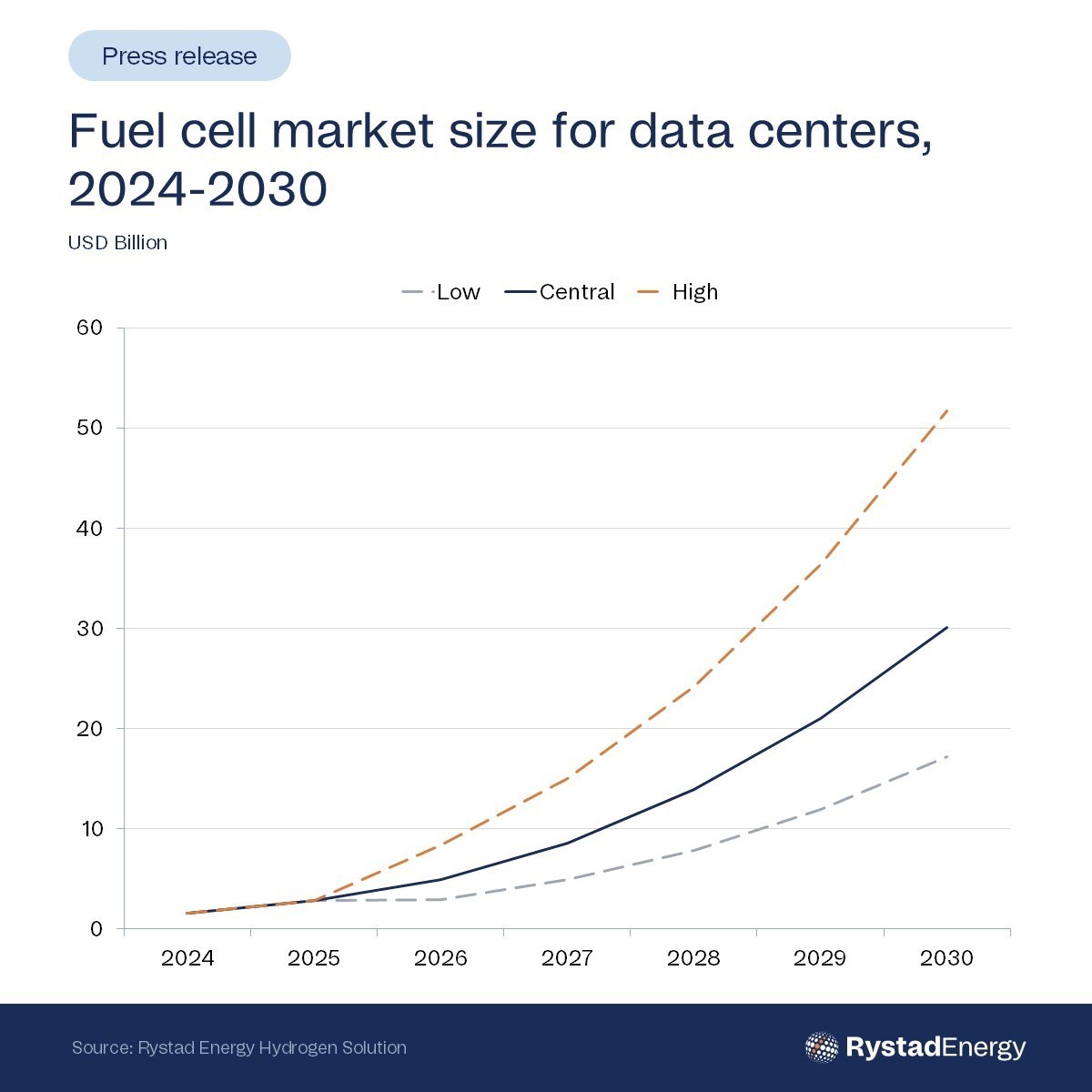
Data center developers are scrambling for reliable power, turning away from congested grids and toward on-site fuel cells. Rystad Energy research and analysis projects a tenfold increase in fuel cell market revenues by 2030, rising from around $2.8 billion in 2025 to roughly $30 billion, as AI computing demand drives unprecedented growth in data center construction. A contracted order book of approximately 9 gigawatts (GW), including framework agreements with Oracle, AEP, Equinix, and Brookfield, points to growing confidence among major operators in fuel cells as a viable long-term power source.
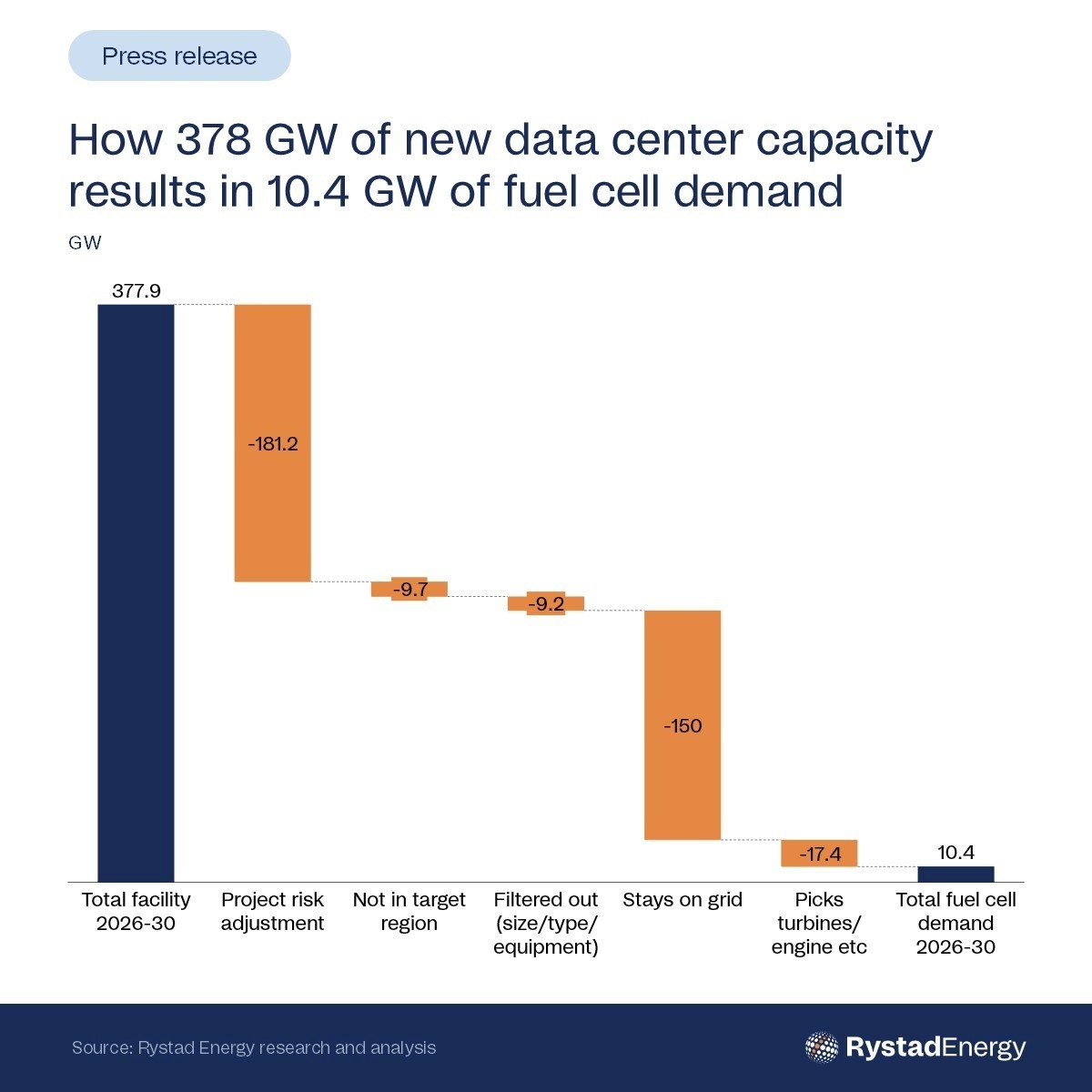
US grid interconnection timelines have tripled since 2015, now stretching to three to six years for large loads. Rystad Energy’s research projects 10.4 GW of cumulative fuel cell demand from data centers between 2026 and 2030, with around 40% of projected 2030 US data center capacity modeled as likely to pursue dedicated on-site power generation rather than grid connection. Unlike conventional grid connections or large gas plants, fuel cells can be deployed quickly and run on natural gas today, transitioning to biogas, renewable natural gas or hydrogen as supply matures, while producing lower on-site emissions than combustion alternatives. North America is expected to account for 91% of installed global on-site power generation capacity, thanks to a combination of grid delays, federal tax incentives and an established domestic supply chain.
Power availability has become one of the defining constraints on data center growth, and operators are increasingly looking beyond the grid for solutions. Fuel cells have moved from a niche application to a measurable part of the firm power mix. The question now is whether the supply chain can scale at the same pace as demand.
Lein Mann Bergsmark, Vice President, Clean Tech Supply Chain Research
Fuel cell manufacturers are expanding capacity in response. Aggregate operational and planned manufacturing output is on track to reach 4 GW per year by 2030, up from 1.8 GW today. Solid oxide fuel cells (SOFC) have become the dominant technology for always-on data center power, accounting for around 53% of cumulative stationary deliveries to date. Bloom Energy holds virtually every primary-load SOFC contract in the visible order book, a concentration that presents supply chain risk if demand accelerates faster than one manufacturer’s production capacity.
That concentration extends to materials. Bloom Energy’s SOFC technology depends on scandium, a critical metal used in its electrolyte chemistry. At full utilization of its planned 2 GW manufacturing expansion, Bloom’s theoretical scandium requirement would approach the size of the entire global market, currently estimated to be around 60 tonnes per year. This potential bottleneck is compounded by the fact that China heavily controls the global scandium supply chain. Competitors using alternative electrolyte chemistries do not share this exposure, and a sustained supply constraint could influence how market share develops as the sector scales. Rystad Energy projects SOFC system costs will fall 20 to 25% by 2030, though the pace will depend on manufacturers’ ability to reduce costs across the full delivered system, not the fuel cell stack alone
You might think that Shark Tank’s “Mr. Wonderful,” Kevin O’Leary, is betting it all on AI, but he is not.
He is betting on the $5+ trillion in infrastructure required to run it, and that’s where big capital is flowing now.
And he’s betting on Bitzero (NASDAQ: AIBZ) to be one of the first to break AI’s biggest chokepoint: power.
Bitzero was looking further ahead while most of the rest of the market was narrowly focused on AI software and semiconductors.
As a result, on May 5th, Bitzero signed a binding letter for a 15-year lease deal for AI power as it makes its first official leap from low-carbon bitcoin mining to being a power provider for a $5-trillion data-center industry that is desperate for cheap electricity.
This Canadian cryptominer-turned-energy-provider for AI has already secured more than a gigawatt of low-cost power across Norway, Finland, and the United States, as the money moves into the assets that AI can’t run without.
Amazon alone projects $200 billion in 2026 capital spending, with most of it tied to data centers. Microsoft is expected to be around $190 billion. Alphabet is also projected near $190 billion, and Meta has laid out a $600 billion U.S. infrastructure plan through 2028. Current estimates now put combined 2026 capex for Amazon, Microsoft, Alphabet, and Meta as high as $725 billion, driven largely by AI data centers, chips, power, and long-lived infrastructure. McKinsey estimates another $5.2 trillion will be deployed into AI infrastructure this decade. That capital is funding land, power, facilities, substations, and equipment before AI capacity can operate.
Half the AI data centers being announced today may not get built because projects fail to secure power on time.
More than 70% of interconnection requests are withdrawn, and only a fraction reach operation. Global data center electricity demand is projected to approach 945 terawatt-hours by 2030, roughly equal to Japan’s total consumption, according to the latest research from Berkeley Labs, which is affiliated with the U.S. Department of Energy’s Science Office.
Megawatts will decide who builds and who doesn’t.
The AI Build List Is Under Duress
A large share of the AI data centers being announced today may never reach completion because power is not available when projects need it. That creates an advantage for companies like BitZero (NASDAQ: AIBZ) that already control gigawatt-scale electricity.
Artificial intelligence demand is expanding quickly, but the electricity required to run it is becoming harder to secure, slower to connect, and more expensive to deliver.
More than 70% of interconnection requests are withdrawn, and only a small portion reach operation. At the same time, global data center electricity demand is projected to approach 945 terawatt-hours by 2030, roughly equal to Japan’s total consumption.
While investors were previously focused on semiconductor chips as the make-or-break element of the AI boom, it’s now clear that it’s a question of power above all.
And that’s exactly why a forward-thinking cryptominer like Bitzero is well positioned to take advantage of the AI-power gap.
“As electricity prices climb across the U.S., driven in large part by soaring demand from both Bitcoin mining and the rapid expansion of AI data centers, Bitcoin miners are at a distinct advantage because we locked in power access well ahead of the curve,” Mohammed Bakhashwain, founder and CEO of Bitzero Holdings, Inc., told Oilprice.com in a recent interview.
Both cryptomining and AI require the same infrastructure: reliable power, advanced cooling, and industrial-grade data centers.
“While others are still fighting for grid access, permits, and infrastructure, Bitzero secured those assets over the past four years and knows how to operate energy-intensive facilities at scale. That creates valuable optionality. The same megawatt can mine Bitcoin or support AI and data center workloads. In a market where power is the real constraint, we believe flexibility is a competitive advantage,” Bakhashwain said.
Full Speed Ahead on the Biggest Boom in Computing History
Earlier this month, Bitzero (NASDAQ: AIBZ) completed engineering due diligence for up to 520 megawatts at its Kokemäki, Finland campus, eyeing up to 1GW at full ramp. An initial 80MW phase is targeted for the first half of 2027, with 400MW to 800MW expected to follow in later stages as the full buildout advances.
And that’s just one venue.
Bitzero’s Norway operations are already running as a fully built industrial platform. The company is operating Bitcoin mining at power costs below four cents per kilowatt-hour, which keeps the site active and monetized while additional infrastructure is layered on top.
At Namsskogan, the next 70MW tranche is scheduled for energization in the fourth quarter of 2026, tied directly to a defined 325MW expansion corridor that follows existing grid capacity.
And here, in Norway, is where Bitzero’s great leap into data center power just became official.
On May 5, Bitzero signed a binding letter of intent with OneQode Networks covering the full 110 MW capacity of its Namsskogan, Norway data center site under a 15-year lease tied to GPU-based AI workloads. The agreement carries an implied value of roughly $2.6 billion over the lease term and marks Bitzero’s formal entry into the large-scale AI data-center infrastructure market.
This is a double victory for Bitzero.
When it mines in Norway, Bitzero uses its own electricity to generate revenue from the Bitcoin it produces. Under the AI agreement, Bitzero generates revenue by leasing the site’s power capacity and infrastructure to OneQode. Simultaneously, OneQode pays the electricity bill tied to running the AI systems inside the facility.
That means Bitzero captures the recurring infrastructure revenue from the site without directly absorbing the massive ongoing power costs associated with operating large-scale AI workloads.
According to Bitzero management, at full utilization of 110 MW, the Namsskogan site could generate roughly $176 million to $178 million in annual revenue. A recent shareholder analysis modeling the agreement estimated potential annual NOI of roughly $151 million based on an 85% margin profile tied to the lease structure.
Norway is served by hydro power, and Finland is served by a cocktail of low-cost hydro, nuclear, solar and wind energy.
Finally, the North Dakota footprint gives Bitzero a second operating lane tied to U.S. demand. The company controls power-backed sites there that position it inside a different pricing and regulatory environment from its Nordic assets.
Across Norway, Finland, and North Dakota, the operating model is consistent: secure power first, bring megawatts online in stages, and deploy that capacity into whichever use case offers the highest return at that point in the cycle, whether it’s mining, colocation, or AI compute.
The AI Investment Model Is Outrunning The Grid
It takes up to 7 years to build out a large-scale power source to feed a data center.
Still, investors have been operating on a massive assumption: That the power will magically be there once all the data centers are built. This is where the data center hype meets an electrification reality.
But securing power isn’t that easy. At a bare minimum, it requires grid studies, transmission access, permitting, utility negotiations and long-term pricing frameworks.
And demand is bursting.
The IEA expects global data-center electricity use to grow 4X the growth rate of total electricity demand from every other sector combined. The agency is eyeing data center power demand of roughly double to around 945 TWh by 2030.
Similarly, Goldman Sachs has forecast data-center power demand soaring 175% by 2030 compared to 2023 levels.
That’s like adding an entire country to the grid.
The business of sourcing power is not keeping pace with the business of building out data centers.
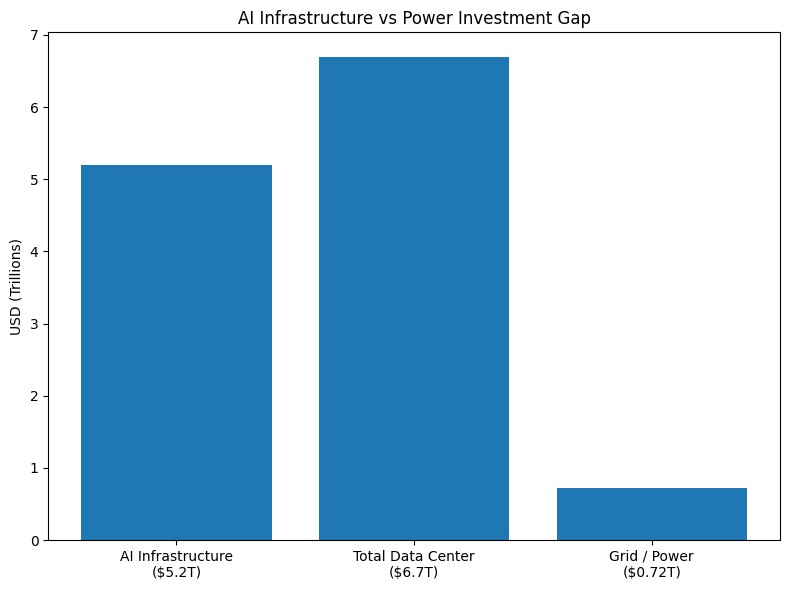
We will need $6.7 trillion in capital by 2030, including $5.2 trillion for AI infrastructure alone, in order to make the data center hype a reality. Yet, so far, grid investment expected to support that demand is only around $720 billion.
With more than a gigawatt of power already secured across Norway, Finland and North Dakota, Bitzero already controls sites, permits, grid access, and expansion capacity while AI developers line up to get a start on the 7-year process.
Why Bitzero’s Model Is Getting Attention
Bitzero (NASDAQ: AIBZ) is building large-scale campuses backed by secured, low-cost power and positioning them for AI and high-performance computing demand. It’s not choosing between crypto and AI. It is running both. Bitcoin mining keeps capacity active and generates cash flow, while the same sites are being developed to support AI and HPC workloads as that demand scales.
“We see a really big opportunity in HPC,” CEO Mohammed Bakhashwain said, pointing to an engineering team that has already worked on deployments with Microsoft and Nscale in Norway. The company controls land, power, and infrastructure in place to deliver large campuses, and is already moving to market that capacity to AI tenants.
The model is built to capture two revenue streams off the same megawatts. Mining today and higher-value AI and colocation tomorrow.
“We’re hoping to get the best of both worlds—the long-term, investment-grade cash flows from HPC and AI, while having exposure to Bitcoin,” Bakhashwain said.
That keeps sites operating while capacity is repositioned for larger, longer-term contracts.
That structure is what has drawn investor attention.
Kevin O’Leary doesn’t frame Bitzero as a mining company. He calls it an energy contract business. The asset is the site: power secured at low cost, tied to land, permits, and continuous load. Mining monetizes that power now. Leasing compute and capacity to large off-takers is where the longer-term value sits.
“The value of what Bitzero has has risen dramatically, and I think over time the market will recognize that,” O’Leary said.
The company is building capacity that can be deployed into whichever market pays more at a given time. That is how the same infrastructure can generate cash flow today and scale into larger contracts as AI demand continues to build.
The AI power boom is also reshaping investor interest across some of the largest publicly traded U.S. energy companies. EQT Corporation (NYSE: EQT), the country's largest natural gas producer, is widely viewed as a key supplier of fuel for the gas-fired generation expected to support rising electricity demand. Vistra Corp. (NYSE: VST) has become a leading AI infrastructure play through its diverse fleet of natural gas, nuclear and renewable power assets, while Constellation Energy (NASDAQ: CEG) has attracted significant attention thanks to its position as the nation's largest producer of carbon-free nuclear electricity. Together, these companies underscore a growing realization across markets: the AI race is no longer just about chips and software—it is increasingly about securing dependable, long-term power. Companies that already control energy assets and grid-connected infrastructure are likely to occupy an increasingly strategic position as electricity becomes the defining constraint on AI expansion.
Given all of this, Bitzero is not simply participating in the AI buildout. It may be sitting on part of the infrastructure that others will have to come to, just as OneQode did on May 5th.
The bigger point is where capital could start to flow as that logic sinks in.
By. Charles Kennedy
World’s largest EV battery repurposing megafactory opens in British Columbia
Moment Energy on Monday opened Megafactory 1, the largest EV battery repurposing facility in the world, bringing domestic battery energy storage manufacturing capacity online with a ceremony attended by investors, industry and government leaders.
The now operational facility transforms retired EV batteries into cost-effective, rapidly deployable energy storage systems that support critical infrastructure, including data centres, factories and microgrids, the company said.
The facility comes online as demand for electricity continues to surge, driven by AI, data centres, the energy transition and grid modernization.
Meanwhile, millions of EV batteries already on North American roads are expected to be retired over the coming years, and Moment Energy said it addresses both challenges by turning retired batteries into scalable energy storage systems that offer an immediate solution to energy shortages.
The facility is expected to produce 1 GWh of battery energy storage systems by 2030, creating more than 100 direct jobs and supporting more than 1,000 indirect jobs across British Columbia.
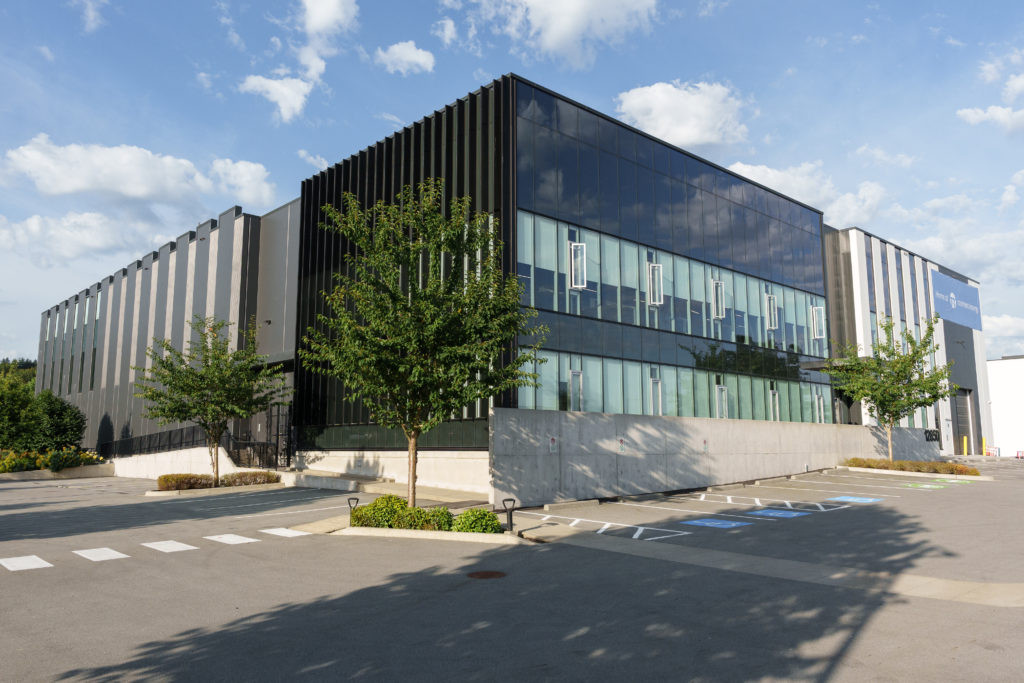
Moment’s megafactory in Surrey, British Columbia. Image: Moment Energy.
“We announced this project six weeks ago. Today it’s operational,” Moment Energy CEO Edward Chiang said in a news release. “Demand for energy storage is accelerating, and so is the supply of retired EV batteries.”
“We show that the right technology can enable North America to re-onshore domestic manufacturing in weeks, not decades, creating thousands of jobs and economic prosperity.”
Since its founding in Vancouver in 2020, Moment Energy has attracted both private and government support across British Columbia’s innovation ecosystem, helping the company scale from a university-born startup into a global leader in second-life battery energy storage, it said.
“This is exactly the kind of homegrown innovation we want to see in British Columbia,” Gregor Robertson, Minister responsible for Pacific Economic Development Canada (PacifiCan) said.
“With PacifiCan’s $4.9 million investment, Moment Energy is expanding clean manufacturing, creating good local jobs, and finding smart solutions to global challenges.”