Burnham - a left response
Monday 29 June 2026, by Dave Kellaway

Following Keir Starmer’s resignation as leader of the Labour Party, and thus as Prime Minister, it seems that Andy Burnham, former Mayor of Greater Manchester, will accede to these two posts without a contest, a procedure known as a "coronation".
Whatever people on the left are saying about Burnham one thing is clear. Activists in the labour movement are discussing issues today that were buried under the Starmer/McSweeney regime.
Darren Jones and the Labour Together tribute act are lobbying hard against Ed Miliband becoming Chancellor with his net zero agenda. Veteran peer, Alf Dubs, who came to Britain as a refugee from the Holocaust, has today called on Burnham to sack Shabana Mahmood and rip up her anti-migrant policies.
This is Labour’s reset moment when we can consign to the past some of the appalling language used by politicians to describe refugees: ‘invaders’, ‘an island of strangers’, ‘tearing our country apart’. We can’t reset by bringing with us policies that many in the PLP do not support, spearheaded by a home secretary who divides opinion. [1]
The Productive State
A policy document called The Productive State from Mainstream – the Labour ginger group that has helped drive Burnham’s rise to power – provides us with a devastating critique of the damage privatization has done to our society. It outlines a reformist framework for change that has been previously totally rejected by Starmer and his allies. For example Starmer’s ministers have consistently rejected taking water back into public ownership. A detailed analysis by Simon Pearson of the Mainstream/Commonwealth document and its limits is currently available on this website. Trade Union Congress leader Paul Novak has welcomed Burnham and called for a real reset in favour of working people.
The current heatwave is provoking a debate within and between major unions about further drilling in the North Sea. Unite leader Sharon Graham has attacked Miliband becoming chancellor going so far as talking of him as putting a ‘noose around job creation’. Of course the net zero economy is growing strongly and can easily replace jobs lost in the winding down of the North sea fossil fuel industry.
Yes, Burnham may pivot completely to some sort of continuity with the Starmer government but at least the political space in which we operate has changed.
The bosses and right wing press are piling in alongside the Labour right and its apparatus. For example they are backing Streeting for chancellor and smearing Ed Miliband. Rocco Forte, a hospitality magnate, has specifically called for a block on Miliband. If Burnham does adopt some or all of the proposals in Productive State he certainly would come under sustained attack from national and international capital which wants to restrict public spending and increased taxation. Already Burnham has floated changes to capital gains tax and some other proposals to raise money that Starmer’s team rejected.
Why is this discussion about Burnham important?
Many socialists see their mission as working with like-minded people to build a party that can lead and participate in a mass movement to build an eco socialist alternative to capitalism. But the conditions in which we do that change as social economic and political forces change. The people who may be attracted to our ideas may come from different currents and mobilize around various issues. We have no choice about who those radicalizing people are – we have to move to them. Our narrative needs to intersect with their discourse and language. We have to work with people generally to our right.
For ultra left sects with their timeless method and definitive programmes nothing ever changes – denounce everybody except yourselves and build yourparty.
Under Corbyn’s rise many of us joined Labour. The radicalisation in the Greens means we are relating to them in a way we did not five years ago. The end of Starmer and the beginning of a Burnham project is not a repeat of Corbyn but it means we have to adjust again. If he really proposes progressive taxes, proportional representation, new devolution or ending privatized utilities we have to respond. We have something to contribute.
WE engage with anything that improves the lives of working class people. At the same time – we denounce and campaign against any continuities with Starmer on Palestine, Trump, defence spending , migrants, dropping of green issues, democratic or trans rights
.
Two wrong positions on what Burnham represents:
• He is just the same as Starmer
Josh Simons’ Labour together is still really in control and nothing policy wise will change, the labour machine will absorb and manage Burnham who will further u turn on all his promises. Things will not materially improve one jot for working people and he will continue to open the door to a reform government. Our only task is to denounce his continuity with Starmer. As a Socialist Worker article stated Labour is swapping one centrist with another
• A new coherent soft left alternative has been born
We are going to see a massive increase in public ownership/control, a democratic revolution with a new electoral system, citizen assemblies and devolution including an Englsh parliament. The Labour party will be revitalized with a real political debate and the end to witchhunts. All this will stop Reform and return a Labour government for a second term. John McDonnell tears on Burnham’s victory expresses somewhat this view. Anthony Barnett has written an article in New Statesman along these lines.
As ecosocialists we disagree with the simplistic response of the both these positions. We need to be more nuanced and understand the complexity of the political shifts going on.
Contradictory indicators
Reading the runes is very difficult at the moment. There are contradictory indicators. The Burnham team says Reeves is out, but at same time their leader has been consulting with Jim O’Neill ex-Goldman Sachs manager. He has proposed dropping the triple lock and for orthodox neo-liberal economics. Other Bank of England economists have been brought on board too. Blairite, James Purnell, who has headed a big lobbying/consultancy company advising firms like Amazon, has been taken on as chief of staff. We have to await the full cabinet team sheet before a proper assessment is possible
We cannot define Burnham just from his past history as a minister in Blair and Brown’s governments or even as a leadership challenger to Corbyn. You also have to take into account his work in Manchester and the fact that politicians can and do change. Tony Benn started off in the centre of Labour politics under Wilson.
Burnham is not quite the empty vessel with no political base that Starmer was. The latter was easily controlled by Labour Together and the party machine. Burnham has a project in a way Starmer never did. It may be limited, contradictory and end up not changing much. The new leader has talked about the ‘politics of place,’ ‘Manchesterism’ and the Preston community wealth building model. This is different from Starmer’s junior partnership with corporate capital. Burnham built his base to win leadership through Mainstream and the soft left in a way that Starmer never did. Starmer was propelled by the McSweeeny/Mandelson matrix who did all the base building inside the apparatus. Burnham has kept himself largely outside that grouping.
Of course that does not mean that the ex Labour Together team will not try to get on board with Burnham and try to keep him under their control. Neither does it rule out Burnham bringing some of them into his team as evidence of a new ecumenical, broad church approach. He may even integrate somebody from the Socialist Campaign Group. The latter had brought out a good list of demands for Burnham to take up that would radicalize his project.
No Burnham surge
Currently there is no sign of any movement back to Labour similar to the Corbyn surge. However those socialists who have stayed in Labour will be encouraged to a degree by the Burnham victory. The demise of Your Party will further convince them of their position so a certain revitalisaton of inner party debate and activity may happen. Given Burnham’s bad positions on migrants, Palestine, defence spending, democratic rights to protest and a full green programme it is unlikely he will attract any of those thousands who have joined the Greens back to Labour.
A coronation now looks likely and it does mean the opportunity for a full discussion of Burnham’s ideas at this stage is still born. The Socialist Campaign Group started off by criticising the lack of debate but John McDonnell more or less accepted that there was nothing to be done and we had to get on with it. The Burnham movement is still very top down dominated by the leader and the MPs, there are no real democratic structures constraining his actions.
Can Burnham stop Reform at the next general election like he did in Makerfield? There were exceptional circumstances since you could vote for Burnham, stop Reform and get rid of Starmer. Greens and Liberal democrat voters did that and their parties did not campaign. Burnham did not confront Reform’s racism head on in the way the Greens did in Gorton. He knew he could win without doing that. Nevertheless you cannot clone Burnham in 600 seats and we will have 2 years of his government with his shine possibly being worn off.
Many people excited about Burnham are forgetting the far right still got 40% in the by-election. A poll shows 43 % of Britons felt no difference after Starmer going. Only 20 % were a bit or more optimistic. His northern schtick also may not run so well in London and the rest of the South. John Curtice, the elections specialist, has suggested that the Reform threat remains live. Another poll puts Labour 3 percentage points ahead of Reform when the leaders are referenced but Labour are still 4 points behind when people are asked Labour or Reform.
Reform could be stopped if Burnham really were to carry out the changes currently being discussed by some of his team. Taking control of utilities and some progressive taxation may enable his government to reduce energy costs for most families. If his radical talk about building more social houses were to be turned into reality that too could change voters’ minds. But will Burnham stand up to the bosses’ counterattack against any radical reforms. Just building a broad church cabinet of the right and left will not cut it.
Socialists will need to adapt our campaigns and demands to relate to the new political issues and debates that are emerging. We still need to build our eco-socialist alternative independent of the Labour Party and the Greens. A resurgence of even ‘soft left’ ideas provides us with an opportunity to engage with broader forces on questions that have only been discussed in much smaller circles since the end of the Corbyn project
28 June 2026
Source: Anti*Capitalist Resistance.
Footnotes
[1] The Guardian, 26 June “Remove home secretary Mahmood and rip up her asylum plans, says Alf Dubs”.
Dave Kellaway
Dave Kellaway is a Socialist Resistance and Fourth International supporter within Anti*Capitalist Resistance.
.png)
Starmer Begone: Another Dud Leaves Number 10
June 30, 2026
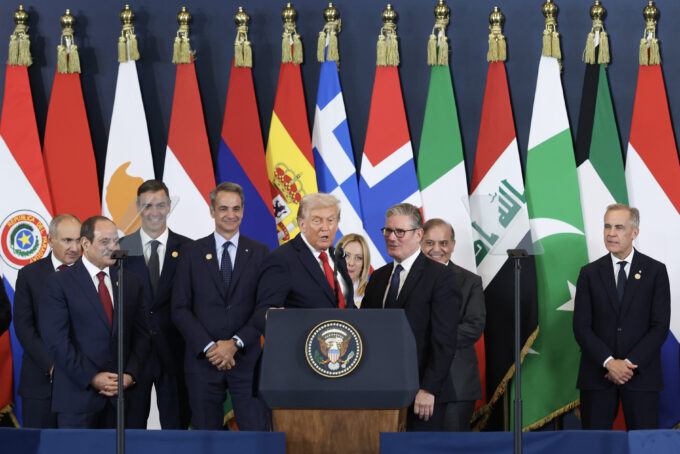
Keir Starmer and Donald Trump at Gaza “peace summit” in Sharm El-Sheikh, Egypt. Photo: Lauren Hurley / No 10 Downing Street.
It is one of the most remarkable ways to fall from grace. Leading British Labour to a deceptively crushing victory over diddling, muddling, decrepit fools. Asserting a period of stable rule, if not exactly dull then at least reliable after several stints of lunacy under the Conservatives gone to the bad. But it was not to be. Sir Keir Starmer, who announced his resignation as Prime Minister on June 22, turned out to be inept in several ways, not being able to communicate well, not being particularly fluent (fudging “hostages” for “sausages”), an appalling lack of judgment (the appointment of the Epstein-soiled Lord Peter Mandelson to the ambassadorial post in Washington), unable to put together that most yearned for thing – a capturing narrative, a glued unity however specious. Economic growth was the agenda, but where did it go?
What the British voter got, instead, was the July 2024 decision to axe winter fuel payments for 10 million pensioners, which was followed by an about turn in May last year. He retained the policy introduced by the Conservatives in 2017 restricting benefits to the first two children of a family, only to be abandoned in last year’s budget. To target the rise of Reform, he took rhetorical pickings from its leader, Nigel Farage, and promised a mandatory digital ID card to be stored on mobile phones as proof of a person’s right to work in the UK. This policy, too, was abandoned.
In foreign affairs, where he was supposedly at greater ease, Starmer proved sickeningly amenable to Israel’s ruthless campaign in Gaza, explicitly approving the withholding of power and water supplies from Palestinian civilians as means of “self-defence”. The real terrorists, it would seem, were to be found at home, incarnated in the direct action group Palestine Action, which the Starmer government banned, placing it in the same league as ISIS or Boko Haram. He also seemed to feign ignorance about the ongoing International Court of Justice genocide case commenced by South Africa towards the end of 2023 against Israel, or the issuing of arrest warrants by the International Criminal Court against Israeli Prime Minister Benjamin Netanyahu and former Israeli Defence Minister Yoav Gallant.
Starmer came to power in the aftermath of Jeremy Corbyn’s defeat to Boris Johnson in 2019, after which he went about purging his party of the radical influence left by his predecessor. Nothing he did suggested he was anything but an establishment creature, whatever his trumpeted credentials as a progressive lawyer respectful of human rights. Where there was an abuse of power, he was likely to be there to be defending it. Oliver Eagleton’s cutting biography, The Starmer Project (2022), is relentless on this: Starmer combined “intervention abroad with repression at home”. As Director of Public Prosecutions, he pursued the hacker Gary McKinnon (Starmer was enraged when then Home Secretary Theresa May halted the extradition to the United States) and the WikiLeaks publisher Julian Assange while sparing, for instance, the police responsible for killing Jean Charles de Menezes at Stockwell tube station and frustrating efforts to charge Home Office officials liable for the death of migrant Jimmy Mubenga.
Other works on Starmer do little to stir feelings of sympathy for this apparently decent figure. Gabriel Pogrund and Patrick Maguire of The Times, for instance, offer the devastating Get In (2025). Starmer, the authors show, became the choice of spear for Morgan McSweeney, the founder of the think tank Labour Together and later Starmer’s Chief of Staff. That particular man of the shadows had a world view characterised by “a certain fanaticism, paranoia and moral certitude.” (The slime of the Mandelson affair was ample enough to make McSweeney fall on his sword.) The purpose of the spear was unambiguous: to target Corbynism on the pretext of combating antisemitism, becoming, effectively, “the great deception”. Paul Holden’s The Fraud (2025) expands on the theme, exposing McSweeney and Labour Together’s use of undeclared donations to the Electoral Commission from hedge fund managers and pro-Israeli figures to discredit Corbyn. Throughout, Starmer’s decency remains well concealed.
The victory of Andy Burnham announced, at least for Starmer, the coming of a slaying spirit. The now former Mayor of Greater Manchester had shown exactly what he thought of his constituency by taking the plunge in the seat of Makerfield, which he won with almost 25,000 votes (55%) to the 15,696 votes for Reform (35% of the share) and 3,111 (7%) votes for the even more rightist Restore. Much is being made of it: Burnham as knight armed against the reactionary forces of Reform and Restore while restoring Labour’s focus. But Burnham is old newspaper wrapping, an echo of the Blair years, one who voted for the Iraq War and against an inquiry into its legality but was sure some two decades later to do some politicking in suggesting regret.
The fall of Starmer is also another reminder about how the political context of popularity and demise has changed. Britain, after Brexit, seems to be in the mood of torching its prime ministers, seeking kindling sooner than a leader can find the necessary bearings. (Seven PMs in a decade is a scorching rate.) That, at least, is the impression the strategists, focus group apparatchiks and party wallahs give us. The social media saturated public are fickle and will turn, sampling the next morsel of misinformation, the next tasty bite of disinformation.
A notable pattern in the aftermath of the by-election was an utter disregard to what might be politely called the factual record. Rumour, gossip, blather and wispy nonsense filtered through the bulletins with wearying force, featuring alleged conversations between Starmer and his wife regarding his future. Starmer loyalists demonstrated their deathless loyalty by telling the press how the man was feeling over a weekend of anguish. The press stable had effectively anointed Burnham in advance of any party vote or decision. Here was an inexorable sense of a position being vacated, its occupant removed, the baton passed on. And not a single British vote was involved in the process. Yet another PM dud. What democracy, and what fine Westminster democracy at that.