Tuesday, July 07, 2026

Six Key Issues to Watch at NATO’s Ankara Summit


  • Defense spending and the path toward NATO's 5% GDP target are expected to be the summit's central focus.

  • Ukraine remains a top priority, with new financial commitments, military cooperation, and a planned Trump-Zelenskyy meeting.

  • The alliance will also address the aftermath of the Iran conflict, U.S. troop levels in Europe, and NATO's future strategic direction.

NATO leaders are meeting in the Turkish capital, Ankara, for the alliance’s annual summit on July 7-8 in the shadow of the Iran war and American complaints that not all European allies are pulling their weight when it comes to defense spending.

The expectation is that US President Donald Trump will have harsh comments for several of his European counterparts as they meet for a dinner on the first day and then an expected three-hour session of the North Atlantic Council on the second and final day.

The following are six things to watch for during the two-day meeting.

Defense Spending

Make no mistake: This summit will be dominated by defense spending.

At last year’s gathering in The Hague, the alliance ceremoniously agreed that all 32 allies would spend 5 percent of GDP on defense by 2035, with 3.5 percent of that being so-called “hard defense spending,” such as purchasing arms and other military equipment. The remaining 1.5 percent could then be dedicated to investment that helps bolster military capabilities, such as infrastructure.

In Ankara, it will be all about demonstrating how to get there. Or as the draft declaration of the summit put it: showing a “credible path” toward the target.

Some NATO officials who spoke to RFE/RL fear many countries will defer major defense investments over the next few years because of strained public finances, only to splurge on expensive military equipment in 2034-35 in what is known within the alliance as the "hockey stick approach, in which years of relatively flat spending are followed by a sharp final spike to meet the target.

The Trump Factor

It is on defense spending that Trump likely will come out swinging.

He has long been skeptical of NATO and days before the Ankara summit he again questioned the alliance on social media by writing that it is “ridiculous for the U.S.A. to continue along this one sided path when the relationship is not reciprocal.”

He also included a graph showing that Washington spends a lot more on its military than any single European ally.

It is here that the NATO Secretary General Mark Rutte once again will try his best diplomatic efforts and point out that Europeans and Canadians actually are stepping up.

Speaking just ahead of the summit, he said the other 31 allies “already are investing around 4 percent of their GDP in defense and security,” often by buying American-made equipment.

This trend, Rutte noted, would mean that the other 31 members were now on “a trajectory to equalize their defense spending with the United States.”

While several NATO officials RFE/RL spoke to admit that -- although they fear the US President will be harsh at the summit -- many still think the meeting will run relatively smoothly with minimal drama.

Oana Lungescu, a former NATO spokesperson who is now a fellow at the Royal United Services Institute for Defense and Security Studies (RUSI), said there is optimism that the positive mood from the recent G7 summit in France will carry over to Ankara.

"Diplomats hope that the 'spirit of Evian,' the constructive atmosphere of the recent G7 talks in France, will extend to Ankara -- including on the need to support Ukraine as momentum on the battlefield seems to be shifting," she said.

Lungescu said officials also believe the personal rapport between Trump, Rutte, and Erdogan could help keep the summit on track. While Trump may criticize some European leaders over the Iran war or defense spending, she said, "he will not want the summit to fail and Erdogan to lose face on home turf."

US Troops In Europe And Industrial Ambitions

In parallel to this debate there is also the issue of US boots on the ground in Europe.

Today’s figure of roughly 80,000 troops might be reduced, as there is talk of Washington redeploying both strategic assets and manpower elsewhere, notably to Asia.

With US Defense Secretary Pete Hegseth saying in May that the US will undertake a six-month review of its force posture in Europe, few NATO officials believe that this will be a major topic at the meeting even though potential bilateral negotiations and lobbying efforts on the sidelines by European nations hosting US bases might very well occur.

In the meantime, NATO's top military commander in Europe, Alexus Grynkewich, said European allies have largely stepped up to fill capability and reinforcement gaps left by recent US troop and asset reductions in Europe.

The draft Ankara declaration, which all allies will endorse, explicitly mentions NATO’s mutual defense clause, Article 5, even though there are fears in some European capitals about whether the alliance would uphold it if Russia tested NATO in the coming years.

Anther thing that alliance officials also hope will trigger defense spending is the NATO defense industrial forum, which will take place on July 7 hours before the summit starts.

This is where big defense actors and politicians will announce plenty of multilateral cooperation deals on defense, including various transatlantic joint ventures.

With Canada taking the lead, several countries will also announce a “global defense bank,” which will make it easier to lend money to small- and medium-sized defense enterprises.

One can also expect Ukrainian companies to be very active in striking deals, as Kyiv is keen to secure some sort of licensing to build Patriot missiles (or their equivalent) in Ukraine

But other countries will perhaps be even more keen to tap into Ukraine’s technological know-how, with one senior NATO official telling RFE/RL that Kyiv could soon produce produce its own domestic version of a Patriot Advanced Capability-2 (PAC-2) interceptor.

“Ukrainians are telling us they can develop an interceptor that is basically an equivalent to a PAC-2 in less than a year,” the official said “And that they can produce them in big numbers. If they're able to do that, we applaud it.”

Nonetheless, although the spending splurge will continue, the question will remain whether Europeans are spending the money wisely.

Olga Oliker, European security director for the International Crisis Group, cautioned that "spending does not translate into capability by itself." She said European governments and manufacturers are still grappling with how to balance investment in "fast, cheap and adaptable weapons" with the urgent need to produce more advanced air defenses.

Ukraine: The Resilient Underdog

While Ukrainian President Volodymyr Zelenskyy will be busy both at the industrial forum and the leaders’ dinner, the most anticipated meeting will be his bilateral meeting with Trump on the sidelines of the summit.

With Russia again killing dozens of people in Kyiv after another missile attack just before the summit, there is hope that some sort of US-led peace talks, which a senior NATO official recently described as “comatose,” can be revived.

The mood surrounding Ukraine within NATO has otherwise changed considerably.

Several officials have been impressed by Kyiv’s ability to strike deep inside Russia.

“Ukraine is in a better place on the battlefield compared to some months ago,” said one European official, noting that the United States is much more supportive of Ukraine now.

“The US loves an underdog as long as the underdog has a chance of winning,” he added.

Unlike last year, there is no debate this time about whether Zelenskyy will be at the summit (though not at the main session as this is for NATO members only).

There is also a pledge in the summit declaration to provide the country with 70 billion euros ($80 billion) for 2026 and the equivalent for next year, even though some discussion ahead of the summit suggested that the declaration would only mention a financial pledge for Kyiv for 2026.

The US will not contribute to this, and 30 billion of the 70 billion euros comes from a 90 billion euro EU loan to Ukraine agreed earlier this year.

In other words, there is not a lot of fresh money.

Speaking to journalists ahead of the summit, Ukraine's ambassador to NATO, Alyona Hetmanchuk, said a financial commitment in the summit declaration could help hold allies to this year's funding pledges while generating additional support for Ukraine.

"We hope that if there is a financial obligation spelled out in the declaration, it will help. Firstly, to oblige countries to fulfill the financial promises made this year. And secondly, generate additional funds," she said.

In another small victory for Ukraine and its supporters, Russia is also mentioned in the declaration, with Moscow described as “a long- term threat to Euro-Atlantic security.”

This is the same language used in the declaration adopted at last year's summit in The Hague, but this time NATO officials say there were no objections and no attempts to water down the wording.

Iran Issues

The Iran war has created tensions within the alliance as well, with President Trump bemoaning the lack of “loyalty” among some allies after they limited or initially stopped Washington from using bases in their countries for US attacks on Iran.

US Ambassador to NATO Matthew Whitaker told reporters earlier this month that "there is no doubt that the president expressed disappointment," but said the alliance had since moved on, adding: "those days are past us, thankfully."

The NATO declaration will call on Tehran to fully respect freedom of navigation in the Strait of Hormuz and there will also be a number of representatives from various Persian Gulf states present in Ankara.

No distinct NATO role in the Gulf is envisaged, however.

Instead, a coalition of the willing led by France and the United Kingdom, with other countries expected to join, is preparing to contribute assets such as minesweepers and diving teams.

However, the coalition’s rules of engagement are still unclear, according to one NATO official, who pointed out that “mixed signals” were coming out of Iran about whether other countries' vessels would be allowed to operate in the Strait of Hormuz.

Another challenge is that few European naval vessels have adequate defenses against drone attacks, making any wider coalition in the strait very vulnerable if they were to be deployed any time soon.

When And Where For The Next Summit?

The final issue to resolve at Ankara is where the next summit will be held and when it will take place.

The Hague declaration stated that Albania would host the event after Turkey, but no location or date is mentioned in the draft Ankara declaration -- at least not yet.

This is because some at NATO have expressed doubt that a country spending just under 2 percent of GDP on defense should be hosting a summit.

Albania is pushing to get a defense budget approved for this year that will take its spending up to 2.6 percent, but it is possible that a final decision on whether Tirana will host the next summit won't be taken until later this year.

Separately, there have also been discussions about whether NATO should go back to having summits every two years, which was the case before Russia’s full-scale invasion of Ukraine in 2022.

While some argue that NATO should continue to meet annually as long as there is a war in Europe, others believe that the lack of concrete political deliverables on an annual basis should allow the alliance to meet at the highest level less frequently.

By RFE/RL

Oil Market Swings From Glut Fears to Hormuz Toll Concerns


  • Rising tanker traffic has revived oversupply fears, but much of the increased crude flow is replenishing depleted global storage rather than reflecting a sustained surge in production.

  • Oil market uncertainty remains high, as analysts debate whether lower prices will spur stronger demand while importers prepare for the possibility that Iran and Oman could impose future transit tolls through the Strait of Hormuz.

  • Producers and consumers are racing to normalize the market, with OPEC increasing output, the U.S. maintaining record production, and importing nations rebuilding strategic inventories.

Despite a lull in peace talks progress between Iran and the United States, analysts have once again started to talk about oversupply as tankers leave the Persian Gulf in greater numbers than the past three months. Importing nations are even being warned of a “wave” of crude coming their way. Meanwhile, some are preparing for a future where Hormuz passage tolls are part of oil price formation.

The latest to warn about a glut of crude oil was the Wall Street Journal, following reports from other major media outlets citing analysts as expecting the global oil market to swing from a sizable deficit to excess supply. OPEC’s latest production figures support the argument that supply is improving, although a glut prediction may be premature. Still, the group’s combined output rose by 3.3 million barrels daily last month from May, to hit 19.43 million barrels daily. That, however, is still far from pre-war production levels.

Meanwhile, the United States broke another oil output record, pumping close to 14 million barrels daily, and the UAE was reported to be exporting all-time high volumes as it empties its storage tanks, filled to the brim during the war when Hormuz was closed. However, there is an important detail in the picture, and that detail is oil in storage.

The Wall Street Journal reported earlier this month that global oil storage refilling was a big part of negotiations. Indeed, the publication cited U.S. Vice President J.D. Vance as saying that the two sides had inked a preliminary agreement to let countries “refill some stocks and then to see where the hand is.” Indeed, the less hasty analysts out there have noted that the recovering tanker traffic via the Strait of Hormuz can hardly be seen as a driver of an oil glut, given how many countries have had to dip into their oil storage, and dip deep, at that. This now has to be replenished.

“The surge in oil supply is about to collide with a market that, at least for now, simply does not need it,” JP Morgan’s Natasha Kaneva said, as quoted by the Wall Street Journal, echoing remarks made by other analysts who believe the world needs less oil than it is currently getting. This is an interesting position given that just until about two weeks ago, analysts were pretty unanimous in their take on the war, recognizing demand destruction by high prices and expecting a deficit possibly extending into 2027 if the war dragged on long enough.

ING analysts, unlike JP Morgan’s Kaneva, expect improved buying of crude ahead, driven by lower prices in recognition of the fundamental patterns governing oil markets. Cheap oil drives higher demand while expensive oil drives lower demand. Noting that despite recovering tanker flows out of the Persian Gulf, the U.S. was still releasing crude from the strategic petroleum reserve, Warren Patterson and Ewa Manthey wrote on Friday that “with the flat price falling and the forward curve moving into contango, we could start to see more buying in the market.”

The price at which this buying will be taking place may well include a Hormuz pass toll, to be paid to both Iran and Oman, Bloomberg reported earlier this month, citing some European countries that were preparing for just that eventuality. According to the report, the view that Iran and Oman will be asking toll payments for tankers was also shared by some officials from the Gulf Arab states, but only privately.

The official position of the Gulf states and the United States is that maritime laws would not allow this, and that if Iran or both Iran and Oman go ahead with the tolls, this would set a precedent for other countries with critical waterways in their maritime territory. Oil buyers from the European Union, however, are particularly worried about the possibility of tolls for Hormuz, suggesting that even after such a deep drop in oil prices from peak wartime levels, oil is not yet cheap enough for some importers, not to mention the next price jump whenever it may occur, as happens in cyclical industries.

For now, however, everyone appears to be focused on keeping prices as low as possible. OPEC is boosting production to make up for three months or more of lost export revenues, the United States is trying to lower prices at the pump even further, and importing nations are refilling their storage. After fears about recession and bankrupt airlines, some relief has been provided to the global economy. It is uncertain whether this relief is permanent, and it would be wise to bear this in mind.”

“Coming off the U.S. long weekend, traders are sitting tight and waiting to see whether U.S.-Iran relations will be cordial or volatile this week,” KCM Trade chief analyst Tim Waterer told Reuters earlier today. That is some sound advice, even coming on the heels of news that OPEC agreed to boost production further in August.

By Irina Slav for Oilprice.com

Big Oil's Windfall Earnings Threaten to Reignite Trump's Price-Gouging Push

  • Big Oil heads for its strongest quarter since 2022, with Chevron and Exxon expected to post surging profits after the Iran conflict and Strait of Hormuz disruption sent oil and gas prices sharply higher.

  • Trump is escalating pressure on oil companies, accusing them of price gouging and demanding gasoline prices fall toward $2.50 per gallon.

  • The clash between the White House and Big Oil is set to intensify, as strong earnings contrast with still-elevated fuel prices and uncertainty over Iran.

Chevron and Exxon are expected to report their best quarter since 2022 this month, as the war that the United States and Israel started against Iran on February 28 drove much tighter oil and gas supply. This could be a problem for President Trump who has already slammed Big Oil for keeping prices at the pump too high.

The two biggest American oil companies are reporting second-quarter results at the end of this month and, according to Reuters, will book the best quarter since 2022, when Western sanctions on Russia following its incursion into Ukraine pushed international benchmarks to well over $100 per barrel. This year, the U.S. and Israeli strikes against Iran prompted the latter to close the Strait of Hormuz, which in turn caused oil and gas prices to skyrocket—although they never quite reached 2022 levels.

As usual, when crude oil prices rise, so do the prices of the end products made from crude, boosting refiners’ bottom lines. In the latest supply crisis, U.S. crude played a central role in offsetting some of the lost supply from the Middle East, with U.S. producers selling abroad record volumes of crude and refined products, turning the country into the world’s largest oil and fuels exporter. This, however, has come at a price for Americans.

Retail fuel prices flew higher in the wake of those strikes by the U.S. and Israel that started the war with Iran, and although they never really hit the highs from 2022 when a gallon of regular gasoline topped $5, they were high enough to anger the U.S. president.

“The big Oil Companies are not dropping their price at the pump commensurate with the sharply lower prices they are paying for Oil. Those prices are dropping ‌like a rock! In other words, customers are being ‘gouged’,” Trump wrote on TruthSocial at the end of last month. “I have instructed the DOJ to immediately start looking into this. Gasoline prices better start going down a lot faster than what I’m seeing!”

The news came as a surprise to many, seeing as the U.S. president has had a cordial relationship with Big Oil, which was a generous donor to his second presidential campaign. Trump also made the expansion of the U.S. oil and gas industry a priority for his second presidential administration, vowing to establish U.S. energy dominance over the world.

In that, he has been quite successful although it is arguable whether it was the federal government’s help that turned the U.S. into the world’s biggest oil and gas exporter or years of efforts by the industry itself to become more resilient to various challenges. The industry responded to Trump’s accusations of price-gouging with a statement along the lines of refiners and fuel marketers not having universal price-setting power and rather following crude price trends on international markets.

President Trump then acknowledged prices have moderated, as the national average slid below $4 per gallon, but insisted gasoline should sell for $2.50 per gallon, and if it was not, then that was the fault of Chevron, Exxon, Shell, and BP. “Our industry shares the goal of delivering relief at the pump and restoring stability to global energy markets,” a spokeswoman for the American Petroleum Institute said in response, noting that fuel prices do not “move in lockstep” with crude oil prices.

“Gasoline prices don’t move in lockstep with crude oil, especially during a major global disruption affecting supply, refining and inventories,” Bethany Williams said at the time. Meanwhile, despite some progress being made by the U.S. and Iran in peace negotiations, a final agreement remains elusive, with tanker traffic recovery in the Strait of Hormuz ongoing but also uncertain. This means that President Trump’s price target, as it were, will also remain elusive for the time being. As for Big Oil’s profits, they may spark stronger anger and more action, for which the industry is already preparing by trying to calm the White House down through lobbying.

By Irina Slav for Oilprice.com


The U.S. Army Just Took a Historic Step to Break China's Rare Earth Dominance


The U.S. Army has placed REalloys at the center of America’s drive to rebuild its heavy rare earth supply chain, selecting the company to build and operate the first-ever commercial critical mineral processing operation on a U.S. military installation.

REalloys (NASDAQ: ALOY) plans to build a heavy rare earth processing complex at the Tooele Army Depot in Utah capable of refining dysprosium and terbium, two of the most strategically important rare earth elements used in high-temperature permanent magnets for defense systems.

For the first time, commercial critical mineral processing is being integrated directly into America’s national security infrastructure. The Tooele platform is expected to support the U.S. Army, the Defense Logistics Agency, the Department of Energy and NASA, placing REalloys at the center of one of the country’s most strategically important industrial buildouts.

Commercial development is targeted to begin in 2027, with initial operating capability expected no later than 2028. That urgent timeframe is scheduled to coincide with the January 1, 2027, federal procurement ban on Chinese rare earth materials used in American defense systems. 

REalloys expects to finance, build, and operate the facilities under an Enhanced Use Lease structure, creating a commercial processing platform on federal military property while keeping ownership, financing, and operations in private hands.

The Army award moves REalloys upstream. Earlier this year, the Defense Logistics Agency backed the company’s metallization technology through a contract to expand domestic samarium and gadolinium metal production. The Tooele project reaches further into the supply chain, adding commercial heavy rare earth processing to a platform that already includes metals and alloys.

Washington is compressing years of supply chain development into a matter of months. An integrated domestic rare earth industry is taking shape in real time.

Why The U.S. Army Chose REalloys

Much of REalloys’ heavy rare earth platform was already in place when the Army selected the company for Tooele.

Over the past two years, REalloys (NASDAQ: ALOY) has assembled feedstock agreements, processing rights, metallization technology, and downstream manufacturing capacity designed for what is expected to become the largest heavy rare earth metallization facility outside China through its partnership with the Saskatchewan Research Council.

The company committed approximately $20.6 million to upgrades at the Saskatchewan Research Council’s rare earth processing facility, securing exclusive supply rights for 80% of the facility’s expanded output, including NdPr metal and dysprosium and terbium oxides.

SRC’s initial commercial production remains targeted for early 2027, with REalloys is building a dedicated heavy rare earth metallization facility for dysprosium and terbium metals. Engineering is underway, major equipment procurement has begun, and qualification materials are expected as early as the fourth quarter of 2026

That gives REalloys something few companies in the Western rare earth sector can claim: access to separated heavy rare earth output, a path to metallization, and a U.S. manufacturing base in Euclid, Ohio.

The company has also secured long-term feedstock, including a definitive long-term offtake agreement for 15% of Phase 1 production from Critical Metals’ Tanbreez project in Greenland, a strategic alliance and offtake commitment tied to the Sheep Creek rare earth deposit in Montana, and a proposed supply framework with Ramaco Resources for coal-hosted rare earth material from the Brook Mine platform in Wyoming.

And it’s pursuing additional supply arrangements with domestic and allied sources, including coal-hosted rare earth material from Ramaco’s Brook Mine platform in Wyoming.

The result is a company already moving across multiple stages of the chain that the Army is trying to rebuild: feedstock, processing, metallization, alloys, and eventually permanent magnets.

Washington Is Building An Industry

The Tooele announcement is about far more than a single processing facility.

Over the past year, Washington has introduced procurement restrictions, awarded defense contracts, backed commercial processing, accelerated qualification programs, and now opened the gates of a U.S. military installation to commercial rare earth production. 

Those decisions are reshaping an industry that scarcely existed outside China only a few years ago.

Building a domestic rare earth industry requires far more than opening new mines. 

Ore must first be mined and concentrated before it can be chemically separated into individual rare earth elements. Those materials are then converted into high-purity metals, alloyed into specialized magnetic materials and ultimately manufactured into the permanent magnets that power everything from precision-guided weapons and fighter aircraft to electric motors, radar systems and naval platforms. 

For decades, China built nearly every step of that industrial chain while much of the West allowed those capabilities to disappear.

The effort extends well beyond the rare earth sector itself. 

Earlier this month, President Trump invoked the Defense Production Act to address production bottlenecks across the defense industrial base, citing limited manufacturing capacity, fragile supply chains and long-lead dependencies. 

This week, President Trump met with the heads of Lockheed Martin, RTX, Boeing, Northrop Grumman, General Dynamics and L3Harris as the administration pressed the defense industry to accelerate production and replenish U.S. weapons stockpiles. 

Three of those companies show exactly why the timeline matters.

Lockheed Martin (NYSE: LMT) builds the F-35, and that jet alone carries more than 900 pounds of rare earth materials, including roughly 50 pounds of samarium-cobalt magnets built to hold their strength at extreme heat. All of it falls under the same January 1, 2027, deadline REalloys is racing to meet at Tooele.

RTX (NYSE: RTX) carries similar exposure through its Patriot missile system and its radar and electronic warfare lines, both of which run on high-purity dysprosium and terbium. Those inputs still trace back through Chinese processing chains, the same chokepoint REalloys’ Tooele complex is meant to break.

Northrop Grumman (NYSE: NOC) has the same problem on its B-21 Raider bomber and its radar and space-surveillance work, including the Deep Space Advanced Radar Capability program. Like Lockheed Martin and RTX, it has to prove its magnet supply chain is free of Chinese material by the 2027 deadline or risk losing eligibility for covered contracts.

Those efforts coincide with the January 1, 2027, procurement restrictions, which require covered defense systems to source compliant rare earth materials and permanent magnets.

Meeting those requirements involves far more than finding new suppliers. Rare earth oxides, metals, alloys, and permanent magnets must all be qualified before they can enter defense production, a process that can take months or even years depending on the application.

That process is already underway. 

REalloys (NASDAQ: ALOY) is expected to began qualification efforts for defense-grade heavy rare earth materials by the end of 2026, allowing prospective customers to validate North American-produced dysprosium, terbium and other rare earth materials ahead of the January 1, 2027, procurement deadline.

The result is one of the most coordinated industrial reconstruction efforts the United States has undertaken in decades, and REalloys is at the heart of it. 

By. Michael Kern


Congo sees no major threat from Middle East crisis to copper, cobalt output


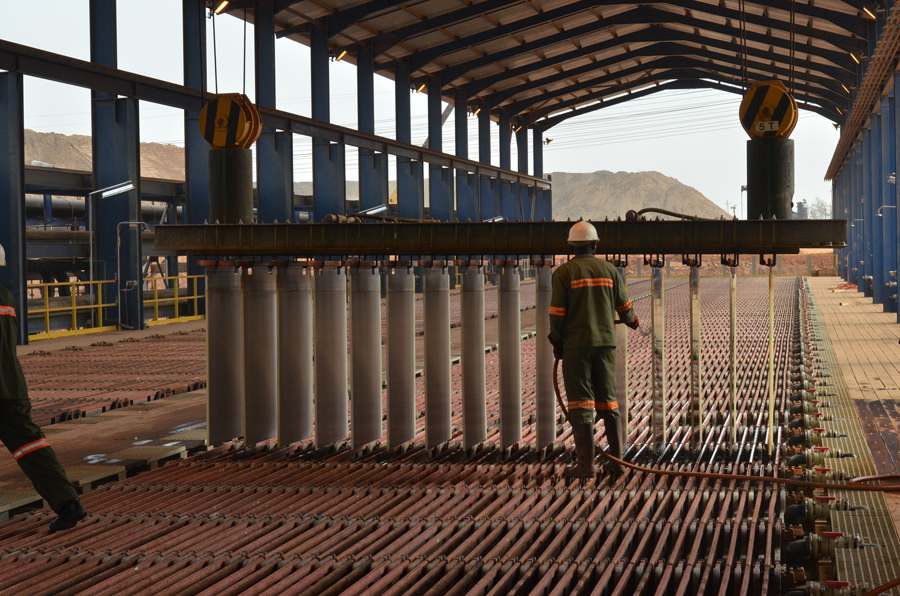
Mutanda copper mine. (Image: Fleurette Group)

Democratic Republic of Congo does not expect significant disruptions to copper and cobalt production this year due to chemical supply constraints stemming from conflict in the Middle East, a senior mining official told Reuters.

The US-Iran conflict that broke out on February 28 and has largely drawn to a halt after last month’s interim peace treaty, has disrupted sulfuric acid supplies, an essential input for copper and cobalt production.

Zambia, a major supplier to Congo, has curbed sulfuric acid exports to prioritize domestic users, prompting some Congolese miners to assess potential output reductions after record first-quarter exports, Reuters previously reported.

The world’s top cobalt producer and second-largest copper miner exported 823,887 metric tons of copper in the quarter, up 4.8% from a year earlier, official data showed.

Cobalt hydroxide exports soared 24.5% to 51,940 tons, or about 17,054 tons of cobalt metal, in the quarter, while gold exports totaled 6.3 tons, valued at $732 million.

“At this stage, we have not observed any major impact on national production related to the supply of mining inputs,” said Grace Mabaya, a senior official in the Mines Ministry.

The outlook for the rest of 2026 remains broadly positive, supported by strong copper demand and stable mining operations, Mabaya said, adding that most miners have long-term supply contracts, maintain strategic inventories or source chemicals from regional suppliers, limiting the risk of major production losses.

Still, he would not rule out higher costs and longer delivery times if disruptions persist.

Congo’s cobalt exports are increasingly shaped by government quotas and export controls, according to Mabaya, as Congo pushes reforms to exert greater influence over the market.

China’s CMOC remained the largest exporter during the first quarter, while Glencore was also a major contributor to copper and cobalt shipments.

(By Fiston Mahamba and Maxwell Akalaare Adombila; Editing by Andrei Khalip)


Op-ed: The paradigm shift in critical mineral investment –Tungsten is just the beginning.


Stock image. Credit: Tulio Mattos

Every critical minerals strategy today is built on a massive, expensive assumption: If governments invest enough money into processing, refining and domestic supply chains, eventually they’ll catch up (and maybe even out-compete) with China.

I’ll say it plainly, that approach will not work.

The Ecosystem Problem

Look at the tech sector. Imagine trying to launch a new search engine to compete with Google today. Technically, it’s possible. Given enough money, engineers and infrastructure, you could probably build something just as good.

But would you? Of course not. Because Google didn’t become dominant simply by building a better search engine. It became dominant by building the ecosystem first. By the time everyone else realised how valuable that position was, the market had already evolved around it.

Yet, as logical as this sounds at face value, this is the exact strategic mistake Western governments are repeatedly making in the global race for critical raw materials (CRMs). Policymakers assume that supply chains can simply be systematically dismantled and rebuilt through diversification, reshoring and investment, failing to recognise when a race is already functionally over.

Simply put, some markets eventually reach a point where they become structurally closed. New entrants can still build capacity, but displacing them becomes progressively more expensive, less profitable and strategically less meaningful.

In other words, there comes a point where it is no longer economically rational to invest in certain midstream market, and that doing so becomes an expensive lesson in path dependency. It forces Western capital into a continuous cycle of playing catch-up, giving dominant players like China the necessary headroom to quietly monopolise the next generation of commodity value chains.

This is where much of the current debate falls short. We tend to think of processing as a collection of individual plants that can simply be replicated elsewhere. In reality, processing dominance is an ecosystem, built on decades of experience and integrated supply chain logistics. By the time a country controls most of a processing market, it has usually accumulated thousands of small competitive advantages that are extraordinarily difficult to recreate.

Calling it “critical” doesn’t make it feasible

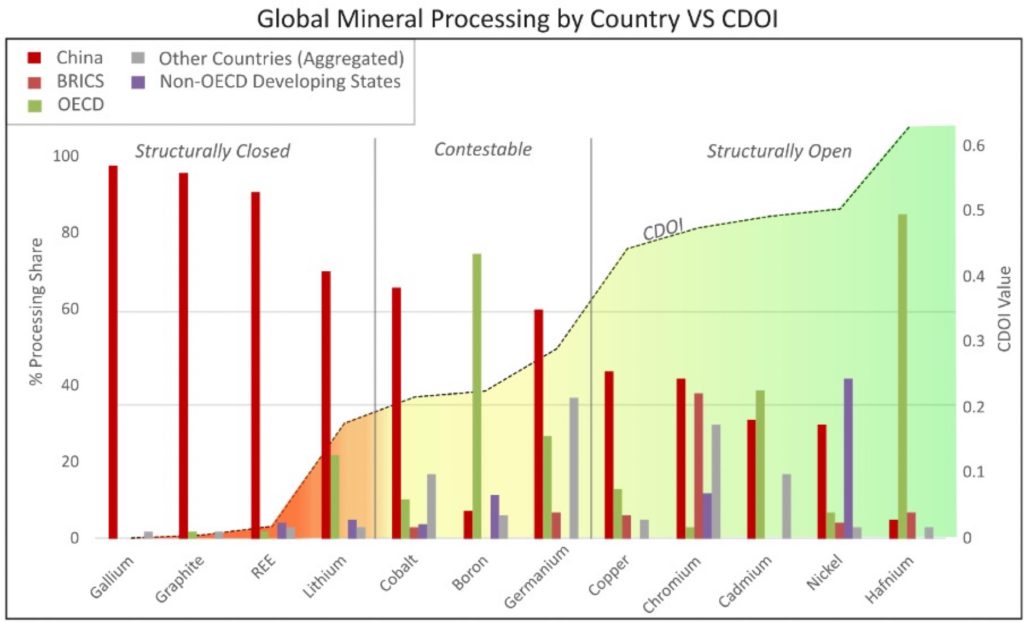
To bridge this analytical blind spot, we must look beyond current market concentration and apply a new metric. This is the Critical Dominance Opportunity Index (CDOI). Rather than taking the typical approach to investment by measuring where processing is concentrated today, it asks a different question:

How much room is actually left for new players to successfully enter a market and build strategic leverage?

When seen through this lens, the realities of the global transition become starkly visible. The processing markets for elements such as gallium, graphite, rare earth elements, and even lithium are already structurally closed. China isn’t just the largest processor, it occupies a midstream position that cannot logically be broken. Could Europe or the United States still build processing plants? Absolutely, but could they realistically overturn China’s position? That is a very different question.

Figure 1. Global mineral processing by country vs CDOI (Source: Vafeas, 2026)

On the other hand, despite having visually intimidating market shares held by single nations, the midstream markets for base metals such as copper, nickel and chromium remains comparatively open. No single global actor has yet achieved overwhelming control. The double-edged reality, however, is that whilst these markets are open to Western positioning, they are equally vulnerable to hostile monopolisation if left ignored.

Then lies the institutional blind spot, and arguably the most interesting area: a market that appears securely closed, until it suddenly isn’t. Markets like hafnium and boron appear protected because they are dominated by OECD nations, but that dominance is an illusion that is entirely dependent on institutional coordination across allied countries. Simply put, if cracks emerge within that coordination, a backdoor opens for strategic competitors to rapidly buy up control.

This distinction fundamentally shifts the paradigm. For the past decade, governments have largely obsessed with identifying which minerals are “critical”, but that is only half the story. The more important question is: which critical minerals remain strategically contestable? These are not the same. One measures today’s dependence, whilst the other measures tomorrow’s opportunity.

The €10 Billion Shift

The solution lies in how we classify “critical”. We tend to treat all critical raw materials as equally actionable. But they’re not. Some markets still have room for new dominance to emerge, and others don’t. That distinction matters.

Imagine two governments each investing €10 billion into refining capacity. One chooses gallium. The other chooses nickel. On paper, both have invested in strategic minerals. In reality, they have made completely different bets. In gallium, they are entering a market where structural dominance has already crystallised. They may improve domestic resilience, but they are unlikely to reshape global market power and remain vulnerable to market shifts beyond their control. In nickel, however, the market remains structurally contestable. The same investment has a far greater chance of creating genuine long-term strategic leverage.

That is why measuring contestability matters. It helps distinguish between investments that improve resilience and investments that can genuinely reshape future market structure. Both have value, but they should never be confused with one another.

China appears to have figured this out. We can see the risk of ignoring this logic in the tungsten market. The midstream processing market (CDOI) for tungsten is effectively closed, comparing well with graphite. But whilst Western nations have failed to recognize this, China has mapped it out perfectly, aggressively campaigning to monopolise the circularity frameworks and secondary processing of tungsten waste streams.

Why would the world’s dominant tungsten processor suddenly become interested in industrial waste? Because they recognise that when a primary processing market is structurally closed, the next contestable frontier automatically becomes secondary supply. China isn’t changing strategy. It is extending exactly the same strategy that built its original dominance. Control every remaining pathway through which future leverage can be created.

If they succeed, they will secure absolute, closed-loop control over the entire global tungsten value chain, from raw extraction to downstream recycling.

A New Architecture for Industrial Policy

This is where contemporary Western industrial policy makes its most costly mistake. Much of today’s geopolitical discussion still revolves around “catching up”. But catching up assumes the race is still being run. In many markets, it isn’t.

Pouring billions into structurally closed processing markets might improve local resilience, or create domestic jobs, but it does so at an unsustainable opportunity cost. It demands permanent capital subsidies to survive and leaves fewer resources available to compete where genuine opportunities still exist.

That doesn’t mean governments should abandon these markets. Resilience, recycling and strategic stockpiling do matter. But defensive resilience should not be mistaken for competitive advantage. There is an important difference between reducing dependence and building dominance, and successful critical minerals strategies need to recognise when each objective is appropriate.

If the US, EU, and wider OECD bloc proactively adopt a structure-aware approach, it will fundamentally transform the mining and investment landscape. The implications here are profound. If governments begin focusing capital according to contestability rather than simple criticality, today’s investment landscape changes dramatically. Projects targeting already-consolidated processing markets may continue attracting public funding for resilience, but they are less likely to reshape global market power. Meanwhile, companies positioned within still-open markets could suddenly find themselves aligned with an entirely new generation of industrial policy. In other words, the next mineral winners may not be those producing the most fashionable critical minerals, but those operating in the “dull” markets that remain open.

But to do this, we must first accept a harsh dose of realism. We must acknowledge where the race has already been lost, so we can focus capital on where the greatest gains are yet to be made. This is not an admission of defeat, but a tactical recognition of reality. If we can do this, the change will be significant. Capital will stop blindly chasing the same handful of over-saturated, “obvious” battery metals, Policy will become ruthlessly selective, and industry will pivot toward massive, currently under-recognized value chains.

Because strategy has never been about stubbornly trying to win every race, but rather about recognising which races are still worth running.

Bio

Dr. Nicholas Vafeas is an economic geologist specializing in critical raw materials, mineral value chains, and strategic resource investments.


De Beers cuts diamond prices, axes 25 elite buyers


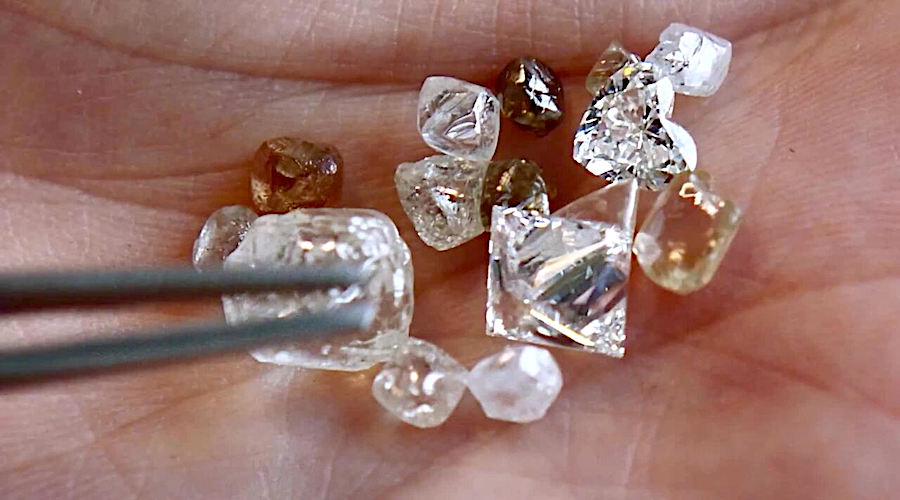
The exact scale of the price cuts was not immediately clear. (Image courtesy of De Beers Group.)

Giant diamond miner De Beers has made sweeping cuts to its official prices at its first sale since culling nearly a third of its handpicked buyers, a strategy aimed at directing more stones to its strongest customers.

The price reductions mark a sharp break from De Beers’ long-running effort to keep official prices above prevailing market levels to avoid undermining confidence in the diamond industry. 


The Anglo American (LON: AAL) unit introduced the changes during its July sales cycle, the first under new supply contracts that reduced the number of sightholders from about 70 to between 45 and 50.

De Beers’ prices, which had ranged from 5% to 50% above secondary market levels depending on the category of stones, seem to be now much closer to prevailing market prices, according to Bloomberg News. A company spokesperson declined to comment.

The move reflects mounting pressure on the world’s largest diamond producer as weak Chinese luxury demand, the rapid rise of laboratory-grown diamonds and increased flux of roughs from producers such as Angola have fuelled one of the industry’s deepest and longest downturns. 

US tariffs and conflict in the Middle East have added further uncertainty, making it increasingly difficult for De Beers to maintain official prices above the market while quietly offering discounts through private sales.

Strategic reset

The exact size of the reductions remains unclear because De Beers earlier this year switched to one-line invoicing, providing buyers with a single total rather than itemized prices for each box of rough diamonds. The company has also altered the composition of some assortments, making direct comparisons difficult, according to people familiar with the sales.

The price cuts come at a pivotal time for De Beers and parent Anglo American, which has been pursuing a sale of the business since May 2024, after years of disappointing performance.


Russian steelmaker Severstal weighs another investment cut


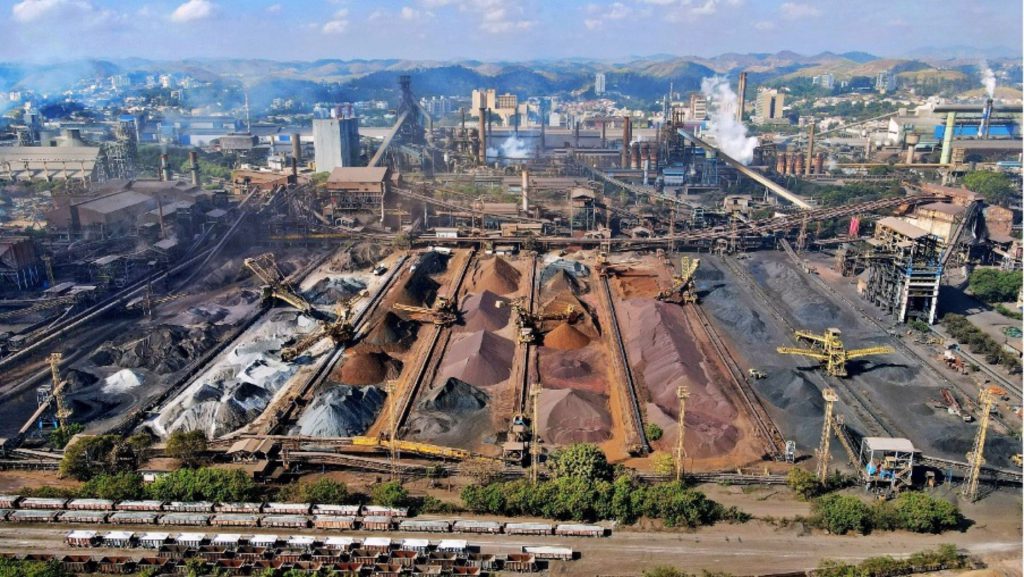
Severstal’s Cherepovets metallurgical plant. Stock image.

Russian steelmaker Severstal may cut its investment program by another 24% to around 85 billion roubles ($1.1 billion) in 2027 due to falling steel demand, according to a company presentation for investors seen by Reuters on Friday.

The measures should help ensure positive free cash flow, the company said.


The forecast for 2027 is preliminary and will remain under review until the end of 2026, according to the presentation.

Steel demand shrinking

Russian steelmakers are under pressure from Western sanctions, high interest rates and weak steel demand, which has fallen by around 30% from 2023 levels.

Demand from Russia’s construction, energy, automotive and machinery sectors — key consumers of steel — is shrinking as companies postpone investment because of high interest rates aimed at curbing inflation.

Steel consumption in Russia fell by about 14% last year, and Severstal, ranked among the country’s top four steelmakers, expects it to decline by a further 7% to 9% this year.

In March the company announced cost-cutting measures in response to weakening demand and a significant deterioration in market conditions, cutting its 2026 investment program by 24% to 112 billion roubles from the 147 billion roubles previously planned.

At the same time it said it intended to continue implementing major strategic projects.

Severstal’s billionaire owner Alexei Mordashov, ranked by Forbes as Russia’s richest businessman, warned in June that the steelmaker would continue cutting investment after slipping into a negative cash position.

($1 = 77.3300 roubles)

(By Anastasia Lyrchikova; Editing by Jan Harvey)