Tuesday, July 07, 2026

Canadian shipping prices surge as companies try to get ahead of new Trump tariffs


Published:


Shipping prices are soaring as companies rush to get ahead of a new round of U.S. tariffs that are expected towards the end of July.

“Shippers are trying to get ahead of the curve and ship their goods sooner, so they don’t have to pay the higher tariffs,” Freight Management Association of Canada president John Corey told CTV’s Your Morning on Tuesday. “This creates a bit of a bulge in demand and it’s making prices go up.”

Fuel price increases and the months-long closure of the Strait of Hormuz due to the Iran war are also contributing to rising maritime shipping costs, which are currently at a four-year high.

“There are [also] other factors that are involved,” Corey explained from Buckhorn, Ont., northeast of Toronto.

“Shipping companies, the operators of the ships, have sort of selectively reduced their capacity to ensure that the costs remain high.”
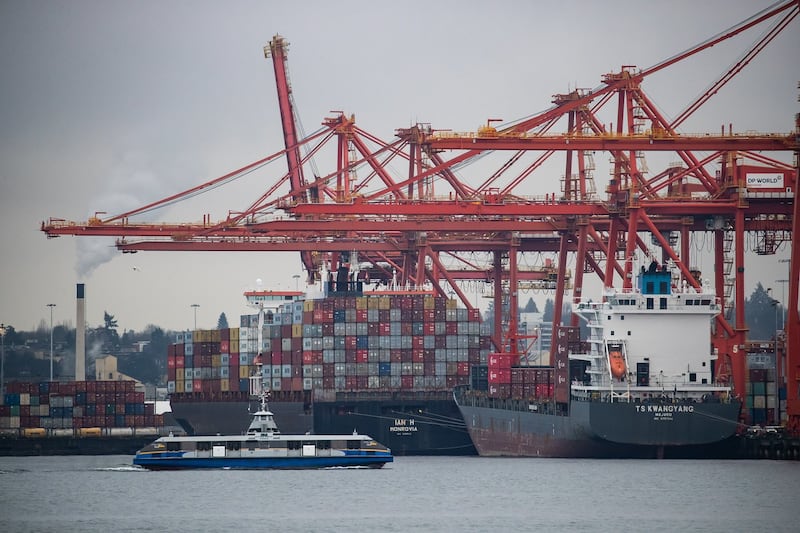
A SeaBus travels across Burrard Inlet as gantry cranes tower above container ships being unloaded and loaded at port, in Vancouver, on Thursday, Feb. 10, 2022. THE CANADIAN PRESS/Darryl Dyck

According to the Platts Container Index, global shipping rates at the end of June were the most expensive they’ve been since April 2022, when pandemic-related supply chain issues peaked. Data from the online logistics platform Freightos shows that the average price to send a 40-foot container from East Asia to North America’s west coast surged by 120 per cent over the past six weeks to reach US$6,200.

Meanwhile, the U.S. is widely expected to impose a fresh round of international tariffs after the current global duties expire on July 24. From running shoes to lawn mowers and toys, Corey says anything that arrives in Canada via a shipping container could see price increases in the near future.

“We’re starting to see the shipping companies obviously passing the fuel price on through fuel surcharges onto consumers,” Corey said. “If this situation continues, obviously it is going to start trickling down and we are going to pay higher prices for just about everything we buy now.”

With files from The Canadian Press

Canadians divided over Alto high-speed rail as government priority: Nanos survey


Published:

Protesters rally in opposition to the Alto high-speed rail project as they gather on Parliament Hill in Ottawa on Wednesday, June 10, 2026. THE CANADIAN PRESS/Sean Kilpatrick

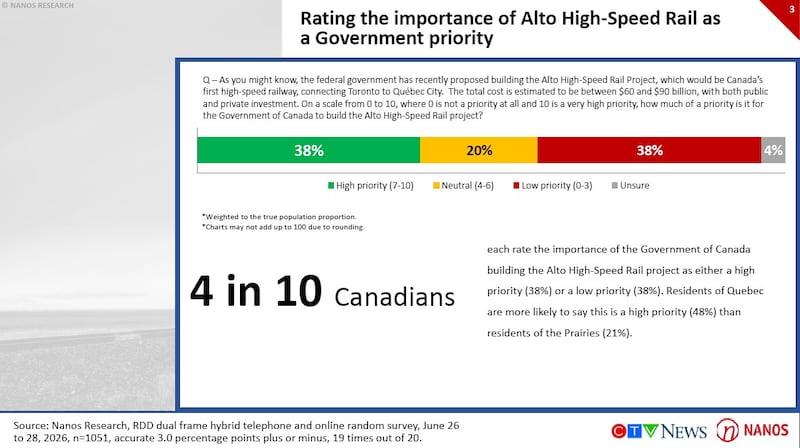
OTTAWA — Canadians are evenly split on whether they believe the proposed Alto high-speed rail project should be a government priority, according to the latest data from Nanos Research, commissioned by CTV News.

The multi-billion-dollar infrastructure project would connect Quebec City to Toronto and promises to cut travel times between those cities in half.

The federal government recently concluded its 100-day public consultation process, with a report published late last month on the findings.

Last month, federal Transport Minister Steven MacKinnon announced a proposed stop in Kingston, Ont.

But the projects have faced significant pushback, including from more than a dozen municipalities who oppose it, and from federal Conservative Leader Pierre Poilievre, who’s called it a “waste of money” and said he would cancel the project altogether if he became prime minister.

According to Nanos Research, when asked how respondents would rate the project from zero to 10 as a priority for the government, 38 per cent of people said it should be “high priority,” 38 per cent said it should be “low priority,” and 20 per cent were neutral.

Four per cent of people said they were unsure.

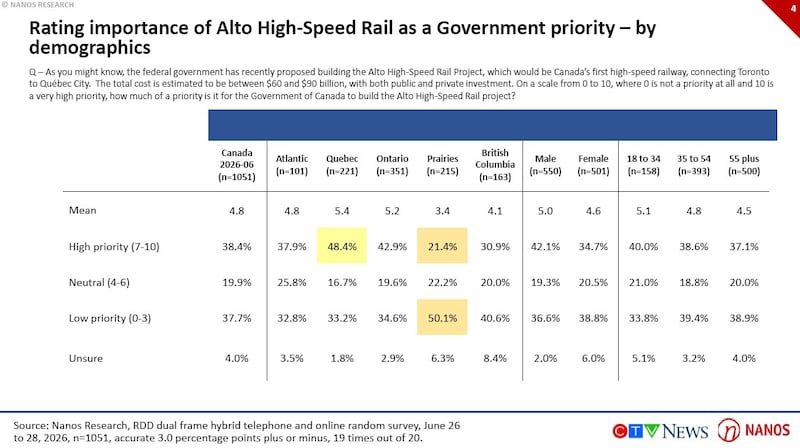
Support for the project as a government priority varies by region. According to the numbers, support for the project is strongest in Quebec and opposition is highest in the Prairies.

In Quebec, 48.4 per cent of respondents said Alto should be a government high-priority project, compared to 42.9 per cent in Ontario, 37.9 per cent in Atlantic Canada, 30.9 per cent in British Columbia, and only 21.4 per cent in the Prairies.

The Prairies, meanwhile, had 50.1 per cent of respondents say the project should be low priority, compared to 40.6 per cent of people in B.C. who said the same, 34.6 per cent of people in Ontario, 33.2 per cent in Quebec, and 32.8 per cent in Atlantic Canada.

People in Atlantic Canada were the most likely to say they’re neutral, at 25.8 per cent, followed by the Prairies, at 22.2 per cent. The region with the smallest percentage of neutral respondents was Quebec, at 16.7 per cent.

With files from CTV News’ Vassy Kapelos and Graham Richardson

Methodology: Nanos conducted an RDD dual frame (land- and cell-lines) hybrid telephone and online random survey of 1,051 Canadians, 18 years of age or older, from June 26 to 28, 2026 as part of an omnibus survey. The sample included both land- and cell lines across Canada. The results were statistically checked and weighted by age and gender using the latest Census information and the sample is geographically stratified to be representative of Canada. Individuals randomly called using random digit dialling with a maximum of five call backs. The margin of error for this survey is ±3.0 percentage points, 19 times out of 20.

Spencer Van Dyk

Opens in new window

Writer & Producer, Ottawa News Bureau, CTV News

U.S. ambassador to Canada hopeful two sides can ‘put together a great’ deal


Updated:


U.S. Ambassador to Canada Pete Hoekstra says he is “very positive” about the potential of the economic and trade relationship between Canada and the United States, and he hopes the two countries can resolve “some of the irritants.”

On Wednesday, U.S. officials announced they’re opting against renewing the Canada-U.S.-Mexico Agreement “in its current form,” and the trilateral trade deal will enter an annual review process.

“The United States will continue to engage with Mexico and Canada to address the agreement’s shortcomings and our trade deficits with these countries,” U.S. Trade Representative Jamieson Greer told CTV News. “However, the agreement remains in force pending resolution of these issues or until the agreement’s termination.”

In an interview with CTV Your Morning Ottawa on Friday ahead of Independence Day celebrations in the capital, Ambassador Hoekstra said he thought Canada and the U.S. would have reached a deal by now.

“I never thought that it would take this long,” Hoekstra said.


“Hopefully, we can resolve some of the irritants and some of the other issues that are out there, and we can put together a great, great trade agreement. It would be good for the Canadian people, it would be good for the American people, and we can move forward.”

Hoekstra was asked if he thinks the trade issues between the two countries can be addressed.

“I’ve always been very, very optimistic that we can fix it,” Hoekstra said.

“There are two strong economies here. The U.S. has a very strong economy. We have lots of resources. The same is true about Canada. Everyone says we’re stronger together. I truly believe that we’ve demonstrated that with our defence and military co-operation, economic co-operation, and energy.”

July 1 was the deadline for officials in Canada, the U.S. and Mexico to say whether they wanted to renew the CUSMA agreement for a 16-year period. Canada-U.S. Trade Minister Dominic LeBlanc said Canada’s preference was to renew the three-country trade deal.

‘We’ve got to get this fixed’

Hoekstra told CTV News chief political correspondent Vassy Kapelos last week that the U.S. and Canada were nowhere near a deal on CUSMA.

In a separate interview with Newstalk 580 CFRA Friday morning, Hoekstra said there is still “some work to do” to get an agreement.

“I thought we would have been done at this point. I’ve been here roughly 14 months, I never thought, after 14 months, we’d still be as far apart as we are on some of the trade stuff,” Hoekstra said.

“We’ve got to get this fixed, and, hopefully, that will happen sooner rather than later. I know that they’re going to continue working, you know, through July and August, even though Parliament is gone for what, three months.”

Hoekstra said the U.S. is trying to get a deal “on (U.S. President Donald) Trump time.”


“Which is really, really fast in the United States,” the ambassador said. “Hopefully, if you put (Prime Minister Mark) Carney time together with Trump time, you know, we can get something done.”

With files from CTV News’ Spencer Van Dyk

Josh Pringle

Opens in new window

CTV News Ottawa Producer and Digital Lead | Ottawa

Analysts cut Canadian dollar forecasts as CUSMA uncertainty clips rate hike chances


Published:

TORONTO -- Canada’s dollar will strengthen less than previously expected over the coming year as uncertain negotiations to revise the Canada-United States-Mexico Agreement (CUSMA) weigh on the domestic economy, reducing the prospects of interest rate hikes from the Bank of Canada, a Reuters poll showed.

The median forecast of 39 foreign exchange analysts in a June 26 to July 1 poll expected the Canadian dollar to gain 1.3 per cent to 1.40 per U.S. dollar, or 71.43 U.S. cents, in three months, which is weaker than the 1.37 per U.S. dollar forecast in a survey last month.

In 12 months, the loonie was expected to strengthen 4.3 per cent to 1.36, compared with 1.34 in the previous forecast.

The Trump administration on Wednesday declined to extend CUSMA, starting a decade-long clock to wind down the trade deal as it seeks changes to try to reshore manufacturing jobs and reduce U.S. trade deficits with its North American neighbours.

Canada sends about 70 per cent of its exports to the U.S., including steel, aluminum, autos and lumber, which have been hit by U.S. tariffs. The most recent quarterly GDP data showed the economy was slipping into a technical recession.

“The loonie has weakened considerably against the greenback over the past few weeks given shifting rate expectations vis-à-vis the U.S.,” said Bradley Saunders, North America economist at Capital Economics.

“We expect that trend to continue, as CUSMA-related uncertainty holds back growth - and therefore rate hikes - in Canada this year, while sticky core inflation and solid GDP growth push the Fed to reverse some of their earlier rate cuts.”

Speculators have raised their bearish bets on the Canadian dollar to the highest level since December.

Last week, the currency touched a 14-month low at 1.4248, while Canada’s 2-year yield fell more than 140 basis points below the U.S. equivalent, marking the widest gap since May last year.

The ​Bank of Canada has said it sees limited evidence that higher energy prices are fueling broad-based inflation. Swap markets have priced in around 10 basis points of tightening this year from the central bank, down from about 60 basis points in May.

U.S. Federal Reserve Chairman Kevin Warsh said on Wednesday he will stick firmly to the U.S. central bank’s two per cent inflation target and “disappoint” anyone who expects loose monetary policy.

A separate Reuters poll on the U.S. dollar showed the weaker dollar view is facing resistance from a growing camp predicting ⁠smaller declines - or even gains in the near term.

(Reporting by Fergal Smith; Polling by Mumal Rathore and Indradip Ghosh; Editing by Thomas Derpinghaus)