Wednesday, July 08, 2026


Electric propulsion is not always the answer for small vessels


Estonian Research Council

Diagram explaining that the best decarbonization option for a small ship depends on emissions performance, operational conditions, cost, and port infrastructure, rather than on technology alone. Author: Riina Otsason 

image: 

Diagram explaining that the best decarbonization option for a small ship depends on emissions performance, operational conditions, cost, and port infrastructure, rather than on technology alone. Author: Riina Otsason

view more 

Credit: Riina Otsason


As shipping faces growing pressure to cut greenhouse gas emissions, new doctoral research from Tallinn University of Technology shows that the cleanest solution for small vessels is not one-size-fits-all. Instead, the best decarbonization pathway depends on route length, electricity supply, port infrastructure, vessel duty cycle, and investment costs. The thesis focuses on vessels below 5,000 gross tonnage (GT), a segment that includes ferries, pilot boats, and regional service vessels that have received far less attention than large ocean-going vessels.

Riina Otsason’s doctoral thesis, Environmental and Techno-Economic Assessment of Decarbonization Pathways for Ships Below 5,000 GT, combines life-cycle assessment, techno-economic modelling, and scenario analysis across four case studies in Estonia and beyond. The studies compare electric and diesel ferries, alternative fuels for pilot vessels, fleet-level decarbonization scenarios for regional ferry lines, and a ground-effect vehicle concept for inter-island transport. Together, they show how environmental performance, economic feasibility, and operational constraints interact in small-vessel decarbonization.

The findings suggest that meaningful emission reductions are technically possible, but the best option depends strongly on context. In one case study, a battery-electric ferry produced about 75% lower greenhouse gas emissions than its diesel sister vessel under the prevailing electricity mix. In another, biomethane delivered the highest emissions reduction potential for a pilot fleet, at roughly 59% compared with marine diesel oil. Across the full thesis, electrification performed best on short, predictable routes with low-carbon electricity and adequate charging infrastructure, while bio-based fuels and hybrid systems offered more practical transitional solutions in more variable operating environments.

The research also shows that technical feasibility does not automatically translate into financial viability. Battery-electric propulsion can reduce operating costs over time, but it typically requires higher upfront capital expenditure than diesel alternatives. In the ferry case study, the estimated payback period was about 17 years without subsidies, improving to around 10 years when financial support mechanisms were included. For small fleets operating with narrow margins, that makes investment risk a decisive factor.

According to the thesis, infrastructure readiness is just as important as vessel technology. Small vessels are especially sensitive to trade-offs between energy density, storage capacity, weight, range, safety requirements, and port infrastructure. Route length, charging availability, fuel supply chains, and grid capacity all shape what can realistically be deployed. The conclusion is clear: decarbonizing smaller vessels is not simply a matter of replacing one engine with another, but of matching the right technology to the right route and the right supporting infrastructure.

The work is particularly relevant for regions with islands, ferries, and coastal services, where maritime transport is part of everyday mobility and local air quality. By focusing on a segment that has been comparatively underexamined in maritime climate research, the thesis offers evidence that could help ship operators, port planners, and policymakers identify practical transition pathways for short-sea and regional transport.

Otsason’s thesis was defended at the Estonian Maritime Academy, Tallinn University of Technology, on 11 June 2026. The work was supervised by Prof. Ulla Pirita Tapaninen, with opponents Magnus Gustafsson of Åbo Akademi University and Prof. Tae Eun Kim of UiT The Arctic University of Norway.

About the thesis

The dissertation integrates four peer-reviewed publications and evaluates alternative propulsion systems and fuel pathways in small-vessel contexts. It argues that small-vessel decarbonization is achievable, but only when environmental goals are aligned with vessel characteristics, route conditions, and infrastructure readiness.


A COF-graphene hybrid opens new horizons for lithium-sulfur batteries


A group of researchers from Tohoku University has solved a long-standing barrier to the mass adoption of lithium-sulfur batteries


Tohoku University

Figure 1 

image: 

Schematic depiction of a Li-S battery equipped with a TUS-44@G interfacial layer, where synergistic polysulfide confinement and redox catalysis regulate sulfur-species evolution, facilitate rapid conversion among S8, soluble lithium polysulfides, and Li₂S₂ / Li₂S, suppress shuttle migration, and sustain stable long-term electrochemical operation.

view more 

Credit: Yuichi Negishi et al.


Lithium-sulfur (Li-S) batteries combine the abundance and affordability of sulfur with an energy-storage capability far beyond that of current lithium-ion technologies. Practical deployment, however, has been slowed by a long-standing challenge known as polysulfide shuttling, whereby dissolved sulfur intermediates migrate within the battery, leading to active-material loss and premature performance decay.

Now, researchers from Tohoku University and collaborating institutions have tackled this problem by developing a molecularly designed covalent organic framework (COF)-graphene interlayer. This lightweight interface mitigates polysulfide shuttling by combining chemical trapping, rapid charge transport, and sulfur-conversion promotion.

The work was published in the journal Small on June 16, 2026.

Li-S batteries generate electricity through a remarkable sequence of chemical transformations. During discharge, solid sulfur is converted into soluble lithium polysulfides and then into lithium sulfides. During charging, the process is reversed. This multielectron reaction network enables sulfur to store far more energy than the cathode materials used in today's lithium-ion batteries, making Li-S technology an attractive candidate for next-generation energy storage.

Yet the very chemistry that gives Li-S batteries their enormous energy-storage potential also creates their greatest weakness. The intermediate lithium polysulfides formed during cycling behave much like wandering travellers: once dissolved in the electrolyte, they can escape from the sulfur cathode, drift across the separator, and reach the lithium-metal anode. This uncontrolled migration initiates a cascade of detrimental processes, including parasitic side reactions, depletion of active sulfur, growth of unstable interfacial layers, self-discharge, and a steady erosion of battery capacity with repeated use.

Prevention, however, does not lie in erecting a physical barrier. Instead, the separator interface must function more like an intelligent checkpoint. It should be capable of selectively recognizing polysulfide species, capturing them through strong chemical interactions, rapidly shuttling electrons to sustain electrochemical activity, and actively guiding sulfur intermediates through their successive reduction and oxidation steps. Combining these diverse functions within a single material platform has remained one of the central challenges in advancing practical Li-S batteries.

To solve this issue, the team created a new tetrathiafulvalene-crown ether COF, named TUS-44, and integrated it with conductive graphene to form a TUS-44@G functional layer for Li-S batteries. The framework contained imine nitrogen, crown-ether oxygen, and sulfur-rich tetrathiafulvalene sites, which together provide a hierarchy of interaction sites for lithium polysulfides while the graphene component supplies an efficient electron-transport pathway.

In battery tests, cells equipped with the TUS-44@G layer delivered a high reversible capacity of 1455.7 mA h g⁻¹ at 0.2 A g⁻¹, retained excellent rate capability with 773 mA h g⁻¹ at 10 A g⁻¹, and showed long-term durability with only 0.034% capacity fading per cycle over 1000 cycles at 5 A g⁻¹. A Li-S pouch cell incorporating the same interlayer achieved an initial energy density of approximately 674 Wh kg⁻¹ at 0.05 A g⁻¹, demonstrating the promise of this molecularly engineered interface for practical high-energy batteries.

"Our goal was to design an interlayer that does not simply block polysulfides, but actively manages their reaction pathway," explains Saikat Das, Junior Associate Professor at the Institute of Multidisciplinary Research for Advanced Materials, Tohoku University. "By integrating crown ether and tetrathiafulvalene chemistry into an ordered COF and coupling it with graphene, we created a cooperative interface that can anchor, redistribute, and convert sulfur species more efficiently."

COFs offer an appealing solution because they can be constructed with molecular-level precision. Unlike conventional porous carbons, which interact only weakly with polysulfides, COFs possess periodically arranged pores whose dimensions, chemical environments, and electronic characteristics can be programmed by design. In essence, COFs provide a molecularly engineered platform that simultaneously captures, conducts, and catalyzes, offering a powerful strategy to transform the long-standing polysulfide shuttle problem from a major obstacle into a controllable aspect of sulfur electrochemistry.

The team synthesized TUS-44 through Schiff-base condensation between a benzo[18]crown-6 tetrabenzaldehyde linker and a tetrathiafulvalene-based tetraaniline building block. Structural analysis confirmed an imine-linked, π-conjugated, two-dimensional bex-topology framework with uniform micropores of approximately 0.9 and 1.2 nm and a BET surface area of about 516 m² g⁻¹.

The team also discovered that TUS-44 is not merely a porous scaffold but a molecularly programmed interface in which distinct functional sites perform complementary tasks. Imine nitrogen atoms serve as preferential docking sites for lithium ions, crown-ether oxygen atoms facilitate additional ion coordination and transport, while electron-rich tetrathiafulvalene moieties promote charge delocalization and mediate sulfur redox reactions. Integrating TUS-44 with graphene onto a polypropylene separator produced a thin, homogeneous interfacial coating that readily absorbs electrolyte and effectively blocks the migration of soluble polysulfides.

"This study shows that reticular chemistry can be used to program battery interfaces at the molecular level," remarks Professor Yuichi Negishi of Tohoku University. "The TUS-44@G design offers a route toward lightweight, durable, and high-rate Li-S batteries by unifying polysulfide immobilization with catalytic sulfur conversion."

Figure 2 

Reticular assembly of the TUS-44 framework and crystallographic verification through powder X-ray diffraction studies.

Credit

Yuichi Negishi et al.


Safer metal recycling for the battery industry


Chalmers University of Technology

Mark Foreman 

image: 

Mark Foreman, Associate Professor, Division of Energy and Materials,Department of Chemistry and Chemical Engineering, Chalmers University of Technology, Sweden

view more 

Credit: Chalmers University of Technology


The metals used in batteries are a valuable, finite resource that are not readily available in Europe. There is therefore a huge desire to recycle as much as possible. Researchers at Chalmers University of Technology in Sweden have come up with a new way of recycling the metals found in rechargeable batteries, with less harmful effects for people and the environment, whilst maintaining the same level of efficiency. Their study investigates how fossil-based chemicals used in metal recovery can be replaced with alternatives produced from renewable biomass.

A rise in global energy consumption and the need to use more sustainable energy systems wherever possible is driving an increasing demand for energy storage systems, such as batteries. At the same time, the need to recover and recycle the metals used in batteries – including copper, cobalt, lithium and manganese – is also increasing. These materials are essential for the green transition, and several of them are included in the EU Critical raw materials act.

Critical raw materials are “raw materials of high economic importance for the EU, with a high risk of supply disruption due to the concentration of their sources and the lack of any good, affordable substitutes”. For example, China supplies 100 per cent of the EU’s demand for heavy rare earth elements. The EU is working to diversify and secure its supply of critical raw materials, and recycling is playing a key role.

Batteries require high degree of purity

To make metal recovery both efficient and economically viable, metals must be separated and purified before they can be reused. The production of batteries and other high-value products often requires metals of a high degree of purity.

In some cases, using higher-purity raw materials can lead to the exclusion of less favorable materials (for both the environment and human safety), such as mercury. For example, in the past, the shelf life of non-rechargeable batteries was extended by adding mercury to the zinc electrode. However, with higher-purity zinc, it is possible to produce an equally stable battery that is free from mercury.

“If we do not separate and purify materials during recycling, their quality will gradually deteriorate. Ultimately, we risk ending up with materials that can no longer be used in advanced applications, and the whole purpose of recycling is lost,” says Mark Foreman, Associate Professor at the Department of Chemistry and Chemical Engineering at Chalmers.

Alternatives for existing production lines

Solvent extraction is a widely used method (read more below) for separating and purifying metals in battery recycling, as well as in mining, the nuclear industry and in other industrial sectors. Today, the diluents used in these processes are typically produced from fossil-based feedstocks.

“In our study, we wanted to demonstrate that renewable biomass, for example, by-products from the forestry industry, can be used to produce alternative diluents. In this case, we investigated two aromatic compounds that could also be used directly in existing industrial production lines,” says Daniel Keywan Hoffmann, PhD student at Chalmers and first author of the study.

The study shows that the aromatic compounds perform just as well as conventional commercial alternatives in the extraction of several important metals. Furthermore, they could be implemented directly in existing industrial production lines.

“It is expensive for industry to rebuild factories or invest in entirely new infrastructure to improve sustainability. If the existing processes and equipment can be used while simply switching to a significantly safer chemical, the barrier to change becomes much lower and far less expensive,” says Daniel Keywan Hoffmann.

The aromatic compounds are safer to handle

Large-scale metal recovery operations use substantial quantities of diluents, which often need to be handled by people, so safety considerations are of particular importance. The researchers found that the two aromatic compounds used in the study have higher flash points and lower volatility than several commercially used alternatives. This means a lower risk of fire and reduced exposure to hazardous substances for workers in recycling facilities.

Some commercial chemicals used frequently for these processes today are particularly potentially harmful, since they form a group of neurotoxins when they degrade. These neurotoxins can have harmful effects in the brain and nervous system of humans and animals, and many conventional diluents are converted into these in the body.  The new aromatic compounds which have been tested in this study cannot form these neurotoxins when they degrade.

“If we can achieve the same performance as current processes while reducing risks to people and the environment, that represents a significant benefit for everyone,” says Mark Foreman.

Aim to inspire industry

The researchers emphasise that manufacturing processes would need to be optimised, and the availability of renewable feedstocks increased, to make the approach cost-effective.

“We hope our work can inspire industry to think differently. Sustainable alternatives do not necessarily require starting from scratch. In many cases, replacing certain chemicals may be enough,” says Daniel Keywan Hoffmann.


More about the study:

  • Read the study in RSC Sustainability: Safer aromatic process diluents for solvent extraction of critical metals from spent batteries
  • Liquid–liquid extraction, also known as solvent extraction, uses an organic phase consisting of:
    a) A complex-forming molecule (extractant) that binds the metal to be extracted.
    b) A diluent in which the extractant is dissolved, such as kerosene.
  • The primary role of the diluent is to dissolve the extractant and create a usable organic phase, as extractants cannot generally be used on their own.

Researchers at Chalmers University of Technology in Sweden have come up with a new way of recycling the metals found in rechargeable batteries, with less harmful effects for people and the environment, whilst maintaining the same level of efficiency. This study investigates how fossil-based chemicals used in metal recovery can be replaced with alternatives produced from renewable biomass. This image shows how the new biobased dilutents are created. The feedstock molecules (which can come from forestry waste and waste from bioalcohol production) are shown in blue on the left. These pass through sulfuric acid and create the new biobased dilutents, seen on the right in grey and white, which can be used for safer battery recycling. 

Credit

Chalmers University of Technology | Mark Foreman


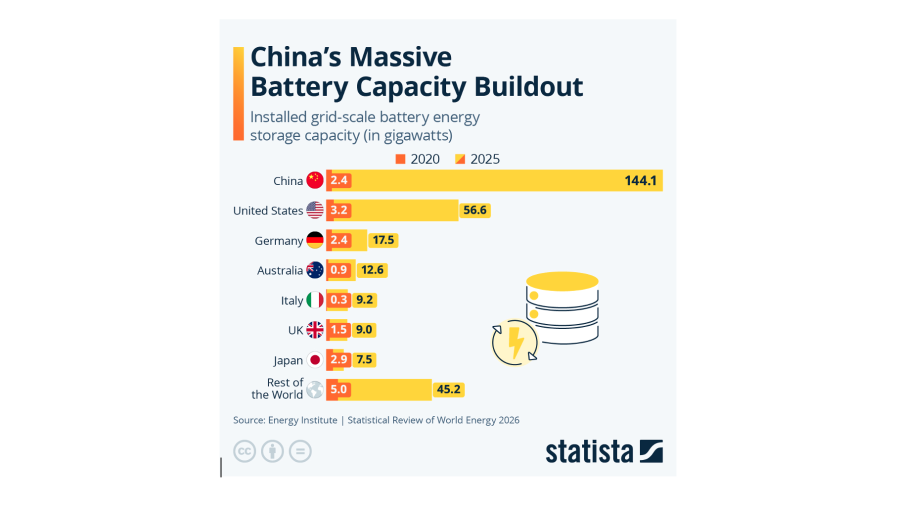
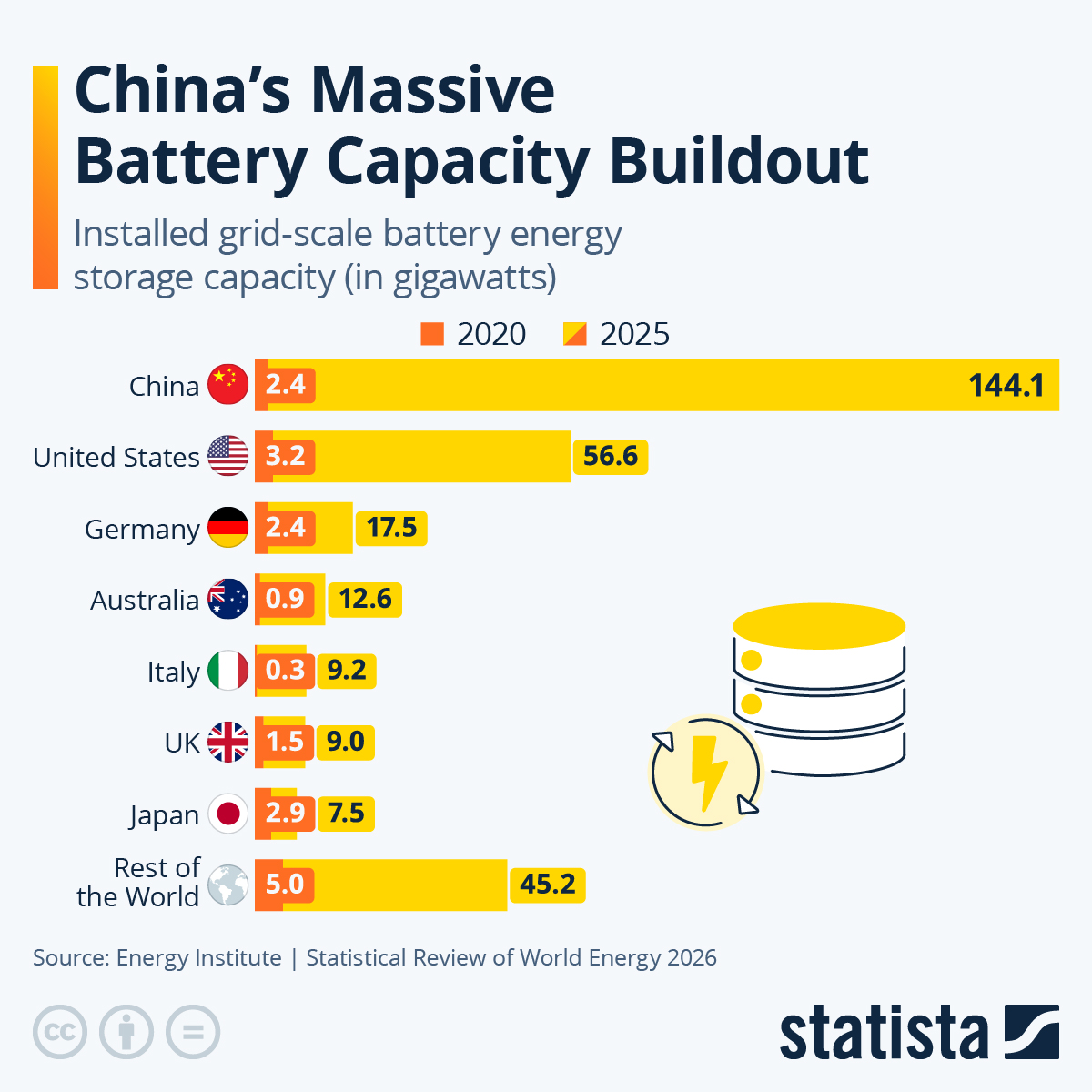
China's massive battery capacity buildout – Statista

China's massive battery capacity buildout – Statista
Already accounting for half of the world's solar panels, China is completing its green revolution by building out massive battery storage capacity. / bne IntelliNews
By Felix Richter of Statistia July 8, 2026

China’s lead in renewable energy is matched by its dominance in battery storage, Statista reports.

According to data from the Energy Institute’s latest Statistical Review of World Energy, the country’s grid-scale battery energy storage capacity surged from just 2.4 gigawatts in 2020 to more than 140 gigawatts in 2025 – far ahead of the United States, which reached roughly 57 gigawatts, and the rest of the world.

This rapid expansion is closely linked to the rise of wind and solar power in the country. Unlike conventional power plants, renewable sources generate electricity intermittently, depending on weather conditions and time of day. Battery storage systems help to smooth out these variations by storing excess electricity and feeding it back into the grid when needed, making large-scale renewable integration more feasible.

In that sense, China’s storage boom is a direct consequence of its clean energy push. As renewable capacity continues to grow, so does the need for flexibility in the power system. By investing heavily in battery storage, China is addressing one of the key challenges of the energy transition, ensuring that its massive buildout of wind and solar power can be used efficiently and reliably.

Policymakers have actively encouraged this development, with many regions requiring new renewable projects to include co-located storage capacity. These measures, combined with falling battery costs and strong domestic manufacturing capabilities, have turned China into the world’s largest market for battery energy storage systems.


You will find more infographics at Statista


Social norms can accelerate or undermine climate action, new model finds


University of Waterloo-led research shows cultural attitudes in one region can unexpectedly influence climate action around the world


University of Waterloo


A new mathematical model suggests that social norms may be just as important as economics in determining how the world responds to climate change. The research shows that efforts to reduce emissions in one region can unintentionally influence climate action elsewhere, with consequences that could either strengthen or weaken global progress.

The model divides the world into five culturally and economically distinct regions and simulates how social norms, perceived climate risks and economic pressures interact to shape climate action.

"Climate models often assume people are rational economic actors who always act in their own best interest," said Dr. Chris Bauch, professor of applied mathematics at the University of Waterloo. "Our model recognizes that people are also influenced by social norms, whether that's eating more beef or choosing reusable water bottles, and those behaviours can significantly affect climate change mitigation."

The model draws on existing data describing cultural values and behaviour across Asia, Latin America, the Middle East and Africa, OECD countries and the Reforming Economies of Eastern Europe and the former Soviet Union. It models how social and economic factors influence mitigation efforts, which in turn affect global warming.

The researchers found that strategies that encourage climate action in one region may have the opposite effect elsewhere.

"We found that greater discussion about climate change often increases support for mitigation, but in some regions, it can also fuel anti-mitigation sentiment," said lead author Amrita Punnavajhala, who recently completed her PhD in applied mathematics at Waterloo. "The best approach depends on each region's unique social and economic circumstances rather than a one-size-fits-all solution."

The model also reveals how regional actions can create unexpected ripple effects.

"If Asia increases its mitigation efforts, global warming slows slightly, which can reduce the perceived urgency in OECD countries such as Canada and the United States," Bauch said. "That could weaken social pressure for climate action and create harmful long-term consequences."

"There are constant feedback loops between climate change and human behaviour," said Dr. Madhur Anand, professor of environmental science at the University of Guelph and adjunct professor in Waterloo's Department of Applied Mathematics. "Understanding those relationships will be essential to reducing emissions and building a more sustainable future."

The study, Implications of regional variations in climate change vulnerability and mitigation behaviour for social-climate dynamics, appears in Nature Communications.


Hotter, drier weather could double water bills in some cities, Stanford study finds


Stanford University


WATCH RELATED VIDEO HERE: https://www.youtube.com/watch?v=U6I-qK-4si0

In Brief

  • Hotter, drier conditions driven by climate change could nearly double water bills in some cities by mid-century, according to a Stanford-led study.
  • Researchers found that costly drought-resilience projects, such as desalination and water reuse systems, could push many low-income households into severe water affordability crises.
  • The study suggests current financing models are ill-equipped to balance reliable water supplies with affordable access as climate pressures intensify.

Hotter, drier weather threatens to double water bills by mid-century in some cities, according to a Stanford-led study. The research, published July 8 in Nature Sustainability, is the first to comprehensively model how climate change, infrastructure investment, and household water demand can combine to compound an already growing affordability crisis.

"Climate change stresses water supplies, and forces utilities to build expensive new infrastructure to maintain reliability,” said study lead author Jennifer Skerker, a PhD student in civil and environmental engineering at the Stanford Doerr School of Sustainability and the Stanford School of Engineering while working on the study. “In cities already struggling with affordability due to aging infrastructure, the additional costs passed on to ratepayers to pay for additional infrastructure and reliability measures can push a substantial share of households into crisis.”

The average cost of tap water in the United States has increased three times faster than inflation over the past two decades, driven largely by aging infrastructure and deferred maintenance. Climate change is layering a new and poorly understood pressure on top of those existing strains, according to Skerker and her study coauthors.

To understand how predicted changes in temperature and rainfall over the next two decades are likely to affect local water supplies and costs, the research team analyzed data from Santa Cruz, California. The small coastal city relies almost entirely on local surface water and a single reservoir. The local utility has implemented many lower-cost conservation options, such as water-saving appliances and reduced irrigation, necessitating infrastructure investments for climate resilience.

Using a modeling framework developed with data from Santa Cruz's water department, the researchers linked plausible future climate scenarios with utility adaptation decisions, such as building a wastewater reuse facility, methods for pricing water, and household-level water demand. Among the results: measures taken to adapt to less water availability could lead to a near doubling of median water bills in Santa Cruz by mid-century. Paying for major new infrastructure could push the share of households exceeding the EPA’s recommended affordability threshold from the 19% to 35%, according to the study’s findings.

The model showed median water bills for the poorest residents could rise from around $60 to $111 per month (in today’s dollars) under a dry climate scenario. More than 5% of households would have to devote as much as a third of their income to water, likely forcing painful trade-offs with food, healthcare, and other necessities.

Different infrastructure strategies produced starkly different outcomes. A risk-averse approach that built large desalination capacity early provided strong supply reliability, but at a steep cost to affordability. A more cautious approach that delayed investments kept bills lower but left the system dangerously exposed during droughts, providing reliable water supply in only 6 out of 10 years on average. 

The modeling framework can be adapted to assess water affordability risks in cities – such as Los Angeles, San Diego, San Francisco, Cape Town, and Melbourne, Australia – facing vulnerabilities similar to those of Santa Cruz. Even cities that seem more resilient now would do well to pay attention. They could become vulnerable over time as climate stress intensifies and utilities raise water rates, according to the researchers.

"The bottom line is that under today's financing and regulatory models, climate adaptation and water affordability are on a collision course,” said study senior author Sarah Fletcher, an assistant professor of civil and environmental engineering and a center fellow at the Stanford Woods Institute for the Environment. “Ensuring reliable water access for everyone is going to require interventions at the state and federal level that go far beyond what individual utilities can do on their own.”


Other coauthors of the study include Christian Klassert of the Helmholtz Centre for Environmental Research; Baptiste Francois and Casey Brown of the University of Massachusetts; and Aniket Verma, a Ph.D. student in civil and environmental engineering at Stanford.