SPACE/COSMOS
Hyperion GR-1 enters orbit: A new step for Greece's space programme

It is the first Greek optical microsatellite developed under the National Microsatellite Programme - launched from Cape Canaveral.
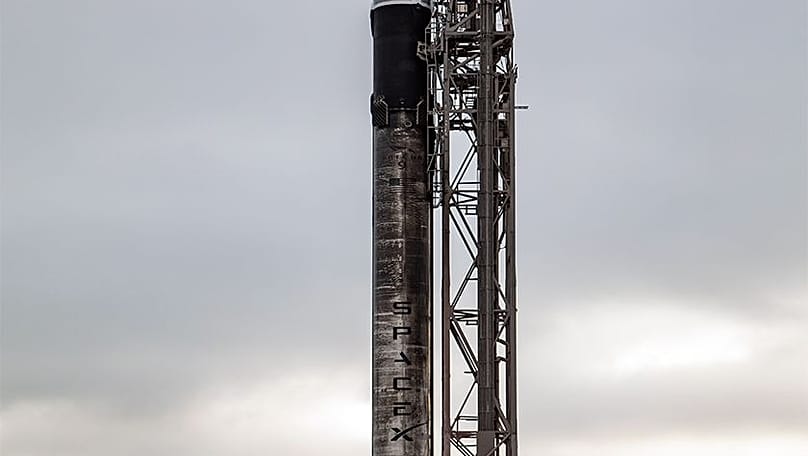
With the successful launch of Hyperion GR-1, Greece has taken another step in developing its national space infrastructure. The first Greek optical microsatellite of the National Microsatellite Programme was placed into orbit around the Earth on Tuesday 7 July, following a launch from Cape Canaveral Space Force Station in Florida on a SpaceX rocket.
Hyperion GR-1 marks the start of the deployment of a constellation of seven optical microsatellites, which are being built in Greece by Open Cosmos Aegean.
The programme aims to create a modern satellite observation system to support critical public-sector operations, ranging from civil protection and environmental monitoring to maritime surveillance, precision agriculture and the safeguarding of critical infrastructure.

The microsatellite can capture high-resolution multispectral images with a ground sampling distance of up to 90 centimetres, enabling the monitoring of changes in natural and urban environments.
At the same time, it is equipped with onboard data-processing capabilities using artificial intelligence (AI), as well as inter-satellite links to speed up the processing and transmission of information to ground stations.
The information collected by Hyperion GR-1 will be used via the Government Geospatial Observation Hub, which is designed to serve as the central digital platform for the aggregation and management of satellite data for public administration.
According to the plans of the Ministry of Digital Governance and Artificial Intelligence, the satellite’s data will be used for the early detection of wildfires and floods, the assessment of the impact of natural disasters, the protection of forest and water resources, as well as for applications in precision agriculture and aquaculture.
In addition, they are expected to be deployed in maritime surveillance, in monitoring shipping and in identifying incidents of marine pollution.
The range of applications also extends to urban planning, the monitoring of major engineering projects and the inspection of critical infrastructure, with the aim of improving decision-making through up-to-date geospatial data.
Hyperion GR-1 is the first of seven microsatellites in the National Microsatellite Programme, which is financed by the Recovery and Resilience Facility “Greece 2.0”.
The programme is being implemented by the General Secretariat for Telecommunications and Post, with the support of the Hellenic Space Centre (ELKED) and the European Space Agency (ESA).
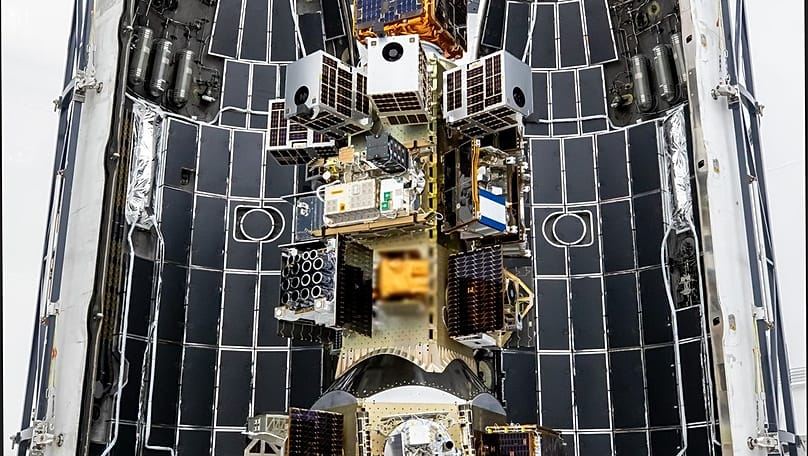
The same mission also carried the Posedònia satellite, which was built by Open Cosmos at its facilities in Spain.
With the addition of Hyperion GR-1, Greece now has a total of 18 microsatellites in orbit, according to the ministry, as part of its strategy to develop national space infrastructure.
The ministry also highlights the involvement of Greek industry in the development of the new microsatellite. Greek companies and engineers took part in the construction of Hyperion GR-1, helping to strengthen domestic know-how and create prospects for the development of exportable space technologies and services.
At the same time, the government has already set out its next plans for the space sector through the HELLAS-SPACE 2.0 programme, with a total budget of 350 million euros, which aims to further expand the country’s capabilities in space applications.
The Minister of Digital Governance and Artificial Intelligence, Dimitris Papastergiou, described the launch as “a new era for the country”, stressing the benefits expected from the use of satellite data.
“The launch of Hyperion GR-1 marks a new era for our country. We are acquiring another powerful tool that will allow us to harness satellite data for the benefit of citizens: to protect our forests and marine areas, to support precision agriculture, to map development both within and outside approved planning zones, and to take faster decisions in times of crisis,” the minister said.
He added that today’s launch is part of a broader national strategy, recalling the recent presentation of the HELLAS-SPACE 2.0 programme, with a budget of 350 million euros, which is the continuation of the National Microsatellite Programme.
“Our goal is for technology to make the state more effective, the country more resilient and citizens’ daily lives better,” he concluded.
The earliest quasars yet observed are shedding light on the infancy of our cosmos
An international team of scientists has discovered 31 of the most ancient quasars ever found
image:
A quasar emits exceptional amounts of energy generated by matter falling into a supermassive black hole.
view moreCredit: NASA, ESA, Joseph Olmsted (STScI)
(Santa Barbara, Calif.) — Quasars are among the brightest, most energetic objects in the universe, powered by supermassive black holes devouring matter at the centers of galaxies. Their extreme luminosity makes them visible across tremendous cosmic distances.
An international team of scientists has discovered 31 of the most ancient quasars ever found. Two of these are the earliest yet observed in cosmic history. They radiated the light of a trillion suns back when the universe was a mere 670 million years old. The findings, published in the journal Astronomy & Astrophysics, mark a significant step forward in our understanding of the early universe.
“These objects provide the best clues for understanding how supermassive black holes form,” said co-author Joseph Hennawi, a physics professor with joint appointments at UC Santa Barbara and Leiden University. “These monsters — weighing billions of times the mass of our sun — somehow already existed when the universe was in its infancy. We don't yet have a good understanding of how they grew so massive, so fast.”
Bright, yet elusive
Astronomers have been hunting for the universe’s very first quasars for decades. These objects reveal what was happening during the cosmos’ earliest days, including how the first supermassive black holes and galaxies took shape.
Yet, quasars from earlier than about 770 million years after the Big Bang are exceedingly rare and difficult to detect. Few galaxies had yet grown large enough to create a quasar. Even then, the light from these primordial quasars is both faint and easily mistaken for signals from stars lying closer to us.
What’s more, their light is stretched from ultraviolet into near-infrared wavelengths by cosmic expansion, falling into a range where Earth’s atmosphere glows brightly, drowning out faint signals. Scientists actually use this “redshift” as a measure of an object’s age and distance, since light from farther away (and thus earlier in the life of the universe) has been shifted more toward longer wavelengths by the subsequent expansion of spacetime. “A redshift of 7 takes us to when the universe was just 750 million years old, less than 6% of its current age,” Hennawi said.
“These two things make finding quasars at these distances incredibly difficult,” said lead author Daming Yang, a doctoral student in Hennawi’s group at Leiden University. “For every one of them there are thousands of stars in our Milky Way and nearby galaxies that look almost identical in the imaging surveys. And since their light is stretched to the infrared at such distances, we need a survey that is both wide enough to capture these rare objects and deep enough to detect their faint light.” The task is nearly impossible to carry out on the ground. You need to get a view from space.
Eye in the sky
In 2023, the European Space Agency (ESA) launched the Euclid space telescope to help demystify this era of ancient cosmic history. It views the universe from above our planet’s infrared haze, surveying an area of the sky far larger than ground-based observatories could cover at comparable depth. The telescope has now discovered an unprecedented number of 31 new quasars in the early universe, pushing back to a time when the cosmos was just 5% of its current age. These appeared in data from the Euclid Wide Survey, which will cover more than one-third of the total sky once complete.
The earliest quasars we knew of until now were the rare, bright outliers that had been easiest to spot. We hadn’t yet found enough quasars from the universe’s early days to study them properly as a group. “Euclid is a true game-changer,” Daming said. “Before, we could only find a handful of the very brightest ancient quasars, but Euclid lets us search far more efficiently across huge areas of sky to capture much fainter light. It’s a unique tool for quasar hunting.”
Beacons from the early universe
The second most ancient quasar found by Hennawi, Daming and their colleagues was recently studied in more detail. The analyses revealed that the quasar was embedded in a dusty, gas-filled galaxy that was furiously forming new stars, hinting at what the host galaxy of an early supermassive black hole may have been like.
These quasars hark back to a fascinating period in cosmic history — known as the epoch of reionisation — when the first stars and galaxies ionized the dark, neutral hydrogen fog filling the early universe. This was a crucial era that set the stage for everything we see today.
Of the 31 new quasars, 14 are at or above a redshift of 7. The two most ancient of the batch have redshifts of 7.69 and 7.77, setting a new record for the earliest quasars ever found. Both lie just over 13 billion light-years away, and emerged during the universe’s first 670 million years. They also break the previous record for earliest quasar that Hennawi’s group set back in 2021.
But each new record isn't just a record for its own sake. “Every step further back in time makes the puzzle more perplexing: How did the Universe produce supermassive black holes so quickly?” Hennawi said. “We're finding black holes with hundreds of millions of times the mass of our sun at a time when the universe was barely getting started.” Answering this quandary will require looking even farther into our cosmic past.
Pushing ever earlier
A combination of better telescopes and smarter searches have enabled astronomers to continue peering deeper into the universe’s history. Discovering the first 10 or so quasars at a redshift of 7 or above took astronomers more than a decade — but Euclid has already discovered more than that in a single year. This finding more than doubles the number of quasars we know of that are so ancient.
In addition to revolutionary observatories like Euclid, new machine-learning methods enable scientists to sift through tens of millions of sources and reliably pick out the handful of real quasars from the far more common imposters, Hennawi explained.
Hennawi’s group has spent years developing the algorithms that proved critical in these recent discoveries. He’s also the lead developer of PypeIt, the software that astronomers at the University of California use to process the data that they collect at the Keck telescopes. Two-thirds of these new quasars, including the three most distant ones, were discovered with Keck through the UC’s privileged access.
The team’s new goal is to push the distance frontier even further, and find the first quasar beyond redshift 8. That would place it within the first 630 million years of the universe’s lifetime.
But discovery is just half the story. The team already has approved programs with the James Webb Space Telescope to study many of these quasars in detail, including measuring the masses of their black holes, probing the chemistry of the gas around them, and using the imprint of the intergalactic medium on their light to trace how reionization progressed. Meanwhile, telescopes like the Atacama Large Millimeter Array will target the cosmic dust glowing in the host galaxies themselves, revealing aspects about their dust, gas and star formation.
“The bigger vision is to stitch all of this together into a coherent timeline,” Hennawi said: “a quasar chronicle of the first billion years.”
Daming Yang, Antoine Basset and Jean-Charles Cuillandre of the Euclid Consortium contributed to this story.
DOI
Euclid discovers the most ancient quasars in the Universe
image:
This artist’s impression shows a quasar: a brief period of life for a big, bright galaxy during which large quantities of material spiral into its central supermassive black hole, releasing energetic light as it does so. Quasars are the most luminous objects in the cosmos, shining hundreds to thousands of times more brightly than entire galaxies.
In March 2026 the European Space Agency's Euclid space telescope discovered 31 of the most ancient quasars ever found, more than doubling the number of quasars we know of that are so old. Two of these giant, dazzling, black hole-powered galaxy cores are older than any we’ve seen before. These cosmic elders shone with the light of a trillion Suns back when the Universe was 670 million years old – just 5% of its current age.
[Image description: The focus of this artist impression is a fiery red-orange disc of spiralling material. The material swirls inwards towards a bright white-yellow centre, from which a thin beam-like jet of material emerges to the left, directed to the top-centre of the frame.]
view moreCredit: ESA
European Space Agency’s Euclid space telescope has discovered 31 of the most ancient quasars ever found. Two of these giant and dazzling galaxy cores, powered by gargantuan black holes, are the earliest quasars yet observed in cosmic history. They shone with the light of a trillion Suns back when the Universe was 670 million years old – just 5% of its current age.
Quasars represent a brief phase in a galaxy’s life during which large amounts of material spiral into the central supermassive black hole, releasing enormous amounts of energy. In this phase, the galaxy’s nucleus shines more brightly than anything else in the Universe, often outshining the rest of its host galaxy by hundreds to thousands of times.
We’ve been hunting for the Universe’s very first quasars for decades. These objects reveal what was happening during the earliest days of the cosmos, including how the first supermassive black holes and galaxies took shape. However, quasars from this time are difficult to find. They’re rare, as few galaxies had yet had time to grow big enough, and their primordial light is both faint and easy to confuse with that from stars lying closer to us.
Euclid, launched in 2023, is digging deeper into this mystifying part of ancient cosmic history – with exciting results. The telescope has now discovered an unprecedented number of 31 new quasars in the early Universe, pushing back to a time when the cosmos was just 5% of its current age.
“These early quasars date back to the Universe's infancy,” says Daming Yang of Leiden University in the Netherlands, lead author of the Euclid discovery paper. "By finding and studying them, we can better understand how these enormous systems formed and grew so quickly – one of the greatest mysteries in astrophysics.”
Beneath the tip of the iceberg
The earliest quasars we knew of until now were just the tip of the iceberg: the rare and bright outliers that have been easiest to spot. We simply hadn’t found enough quasars from the Universe’s early days to study them properly as a group. Euclid’s new finding changes all that, capturing not just the bright outliers but most of the ancient quasar population.
“Euclid is a true game-changer,” adds Daming. “Before, we could only find a handful of the very brightest ancient quasars, but Euclid lets us search far more efficiently across huge areas of sky to capture much fainter light. It’s a unique tool for quasar hunting.”
The discovery adds 12 new quasars at a ‘redshift’ – a measure of distance and motion related to how light moves through our expanding cosmos – of 7 or above, corresponding to the first 770 million years of the Universe.
The two most ancient of the batch, EUCL J172902.75+641018.1 and EUCL J125308.55+705432.3, have redshifts of 7.77 and 7.69, respectively, setting a new record for the most ancient quasars ever found. Both lie just over 13 billion light-years away, and emerged during the Universe’s first 670 million years.
“This finding more than doubles the number of quasars we know of that are so ancient,” says Antonio La Marca, an ESA Research Fellow in the Euclid team. Discovering the first 10 or so quasars at a redshift of 7 or above took astronomers more than a decade – but Euclid has already discovered more than that in a single year.
“The Euclid team has taken a true ‘census’ of quasars at the dawn of the Universe for the first time,” adds Antonio. “It’s a big step towards understanding these fascinating objects on a more fundamental level.”
A milestone in cosmic history
The second most ancient quasar found by Daming and colleagues was recently studied in more detail by Silvia Belladitta and collaborators. These observations showed that the quasar is embedded in a dusty, gas-filled galaxy that is furiously forming new stars, hinting at what the host galaxy of an early supermassive black hole may be like.
The quasars hark back to a fascinating period in cosmic history known as the ‘epoch of reionisation’: when everything shifted from being cold and dark (the ‘dark ages’) to hot and ‘ionised’ (split apart by energetic light). This transitional epoch was a crucial era that set the stage for everything we see today.
“Ancient quasars are rare discoveries. They're interesting in themselves, but also time machines that enable us to explore the early Universe and understand how the first generation of galaxies came to be,” says ESA Euclid Project Scientist Valeria Pettorino.
“Euclid’s capabilities are unrivalled. The telescope combines a large area, depth, sharp imaging, and unique space-based infrared vision in a way that lets us pick out rare, extremely distant objects far more efficiently than before.
And it’s not just the telescope: the data processing is only possible thanks to thousands of Euclid Consortium scientists and engineers working together to deliver scientific discoveries, sifting through enormous datasets to identify rare, distant quasars that we can study further using telescopes on the ground.”
The 31 quasars reported here were discovered in data from the Euclid Wide Survey, which will cover more than one-third of the total sky once complete. Euclid will reveal the secrets of the dark Universe; the telescope is exploring its composition, history, evolution, and mapping out its large-scale structure, observing billions of galaxies – and revealing many quasars – as it does so.
Notes to editors
Euclid: Discovery of 31 new quasars at 6.6<z<7.8 by D. Yang et al will be published published on 6 July 2026 in Astronomy & Astrophysics. DOI: 10.1051/0004-6361/202658883
The highest-redshift quasar in this work is named EUCL J172902.75+641018.1 (redshift of 7.77), and the second-highest is named EUCL J125308.55+705432.3 (redshift of 7.69). The previous record-holder, discovered in 2021, has a redshift of 7.64.
About Euclid
Euclid launched in July 2023 and started its routine science observations on 14 February 2024. In November 2023 and May 2024, the world got its first glimpses of the quality of Euclid’s images, and in October 2024 the first piece of its great map of the Universe was released. Euclid’s first batch of survey data, including a preview of its deep fields, was released in March 2025. For more of the mission’s discoveries and data releases see: esa.int/Science_Exploration/Space_Science/Euclid
Euclid is a European mission, built and operated by ESA, with contributions from its Member States and NASA. The Euclid Consortium – consisting of more than 2000 scientists from 300 institutes in 15 European countries, the USA, Canada and Japan – is responsible for providing the scientific instruments and scientific data analysis. ESA selected Thales Alenia Space as prime contractor for the construction of the satellite and its service module, with Airbus Defence and Space chosen to develop the payload module, including the telescope. NASA provided the detectors of the Near-Infrared Spectrometer and Photometer, NISP. Euclid is a medium-class mission in ESA’s Cosmic Vision Plan.
Contact
ESA Media relations
media@esa.int
Journal
Astronomy and Astrophysics
Article Title
Euclid: Discovery of 31 new quasars at 6.6<z<7.8
Article Publication Date
6-Jul-2026
Quasars discovered by Euclid
This collage shows 15 of the 31 newly discovered quasars by the European Space Agency’s Euclid space telescope, with their names and redshift (z).
Two of these giant, dazzling, black hole-powered galaxy cores are older than any we’ve seen before. These are visible on the first row, the first and second from the left.
The farthest quasar is named EUCL J172902.75+641018.1 (redshift of 7.77), and the second-farthest is named EUCL J125308.55+705432.3 (redshift of 7.69).
These cosmic elders shone with the light of a trillion Suns back when the Universe was 670 million years old – just 5% of its current age.
[Image description: This collage with observations of the Euclid space telescope shows a grid of small, dark panels filled with tiny points and faint smudges of light. The lights vary in brightness and colour, including white, blue, yellow, and orange, with some appearing as dots and others as slightly blurred shapes. Each panel has a small label with letters and numbers at the bottom.]
Credit
ESA/Euclid/Euclid Consortium/NASA, image processing by the Euclid Science Ground Segment and Antoine Basset (CNES)
Location of the 31 new Euclid quasars
This graphic shows the location of the 31 newly discovered quasars (yellow dots) by the European Space Agency’s Euclid telescope, and the mission’s survey footprint in August 2025 (blue area). The locations of the farthest found quasars are shown as red dots. The farthest quasar is the one on the right and is named EUCL J172902.75+641018.1 (redshift of 7.77), and the second-farthest (the red dot on the left) is named EUCL J125308.55+705432.3 (redshift of 7.69).
This all-sky view is overlaid on ESA Planck’s map from 2014, with the bright horizontal band corresponding to the plane of our Milky Way galaxy, where most of its stars reside.
[Image description: An oval image showing a projection of the night sky with the bright plane of our Milky Way galaxy running horizontally through the centre. Cloud-like features representing stars and interstellar gas and dust extend above and below the plane. Some regions are marked in blue, indicating Euclid’s survey footprint in August 2025. In these regions, yellow an red dots show the locations of the quasars.]
Credit
ESA/Euclid/Euclid Consortium/NASA/Planck Collaboration/A. Mellinger; Acknowledgment: Jean-Charles Cuillandre, João Dinis)
Super-Kamiokande unveils a clue to the faint "whispers" imprinted across cosmic history
Located 1,000 meters underground, the Super-Kamiokande observatory strains to detect the faintest of signals amongst all sorts of noise: ghost-like neutrino particles from distant supernovae.
image:
Across the universe, supernova explosions occur several times per second. Since the birth of the universe, neutrinos emitted by these supernovae have diffused through space and accumulated over cosmic time.
view moreCredit: Kamioka Observatory, Institute for Cosmic Ray Research, The University of Tokyo
Neutrinos: they have no electric charge, pass through matter like a ghost, and are so light they were initially thought to have zero mass. These are just some of the traits that make them so difficult to detect. Research on neutrinos requires massive underground observatories far away from potential confounders that drown out their weak signals. One of the largest in the world, located 1,000 meters underground in Gifu Prefecture, Japan, is called the Super-Kamiokande.
For the first time ever, the Super-Kamiokande Collaboration found an indication of the Diffuse Supernova Neutrino Background (DSNB), which is an integrated flux of neutrinos originating from many different supernovae over time. This international collaboration group involving approximately 250 researchers from 60 universities and research institutions has made a ground-breaking achievement that provides an important clue for deepening our understanding of the history of cosmic star formation and nucleosynthesis.
The research results were presented on June 25, 2026, at Neutrino 2026: XXXII International Conference on Neutrino Physics and Astrophysics, held at the University of California, Irvine, USA.
The DSNB is the accumulation of neutrinos emitted by all core-collapse supernovae throughout cosmic history, from the early universe to the present. Capturing the DSNB would provide a definitive observational means to quantitatively unravel the history of nucleosynthesis and star formation in the universe, and to test theoretical models. However, neutrinos arriving from vast distances are diffuse, and their signals are extremely faint and challenging to detect. Undertaking this observation is like straining to hear the "faint whispers" of supernova explosions engraved in cosmic history.
To tune in to these "whispers", the research team conducted a detailed analysis of approximately 5,000 days of observational data, combining two phases of data collection involving either ultrapure water or ultrapure water with the addition of Gadolinium (which improves detection). Super-Kamiokande detects Cherenkov light produced when neutrinos interact with water, using a 50,000-ton tank of ultrapure water and approximately 13,000 photomultiplier tubes installed underground. This level of dedication is required just to be able to potentially detect neutrinos and minimize background noise such as cosmic rays.
Ultimately, the team identified a statistically significant excess signal in the neutrino energy range from 13.3 to 81.3 MeV. The significance of the excess signal was 2.6 sigma (99.5% confidence level). Although it cannot be explained as a random fluctuation, it does not yet meet the discovery threshold (5 sigma or higher) and is therefore currently described as an indication rather than a definitive detection.
"We are already planning on incorporating ongoing observations at Super-Kamiokande together with its successor detector, Hyper-Kamiokande, to further improve sensitivity in future collaborative studies," says Yosuke Ashida, Assistant Professor at Tohoku University.
The current results are anticipated to contribute to a better understanding of the formation processes of neutron stars and black holes, as well as the chemical evolution of the universe.
Regarding this result, Hiroyuki Sekiya, Associate Professor at the University of Tokyo, and spokesperson for the Super-Kamiokande experiment, commented: "Observing the world's first indication of the Diffuse Supernova Neutrino Background is a deeply meaningful achievement and has been a long-cherished goal since the beginning of the Super-Kamiokande project."
The Super-Kamiokande facility. The addition of gadolinium enables signals from electron antineutrinos to be distinguished and detected more effectively.
Credit
Kamioka Observatory, Institute for Cosmic Ray Research, The University of Tokyo
