Wednesday, July 08, 2026

Identity, Religion, Nationalism, And Political Mobilization In The Middle East – Analysis


Identity Politics in the Middle East is Fluid and Instrumentalised — Nationalism, religion, ethnicity, class, and gender are not fixed but continuously renegotiated by state and non-state actors depending on power, legitimacy, and political opportunity.

Modern Constructs Meet Deep Cultural Repertoires — While Arab nationalism and state borders were modern inventions (shaped by colonialism and print capitalism), they draw on pre-existing ethnic, religious, and symbolic resources that give them strong affective power.

No Single Identity Dominates — Secular Arab nationalism declined after 1967, Islamism rose then adapted, and sectarian/ethnic identities persist — all are strategically mobilised rather than primordial, with outcomes shaped by context and elite competition.


Introduction

The politics of identity—encompassing nationalism, ethnicity, religion, class, and gender—provides the affective and normative fuel of political mobilisation across all regime types, and its comparative analysis has generated some of the most vibrant and contested debates in the discipline. Nationalism, as the ideological claim that the legitimate unit of political authority is the nation, was analysed by Anderson (1983/2006) as the product of particular conditions of modernity—print capitalism, vernacular standardisation, and the displacement of religious cosmologies—rather than as the natural political expression of pre-existing primordial communities. Gellner’s (1983) structural account, which derived nationalism from the homogenising cultural demands of industrial society, and Hobsbawm and Ranger’s (1983) constructivist emphasis on the ‘invention of tradition’ converge on the insight that national identities, however experienced as ancient and organic, are modern political constructions whose genealogies are contingent and recoverable.

The Middle East, however, poses a set of complications for this modernist consensus that make it an especially productive terrain for comparative analysis. First, the region’s national boundaries were substantially the product of external imperial cartography—the Sykes-Picot arrangement and the League of Nations mandate system—such that the ‘nation’ frequently postdated, rather than preceded, the state (Hourani, 1991; Fromkin, 1989). Second, Islam supplies a transnational normative vocabulary—the umma, the caliphate, sharī’a—that both antedates and persistently competes with the territorial nation-state as a locus of ultimate political loyalty (Piscatori, 1986; Zubaida, 1993). Third, ethnic and sectarian cleavages—Kurdish, Amazigh, Shi’a, Sunni, Christian, and others—cross-cut and often subvert the nationalist project, producing what Makdisi (2000) termed ‘the culture of sectarianism’ as a durable political technology rather than a residue of primordial hatred. This essay argues that political mobilisation in the Middle East is best understood not as the triumph of one axis of identity over the others but as a continuous, historically contingent renegotiation among nationalist, religious, ethnic, class, and gendered idioms of solidarity, each instrumentalised by state and non-state actors according to shifting configurations of legitimacy and power (Barnett, 1998; Telhami & Barnett, 2002).

Theorising Nationalism: Modernism, Ethno-Symbolism, and Their Limits

The modernist paradigm associated with Anderson (1983/2006), Gellner (1983), and Hobsbawm (1990) treats the nation as an artefact of capitalism, bureaucratic rationalisation, and mass literacy. Anderson’s (1983/2006) concept of the nation as an ‘imagined community’—imagined because its members will never know most of their fellow-nationals yet nonetheless perceive a horizontal fraternity—rests on the technological precondition of print capitalism, which standardised vernacular languages and created the simultaneity of experience that national consciousness requires. Gellner (1983) located the causal mechanism instead in the functional requirements of industrial society, which demands a culturally homogeneous, literate workforce mobile across an anonymous labour market; nationalism, in this reading, is the political roof that industrialism requires. Hobsbawm and Ranger’s (1983) edited volume complements both accounts by demonstrating empirically how ostensibly ancient traditions—kilts, coronations, civic rituals—were frequently fabricated in the nineteenth century to manufacture the historical depth that new political communities required (Chtatou, 2026, June 7).


Against this modernist current, Smith (1986, 1991) advanced an ethno-symbolist corrective, arguing that modern nations, whatever their political novelty, typically crystallise around pre-existing ethnies—named human populations with shared ancestry myths, historical memories, and cultural markers—such that nationalism’s ideological work is one of reinterpretation and mobilisation rather than pure invention. Connor (1994) pressed a related point about the affective, quasi-kinship character of national feeling, cautioning that instrumentalist accounts of nationalism-as-elite-manipulation understate the visceral force such identities exert once activated. The Middle Eastern cases discussed below vindicate elements of both positions: Arab nationalism’s ideologues self-consciously constructed a modern qawmiyya (pan-Arab nationhood) using print media and party organisation in a manner consistent with Anderson and Gellner, yet they did so by reworking pre-existing linguistic, tribal, and religious materials whose symbolic resonance—per Smith and Connor—could not simply be manufactured ex nihilo (Dawisha, 2003; Choueiri, 2000). The analytical task, then, is not to adjudicate definitively between constructivist and ethno-symbolist positions but to trace how political entrepreneurs mobilise available cultural repertoires under specific structural constraints (Chtatou, 2022, January 11).
Religion and the Nation-State: A Structural Tension

A second complication specific to the Middle East concerns the relationship between religion and the nationalist project. Piscatori (1986) demonstrated that Islamic political thought has historically resisted full assimilation into the Westphalian logic of territorially bounded, mutually exclusive sovereignties, since the umma is conceived as a single moral-political community transcending ethnic and territorial particularism. Zubaida (1993) extended this analysis by showing how modern Middle Eastern states have nonetheless successfully appropriated Islamic symbolism in the service of territorial nationalism—Egyptian, Moroccan, and Saudi state Islam each construct a nationally bounded religious authority that domesticates the universalist claims of the umma. Ayubi (1991) characterised this appropriation as constitutive of what he called ‘the over-stated’ Arab state: a state apparatus strong in coercive and symbolic reach yet weak in autonomous legitimacy, compelled continuously to borrow religious authority to compensate for thin nationalist consensus.

Halliday (2000) usefully disaggregated the analytic confusion that often attends discussions of ‘religious nationalism’ in the region, distinguishing between religion as a marker of communal boundary (a functional equivalent of ethnicity), religion as a totalising political ideology (Islamism proper), and religion as a legitimating discourse instrumentalised by incumbent states. These are analytically distinct even though empirically entangled: Ba’athist Syria’s minority-inflected Alawite leadership deployed a studiously secular Arab nationalist idiom precisely because sectarian identity could not supply legitimating universality (Batatu, 1999), whereas Saudi Arabia’s ruling family fused dynastic nationalism with Wahhabi religious authority from the state’s founding (Al-Rasheed, 2010). The variation across cases confirms Barnett’s (1998) broader point that Arab and Middle Eastern politics unfold within a shared normative field—pan-Arabism, pan-Islamism, sovereignty—whose meaning is nonetheless perpetually contested and redeployed by rival elites for domestic and regional advantage (Chtatou, 2022, January 11).

Arab Nationalism and Its Vicissitudes

Arab nationalism (qawmiyya) emerged in the late Ottoman period among Christian and Muslim intellectuals of the Levant who sought, per Anderson’s (1983/2006) model, to construct a horizontal fraternity transcending confessional and dynastic loyalty through a shared Arabic print culture (Hourani, 1991; Dawisha, 2003). Its interwar and post-independence apotheosis under Nasserism and Ba’athism reworked this cultural nationalism into a state-centred ideology of anti-imperial liberation, non-alignment, and Arab unity, most spectacularly embodied in the short-lived United Arab Republic (Choueiri, 2000). Yet as Ajami (1978) diagnosed with prescient bitterness, pan-Arab nationalism’s normative claim—that the Arab nation, not the individual territorial state, constituted the legitimate unit of sovereignty—generated a persistent legitimacy deficit for the very states that invoked it, since qutriyya (territorial patriotism) and qawmiyya (pan-Arab nationhood) pointed in mutually undermining directions.

The 1967 defeat is conventionally treated as the watershed moment in this ideology’s decline (Ajami, 1978; Kerr, 1971), discrediting the secular nationalist regimes’ claim to have mastered the instruments of modern statecraft and creating the ideational vacuum into which Islamist movements would later expand (Kepel, 2002). Batatu’s (1999) monumental study of Syria demonstrates how, even as pan-Arab rhetoric persisted, Ba’athist power became increasingly captured by minority-sectarian and rural class networks, such that official nationalist ideology functioned less as a description of the regime’s social base than as a legitimating veneer over what was, in practice, an exclusionary patrimonial order—an early instance of the instrumentalisation dynamic elaborated below (Chtatou, 2025, January 14).

The Islamist Alternative: Religion as Mobilising Ideology

The eclipse of secular pan-Arabism created the political opening that Islamist movements—the Muslim Brotherhood chief among them—were organisationally and ideologically positioned to exploit (Kepel, 2002; Wickham, 2002). Wickham’s (2002) ethnographic study of Egyptian Islamist activism reframes mobilisation theory itself: rather than treating Islamism as a spontaneous outpouring of religious sentiment, she demonstrates how movements like the Muslim Brotherhood built dense networks of social provision, professional syndicates, and moral community that functioned as parallel infrastructures of solidarity where the state had retreated under structural adjustment. Ismail (2003) similarly emphasised the everyday, associational, and disciplinary dimensions of Islamist politics—mosque study circles, dress codes, neighbourhood surveillance of moral conduct—arguing that Islamism’s political effectiveness lay as much in its capacity to reshape the texture of daily life as in its formal ideological claims.

Roy’s (1994) comparative analysis complicated any triumphalist reading of political Islam’s ascendancy, arguing that Islamism as a totalising revolutionary project—aiming at the wholesale Islamisation of state and society—had substantively failed by the 1990s even as ‘neo-fundamentalism,’ a more socially conservative, depoliticised piety movement, continued to expand. This distinction proved analytically prescient: the subsequent trajectories of Islamist parties after 2011, from the Egyptian Muslim Brotherhood’s brief and calamitous experience of incumbency to Tunisia’s Ennahda’s pragmatic accommodation with pluralist competition (Cavatorta & Merone, 2015), illustrate the instability of Islamism’s relationship to formal state power, in contrast to its comparatively greater durability as a social and associational force. Kandiyoti’s (1991) work on gender and Kepel’s (2002) transnational history of jihadist trajectories further indicate that Islamist mobilisation itself fractured along multiple axes—reformist versus revolutionary, quietist versus militant, nationally bounded versus transnational—undermining any monolithic characterisation of ‘political Islam’ as a single actor or ideology.

Sectarianism, Ethnicity, and the Politics of Fragmentation

Where Arab nationalism and Islamism each aspired, in different registers, to transcend sub-national particularism, a third body of scholarship has examined how ethnic and sectarian identities have been actively produced and instrumentalised as bases of political mobilisation rather than surviving as inert pre-modern residues. Makdisi’s (2000) genealogy of Lebanese sectarianism is foundational here: he shows that the very category of a fixed, politically salient sectarian identity was itself a product of nineteenth-century Ottoman reform and European intervention, which recast a more fluid social order into administratively legible confessional communities—an argument structurally parallel to Anderson’s (1983/2006) and Hobsbawm and Ranger’s (1983) treatment of nationalism as constructed rather than primordial. Salloukh et al. (2015) extended this analysis to contemporary Lebanon, arguing that the post-civil-war confessional power-sharing arrangement did not merely reflect sectarian identity but actively reproduced and hardened it, since political elites’ access to patronage resources depends on the perpetuation of confessional voting blocs—an instance of what Cammett (2014) termed ‘compassionate communalism,’ whereby sectarian parties furnish welfare goods in ways that entrench, rather than dissolve, communal boundaries (Chtatou, 2026, June 7).


Comparable dynamics obtain for ethnic mobilisation more broadly. Kurdish nationalism, straddling Turkey, Iraq, Iran, and Syria, illustrates Brubaker’s (1996) argument that nationalism is best conceptualised not as the property of bounded groups but as a relational, contingent ‘nationalising’ practice pursued by state elites, homeland minorities, and external patrons in dynamic triadic interaction; Kurdish mobilisation has accordingly taken sharply divergent institutional forms—armed insurgency in Turkey, federal autonomy in Iraq, and localised self-administration in Syria—depending on the specific configuration of state strategy and external alliance in each context (McDowall, 2004; Romano, 2006). Amazigh (Berber) mobilisation in North Africa presents a further variant: rather than seeking territorial secession, Amazigh movements in Morocco and Algeria have pursued cultural and linguistic recognition within the existing nation-state, contesting the Arabo-Islamic monopoly on official national identity while working through, rather than against, state institutions (Maddy-Weitzman, 2011; Silverstein & Crawford, 2004). This variation across the Kurdish and Amazigh cases underscores that ethnic mobilisation, no less than religious or nationalist mobilisation, is shaped by the political opportunity structures within which it operates rather than by the intrinsic content of ethnic grievance alone (Wimmer, 2013).
Class, Gender, and the Intersectional Terrain of Identity Politics

Identity politics in the Middle East cannot be reduced to nationalism, religion, and ethnicity alone; class and gender constitute intersecting axes that mediate how the former are experienced and mobilised. Batatu’s (1999) analysis of Syria already demonstrated the inseparability of sectarian and class dynamics, as rural, minority-sect officers used the vehicle of Ba’athist party organisation to displace an urban Sunni landholding elite—sectarian mobilisation, in this instance, cannot be understood independently of the class realignment it accomplished. Bayat’s (2010) concept of the ‘quiet encroachment of the ordinary’ similarly reframes subaltern class politics in the region away from formal movements and towards incremental, informal appropriations of urban space and resources by the poor, a mode of mobilisation that operates beneath, rather than through, the nationalist or religious idioms more commonly studied.


Gender constitutes an equally constitutive axis. Kandiyoti’s (1991) edited collection demonstrated that nationalist and Islamist projects alike have relied on the regulation of women’s bodies, dress, and family status law as a primary terrain upon which competing visions of authentic national or religious identity are enacted and contested—the female body functions, in this literature, as a privileged symbolic site onto which anxieties about modernity, authenticity, and communal boundary are projected. Moghadam’s (1993) comparative study extended this argument by tracing how state-led modernisation projects across Iran, Afghanistan, and elsewhere instrumentalised women’s legal and social status as an index of national progress, only for subsequent Islamist reactions to reverse these very reforms as a means of repudiating a discredited secular-nationalist order. Joseph’s (2000) concept of ‘relational rights’—wherein legal and political personhood in much of the region is mediated through kinship and confessional status rather than direct individual citizenship—further demonstrates how gender, sect, and nationality are structurally co-constituted within the region’s legal and political architecture rather than analytically separable variables (Chtatou, 2025, January 14).
Authoritarian Durability and the Instrumentalisation of Identity

A final dimension concerns the relationship between identity politics and the durability of authoritarian rule that long characterised, and in most cases still characterises, the region. Bellin’s (2004) influential ‘robustness of authoritarianism’ thesis located regime durability primarily in the coercive apparatus’s institutional cohesion and willingness to repress, but subsequent scholarship has argued that coercive capacity alone cannot explain variation in regime survival without attention to how identity cleavages are managed. Anderson (1991) had earlier shown that Middle Eastern monarchies in particular derived resilience from dynastic and tribal legitimating formulas unavailable to republican regimes, which were correspondingly more reliant on the nationalist and populist legitimation whose 1967 collapse Ajami (1978) diagnosed. Brownlee’s (2007) comparative analysis of party institutionalisation similarly demonstrated that regimes which successfully channelled elite competition through ruling-party structures—again frequently articulated through nationalist or religious idiom—proved more durable than those relying on coercion alone (Chtatou, 2026, June 7).

Lynch’s (2006) study of the post-2000 Arab public sphere added a further dimension: the proliferation of satellite television and, later, social media created a transnational discursive space in which pan-Arab identity was reactivated—now channelled through networks like Al Jazeera rather than Nasserist state broadcasting—generating new forms of mobilisation, most consequentially during the 2011 uprisings, that cut across the boundaries of individual authoritarian states even as those states’ formal identity-management strategies remained nationally bounded (Lynch, 2012). The uprisings themselves, and their profoundly divergent outcomes—democratic transition in Tunisia, military restoration in Egypt, state collapse in Libya, Syria, and Yemen—confirm that identity mobilisation is neither uniformly liberalising nor uniformly authoritarian in its effects; rather, as Barnett (1998) and Telhami and Barnett (2002) argued in advance of these events, the political consequences of identity mobilisation depend on the specific institutional and coalitional context into which mobilised sentiment is channelled, not on the intrinsic content of the identity invoked (Chtatou, 2022, January 11).

Conclusion

The comparative study of identity politics in the Middle East vindicates the modernist premise, shared by Anderson (1983/2006), Gellner (1983), and Hobsbawm and Ranger (1983), that nationalism and its cognate identity formations are historically contingent constructions rather than primordial essences—a premise borne out empirically by Makdisi’s (2000) genealogy of Lebanese sectarianism, Batatu’s (1999) account of Syrian Ba’athism, and Dawisha’s (2003) history of Arab nationalism’s rise and decline. Yet the region’s experience equally illustrates the limits of a purely constructivist account: religious, ethnic, and communal identities, once activated by political entrepreneurs, acquire an affective density and institutional entrenchment—through confessional power-sharing, welfare provision, and associational life—that render them resistant to unmaking even after the political conditions that produced them have changed, a durability closer to Smith’s (1986) and Connor’s (1994) ethno-symbolist emphasis (Chtatou, 2022, January 11). The overarching lesson for comparative politics is that nationalism, religion, ethnicity, class, and gender in the Middle East are not competing, mutually exclusive vectors of political mobilisation but a continuously reconfigured repertoire, whose relative salience at any moment reflects the shifting strategic calculations of state and non-state actors operating within specific, historically produced structures of opportunity and constraint (Barnett, 1998; Wimmer, 2013).


ReferencesAjami, F. (1978). The end of pan-Arabism. Foreign Affairs, 57(2), 355–373. https://doi.org/10.2307/20039996
Al-Rasheed, M. (2010). A history of Saudi Arabia (2nd ed.). Cambridge University Press.
Anderson, B. (2006). Imagined communities: Reflections on the origin and spread of nationalism (Rev. ed.). Verso. (Original work published 1983)
Anderson, L. (1991). Absolutism and the resilience of monarchy in the Middle East. Political Science Quarterly, 106(1), 1–15. https://doi.org/10.2307/2152181
Ayubi, N. (1991). Political Islam: Religion and politics in the Arab world. Routledge.
Barnett, M. (1998). Dialogues in Arab politics: Negotiations in regional order. Columbia University Press.
Batatu, H. (1999). Syria’s peasantry, the descendants of its lesser rural notables, and their politics. Princeton University Press.
Bayat, A. (2010). Life as politics: How ordinary people change the Middle East. Stanford University Press.
Bellin, E. (2004). The robustness of authoritarianism in the Middle East: Exceptionalism in comparative perspective. Comparative Politics, 36(2), 139–157. https://doi.org/10.2307/4150140
Brownlee, J. (2007). Authoritarianism in an age of democratization. Cambridge University Press.
Brubaker, R. (1996). Nationalism reframed: Nationhood and the national question in the New Europe. Cambridge University Press.
Cammett, M. (2014). Compassionate communalism: Welfare and sectarianism in Lebanon. Cornell University Press.
Cavatorta, F., & Merone, F. (2015). Post-Islamism, ideological evolution and ‘la tunisianité’ of the Tunisian Islamist party al-Nahda. Journal of Political Ideologies, 20(1), 27–42. https://doi.org/10.1080/13569317.2015.991508
Choueiri, Y. M. (2000). Arab nationalism: A history—Nation and state in the Arab world. Blackwell.
Chtatou, M. (2026, June 7). The Middle East under tension: What future? Eurasia Review. https://www.eurasiareview.com/07062026-the-middle-east-under-tension-what-future-analysis/
Chtatou, M. (2022, January 11). Politics, society and religion in the Middle East and North Africa – Analysis. Eurasia Review. https://www.eurasiareview.com/11012022-politics-society-and-religion-in-the-middle-east-and-north-africa-analysis/
Chtatou, M. (2025, January 14). The deadly eruption of the Middle East volcano – Analysis. Eurasia Review. https://www.eurasiareview.com/14012025-the-deadly-eruption-of-the-middle-east-volcano-analysis/
Connor, W. (1994). Ethnonationalism: The quest for understanding. Princeton University Press.
Dawisha, A. (2003). Arab nationalism in the twentieth century: From triumph to despair. Princeton University Press.
Fromkin, D. (1989). A peace to end all peace: The fall of the Ottoman Empire and the creation of the modern Middle East. Henry Holt.
Gellner, E. (1983). Nations and nationalism. Cornell University Press.
Halliday, F. (2000). Nation and religion in the Middle East. Lynne Rienner.
Hobsbawm, E. J. (1990). Nations and nationalism since 1780: Programme, myth, reality. Cambridge University Press.
Hobsbawm, E. J., & Ranger, T. (Eds.). (1983). The invention of tradition. Cambridge University Press.
Hourani, A. (1991). A history of the Arab peoples. Harvard University Press.
Ismail, S. (2003). Rethinking Islamist politics: Culture, the state and Islamism. I.B. Tauris.
Joseph, S. (Ed.). (2000). Gender and citizenship in the Middle East. Syracuse University Press.
Kandiyoti, D. (Ed.). (1991). Women, Islam and the state. Temple University Press.
Kepel, G. (2002). Jihad: The trail of political Islam (A. F. Roberts, Trans.). Harvard University Press.
Kerr, M. (1971). The Arab cold war: Gamal ‘Abd al-Nasir and his rivals, 1958–1970 (3rd ed.). Oxford University Press.
Lynch, M. (2006). Voices of the new Arab public: Iraq, al-Jazeera, and Middle East politics today. Columbia University Press.
Lynch, M. (2012). The Arab uprising: The unfinished revolutions of the new Middle East. PublicAffairs.
Maddy-Weitzman, B. (2011). The Berber identity movement and the challenge to North African states. University of Texas Press.
Makdisi, U. (2000). The culture of sectarianism: Community, history, and violence in nineteenth-century Ottoman Lebanon. University of California Press.
McDowall, D. (2004). A modern history of the Kurds (3rd ed.). I.B. Tauris.
Moghadam, V. M. (1993). Modernizing women: Gender and social change in the Middle East. Lynne Rienner.
Piscatori, J. P. (1986). Islam in a world of nation-states. Cambridge University Press.
Romano, D. (2006). The Kurdish nationalist movement: Opportunity, mobilization, and identity. Cambridge University Press.
Roy, O. (1994). The failure of political Islam (C. Volk, Trans.). Harvard University Press.
Salloukh, B. F., Barakat, R., Al-Habbal, J. S., Khattab, L. W., & Mikaelian, S. (2015). The politics of sectarianism in postwar Lebanon. Pluto Press.
Silverstein, P. A., & Crawford, D. (2004). Amazigh activism and the Moroccan state. Middle East Report, 233, 44–48.
Smith, A. D. (1986). The ethnic origins of nations. Blackwell.
Smith, A. D. (1991). National identity. University of Nevada Press.
Telhami, S., & Barnett, M. (Eds.). (2002). Identity and foreign policy in the Middle East. Cornell University Press.
Wickham, C. R. (2002). Mobilizing Islam: Religion, activism, and political change in Egypt. Columbia University Press.
Wimmer, A. (2013). Waves of war: Nationalism, state formation, and ethnic exclusion in the modern world. Cambridge University Press.
Zubaida, S. (1993). Islam, the people and the state: Political ideas and movements in the Middle East. I.B. Tauris.



About Dr. Mohamed Chtatou

Dr. Mohamed Chtatou is a Professor of education science at the university in Rabat. He is currently a political analyst with Moroccan, Gulf, French, Italian and British media on politics and culture in the Middle East, Islam and Islamism as well as terrorism. He is, also, a specialist on political Islam in the MENA region with interest in the roots of terrorism and religious extremism.

View all posts by Dr. Mohamed Chtatou →
Erdogan’s Turkey: Far Removed From EU And NATO Principles, Yet More Indispensable Than Ever – Analysis

Key Takeaways

Erdoğan Uses the Ankara NATO Summit as a Personal Triumph — Hosting the summit boosts the Turkish leader’s international stature at a time when he faces domestic economic crisis and is cracking down on opposition and civil society.

Turkey’s Strategic Importance Gives It Leverage — As a middle power with the second-largest NATO army, advanced drones, and key geographic position, Turkey is becoming more indispensable to the alliance — even as it drifts toward authoritarian “Putinism.”

NATO Faces a Values vs. Strategy Dilemma — While Turkey is a necessary partner for European security, Ukraine, and the Middle East, its authoritarian turn and rule-of-law violations are increasingly difficult for the alliance to overlook.


Analysis


The venue was chosen long ago as part of a rotation system among the 32 member states. However, the NATO summit in Ankara, Turkey’s capital, on July 7 and 8 nevertheless feels like a crowning achievement for Recep Tayyip Erdoğan, the “reis” — the “leader,” as his supporters call him — a formidable political figure who knows how to seize every opportunity.

Since joining NATO in 1952, Turkey has capitalized on its geopolitical position at the crossroads of three major crisis zones on Europe’s periphery: the post-Soviet space, the Balkans, and the Middle East. Since the end of the Cold War, Turkey has never been more indispensable, positioning itself readily as a mediator in various regional crises. However, Erdogan’s Turkey, which began EU accession negotiations in October 2005 after implementing significant democratic reforms that have since stalled, has never been more removed from the founding principles of the 27 and the North Atlantic Treaty. This is because the EU and NATO are not merely military organizations; they are also founded on shared values, foremost among them respect for the rule of law. This is how the difficult Turkish equation might be summarized.

Massive Crackdown on Turkish Civil Society


Much like Viktor Orbán’s Hungary, Turkey had already been an illiberal democracy for years, but it is now heading toward Turkish-style “Putinism,” which is both nationalist and religious. We must denounce this plebiscitary autocracy, which has docile opposition parties in parliament and allows for a few token spaces of freedom, that enables Western allies, particularly European ones, to turn a blind eye and accept Erdoğan into the fold. Over the past two weeks, authorities have carried out dozens of arrests across the country, targeting lawyers, political opponents, students, environmental activists, and journalists. The hugely popular comedian Deniz Göktas was arrested for a stand-up routine that was deemed insulting to the head of state. The routine has garnered well over nine million views in recent days.


The “reis’s” real international stature masks a weakening of his domestic political standing. Worn down by twenty-three years of unchallenged power, the Islamist leader and founder of the AKP (Justice and Development Party) has embarked on an authoritarian headlong rush against the backdrop of a social and economic crisis. Unemployment is skyrocketing, and inflation is at 30 percent. The massive crackdown on civil society and the cultural sector is accompanied by a relentless effort to bring the military, the judiciary, universities, much of the media, and major economic groups under direct control.

The main opposition party, the Republican People’s Party (CHP), founded 102 years ago by Mustafa Kemal alongside the Republic, is now in the crosshairs and risks judicial supervision by a government-controlled judiciary. Ekrem Imamoglu, the mayor of Greater Istanbul and the CHP’s leading figure and potential candidate for a future presidential election, had alread
y been behind bars for a year on questionable corruption charges.

A Balance of Power in Ankara’s Favor

Turkey’s offer to defend Europe comes with a catch: an open rejection of the rule of law for domestic political reasons. The “Reis” refuses to accept any external criticism of his governance. Should NATO accept this price? There have been numerous crises between NATO and Turkey, most notably during the invasion of Northern Cyprus and the three military coups (1960, 1971, and 1980). These crises have always been resolved because Turkey needs NATO as much as the alliance needs Turkey strategically.


However, the balance of power is increasingly shifting in Ankara’s favor as Turkey skillfully navigates its position as a middle power. It is also unafraid to use force to protect its interests in the Caucasus, Libya, and the Aegean Sea. Turkey has the second-largest army in NATO and a highly capable defense industry that now ranks 11th in the world. This rise in power has taken place over the past decade thanks to the formidable Bayraktar TB2 drones. These inexpensive yet incredibly effective drones have been nicknamed “the Kalashnikov of the skies.” Notably, they helped Ukraine counter Russian aggression in the early stages of the conflict. Since then, Turkish-made weaponry has continued to improve.

More Turkish Influence into NATO


The Ankara summit, like the previous one in The Hague, is dominated by the issue of transatlantic relations, which have been severely strained since the billionaire returned to the White House. Of course, one shouldn’t take Donald Trump’s vengeful bluster at face value. He’s still upset that his allies didn’t support him in his war against Iran. However, the United States also benefits greatly from the alliance, including through the sale of its military equipment. Most European NATO member countries have acknowledged this and, at the previous summit, pledged to increase their defense spending to 3.5% of their GDP — and even 5% when infrastructure spending is included.

However, the time has come not just for “burden sharing,” but for “burden shifting.” This is ultimately inevitable, even if the scope and timeline of the U.S. withdrawal are still unclear. However, a NATO with less America means a NATO with more Turkey.

Recep Tayyip Erdoğan continues to insist that “European security is unthinkable without Turkey.” As recently as two years ago, French authorities viewed Turkey as a “strategic competitor” on par with Vladimir Putin’s Russia and Xi Jinping’s China. For several years, the two countries were in open rivalry in Libya, the Caucasus, and the Aegean Sea. Today, the European defense industries of the 27 are cooperating ever more closely with their Turkish counterparts. Gone, too, are the verbal spats with Emmanuel Macron. The two presidents frequently discuss the war in Ukraine and the Middle East. On July 7, Macron became the first Western head of state to visit Damascus and meet with his Syrian counterpart Ahmed al-Sharaa, a former jihadist who is close to Ankara.

Erdoğan: Again, a Necessary Partner

Dealing with a Turkish leader consumed by hubris who is unpredictable and determined to act independently against a backdrop of nostalgia and neo-Ottoman ambitions is no easy task. This is especially true since the Anatolian autocrat enjoys strong support from his counterpart in the Oval Office. In fact, Donald Trump never ceases to extol his great friendship with Erdogan and arrived in Ankara with a gift that pleased him greatly—the U.S. will lift Turkey sanctions and consider selling F-35s, despite opposition from Congress. The two men have fairly similar views on the exercise of power and its perks. They both rely on an omnipresent family clan that unabashedly blurs the line between private interests and public funds.

However, necessity is the mother of invention. The new sultan is once again considered a necessary partner, even though he is not entirely trustworthy. This is evident in the Ukraine issue, where Turkey has played an active role in the “coalition of the willing” launched by Paris and London from the outset. This coalition comprises some 35 countries that have committed to providing security guarantees to Kyiv once the fighting has ceased. Turkey will lead the maritime component, and its headquarters will be based in Istanbul.

Recep Tayyip Erdoğan sees himself as indispensable in the Middle East. He has positioned himself as a champion of the Palestinian cause and has claimed deep ties to Hamas. Like the AKP, Hamas emerged from the Muslim Brotherhood movement. However, through outrageous remarks such as “Netanyahu has surpassed Hitler in barbarism,” Erdogan has cut himself off from participating in an international stabilization force in Gaza. Nevertheless, Turkey remains a significant regional power, the only other true military power alongside—or rather, in opposition to—Israel. Relations between the two U.S. allies have deteriorated significantly, despite the fact that Ankara was the first capital of a Muslim-majority state to recognize the Jewish state in 1949. Turkey’s NATO dilemma risks becoming increasingly complex.


About Richard Rousseau

Richard Rousseau, Ph.D., is an international relations expert. He was formerly a professor and head of political science departments at universities in Canada, Georgia, Kazakhstan, Azerbaijan, and the United Arab Emirates. His research interests include the former Soviet Union, international security, international political economy, and globalization. Dr. Rousseau's approximately 800 books, book chapters, academic journal and scholarly articles, conference papers, and newspaper analyses on a variety of international affairs issues have been published in numerous publications, including The Jamestown Foundation (Washington, D.C.), Global Brief, World Affairs in the 21st Century (Canada), Foreign Policy In Focus (Washington, D.C.), Open Democracy (UK), Harvard International Review, Diplomatic Courier (Washington, C.D.), Foreign Policy Journal (U.S.), Europe's World (Brussels), Political Reflection Magazine (London), Center for Security Studies (CSS, Zurich), Eurasia Review, Global Asia (South Korea), The Washington Review of Turkish and Eurasian Affairs, Journal of Turkish Weekly (Ankara), The Georgian Times (Tbilisi), among others.

View all posts by Richard Rousseau →


IMF downgrades global growth forecast second time in a row – Statista

IMF downgrades global growth forecast second time in a row – Statista
Global growth is slowing to just 3% ni 2026, says the IMF reducing its outlook for a second time this year. / bne IntelliNewsFacebook

By Katharina Buchholz for Statista July 8, 2026

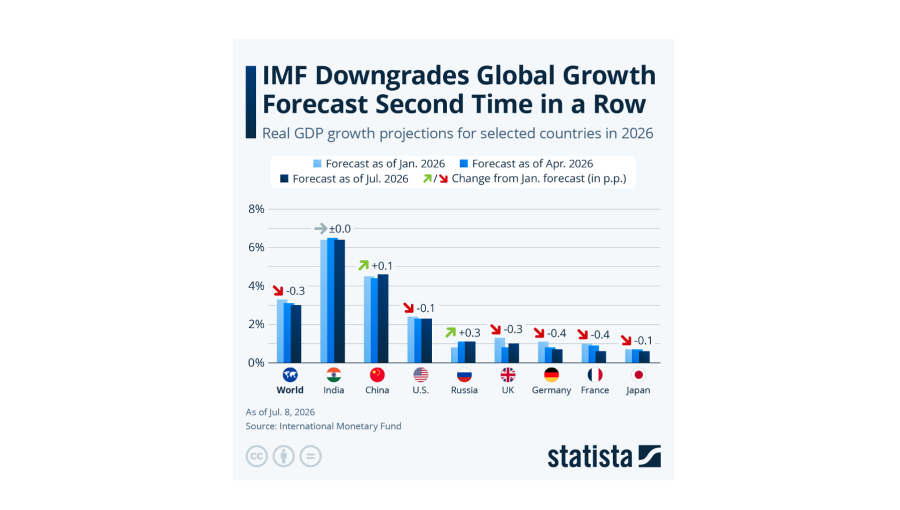
The IMF downgraded global growth prospects for the second time this year, saying it expects the global economy to grow by just 3 percent in 2026. In January, this projection had still stood at 3.3 percent, Statista reports.

While the downgrade is slight, it still conveys the multiple risks to the global economy currently present. As shocks from the Iran war persist, driving up the price of energy and other traded goods, disinflation has stalled and financial markets continue to be at risk of negative reactions. The IMF saw a positive aspect in the global AI boom, creating an increase in demand for related technologies.

Two countries upgraded since the last forecast were China and the UK, the latter one on a very low level, however. Other countries where economic growth is paper-thin and decreasing are France, Germany and Japan. All three are expected to grow by only 0.6–0.7 percent each this year. This number was as low as 0.9 percent for the Euro Area and 1.1 percent for Canada, giving rise to some doubts around the economic prospects of developed countries in general. The IMF meanwhile said the global economy weathered the current shocks "better than feared".

The organization also said that global first-quarter growth in 2026 turned out better than expected at an annualized 3.0 percent quarter-over-quarter, slightly above forecast. According to the IMF, the rise in renewable energy use was making economies less vulnerable to elevated energy prices which are currently an issue. The AI boom also helped some countries and territories to achieve better economic growth numbers, but this was mostly limited to Taiwan, South Korea, Thailand and Malaysia. China could also grow more than expected on the back of public investments and a high-tech manufacturing surge. Much of the rest of the world, however, pretty much suffered the negative effects of the current crisis without many upsides.

The IMF concludes that risks to the world economy were more balanced than in April, but still pointed in a negative direction as both peace in the Middle East and gains from the AI boom remain fragile. It also cautions that trade tensions could resurface as a result of war-induced shortages, which would put an additional damper on the economy.

 You will find more infographics at Statista


Brazil fears US military intervention after cartel terrorist listing

Brazil fears US military intervention after cartel terrorist listing
"Designating criminal organisations as terrorists will not bring benefits," Foreign Minister Mauro Vieira said, adding that the US decision "poses concrete risks to national sovereignty." / agencia brasil
By bnl Sao Paulo bureau July 8, 2026

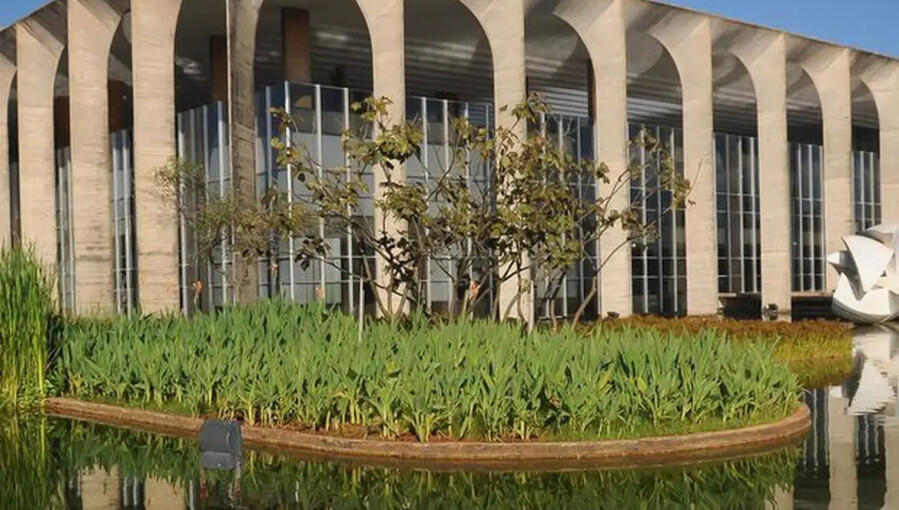
Brazil's government has warned lawmakers that the US’ decision to designate the criminal factions Comando Vermelho (CV) and Primeiro Comando da Capital (PCC) as terrorist organisations could open the door to US military action on Brazilian soil.

The assessment was published by the Foreign Ministry – known as Itamaraty – after Congressman Evair Vieira de Melo formally requested information on the matter.

"There is a possibility of the use of military force by the US on Brazilian territory," Foreign Minister Mauro Vieira wrote on July 1 in a parliamentary missive, adding that the designation "will not bring concrete benefits to international cooperation" and could carry "significant impacts both economically and on national sovereignty."

"Such application can occur with a wide degree of discretion, given the breadth of the terms adopted in that country's counterterrorism legislation, with serious possibilities of implications for Brazilian citizens in the financial, immigration and criminal spheres," Vieira wrote.

In another passage, Vieira reiterated that the unilateral classification "could be invoked as justification for extraterritorial actions against Brazilian institutions" and that "furthermore, there is a risk of the use of US military force against the national territory."

O Globo reported that the measure could affect Brazilian individuals, companies or organisations even where their ties to the designated factions are indirect or involuntary.

The Trump administration classified PCC and CV as Specially Designated Global Terrorists and Foreign Terrorist Organisations, effective June 5, a decision announced by Secretary of State Marco Rubio roughly a month ago.

According to Poder360, Itamaraty said Brazil received no official communication from Washington before the classification took effect, though the government has since registered its opposition.

The move came days after Senator Flávio Bolsonaro, a supporter of the designation and the likely right-wing candidate in the October election, visited US President Donald Trump. President Lula da Silva has accused Bolsonaro of stoking tensions with Washington, including over a tariff row that could see fresh levies imposed next week.

Since taking office in January 2025, Trump has taken a more active role in Latin America, threatening to seize control of the Panama Canal, launch land strikes in Mexico against cartels, and stage a “friendly takeover” of Cuba – while already imposing an oil blockade on the island. On January 3, US forces captured former Venezuelan president Nicolás Maduro in a military operation, prompting his deputy Delcy Rodríguez to take power as interim leader; she is now governing under de facto US tutelage.

On July 1, the US announced sanctions against two Brazilian nationals, three São Paulo-based companies and a Portuguese firm suspected of laundering money for PCC, which the Trump administration described as now "the largest transnational criminal organisation in the Western Hemisphere."

The dispute has sparked a flurry of diplomatic engagement. Defence Minister José Múcio will travel to Peru on July 8 to meet US Under Secretary of War Elbridge Colby on the sidelines of the Conference of Ministers of Defence of the Americas.

Before departing, Múcio is due to meet President Lula to align Brazil's position; the Presidential Palace's central concern is whether Washington intends any intervention or direct action on Brazilian territory under the pretext of combating the factions.

Lula has instructed Múcio to strike a firm tone in defence of national sovereignty while presenting the results of Brazil's own efforts against organised crime in recent years.

Brasília maintains that existing legal-assistance agreements, intelligence-sharing and police cooperation already give both countries effective tools against transnational criminal groups, making the terrorist designation unnecessary to strengthen joint action, the ministry's document said.


MEPs and environmentalists warn Albania’s Kushner-linked resort sets dangerous precedent

MEPs and environmentalists warn Albania’s Kushner-linked resort sets dangerous precedent
A luxury tourism development linked to US President Donald Trump’s son-in-law sparked the ‘Flamingo revolution’ in Albania.Facebook
By Clare Nuttall in Durres July 8, 2026

Plans for a luxury tourism development linked to US President Donald Trump’s son-in-law Jared Kushner on Albania's Adriatic coast risk becoming a precedent for large-scale construction across the country's protected coastal areas, environmental groups and European lawmakers have said, arguing the project threatens one of the Mediterranean's most important wetlands.

MEPs and campaigners say the proposed resort inside the Vjosa-Narta Protected Landscape is not simply a single investment but a test case that could pave the way for further development inside Albania's protected areas following changes to environmental legislation last year.

"What this would cause is much bigger than a single project because it's a gate-opener project," Joni Vorpsi of Albanian conservation group PPNEA told a webinar on July 6.

"It is the first one, and it will be followed by others that are already published or planned inside the same area. The name of Jared Kushner is being used to open the gate to transforming the most important protected coastal wetland we have in Albania into a new city."

Kushner announced plans in 2024 to develop a luxury resort on the Albanian coast through his investment firm, Affinity Partners. The project has become one of the country's most controversial developments, with critics arguing it threatens a protected ecosystem while supporters say it will attract investment and boost tourism.

Construction activity has already begun in parts of the site,  before the completion of environmental procedures. Vorpsi said heavy machinery entered the protected area in early May "without any public consultation, without any discussion about the environmental impact assessment”. 

"The first thing we noticed was that it entered during the breeding season of the sea turtles. Bulldozers were going over the dunes and flattening them," he said.

"In one of the most important sites for sea turtles in Albania, at the beginning of the breeding season, we had bulldozers running over the dunes."

He said campaigners later observed forest clearance and drainage works behind newly erected fencing, making it increasingly difficult to monitor activity inside the site.

According to PPNEA, the proposed development would extend across about six kilometres of coastline and include around 10,000 rooms, many of them residential properties.

"It is the size of a new city," Vorpsi said. "The project is made attractive through the renderings published on the government's website and on Jared Kushner's pages, but what hides behind those pictures are 10 to 15 years of construction work inside the most important coastal wetland Albania has.

"This means hundreds of trucks, bulldozers and workers inside this fragile ecosystem. We are wiping out nature to develop the coastline."

The dispute has rapidly evolved from an environmental campaign into a broader protest movement, with demonstrators raising concerns about transparency, corruption and the rule of law.

"What started with people asking for transparency and stopping the project has grown into a new phase where people want more accountability, more transparency," Vorpsi said.

"Different groups have joined to bring their own cases and talk about other social issues that are not going right in Albania."

He said the movement had emerged after campaigners felt official concerns about the environmental impact were being ignored.

"What we were facing was the complete disregard for our data," he said. "Experts spent hours in the field monitoring this internationally important site."

Initially, environmental groups struggled to attract public attention, but awareness spread, demonstrations grew larger.

"There was a big interest. People were completely against this. Then what you all know happened. Local people protested against the fences and there were acts of violence."

He said the movement subsequently expanded beyond organised environmental groups. "People were no longer waiting for any coordination. A peaceful revolution started."

European lawmakers say the dispute highlights broader concerns about governance as Albania seeks membership of the European Union.

Jutta Paulus, a German member of the European Parliament, said Albania had previously adopted strong environmental legislation in preparation for EU accession but that amendments approved in recent years had weakened protections.

"They used to have very good environmental protection laws," she said. "But two years ago a number of amendments were made. The governing majority imposed changes excluding five-star luxury resorts, allowing them to build in protected natural areas without paying compensation and giving them access to land that previously could not be developed."


Paulus said the Vjosa-Narta Protected Landscape was among Albania's most valuable natural areas, combining internationally important wetlands with a largely undeveloped stretch of Mediterranean coastline.

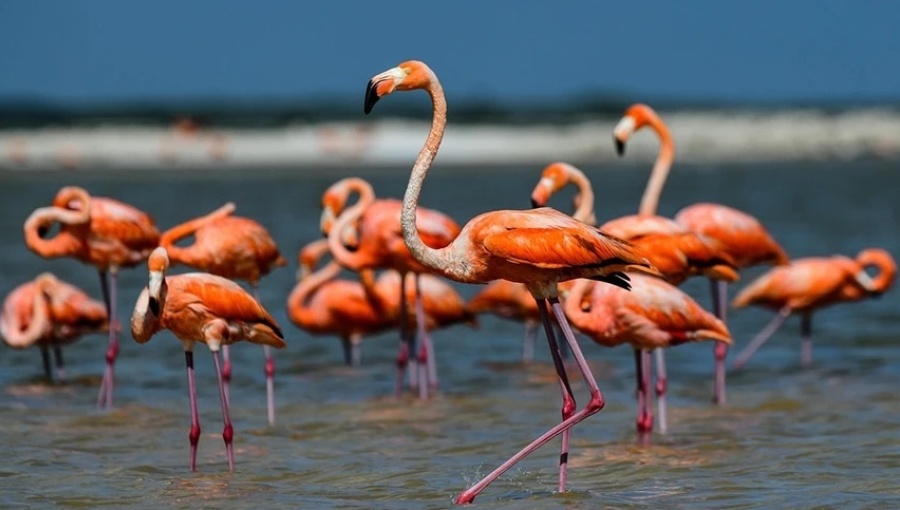
"It is a beautiful region on the coast," she said. "There are flamingos, pelicans, loggerhead turtles and Mediterranean monk seals that give birth there. It is one of Albania's natural crown jewels."

She said residents had become increasingly alarmed after fencing was erected around parts of the site. "They started putting up fences to enable construction and locked out people living in the surrounding areas," she said. "Shepherds could no longer take their animals there, for example, and people started to protest."

Paulus said tensions escalated after private security guards were deployed. "Private security was called in and took action, while the police just stood there and watched. That escalated the situation."

She argued that the dispute reflected a wider debate over Albania's future development model. "Albania has beautiful natural resources which are in stark contrast to much of the rest of the European Union because they are still untouched," she said. "It is not necessary to restore nature. It is about preserving it — clean water, good soil, clean air. Everything needs to be protected because Albania still has a lot of it … It would be more than a great shame if this were lost because of short-term financial interests."

Environmental groups argue that Vjosa-Narta deserves protection not only under Albanian law but because of its international ecological significance.

The protected landscape encompasses the delta of the Vjosa River, widely described as Europe's last major wild river, which flows into what campaigners say is the Mediterranean's most intact river delta.

"This site is a mosaic of habitats," Vorpsi said. "A recent study shows it is the most intact delta in the Mediterranean, leaving a lot of space for wildlife to flourish. It is an exceptional area."

Because of its ecological importance, he said, the site is recognised internationally as an Important Bird Area, a Key Biodiversity Area and a candidate Emerald Network site, with the expectation that it will eventually become part of the EU's Natura 2000 network once Albania joins the bloc.

The wetlands are one of the Adriatic flyway's most important stopping points for migratory birds. The wetlands also support breeding flamingos, while the lagoon, coastal dunes, marshes and centuries-old pine forests create a rare combination of habitats.

Campaigners reject accusations that they oppose economic development. "What we are facing is being portrayed as people who are against development," Vorpsi said. "But what we are really talking about is the rule of law, protecting protected areas and protecting ecosystems that are already recognised as nationally and internationally important."

He said recent legal changes allowing development inside protected areas had created concern among conservationists that further industrial and tourism projects could follow.

"Recently we have been finding information suggesting that industrial sites are also being planned inside protected areas," he said. "So this is about much more than one resort."

The dispute has also drawn attention in Brussels, where some members of the European Parliament argue the issue should form part of Albania's EU accession negotiations.

Daniel Freund, a German MEP, said Albania could not expect to move towards membership while weakening environmental protections.

"If a country wants to join the European Union, it has to abide by the rule of law, fight corruption and protect nature," he said. "If Albania does not do that because its government does not do that, then accession is under threat."

Freund said concerns extended beyond environmental protection to transparency surrounding the investment. "Today it is difficult to know who is behind these projects and who is paying for them," he said. "There are very complicated company structures, companies owning other companies, and all of this is used to hide who is actually behind it. That contributes to a high level of frustration."

He added that many Albanians believed wealth and political influence had allowed normal procedures to be bypassed. "If you have enough money and political support, suddenly all the laws, the rule of law and the usual procedures can be undermined," he said.

Campaigners say the protests have already achieved one important objective by drawing international attention to the issue.

"The first victory is that everybody now knows Albania is about to destroy the most important coastal wetland it has," Vorpsi said.

"The second is that the Albanian people are giving an example and are actually showing the way to Europe. The government has obligations to align with the EU environmental acquis, but it is not doing so. The people of Albania are asking for those obligations to be respected."


Albanian PM defends €4mn state support for Kanye West concert

Albanian PM defends €4mn state support for Kanye West concert
Prime Minister Edi Rama and Tourism, Culture and Sports Minister Blendi Gonxhja inspected final preparations for the concert on July 7. / Blendi Gonxhja via FacebookFacebook
By Clare Nuttall in Durres July 8, 2026

Albania’s government has defended its decision to provide financial support for a Kanye West concert in Tirana, saying the event will boost tourism, attract international attention and create long-term opportunities for the country’s events industry, despite criticism over the cost and controversy surrounding the US rapper.

West, who now performs under the name Ye, has faced cancellations and restrictions in several countries because of his antisemitic statements. The rapper has previously apologised for some remarks and attributed some of his behaviour to mental health struggles.

Albanian officials have focused on the economic and promotional benefits of the concert, saying the event will bring tens of thousands of visitors and help strengthen the country’s position on the international tourism map.

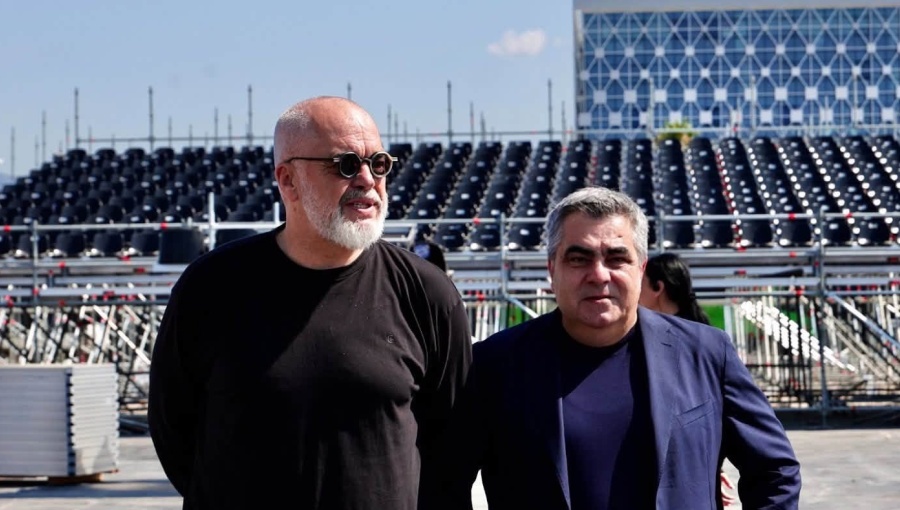
Prime Minister Edi Rama and Tourism, Culture and Sports Minister Blendi Gonxhja inspected final preparations on July 7 for the July 11 concert, with authorities saying thousands of workers are racing to complete a temporary stadium infrastructure expected to host visitors from around the world. 

The Albanian government has allocated around €4mn in support for the event, a decision that has drawn criticism from opposition figures and civil society groups who questioned whether public funds should be used for a private concert.

Rama said the state intervention was necessary to ensure the event could proceed after thousands of ticket holders from around 80 countries had already made plans to attend.

"The Albanian state was forced to intervene only yesterday to give not tens of millions of euros as the crows and ravens of the boulevard say, but €4mn,” Rama said, according to a government statement.

He argued that international events could generate wider economic benefits, comparing the concert with the 2022 UEFA Conference League final held in Tirana, which he said had delivered a major boost for tourism.

"€4mn at the last minute, not to embarrass Albania, in the eyes of nearly 25,000 foreigners from 80 countries whose citizens have bought tickets for Kanye West on time, while many others are scared of the concert being canceled; not to miss a fantastic opportunity to promote Tourist Albania, for one of the largest communities in the world, music lovers," Rama wrote on Facebook. 

Rama said reservations on booking platforms had increased sharply for the concert weekend and estimated the economic impact could reach €100mn.

The government has faced criticism and accusations of hypocricy over hosting West, who has attracted international condemnation for antisemitic comments and public controversies in recent years.

The concert takes place after weeks of anti-government protests sparked by a planned development within a protected area of the Albanian coast by developers linked to US President Donald Trump's son-in-law Jared Kushner. 

The Albanian Jewish Community previously warned that giving the rapper a public platform risked normalising rhetoric targeting Jewish people, while opposition lawmakers called for the event to be cancelled.

Gonxhja defended the decision, describing the concert as a major opportunity for Albania’s international profile.

"Even the Germans who know us better, were surprised," Gonxhja said, referring to foreign technical teams involved in preparations. "European groups from England, France, and the Netherlands are all surprised by the conditions and the Albanian ambition with 65,000 square metres, an improvised stadium."

He said the project involved around 3,500 workers and required round-the-clock operations because of its technical complexity.

"Here we are not working for an event, here we are working to have a reputation that if we succeed with all the elements and we believe we will succeed in being where we need to be in this organisation, it will be something that will exist for 10 years," Gonxhja said.

Authorities said the temporary venue and associated infrastructure represented one of the most ambitious entertainment projects undertaken in Albania. The government hopes successful delivery will help position Tirana as a destination for future international concerts and large-scale events.

Critics, however, have argued that the money could have been directed towards social priorities. Civic Centre executive director Rigels Xhemollari said the funds could instead have supported youth and cultural programmes.

“€4.23mn in one day … for Kanye West. No money for electric buses! There is no money for medicine! There is money for the show!” he wrote on Facebook.

“With this much money cultural and educational summer camps could have been organised for 15,000 children for 30 days, while you spent them on one spectacular day!”


Iran negotiator Ghalibaf accuses US of major memorandum violations

Iran negotiator Ghalibaf accuses US of major memorandum violations
Iran negotiator Ghalibaf accuses US of major memorandum violations. / bne IntelliNewsFacebook
By bnm Gulf bureau July 8, 2026

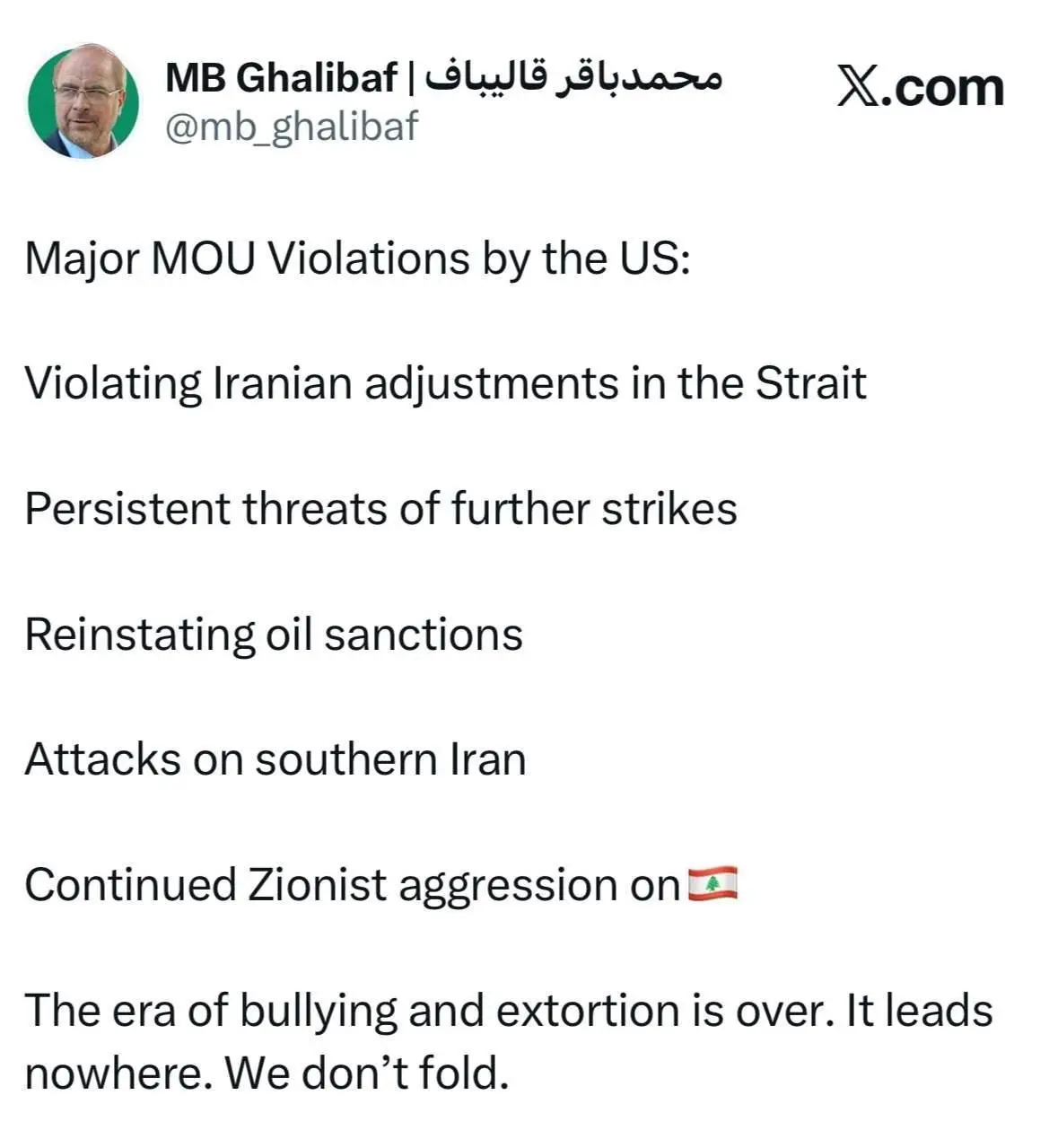
Iran's chief negotiator, Mohammad Bagher Ghalibaf, accused the United States of major violations of the memorandum of understanding between the two countries in a post on X on July 8.

His comments come as the US military continues to strike Iran's southern areas of Bandar Abbas and Sirik, according to Iranian reports late on July 8.

The statement points to the unravelling of an accord signed last month to extend a ceasefire, coming as Tehran and Washington traded strikes and the US revoked a waiver allowing sales of Iranian oil.

Ghalibaf listed what he described as US breaches, including violating Iranian adjustments in the Strait of Hormuz, persistent threats of further strikes, the reinstatement of oil sanctions, and attacks on southern Iran.

The Iranian official also cited what he called continued Israeli aggression against Lebanon following more than 24 hours of exchanges between IRGC forces and US military across the region.

"The era of bullying and extortion is over. It leads nowhere. We don't fold," Ghalibaf wrote.

The comments followed US Central Command's announcement of strikes on Iran in response to attacks on three commercial ships in the Strait of Hormuz, and the US Treasury's cancellation of a licence that had allowed Iran to sell crude.

US President Donald Trump said the ceasefire was over, telling reporters at the Nato summit in Ankara that as far as he was concerned it had ended.


Trump again attacks Spain: calls it a 'lost cause' and urges cutting trade

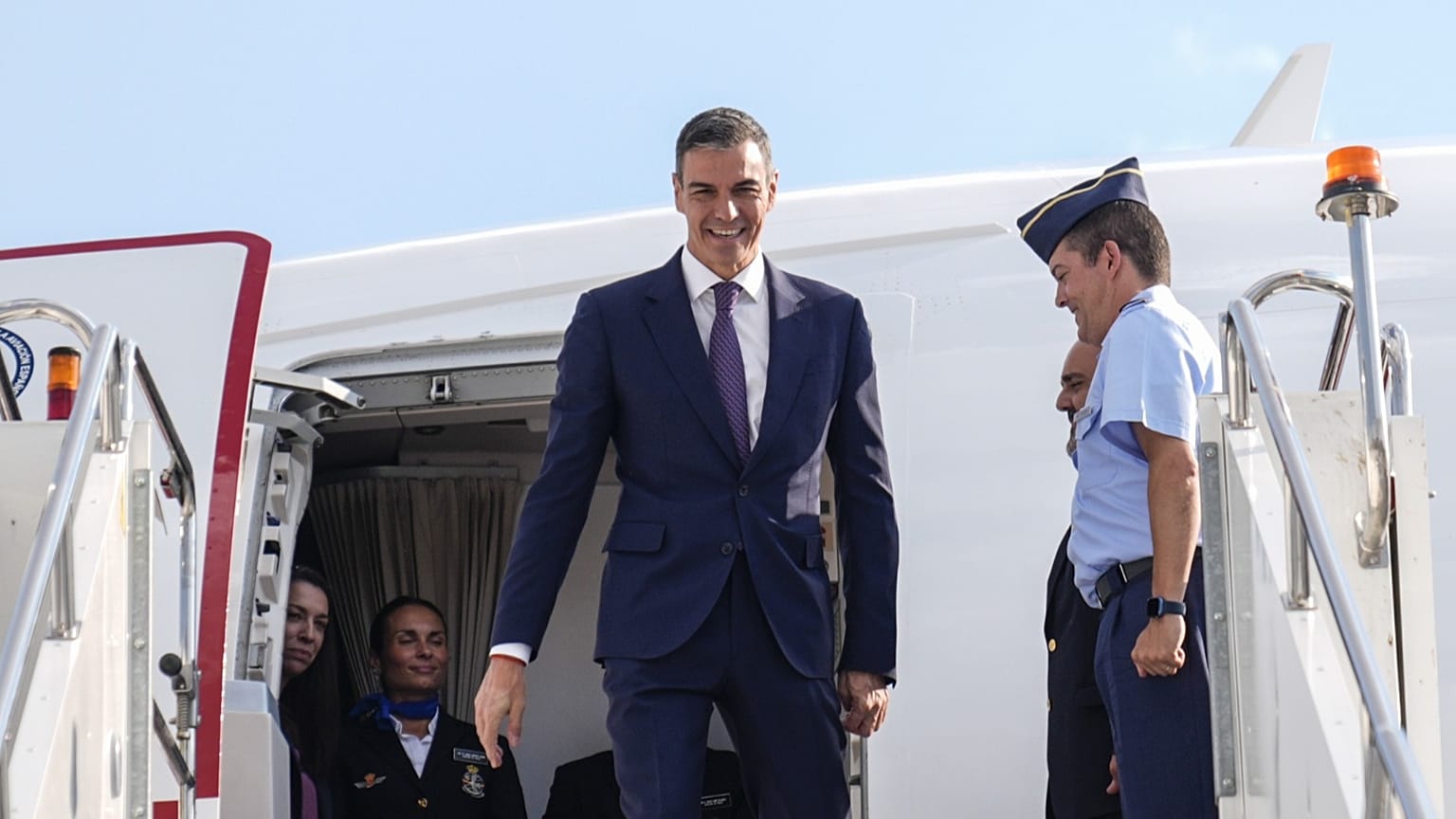
Spanish prime minister Pedro Sánchez arrives at the NATO summit in Ankara, Turkey, on Tuesday 7 July 2026. (Osmancan Gürdoğan, file photo via AP)
Copyright AP Photo

By Christina Thykjaer & Sergio Garcia
Published on

The US president had already threatened in March to take economic reprisals against Spain after Moncloa blocked the use of the Rota and Morón bases for Washington’s bombing campaign against Iran.

Donald Trump has once again turned up the heat on Spain, as he arrived for the NATO summit in Ankara. The US president said on Wednesday that he had instructed Treasury Secretary Scott Bessent to "cut off all trade" with Spain, which he described as a "terrible" partner within the Atlantic Alliance.

"Spain is a wasted cause. We don't want to do any trade business with Spain anymore," Trump said.

The remarks came during a joint appearance before the press with NATO Secretary General Mark Rutte. Trump once again took aim at Pedro Sánchez’s government over its refusal to raise defence spending to 5% of GDP, a demand Washington has been making of its European allies in recent months.

Spanish government "calm"

From the Moncloa palace, sources close to the prime minister insist they were prepared for this scenario and say they are taking the tycoon’s snubs with relative "calm". The government had put together a solid set of talking points, and Pedro Sánchez travelled to Ankara with a raft of data to respond to Donald Trump’s attacks.

Despite US demands, Spain points out that it has already reached 2% of GDP in defence spending, that it now ranks seventh among NATO’s 32 members, and that NATO’s own technical projections suggest spending 2.1% will be enough for it to meet its commitments.