Wednesday, July 08, 2026


'Defining image of the era of American history': July 4 Patriot Front photo goes viral

Members of the group Patriot Front wear masks as they march through Washington before Independence Day events - 4 July 2026
Copyright Mark Sherman via AP

By David Mouriquand
Published on

The Fourth of July, marking the 250th anniversary of the founding of the United States, left behind a disturbing photograph depicting a young Black woman in a Washington Metro carriage, surrounded by masked white supremacists. Many have called for the Reuters photo to receive the Pulitzer Prize.

A Reuters photograph taken during this weekend’s 250th Independence Day celebrations in the US has become one of the most viral and discussed images on social media this ye

The image, taken by Cheney Orr on 4 July, depicts a Black woman sitting quietly inside a Washington Metro train. She is surrounded by dozens of masked members of the white nationalist group Patriot Front, who were on their way to a march in downtown Washington D.C.

The image is captioned: "A commuter sits as members of the group Patriot Front ride the metro on the 250th anniversary of U.S. independence in Washington, D.C., July 4, 2026."

Further images were taken of the racist group marching through Capitol Hill with upside down American flags and Confederate banners. They also wore caps bearing 13 stars – representing the original 13 colonies that approved the Declaration of Independence on 4 July 1776.

However, Orr’s photo is the one that has been described as the "defining image of the era of American history we live in".

The post above has been widely shared and gone viral, prompting thousands of reactions.

Countless comments have described it as an eerily powerful representation of the racial tensions and political divisions under Donald Trump, while some users have compared Orr’s chilling image to Rosa Parks - the civil rights figure who refused to move from her seat on a bus in Montgomery, Alabama, in defiance of Jim Crow racial segregation laws in 1955.

“Anyone else get flashbacks to the image of Rosa Parks on that bus?”

Several social media users have called for the photo to receive the Pulitzer Prize, while many highlighted the discrepancy between celebrating the “Greatest Country on Earth” and how little things have evolved over time – and how the US has regressed.

Check out some of the comments below:

“The image is striking because it reveals a simple truth: those who promote intimidation hide behind masks, while ordinary citizens have no reason to. Patriotism is not measured by the size of the flag someone carries or the volume of the slogans they chant. It is measured by whether a person defends the founding promise that all people are created equal. The true test of patriotism is not silence in the face of hatred. It is the courage to stand against it.”

“Different decade. Different faces. Same message: Black existence is still treated by some as something to monitor, intimidate, or control. America celebrates 250 years of liberty. Black Americans have spent much of those 250 years fighting to make those words apply to us too. Different time. Same struggle.”

Claims that the image was staged or AI-generated are unsubstantiated.

The white supremacist militia Patriot Front is based in Texas. It emerged in 2017 and says it is loyal to the “American nation”.

The Center for the Study of Extremism at George Washington University describes it as “a white nationalist and fascist organization that promotes the idea of a homogenous, white ethnostate in the United States. The group advocates for the preservation of white European culture, viewing multiculturalism, immigration, and diversity as existential threats to its vision of America.”


 

Infertility to affect 80 million women by 2036 with sharpest rise in over-35s, study finds


By Marta Iraola Iribarren
Published on

A new study projects infertility among women will reach nearly 80 million cases in the next decade globally —an almost 1,5-fold increase compared to 2023— driven largely by delayed motherhood.

Infertility has been rising over the last few years, especially among women aged 35 to 49 years, according to new research published in The Lancet.

Cases of infertility among women in this age group will approach 80 million by 2036 — a sharp rise from around 53.60 million in 2023 — with the sharpest increase expected among women aged 35–39.

The authors note this is mainly driven by age-related declines in eggs’ reserve and their ability to fertilise, which reduce fecundity, increase miscarriage risk, and lower the success rates of assisted reproductive technologies.

“As population ageing and socioeconomic transitions accelerate, the number of women exposed to advanced-age infertility risk is rising, expanding its public health relevance,” the authors wrote.

Analysing data from the Global Burden of Disease 2023 study, which covered 204 countries and regions from 1990 to 2023, Chinese researchers found that infertility has risen the most in more developed countries.

Why are cases rising

In many middle‑income and rapidly developing countries, infertility is becoming more common because several social and demographic changes are happening at the same time.

People are marrying and trying to have children later; more women in their late 30s and 40s still want to become pregnant; and greater awareness of fertility problems means more couples are seeking help.

Yet in many of these settings, fertility tests and treatments remain expensive, limited, or hard to reach, meaning demand for care is rising much faster than access.

However, according to Rocío Núñez Calonge, biologist and fertility expert who did not participate in the study, the rise in infertility among older women cannot be addressed solely by expanding the range of assisted reproductive therapy options.

“In countries such as Spain, it is also necessary to address the social factors that contribute to delayed motherhood, particularly those relating to work-life balance, economic stability and institutional support for early motherhood,” she said.

Infertility is not a women-only problem. It is estimated that around one in six people globally will suffer from it at some point in their lives, and between 8–12% of reproductive-aged couples worldwide will experience it.


'The next pandemic is not a matter of if, but when,' Oxford professor says


By Symela Touchtidou
Published on

The Oxford professor who developed the first highly effective malaria vaccine explains what Covid taught us, why misinformation is still a threat and why Europe must invest more in public health

Epidemics are not a thing of the past. On the contrary, they will continue to emerge and the next major pandemic is only a matter of time, says Adrian Hill, one of the world’s leading vaccine scientists and winner of the 2026 European Inventor Award in the category “Research”.

Speaking to Euronews, the British Oxford University professor argues that the world is better prepared today than it was before the Covid-19 pandemic, without, however, downplaying the challenges that lie ahead.

Epidemics will continue. They happen frequently. Some of them we never even hear about, because they are contained very quickly thanks to public health measures. But roughly once every decade, one emerges that turns out to be far more serious. Covid is, of course, the most striking example.
 Andrian Hill 
Professor at the University of Oxford and co-founder of the Jenner Institute

What Covid taught us

The British Oxford University professor is co-founder of the Jenner Institute. The Jenner Institute is one of the world’s leading vaccine research centres. It is part of the University of Oxford and is dedicated to the research and development of new vaccines for infectious diseases such as malaria, Ebola, tuberculosis and COVID-19.

According to Hill, the pandemic’s greatest legacy was that it proved the scientific community can develop a new vaccine in a timeframe that, until a few years ago, would have been considered unth

“What did we learn from Covid? That we can develop a vaccine within a year. Until then, we didn’t know that. Even leading experts believed it would take several years,” he said.

Hill believes that the infrastructure built in recent years now allows countries to detect new pathogens more quickly, develop vaccines and rapidly organise clinical trials, significantly strengthening global readiness for new health crises.

“Education is the answer to disinformation”

Despite the mistrust that grew around vaccines after the coronavirus pandemic, Hill is optimistic that public confidence is gradually being restored.

“There was a lot of disinformation. The remedy for disinformation, in a single word, is education," he said, hopeful that most people now understand that vaccines "played a pivotal role in tackling the pandemic.”

The vaccine that changed the course of malaria

Hill was honoured this year with the European Inventor Award for developing the R21/Matrix-M vaccine, the first highly effective malaria vaccine.

This breakthrough came after more than three decades of research in a field where more than a hundred previous attempts had failed.

“When I started working on malaria vaccines, every attempt had failed,” he recalls. “But we gradually learned to understand the parasite itself better and to choose the right target from about 5,000 genes. Through extensive trial, error and perseverance, we arrived at a vaccine that today has an efficacy of around 80%.”

According to the World Health Organization, in 2024 there were about 282 million malaria cases and 610,000 malaria deaths across 80 countries.

Children under the age of five accounted for roughly 75% of all malaria deaths in the WHO African Region. Traditional malaria vaccines were not very effective, especially in children, because of the parasite’s genetic diversity.

Hill and his team developed a vaccine containing more of the malaria-specific protein regions that the immune system needs to recognise in order to mount an effective response, while omitting unnecessary components that could divert the immune reaction

After decades of research, their work has evolved from a laboratory innovation into a scalable public-health intervention in a growing number of African countries, with the WHO officially recommending it for broad use in October 2023.

Why malaria matters to Europe as well

Although malaria mainly affects African countries, Hill insists that Europeans cannot treat such diseases as “someone else’s problem”.

As he points out, in a globalised world epidemics and health crises quickly spill over national borders, while investing in the health of poorer countries ultimately means investing in everyone’s security.


European Parliament to ask for probe into FIFA boss Infantino over Balogun red card


By Vincenzo Genovese
Published on

A letter circulating in the European Parliament calls for an investigation into whether pressure from the US administration influenced FIFA's decision to reverse American striker Folarin Balogun's red card suspension. Belgium went on to rout Team USA 4-1 in a resounding victory.

The European Parliament has entered the row over US President Donald Trump's pressure on FIFA to reverse the red-card suspension of striker Folarin Balogun, who played in the World Cup round-of-16 match that the United States lost 4-1 to Belgium.

A group of MEPs launched an initiative on Tuesday calling for an investigation into the role of FIFA President Gianni Infantino to determine whether pressure from the US administration influenced the decision.

The letter, seen by Euronews, is addressed to the 27 football associations of the European Union, urging them to take formal action with FIFA by requesting an investigation into the decision-making process behind the reversal of Balogun's suspension.

"We feel that it is time for European Football Associations, all of whom are member associations of FIFA, to intervene and ask that FIFA investigate the [Balogun's case] decision-making processes," the text reads.

"Once again, we've seen Infantino and FIFA surrender to the demands of the Trump administration," MEP Barry Andrews, one of the promoters of the letter, told Euronews, calling FIFA's decision "a disgrace and a perversion of justice".

Balogun received a disputed red card in the Team USA game against Bosnia and Herzegovina last week and should have been suspended against Belgium in a win-or-home game, as a red card automatically carries a one-match suspension.

Trump later acknowledged calling Infantino over Balogun's red card, which he described as unfair, but said he did not ask for anything in return. FIFA subsequently suspended the implementation of the ban through a controversial legal loophole that has never before been used at a World Cup since the introduction of red cards.

Trump later thanked Infantino for "reversing a great injustice". Infantino said he told the US president during the call that FIFA's disciplinary body was independent.

The decision sparked outrage across Europe.

UEFA, European football's governing body, described it as "unprecedented, incomprehensible and unjustifiable", while the Belgian Football Federation has launched a formal challenge against Balogun's eligibility.

European Commissioner Glenn Micallef, whose portfolio includes sport, also called the reversal the "wrong decision".

"It's completely against the rules and the status of FIFA [...] and it is quite a scandal," William Gaillard, former Director of Communications and Public Affairs for UEFA, told Euronews' flagship show Europe Today on Tuesday.

The Parliament's letter was initiated by MEPs Barry Andrews (Renew Europe), Lara Wolters and Niels Fuglsang (Socialists and Democrats), and is currently circulating among lawmakers to gather signatures ahead of a deadline of 6pm CET on Wednesday.

The signatories ask the football associations to ensure that "senior FIFA officials be held accountable if evidence exists to suggest they are breaching rules on political neutrality".

They also recall another letter, signed by 50 MEPs and sent to FIFA, calling for an investigation into the awarding of the FIFA Peace Prize to President Trump.

'The Trump Curse': Is Donald Trump a bad omen for sports teams?

'The Trump Curse': Is Donald Trump a bad omen for sports teams?
Copyright AP Photo - Canva


By David Mouriquand
Published on


Following the elimination of the US at the World Cup, social media went into a frenzy with claims of a “Trump curse”. There seems to be prior form, as fans are citing other losses linked to Trump’s team endorsements or even his presence at games.

A jinx. A hex. A malediction. The kiss of death.

Call it what you will, but following the US’ humiliating defeat against Belgium at this year’s World Cup – a match overshadowed by the tournament’s biggest scandal yet – the term “Trump curse” began trending online.

Sports fans have blamed Trump for getting involved, saying that he had cursed the US team after boasting about calling FIFA president Gianni Infantino to get American striker Folarin Balogun’s red card overturned.

Critics accused Trump and FIFA of corruption, with the European Commission demanding “fairness and transparency” after the controversial red card SNAFU. A letter even started circulating in the European Parliament calling for an investigation into whether pressure from Trump influenced FIFA’s decision to ditch the suspension.

Regardless, Trump's interference didn't help. In fact, it made things worse, turning football fans the world over against the US team – who hadn’t asked for this - and getting them to cheer when Belgium knocked the host nation out of the World Cup.

"At this point, a Trump endorsement is starting to look less like support and more like a curse,” said one social media user, while another wrote: "Trump stuck his nose in where it didn't belong. It made the world hate us even more than they already do, and emboldened Belgium. I wish the US had won and I have to wonder if we would have, if Trump had not interfered. ETTD: Everything Trump touches dies."

Another wrote: "4 to 1 Belgium, and Trump cheating on Team USA's behalf ends up meaningless because his curse always takes over."

Overreaction? Not when you look at the evidence.

The snag for Trump, who clearly needs to get an exorcism booked, is that there’s a precedent for his reverse Midas Touch, as he has seemingly cursed sports teams before.

"He cursed the Knicks in Game 3 and now this. The Trump Curse is real," wrote one X user.

Indeed, Trump most recently attended the New York Knick’s Game 3 in the NBA finals, which was their only defeat of the series.

Knicks fans accused Trump of placing a "curse" on the team, leading some to “cleanse” Madison Square Garden with sage – a practice known as “smudging”, by which sacred herbs are burned to drive out negative energy and promote healing.

It seemed to work, as the Knicks went on to win the series in five games.

Adding credence to the Trump curse theory is last year’s NFL game, which saw the Washington Commanders face off against the Detroit Lions. The Lions ended up winning, to the sounds of boos aimed at Trump, who was in attendance.

Then Trump attended the first day of the 2025 Ryder Cup on Long Island, New York. The US golfers were down 3-1 to Europe. Trump told reporters: “We're going to get it done. One way or another, we'll get it done."

The US finsished the day down 5 ½ to 2 ½, and Europe ended up winning the competition 15-13.

Still not convinced?

In February 2025, Trump openly supported a team during Super Bowl LIX by predicting the Chiefs would beat the Eagles. Can you guess what happened next? The Eagles won 40-22.

So, is Trump a bad omen for sports teams?

Football fans seem to think so, believing that if Trump hadn’t got involved and wasn’t so keen to make everything about himself in a bid to share the glory, then the US team might have beaten Belgium. And while you can’t win all the time, the evidence mounts up.

Our advice? Since Trump isn't staying out of sports, see the silver lining and embrace the following cheat code: Whichever team Trump backs, bet the other way. It seems to be working so far.


Estonia and Ukraine sign drone pact to deepen defence industry ties 

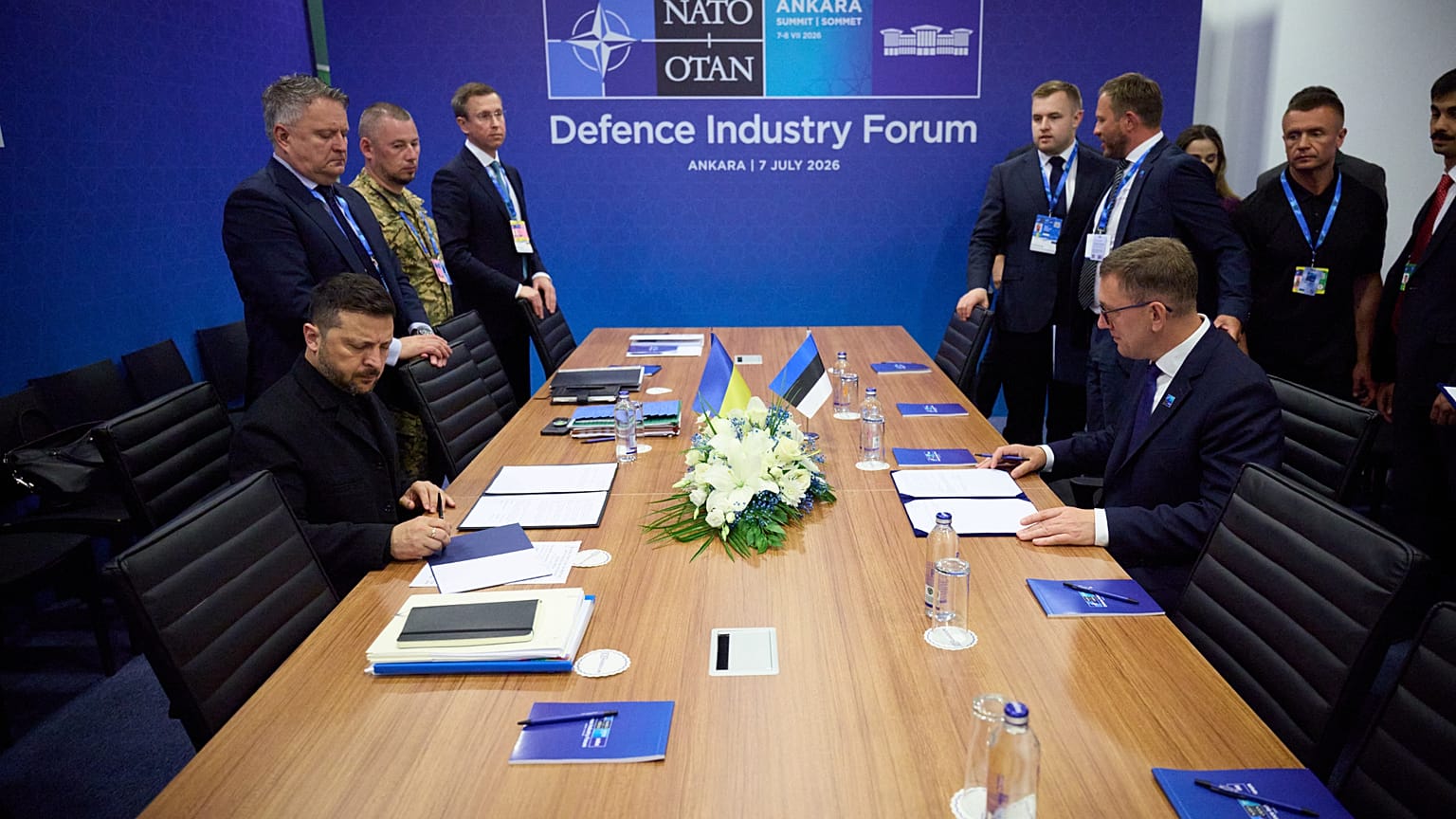
The agreement will deepen cooperation between the Estonian and Ukrainian defence industry.
Copyright Press Service Of The President Of Ukraine / YPV.2026

By Giedre Peseckyte
Published on

'Ukraine has developed one of the most competitive defence industries in the world' through its experience fighting Russia's full-scale invasion, Michal said.

Estonian Prime Minister Kristen Michal and Ukrainian President Volodymyr Zelenskyy have signed a new agreement aimed at expanding collaboration on drones, military technology and the defence industry, as European allies seek to draw more closely on Kyiv’s battlefield experience.

The agreement, signed on Tuesday on the sidelines of the NATO summit in Ankara, will deepen cooperation between the Estonian and Ukrainian defence industries, including the exchange of expertise in drone technology, cybersecurity, information technology and military innovation.

“Ukraine has developed one of the most competitive defence industries in the world” through its experience fighting Russia's invasion, Michal said, arguing that closer cooperation “will benefit our defence capability, the defence industry and Ukraine.”

Defence products have “so far been subject to very strict export restrictions,” Michal said in a press release. Under the agreement, Ukraine “is ready” to export defence products to Estonia, a Baltic country of 1.3 million, while Estonia could procure Ukrainian-developed capabilities or work with Ukrainian companies on jointly produced systems tailored to the needs of the Estonian Defence Forces.

"It is important for Estonia to create as much combat capability as possible from every euro, and if possible, we also prefer local production," he said.

The agreement would allow joint ventures to begin production in Estonia and Ukraine, with Kyiv providing the necessary export approvals for selected technologies, Estonian defence minister Hanno Pevkur added.

The agreement does not include specific financial commitments from the Estonian state, according to the government.

It comes as European countries increasingly seek closer defence-industrial cooperation with Ukraine, particularly in areas such as drones, electronic warfare and battlefield technologies, in which Ukrainian companies have gained extensive experience in the war against Russia.

Joint Fish Stock Assessment In The South China Sea: Sustaining A Good Catch – Analysis

Fish Stocks Ignore Borders — Highly migratory species like tunas, mackerels, and squids require regional cooperation. Joint stock assessments provide essential scientific data for sustainable management in the South China Sea.

Ongoing Practical Cooperation — The Common Fisheries Resource Analysis (CFRA) has completed two rounds of assessments (skipjack tuna and little tuna) with a third (squids) underway, involving scientists from China, Indonesia, Malaysia, Philippines, and Vietnam.

Low-Politics Success Model — CFRA avoids sensitive sovereignty issues, uses voluntary participation and shared methodologies, and demonstrates that science-based collaboration can build trust and prevent overfishing despite territorial disputes.


Analysis

Fish knows no boundaries. Straddling and highly migratory commercial species like tunas, billfishes, mackerels, and squids do not recognize artificial lines drawn on the sea. Hence, managing such transboundary stocks requires regional, if not international, cooperation. And one cannot manage something one cannot measure. This highlights the significance of conducting joint fish stock assessments to gauge the health, size, and factors affecting wild marine catch. Although less known, two rounds of joint fish stock assessments have already been conducted in the South China Sea (SCS), with the third underway. Hence, while the sea’s reputation as a flashpoint gets more limelight, coastal states continue to pursue practical cooperation, quietly but effectively.

Joint fish stock assessments help science, industry, and diplomacy. They provide a basis for data-driven solutions to manage commercial fisheries bounty that defies borders. They foster collaboration between marine scientists and policymakers of neighboring coastal states. This partnership can prevent a tragedy of the commons, in this case, the collapse of rich fishing grounds beyond the point of recovery. It creates a platform for non-sensitive, pragmatic, and science-based cooperation without prejudice to competing sovereign claims. Years of sustained work can gradually build trust and confidence. Along with economic impetus, it can help set the stage for bigger undertakings, such as fisheries arrangements or maritime boundary delimitation. Joint fisheries surveys are not unprecedented, with ample extant cases offering valuable references.

Precedents and success stories

The North Sea has one of the most institutionalized fisheries cooperation. Stock assessment is conducted by the International Council for the Exploration of the Sea (ICES), while management decisions are negotiated jointly by the European Union, the United Kingdom, and Norway. ICES, founded in 1902 by eight Northern European coastal countries, provides advice on sustainable catches. It now has 19 member countries, and its geographic coverage has expanded to other areas of the Northeast Atlantic. Economics is a key motivation. North Sea’s approximate annual fisheries landed value alone is $3-4billion, an industry too big to be lost to unchecked fishing.

Considered a gold standard in fisheries cooperation amid overlapping maritime claims is the one between Norway and Russia in the Barents Sea. Their Joint Fisheries Commission meets annually to determine total allowable catches (TAC) and allocate quotas for their fishermen and for those of third countries. Cooperation on fisheries research between the two sides has a long history dating back to the 1900s, becoming more organized in the 1950s and formalized through agreements reached in 1975 and 1976. The joint management prevents overfishing and ensures the sustainability of a billion-dollar annual catch of cod, haddock, and capelin. Last year alone, $2 billionworth of cod and other seafood landed in Norwegian ports. In 2010, the two countries agreed to demarcate their maritime boundaries. Even after this, the Joint Fisheries Commission continues to serve as a coordination framework for setting TACs and quotas for transboundary fisheries.

Taking cues and localizing

In contrast to long historical and formal fisheries cooperation in northern Europe, management of straddling and highly migratory fish stocks in East Asia’s waters remains fragmented. This is despite the region’s semi-enclosed seas, such as the SCS, being home to some of the most biodiverse and abundant commercial marine catches. The absence of bodies like ICES led to weaker scientific coordination, a higher risk of overfishing, greater exposure to illegal, unreported, and unregulated (IUU) fishing, uncertain long-term viability of the capture fisheries industry, and heightened political tensions. Some countries have entered into fisheries agreements, but these have yet to lead to regular joint scientific work and comprehensive stock surveys. For instance, China has entered into fisheries pacts with Japan (signed in 1997 and entered into force in 2000) in the East China Sea and with South Korea (signed in 2000 and took effect in 2001) in the Yellow Sea.

The fisheries accord between China and Vietnam in the Beibu Gulf, signed in 2000 and entering into force in 2004, is probably among the most advanced in the region. Unlike those reached by Beijing with Tokyo and Seoul, this deal came with a maritime boundary delimitation. The agreement established a joint fisheries committee and facilitated joint stock assessments. It capped the number of fishing vessels allowed to operate in the Common Fishery Zone and included a provision for setting allowable catch based on joint surveys.

In the Sulu-Sulawesi Seas, a subregional governance framework is evolving, promoting joint identification of transboundary fishery issues, collaborative scientific work, ecosystem-based fisheries management, data sharing, and harmonization measures. These developments, though relatively new, are promising and offer hope for future management of transboundary fisheries in choppy waters.

Defying the odds

Joint stock assessment in the SCS is done through the Common Fisheries Resource Analysis (CFRA), a groundbreaking initiative. Like the North Sea, SCS is a semi-enclosed sea bordered by multiple countries. But unlike the Mediterranean or Black Seas, there is no dedicated regional fisheries management organization (RFMO) for SCS. Coastal states surrounding the marginal sea neither have formal delimitation nor fisheries agreements, except in the Beibu Gulf between China and Vietnam. Hence, CFRA’s ability to thrive despite the lack of a sturdy anchor is commendable. As a pioneering undertaking in SCS, CFRA can lay the foundation for greater fisheries cooperation in the future. Hosting 12% of the world’s total catch estimated at $21.8 billion, the stakes are high in promoting sustainable fishing in SCS.

CFRA is a voluntary scientific partnership involving participants from China, Indonesia, Malaysia, Philippines, and Vietnam. More than 100 scientists and policymakers gathered for a series of workshops from 2018 to 2022 to develop shared evidence to inform cooperative management of the sea’s bounty. An informal SCS Fisheries Working Group was formed. A uniform methodology, the length-based spawning potential ratio (LBSPR), was adopted to assess the status of selected species.

The first CFRA result on skipjack tuna was published in a simultaneous event in Manila and Beijing in 2022. Former Philippine National Security Adviser Dr. Clarita Carlos delivered the keynote speech, where she stressed the importance of pursuing low-politics cooperation to build trust and confidence. The second round focused on the little tuna, and the findings were shared in a seminar in Qingdao in 2025. The third iteration is looking at the Mitre squid and the Indian Ocean squid. As squids are particularly sensitive to changes in water temperature, the third survey can also reveal the effects of global warming and climate change on SCS’s capture fisheries.

CFRA demonstrated the possibility and salience of continued cooperation among state-affiliated scientists and experts to provide a big-picture perspective on a specific fisheries resource that no single country can provide. Certain common standards, including a shared method for assessing a particular transboundary stock, were embraced. Its success can be attributed to several features. First, participation in the process was voluntary, and policymakers were involved. Second, territorial disputes and other sensitivities were avoided. Third, the sharing of raw data or other sensitive information was not required. In the early stages, fisheries managers, diplomats, and government officials convened to create a shared strategy. A reputable international non-government organization, the Swiss-based Centre for Humanitarian Dialogue, was a key player, serving as the secretariat and facilitator.

In sum, joint fish stock assessment in SCS is a good start worth sustaining. Collaboration among marine scientists can provide valuable advice in managing transboundary fisheries, averting a tragedy in the maritime commons. Joint capture fisheries surveys can recommend maximum catches, prohibit certain fishing practices, and suggest a common closed fishing season to allow stocks to replenish naturally. Coastal states can also cooperate to restock overfished areas. That such joint surveys are now in their third round shows that coastal states can rise above the noise and still carry on practical cooperation quietly but effectively.

As the history of the North and Barents Seas revealed, preserving the economic value from capture fisheries wealth can move states to cooperate even without delimitation or formal fisheries agreements. That said, it helps if such worthy scientific activities are spared from political or diplomatic turbulence.


About Lucio Blanco Pitlo III
Lucio Blanco Pitlo III is a Research Fellow at the Asia-Pacific Pathways to Progress Foundation. He was a lecturer at the Chinese Studies Program at the Ateneo de Manila University and the International Studies Department at the De La Salle University and contributing editor (Reviews) for the journal Asian Politics & Policy. He is also a member of the Board of Directors of the Philippine Association for Chinese Studies. He obtained his Master of Laws from Peking University and a MA International Affairs at American University in Washington D.C.
View all posts by Lucio Blanco Pitlo III →