Thursday, July 09, 2026

No Country on Earth Fully Respects Workers’ Rights, and It’s Getting Worse

Source: Systemic Disorder

Class warfare continues to be waged incessantly. And that war’s offensives continue to be more intense. In just the past year, the world’s working people have seen more attacks on the rights of free speech and assembly, more attacks on civil liberties, more arrests and imprisonments, more refusals to engage in collective bargaining with unions and more technology used to monitor, discipline and silence workers.

None of this new, but it is getting worse. The International Trade Union Confederation (ITUC) has issued its 2026 Global Rights Index report, and has been the case in past years, the annual report makes for grim reading. Once again, no country on Earth fully protects workers’ rights.

In past years, there were only nine countries that met the qualifications for the best category, “sporadic violations of rights,” defined as where “Violations against workers are not absent but do not occur on a regular basis.” That was the case for the 2023 and 2022 reports. This year? Only eight countries were found to be merely “sporadic violations of rights.” Those countries are Austria, Denmark, Germany, Iceland, Ireland, Norway, Sweden and Uruguay, with Uruguay newly promoted to this level from a year ago.

Before we dip into the details, the larger picture is alarming. And the advanced capitalist countries, you won’t be surprised to know, are no exceptions. “In Europe and the Americas, workers’ rights are suffering an alarming decline. Both regions registered their worst average country rating since the Index began in 2014, and the increasing influence of the far right is putting workers and unions at risk in countries such as Argentina and France – two out of four countries to be downgraded in 2026,” the ITUC said in its report. Nor are the reasons behind these developments a mystery. “This year’s results reinforce the ITUC’s view that we are witnessing a global erosion of democratic principles – a ‘billionaire coup against democracy’ – funded by the rich and delivered by far-right and authoritarian leaders,” the report said. “As a snapshot of the violations of workers’ rights, the 2026 Index exposes a pattern that the powerful would rather keep hidden: the systematic weakening of democracy through attacks on workers, unions and collective bargaining. From repression of strikes to the erosion of legal protections and the criminalisation of unions, these are not isolated incidents but part of a broader strategy to silence dissent and entrench inequality.”

Fully half of the world’s national governments launched attacks on the rights to free speech and assembly, and half also arrested or detained workers, the highest total yet. Workers in three-quarters of the world’s countries had their right to union organizing impeded, also a record high, and 80 percent of countries restricted the right to collectively bargain. Worse still, 87 percent of countries violated the right to strike.

For the past decade, the number of countries that exclude workers from the right to establish or join a union, that violate the right to collective bargaining, that violate the right to strike, that arbitrarily arrest and detain trade union members, and that deny or constrain freedom of speech and assembly have all risen.

The global rise of hard right governments has gone hand-in-hand with the deterioration of workers’ rights. Argentina, where President Javier Milei has carried out his promise to impose the harshest variety of austerity that he can get away with, achieved the unprecedented “accomplishment” of falling in the ratings for two consecutive years. Argentina is now classified in the ITUC survey as a 5 rating, the worst category, representing the worst offenders where workers “have effectively no access to rights.” The ITUC lists Argentina has one of the world’s ten worst. “Milei has led a staunchly anti-union agenda since coming to power in 2023, undermining basic workers’ rights, civil liberties and union activity,” the Confederation reports. “Workers and unionists face systematic abuse and the shrinking of civic space. … Union offices, including the headquarters of the glassworkers’ union, were infiltrated and vandalised.” High union officials have fled the country after a police roundup. “Employers in Argentina engage in union busting and exploitative practices with impunity,” the report concludes.

In France, which also saw its rating decline, there is a “sustained deterioration of workers’ rights, an increasingly hostile political atmosphere, and incrementally regressive government policy since nationwide protests against pension reform deeply shook the political landscape in 2023.” Furthermore, in an atmosphere of the government attempting to impose regressive labor policies, “more than 1,000 Confédération Générale du Travail (CGT) activists have fallen foul of state and employer crackdowns and a spate of violent attacks by far-right groups.”

And what of the two countries that love to claim their defense of democracy is unwavering and endlessly point fingers at other countries? The United Kingdom was rated as a “regular violator of rights,” a ranking of 3, the middle of the five categories. That was actually an improvement from a year earlier, with the ITUC crediting the outgoing Starmer administration for “repeal[ing] excessive restrictions to industrial action introduced in the previous Conservative government’s 2016 Trade Union Act.” And the United States? Once again given a rating of 4, the category for countries that have “systematic violations of rights,” the second worst ranking.

“In 2025, Trump stripped collective bargaining rights from more than a million federal workers across more than 30 agencies — perhaps the biggest act of union busting in the nation’s history,” the report said. “The move, reserved in the past for emergencies, was portrayed by the Republican administration as being in the interest of national security. It means entire departments, such as the Departments of State and Justice, and even the Food and Drug Administration, are excluded from this basic right.” The ITUC also cited Trump leaving the federal labor arbitration body, the National Labor Relations Board, without a quorum so that no cases brought by unions can be heard, as well as imposing an intimidating environment for immigrant workers, the excessive force used by Immigration and Customs Enforcement (ICE) and arbitrary arrests of union leaders. “The harm caused by these militarised enforcement practices extends well beyond these high-profile cases, as hundreds of other workers and trade unionists have been arrested and deported or detained in life-threatening conditions without charges or due process,” the report said.

The Global Rights Index ranks the world’s countries from 1 to 5, with 1 the best category, denoting “sporadic violations of rights,” defined as where “Violations against workers are not absent but do not occur on a regular basis.” Those are the aforementioned eight countries. (These are green on the report’s maps.)

Rating 2 countries are those with “repeated violations of rights,” defined as where “Certain rights have come under repeated attacks by governments and/or companies and have undermined the struggle for better working conditions.” Countries with this rating include Australia, Italy, Japan, the Netherlands, New Zealand, Portugal and Spain. (These are yellow on the report’s maps.)

Rating 3 countries are those with “regular violations of rights,” defined as where “Governments and/or companies are regularly interfering in collective labour rights or are failing to fully guarantee important aspects of these rights” due to legal deficiencies “which make frequent violations possible.” Countries with this rating include Belgium, Canada, Chile, France, Mexico, South Africa and Switzerland. (These are light orange on the report’s maps.)

Rating 4 countries are those with “systematic violations of rights,” defined as where “The government and/or companies are engaged in serious efforts to crush the collective voice of workers, putting fundamental rights under threat.” Countries with this rating include Brazil, Greece, Israel, Peru, the United States and Vietnam. (These are dark orange on the report’s maps.)

Rating 5 countries are those with “no guarantees of rights,” defined as where “workers have effectively no access to these rights [spelled out in legislation] and are therefore exposed to autocratic regimes and unfair labour practices.” Countries with this rating include Argentina, China, Colombia, Ecuador, India, the Philippines, Russia, South Korea and Turkey. (These are red on the report’s maps.) In addition, there are countries with a 5+ rating, those with “No guarantee of rights due to the breakdown of the rule of law.” The dozen countries listed here include Afghanistan, Myanmar, Syria and Yemen.

The ITUC determines its ratings by checking adherence to a list of 97 standards derived from International Labour Organization conventions. Those 97 standards pertain to civil liberties, the right to establish or join unions, trade union activities, the right to collective bargaining and the right to strike. As a self-described confederation of national trade union centers, it says it represents 191 million workers in 169 countries and has 340 national affiliates.

Outside the scope of the International Trade Union Confederation’s report is the ability of workers to even have a job. Unemployment statistics notoriously greatly understate the number of people out of work and ignore altogether those with part-time work who need a full-time job. Even those lesser known statistics, such as such as the U-6 in the United States and R8 in Canada, that reveal higher numbers because of a more expansive definition of counting unemployment than the standard measures, undercount. One estimate of the true rate of un- and under-employment is 24.3 percent, calculated by the Ludwig Institute for Shared Economic Prosperity. The International Labour Organization estimates that 2.1 billion workers are employed informally, far fewer than those with regular work. The ILO notes that “Informality is typically associated with lower job quality due to limited access to social protection, rights at work, workplace safety and job security.” And all this at a time when the gigantic sums of money shoveled into the pockets of billionaires and other capitalists is so high that there is not enough outlet for investment or other productive use, and instead the money is shoveled into financial speculation — the volume of trading in currency (foreign exchange), stocks, bonds and their derivatives exceeds the size of the global economy in 10 business days.

As we yet again have cause to note, class warfare is intensifying and remains decisively one-sided. For how long?


This article was originally published by Systemic Disorder; please consider supporting the original publication, and read the original version at the link above.Email
avatar

Pete Dolack is an activist, writer, poet, and photographer. He has been involved in various activist organizations, including Trade Justice New York Metro, National People’s Campaign, and New York Workers Against Fascism, among others. He has authored the books "It’s Not Over: Learning from the Socialist Experiment," which examines attempts to create societies outside of capitalism and explores their relevance to the present world while seeking a path to a better future and "What Do We Need Bosses For: Toward Economic Democracy," which analyzes past and present efforts to establish systems of economic democracy on a national or society-wide basis. He authored the book "It’s Not Over: Learning from the Socialist Experiment," which examines attempts to create societies outside of capitalism and explores their relevance to the present world while seeking a path to a better future.

How Unions Pave the Way to the American Dream
Source: Originally published by Z. Feel free to share widely.

Marcelo Assis recalled how his family arrived in the United States about 35 years ago, “poor as hell”—yet certain that America offered the path forward that they’d never find in their native Brazil or anywhere else.

The following years brought ups and downs, with Marcelo serving as a combat medic in the Army and then falling disillusioned with low-paying nonunion work that held him back instead of helping him move ahead.

But Marcelo ultimately landed back-to-back union jobs that catapulted him into the middle class and firmly anchored him there. Just as he clearly recalls his arrival in this country, Marcelo vividly remembers the moment years later when he looked around his newly purchased home, thought about the good life he provided to his family, and realized for the first time that he’d made it.

“This is the American dream,” he said to himself.

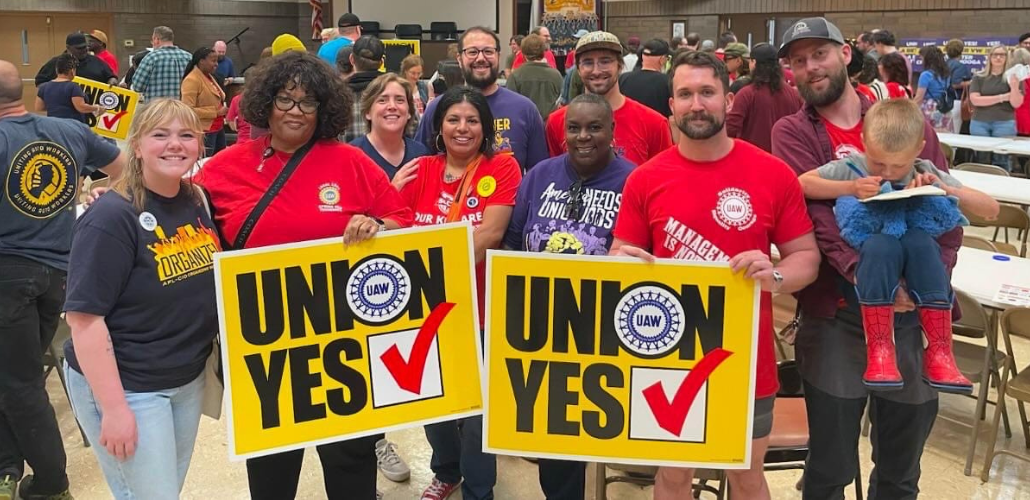
Marcelo’s experience shows how unions pave the way to a brighter future. That’s true even now—a time when the majority of working people feel as though the American dream has slipped out of reach because of rampant economic inequality, skyrocketing costs, and the callous indifference of the greedy rich.

In all, nearly 70 percent of Americans no longer see the country promising mobility or financial security to those who work hard and strive to get ahead, according to a January 2024 ABC News/Ipsos poll.

A separate survey, conducted in conjunction with the nation’s 250th birthday by AP-NORC Center for Public Affairs Research, found that half of respondents lost faith in the American dream. Many see America working for the wealthy, not people like them.

But Marcelo, president of United Steelworkers (USW) Local 12000 and a mechanic at Southern Connecticut Gas, will be the first to say it doesn’t have to be this way. After helping him fulfill the American dream, the union now enables him to hold on to it.

A USW contract provides Marcelo with the good wages he needs to ride out Donald Trump’s inflationary economy, including the runaway costs of groceries, utilities, and house insurance. It affords him retirement security even as Republicans threaten to cut lifelines for the elderly.

The contract delivers quality, employer-sponsored health care, while more and more Americans today have no choice but to put off doctor’s visits or treatments because of the spiraling costs.

“There’s the stability of knowing you have benefits,” Marcelo said of the contract, which he and his coworkers negotiated. “You don’t have to worry.”

This is all fabulous. But it isn’t unique.

Union members across the country make significantly more money than their non-union peers. They’re also more likely to have family leave, paid time off, and work-life balance. This all adds up to cars in the garage, summer vacations, and sports leagues for the kids, along with all of the other pluses that make life worth living.

This is what independence looks like. Marcelo simply calls it the “union life.”

There’s more.

Because unions provide a voice on wages, safety, and other issues, they empower workers at a moment when a depressing sense of helplessness haunts many other Americans.

Union members also forge a bond that transcends the shop floor. Everyone looks out for everybody else, and that’s a formidable counterweight to the epidemic of loneliness and isolation also plaguing the country right now.

Even better, this shared identity galvanizes union members to fight together for the greater good and to assert an ownership stake in their communities, often through the kind of volunteer work and political advocacy that Local 12000 members do.

“Doing it together makes it a much easier climb than doing it by myself,” Marcelo said of the solidarity uniting hundreds of his coworkers.

It’s a message that’s resonating with the growing number of workers weary of working their tails off, only to fall further behind while the rich get richer.

Polls show record levels of support for unions, and workers in every part of the country are joining them to take the future into their own hands.

The American dream endures. We just have to stand together to claim it.Email

Roxanne D. Brown is the international president of the United Steelworkers Union (USW).


Israel rejects reports of humanitarian crisis in Gaza

09.07.2026

Photo: Abed Rahim Khatib/dpa

Reports of a humanitarian crisis in the Gaza Strip are "extremely misleading," a high-ranking official of the Israeli government organization responsible for the occupied territories said on Thursday.

The situation for Palestinians in the territory has improved considerably, the COGAT official said in a press interview.

He pointed to a COGAT report issued on Thursday that states that around 1.78 million tons of food entered the Gaza Strip between October 2025, when the ceasefire went into effect, and June 7.

This was well above the guidelines of the UN's World Food Programme (WFP), he said. 

The official noted that food prices had fallen by 72% in the Gaza Strip since September 2025 and that water provision, at 40 litres per person per day, was double the World Health Organization guideline.

The information could not be independently verified.

A WFP report from June 9 referred to high and fluctuating food prices as jeopardizing food security in the region as well as access to adequate and varied nutrition.

Military operations, air attacks and population displacements were restricting humanitarian operations, it said.

UN children's organization UNICEF said in a May 29 report that drinking water distribution was reaching up to 1.5 million people. 

It added that 82% of families remained water-insecure and that up to 70% were unable to collect the minimum of 6 litres per person per day for drinking and cooking.

The COGAT official said Israel was "committed to facilitating the humanitarian response in the Gaza Strip" in coordination with its international partners, despite challenges.

He referred to "Hamas's continued obstruction of humanitarian operations," accusing the militant organization that controls Palestinian areas in the region of poor management resulting in large amounts of food being spoiled and destroyed.

The COGAT official also said that Hamas was imposing taxes and fixing prices in a way that distorted market conditions.


Date set for first Palestinian election in more than 20 years

09.07.2026, 

Photo: Wolfgang Kumm/dpa

Palestinian President Mahmoud Abbas has set November 28 as the date for the first parliamentary elections in more than two decades, the Palestinian news agency WAFA reported on Thursday.

Abbas issued the date by decree, calling upon Palestinians in the West Bank, East Jerusalem and the Gaza Strip to vote.

At the last election on January 25, 2006, the Islamist Hamas organization won a majority with 74 seats in the 132-seat Palestinian Legislative Council.

A year later, Hamas seized control of the Gaza Strip following violent clashes with Abbas's Fatah movement. After that, the parliament was largely paralysed. The Palestinian Constitutional Court eventually dissolved it at the end of 2018.

Whether and under what conditions the election can take place remains uncertain. Israel has regarded East Jerusalem as part of its indivisible capital since its annexation in 1967 and has banned official political activity by the Palestinian Authority (PA) within the city. The annexation is largely not recognized internationally. 

In the war-torn Gaza Strip, Hamas remains the main political actor.

The long-overdue presidential election is to be held in the first quarter of 2027. 

Abbas, now 90, won the last election on January 9, 2005. His regular four-year term ended in 2009. 

Since then, presidential elections have repeatedly been postponed or cancelled.


Source: The Grind Magazine

A new report details how the Israeli government is covertly and illicitly trying to influence public affairs in Canada.

While countries regularly lobby one another, four cases of Israel’s actions crossed a line because they were done in secret, according to Canadians for Peace and Justice in the Middle East (CJPME), the advocacy group behind the report.

First, in October 2023, the Israeli consulate in Toronto secretly commissioned an opinion poll that “manipulated Canadian public opinion about Israel’s war on Gaza,” according to an investigation by The Breach. The poll used “completely and totally loaded questions,” another pollster commented, to sway results in support of Israel’s bombing of Gaza and to make it appear that Canadians were concerned about pro-Palestine protests. The poll was conducted by high-powered Toronto PR firm Aurora Strategies Global without disclosing it was paid for by the Israeli consulate. A select group of Liberal MPs received the results before the poll was published and discussed how to bring it to Prime Minister Justin Trudeau’s attention.

Second, Israel’s Ministry of Justice secretly hired the high-powered Torys law firm in Toronto in 2019 to intervene in a legal dispute over Canada’s labelling of wines from illegal West Bank settlements, according to The Breach. After the intervention by Torys, the government appealed an earlier court decision, fighting the courts in Israel’s favour.

Third, Israel has secretly funded a series of propaganda trips to Israel for politicians and journalists. This includes trips organized by the Ontario-based Exigent Foundation, which took place as recently as 2025, according to a PressProgress investigation.

Fourth, Israel’s Ministry of Diaspora Affairs funded a secret campaign targeting Canada and the U.S. by making websites for fake groups, along with hundreds of fake social media accounts powered by ChatGPT, according to Haaretz and the New York Times. The campaign spread pro-Israel and Islamophobic messages, portraying Muslims as a threat to the West. Canada’s Deputy Prime Minister at the time, Chrystia Freeland, said this was unacceptable.

The report also raises the alarm about how Israeli ministries and leaders are doxxing Canadian activists and openly calling for restricting Canadians’ right to protest.

Canadian media ignores report, government staying quiet

While concerns around foreign interference from Russia, India, China and other nations receive significant attention from Canadian politicians and media, the new CJPME report was not covered by Canadian media nor discussed publicly by Mark Carney’s Liberal government.

International outlets The Cradle and Middle East Eye published articles about it.

CJPME tells The Grind they sent the report to Parliament’s Subcommittee on International Human Rights of the Standing Committee on Foreign Affairs and International Development for their ongoing study on Global Impact of Transnational Repression. The subcommittee acknowledged receipt of the report, according to CJPME, but it has not yet been added as a brief to their website.

Global Affairs Canada did not answer The Grind’s questions for this article, telling us to ask Public Safety Canada instead. Nearly two weeks after receiving questions, Public Safety sent generic comment, which did not answer our questions. Their only update was that “Canadian Security Intelligence Service (CSIS) assessed that the main perpetrators of foreign interference and espionage against Canada remains unchanged.”

Neither Public Safety nor Global Affairs Canada would say whether the government had received and read CJPME’s report.

Public Safety suggested asking the National Security and Intelligence Committee of Parliamentarians (NSICOP) for comment. The NSICOP had published a report in 2024 titled Foreign Interference in Canada’s Democratic Processes and Institutions. The report does not mention Israel, but CJPME notes Israel may have been one of the three countries that was redacted in Chapter 2 of the report, titled “Key Threat Actors,” which identified the six “primary perpetrators of repression against ethnocultural communities in Canada.”

In February 2023, the Toronto Star reported that, according to a Conservative Party source, Canadian security agencies had flagged Israel as one of six countries potentially engaging in influence activities, along with China, India, Russia, Saudi Arabia and Iran. While the U.S. wields enormous influence over Canadian affairs in overt ways, Canada’s security agencies haven’t raised the alarm about covert American influence, at least not publicly.

NSICOP would not comment directly on the CJPME report, saying the committee only comments through its official reports. A spokesperson also said they would not reveal the names of the redacted countries in their 2024 report.

The NSICOP Secretariat suggested contacting the Privy Council Office (PCO) for comment. The PCO, which provides non-partisan support to the prime minister and cabinet, responded to say they had nothing to add to the comments Public Safety sent The Grind..

Why the lack of concern?

“The CJPME report is authoritative, provocative (in the best sense of that word) and demands a fuller investigation by the Canadian government itself,” Michael Lynk tells The Grind by email. Lynk is an emeritus law professor at the University of Windsor and is a former UN Special Rapporteur for the human rights situation in the Palestinian Territories occupied since 1967.

To date, Lynk says, “the Canadian government has not taken the issue of foreign interference coming from Israel seriously, certainly not to the scale of its apparent interference.”

Asked why Israel seems to get off easy, Lynk states that “no other foreign state has as effective a domestic lobby in Canada advocating on its behalf and closely coordinating its advocacy with this foreign state.”

“There is no Russia lobby or a very effective China lobby in Canada,” Lynk continued. The organizations in the Israeli lobby,” which are separate from the Israeli government, “are not doing anything illegal, but they are advocating for a state that is in multiple violations on international law and hundreds of UN resolutions.”

“I cannot think of another country that stands so firmly on the wrong side of international law, yet continues to enjoy normal relationships with Canada,” he added.

Lynk believes the government should take the report seriously, but doubts it will. This, he says, will be “the litmus test on whether the mild criticisms that the Carney government has issued towards Israel over the past year have any real substance or are meant as eyewash.”

The Israeli consulate in Toronto, Torys, Aurora Strategies Global and the the Exigent Foundation did not respond to The Grind’s requests for comment.


This article was originally published by The Grind Magazine; please consider supporting the original publication, and read the original version at the link above.

Has the Democratic Party’s Support for Israel Hurt them at the Polls?


 July 9, 2026


The Biden administration made a pretense of supporting democracy and the so-called “rules-based order” advocated by former Secretary of State Anthony Blinken. It was surprising, then, that Blinken’s initial response to the International Criminal Courts’s issue of arrest warrants for Netanyahu and Gallant was to threaten to impose financial sanctions on the members of that court. Apparently, Blinken thought the I.C.C’s action, which aimed to enforce the laws of international conduct, broke his rules, which seemed to allow war crimes by Israel. Many supporters of Israel state that they support its actions because of Hamas violent assault on Israeli military bases and murder of civilians several years ago. As economist Jeffrey Sachs recently stated, the attack by Hamas had been preceded by fifty years of violent subjugation of Palestinians by Israel.

Then there was Biden himself, who liked to hug the indicted war criminal Netanyahu. The weak charade that he and Blinken put on of trying to require that Israel reframe from war crimes was pitiful and sickening, even as the whole world was watching.

Biden has been a major advocate for Israel his whole career. In the 1980s, then Senator Biden held a town hall meeting at the University of Delaware. He was praising Israel when a Palestinian student asked why the Israelis would not allow his family to visit their former home in Israel. Biden told him to come see his office and he would help him out. The student later told me Biden did nothing. The Israelis had driven the student’s family from their home during the ethnic cleansing and massacres of 1948. During this town hall, I had an exchange with the Senator, who, to my surprise, asked me what I would do about Israel. I responded that I would make them sit down and negotiate. “Oh, no!” he replied. “You better work real hard to get me out of office, then!”

When Senator Sanders offered his first resolution opposing further arms sales to Israel in the autumn of 2024, only 16 Democratic Senators supported it. The Republicans, of course, all opposed it. The Congressional delegation from Delaware, my state, is no exception. Both of our Senators, Coons and Rochester, voted against Sanders’ first resolution. Sanders’ second resolution got Rochester’s vote along with a bare majority of the Democratic Senators’, but Coons again voted no.

The American Israeli Political Action Committee, or AIPAC, is regarded as an enforcer of support for Israel, and often works to defeat Senators or Representatives who refuse to toe its pro-Israel line. According to the website of AIPAC Tracker, Coons has received $376,561 from the Israeli lobby, and is endorsed by AIPAC. Former Representative, now Senator, Rochester has received $62,626 from the Israeli lobby, according to the same source; she is endorsed by J Street, which is not the same as AIPAC. Representative Sarah McBride, widely known as the first transgender member of Congress, is a strong supporter of Israel; she has accepted $72,316 from the Israeli lobby, and is endorsed by AIPAC, according to AIPAC Tracker. At two recent meetings of the Democratic National Committee, a resolution calling for an end of U.S. arms to Israel was defeated, even though only an estimated 7% of Democratic voters support Israel’s actions.

The U.S. Congress is, shamefully, in gross violation of its own laws, the Leahy Laws, which Wikipedia defines as U.S. human rights laws that prohibit the U.S. Department of State and Department of Defense from providing military assistance to foreign security force units that violate human rights with impunity. As is evidenced by the warrant for Israel’s Prime Minister and former Defense Minister for Genocide by the International Criminal Court, Israel certainly violates the human rights of Palestinians with impunity. According to the Leahy law, Congress is obliged to end military assistance to Israel. However, Congress and many Democrats there instead blatantly violate their own law.

There are reports that the Democratic Party has suffered at the polls for its ongoing support for Israel’s crimes. Kamala Harris’ pledge of unyielding support for Israel, following in the footsteps of Biden, seems to have lost the election because it was a prime reason for former Biden voters to stay home. Recently, graduating college students clearly showed they support protests for Palestine. That does not bode well for the Democratic Party’s future support from younger voters.

In the recent democratic primary in New York, the DSA candidates emphasized their support for Palestinians. Several of them defeated mainstream Democrats in their campaigns. As part of the lead-up to the primary, one mainstream Democrat, when asked about Israel, replied that we’re against Netanyahu, but we definitely support Israel. That ploy has the problem that the large majority of Israelis support the genocide in Gaza, according to polling results. To try to pin the whole problem on Netanyahu will not work. It seems clear that the Democratic Party will be struggling with the issue of its support for Israel and its Zionist goals, for a long time. The essentially apartheid and colonial nature of Israel will be too difficult to conceal.