Monday, June 08, 2026


South Korea election victory marred by ongoing ballot crisis

South Korea election victory marred by ongoing ballot crisis
/ Daniel Bernard - UnsplashFacebook
By IntelliNews June 8, 2026

The ruling Democratic Party of Korea (DPK) scored a sweeping victory across local administrations in recent elections, but missed out on the ultimate capital prize, while the conservative opposition salvaged a critical political lifeline. At the same time, an unprecedented administrative failure by election authorities left thousands of voters without ballots, triggering violent street demonstrations and allegations of systematic electoral fraud, The Korea Herald reports.

This dramatic split vote on the southern half of the Korean peninsula points to a highly volatile regional landscape. While the DPK now controls the vast majority of provincial governments nationwide, its absolute failure to breach the capital proves it lacks an uncontested national mandate. More critically, the National Election Commission’s administrative blunders have completely destroyed public confidence in South Korea’s democratic architecture at a moment when hyper-polarisation is running at record levels.

The DPK captured 12 out of 16 mayoral and gubernatorial races across the country, the National Election Commission (NEC) announced on June 4. The main opposition People Power Party (PPP) retained only four jurisdictions, clinging firmly to its core southeastern heartlands of Daegu, North Gyeongsang Province, and South Gyeongsang Province, along with the capital city, Seoul. The outcome reverses the trends of the 2022 local elections when the DPK won a mere five of 17 metropolitan and provincial seats. Despite building a massive national footprint in this cycle, senior liberal officials voiced immediate anger over the loss of Seoul. The defeat in the capital is a serious blow because the DPK went into the mosst recent poll carrying a comfortable double-digit lead across major independent opinion surveys, while President Lee Jae Myung maintained a rock-solid personal approval rating of 60%.

According to The Korea Herald, PPP candidate Oh Se-hoon bypassed DPK challenger Chong Won-o to secure an unprecedented fifth term as Seoul mayor. Chong was personally selected and heavily backed by President Lee. DPK Chair Rep. Jung Chung-rae stated during a press briefing that whilst he felt deep gratitude to the electorate for giving the party a sweeping victory across the country, it was incredibly painful that they failed to reclaim Seoul. Former DPK leader Song Young-gil expressed almost identical levels of frustration during a radio interview with MBC, noting that the party’s central campaign strategy failed to convert the administration’s massive popularity into a victory in the capital.

Logistical failures trigger institutional crisis

According to Chosun Biz, however, electoral politics immediately shifted to raw institutional panic as extensive ballot shortages halted voting. The NEC admitted it had miscalculated voter turnout and under-printed paper ballots for the election. Polling stations in the affluent, conservative-leaning district of Songpa-gu ran out of forms after receiving supplies covering only 50% of registered local voters.The deficit froze voting at 14 stations in Seoul and 17 sites nationwide. The administrative failure forced officials to stretch voting hours until 10:00 pm at disrupted stations, though hundreds of angry citizens walked away without voting.

The failure sparked an instant institutional crisis leading into the weekend as a crowd of 1,200 protesters launched an overnight siege at the central NEC headquarters in Gwacheon, Gyeonggi Province, Chosun Biz reports. Demonstrators blocked the exits, physically trapping employees inside the building and shoved staff who attempted to leave. The political fallout worsened by the hour, with PPP Floor Leader Rep. Song Eon-seog demanding a parliamentary probe and a special counsel investigation. Simultaneously, a conservative activist group filed a formal criminal complaint against NEC Chair Roh Tae-ak and Secretary-General Heo Cheol-hoon for dereliction of duty, and the Seoul Metropolitan Police Agency opened a full criminal investigation.

The DPK hit back at the opposition's outrage, when DPK Secretary General Rep. Jo Seoung-lae remarked that the PPP screamed for a total suspension of the vote count and a re-run when it expected a heavy defeat, but completely buried those demands the moment the mayoral numbers turned in its favour. The standoff remains highly volatile in Jamsil-dong, Seoul, on June 8, where furious crowds numbering up to 8,000 physically blocked the transit of two remaining ballot boxes holding 2,000 uncounted votes. While these ballots are not enough to threaten the 53,000-vote lead held by Oh Se-hoon, the city election commission cannot legally certify the mayoral outcome until every single box is processed, leaving the governance of South Korea’s capital up in the air.



ASEAN’s Shifting Views On China And The United States – Analysis

June 8, 2026 
By Lucio Blanco Pitlo III

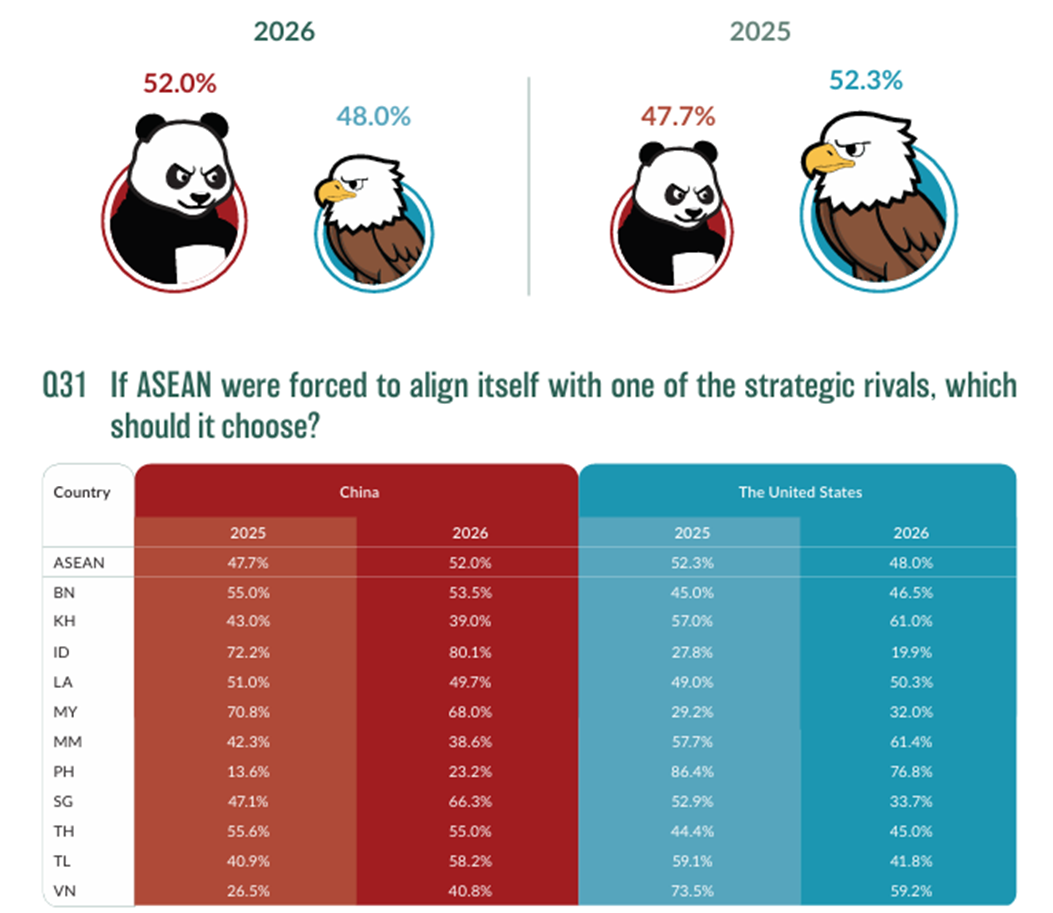
For the second consecutive year, ASEAN stakeholders prefer China over the United States as a strategic partner, driven by China’s dominant economic presence, infrastructure investments, and growing trust. U.S. standing has eroded due to policy unpredictability under the Trump administration, climate withdrawal, and declining reliability as a partner.

For the second time, China has edged out the United States as ASEAN’s preferred partner, a trend that hints at the shifting sands in how Southeast Asian stakeholders view the two great powers. According to the annual State of Southeast Asia Survey Report by Singapore’s Institute of Southeast Asian Studies (ISEAS) Yusof Ishak Institute, published on April 7, (52%) of respondents said they would align with Beijing over Washington (48%) if forced to choose. A review of the key risks identified by respondents helps explain this evolving take on the U.S.-China contest for regional influence.From pg. 51 of 80 of 2026 ISEAS Yusof Ishak Institute State of Southeast Asia Survey

Leveraging economics to become a favored strategic partner

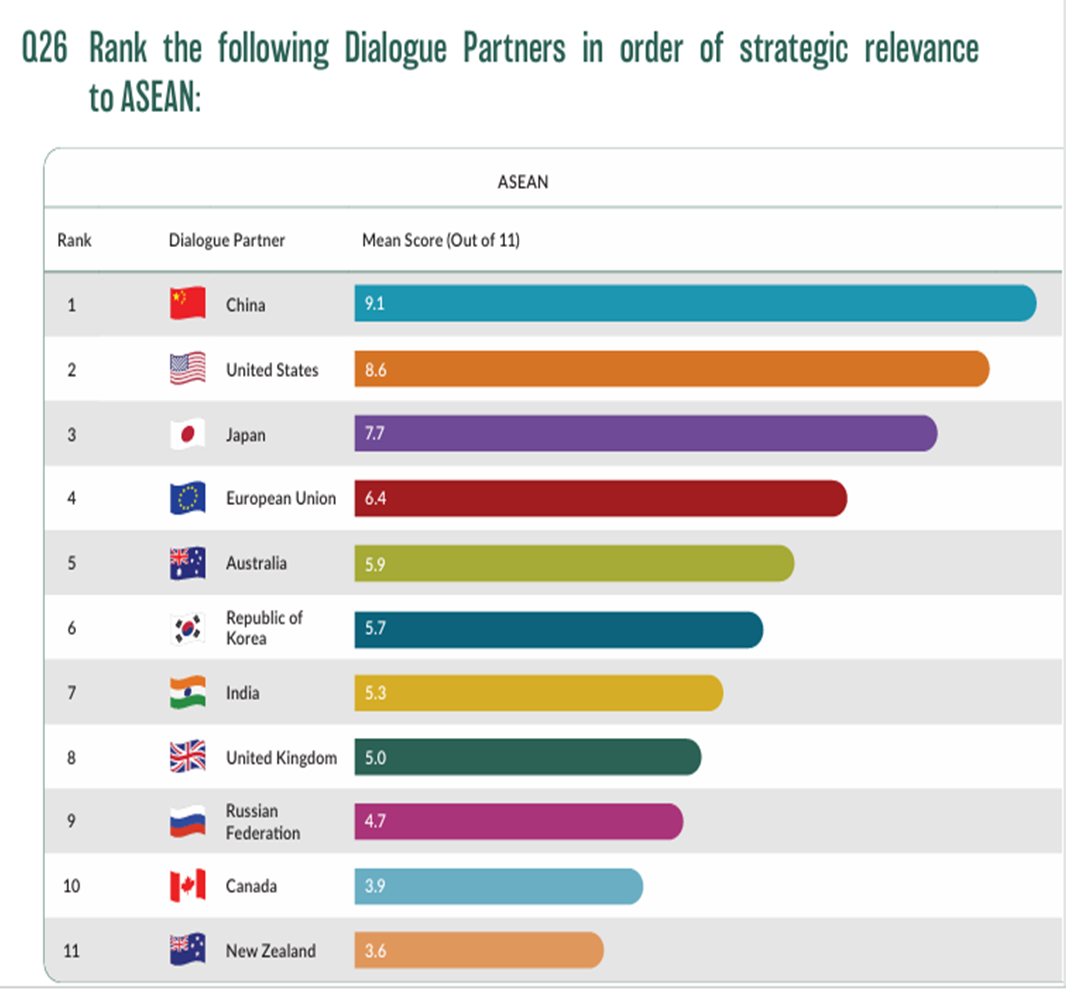
In this year’s survey, China kept its position as ASEAN’s most influential economic (55.9%) and political-strategic (40%) partner. Beijing also emerged as the partner with greatest strategic relevance (9.1 out of 11), followed by Washington (8.6). In forecasting ties with major powers, more ASEAN respondents had high expectations for improved relations with China over the next three years (55.6%) than with the U.S. (32.8%). The economic part is easy to explain. China has been ASEAN’s largest trade partner for 16 consecutive years since 2009. Since 2019, ASEAN has also become China’s top trade partner, reinforcing economic linkages between the two sides. The upgrading of the ASEAN-China Free Trade Agreement last year to cover digital and green economy and supply chain connectivity is bound to deepen this economic interdependence.

From pg. 42 of 80 of 2026 ISEAS Yusof Ishak Institute State of Southeast Asia Survey

ASEAN countries and China are also part of the world’s largest free trade area, the Regional Comprehensive Economic Partnership. RCEP, which entered into force in 2022 and will be due for a general review next year, is looking to elevate its standards and expand. Hong Kong, Sri Lanka, Chile, and Bangladesh seek membership in the trade bloc. China also applied to join other regional trade pacts in which several ASEAN countries are already members, such as the Comprehensive and Progressive Trans-Pacific Partnership (Brunei, Malaysia, Singapore, Vietnam) and the Digital Economy Framework Agreement (Singapore). Survey respondents ranked ASEAN as a leader in championing global free trade (25.5%), followed by China (21.3%). In sharp contrast, the US prefers bilateral trade deals and employs tariffs to pressure trade partners to negotiate. The poll ranked the U.S. a distant fourth (14.8%) after the European Union (19.2%) in promoting trade liberalization.

Furthermore, compared to China’s Belt and Road Initiative, which is now in its 13th year and has already delivered concrete projects like the Laos-China railway, Jakarta-Bandung high-speed railway, and Phnom Penh-Sihanoukville Expressway, among others, U.S. alternatives like the Blue Dot Network or the Indo-Pacific Economic Framework have yet to make their presence felt in the region. New Chinese pitches, such as the Global Development Initiative, also received unanimous support from ASEAN, given China’s success in poverty alleviation and in achieving many United Nations Sustainable Development Goals ahead of the 2030 schedule.


China is a major force in deepening regional connectivity through cross-border railways, highways, ports, grid, and digital infrastructure. It supports the transition to green energy and industrial upgrading of its ASEAN neighbors. The Beijing-based Asian Infrastructure Investment Bank is one of the financiers of Laos’ Monsoon Wind Farm, Southeast Asia’s largest, which began commercial operations last year and now transmits clean energy to Vietnam. State-owned PowerChina led the construction with wind turbines supplied by Shanghai-based Envision Energy. China plays a big part in the rise of Laos as the region’s battery, exporting renewable energy to its neighbors, and a land link connecting mainland ASEAN to China. It powered Indonesia’s shift from a raw nickel ore exporter to a critical mineral processor. Beijing was also quick to dispatch relief and financial assistance to ASEAN countries visited by calamities from the earthquake in Myanmar to typhoons in the Philippines and Vietnam last year. Chinese carmakers are ramping up production of electric vehicles (EVs) and batteries in Southeast Asia, pushing the region’s shift to modern green transport

Beyond economics, China is also active in mediating conflicts, pursuing sustained shuttle diplomacy to defuse the Cambodia-Thailand border clash last year. Trilateral foreign minister meetings were held in Anning (August 14) and Yuxi (December 29), both in Yunnan province, in 2025. Complementing these official meetings, China Foreign Affairs University hosted the first trilateral Track 2 dialogue on February 10 this year in Beijing.
Policy reversals and unpredictability undermine appeal

ASEAN respondents identify climate change and extreme weather events (60.0%) as the region’s top challenge this year. Economic competition between major powers ranks only second (51.7%). The U.S. exit from the Paris Climate Agreement, introduction of incentives for oil and gas expansion, while terminating subsidies on EVs, dented its role in global climate change conversations. Curtailment of humanitarian and development aid further diminished the U.S.’ profile. Meanwhile, China’s massive new energy capacity, robust portfolio of overseas projects in renewables and EV and battery production, and increasing climate change aid, especially to Global South countries, enhance Beijing’s position.


ASEAN elites also identify US leadership under President Donald Trump (51.9%) as the top geopolitical concern. It scored higher than global scam operations (51.4%) and aggressive behavior in the South China Sea (48.2%). This is a reverse order of 2025, when maritime tensions ranked first. To view the U.S. as a source of geopolitical risk is a turning point. It undermines Washington’s position as a defender of the so-called “rules-based order.” The capture and trial of a sitting leader of a sovereign country, Venezuelan President Nicolas Maduro, and oil blockade of neighboring Cuba generated unease among ASEAN countries. The use of force or threats to use force to effect “regime change” is disturbing, as it may set precedent for rival powers or other countries at odds with their neighbor. The destruction in Gaza and U.S. failure to rein in its ally Israel also fueled resentment in Muslim-majority ASEAN countries like Indonesia and Malaysia. Designs over the territory (Greenland) of a fellow NATO ally (Denmark) also raised concerns over the U.S. treatment of allies and friends.

Nevertheless, the U.S. continues to have the upper hand over China when it comes to trust. But the ISEAS survey made some interesting insights. First, while ASEAN respondents have more trust in America (44%) than China (39.8%), trust in the latter has increased from last year (36.6%), while the former’s number declined (from 47.2%). Second, distrust of both powers has also become comparable – the U.S. got 35%, while China got 34.5%. Third, for the first time since the survey was conducted in 2019, more respondents have expressed trust (39.8%) than distrust (34.5%) of Beijing. Finally, while the survey cited the same factors to explain trust and distrust of the two competing powers, the differences in the numbers could be telling. ASEAN respondents see China as having more vast economic resources and a strong political will to provide global leadership (47.8%) than the US (32.5%).

That said, respondents also shared greater concern over Beijing’s use of economic and military power to threaten an ASEAN country’s interests and sovereignty (43.8%) than that of Washington (35%). It goes without saying that with greater power comes greater responsibility, restraint, and reassurance. Of the things China should do to improve relations with ASEAN, the resolution of territorial and maritime disputes peacefully in accordance with international law ranks highest (35.1%). This is followed by a desire to see Beijing respect the sovereignty and not constrain the foreign policy choices of its Southeast Asian neighbors (25.5%).

Indeed, parsing the survey results offers clues about Southeast Asia’s thinking, giving powers keen to influence the region a chance to adjust and recalibrate. 


This article was published at China-US Focus

About Lucio Blanco Pitlo III

Lucio Blanco Pitlo III is a Research Fellow at the Asia-Pacific Pathways to Progress Foundation. He was a lecturer at the Chinese Studies Program at the Ateneo de Manila University and the International Studies Department at the De La Salle University and contributing editor (Reviews) for the journal Asian Politics & Policy. He is also a member of the Board of Directors of the Philippine Association for Chinese Studies. He obtained his Master of Laws from Peking University and is presently pursuing his MA International Affairs at American University in Washington D.C.

View all posts by Lucio Blanco Pitlo III →


China’s Economy And The World Order – OpEd

June 7, 2026 

By Simon Hutagalung

China’s economy is a global force. It is a means of projecting power, of insulating against vulnerability, of shaping global norms. It is more than a simple growth model; it is a tool of statecraft that is strengthening China’s national power and changing the international balance of power. It is a manifestation of the political authority of the Communist Party of China, of the country’s system of economic management, and of its growing engagement with the rest of the world.

At its core, China’s economic system is that of a Communist Party at the apex of power. The Party controls the strategic resources and the core sectors of the economy. The National Development and Reform Commission and the Five-Year Plans represent the focal point for economic planning and the promotion of technology, and for the integration of economic management and national security. While since the 1970s the state has been introducing market elements and has allowed foreign capital in order to foster competition, the leeway granted to markets and to foreign elements is always strictly controlled by the state and remains subordinate to the Party.

Domestically, China is operating under a so-called dual-track-structure. The energy sector, telecommunications, finance as well as the defence sector are dominated by state-owned enterprises. But there are also private companies, which drive innovation, employment and consumer spending. Yet growth by the private sector is being restricted by the state. The state-controlled banks allocate the credit within the framework of the priorities set by the government, thus fuelling local debt, property bubbles and shadow banking activities.

A reflection of these contradictions is the Party’s dual circulation strategy launched by Xi Jinping in autumn 2020. The aim is to reduce dependence on foreign markets and to promote foreign technology while at the same time strengthening domestic demand for Chinese products and services and promoting indigenous innovation. However, so far, only a limited rebalancing has taken place. In order to stimulate consumption, the government could introduce a comprehensive social security system, allow the housing market to develop more freely and grant more scope to private enterprises to grow. However, the Party would risk losing control if it were to implement these reforms.


On the international front, China seeks to extend the reach of its economic system by increasing engagement in trade and investment with countries and regions across the globe. It aims to tap into global markets for its goods and services, to attract foreign capital to fuel further growth and to develop a network of infrastructure across Asia, Africa and Europe through its New Silk Road/Belt and Road Initiative (BRI). The BRI can be seen as a key component of China’s pursuit of a greater role on the global stage. In addition to the financial advantages that the BRI could bring to countries along the routes, it also promises to open up new markets for Chinese firms, provide a destination for the surplus productive capacity that China’s state-owned enterprises have been unable to absorb within the country, and serve as a platform for China to project its hard and soft power to all corners of the globe. However, as with many countries along the routes, which are struggling with debt sustainability and the effective governance of large-scale BRI projects, resistance is also rising.

The Digital Silk Road will also help to establish China’s position in global telecommunications and information systems, through the spread of affordable and efficient telecommunications networks, as well as of surveillance systems and models of digital governance, which will allow the country to impose its own technology standards and models of political management on other parts of the world. While for developing countries the Digital Silk Road may be an attractive option due to financial benefits, for advanced countries it is perceived as a threat to their data security and as a means to gain strategic control over their key sectors. The rise of China therefore also challenges Western dominance in the sphere of 5G telecommunications and of artificial intelligence.


The global impact of China’s model of economic development is vast. China today is the world’s largest growth market, a leading manufacturer, and a major provider of financing for global infrastructure. Commodity prices are influenced by China’s demand. The country’s rise has created new challenges and sparked growing trade tensions and de-risking in developed countries. Supply chains for semiconductors and critical raw materials are being reorganised around China.

The model, however, also has several constraints. Demographic decline and its impact on productivity and fiscal sustainability will require significant adjustments. Several years of damage to the environment will require even more significant investments to reverse. The property sector has become a systemic vulnerability. Finally, export controls and investment screening measures currently in place in several countries are already restricting access to advanced technology and foreign capital for Chinese firms.

China’s economic system is a deliberate creation, a product of design and of ongoing effort. It is a system in which the state plays a commanding role, but in which markets and in some measure even private enterprise are also allowed to function. At home, the economy is shaped by strategic priorities; abroad, by a global strategy. Can China manage its vulnerabilities and sustain its system as a stabilising force in the world, or will it bring increased global tension instead?

The opinions expressed in this article are the author’s own.


References
Jain-Chandra, S., Kothari, S., Garcia-Macia, D., & Xu, Y. (2026, February 18). How China’s economy can pivot to consumption-led growth. International Monetary Fund.

Hill, F. (2026, April 3). Peril and possibility: Collapsing old order, emerging disorder, or new order? Brookings.


About Simon Hutagalung

Simon Hutagalung is a retired diplomat from the Indonesian Foreign Ministry and received his master's degree in political science and comparative politics from the City University of New York. The opinions expressed in his articles are his own.

View all posts by Simon Hutagalung →

Inflation beating pay rises in Europe: Where are workers losing the most?

CGT union secretary general Sophie Binet, center, attends a demonstration for higher wages and against austerity, in Paris, Tuesday, Dec. 2, 2025.
Copyright Copyright 2025 The Associated Press. All rights reserved

By Servet Yanatma
Published on

As inflation surges across Europe following the recent Middle East conflict, advertised pay growth in the eurozone is failing to keep up, causing workers' real earnings and purchasing power to fall.

Prices are rising again across Europe, but pay is not keeping up.

Inflation in the EU reached 3.2% in April 2026, its highest level since January 2024, and Eurostat's flash estimates suggest prices continued to climb in May.

However, wage growth in salaries advertised in job postings across the eurozone are not keeping pace with inflation, according to Indeed. That means inflation is outpacing posted wage growth across Europe, weighing heavily on workers' purchasing power, with earnings buying less than before.

The latest inflationary pressures come after the EU experienced its biggest price shock in decades. Annual inflation surged to more than 11% in 2022, driven largely by soaring energy costs following Russia's invasion of Ukraine.

So, how do inflation and posted wage growth compare across major European economies?

Middle East conflict: Inflation on the rise

It remained below 3% from early 2024 until recently. But a gradual upward trend has emerged since the joint US-Israeli attack on Iran and Tehran's response in late February 2026.

In January 2026, annual inflation in the EU stood at 2%. It rose sharply to 2.8% in March and 3.2% in April.

The post-pandemic inflation eroded workers' purchasing power across major European economies as consumer prices rose faster than wages. As of early 2026, cumulative real posted wages remained below pre-pandemic levels in Europe's five largest economies, according to Indeed.

With inflation rising following the recent conflict in the Middle East, wage growthin the eurozone fell below inflation in March 2026, with the gap widening further in April. This reversed a trend that had held since September 2023, when posted wage growth consistently outpaced inflation in the eurozone.

With annual consumer prices climbing to 3.0% in the eurozone in April, workers’ wages are no longer keeping up with cost-of-living increases, according to Indeed's wage tracker, which shows year-over-year growth in posted wages of just 2.3%.

In January 2026, posted wage growth stood at 2.4%, while annual inflation was just 1.7%, highlighting how quickly the picture has changed.

“Inflationary pressures from the global energy price shock have started to show in the European data, eroding real wage gains,” Aubrey Woessner, associate economist at the Indeed Hiring Lab, said.

Why is the UK bucking the trend?

Inflation and posted wage growth vary across major European economies. The UK stands out with posted wage growth of 4% year-on-year, well above its inflation rate of 2.8%.

“But even so, real wage growth is stalling. The slip in real purchasing power will weigh on demand in the coming months, adding to other headwinds facing the economy,” Woessner noted.

Pawel Adrjan, director of economic research at Indeed, emphasised that the UK still has a real-wage cushion that much of the eurozone has already lost. UK inflation eased in April, helped by government measures to bring down energy bills, even as it rose across the continent.

“But the UK's real wage cushion is thinning fast. Growth in posted wages was 4.0% year on year in April, supported in part by a headline minimum wage rise of 4.1%, but this was the slowest rate in four years,” he told Euronews Business.

“Since hiring remains weak, recent real wage gains will erode quickly if the Iran conflict keeps oil and gas prices high.”

The UK is not alone. As of April 2026, posted wage growth also exceeded inflation in Germany and Ireland, although the margin was much narrower. In Germany, posted wage growth stood at 3.2% compared with inflation of 2.9%. In Ireland, the gap was even tighter, with posted wages growing by 3.7% compared with inflation of 3.6%.

Italy and France: The hardest hit for workers

Italy and France appear to be the hardest hit countries for workers. While posted wage growth in France has remained stable at 1.1% throughout 2026, inflation climbed from 0.4% in January to 2.5% in April.

Workers are also losing ground in Italy. Posted wage growth has been below 0.8% since mid-2025, while inflation has consistently outpaced it over the past year. The gap deepened further this year as inflation reached 2.8% in April.

While monthly trends offer useful insights, cumulative real wage growth over recent years provides a fuller picture.

Bessent Backs 3% Deficit Goal Despite 5% Budget Forecasts


File photo of US Treasury Secretary Scott Bessent. Photo Credit: @SecScottBessent, X


June 7, 2026 
The Center Square
By Brett Rowland

(The Center Square) – U.S. Treasury Secretary Scott Bessent pledged in two congressional hearings this week to cut the federal deficit to 3% of GDP, a target the government’s own budget projections do not currently support.

Bessent repeated the goal before both the Senate Finance Committee and the House Ways and Means Committee, telling lawmakers the administration could achieve “something with a three in front of it” by the end of President Donald Trump’s term.

The administration’s fiscal 2027 budget, however, projects deficits above 5% of GDP through 2029.

The Congressional Budget Office projected in February that the federal deficit will reach $1.9 trillion, or 5.8% of GDP, in fiscal year 2026 – and will not fall below 5.6% of GDP at any point over the next decade. Debt held by the public reached 101% of GDP, the highest level since World War II. Bessent told the House committee the deficit had fallen to 5.5% of GDP, a figure that Treasury has not publicly reconciled with CBO’s 5.8% projection for fiscal year 2026. Treasury did not respond to questions about the basis for Bessent’s 5.5% figure.

The federal government is projected to spend more than $1 trillion on interest payments alone in fiscal year 2026, more than all discretionary defense spending. By 2036, CBO projects annual interest costs will reach $2.1 trillion, approaching the total projected cost of all discretionary federal spending that year.

Maya MacGuineas, president of the Committee for a Responsible Federal Budget, said in a May 6 statement that $2 trillion deficits have become routine.

“Two trillion dollar deficits used to be unheard of, and then they only occurred during major recessions,” MacGuineas said. “It’s beyond scary that $2 trillion deficits are now the norm.”

A $2 trillion deficit, she noted, amounts to more than 6% of GDP – about double the 3% target Bessent has endorsed.

Despite those projections, a bipartisan group of House members has backed H.Res. 981, a nonbinding resolution that would set a congressional goal of reducing the deficit to 3% of GDP by 2030. The resolution has 20 cosponsors, evenly split between Republicans and Democrats, but has remained in committee without action since its introduction in January.

Rep. Lloyd Smucker, R-Pa., one of the resolution’s original cosponsors, raised it directly during Thursday’s House hearing, telling Bessent the measure has bipartisan support. Bessent has publicly endorsed the resolution and told the committee he left a career in finance partly out of concern about the nation’s debt trajectory.

H.Res. 981 was introduced Jan. 7 by Rep. Bill Huizenga, R-Mich., and Rep. Scott Peters, D-Calif., co-chairs of the Bipartisan Fiscal Forum, a House caucus focused on deficit reduction, along with Smucker and Rep. Mike Quigley, D-Ill. The resolution has been referred to three House committees – Budget, Ways and Means, and Rules – without further action.

The federal government has not recorded a budget surplus since 2001, and the deficit has exceeded 3% of GDP every year since 2015, according to the Committee for a Responsible Federal Budget.

Adding to the fiscal pressure, the Social Security trust fund that pays retirement and survivors benefits is projected to be exhausted in 2032 – one year earlier than previously projected – at which point benefits would fall by an average of 28% without congressional action, according to the Congressional Budget Office’s February 2026 budget outlook.

Researchers at the Penn Wharton Budget Model have estimated the United States has roughly 20 years to change course before the national debt approaches the outer limits of what financial markets can absorb.

“As soon as capital markets start believing that Congress will never get its act together, things unravel immediately,” Kent Smetters, faculty director of the Penn Wharton Budget Model, told The Center Square.


About The Center Square

The Center Square was launched in May 2019 to fulfill the need for high-quality statehouse and statewide news across the United States. The focus of their work is state- and local-level government and economic reporting.

View all posts by The Center Square →


Imperial War Comes Home: Iran, Fuel Prices, And The Crisis Inside The U.S. Core – OpEd

June 7, 2026 
By Michael Harrison


The United States has long treated war as something that happens elsewhere. Bombs fall in West Asia, sanctions starve economies in the Global South, fleets patrol distant waters, and Washington calls it “security.” But imperialism never remains external forever. It returns to the imperial core in distorted forms: inflation, public debt, militarized politics, decaying infrastructure, and the slow erosion of everyday life for ordinary people.

The war with Iran is revealing this contradiction with unusual clarity. It is not only a military confrontation. It is not only a geopolitical struggle over West Asia. It is also a domestic economic crisis for the United States, expressed most visibly through fuel prices.

The gas pump has become one of the most honest political instruments in America. It shows what official language tries to hide: imperial war is not cost-free. It is paid for by workers, commuters, small businesses, truck drivers, farmers, and families whose lives are already organized around precarity.

The material link is obvious. The U.S. Energy Information Administration describes the Strait of Hormuz as one of the world’s most important oil chokepoints. Before the current crisis, roughly one-fifth of global petroleum liquids consumption passed through this narrow corridor. When military conflict disrupts this route, the effect does not remain confined to the Gulf. It moves through tanker insurance, shipping delays, crude benchmarks, refinery margins, diesel markets, freight contracts, and finally into the price of food, transport, and basic goods.

This is the material geography of empire. Washington may speak in the language of freedom, deterrence, and order, but the world economy speaks in supply chains, chokepoints, commodities, and class power. The U.S. can dominate sea lanes militarily, but it cannot abolish the dependence of its own economy on the very global system it has built and policed.

That contradiction is now being felt inside the United States. According to the EIA’s Gasoline and Diesel Fuel Update, regular gasoline reached $4.475 per gallon in the week of May 25, 2026, while on-highway diesel stood at $5.523. Gasoline attacks household budgets directly. Diesel attacks them indirectly by raising the cost of moving nearly everything: food, construction materials, retail goods, farm products, medical supplies, and industrial inputs.

This is how imperial war becomes inflation.

The Bureau of Labor Statistics reported that the Consumer Price Index rose 3.8 percent over the twelve months ending in April 2026. Energy prices rose 17.9 percent over the year, while gasoline rose 28.4 percent. These figures are not simply “market data.” They are class data. They show the transfer of war costs downward onto those least able to absorb them.

For the wealthy, higher fuel prices are an inconvenience. For workers, they are discipline. They discipline movement by making commuting more expensive. They discipline consumption by forcing families to cut back elsewhere. They discipline labor by making people more dependent on jobs that may not pay enough to keep up with rising costs. A worker cannot negotiate with the gas pump. A parent cannot ask the landlord to reduce rent because imperial strategy made diesel more expensive.

This is why the official separation between “foreign policy” and “domestic economics” is false. A war in Iran becomes a grocery bill in Ohio. A naval confrontation in the Persian Gulf becomes a delivery surcharge in Arizona. A decision made in Washington becomes a missed medical appointment, a delayed car repair, or another balance carried on a credit card.

Economists describe this process through pass-through effects. Research from the Dallas Fed shows that unexpected oil price shocks move quickly into gasoline prices and then into broader inflation. The Federal Reserve has also warned that oil shocks can create second-round effects, spreading beyond energy into food, services, wages, expectations, and price-setting behavior.

But behind the technical language is a simple reality: imperialism raises the cost of life.

The U.S. ruling class presents military escalation as a way of securing order. In practice, it destabilizes both the targeted region and the society that pays for the intervention. The empire exports destruction, then imports inflation. It produces insecurity abroad and austerity at home.

Even a ceasefire would not immediately end the damage. Oil markets do not return to normal because politicians announce a pause. Tanker routes must reopen. Insurance premiums must fall. Inventories must be rebuilt. Refining capacity must recover. Traders must believe the next escalation is not imminent. Until then, the war premium remains embedded in fuel prices.


The EIA’s Short-Term Energy Outlook has already warned that global oil inventories are falling sharply and that Brent prices are expected to remain elevated in the near term. The International Energy Agency has similarly noted the strain on inventories and refining margins caused by disruptions to Gulf energy flows. This means that even if the shooting slows, the economic consequences will continue.

Here the deeper problem appears. The United States is not simply suffering from an accidental energy shock. It is suffering from the contradictions of the imperial mode of living itself. The American economy depends on cheap energy, global logistics, military dominance, and unequal access to the resources and labor of the world system. Yet the military machinery used to preserve that arrangement increasingly destabilizes the conditions that make it possible.

This is not a temporary policy mistake. It is structural. Imperialism creates a world economy in which the core depends on the controlled vulnerability of the periphery. But when the periphery resists, when strategic regions become ungovernable, when sanctions, blockades, and wars disrupt the flow of commodities, the core discovers that its own comfort was never independent. It was always built on coercion.

The war with Iran exposes this dependency. Washington may imagine itself as the manager of global energy security, but its own population is now paying for the insecurity its policies produced. The same empire that claims to protect oil routes has helped make fuel unaffordable for many of its own people.

This does not mean the American working class is the primary victim of U.S. imperialism. It is not. The greatest violence is still inflicted on the peoples of West Asia and the Global South, who endure sanctions, military threats, assassinations, occupation, and economic strangulation. But the domestic consequences matter because they reveal that imperialism does not even provide real security to the population in whose name it acts. It offers only a declining bargain: tolerate war abroad, accept higher costs at home, and call it national interest.

That bargain is collapsing.

The Bureau of Economic Analysis reported that in April 2026, disposable personal income fell while personal consumption expenditures rose, and the personal saving rate dropped to 2.6 percent. This is not strength. It is exhaustion. People are still spending because survival requires spending, but they are doing so with fewer reserves and more debt.

This is the domestic face of imperial crisis: a population told it lives at the center of the world, while its daily life becomes more fragile, more expensive, and more insecure.

The anti-imperialist lesson is clear. The fight against war cannot be separated from the fight against the political economy that produces war. The fuel shock is not merely a consumer problem. It is a symptom of a system that organizes the world around extraction, military domination, and unequal exchange, then demands that ordinary people pay when that system breaks down.

Diplomacy and de-escalation are not acts of weakness. They are the minimum conditions for preventing further social damage. But a deeper answer requires more than a ceasefire. It requires confronting the imperial structure that turns entire regions into battlefields and then turns the consequences into household expenses.

The war with Iran has come home to America. Not as victory. Not as security. Not as order.

It has come home as inflation, fuel shock, declining savings, and a higher price for ordinary life. And in that return, it has exposed the truth Washington fears most: empire is not stability. Empire is crisis, moving through the world until it reaches its own center.


About Michael Harrison

Michael Harrison is an independent writer focusing on politics, history, and global affairs. His work offers a critical perspective that goes beyond headlines, exploring the deeper forces shaping international events and public discourse. He can be reached on X at @M_Harrison93

View all posts by Michael Harrison →

GENDER APARTHEID

Women detained in Afghanistan's Herat in clothing crackdown, eyewitnesses say

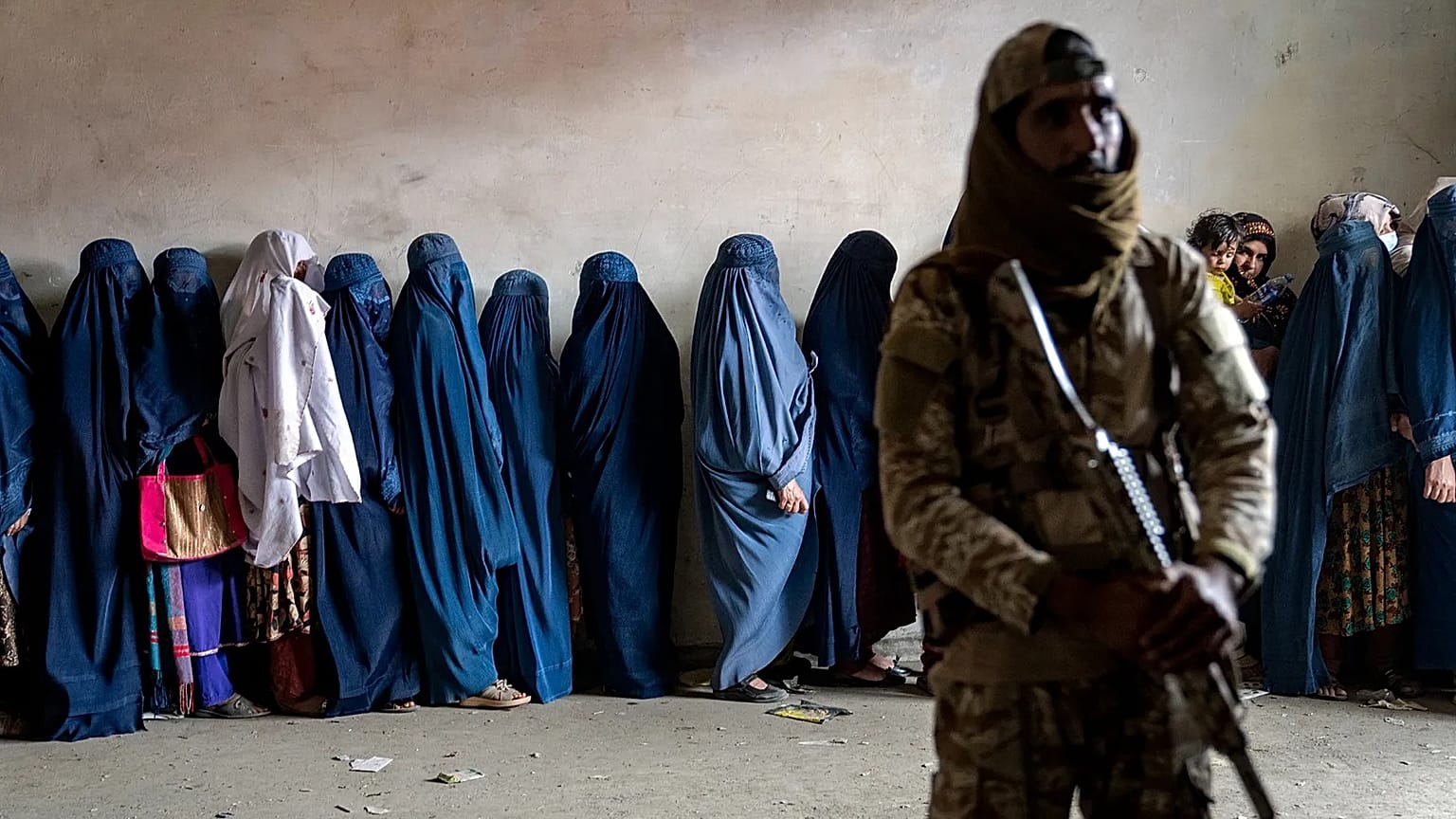
A Taliban fighter stands guard as women wait to receive food rations distributed by a humanitarian aid group in Kabul, 23 May, 2023
Copyright AP Photo

By Gavin Blackburn
Published on

Women nationwide must be completely covered when they leave home, with many wearing a flowing abaya robe along with a Muslim headscarf and a face covering.

Residents in the western Afghan city of Herat told the AFP news agency they had witnessed several women detained by the Taliban government's morality police, in a crackdown over clothing which has drawn criticism from the United Nations.

The UN mission in Afghanistan (UNAMA) said on Sunday it was "concerned over multiple arrests and detentions of women in Herat Afghanistan for alleged non-compliance with dress requirements."

Taliban authorities rule according to a strict interpretation of Islamic law and have gradually tightened restrictions on women since returning to power in August 2021.

Women nationwide must be completely covered when they leave home, with many wearing a flowing abaya robe along with a Muslim headscarf and a face covering.

In Herat, residents witnessed women being detained on Saturday for not wearing the body-cloaking chador or burqa. They spoke to AFP on condition of anonymity for security reasons.

"I saw two employees of the ministry, one of whom was carrying a whip, putting two women who were not wearing chadors into a vehicle," said a 23-year-old woman, referring to officials from the Ministry for the Propagation of Virtue and the Prevention of Vice (PVPV).

She said those detained were fully covered, including wearing Muslim headscarves.

"Everyone is frightened," she told AFP.

Another woman said she saw PVPV officials stopping vehicles and checking passengers' clothing and saw multiple women being detained and put into vans.

"The majority of those arrested were women who were not wearing chadors," the 27-year-old said.

The PVPV ministry did not comment on women being detained when contacted by AFP.

"There is nothing unusual in Herat," the ministry's information department said.

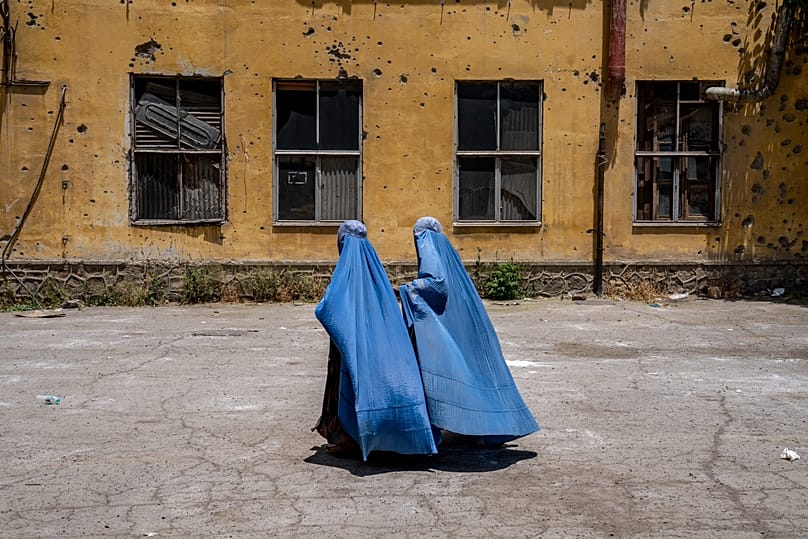
Afghan women wait to receive food rations distributed by a humanitarian aid group in Kabul, 28 May, 2023 AP Photo

The dress code "is a divine command and an enforced law and we are obligated to implement it," the ministry said.

Since the crackdown was launched, an AFP journalist and multiple residents in Herat said the number of women leaving home had dropped sharply.

A 20-year-old taxi driver said "they're not seen in the city at all."

"We've been told not to transport women without a chador," he said.

One woman described the situation as "unbearable".

"I am genuinely saddened that we don't even have the right to breathe freely," the 33-year-old said. "Life has become very difficult for us."


The International Refugee System Has Collapsed – OpEd


June 7, 2026 
Arab News
By Dr. Azeem Ibrahim

Displacement is no longer an interruption between two stable lives. It has become a condition of its own and the institutions built to address it were never designed for that reality.

When the architects of the postwar international order drafted the 1951 Refugee Convention, they had a specific crisis in mind. Europe was full of displaced people. Camps were filled with those uprooted by a war that had, mercifully, ended. The assumption embedded in every article of that convention was that displacement was an interruption, a temporary rupture that good institutions could bridge. Build the camps. Mobilize the aid. Wait for conditions to stabilize. Send the people home.

That model has not merely aged poorly. It has collapsed.


The numbers tell a story the international community has been reluctant to directly confront. According to the UN Refugee Agency, the number of forcibly displaced people worldwide passed 117 million in 2023, more than double the figure recorded a decade earlier. That doubling did not happen because the world suddenly became twice as violent. It happened because old crises are not resolving, while new ones accumulate on top of them. The pipeline flows in. Almost nothing flows out.

The clearest measure of this failure is duration. The average length of a major refugee situation now exceeds 20 years. Two decades. A child born in a camp at the moment of displacement grows to adulthood, forms a family and raises children of their own, all within a system designed to be temporary. The Afghan displacement crisis has, in various forms, persisted for more than 40 years. The Somali crisis for 30. The Palestinians, the original test case for whether the international community could manage protracted displacement, have been displaced for more than 75 years and counting. The emergency, in each case, became the permanent condition. The institutions responded by pretending otherwise.

This is not a resource problem, though resources are chronically inadequate. It is a structural one. The UN Refugee Agency’s mandate is organized around three durable solutions: voluntary repatriation, local integration in the country of first asylum and third-country resettlement. In theory, one of these three pathways resolves every refugee situation. In practice, all three are failing simultaneously.

Repatriation, historically the preferred and most common outcome, requires a safe, voluntary and dignified return. In the current landscape of protracted civil wars and authoritarian consolidation, those conditions rarely materialize.

Local integration is politically toxic in most host countries, which are overwhelmingly low and middle-income states already absorbing populations that dwarf anything the wealthy world accepts. Turkiye hosts more than 3.2 million registered Syrian refugees. Pakistan and Iran together host at least 4 million Afghans. Bangladesh carries nearly a million Rohingya in what is arguably the world’s most densely populated refugee settlement. These are not short-term burdens being temporarily shouldered. They are permanent demographic realities that host governments were never asked to formally accept and receive no proportionate support to manage.

Third-country resettlement, meanwhile, operates at a scale that borders on the symbolic. In 2022, the US, historically the world’s largest resettlement country, admitted fewer than 25,000 refugees from a global population requiring resettlement that the UN estimated at more than 1.5 million. The entire global resettlement system that year processed about 114,000 people. The math does not work and everyone involved knows it does not work.

The Rohingya crisis illustrates what this failure looks like in human terms. Nearly a million people have now spent eight years in the camps of Cox’s Bazar, with repatriation blocked by conditions in Myanmar that have deteriorated rather than improved since the 2017 expulsions. Local integration is politically unavailable in Bangladesh. Resettlement proceeds at a pace that could absorb the population over several centuries.

A generation of children has grown up with access to informal education at best, no legal right to work and no documentation that would allow participation in any formal economic life. The system’s three solutions are all inoperative. What remains is indefinite management dressed up as temporary accommodation.

The geopolitical consequences of this management approach are becoming impossible to ignore. Host states carrying disproportionate burdens without proportionate support eventually reach their political limits. When they do, the results are not orderly. They are dangerous. Secondary displacement, sea crossings, stateless populations that become recruitment pools for criminal networks and armed groups — these are not hypothetical risks, they are the documented outcomes of a system that offers people no legal horizon.


What is required is not more humanitarian pledges. The pledge-making machinery runs without interruption and without discernible effect. What is required is for the meaning of refugee protection to be fundamentally reconceived in cases where there is no foreseeable prospect of return.

Displaced people need the right to work, to move and to build economic lives in the countries that host them. Host countries need binding, enforceable burden-sharing arrangements rather than voluntary commitments that wealthy states consistently fail to honor. Development finance, not just emergency relief, needs to flow to the communities — both refugee and host — that are absorbing the cost of crises they did not cause.

The 1951 convention was a serious document written by serious people for a world in which displacement was an exception. They could not have imagined, or perhaps chose not to imagine, a world in which it was a permanent feature of the international landscape. That world is here. The gap between the institutions we have and the problem we face grows wider every year. Filling it is not a humanitarian aspiration. It is a geopolitical necessity.

The emergency was always going to become permanent. The only question was whether the system would adapt before the cost became unbearable. The answer, so far, is no.


Dr. Azeem Ibrahim is the director of special initiatives at the New Lines Institute for Strategy and Policy in Washington. X: @AzeemIbrahim


About Arab News

Arab News is Saudi Arabia's first English-language newspaper. It was founded in 1975 by Hisham and Mohammed Ali Hafiz. Today, it is one of 29 publications produced by Saudi Research & Publishing Company (SRPC), a subsidiary of Saudi Research & Marketing Group (SRMG).

View all posts by Arab News →


The dark side of the 2026 World Cup: Record-breaking emissions and thousands of flights

FILE - Azteca Stadium in Mexico City, 100 days before the opening ceremony of the FIFA 2026 World Cup, 3 March 2026.
Copyright AP Photo


By Christina Thykjaer
Published on

A report warns that the tournament in the US, Canada and Mexico could produce twice the emissions of previous editions.

The 2026 World Cup, to be held in the US, Canada and Mexico, could become the most polluting tournament in football history. That is the warning from FIFA's Climate Blind Spot, a report outlining how the expanded format, geographical spread and reliance on air travel will sharply increase its climate impact.

According to the study, produced by the New Weather Institute, this year's World Cup will generate at least nine million tonnes of CO₂ equivalent, almost double the average for tournaments held between 2010 and 2022, which was around 4.7 million. In broader scenarios, that figure could rise to 15 million tonnes, making the event one of the most polluting in the history of sport.

More teams, more matches, more emissions

One of the key factors is the change in format. The 2026 World Cup will feature 48 teams and 104 matches, a 63 per cent increase on previous editions. This expansion means more travel, more fans and greater pressure on infrastructure. The report stresses that this growth will lead to a significant increase in emissions, especially from air travel, which is already the tournament’s main source of pollution.

The most critical issue is logistics. Unlike other tournaments concentrated in a single country, the 2026 World Cup will be played in 16 cities spread across the North American continent, separated by thousands of kilometres. This will mean that teams, journalists and millions of fans will depend almost entirely on planes. In fact, the report estimates that air travel will generate more than 7.7 million tonnes of CO₂.

In addition, emissions linked to flights could rise by between 160 per cent and 325 per cent compared with previous tournaments, cementing transport as the event’s main climate problem.

A model that is hard to justify

Although the tournament will not require the mass construction of new stadiums, which partly reduces its impact, the report argues that the real problem is structural: a competition model that is ever larger, more global and more dependent on long-distance travel.

This is compounded by the lack of sustainable alternatives. Unlike Europe or Asia, North America does not have extensive high-speed rail networks that would help cut the carbon footprint of transport.

The report also questions FIFA’s climate strategy, accusing the body of having a "blind spot" when it comes to the environmental crisis. According to the authors, there is a clear gap between the organisation’s sustainability pledges and the reality of its decisions, such as expanding the tournament or choosing widely scattered host cities.

They warn that the 2026 World Cup could worsen the climate crisis, at a time when the world is calling for urgent cuts in emissions.

What does FIFA say?

The Fédération Internationale de Football Association (FIFA), for its part, insists that the 2026 World Cup will be accompanied by a sustainability strategy focused on reducing environmental impacts and leaving a "positive legacy" in the host cities. On its website, the organisation says it will promote sustainable construction standards in stadiums and temporary infrastructure, encourage the use of public transport and seek to cut waste, energy consumption and emissions associated with the tournament.

It also maintains that the host cities will be key to implementing long-term climate measures and promoting more sustainable practices beyond the competition itself. However, the report, produced in partnership with Scientists for Global Responsibility, Environmental Defense Fund and The Sport for Climate Action Network, warns that these measures are unlikely to offset the tournament’s structural impact.