Ice in the sky: Thailand's fight against air pollution
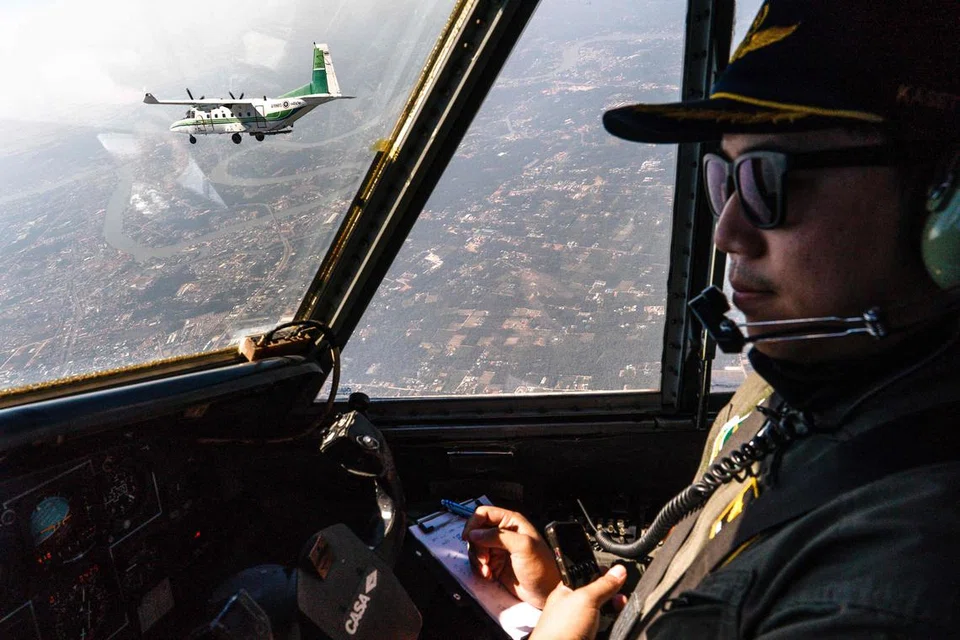
Twice a day, the Royal Rainmaking department sends aircraft up to spray cold water or dry ice into the layer of warm air to cool it down.PHOTO: AFP
UPDATED Jan 24, 2025,
Hua Hin - Flying through Bangkok’s cloudless blue skies, a small aircraft sprays a white mist over a thick haze of pea soup smog below.
This is Thailand’s desperate, unproven attempt at reducing the oppressive air pollution over its capital, which on Jan 23 reached eight times the World Health Organisation’s recommended daily maximum average.
The scourge has made more than a million people ill since late 2023 and cost Thailand more than US$88 million (S$119 million) in medical expenses, the public health ministry said earlier in January.
Air pollution in the Thai capital forced the closure of more than 350 schools – over a hundred more than the previous day – city authorities said on Jan 24, as Bangkok was ranked the world’s 7th-most polluted major city by air quality monitor IQAir.
According to Bangkok governor Chadchart Sittipunt, the main culprits are vehicle emissions, crop burning in the wider region and “closed” weather conditions – a warm atmospheric lid covering the dust, preventing it from dispersing.
Known as a temperature inversion, the kingdom is trying to deal with the phenomenon using a homegrown experimental method to displace the pollution.
Twice a day, the Royal Rainmaking department sends aircraft up to spray cold water or dry ice into the layer of warm air to cool it down.
AFP was granted exclusive access on board a flight over the outskirts of Bangkok.
Inside the small craft – which climbed to an altitude of around 1,500m – a scientist tracks the flight path on an iPad as two crew members release icy water from a pair of large blue containers that sprays out from the craft’s belly.
The theory is that reducing the temperature difference between the levels makes it easier for the trapped particles, known as PM2.5, to disperse into the upper atmosphere.
It is an unconventional method the department says is only used in Thailand.
“This is not the usual cloud seeding,” said programme head Chanti Detyothin.
‘Doing our best’
Countries have long tried “cloud seeding” – injecting chemicals such as silver iodide into clouds to trigger rain or snowfall – in attempts to alleviate drought and, increasingly, air pollution.
But its effectiveness is open to question and scientists say it has been shown to only be marginally useful in creating rain and absorbing pollutants.
Thailand’s worst smog happens during the dry season between December and April, when it is too windy and cloudless to induce precipitation.
More on this Topic
More than 250 Bangkok schools close over air pollution
Twice a day, the Royal Rainmaking department sends aircraft up to spray cold water or dry ice into the layer of warm air to cool it down.PHOTO: AFP
UPDATED Jan 24, 2025,
Hua Hin - Flying through Bangkok’s cloudless blue skies, a small aircraft sprays a white mist over a thick haze of pea soup smog below.
This is Thailand’s desperate, unproven attempt at reducing the oppressive air pollution over its capital, which on Jan 23 reached eight times the World Health Organisation’s recommended daily maximum average.
The scourge has made more than a million people ill since late 2023 and cost Thailand more than US$88 million (S$119 million) in medical expenses, the public health ministry said earlier in January.
Air pollution in the Thai capital forced the closure of more than 350 schools – over a hundred more than the previous day – city authorities said on Jan 24, as Bangkok was ranked the world’s 7th-most polluted major city by air quality monitor IQAir.
According to Bangkok governor Chadchart Sittipunt, the main culprits are vehicle emissions, crop burning in the wider region and “closed” weather conditions – a warm atmospheric lid covering the dust, preventing it from dispersing.
Known as a temperature inversion, the kingdom is trying to deal with the phenomenon using a homegrown experimental method to displace the pollution.
Twice a day, the Royal Rainmaking department sends aircraft up to spray cold water or dry ice into the layer of warm air to cool it down.
AFP was granted exclusive access on board a flight over the outskirts of Bangkok.
Inside the small craft – which climbed to an altitude of around 1,500m – a scientist tracks the flight path on an iPad as two crew members release icy water from a pair of large blue containers that sprays out from the craft’s belly.
The theory is that reducing the temperature difference between the levels makes it easier for the trapped particles, known as PM2.5, to disperse into the upper atmosphere.
It is an unconventional method the department says is only used in Thailand.
“This is not the usual cloud seeding,” said programme head Chanti Detyothin.
‘Doing our best’
Countries have long tried “cloud seeding” – injecting chemicals such as silver iodide into clouds to trigger rain or snowfall – in attempts to alleviate drought and, increasingly, air pollution.
But its effectiveness is open to question and scientists say it has been shown to only be marginally useful in creating rain and absorbing pollutants.
Thailand’s worst smog happens during the dry season between December and April, when it is too windy and cloudless to induce precipitation.
More than 250 Bangkok schools close over air pollution
Air quality falls in parts of Bangkok; residents urged to take precautions
The new technique was first used last year and is still in its testing stages.
Another aircraft measures pollutant concentrations before and after spraying to gauge the difference in air quality.
“The concentration (of PM 2.5) is less,” said Mr Chanti.
“The data suggests that at the level of our area of focus, the dust cleared up,” though he admits they cannot “make the pollution go away entirely. Even with this new technology, there are limitations.”
“We have been working every day for Bangkok to have clean air. We are doing our best as much as we can,” he said.
Oil and gas firm
Ahead of takeoff, rainmaking staff pile a tonne (1,000 litres) of either dry ice, or ice and water into a plane – traditional cloud-seeding aircraft with repurposed spraying equipment.
The dry ice – solidified carbon dioxide – is provided by Thailand’s oil and gas giant PTT and other energy companies.
PTT did not immediately respond to requests from AFP for comment.
Another fossil fuel company, Bangkok Industrial Gas, also donated dry ice to the programme this month, with managing director Piyabut Charuphen saying in a statement the gift was part of their “commitment to creating a sustainable future”.
Carbon dioxide is itself a greenhouse gas and the environmental and health effects of spraying dry ice in the atmosphere are not fully understood.
Ms Weenarin Lulitanonda, co-founder of Thailand Clean Air Network, accused the energy firms of “using cilantro to garnish their dish”.
The Thai idiom, she explained, meant that “instead of solving the problem, (they) are creating a beautiful image”.
Just one flight can cost up to US$1,500, and with aircraft taking off from three bases around the country, it can reach US$9,000 per day.
Mr Ekbordin Winijkul of the Asian Institute of Technology said it is more cost-effective for Bangkok to address the causes of pollution with proven measures such as low-emissions traffic zones.
City authorities are already pursuing many of these, he said, like banning some heavy-duty vehicles and working with other provinces to control agricultural burning.
“Before we try to do something,” he said, “at least we should have confidence in the data first”.
The new technique was first used last year and is still in its testing stages.
Another aircraft measures pollutant concentrations before and after spraying to gauge the difference in air quality.
“The concentration (of PM 2.5) is less,” said Mr Chanti.
“The data suggests that at the level of our area of focus, the dust cleared up,” though he admits they cannot “make the pollution go away entirely. Even with this new technology, there are limitations.”
“We have been working every day for Bangkok to have clean air. We are doing our best as much as we can,” he said.
Oil and gas firm
Ahead of takeoff, rainmaking staff pile a tonne (1,000 litres) of either dry ice, or ice and water into a plane – traditional cloud-seeding aircraft with repurposed spraying equipment.
The dry ice – solidified carbon dioxide – is provided by Thailand’s oil and gas giant PTT and other energy companies.
PTT did not immediately respond to requests from AFP for comment.
Another fossil fuel company, Bangkok Industrial Gas, also donated dry ice to the programme this month, with managing director Piyabut Charuphen saying in a statement the gift was part of their “commitment to creating a sustainable future”.
Carbon dioxide is itself a greenhouse gas and the environmental and health effects of spraying dry ice in the atmosphere are not fully understood.
Ms Weenarin Lulitanonda, co-founder of Thailand Clean Air Network, accused the energy firms of “using cilantro to garnish their dish”.
The Thai idiom, she explained, meant that “instead of solving the problem, (they) are creating a beautiful image”.
Just one flight can cost up to US$1,500, and with aircraft taking off from three bases around the country, it can reach US$9,000 per day.
Mr Ekbordin Winijkul of the Asian Institute of Technology said it is more cost-effective for Bangkok to address the causes of pollution with proven measures such as low-emissions traffic zones.
City authorities are already pursuing many of these, he said, like banning some heavy-duty vehicles and working with other provinces to control agricultural burning.
“Before we try to do something,” he said, “at least we should have confidence in the data first”.
AFP
Southeast Asian cities among world's most polluted, ranking shows

A view of the city amid air pollution in Bangkok, Thailand on Jan 24.
PHOTO: Reuters
REUTERS
A view of the city amid air pollution in Bangkok, Thailand on Jan 24.
PHOTO: Reuters
REUTERS
January 24, 2025
BANGKOK — Southeast Asian cities were among five most polluted in the world on Friday (Jan 24) according to air-monitoring organisation IQAir, with Ho Chi Minh City ranked second-most polluted, followed by Phnom Penh and Bangkok fourth and fifth, respectively.
In the Thai capital, a thick smog was seen covering the city's skyline. Workers, especially those who spend most of their time outdoors, were suffering.
"My nose is constantly congested. I have to blow my nose all the time," said motorcycle taxi driver Supot Sitthisiri, 55.
Air pollution is caused by a combination of crop-related burning, industrial pollution and heavy traffic.
In a bid to curb pollution, the government is allowing free public transportation for a week, Transport Minister Suriya Juangroongruangkit said.
Some 300 schools in Bangkok were closed this week, according to the city administration.
"They should take more action, not just announce high dust levels and close schools. There needs to be more than that," said Khwannapat Intarit, 23.
"It keeps coming back, and it’s getting worse each time."
Thai Prime Minister Paetongtarn Shinawatra said in a social media post that companies and government agencies should allow staff to work from home to reduce car use and construction sites should be using dust covers.
"The government is fully committed to solving the dust problem," she said.
In Vietnam's largest city, IQAir said the level of fine inhalable particles in Ho Chi Minh City was 11 times higher than the recommended level by the World Health Organisation.
Weeks earlier, the capital Hanoi was ranked the world's most polluted, prompting authorities to issue a warning about the health risks from air pollution and urging the public to wear masks and eye protection.
Governments in Southeast Asia were pushing for longer-term solutions to bring pollution down including a carbon tax and promoting the use of electric vehicles.
BANGKOK — Southeast Asian cities were among five most polluted in the world on Friday (Jan 24) according to air-monitoring organisation IQAir, with Ho Chi Minh City ranked second-most polluted, followed by Phnom Penh and Bangkok fourth and fifth, respectively.
In the Thai capital, a thick smog was seen covering the city's skyline. Workers, especially those who spend most of their time outdoors, were suffering.
"My nose is constantly congested. I have to blow my nose all the time," said motorcycle taxi driver Supot Sitthisiri, 55.
Air pollution is caused by a combination of crop-related burning, industrial pollution and heavy traffic.
In a bid to curb pollution, the government is allowing free public transportation for a week, Transport Minister Suriya Juangroongruangkit said.
Some 300 schools in Bangkok were closed this week, according to the city administration.
"They should take more action, not just announce high dust levels and close schools. There needs to be more than that," said Khwannapat Intarit, 23.
"It keeps coming back, and it’s getting worse each time."
Thai Prime Minister Paetongtarn Shinawatra said in a social media post that companies and government agencies should allow staff to work from home to reduce car use and construction sites should be using dust covers.
"The government is fully committed to solving the dust problem," she said.
In Vietnam's largest city, IQAir said the level of fine inhalable particles in Ho Chi Minh City was 11 times higher than the recommended level by the World Health Organisation.
Weeks earlier, the capital Hanoi was ranked the world's most polluted, prompting authorities to issue a warning about the health risks from air pollution and urging the public to wear masks and eye protection.
Governments in Southeast Asia were pushing for longer-term solutions to bring pollution down including a carbon tax and promoting the use of electric vehicles.

No comments:
Post a Comment