Disability justice organizers are turning to immigrant rights groups to guide their interventions and support work.
By Marianne Dhenin ,
March 25, 2026
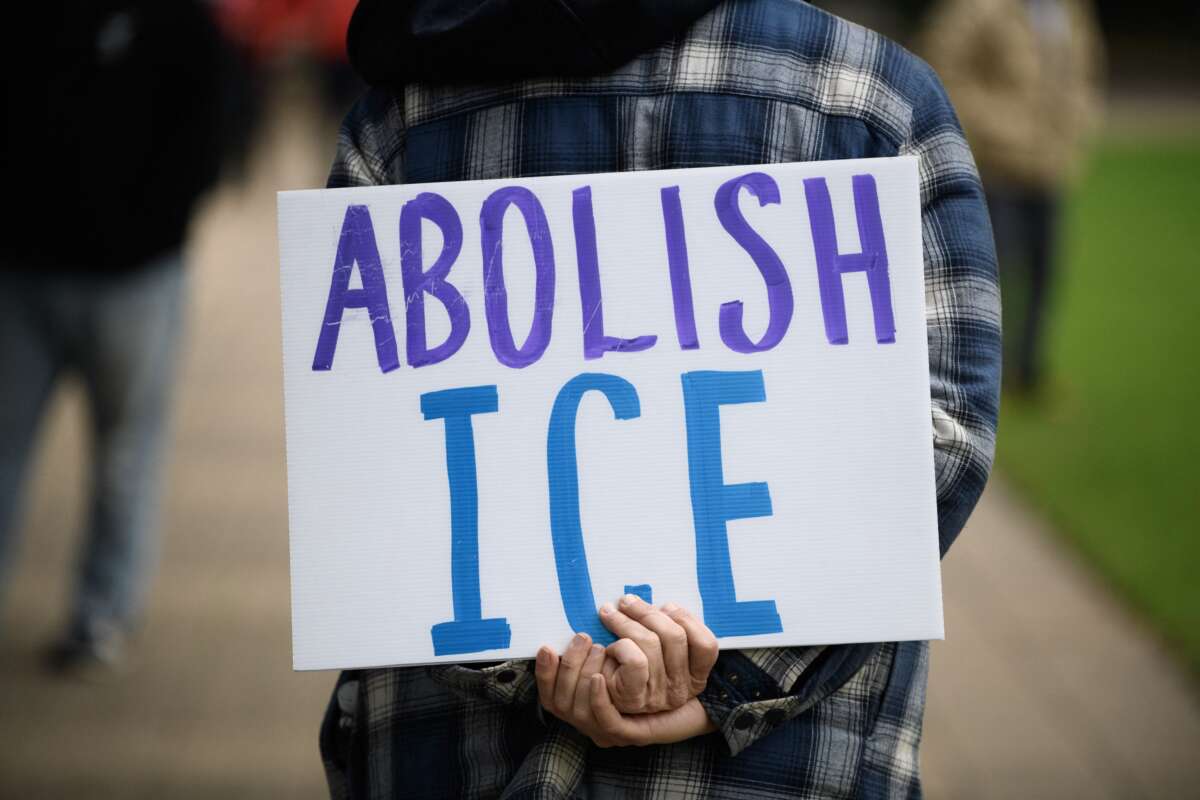
A demonstrator holds a sign that says “Abolish ICE” during a protest in Houston, Texas, on January 10, 2026.Mark Felix / AFP via Getty Images
Since Donald Trump returned to the Oval Office last year, the number of people in immigration detention has almost doubled from 40,000 to about 75,000. Disabled people face an increased threat of violence and detention from law enforcement, including the Immigration and Customs Enforcement (ICE) and Customs and Border Protection (CBP) agents who have been deployed to terrorize communities and detain neighbors in Los Angeles, Chicago, Minneapolis, and elsewhere as part of Trump’s crackdown over the last year.
As the Trump administration’s assault on migrant communities escalates, members of the disability community are showing up for their neighbors on all fronts — in Congress and the courts, at protests, and as nodes in mutual aid and ICE watch networks. Disabled organizers who spoke to Truthout said the attacks feel all too familiar, and it’s a fight they cannot imagine sitting out.
“Fascism is not new to this group, the idea of being disposable, not being of value to this capitalist society, aggressive institutionalization, state-sanctioned violence, lack of resources — we have been screaming from our lungs that there was something severely wrong,” Ramiro Alvarez, communications director at Detroit Disability Power (DDP), told Truthout. “It’s not a ‘We told you so’ moment. It’s a ‘We are glad more people are waking up and there are more in this fight’ moment.”
Research has repeatedly shown that disabled people are overrepresented at every stage of the criminal legal system. They account for upwards of two-thirds of the U.S. prisoner population. However, no similar demographic data exists for the population in immigration jails.
Members of the disability community are showing up for their neighbors on all fronts — in Congress and the courts, at protests, and as nodes in mutual aid and ICE watch networks.
The risks are even greater for disabled people of color, who are likewise overrepresented in the criminal legal system. Of those incarcerated in the U.S., 1 in 3 are Black men, and 1 in 6 are Latino men, compared to only 1 in 17 white men. People of color are also more likely to be disabled and less likely to have access to needed health care.
“Anybody who’s not white and is disabled is at such a huge risk of being profiled by ICE and CBP,” CT Tyson, government affairs liaison at the Disability Rights Education and Defense Fund (DREDF), told Truthout.
Since Donald Trump returned to the Oval Office last year, the number of people in immigration detention has almost doubled from 40,000 to about 75,000. Disabled people face an increased threat of violence and detention from law enforcement, including the Immigration and Customs Enforcement (ICE) and Customs and Border Protection (CBP) agents who have been deployed to terrorize communities and detain neighbors in Los Angeles, Chicago, Minneapolis, and elsewhere as part of Trump’s crackdown over the last year.
As the Trump administration’s assault on migrant communities escalates, members of the disability community are showing up for their neighbors on all fronts — in Congress and the courts, at protests, and as nodes in mutual aid and ICE watch networks. Disabled organizers who spoke to Truthout said the attacks feel all too familiar, and it’s a fight they cannot imagine sitting out.
“Fascism is not new to this group, the idea of being disposable, not being of value to this capitalist society, aggressive institutionalization, state-sanctioned violence, lack of resources — we have been screaming from our lungs that there was something severely wrong,” Ramiro Alvarez, communications director at Detroit Disability Power (DDP), told Truthout. “It’s not a ‘We told you so’ moment. It’s a ‘We are glad more people are waking up and there are more in this fight’ moment.”
Research has repeatedly shown that disabled people are overrepresented at every stage of the criminal legal system. They account for upwards of two-thirds of the U.S. prisoner population. However, no similar demographic data exists for the population in immigration jails.
Members of the disability community are showing up for their neighbors on all fronts — in Congress and the courts, at protests, and as nodes in mutual aid and ICE watch networks.
The risks are even greater for disabled people of color, who are likewise overrepresented in the criminal legal system. Of those incarcerated in the U.S., 1 in 3 are Black men, and 1 in 6 are Latino men, compared to only 1 in 17 white men. People of color are also more likely to be disabled and less likely to have access to needed health care.
“Anybody who’s not white and is disabled is at such a huge risk of being profiled by ICE and CBP,” CT Tyson, government affairs liaison at the Disability Rights Education and Defense Fund (DREDF), told Truthout.

Disability Justice Organizers Are Creating the Liberatory Future We All Deserve
Organizers share where they find hope in the struggle for disability justice as we go into the second year of Trump 2.0. By Marianne Dhenin , Truthout January 6, 2026
Laura Murchie, a staff attorney focused on immigration law at Disability Law United, told Truthout that even if a person is not disabled when agents arrest them, many will develop illnesses or disabilities as they are moved through the immigration detention system. The scale and speed of Trump’s crackdown make matters worse.
“The harm is disproportionate to folks who are disabled,” Murchie told Truthout. “This has always been true, but I think because of the extra violence with which the administration is quote-unquote ‘executing the laws,’ it is a disabling event, as well.”
Several high-profile cases of federal agents harming disabled people have already made headlines. Last August, agents handcuffed a 15-year old disabled teen outside a Los Angeles high school. In January, agents dragged Aliya Rahman, a disabled woman with autism and a traumatic brain injury, from her car in Minneapolis, detained her, and denied her emergency medical care. Last month, agents abandoned Nurul Amin Shah Alam, a low-vision Rohingya refugee from Myanmar, alone and in freezing weather outside a closed shop near Buffalo, New York. He was later found dead.
“Anybody who’s not white and is disabled is at such a huge risk of being profiled by ICE and CBP.”
Abuse of sick and disabled people and medical neglect within ICE detention are well-documented issues that predate Trump 2.0, and advocates fear conditions could worsen further under the current administration. One U.S. Senate report released last October uncovered more than 80 instances of medical neglect in immigration jails nationwide. The following month, seven people sued the Trump administration over inhumane conditions at a California ICE jail. The plaintiffs report being denied treatment for a likely case of prostate cancer, having insulin and heart medications withheld, and being denied proper access to hygiene facilities.
Murchie told Truthout that many of her deaf clients are not being provided interpreters. Other clients who communicate using sign language are also having their hands shackled.
But the involvement of disability rights and justice advocates in the fight against Trump’s anti-immigrant crackdown runs deeper than concerns for the disabled people swept up in it. “We are upset and concerned and panicked about what this means for our entire community,” Tyson told Truthout. “You don’t have to be disabled for us to care; we’re speaking up for everybody.”
Speaking up looks a little different for each organization, as organizers turn to immigrant rights groups to guide their interventions and respond to the needs of their local communities. DREDF is collaborating with human rights, emergency management, and other organizations to demand that Congress adopt meaningful measures to stop the violence. The organization also spearheaded a March 1 letter urging lawmakers to return funds taken from Medicaid and the Supplemental Nutrition Assistance Program (SNAP) to arm the Department of Homeland Security. DREDF has also compiled a suite of resources on how immigrant rights and disability rights are intertwined, in the hopes of helping disabled immigrants, their community members, and the organizations that serve them navigate Trump’s crackdown.
“We have heard from some of the immigrant rights groups we follow how important it is for there to be allied organizations that Congress doesn’t expect to hear from,” Tyson told Truthout. “We are going to use whatever platform we have to call this out [and] demand the funding and the prioritization of care and not violence.”
Access Living, a Chicago-based disability services and support organization, is among the 70 groups that signed DREDF’s March 1 letter. The organization has also been hard at work coordinating “know your rights” trainings in several languages, as well as other educational events and resources focused on protecting disabled migrants. That work helped the city overcome ICE’s “Operation Midway Blitz,” an onslaught launched in September.
“We have been highlighting the fear that our immigrants with disabilities have [when they] go into hospitals and get treatments that they need,” Michelle Garcia, manager of organizing and community development at Access Living, told Truthout. “They fear ICE going into the clinics and taking them away, or not getting the proper care because if they say they’re not documented, that means they won’t receive care because they don’t have insurance.”
Garcia told Truthout that many immigrants with disabilities are also scared of being removed: “If they go back to their countries of origin, they’re more likely to end up in a worse condition than they are now here without any supports.”
To help community members navigate these concerns and organize to protect one another, Access Living has also expanded its Cambiando Vidas (Changing Lives) group. Cambiando Vidas functions as a support group and lobbies for legislative changes to support immigrants in Illinois. It was launched to serve Latinx people with disabilities and now welcomes disabled immigrants from other communities.
Meanwhile, Alvarez told Truthout his organization understands its role as one of building bridges between “all these badass disabled Detroiters” who want to get involved in fighting Trump’s anti-immigrant agenda and local grassroots campaigns that might not have the resources or the know-how to make their efforts more inclusive.
Among its interventions, DDP has advised on making outreach and recruitment materials more accessible, recommended adding questions about access needs to sign-up forms, trained organizations to use plain language, and encouraged masking and other access considerations at events. These efforts have helped a growing number of disabled people get involved in neighborhood ICE watch and other efforts, such as grocery delivery and student pick-up and drop-offs, to support families forced to reduce outings or shelter in place.
“What spurred this whole idea is this desire that we see in our community of a bunch of disabled people ready to plug in, and then this movement that’s not ready to have them plug in because there are so many access barriers,” Alvarez told Truthout. “We’re trying to create something that meets both of those needs.”
Wherever disability rights and justice organizers contribute, they bring a unique perspective to those organizing spaces. Alvarez told Truthout that this includes helping organizers understand how improving access and thinking about disability justice benefits everyone, not only disabled people.
“A lot of the organizers are realizing they’re experiencing an access need at their own job, that they are near burnout, that they’re experiencing fatigue, that they’re having pain flare-ups, that they’re getting sick more often,” Alvarez told Truthout. “Part of our disability wisdom is reminding movements that being unhealthy, tired, and burnt out is exactly where they want us, and our movements only succeed if we treat this as a marathon relay and not a single-man sprint.”
Looking forward, Alvarez said he hopes the movement will continue to learn from and lean on its disabled organizers and their ideas for building a more just and caring future. “At the end of this — because there will be an end to this, and we will win — there’s going to need to be a grand effort of care,” he told Truthout. “Disabled people are saying, ‘This time we’re going to center the most vulnerable instead of centering an individual … we’re going to center a community,’ and that community being our children, our elderly, and our disabled — those that need us the most.”

No comments:
Post a Comment