Meant to be a time of celebration and renewal, Nowruz has taken on a different tone under US-Israeli attacks.
By Kourosh Ziabari ,
March 27, 2026
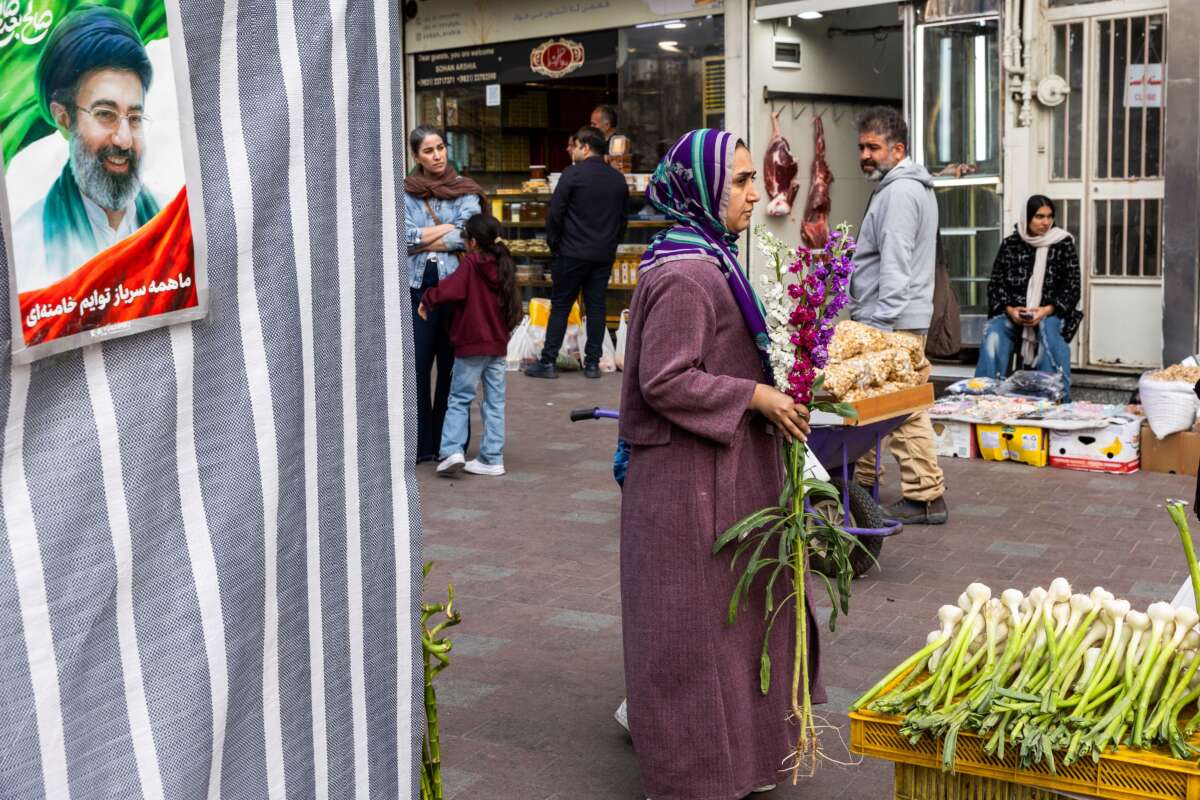
A woman carries flowers at a market as people prepare for Nowruz celebrations, on March 19, 2026, in Tehran, Iran.Majid Saeedi / Getty Images
For millennia, Iranians have marked the first day of spring, which usually falls on March 20 or 21 according to the Persian solar calendar, as the beginning of their new year. The 13 days of festivities that typically follow are known in Iran as Nowruz, meaning “new day” in the Persian language. But as Iran continues to be bombed by the United States and Israel in a war of aggression that is now well into its fourth week, the holiday has taken on a different meaning and tone this year.
Preparations for Nowruz often start several weeks ahead of spring, as families embark on a comprehensive home cleaning known as khaneh-tekani, or “shaking the house”: washing carpets, dusting off furniture and surfaces, recycling old items, painting the walls, and sweeping the yards. This year, many Iranians, including those who managed to share their experiences on social media, said they didn’t have the opportunity or energy to engage in the thorough spring-cleaning effort.
Instead, houses shook across the country — including in major cities such as Tehran, Ahvaz, Isfahan, Karaj, and Tabriz — under U.S.-Israeli bombardment. Throughout the war, U.S.-Israeli strikes have killed at least 3,300 Iranians, including at least 1,464 civilians as of March 26, and destroyed (either partially or fully) more than 85,000 residential buildings, hospitals, schools, and businesses. The strikes hit an elementary school in Minab, in which more than 150 students were killed, and severely damaged multiple historical sites, including an 1,800-year-old citadel.
Parnian, a 22-year-old college student in the city of Rasht in northern Iran, told Truthout the war wreaked havoc on her plans to mark the holiday, adding that her family didn’t start the traditional house cleaning and shopping until two days before Nowruz began on March 20.
“Our lives have become totally different compared to the previous war,” she said, referring to the 12-day U.S.-Israeli war on Iran last June. “Whatever motivation we had gathered for Nowruz faded away and my family wasn’t really in the mood to do anything.” Parnian shared this through an instant messaging app that she connected to with intermittent signals as the Iranian government’s near-total blockade on internet access drags on.
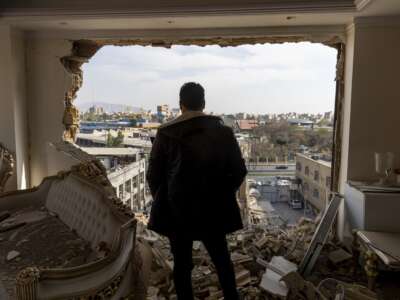
Tehran Residents’ Social Media Offer Nightmarish Glimpse of Humanitarian Crisis
Oily smoke. Black rain. Destroyed apartments. Loved ones killed by airstrikes. Iran will not recover soon from this. By Kourosh Ziabari , Truthout March 18, 2026
“But we couldn’t resist the urge, so we got up, quickly ran some cleaning errands, and set up a beautiful haft-seen table three hours before the transition of the year,” she added, referring to a decorative table that Iranian households prepare, containing seven items whose name start with the letter ‘s’ each carrying a symbolic significance. Families usually huddle around the haft-seen during the exact moment of vernal equinox, as cannon fire and folk music mark the official beginning of the new year.
Iranians also mark Nowruz with visits to loved ones. Parnian noted, unhappily, that conversations during such visits this year revolved around politics and the trajectory of the war. She said many extended family members had simply called off large gatherings that often follow the arrival of Nowruz because of the climate of bereavement that’s dominant around the country.
“Nowruz is meant to be a time of gathering, celebration, and renewal, but for many Iranians this year, it became something much heavier.”
That feeling has been pervasive across parts of the diaspora as well. “Nowruz is meant to be a time of gathering, celebration, and renewal, but for many Iranians this year, it became something much heavier,” said Vira Ameli, a postdoctoral researcher and lecturer at the University of Oxford’s Health Systems Collaborative, in an interview with Truthout. “It almost felt like mourning for Nowruz itself. There was uncertainty, anxiety, and grief.”
On March 23, Ameli gave a public address at the Oxford City Council in support of a motion condemning the unprovoked U.S.-Israeli war on Iran. One theme she highlighted was the attack on Iran’s cultural heritage sites, several of which have been damaged in the airstrikes. That includes the 14th-century Golestan Palace, one of Tehran’s oldest monuments that often hosts Nowruz celebrations.
“These are not simply magnificent structures. They are the record of continuity of a civilization that has endured far more than two and a half thousand years, and that endurance has not been built on expansion. It has been built on preservation, on the ability of a people to remain alive in their language, in their memory, in their resistance, and in their understanding of themselves,” she said in her speech.
“When these sites are targeted, what is struck is not only stone, it is the continuity, it is the link between past and present, it is our national heritage, but also world heritage. And here in Oxford, this cannot be unfamiliar. This is a city that has made a life out of preservation … So, when heritage is damaged elsewhere, Oxford is not untouched by it,” Ameli added. Her address drew sustained applause from the audience.
The Oxford scholar said she had booked a flight to Tehran for March 6 to see her mother and family. The onset of war made it impossible for them to reunite ahead of Nowruz.
The fact that U.S. and Israeli attacks didn’t stop for the holiday — with air strikes even continuing in the moments that Iran rang in the new year — has been seen by some Iranians as yet another infringement on cultural heritage: The military campaign wasn’t halted, at least temporarily, as an indication of respect for an ancient new year tradition. Instead, on March 20, Donald Trump issued a lukewarm Nowruz message without mentioning Iran. In the same message, he called the ongoing campaign a “righteous mission.” Since coming back to power last year, in line with his first term, Trump has called off the annual Nowruz receptions that Presidents Barack Obama and Joe Biden often hosted at the White House.
Rooted in Zoroastrianism, Nowruz has long connected Iranians of all religious, ethnic, and cultural backgrounds, blurring the lines of ideological differences. Despite its Iranian provenance, the holiday is marked across Central Asia, the Caucasus, the Balkans, and the Middle East.
In 2009, Nowruz was included in the inventory of the UN cultural and educational agency’s Intangible Cultural Heritage of Humanity for the first time. In 2010, the United Nations General Assembly recognized March 21 as the International Day of Nowruz, noting that the holiday offers “a rich tapestry of customs, traditions, and shared values.” Following a nomination submitted by Iran and 12 other countries, Nowruz was added to UNESCO’s representative list of the intangible cultural assets in 2024, replacing an earlier inscription in 2016.
In Iran’s neighborhood, countries such as Afghanistan, Iraq, Kyrgyzstan, and Tajikistan, as well as Kurdish communities, observe Nowruz, celebrating it with rituals that include folk dances, musical performances, cooking a sweet wheat pudding known as samanu, growing hyacinth flowers, and donating to charity.
Generations of Iranians have cherished Nowruz, shielding it from attempts by some domestic rulers and foreign conquerors to erase it. So acknowledging that a large-scale war has interfered with the marking of a treasured holiday meant to celebrate renewal and nature has not been easy.
Kaveh, a 27-year-old student of English language from Rasht who wished to use a pseudonym for security reasons, said the community is mournful and dejected, but people are still trying to lift each other up as much as possible.
“At the haft-seen table, my family and I were sitting motionless after the new year was announced, shedding tears for five minutes,” he told Truthout. “I talked to other people I could communicate with online, and we were all wondering if something had changed compared to a few minutes earlier when the new year hadn’t started yet.”
“I didn’t buy new year clothes, and my dad didn’t even go to buy dried nuts,” Kaveh said, referencing something Iranian families would typically have on hand for the holiday. “We only bought some gifts for my younger brother and sister,” he added. “People aren’t feeling happy. They’re just pretending that they’re doing okay.”
“Nowruz is a huge part of our identity. It’s rooted in our culture, and it connects us all.”
“Nowruz is a huge part of our identity. It’s rooted in our culture, and it connects us all,” Shirin Jaafari, an Iranian American journalist at the WGBH radio station, told Truthout. “It’s more than just a New Year celebration, it’s a time for us to pause and reflect on the past year, come together with family and friends and celebrate a new beginning.”
But, she said, many Iranians have been feeling something different this year: “Those of us who have loved ones in Iran spend every hour worried about their safety and well-being.”
“And it’s not just the bombs. The huge fires at the fuel depots around Tehran sent toxic chemicals into the air,” Jaafari said, referencing the brutal aftermath of Israeli strikes on oil depots around Tehran. “What does that do to people’s health? What does it do to the environment?”
The bombing campaign has shown no sign of slowing down in the new year, and has continued to hit significant civilian targets. Imam Ali Hospital in the southeastern city of Andimeshk in Khuzestan Province was partially destroyed in U.S.-Israeli airstrikes. On the second day of Nowruz, the house of the late acclaimed Iranian director Abbas Kiarostami, a Palme d’Or winner at the 1997 Cannes Film Festival, was damaged in airstrikes that targeted Tehran’s Chizar neighborhood.
Porochista Khakpour, an Iranian American writer and author of the 2007 novel Sons and Other Flammable Objects, said the spirit of Nowruz is the antithesis of “global fascist movements”: “I love that it is a celebration that unites so many cultures, beyond Iran even, and that it falls on the vernal equinox, a symbolically lovely starting point for a new year.”
But, despite the political resonance of Nowruz, Khakpour said she is not feeling festive this year. “It is the most life-affirming celebration there is. If there is a real ceasefire and end to this war, I will celebrate then.”
This article is licensed under Creative Commons (CC BY-NC-ND 4.0), and you are free to share and republish under the terms of the license.
For millennia, Iranians have marked the first day of spring, which usually falls on March 20 or 21 according to the Persian solar calendar, as the beginning of their new year. The 13 days of festivities that typically follow are known in Iran as Nowruz, meaning “new day” in the Persian language. But as Iran continues to be bombed by the United States and Israel in a war of aggression that is now well into its fourth week, the holiday has taken on a different meaning and tone this year.
Preparations for Nowruz often start several weeks ahead of spring, as families embark on a comprehensive home cleaning known as khaneh-tekani, or “shaking the house”: washing carpets, dusting off furniture and surfaces, recycling old items, painting the walls, and sweeping the yards. This year, many Iranians, including those who managed to share their experiences on social media, said they didn’t have the opportunity or energy to engage in the thorough spring-cleaning effort.
Instead, houses shook across the country — including in major cities such as Tehran, Ahvaz, Isfahan, Karaj, and Tabriz — under U.S.-Israeli bombardment. Throughout the war, U.S.-Israeli strikes have killed at least 3,300 Iranians, including at least 1,464 civilians as of March 26, and destroyed (either partially or fully) more than 85,000 residential buildings, hospitals, schools, and businesses. The strikes hit an elementary school in Minab, in which more than 150 students were killed, and severely damaged multiple historical sites, including an 1,800-year-old citadel.
Parnian, a 22-year-old college student in the city of Rasht in northern Iran, told Truthout the war wreaked havoc on her plans to mark the holiday, adding that her family didn’t start the traditional house cleaning and shopping until two days before Nowruz began on March 20.
“Our lives have become totally different compared to the previous war,” she said, referring to the 12-day U.S.-Israeli war on Iran last June. “Whatever motivation we had gathered for Nowruz faded away and my family wasn’t really in the mood to do anything.” Parnian shared this through an instant messaging app that she connected to with intermittent signals as the Iranian government’s near-total blockade on internet access drags on.
Tehran Residents’ Social Media Offer Nightmarish Glimpse of Humanitarian Crisis
Oily smoke. Black rain. Destroyed apartments. Loved ones killed by airstrikes. Iran will not recover soon from this. By Kourosh Ziabari , Truthout March 18, 2026
“But we couldn’t resist the urge, so we got up, quickly ran some cleaning errands, and set up a beautiful haft-seen table three hours before the transition of the year,” she added, referring to a decorative table that Iranian households prepare, containing seven items whose name start with the letter ‘s’ each carrying a symbolic significance. Families usually huddle around the haft-seen during the exact moment of vernal equinox, as cannon fire and folk music mark the official beginning of the new year.
Iranians also mark Nowruz with visits to loved ones. Parnian noted, unhappily, that conversations during such visits this year revolved around politics and the trajectory of the war. She said many extended family members had simply called off large gatherings that often follow the arrival of Nowruz because of the climate of bereavement that’s dominant around the country.
“Nowruz is meant to be a time of gathering, celebration, and renewal, but for many Iranians this year, it became something much heavier.”
That feeling has been pervasive across parts of the diaspora as well. “Nowruz is meant to be a time of gathering, celebration, and renewal, but for many Iranians this year, it became something much heavier,” said Vira Ameli, a postdoctoral researcher and lecturer at the University of Oxford’s Health Systems Collaborative, in an interview with Truthout. “It almost felt like mourning for Nowruz itself. There was uncertainty, anxiety, and grief.”
On March 23, Ameli gave a public address at the Oxford City Council in support of a motion condemning the unprovoked U.S.-Israeli war on Iran. One theme she highlighted was the attack on Iran’s cultural heritage sites, several of which have been damaged in the airstrikes. That includes the 14th-century Golestan Palace, one of Tehran’s oldest monuments that often hosts Nowruz celebrations.
“These are not simply magnificent structures. They are the record of continuity of a civilization that has endured far more than two and a half thousand years, and that endurance has not been built on expansion. It has been built on preservation, on the ability of a people to remain alive in their language, in their memory, in their resistance, and in their understanding of themselves,” she said in her speech.
“When these sites are targeted, what is struck is not only stone, it is the continuity, it is the link between past and present, it is our national heritage, but also world heritage. And here in Oxford, this cannot be unfamiliar. This is a city that has made a life out of preservation … So, when heritage is damaged elsewhere, Oxford is not untouched by it,” Ameli added. Her address drew sustained applause from the audience.
The Oxford scholar said she had booked a flight to Tehran for March 6 to see her mother and family. The onset of war made it impossible for them to reunite ahead of Nowruz.
The fact that U.S. and Israeli attacks didn’t stop for the holiday — with air strikes even continuing in the moments that Iran rang in the new year — has been seen by some Iranians as yet another infringement on cultural heritage: The military campaign wasn’t halted, at least temporarily, as an indication of respect for an ancient new year tradition. Instead, on March 20, Donald Trump issued a lukewarm Nowruz message without mentioning Iran. In the same message, he called the ongoing campaign a “righteous mission.” Since coming back to power last year, in line with his first term, Trump has called off the annual Nowruz receptions that Presidents Barack Obama and Joe Biden often hosted at the White House.
Rooted in Zoroastrianism, Nowruz has long connected Iranians of all religious, ethnic, and cultural backgrounds, blurring the lines of ideological differences. Despite its Iranian provenance, the holiday is marked across Central Asia, the Caucasus, the Balkans, and the Middle East.
In 2009, Nowruz was included in the inventory of the UN cultural and educational agency’s Intangible Cultural Heritage of Humanity for the first time. In 2010, the United Nations General Assembly recognized March 21 as the International Day of Nowruz, noting that the holiday offers “a rich tapestry of customs, traditions, and shared values.” Following a nomination submitted by Iran and 12 other countries, Nowruz was added to UNESCO’s representative list of the intangible cultural assets in 2024, replacing an earlier inscription in 2016.
In Iran’s neighborhood, countries such as Afghanistan, Iraq, Kyrgyzstan, and Tajikistan, as well as Kurdish communities, observe Nowruz, celebrating it with rituals that include folk dances, musical performances, cooking a sweet wheat pudding known as samanu, growing hyacinth flowers, and donating to charity.
Generations of Iranians have cherished Nowruz, shielding it from attempts by some domestic rulers and foreign conquerors to erase it. So acknowledging that a large-scale war has interfered with the marking of a treasured holiday meant to celebrate renewal and nature has not been easy.
Kaveh, a 27-year-old student of English language from Rasht who wished to use a pseudonym for security reasons, said the community is mournful and dejected, but people are still trying to lift each other up as much as possible.
“At the haft-seen table, my family and I were sitting motionless after the new year was announced, shedding tears for five minutes,” he told Truthout. “I talked to other people I could communicate with online, and we were all wondering if something had changed compared to a few minutes earlier when the new year hadn’t started yet.”
“I didn’t buy new year clothes, and my dad didn’t even go to buy dried nuts,” Kaveh said, referencing something Iranian families would typically have on hand for the holiday. “We only bought some gifts for my younger brother and sister,” he added. “People aren’t feeling happy. They’re just pretending that they’re doing okay.”
“Nowruz is a huge part of our identity. It’s rooted in our culture, and it connects us all.”
“Nowruz is a huge part of our identity. It’s rooted in our culture, and it connects us all,” Shirin Jaafari, an Iranian American journalist at the WGBH radio station, told Truthout. “It’s more than just a New Year celebration, it’s a time for us to pause and reflect on the past year, come together with family and friends and celebrate a new beginning.”
But, she said, many Iranians have been feeling something different this year: “Those of us who have loved ones in Iran spend every hour worried about their safety and well-being.”
“And it’s not just the bombs. The huge fires at the fuel depots around Tehran sent toxic chemicals into the air,” Jaafari said, referencing the brutal aftermath of Israeli strikes on oil depots around Tehran. “What does that do to people’s health? What does it do to the environment?”
The bombing campaign has shown no sign of slowing down in the new year, and has continued to hit significant civilian targets. Imam Ali Hospital in the southeastern city of Andimeshk in Khuzestan Province was partially destroyed in U.S.-Israeli airstrikes. On the second day of Nowruz, the house of the late acclaimed Iranian director Abbas Kiarostami, a Palme d’Or winner at the 1997 Cannes Film Festival, was damaged in airstrikes that targeted Tehran’s Chizar neighborhood.
Porochista Khakpour, an Iranian American writer and author of the 2007 novel Sons and Other Flammable Objects, said the spirit of Nowruz is the antithesis of “global fascist movements”: “I love that it is a celebration that unites so many cultures, beyond Iran even, and that it falls on the vernal equinox, a symbolically lovely starting point for a new year.”
But, despite the political resonance of Nowruz, Khakpour said she is not feeling festive this year. “It is the most life-affirming celebration there is. If there is a real ceasefire and end to this war, I will celebrate then.”
This article is licensed under Creative Commons (CC BY-NC-ND 4.0), and you are free to share and republish under the terms of the license.
Kourosh Ziabari
Kourosh Ziabari is a journalist and media studies researcher. A contributor to Foreign Policy and New Lines Magazine, he has earned a master’s degree in political journalism from Columbia University Graduate School of Journalism. In 2022, he received the Professional Excellence Award from the Foreign Press Correspondents Association. In 2022, Kourosh became the first journalist from Iran to be selected for the World Press Institute fellowship with the University of St. Thomas, Minnesota, since 1979. He was a finalist for three Kurt Schork Awards in International Journalism in 2020, 2021 and 2022 and has reported from the United Nations on a Dag Hammarskjold Fund for Journalists fellowship. He was a 2016/17 Chevening Scholar with the UK’s Foreign and Commonwealth Office.

No comments:
Post a Comment