Italian voters reject Giorgia Meloni's judicial reform in referendum defeat
Italian Prime Minister Giorgia Meloni conceded defeat on Monday in a referendum which sought to overhaul the country's judiciary. The vote is a major blow to Meloni's far-right leadership, and could weaken her re-election chances next year.
Issued on: 23/03/2026 -
By: FRANCE 24

Italian Prime Minister Giorgia Meloni conceded defeat on Monday in a referendum on justice reform, but despite the major blow to her far-right leadership, she insisted she was going nowhere.
With almost all ballots counted from the Sunday-Monday vote, the "No" camp was at almost 54 percent, compared to just over 46 percent for "Yes", according to official figures.
During the campaign, Meloni had insisted the referendum, which concerned the role and oversight of judges and prosecutors, was not about her own leadership of the government.
And she repeated this Monday, saying "the Italians have decided", but adding that "this does not change our commitment to continue".

01:42
Yet she had forcefully campaigned for the proposals, alongside her coalition partners in the hard-right government, while the opposition parties had fought for a "No".
Daniele Albertazzi, a professor of politics at the UK's University of Surrey told AFP it was a "bad, bad result" for Meloni.
"It means she has lost the Italian electorate on a major issue in her manifesto, and one of the key proposals of the right... for the past 30 years," he said.
It is the first such setback for Meloni, who has led an uncharacteristically stable coalition government since October 2022 and faces parliamentary elections next year.
"If the centre-left gets its act together, this is going to help them. Because it means that her image as unbeatable is not there any more," Albertazzi said.
Turnout was relatively high for a referendum, at almost 59 percent.
'Eviction notice'
The referendum, voted Sunday and Monday, sought to separate the role of judges and prosecutors and change their oversight body in what the government cast as necessary measures to ensure impartiality in the courts.
But critics said it was an attempt to exert more control over independent judges, whose decisions Meloni's ministers have often attacked in public.
They also argued the reform failed to address the real challenges facing Italy's dysfunctional justice system, from years-long trials and huge case backlogs to prison overcrowding.
Political analysts said the reform's complexity, not easily understood by many Italians, and the rhetoric surrounding it meant the vote ultimately became a referendum on the Italian leader herself.
"Meloni is certainly weakened," Lorenzo Castellani, professor of politics at Rome's Luiss university, told AFP.
Former prime minister Giuseppe Conte, the leader of the Five Star Movement, who had campaigned against the referendum, said it was time for a new government.
"It's an eviction notice for this government after four years," he told a press conference.
Rallying cry
Italy's right has championed the issue of judicial reform since it became a key rallying cry of late conservative prime minister Silvio Berlusconi, who accused the magistrates bringing a slew of trials against him of left-wing bias.
Members of Meloni's government have similarly attacked the judiciary, with Justice Minister Carlo Nordio saying last month the reform would correct a "para-Mafia mechanism" operating within the body.
The referendum would have prevented judges and public prosecutors from switching roles, although only a tiny minority currently do so, addressing concerns that too-cosy relations between the two groups harm defendants.
The reform's most divisive part involved changes to the Superior Council of the Judiciary (CSM), an oversight and disciplinary body whose members are elected by their peers and parliament.
The changes would have divided the CSM into two separate councils, one for judges and one for prosecutors, and created a new 15-member disciplinary court.
Members would have been drawn by lots, no longer voted by their peers, while a fraction of the judges chosen randomly for the court will come from lists compiled by parliament.
Dividing the powerful CSM would make its members more susceptible to political pressure, argued the "No" camp, which also said that using a lottery system to choose those to sit on the court undermined the concept of merit.
(FRANCE 24 with AFP)
Highest referendum turnout in years as Italians vote on high-stakes judicial reform
Polling stations opened Sunday in Italy for a two-day referendum on judicial reform.The vote is seen as a key test for Giorgia Meloni's government.
Polling stations across Italy opened on Sunday for a two-day referendum on judicial reform, which would split the career paths of judges and prosecutors, a reform that has sharpened political divisions and unified the centre-left opposition.
As of 7 p.m., according to the Interior Ministry’s Eligendo portal, turnout stood at 38.90% of eligible voters. This is higher than in previous two-day referendums; in 2025, just over 16% had voted by 7 p.m.
Already at 12:00 p.m., according to the Interior Ministry’s Eligendo portal, voter turnout reached 14.88% of eligible voters. This figure is double the turnout recorded at 12:00 p.m. for the 2025 citizenship referendum and is also the highest for any referendum in the past 23 years.
The reform already passed parliament in October, but failed to secure the two-thirds majority needed to avoid a popular vote, turning it into a key test of Prime Minister Giorgia Meloni's government one year ahead of national elections.
At the polling station voters will receive a single ballot paper on which they can choose between two options: "Yes" (to confirm the reform) or "No" (to reject the reform).
Recent polls show that the race is too close to call, with the "No" camp gaining late momentum.
Italy currently operates a unified judiciary where judges and prosecutors belong to the same professional body. They take the same entrance exam and can switch between roles during their careers.
The reform would establish distinct career tracks requiring an initial choice at the start of a career. Switching between roles would no longer be permitted.
The Superior Council of the Magistracy, which currently governs both judges and prosecutors, would split into two separate councils - one for judges and one for prosecutors. Both would be chaired by the Italian president.
Each council would comprise one-third lay members and two-thirds magistrates. Members would be selected by lottery rather than by election.
A test for the government ahead of national elections next year
The vote is seen by many commentators as a test for Meloni's government. The Italian prime minister initially avoided tying her image too closely to the referendum, but a "Yes" win would significantly strengthen her tenure at home, alongside her international standing.
As the vote neared and polls tightened, Meloni shifted strategy and embraced the "Yes" campaign.
"If the reform doesn’t pass this time, we will probably not have another chance," she said at a campaign event last week.
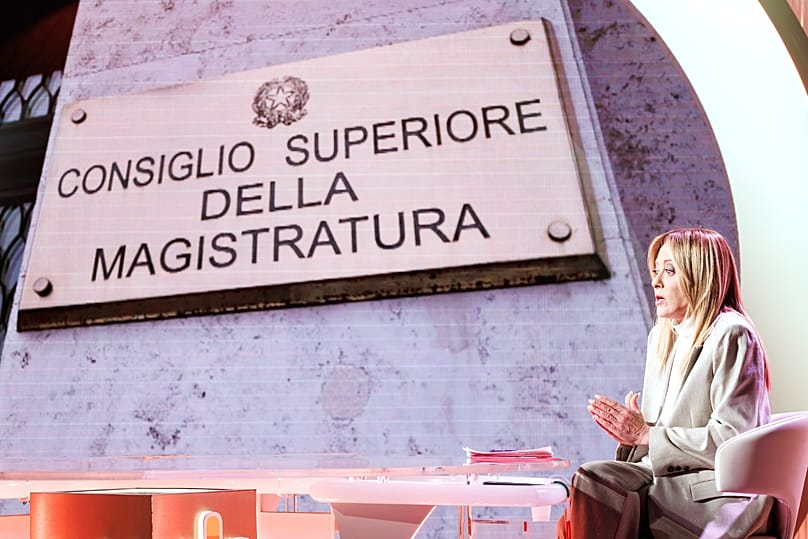
"We will find ourselves with even more powerful factions, even more negligent judges, even more surreal sentences, immigrants, rapists, pedophiles, drug dealers being freed and putting your security at risk," Meloni added.
Lorenzo Pregliasco, political analyst and polling expert at YouTrend said a "No" victory "would send a political signal, weakening Meloni’s aura of invincibility, while pushing the center-left opposition to say that there is already an alternative in the country".
Italy: The stakes of the March referendum on justice
Monday 23 March 2026, by Hélène Marra
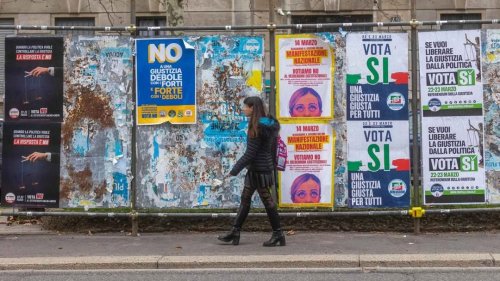
In Italy, prime minister Giorgia Meloni’s government is continuing its authoritarian offensive with a reform of the judiciary that threatens the independence of the judiciary. The referendum on 22 and 23 March is a central political issue. After the “security” decree, the reform of the judiciary is another important link in the authoritarian project promoted by Meloni’s government. By changing the methods of electing members of the Supreme Council of the Judiciary (CSM), the latter threatens the independence of this body and limits its ability to act as a counter-power to the political and economic systems. The victory of the “No” vote in the referendum on 22 and 23 March is an important opportunity to destabilise Meloni’s coalition and to solidify the political and social opposition camp.
Strengthening executive power, silencing dissent
Waging war on the “toghe rosse” (red togas) was the obsession of the Berlusconian right during the four terms of office of the “Cavaliere”. Today, the battle against the judiciary is part of an authoritarian project aimed at gradually emptying bourgeois liberal democracy of all substance while preserving its appearance. The provisions of the “security” decree, which came into force last February, had already alerted some legal experts who speak of a “genuinely subversive project aimed at preventing dissent and gradually transforming the state of law into a police state”. This is indeed a very serious attack on the freedom of assembly and demonstration, quite unprecedented in the recent history of the Italian Republic. Added to this are the already very strong restrictions on the freedom of movement of migrants, on lifestyles, as well as attacks on the right to strike and the working conditions of the subaltern classes.
The dangers of constitutional reform
Contrary to what is often claimed, the reform does not propose any remedy for the ills of the Italian justice system: the delays in justice, both criminal and civil, which allow the most powerful to delay trials and deny rights to the most vulnerable; miscarriages of justice; or the overcrowding of prisons and the disastrous state of prisons.
The reform also does not concern the separation of careers, as there is already a substantial separation between the prosecutor’s office and the judges, enshrined in the Cartabia law in 2022. In reality, it is a reform that questions the independence of the judiciary and limits the guarantees of the principle of separation of powers, favouring on the contrary the tendency towards centralisation characteristic of authoritarian regimes.
It is therefore not a technical and abstract question, but an eminently political question. According to constitutional law professor Alessandra Algostino, this reform is part of a context of concentration of powers and disqualification of the work of judges by the executive. This includes the duplication of the Supreme Council of the Judiciary (one for prosecutors and one for judges).
At present, this body of self-government of judges is composed of one-third so-called “secular” members, elected by Parliament, two-thirds members with togas elected by the judges, plus three members sitting ex officio: the President of the Republic, the First Prosecutor General of the Court of Cassation and the President of the Court of Cassation. This composition ensures a majority of magistrate members elected by the judges, who decide in particular on disciplinary sanctions.
The reform provides for this disciplinary jurisdiction to be taken away from the CSM and assigned to a new body, the High Disciplinary Court, composed of the judges who are the most advanced in their careers, which would imply a pyramidal logic. Another important change concerns the introduction of the drawing of lots for the appointment of members of the two judicial councils. This draw differs according to the type of member: lay people (law professors or lawyers with at least fifteen years of experience) would be drawn by lot from a list drawn up by the parliamentary majority. This means that this component of the CSM would be homogeneous and compact, while the drawing of lots for judges would be carried out on the basis of the complete list of judges in office.
The objective: to control the justice system
Under the pretext of countering the currents of the judiciary, this system leads to a form of fragmentation of the CSM, which would become, because of its fragmentation, more permeable to the influences of the politicized secular component. The reform is in fact based on a false conception of democracy, considering that the currents of the judiciary constitute in themselves a danger.
To deal with the “peril” of the currents, the government wants to impose political control of the judges drawn by lot by the parliamentary majority. Meloni says that this should also serve the interests of her opponents, leaving no doubt about her desire to control this body.
On the contrary, the pluralism of currents constitutes a democratic lever, allowing debating different interpretations of the law. This certainly does not guarantee the exercise of progressive justice: there are legacies of the patriarchal and racist system that run through legal cultures. However, it is known that in countries where such a system has been experimented with, it has led to a rapprochement between the public prosecutor’s office and the executive.
This rapprochement becomes indispensable for Meloni’s authoritarian government in order to ensure the application of repressive reforms towards exiled people, minorities, workers and, more broadly, all opponents. The Nordio “reform”", like every action of the Meloni government, ultimately serves to “distort the framework of rights and the balance of forces between the classes”.
Campaigning for a “No” vote in the referendum
The campaign for the “No” vote is dynamic and brings together trade unions, left-wing parties in the country, as well as artists and civil society movements. On Saturday, 14 March, 20,000 people marched in the Italian capital to say “No” to the constitutional referendum and the imperialist war in the Middle East. This is an encouraging sign for a victory for the “No” vote in the referendum that could put a brake on the Meloni government’s repressive project and destabilise its hegemonic role within the government coalition.
L’Anticapitaliste 20 March

No comments:
Post a Comment