TACO
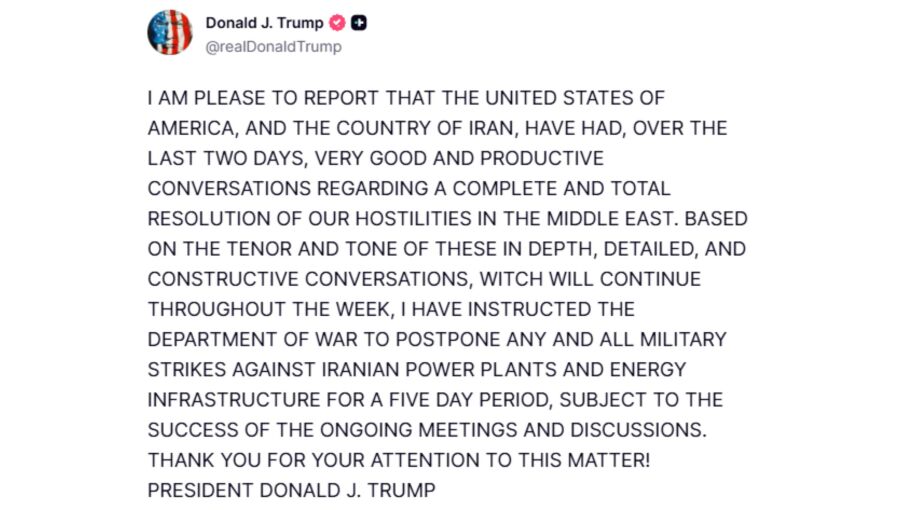
UPDATED: US President Donald Trump announced on March 23 that he had ordered a five-day suspension of planned strikes on Iranian power plants and energy infrastructure, he said on social media.
The American president said the US and Iran had held "very good and productive conversations" over the preceding two days aimed at a "complete and total resolution" of the conflict.
The announcement came just hours before Trump's 48-hour ultimatum for Iran to reopen the Strait of Hormuz was due to expire, averting what would have been a major escalation that Iran had warned would trigger "irreversible" destruction of Gulf energy infrastructure.
"Based on the tenor and tone of these in depth, detailed, and constructive conversations, which will continue throughout the week, I have instructed the Department of War to postpone any and all military strikes against Iranian power plants and energy infrastructure for a five day period, subject to the success of the ongoing meetings and discussions," Trump wrote on Truth Social.
The disclosure that the US and Iran have been in direct communication marks a significant shift. IAEA chief Rafael Grossi said on March 18 that he did not believe Iran would negotiate while the military campaign continued.
Iran's foreign minister, Abbas Araghchi, and its ambassador to Germany both said Tehran was open to diplomacy but demanded guarantees and compensation.
It was not immediately clear through which channel the talks were conducted. Belarus's President Lukashenko said on March 20 he had submitted a mediation plan to the Trump administration.
Oman, which hosted pre-war nuclear talks, has also been praised by Gulf states for its role in diplomacy.
The five-day window, if held, would expire on March 28. Military operations against other Iranian targets were not mentioned in the statement.
Oil prices and global markets will be watching closely for signs that the pause extends beyond energy infrastructure to a broader ceasefire. Brent crude had been trading above $113 per barrel, with analysts warning prices could reach $200 if the energy war intensified further.
On Iran, Trump executes his most spectacular U-turn yet
Washington (United States) (AFP) – International markets and the world at large have grown used to US President Donald Trump's abrupt reversals, but Monday's about-face on Iran was one of his most spectacular yet.
Issued on: 23/03/2026 - RFI
Since returning to power last year, Trump has openly embraced governing "by instinct."
On the Mideast conflict, he has made a flurry of contradictory statements about goals and the timeline, and even declared on March 13 that the war would end when he "felt it in his bones."
"Trump has been a master of sudden pivots and switches. So it's sometimes hard to know if there is a strategy or if it's just always improvisation," said Garret Martin, a professor of international relations at American University in Washington.
These reversals typically follow a pattern. The Republican president issues commercial, diplomatic or military threats -- often accompanied by ultimatums -- that stun the international community.
Then he abruptly reverses course. He claims to have secured decisive concessions that he rarely divulges and promises a resolution to the crisis, causing markets to swing dramatically.
On Monday, oil prices plunged and stocks surged after Trump announced on his Truth Social platform that the United States had held talks with Iran about ending the conflict. North Sea Brent crude plummeted by more than 14 percent while its American equivalent, West Texas Intermediate, lost nearly 10 percent. The Dow Jones Industrial Average, meanwhile, jumped 700 points.
TACO
As recently as Saturday, Trump had given Iran 48 hours to reopen the Strait of Hormuz — a vital passage for oil shipments out of the Gulf — under threat of massive strikes against the country's power plants. He did not mention dialogue.
But then on Monday, he declared a new deadline — five days this time — to allow time for the talks to continue.
He spoke of "very productive" discussions with "highly respected" and "very solid" Iranian officials, without identifying them.
But Iranian officials denied that any negotiations were taking place, which partially dampened market enthusiasm.
Trump bragged about this negotiating skills in a speech Monday in Memphis, Tennessee, highlighting his business instincts rather than specific concessions from Tehran.
"My whole life has been a negotiation, but with Iran we've been negotiating for a long time," he said. "And this time they mean business."
The pattern is so familiar that it has its own acronym -- "TACO" for "Trump Always Chickens Out" -- coined by The Financial Times journalist Robert Armstrong in May 2025 after Trump backed down on threats to impose global tariffs that caused market havoc.
Shaking up markets
The TACO term originally referred to a stock market strategy involving capitalizing on a decline in assets -- triggered by a bombastic announcement from Trump -- to buy low, in the hope of reselling at a profit once he inevitably changed his mind.
Other examples include Trump backing down from threats on the United States taking over Greenland, or those directed at Federal Reserve Chairman Jerome Powell over US interest rates.
Quite often, while these U-turns shake up markets, they remain nebulous in terms of actual deals.
US partners and adversaries alike now know "there's always an impermanence with everything with this administration; agreements and promises are only as good as the minute they're made," said Martin.
In the case of Iran, Martin suggests that Trump backed down due to three factors: market jitters, potential pressure from Gulf nations and the emergence of "tensions" within his own Make America Great Again, or MAGA, political movement over the conflict.
© 2026 AFP
Little Change at Strait of Hormuz After Trump's 48-Hour Threat
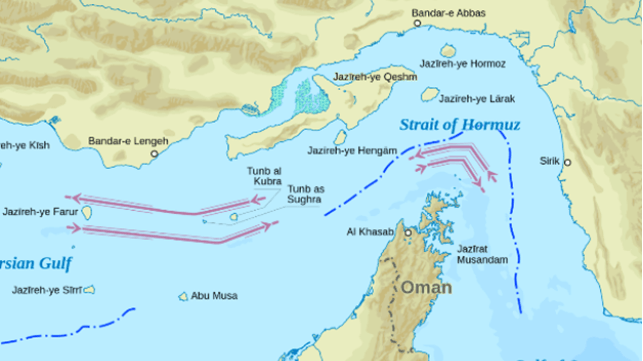
President Donald Trump has given the Iranian government until Monday evening to reopen the Strait of Hormuz, which he has said that the U.S. does not need. If Iran does not do so, Trump said, the U.S. will destroy Iran's electrical power plants. The threat is unlikely to affect the choices of Iran's new hardline leadership, multiple analysts assess.
For its part, Iran claims that the Strait is already open - for the right ships. A trickle of tonnage is getting past, according to tracking services, most of it using an Iranian-controlled lane past Qeshm and Larak. Iranian state media claims that negotiations are under way with multiple nations on the terms of passage, including India and China. Iran's own tankers continue to load and transit, facilitated by the U.S. decision to allow free passage for Iranian vessels and (as of Friday) to lift sanctions on Iranian oil.
Iran has refused to comply with Trump's 48-hour threat, and traffic at the strait remains light. It has promised to retaliate with strikes on neighboring states' critical infrastructure if its power grid is hit.
"If Iran's fuel and energy infrastructure is attacked by the enemy, all infrastructure of energy, information technology, and desalination facilities belonging to the US and [Israeli] regime in the region will be targeted," an IRGC spokesperson warned.
In the past week, Iran has destroyed approximately six percent of global LNG liquefaction capacity, damaged oil infrastructure infrastructure on the Saudi Red Sea coast, and launched strikes on the U.S.-UK base at Diego Garcia - more than 2,000 miles away from the combat zone. Dozens of oil and gas sites, ports and ships around the Gulf have been hit in the conflict so far, from Kuwait to Oman.
Multiple analysts assess that the likely near-term outcomes include U.S./Israeli strikes on the Iranian power grid, now required to demonstrate U.S. follow-through on Trump's 48-hour threat; Iranian retaliatory strikes on high-value infrastructure in neighboring states; uninterrupted Iranian control of the Strait of Hormuz; and continued pressure on the global supply of oil, gas and refined products, particularly affecting Asian consumers.
"Iran will not reopen the Strait of Hormuz. That’s not going to happen. In the coming days, we can expect Tehran to threaten to 'set the Gulf on fire,' especially if the U.S. strikes critical infrastructure," said former Israeli Defense Intelligence Iran chief Danny Citrinowitz. "Such rhetoric [U.S. threats] will not shift Iran’s position; instead, it forces the president to choose: escalate and follow through, risking broader war, or back down and further erode U.S. deterrence."

No comments:
Post a Comment