Why Military Force May Not Be Enough to Reopen the Strait of Hormuz
- Iran has made Hormuz ungovernable through attacks, mines, GPS disruption, and insurance shock.
- U.S. military options appear costly, risky, and unlikely to fully restore normal tanker traffic.
- A political settlement may be the only realistic way to reopen the strait.
The Strait of Hormuz, a 33-kilometer-wide chokepoint through which roughly a third of the world's seaborne oil passes, is effectively closed to normal commercial traffic.
Iran has not blockaded the strait with a chain or a fleet. Instead, it has made the waterway ungovernable through a combination of kinetic strikes, mines, electronic warfare, and market fear -- creating a closure that is arguably harder to reverse than a conventional blockade.
"I can think of no way to reopen and keep open Hormuz militarily and easily," Richard Allen Williams, a retired US Army colonel and former NATO Defense Investment Division official, told RFE/RL.
How The Strait Was Closed
The shutdown has four interlocking layers.
The first is physical: more than two dozen drone, missile, and fast-attack boat strikes on commercial shipping since the war began, with Iran demonstrating it can reach vessels hundreds of kilometers from the strait itself, off the coast of Iraq.
The second is mines. According to US intelligence reporting, Iran has begun laying mines in the strait. Its total arsenal is estimated at around 6,000, ranging from crude contact mines to sophisticated seabed devices that respond to acoustic or magnetic signals.
Laying them is easy; it can be done from ordinary fishing boats, indistinguishable from normal Persian Gulf traffic. Clearing them is not. It took the United States and its allies 51 days to sweep 907 mines off Kuwait after the Persian Gulf War, with the advantage of Iraqi minefield maps. Even a limited Iranian mining campaign would mean a closure measured in months.
The third layer is electronic. GPS spoofing and signal jamming affected more than 1,650 vessels on a single day in March, with navigation systems showing supertankers sailing over dry land and cargo ships transiting airports. In a narrow waterway, that level of disruption creates genuine collision risk with no missile required.
The fourth and final layer is financial: War-risk insurers have withdrawn coverage across much of the commercial market. Without insurance, ships don't move.
Michael Horowitz, an independent defense expert based in Israel, says the threat is structurally asymmetric.
"Just a few attacks per month is enough to increase insurance prices and market pressure," he told RFE/RL, comparing the situation to the Houthi campaign in the Red Sea. "This is a battle heavily tilted in favor of the disrupter."
What Washington Is Considering, And Why It's Hard
The Trump administration is weighing a couple of options.
Tanker escorts -- warships accompanying commercial vessels with drone and missile cover -- are the lightest footprint but require roughly two warships per tanker and continuous drone patrols overhead.
But the risk is high, according to Horowitz.
"A land-based attacker, even without a proper navy, can be very effective. A US loss would be dramatic and roll back the positive impact of escort missions in an instant."
Mines compound the problem further. The US mine countermeasure capability in the region, already limited to aging helicopters and troubled littoral combat ships, was weakened further when dedicated minesweepers stationed in Bahrain were decommissioned in late 2025.
Heavier air strikes aimed at Iranian coastal infrastructure are a second option. US Central Command says it has destroyed 16 Iranian minelayers. But Iran's mobile launchers are designed for shoot-and-scoot operations, and years of dispersal and hardening make systematic degradation from the air enormously difficult.
A third option that has been floated in the media is a ground operation, a Marine amphibious assault to seize or repeatedly raid Iran's southern coastline.
Williams was blunt about what that means in practice: large forces, mountainous terrain, and 190,000 Islamic Revolutionary Guards Corps (IRGC) troops with asymmetric warfare experience. "Difficult, expensive, risky," he said, "with no assurance of success."
The Bottom Line
Even an optimistic escort scenario would reduce traffic to 10 percent of normal volume, according to Lloyd's List Intelligence, with a backlog of over 600 stranded vessels taking months to clear. None of the military options address the insurance and market dimension -- and shippers, not the Pentagon, ultimately decide whether tankers sail.
Horowitz sees a negotiated settlement as the most realistic path, but flags two other possibilities: blockading Iran's own energy exports to pressure both Tehran and its top buyer, China, or waiting for the collapse of the Islamic Republic. He's skeptical of the latter.
"The chances of that happening quickly enough for markets to recover are low, to say the least," he added.
What that leaves is a strait that may stay closed for the foreseeable future, not for lack of military options, but because none of them can do what only a political outcome can.
By RFE/RL
Securing the Strait: The Need to Reclaim the Disputed Islands
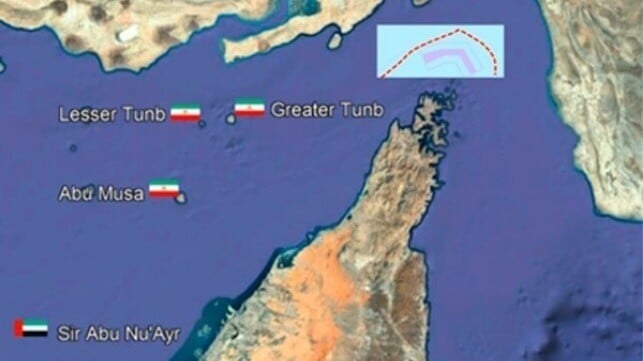
Predictably, given that their control over the Strait of Hormuz is their strongest negotiating card, the Iranian regime has ignored President Donald Trump's demand that they reopen the waterway to international traffic. President Trump says that constructive talks are now underway with Iran, something that Iran denies, although President Trump has followed up by suspending his threat to destroy Iran's power infrastructure. Any such attempt would no doubt in turn bring an Iranian response in kind, albeit with the power and desalination infrastructure of the Gulf states targeted and suffering the damage, rather than the United States.
The United States does, however, have a number of ways it could respond to Iranian intransigence.
Iranian crude oil and LNG traffic is still passing through the Strait, with Iran enjoying huge increases in the price of these cargoes created as a consequence of their closure to traffic carrying the crude and LNG produced by GCC states, and Kuwait, Qatar, and the UAE in particular. The United States has the wherewithal to shut down this Iranian traffic immediately, thereby starving the Iranian regime of the funds to keep the repressive internal security apparatus of the IRGC motivated, and for the subsidies on basic essentials, which dampen the ardor of ordinary Iranians to rise up against the regime.
A similar effect could be delivered by closing down loadings of crude oil from Kharg Island, which could be achieved simply and efficiently either by imposing a no-sail zone around Kharg Island, enforced remotely by air and sea power, or at huge cost in casualties with boots on the ground by seizing and then holding on to Kharg Island with U.S. Marines.
Otherwise, Admiral Brad Cooper, Commander CENTCOM, may have to resort to a complex military operation to clear the Strait. This would entail a continuation of the current program of attacks on Iranian naval and missile infrastructure used to keep the Strait closed, followed by a mine clearance operation, expulsion of any Iranian vessel, large or small, from the Hormuz area, and finally convoy operations through the Strait with a heavy aerial overwatch in place over areas from which any convoy might be threatened. With the Iranian side of the Strait stretching to about 250 miles of coastline, this would be an operation fraught with risks and ample opportunities for things to go wrong. Even when the first convoy was ready to set sail, risks for merchant traffic would have been reduced - but not eliminated.
There is a further complication, not widely appreciated outside maritime circles. Once through the Strait, traffic in the Gulf remains under the guns of the Iranians. Indeed, whereas both inward and outward channels of the TSS within the narrows of the Strait are actually within Omani territorial waters, once inside the Gulf, the TSS channels then switch into Iranian waters. Indeed, the TSS channels pass either side of the Greater and Lesser Tunb islands, which, along with Abu Musa island that dominates the southern Gulf, are islands seized by Iran from the British on November 30, 1971, hours before they should have been handed over to the newly-independent United Arab Emirates.
There can be no security for international maritime traffic if Iran remains hostile and in charge of these three Disputed Islands, armed with drones and missiles which can dominate the surrounding waters; as such, they are a more worthwhile (and safer) target for occupation than Kharg Island. Hence, there is a strong argument that the Disputed Islands should be returned to their rightful owners, and that the United Kingdom has a residual responsibility under international law for completing the handover of what should have formed an integral part of the United Arab Emirates on December 2, 1971.
The opinions expressed herein are the author's and not necessarily those of The Maritime Executive.

No comments:
Post a Comment