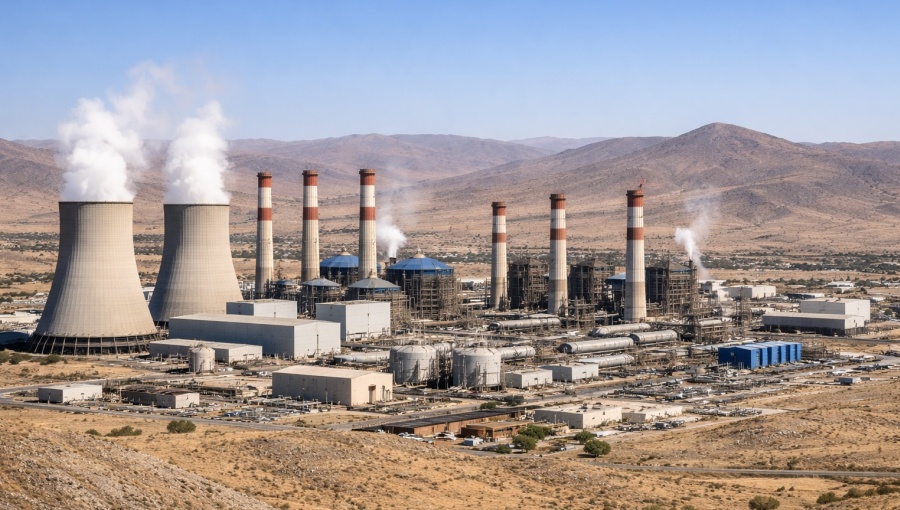
US President Donald Trump threatened to bomb Iran's power grid into oblivion. However that could prove more difficult to do than say as the Iranian electricity grid is one of the most decentralised in the world making it extremely resistant to attack, says bne IntelliNews’ military analyst Patricia Marins.
Unlike many countries that rely on a handful of large generating hubs, Iran’s grid is unusually dispersed making it very difficult to attack. There are no significant targets to destroy. Instead a network of small interlinked power stations is much more suited to absorbing strikes and still able to provide electricity to the whole country.
"The Iranian electric grid is one of the most decentralised in the world, with around 130 to 150 power plants, primarily gas-fired thermal plants," Marins says. "No individual plants dominate large portions of the country’s electricity generation."
The dispersion is striking when set against the size of the system. Iran’s total installed capacity is approaching 100GW, according to official figures, yet even its largest facility plays only a marginal role.
"The largest power plant in the country, Damavand, located near Tehran, has a capacity of approximately 2,868 MW, representing only about 2.9% of the total installed capacity."
Other major plants, such as Shahid Salimi Neka, Rudeshur and Kerman, as well as hydroelectric facilities like Karun-3, operate in the 1.6–2.2GW range. Even taken together, Marins notes, "the 5-10 largest plants account for only a modest share, probably less than 15–20% of the total. The rest of the capacity is spread across dozens of smaller and medium-sized facilities."
This fragmentation is compounded by the nature of Iran’s generation mix. Around 80–85% of electricity is produced from natural gas, distributed across numerous thermal plants rather than concentrated in a few strategic nodes. The result is a grid that is inherently resilient to targeted strikes.
"Iran appears to have been designed for this kind of battle against the world’s leading military power and the strongest air force in the Middle East," says Marins.
Military planners familiar with infrastructure targeting say that while strikes on major plants or substations could trigger localised blackouts — particularly in high-demand centres such as Tehran — they would be unlikely to produce an immediate nationwide collapse. Recent analysis suggests that even coordinated attacks would primarily generate “serious domestic disruption and economic strain” rather than decisively degrading Iran’s military capabilities.
That resilience has strategic implications. US President Donald Trump threatened to blow up all of Iran’s power resources on March 21 if the Strait of Hormuz were not opened within 48 hours. However, he backtracked almost immediately, extending the deadline by another five days to March 28, after Tehran threatened to destroy all the power assets in the entire Gulf region in retaliation if the US carried through on its threat. That deadline has now been extended again to April 6.
"Attacks on its electrical infrastructure would take several days to have a significant effect and would almost certainly be followed by a retaliation that could leave the Gulf in the dark," says Marins.
Energy infrastructure across the Gulf is tightly interconnected and highly exposed, particularly in export-oriented economies dependent on desalination plants and air conditioning. Any escalation targeting grids risks rapid regional spillover that would have serious humanitarian consequences – especially if the desalination plants went offline, which provide drinking water for almost all the countries in the region. And this was no idle threat, experts say.
"After 26 days of war, Iran continues to launch between 30 and 40 missiles daily while deploying additional air defences, leading to a gradual increase in incidents of aircraft being hit," says Marins. "The country has effectively absorbed the coalition's strikes. Meanwhile, the coalition's strategic options are dwindling as stockpiles of both offensive and defensive munitions reach critical levels."
This raises questions about the viability of coercive strategies centred on infrastructure destruction.
"I see very few options powerful enough to genuinely force the Iranians into negotiations," says Marins, who adds that the comparison with other energy-heavy states is also misleading.
"If Washington’s political thinking ever drew a parallel, I would say there is virtually nothing similar between Iran and Venezuela other than oil production."
Bombing power sectors into ruins has become a fairly standard tactic in wars. The Nato allies destroyed 80% of Serbia’s power sector during the Kosovo war in 1999, saying it was a legitimate military target.
"Yes, I'm afraid electricity also drives command and control systems. If President Milosevic really wants all of his population to have water and electricity all he has to do is accept Nato's five conditions and we will stop this campaign," Nato’s Chief Spokesman Jamie Shea said at the time. "But as long as he doesn't do so we will continue to attack those targets which provide the electricity for his armed forces. If that has civilian consequences, it's for him to deal with."
Russian President Vladimir Putin has adopted the same tactic in the Ukraine war, destroying much of Ukraine’s power sector over the last two years, building up to a crescendo when he tried to freeze Ukraine into submission during one of the coldest winters in a decade. Only an estimated 20% of Ukraine’s pre-war generating capacity has survived, experts say.
Unlike Serbia, Ukraine or Venezuela, where the grid is heavily centralised and vulnerable to cascading failure, Iran’s network reflects decades of sanctions-era adaptation — a system built not for efficiency, but for survival.
"Trump’s threat highlights a broader strategic dilemma: even overwhelming military superiority does not guarantee leverage when the target has engineered its infrastructure to withstand precisely that kind of pressure," says Marins.

No comments:
Post a Comment