SPACE/COSMOS
Astronomers spot 8.5 billion year old 'jellyfish galaxy'
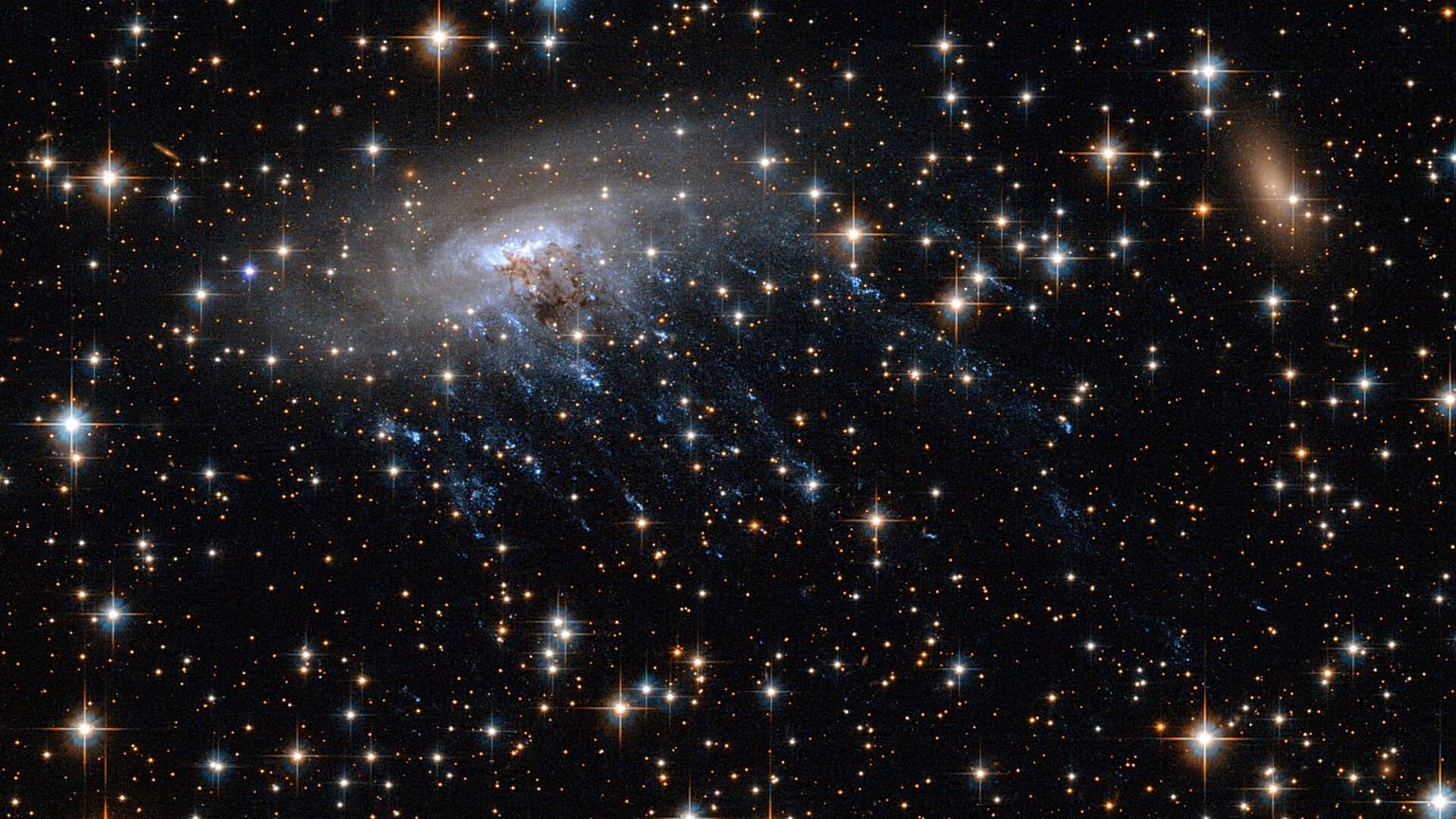
Seen as it was 8.5 billion years ago, the galaxy shows that the early universe was harsher than scientists previously thought.
Researchers have identified what could be the most distant jellyfish galaxy ever observed, using data from NASA's James Webb Space Telescope.
The discovery, published in the Astrophysical Journal, was made by a team at the University of Waterloo, who spotted the unusual object while analysing deep space observations.
Launched in 2021 through a collaboration between NASA, the European Space Agency (ESA), and the Canadian Space Agency (CSA), the JWST is the largest, most powerful and most sophisticated telescope ever sent into space.
What is a jellyfish galaxy?
Jellyfish galaxies get their nickname from the long, flowing streams of gas that trail behind them like tentacles.
These galaxies move rapidly through crowded galaxy clusters filled with extremely hot gas.
As they travel, that surrounding gas acts like a headwind, sweeping material away from the galaxy and leaving behind flowing strands in a process known as ram-pressure stripping.
What we know about the new discovery
The newly identified galaxy sits at a redshift of z = 1.156. This means its light has taken around 8.5 billion years to reach Earth - so what we're seeing is a view of the galaxy when the universe was much younger.
The team found the galaxy while studying the COSMOS field - the Cosmic Evolution Survey Deep field - one of the most intensely studied patches of sky. Astronomers favour this region because it lies away from the busy plane of the Milky Way, which means less interference from nearby stars and dust.
"We were looking through a large amount of data from this well-studied region in the sky with the hopes of spotting jellyfish galaxies that haven't been studied before," said Dr. Ian Roberts, from the Waterloo Centre for Astrophysics in the Faculty of Science. "Early on in our search of the JWST data, we spotted a distant, undocumented jellyfish galaxy that sparked immediate interest."
The galaxy itself has a relatively typical disk shape. What stands out are bright blue clumps scattered along its trailing streams. These glowing knots are extremely young stars.
Their ages suggest they formed outside the galaxy's main body, within gas that had been stripped away. That type of star formation is consistent with what astronomers expect in jellyfish galaxies undergoing ram-pressure stripping.
Significance of the find
The discovery is important because it pushes evidence of ram-pressure stripping much further back in time.
Many researchers had assumed that galaxy clusters 8.5 billion years ago were still developing and not yet dense or extreme enough to strip gas so effectively. This galaxy suggests that clusters were already harsh environments capable of reshaping galaxies.
"The first is that cluster environments were already harsh enough to strip galaxies, and the second is that galaxy clusters may strongly alter galaxy properties earlier than expected," Roberts said.
He continued: "Another is that all the challenges listed might have played a part in building the large population of dead galaxies we see in galaxy clusters today. This data provides us with rare insight into how galaxies were transformed in the early universe."
The researchers have now applied for additional observing time with the James Webb Space Telescope to take a closer look and provide further evidence.

February 28, 2026 0 Comments
By Eurasia Review
Mauve, the world’s first commercial space science satellite, has successfully achieved ‘first light’, sending back data to astronomers about the universe for the first time.
Created by Blue Skies Space Ltd., a British space company co-founded by current King’s staff and alumni, Mauve will study stars in the ultraviolet and visible light, enabling a greater understanding of their magnetic activity, stellar flares, and how they impact the habitability of nearby exoplanets – planets that orbit stars that are not our sun.
The start-up hopes the craft will pioneer a new era of exploration founded on low-cost, rapidly built space telescopes, delivering high-quality information about the universe directly to researchers.
Professor Giovanna Tinetti, Vice Dean (Research) in the Faculty of Natural, Mathematical and Engineering Sciences and co-founder of Blue Skies Space, said of the milestone, “The launch of Mauve has been a really emotional moment – seeing the project we worked hard for a number of years being sent to space!
“But as a scientist the real excitement comes when the data start flowing in: seeing the first spectrum from Mauve has suddenly made me realise that we’ll soon do science with the first privately funded space science mission ever!”
Mauve used its 13 cm spectrophotometric telescope, designed to measure and collect data on the spectrum of light emitted by stars, to observe Eta Uma, a star 104 light-years away in the constellation Ursa Major or the Great Bear.
A hot, blue-white star, much hotter than the Sun, Eta UMa shines in ultraviolet light which makes it an ideal calibration target for an observatory collecting ultraviolet data like Mauve.
Dr Marcell Tesseny, CEO and co-founder Blue Skies Space, as well as an alumnus from the Department of Physics, said “Blue Skies Space was founded to provide access to space science data for scientists worldwide through a fleet of small, agile satellites. The first light from Mauve is a demonstration of this vision to serve the space science community.”
Throughout its three-year mission, Mauve also hopes to gather information on early-stage planetary evolution, test theories of gravity through examination of binary star systems and chart how stars live and die – in addition to research priorities highlighted by members of the science community who sign up to Mauve’s observational programme.
Life Forms Can Planet Hop On Asteroid Debris – And Survive

By Eurasia Review
Tiny life forms tucked into debris from an asteroid hit could catapult to other planets – including Earth – and survive, a new Johns Hopkins University study finds.
The work demonstrates that a certain hardy bacterium easily withstands extreme pressure comparable to an ejection from Mars after an asteroid hit, as well as the inhospitable conditions it would face during the ensuing interplanetary journey.
The study, published today in PNAS Nexus, suggests that microorganisms can survive remarkably more extreme conditions than expected, and raises questions about origins of life. The work also has significant implications for planetary protection and space missions.
“Life might actually survive being ejected from one planet and moving to another,” said senior author K.T. Ramesh. “This is a really big deal that changes the way you think about the question of how life begins and how life began on Earth.”
Impact craters cover the surfaces of most bodies in the solar system. Mars, a planet that could harbor life, is one of the most cratered celestial bodies. We know asteroid strikes can launch material across space—and Martian meteorites have been found on Earth.
However, scientists have long wondered if life forms could also be launched from an asteroid impact. Tucked inside ejected debris, they might land on another planet—a theory called the lithopanspermia hypothesis.
Previous experiments to test the theory have been inconclusive, and targeted organisms widely found on Earth, rather than a life form that would suit the extreme environments of other planets.
To study how a microorganism would realistically handle the stress of a planetary ejection, the team devised a way to replicate the pressure and a singular biological model.
The team chose to test Deinococcus radiodurans, a desert bacterium found in the high deserts of Chile that is notorious for its ability to survive the most inhospitable, space-like conditions—everything from extreme cold and dryness to intense radiation. It has a thick shell and a remarkable ability to self-repair.
“We do not yet know if there is life on Mars, but if there is, it is likely to have similar abilities,” Ramesh said.
The experiment simulated the pressure of an asteroid strike and ejection from Mars by sandwiching the microbe between metal plates and then firing a projectile at it from a gas gun. The projectile hit the plates at speeds up to 300 mph, generating 1 to 3 Gigapascals of pressure.
For perspective, the pressure at the bottom of the Mariana Trench, the deepest part of the Earth’s oceans, is a tenth of a Gigapascal. Even the lowest pressure in this experiment is more than ten times that.
After shooting the microbes, the team determined whether they survived and examined the survivors’ genetic material for clues to how they handled the pressure.
The bacteria proved very hard to kill. They survived nearly every test at 1.4 Gigapascal of pressure and 60% at 2.4 Gigapascals of pressure. The cells showed no signs of damage after the lower pressure hits, but after the higher pressure experiments, the team observed some ruptured membranes and internal damage.
“We expected it to be dead at that first pressure,” said lead author Lily Zhao. “We started shooting it faster and faster. We kept trying to kill it, but it was really hard to kill.”
In the end, what did die was the equipment. The steel configuration holding the plates fell apart before the bacteria did.
When asteroids hit Mars, ejected fragments experience a range of pressures, perhaps close to 5 Gigapascals, though some could see much higher. Here the microbe easily survived almost 3, much higher than previously thought possible.
“We have shown that it is possible for life to survive large-scale impact and ejection,” Zhao said. “What that means is that life can potentially move between planets. Maybe we’re Martians!”
The possibility of life spreading between planetary bodies has significant implications for planetary protection and space missions, the team said.
Space mission protocols evaluate the likelihood of life surviving on the target planet. When missions travel to planets that might sustain life, like Mars, there are tight restrictions and safety measures to prevent contaminating the planet with Earth life. And when a mission brings back materials from a planet, there are very strict measures to control the possible release of that life on Earth. Because this work demonstrates that materials from Mars might reach other bodies, particularly its two nearby moons that aren’t currently restricted, the team said policies might need to be reassessed.
Phobos, in particular, orbits so close to Mars that any ejecta that gets there is probably exposed to much less pressure than what is required to get to Earth, the team said.
“We might need to be very careful about which planets we visit,” Ramesh said.
The team next hopes to explore whether repeat asteroid impacts result in hardier bacterial populations—or whether bacteria adapt to this kind of stress. They’d also like to see if other organisms, including fungi, can survive these conditions.

No comments:
Post a Comment