It may take a year to restore Abu Dhabi aluminum output, EGA says
The Middle East’s biggest aluminum producer said it may take as long as a year to restore full output at its Abu Dhabi plant, following an Iranian attack a week ago.

Emirates Global Aluminium said the Al Taweelah smelter went into emergency shutdown, after suffering significant damage from missiles and drones. The company has completed an initial damage assessment of the facilities in the United Arab Emirates and is in contact with customers whose shipments may be impacted, it said in a statement Friday.
The Middle East accounts for about 9% of global aluminum production, but the impact of the war is being amplified because constraints on output elsewhere have eroded inventories, leaving the market with little buffer to cushion any shocks. Even before the attacks on EGA’s facilities, the industry was bracing for more production cuts as Strait of Hormuz disruptions affected the flow of raw materials for the region’s plants.
“To resume operations at the smelter, EGA must repair infrastructure damage and progressively restore each of the reduction cells,” the company said in the statement. “Early indications are that a complete restoration of primary aluminum production could take up to 12 months.”
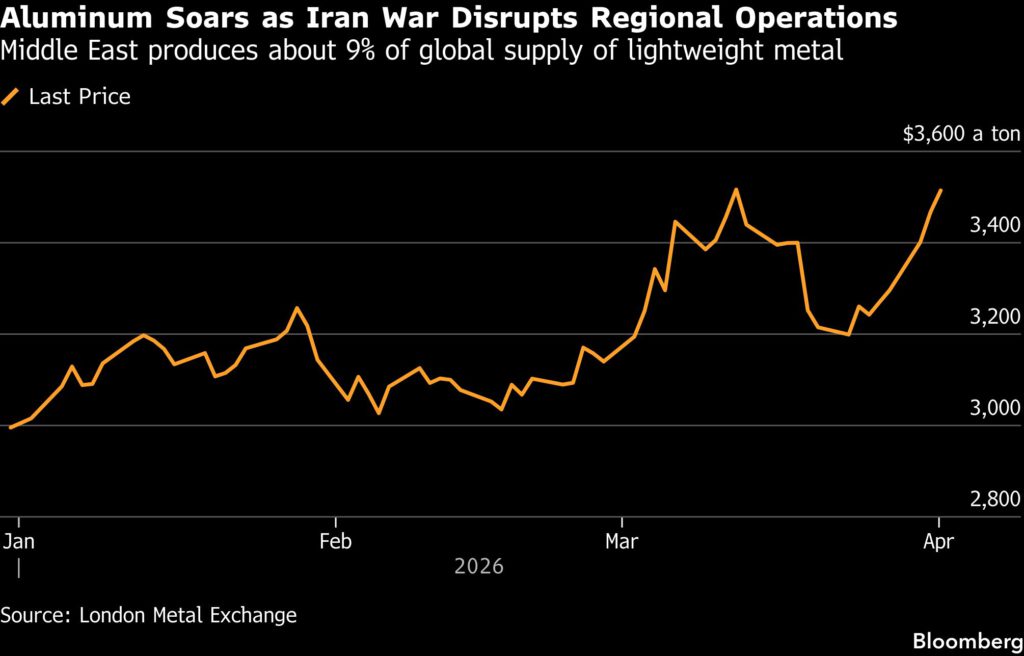
Aluminum prices have climbed more than 10% on the London Metal Exchange since the start of the Iran war.
Al Taweelah is one of the world’s biggest smelters, producing 1.6 million tons of cast metal in 2025. Other facilities at the site in Abu Dhabi, including an alumina refinery and a metals recycling plant, could resume some production earlier, pending a final damage assessment, EGA said.
“We are working directly with customers whose deliveries might be impacted by the situation at Al Taweelah,” EGA chief executive officer Abdulnasser Bin Kalban said in the statement.
Iran also hit Aluminium Bahrain’s smelter in the Persian Gulf on March 28. The company known as Alba said it’s assessing damages.
(By Anthony Di Paola)
Top Gulf aluminum producer EGA halted output after Iran strike
Emirates Global Aluminium, the Middle East’s top producer of the metal, halted operations at its Al Taweelah smelter after the site was struck by Iranian missiles and drones over the weekend, according to a person familiar with the matter.
The smelter on the outskirts of Abu Dhabi lost power due to the strikes and smelting facilities known as potlines were forced into an uncontrolled shutdown, said the person, who asked not to be identified as the information isn’t public. Metal has solidified inside the smelting circuits, causing significant damage to the operations, the person said
Aluminum prices rose as much as 2% on the London Metal Exchange after Bloomberg reported on the halt, while shares of rival producers including Alcoa Corp. and Century Aluminum Co. rallied more than 7%.
LME futures of the lightweight metal have surged since the strikes, with Aluminium Bahrain, another major producer in the region, also confirming its operations were attacked by Iran over the weekend. The two plants are among the world’s largest, each producing 1.6 million tons of aluminum in 2025.
A halt at EGA’s smelter, along with Alba’s reduced operations and earlier curtailments at Qatar’s Qatalum smelter would take around 3 million tons of annual capacity offline — close to half of Middle East aluminum production, said Ewa Manthey, commodity strategist at ING Groep NV. That marks a “sharp escalation” from earlier disruptions and would imply “deeper aluminum deficits” across all scenarios.
The Middle East as a whole produces about 9% of global supply, with EGA and others playing a key role in supplying manufacturers across Europe, Asia and the US. Even before the industry was directly targeted, the effective closure of the Strait of Hormuz had already left the region’s major producers short of critical inputs, with the sector anticipating a cascading wave of production cuts unless the strait reopens soon.
“The Strait of Hormuz is effectively a chokepoint for the global aluminum market,” Wood Mackenzie principal analyst Charvi Trivedi said in an April 1 note, which estimated that disruptions could remove 3 million to 3.5 million tons of output this year. “Disruptions here could cut off up to 60% of alumina supply to Middle Eastern smelters, rapidly deepening the market deficit.”
Aluminum is the most ubiquitous industrial metal after steel, but in recent years the industry has faced several disruptions in a complex global supply chain that involves mining raw bauxite ores, refining them into alumina and then smelting that into finished metal. While EGA can produce some alumina itself, it’s typically a large buyer of the material, bringing in additional cargoes through the strait to feed Al Taweelah and a second smelter in Dubai.
EGA has moved to sell large volumes of alumina in the wake of the strikes, Bloomberg reported earlier Wednesday.
With the exception of aluminum, base metals faced heavy downward pressure in March as hostilities in the Middle East disrupted commodity supplies and threatened an inflationary shock for the world economy. US President Donald Trump said Wednesday he’ll only consider a halt to attacks on Iran when the Strait of Hormuz is reopened, sowing further confusion about how long he’s prepared to continue the war.
Aluminum on the LME settled 1.9% higher at $3,531.50 a ton in London. Copper closed 0.8% higher at $12,434.50 a ton, while other key industrial metals also ended higher.
(By Yvonne Yue Li)

No comments:
Post a Comment