A small non-hierarchical collective in Arizona is using an open-source design to create life-saving tourniquets.
By Ella Fassler ,
May 29, 2026
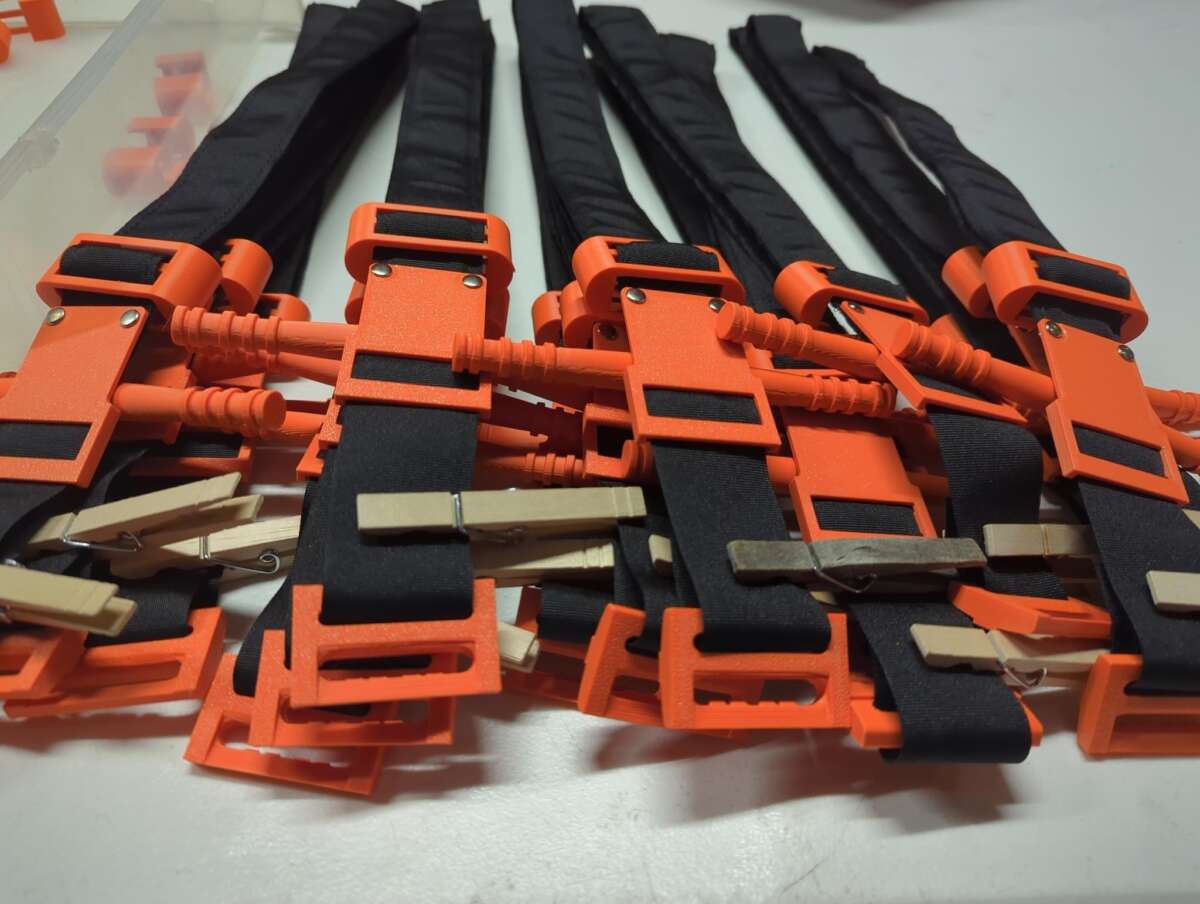
3D-printed tourniquets manufactured by the Distributed Medical Device Manufacturing collective (DMDM) are stacked on a table after a work party held in April 2026.DMDM
Did you know that Truthout is a nonprofit and independently funded by readers like you? If you value what we do, please support our work with a donation.
In late April, the humanitarian aid organization Anera received a peculiar donation of 250 3D-printed tourniquets. Even more unusual was the fact they were manufactured by a small non-hierarchical collective using an open-source design on the other end of the world, in Tucson, Arizona.
The shipment arrived in Lebanon after more than 100 Israeli strikes wounded at least 1,000 people in less than 10 minutes on April 8. The World Health Organization (WHO) warned that Lebanon’s hospitals may run out of life-saving supplies within days.
“The day after [these strikes], the hospitals and ministry launched a call for support because items were out of stock already,” Rima Kamal, a Lebanon-based medical donations program coordinator working for Anera, told Truthout. “Items that were supposed to last for one or two months were directly depleted because the hospitals weren’t expecting to support that many patients.”
Since March 2, Israel has killed more than 3,224 people in Lebanon, injured more than 10,000, and displaced more than 1.2 million people. Its military has hunted down and killed journalists, attacked health care centers, destroyed bridges, and demolished entire neighborhoods.
Anera is one of the organizations struggling to keep Lebanon’s medical system functioning amid unrelenting Israeli attacks, working closely with hospitals, first responders, and other NGOs to source and distribute urgently needed medical supplies.
Since March 2, Israel has killed more than 3,224 people in Lebanon, injured more than 10,000, and displaced more than 1.2 million people.
“We met with all the hospital directors, and we learned there is a high need for IV anesthesia, IV painkillers, IV antibiotics,” she said. Anera is currently accepting donations to procure these items. “We coordinate closely with the ministry and other NGOs to avoid duplication and ensure that we are addressing help whenever it’s most needed.”
The shipment of 3D-printed tourniquets is not more important or critical than other forms of aid at present. Kamal said the shipment that arrived in late April was most valuable because — in addition to the tourniquets — it contained tens of thousands of other critically needed supplies, including wheelchairs, transport chairs, menstrual hygiene kits, and adult diapers. The effort is notable, though, as grassroots groups are attempting to move toward decentralized medical manufacturing that is less dependent on traditional corporate production chains
Did you know that Truthout is a nonprofit and independently funded by readers like you? If you value what we do, please support our work with a donation.
In late April, the humanitarian aid organization Anera received a peculiar donation of 250 3D-printed tourniquets. Even more unusual was the fact they were manufactured by a small non-hierarchical collective using an open-source design on the other end of the world, in Tucson, Arizona.
The shipment arrived in Lebanon after more than 100 Israeli strikes wounded at least 1,000 people in less than 10 minutes on April 8. The World Health Organization (WHO) warned that Lebanon’s hospitals may run out of life-saving supplies within days.
“The day after [these strikes], the hospitals and ministry launched a call for support because items were out of stock already,” Rima Kamal, a Lebanon-based medical donations program coordinator working for Anera, told Truthout. “Items that were supposed to last for one or two months were directly depleted because the hospitals weren’t expecting to support that many patients.”
Since March 2, Israel has killed more than 3,224 people in Lebanon, injured more than 10,000, and displaced more than 1.2 million people. Its military has hunted down and killed journalists, attacked health care centers, destroyed bridges, and demolished entire neighborhoods.
Anera is one of the organizations struggling to keep Lebanon’s medical system functioning amid unrelenting Israeli attacks, working closely with hospitals, first responders, and other NGOs to source and distribute urgently needed medical supplies.
Since March 2, Israel has killed more than 3,224 people in Lebanon, injured more than 10,000, and displaced more than 1.2 million people.
“We met with all the hospital directors, and we learned there is a high need for IV anesthesia, IV painkillers, IV antibiotics,” she said. Anera is currently accepting donations to procure these items. “We coordinate closely with the ministry and other NGOs to avoid duplication and ensure that we are addressing help whenever it’s most needed.”
The shipment of 3D-printed tourniquets is not more important or critical than other forms of aid at present. Kamal said the shipment that arrived in late April was most valuable because — in addition to the tourniquets — it contained tens of thousands of other critically needed supplies, including wheelchairs, transport chairs, menstrual hygiene kits, and adult diapers. The effort is notable, though, as grassroots groups are attempting to move toward decentralized medical manufacturing that is less dependent on traditional corporate production chains
.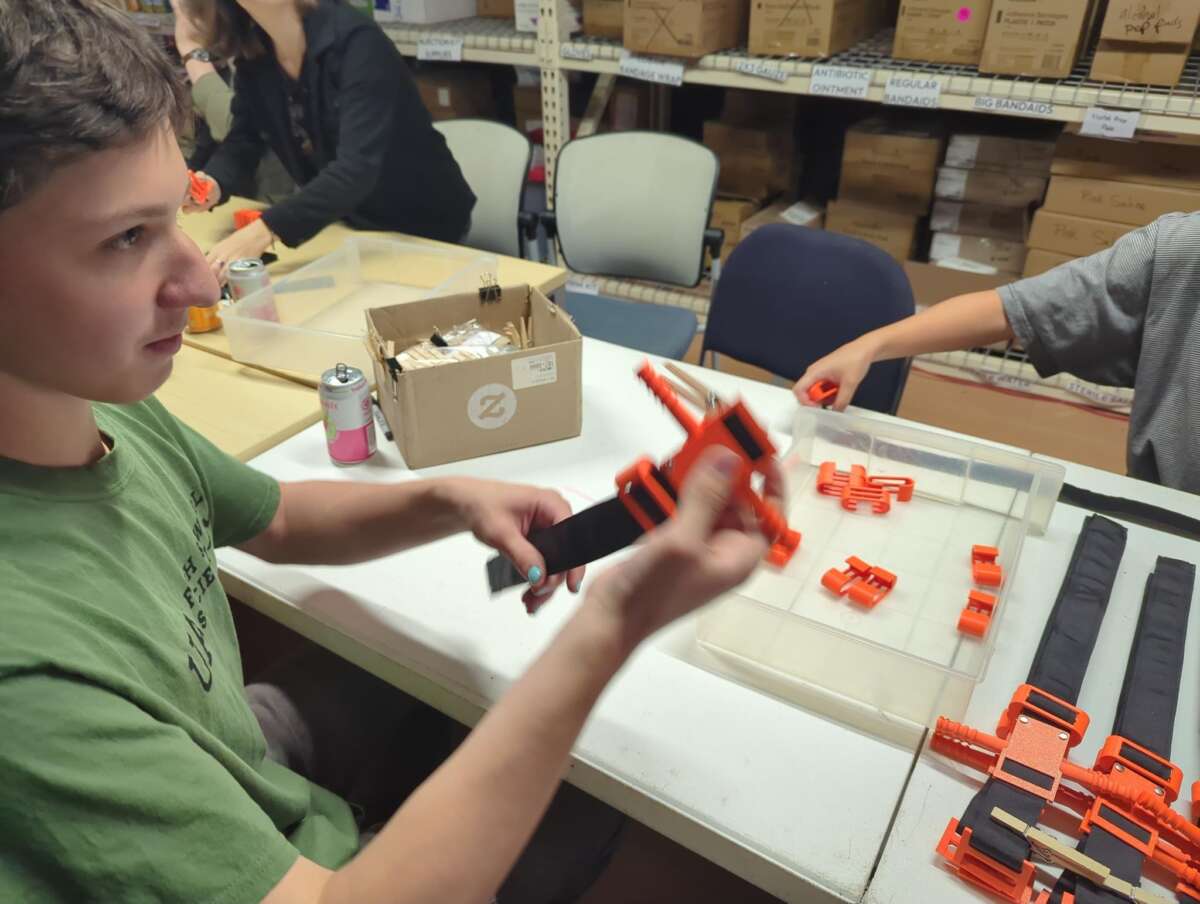
Volunteers gather to manufacture tourniquets during a work party hosted by the Distributed Medical Device Manufacturing collective (DMDM) in April 2026.DMDM
Manufacturing Mutual Aid
The tourniquet manufacturing pipeline hinged on an open-source design published to GitHub in February 2017 by Glia, a medical solidarity organization that empowers low-resource communities to build sustainable, locally-driven healthcare projects. Glia released the design in response to an acute shortage of medical supplies in Gaza due to Israel’s longstanding illegal blockade of food, fuel, and medicine. It has since allowed for about 6,000 tourniquets to be manufactured locally in Gaza, and another 1,000 were sent to Ukraine.
Several years later, Alex Barton, a member of Mutual Aid Disaster Relief, caught wind of Glia’s design through an interview with co-founder Dr. Tarek Loubani on the podcast It Could Happen Here. After more than a decade as a quality engineer in the medical device industry, Barton became interested in open-source medical device manufacturing during the COVID pandemic, but was ultimately discouraged by some of the community’s lack of emphasis on quality.
Grassroots groups are attempting to move toward decentralized medical manufacturing that is less dependent on traditional corporate production chains.
Glia’s values around accessibility, safety, and quality aligned with Barton’s own. Shortly after listening to the episode, he began experimenting with manufacturing the design alongside his partner. They formed a collective called Distributed Medical Device Manufacturing (DMDM), with the stated goal of exploring manufacturing regulatory compliant aid supplies outside of the existing profit driven, hierarchical medical device industry.
“My political camp is that I don’t want people bleeding out because they don’t have access to equipment that we have the luxury of having access to,” Barton told Truthout. “My main motivation is to make sure that anybody that needs these can get them. We’re not there yet, but we’re trying to get there, and there’s a wonderful group of people around the world trying to make sure that happens.”
In 2023, Alex recruited a few friends he met at the Blacklidge Community Collective (BCC), a mutual aid and political education hub in Tucson, to join the collective. A private grant and more than $10,000 in crowdfunding allowed DMDM to apply to have the BCC designated as a Food and Drug Administration (FDA)-approved manufacturing facility.
DMDM’s testing process is more extensive than what the FDA requires, and more rigorous than those produced cheaply by large corporations. Because of a loophole called the 510(k) process, many medical devices do not have to undergo pre-market clinical testing prior to use so long as they can prove they are “substantially similar” to what’s already on the market. The FDA typically does not conduct independent tests of medical devices.
“The two-dollar tourniquets you get on Amazon are totally unsafe,” said Mike Jacobs, a member of DMDM. “They’re unchecked, they are non-FDA registered. You don’t know what the quality process is like.”
Manufacturing Mutual Aid
The tourniquet manufacturing pipeline hinged on an open-source design published to GitHub in February 2017 by Glia, a medical solidarity organization that empowers low-resource communities to build sustainable, locally-driven healthcare projects. Glia released the design in response to an acute shortage of medical supplies in Gaza due to Israel’s longstanding illegal blockade of food, fuel, and medicine. It has since allowed for about 6,000 tourniquets to be manufactured locally in Gaza, and another 1,000 were sent to Ukraine.
Several years later, Alex Barton, a member of Mutual Aid Disaster Relief, caught wind of Glia’s design through an interview with co-founder Dr. Tarek Loubani on the podcast It Could Happen Here. After more than a decade as a quality engineer in the medical device industry, Barton became interested in open-source medical device manufacturing during the COVID pandemic, but was ultimately discouraged by some of the community’s lack of emphasis on quality.
Grassroots groups are attempting to move toward decentralized medical manufacturing that is less dependent on traditional corporate production chains.
Glia’s values around accessibility, safety, and quality aligned with Barton’s own. Shortly after listening to the episode, he began experimenting with manufacturing the design alongside his partner. They formed a collective called Distributed Medical Device Manufacturing (DMDM), with the stated goal of exploring manufacturing regulatory compliant aid supplies outside of the existing profit driven, hierarchical medical device industry.
“My political camp is that I don’t want people bleeding out because they don’t have access to equipment that we have the luxury of having access to,” Barton told Truthout. “My main motivation is to make sure that anybody that needs these can get them. We’re not there yet, but we’re trying to get there, and there’s a wonderful group of people around the world trying to make sure that happens.”
In 2023, Alex recruited a few friends he met at the Blacklidge Community Collective (BCC), a mutual aid and political education hub in Tucson, to join the collective. A private grant and more than $10,000 in crowdfunding allowed DMDM to apply to have the BCC designated as a Food and Drug Administration (FDA)-approved manufacturing facility.
DMDM’s testing process is more extensive than what the FDA requires, and more rigorous than those produced cheaply by large corporations. Because of a loophole called the 510(k) process, many medical devices do not have to undergo pre-market clinical testing prior to use so long as they can prove they are “substantially similar” to what’s already on the market. The FDA typically does not conduct independent tests of medical devices.
“The two-dollar tourniquets you get on Amazon are totally unsafe,” said Mike Jacobs, a member of DMDM. “They’re unchecked, they are non-FDA registered. You don’t know what the quality process is like.”
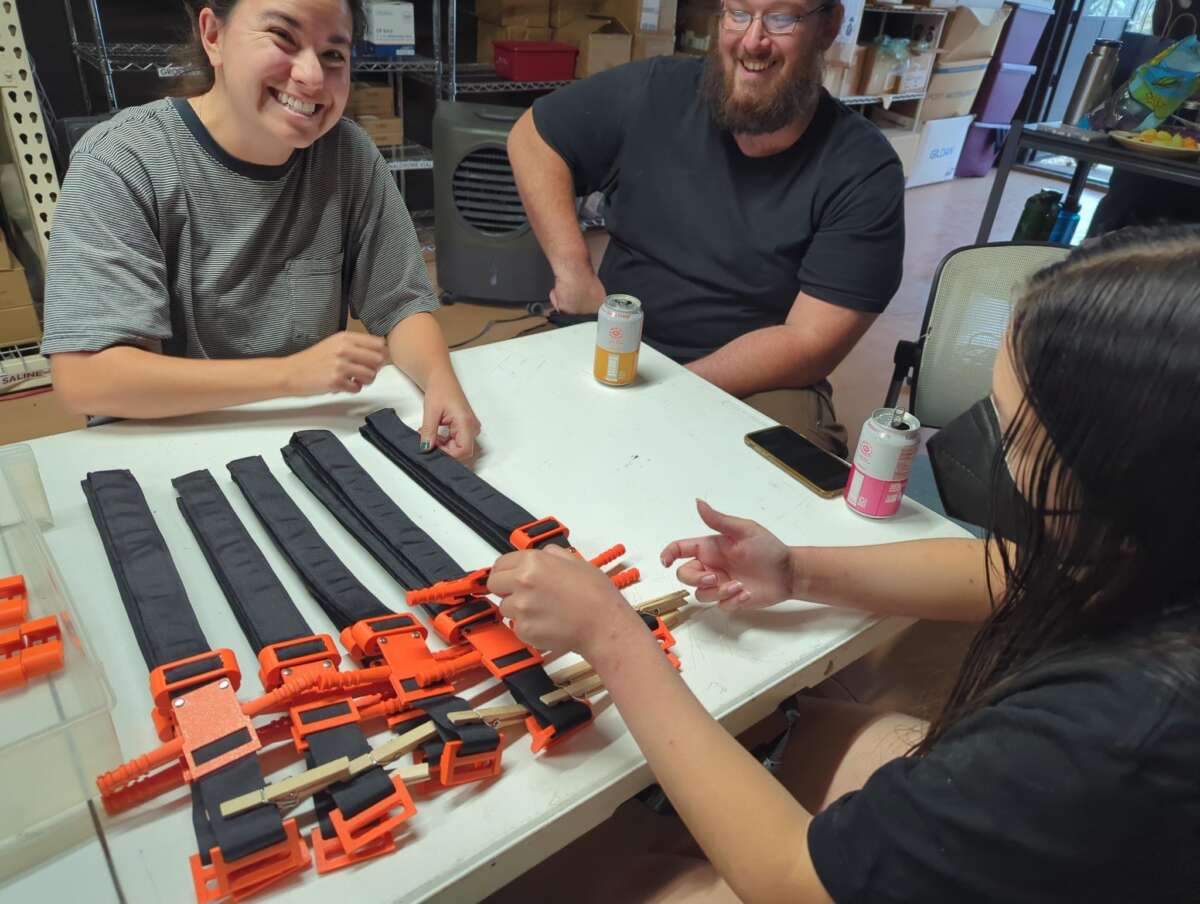
Volunteers gather to manufacture tourniquets during a work party hosted by the Distributed Medical Device Manufacturing collective (DMDM) in April 2026.DMDM
The collective worked with academics to devise robust quality assurance practices, and relies on an open-source tourniquet tester to pressure test each batch to ensure the devices can save lives when needed.
After registering with the FDA, DMDM raised funds to manufacture the 250 tourniquets that landed in Lebanon recently. A second ongoing fundraiser and weekly work parties with trained volunteers will allow them to ship another 200 tourniquets to Lebanon soon. They’ve also sent some to Sudan, and to Los Angeles and Minneapolis during the height of ICE’s invasion.
Last November, an additional $14,000 was raised for the effort in a single day by the Palestine Hurra Collective (PHC), a Nashville-based collective fighting for Palestinian liberation. Palestinian American organizer Aminah Alhassan said just four or five people came together over the course of about two months to plan the fundraiser — a day full of music, Palestinian food, vendors, films, and a panel. About 13 people ran the event.
“There is power in community,” Alhassan told Truthout. “It doesn’t take a lot to make a huge difference. A small group of people were able to achieve this huge thing. It was so special and so powerful.”
“We need to take control of the ability to create the things that we need, especially the most important things — things that save our lives, things that we need in crises.”
A portion of the funds were then sent to Distribute Aid, a grassroots organization of logistics experts that serve as the web connecting the various nodes in the aid pipeline together. Distribute Aid coordinated with Afya, a nonprofit that rescues unused medical supplies for under-resourced health systems and acts as a staging point for donors prior to shipment, and with the nonprofit Airlink which organizes shipments directly with airlines.
The whole pipeline — from Glia, to DMDM, PHC, Afeya, Airlink, and finally Anera — offers an example of what decentralized, community-controlled medical infrastructure can look like in practice. “We need to take control of the ability to create the things that we need, especially the most important things — things that save our lives, things that we need in crises,” DMDM member Ryan Fattica told Truthout. “Doing so together with our community is part of remaking the world and remaking our lives the way we want to live them, and living less alienated lives.”
What would scaling up the autonomous aid pipeline look like in practice? “The immediate step would be that there’s a distributed network of manufacturers of tourniquets and other necessary medical devices across the country,” Fattica envisioned. “We would have strategically placed distribution hubs in major cities, that are able to quickly and nimbly get aid all over the country to anywhere it’s needed.” At an even bigger level, communities would be able to grow all the things they need and share them directly with each other without relying on a profit motive.
The group’s members hope their modest contribution will generalize into something along these lines. They’re actively seeking collaborators, and said the lessons they’ve learned will pave an easier path forward for others who want to pitch in. “The main advice I’d give [for those who want to help] is to reach out to us,” said Fattica. Jacobs added that other groups could be suppliers to DMDM without needing to become an FDA-registered facility. “We are excited to train people in the process so that they can contribute.”
This article is licensed under Creative Commons (CC BY-NC-ND 4.0), and you are free to share and republish under the terms of the license.
The collective worked with academics to devise robust quality assurance practices, and relies on an open-source tourniquet tester to pressure test each batch to ensure the devices can save lives when needed.
After registering with the FDA, DMDM raised funds to manufacture the 250 tourniquets that landed in Lebanon recently. A second ongoing fundraiser and weekly work parties with trained volunteers will allow them to ship another 200 tourniquets to Lebanon soon. They’ve also sent some to Sudan, and to Los Angeles and Minneapolis during the height of ICE’s invasion.
Last November, an additional $14,000 was raised for the effort in a single day by the Palestine Hurra Collective (PHC), a Nashville-based collective fighting for Palestinian liberation. Palestinian American organizer Aminah Alhassan said just four or five people came together over the course of about two months to plan the fundraiser — a day full of music, Palestinian food, vendors, films, and a panel. About 13 people ran the event.
“There is power in community,” Alhassan told Truthout. “It doesn’t take a lot to make a huge difference. A small group of people were able to achieve this huge thing. It was so special and so powerful.”
“We need to take control of the ability to create the things that we need, especially the most important things — things that save our lives, things that we need in crises.”
A portion of the funds were then sent to Distribute Aid, a grassroots organization of logistics experts that serve as the web connecting the various nodes in the aid pipeline together. Distribute Aid coordinated with Afya, a nonprofit that rescues unused medical supplies for under-resourced health systems and acts as a staging point for donors prior to shipment, and with the nonprofit Airlink which organizes shipments directly with airlines.
The whole pipeline — from Glia, to DMDM, PHC, Afeya, Airlink, and finally Anera — offers an example of what decentralized, community-controlled medical infrastructure can look like in practice. “We need to take control of the ability to create the things that we need, especially the most important things — things that save our lives, things that we need in crises,” DMDM member Ryan Fattica told Truthout. “Doing so together with our community is part of remaking the world and remaking our lives the way we want to live them, and living less alienated lives.”
What would scaling up the autonomous aid pipeline look like in practice? “The immediate step would be that there’s a distributed network of manufacturers of tourniquets and other necessary medical devices across the country,” Fattica envisioned. “We would have strategically placed distribution hubs in major cities, that are able to quickly and nimbly get aid all over the country to anywhere it’s needed.” At an even bigger level, communities would be able to grow all the things they need and share them directly with each other without relying on a profit motive.
The group’s members hope their modest contribution will generalize into something along these lines. They’re actively seeking collaborators, and said the lessons they’ve learned will pave an easier path forward for others who want to pitch in. “The main advice I’d give [for those who want to help] is to reach out to us,” said Fattica. Jacobs added that other groups could be suppliers to DMDM without needing to become an FDA-registered facility. “We are excited to train people in the process so that they can contribute.”
This article is licensed under Creative Commons (CC BY-NC-ND 4.0), and you are free to share and republish under the terms of the license.
Ella Fassler
Ella Fassler is an independent journalist based in Providence, Rhode Island. Their work on social movements, labor, technology and the carceral system has been featured in Teen Vogue, The Boston Globe, The Nation, Vice, The Appeal, Slate, Mic, In These Times, and elsewhere. Follow them on Twitter or Bluesky.


No comments:
Post a Comment