Brazil’s Record Oil Production Comes at a Crucial Moment for Global Markets
- Brazil’s oil production hit a record 4.24 million barrels per day in March 2026, driven largely by ultra-deepwater pre-salt developments in the Santos Basin.
- Petrobras, Shell, and Equinor are pouring billions into offshore projects that could significantly expand Brazil’s oil and natural gas output through the end of the decade.
- Brazil’s low-cost and relatively lower-carbon offshore reserves are becoming strategically important as geopolitical tensions threaten Middle Eastern energy exports.
Recent oil price shocks in response to the closure of the Strait of Hormuz underscore the importance of oil-producing countries outside of the Middle East. One of the most important is Brazil, Latin America’s largest economy and oil producer. The country is experiencing an epic decades-long oil boom, which was responsible for production hitting a new record high for March 2026. This places Brazil on track to become a top-five global producer by the end of the decade, making the country important to bolstering energy security in the Americas.
Data from Brazil’s hydrocarbon regulator, the National Agency of Petroleum, Natural Gas and Biofuels (ANP), shows oil production hit 4.24 million barrels for March 2026. This represents a notable 4.6% increase over the month prior and is a whopping 17.3% greater year over year.
Brazil Oil and Natural Gas Production January 2020 to March 2026
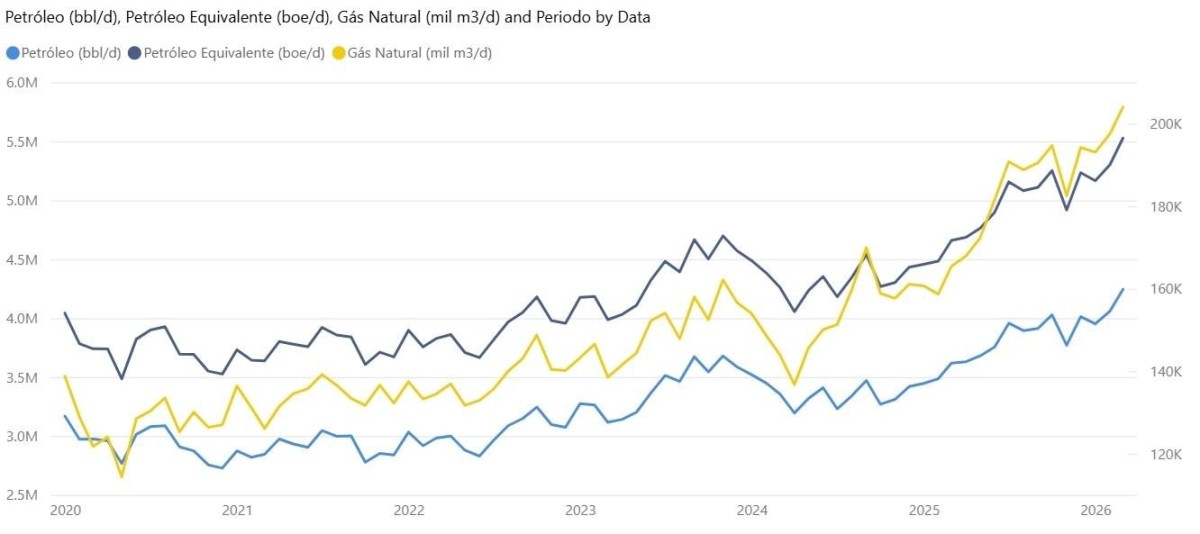
Source: Brazilian National Agency of Petroleum, Natural Gas and Biofuels (ANP).
Natural gas production is also soaring higher at this crucial time, with global supply further constrained by Tehran’s strikes on liquefied natural gas (LNG) and liquefied petroleum gas (LPG) producing facilities in Qatar. Brazil’s March 2026 natural gas output hit an all-time high of 7.2 billion cubic feet per day, a 3.3% increase over February 2026 and a notable 23.3% greater than a year earlier.
This couldn’t occur at a better time for South America’s largest economy. Not only is global supply sharply impacted by events in the Middle East, but key regional natural gas exporter Trinidad and Tobago is suffering from a major decline in hydrocarbon output. As a result, regional supply is falling at a time of rising demand, as illustrated by Colombia, the region’s third-largest economy, which is experiencing such strong demand that LPG imports are soaring, forecast to expand by at least 26% this year.
Brazil’s hydrocarbon production will continue expanding at a healthy clip. National oil company Petrobras will be a key driver of higher hydrocarbon production. The driller, where the government owns 37%, is planning to invest $109 billion between 2026 and 2030. Importantly, $78 billion or 71.6% of that capital spending will be directed to Petrobras exploration and production facilities, with most to be spent on the company’s prolific pre-salt operations.
It is Brazil’s deepwater pre-salt oilfields, located in the prolific offshore Santos Basin, which are the primary driver of the country’s massive oil boom, which has been underway since 2006. There are currently nine pre-salt projects under development, with six floating production, storage, and offloading (FPSO) vessels to be installed in the offshore ultra-deepwater 210,500-acre Buzios oilfield. Petrobras claims Buzios is the world’s largest deepwater oilfield. That large oilfield is shaping up to be the key driver of Brazil’s future production growth.
Buzios is proving to be highly profitable for Brazil’s national oil company with an estimated breakeven price of less than $35 per barrel. Petrobras recently announced that its entire upstream portfolio has an average breakeven price of a mere $25 per barrel, one of the lowest in the industry. Petrobras expects to be lifting 2.7 million barrels of crude oil per day by 2028, with 81% comprised of pre-salt petroleum, while combined commercial oil and natural gas production will hit 2.9 million barrels of oil equivalent that year.
Overall, Brazil’s pre-salt oilfields have industry-low breakeven prices estimated to be $30 to $40 per barrel, making them extremely attractive for foreign energy companies. The appeal of investing in offshore Brazil is amplified by the low carbon intensity of oil extraction operations. Analysts estimate Brazil’s oil industry emits an average of 10 to 12 kilograms of carbon for every barrel of crude oil lifted, compared to a global average of around 17 kilograms. Meanwhile, Petrobras claims its upstream portfolio emits 17 kilograms of carbon for every barrel of crude produced.
Shell, Brazil’s second largest oil producer, lifting 11.62% of total production, continues to invest in the country’s prolific offshore pre-salt basins. In December 2025, the global supermajor announced the acquisition of additional acreage in the Santos Basin Mero and Atapu operations. Shell committed $50.5 million to acquire an additional 0.254% of Atapu and $293.4 million for an additional 0.70% of Mero. This boosted the supermajor’s pre-salt oil production by a yet undefined amount.
Another global energy major, Norway’s national oil company Equinor, is developing the $9 billion Raia natural gas project in the offshore Campos Basin. Equinor, which is the operator, holds a 35% working interest in the facility, while 35% is held by Beijing-controlled Sinopec and the remaining 30% by Petrobras. The facility is targeting natural gas and condensate reserves totalling at least one billion barrels of oil equivalent. Raia will come online during 2028 with the capacity to pump 565 million cubic feet of natural gas per day and 126,000 barrels of condensate per day.
The offshore facility possesses the potential to supply up to 15% of Brazil’s natural gas demand in 2028. Raia will ease the impact of declining sales of the fossil fuel in Latin America and the Caribbean, which are falling because of the structural decline of Trinidad and Tobago’s once-dominant natural gas industry. The Raia facility, which will have industry-low carbon emissions of 6 kilograms per barrel produced, compared to 17 kilograms globally, will boost Brazil’s energy self-sufficiency.
By Matthew Smith for Oilprice.com

No comments:
Post a Comment