VLAD TRUMP
US Waiver Extension Keeps India’s Russian Crude Lifeline Open
- The extension of the US waiver on Russian crude lands at a critical moment for India, just as Russian barrels have grown to around 40% of its 4.5 million b/d crude import slate.
- Unlike China, India has little inventory cushion and rising domestic fuel demand that leaves refiners with almost no room for disruption.
- With Gulf flows constrained and medium-sour crude scarce, the extended waiver keeps New Delhi’s only remaining large-scale supply option open
The middle of May brought very little good news to the Asian refiners, but the extension of the US waiver on Russian crude and oil products on May 18 has certainly become one. The Trump administration first introduced the waiver on March 12 for Russian crude and products already loaded on ships before that date, as an emergency response to the blockage of the Strait of Hormuz and the resulting shortage of oil on the market. It was extended once in mid-April for another month, and for the second time on May 18, for another 30 days. For New Delhi, the extension comes as a significant relief, shielding its crude supply that has kept Indian refineries running through the worst of the Gulf disruptions on record.
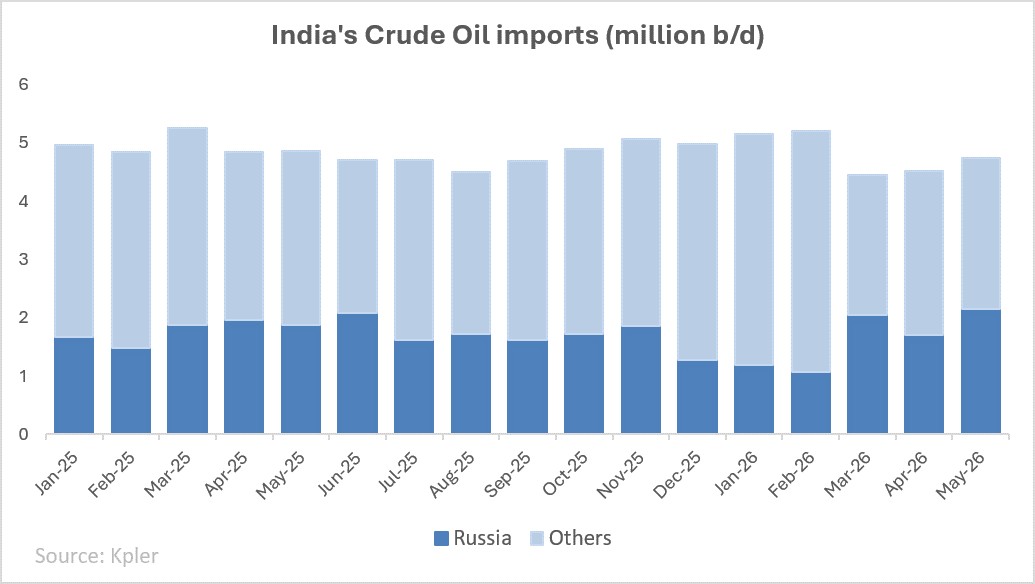
India’s request to extend the waiver proved successful, securing continued access to much-needed volumes, as Russian crude has become central to India’s supply balance. In March and April, India was the largest buyer of seaborne Russian crude, taking 2.08 million b/d and 1.7 million b/d, respectively. That was roughly half of India’s average crude imports of 4.5 million b/d over the past two months. China, the second-largest buyer of Russian seaborne crude, purchased 1.8 million b/d in March and 1.4 million b/d in April. In May, India is set to receive around 2.1 million b/d of Russian crude.
The waiver never mattered to China in the same way. Many Chinese consumers of Russian crude are less sensitive to US sanctions in the first place, and China also has one of the largest crude stockpiles in the world. Its inventories rose from 1.22 billion barrels in March to 1.23 billion barrels after the Gulf conflict began and Hormuz was shut. That is enough to sustain even China’s massive domestic consumption of 14-15 million b/d for several months. India has no such cushion. Even before the conflict started in February, its crude inventories were only 106 million barrels. By April, they had fallen to 90 million barrels. With consumption of 5.5 million to 6 million b/d, those stocks are getting dangerously thin
The supply hit due to the Hormuz closure has been brutal. India has lost more than a third of its usual February monthly oil supply from Gulf producers. Saudi Arabia and the UAE remain the only Gulf suppliers still able to sell crude through bypass pipeline routes, but both are sending less than India would need. Saudi exports to India fell from 1.03 million b/d in February to 670,000 b/d in April. The UAE has managed to keep exports at around 550,000-600,000 b/d over the past two months but has little room to raise them. India has therefore been searching globally for medium-sour cargoes, the grades best suited to many of its refineries and the least available after Hormuz was blocked. It has turned to Latin America, importing 285,000 b/d from Venezuela in April and 275,000 b/d from Brazil, twice the previous month’s level. Nigeria has also exported more in April, but its crude is generally too light for Indian refinery needs.
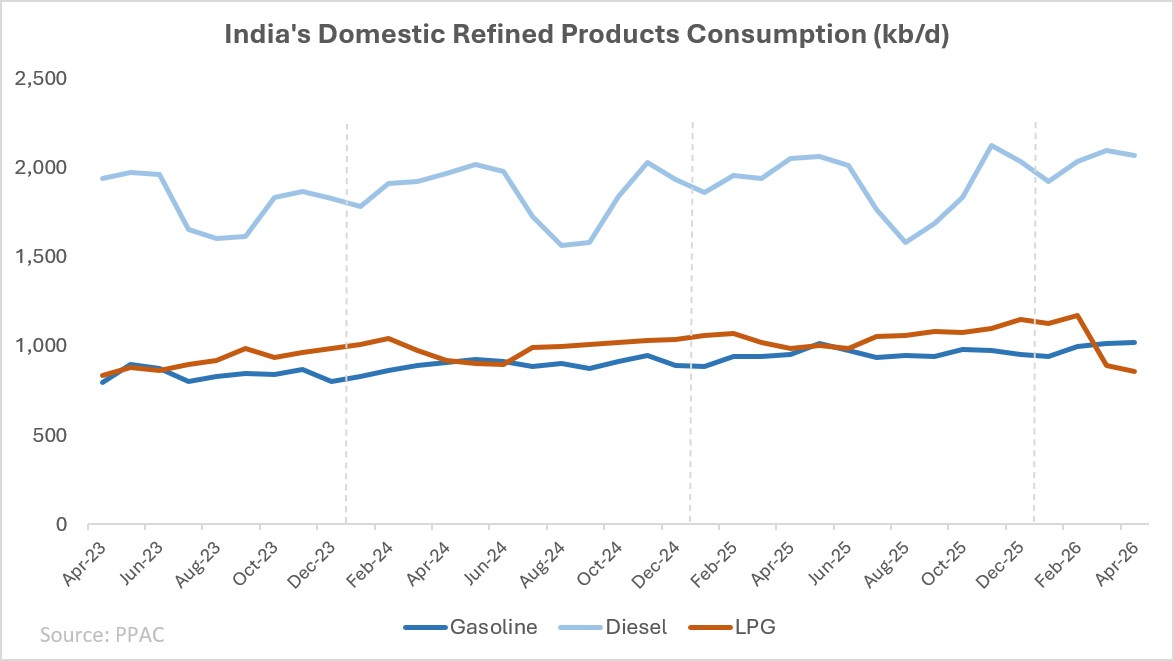
At the same time, India’s domestic oil products demand is still rising (in contrast to China). Adjusting for seasonal patterns, diesel and gasoline consumption in April 2026 was 1% and 7% higher, respectively, year-on-year, at 2.07 and 1.06 million b/d. LPG consumption is the exception, but that decline reflects nationwide shortages rather than a clean demand signal.
There’s also a more practical aspect to the White House’s extension of the sanctions waiver. The Vadinar refinery has returned from maintenance after being offline from April 10 to May 15 and is expected to resume buying the 400,000 b/d of Russian crude that it used to before turnarounds (since August 2025, it has only been buying oil from Russia). So as not to have the refinery overflowing with crude, Vadinar saw its imports of Russian oil collapse to 25,000 b/d in April, suggesting there would be an upside of 350-375,000 b/d of buying in the months to come. As the refinery is co-owned by Rosneft and already under sanctions, additional US restrictions matter less to it.
But the broader rise in Russian imports over the past two months was not driven only by sanctioned or sanction-insulated players. State-owned IOC became the largest buyer, importing 750,000 b/d in April. BPCL bought 190,000 b/d. Partly state-owned HMEL, MRPL and HPCL, which had not bought Russian oil for several months before the waiver, together purchased 350,000 b/d in April out of India’s total 1.7 million b/d of Russian crude imports. These are the refiners most exposed to a shift in US enforcement. They had already stopped buying Russian crude after Washington threatened 25% tariffs, suggesting that some Indian refiners remain highly compliance-sensitive.
Reliance also stopped purchasing Russian cargoes in January 2026 because of sanctions, only for the waiver to bring it back. In April, Russian crude accounted for around 18% of the Jamnagar complex’s total 1.2 million b/d imports. With the Strait of Hormuz still closed, Reliance will continue looking for medium-sour grades, and Russian crude will be difficult to ignore. Jamnagar’s planned maintenance at the end of May will put pressure on consumers but may give Reliance a temporary pause in the middle of the chaos.
The economic cost is already reaching consumers. For the first time in four years, the government had to raise prices for refined oil products that are usually cushioned by the state. Diesel and gasoline prices rose by 3 rupees per litre (around $0.03/litre), lifting diesel to $0.94/litre and gasoline to $1.02/litre. The last increase came in 2022, after the shock caused by the start of the war in Ukraine. Alternative crude will likely come increasingly from Latin America, and while freight is rising, India is becoming the premium crude market in Asia. That premium can cover delivery costs and pull barrels from farther away. It should also encourage the UAE to redirect more of its Murban exports, available through the pipeline to Fujairah on the Arabian Sea. In April, the UAE exported 600,000 b/d to India, twice as much as a year earlier and the highest monthly volume on record.
The extension of the waiver therefore arrives at a critical moment, but it does not resolve the underlying vulnerabilities. China can absorb the disruption through inventories, pipelines, state-controlled trading channels and a higher tolerance for sanctions risk. India cannot. Its refineries need medium-sour crude, its stocks are thin, most of its Gulf supply has been damaged, its demand is still growing, and its most important incremental barrel is now politically more expensive. Russian crude is no longer just a discounted opportunity for India; it has become the commodity standing between New Delhi and a much more visible domestic fuel shortage crisis.
By Natalia Katona for Oilprice.com

No comments:
Post a Comment