Blykalla applies to build Swedish SMR plant
_64217.jpg)
Blykalla said it chose Norrsundet in the municipality of Gävle as the location for its nuclear facility due to its strategic location between two key bidding zones, an existing port, key infrastructure, and industrial heritage – reducing construction complexity while addressing regional power shortages with predictable baseload power. The proposed plant will have a total generating capacity of 330 MWe.
"This application is a historic first for Sweden," said Blykalla CEO Jacob Stedman. "We're not just planning an advanced reactor park - we're building Sweden’s energy future and putting the country at the forefront of the global nuclear power renaissance. Building new energy infrastructure is critical, and the energy systems of the future need to be predictable, reliable and fossil-free. As AI and electrification grow worldwide, we need to accelerate the deployment of predictable, clean baseload power. That's exactly what Blykalla's technology does, and we are uniquely positioned to meet this moment."
The Ministry of Climate and Enterprise said the government will now assess whether the application meets the requirements, whether the proposed activity is justified and whether there are conditions for preparedness and for handling the nuclear material being handled and the nuclear waste that is generated. The government review of the application launches a comprehensive approval process involving multiple agencies, including the Land and Environmental Court and Swedish Radiation Safety Authority. The government will then produce a facility plan to guide decisions on how land and water areas will be used.
The ministry noted the municipality of Gävle needs to approve both the plan and the application before the government can make a decision to approve a nuclear facility. "The approval does not replace the permit review according to the Environmental Code and the Nuclear Activities Act," it said. "However, the government's approval replaces the permissibility review that the government must otherwise carry out according to Chapter 17 of the Environmental Code."
_c2dd3e92.jpg)
Rendering of the SEALER building in Norrsundet (Image: Blykalla)
Blykalla - formerly called LeadCold - is a spin-off from the KTH Royal Institute of Technology in Stockholm, where lead-cooled reactor systems have been under development since 1996. The company - founded in 2013 as a joint stock company - is developing the SEALER (Swedish Advanced Lead Reactor). A demonstration SEALER (SEALER-D) is planned to have a thermal output of 80 MW.
Subject to the necessary permits and final investment decisions, the commercial-scale Norrsundet facility could become operational in the first half of the 2030s.
In February, the Swedish government announced several proposed measures to make it easier to establish new nuclear power in the country. The new legislation introduces an early-stage government approval process designed to improve predictability and accelerate the deployment of new nuclear capacity. The following month, Kärnfull Next submitted an application to build a power plant based on small modular reactors (SMRs) in the municipality of Valdemarsvik in Östergötland county in southeastern Sweden, becoming the first application under the country's new Act on Government Approval of Nuclear Facilities. It marked the first application for the establishment of new nuclear power in Sweden 50 years.
"New nuclear power is an important piece of the puzzle for Sweden's energy independence," said Acting Minister of Climate and Environment Johan Britz. "The concern we are now seeing in the world clearly shows how vulnerable we are becoming from our dependence on fossil fuels – and how crucial it is to expand fossil-free electricity production. Thanks to our new permit review, more actors now dare to invest in nuclear power."
In October 2022, Sweden's incoming centre-right coalition government adopted a positive stance towards nuclear energy. In November 2023, it unveiled a roadmap which envisages the construction of new nuclear generating capacity equivalent to at least two large-scale reactors by 2035, with the equivalent capacity of up to 10 new large-scale reactors (which may include small modular reactors) coming online by 2045. A new act on state aid entered into force on 1 August 2025, since when interested companies have been able to apply for the aid.
The Swedish government received the first such application in December to support proposals for either five GE Vernova Hitachi BWRX-300 reactors or three Rolls-Royce SMRs to provide about 1500 MW capacity at Ringhals on the Värö Peninsula. The application came from Videberg Kraft AB, a project company owned by Vattenfall AB and backed by a series of industrial firms via the Industrikraft i Sverige AB consortium.
Permit issued for second phase of Grohnde dismantling work
_15918.jpg)
PreussenElektra - a subsidiary of EOn Group - applied in October 2017 for approval to decommission and dismantle the 1,360 MWe pressurised water reactor which entered commercial operation in February 1985, and was shut down in December 2021.
The Lower Saxony Ministry for the Environment, Energy and Climate Protection issued the first decommissioning and dismantling permit to the company for the Grohnde plant in December 2023, with dismantling work beginning in the following month.
The dismantling process to date has included the removal of components from the primary cooling circuit. Simultaneously, the newly constructed waste treatment centre has commenced operations. There, all dismantled materials are broken down, radiologically measured, cleaned, and, after official approval, either disposed of or recycled. On 7 April this year, PreussenElektra announced that all the used nuclear fuel assemblies in the storage pool at Grohnde had been transferred to an on-site interim storage facility. To achieve fuel-free status, a total of 694 fuel assemblies were transferred from the plant's storage pool into CASTOR used fuel storage casks.
PreussenElektra submitted the application for the second decommissioning permit in January 2024. This permit allows further key decommissioning work to proceed, including the removal of the reactor pressure vessel and the surrounding biological shield.
During a visit to the plant on 15 May, Lower Saxony's Minister for the Environment, Energy and Climate Protection, Christian Meyer, officially presented PreussenElektra with the second and final permit for the plant's decommissioning. With this, all necessary permits for the complete dismantling of the plant are now in place.
Starting later this year, one of the most technically demanding phases of the decommissioning process will begin: the dismantling of the reactor pressure vessel's internal components. Planning for this is already under way. The first cut is currently scheduled for early 2027. The project is expected to be completed by mid-2028.
"I thank everyone involved for their excellent work on the decommissioning application," said Environment Minister Christian Meyer. "With the final decommissioning permit now granted and the reactor building being free of nuclear fuel, we are creating clarity and the conditions for the safe and sustainable decommissioning of the Grohnde nuclear power plant and its interim storage on site. The decommissioning of nuclear facilities must be safe, transparent, and under strict nuclear regulatory oversight. Our shared goal is a swift, competent, and responsible decommissioning process."
Guido Knott, Chairman of the Management Board of PreussenElektra, said: "With the second permit, we now have all the legal prerequisites to carry out the dismantling of the KWG consistently and according to plan. Our aim is to implement the dismantling safely, efficiently and quickly - with the clear goal of completing the nuclear dismantling by the mid-2030s and being able to use the site for future projects as soon as possible."
In a third, conventional phase, the dismantling will take place after clearance from nuclear regulatory oversight. The dismantling of Grohnde is scheduled for completion by 2039. Afterwards, the power plant site will be available for redevelopment.
PreussenElektra is responsible for the decommissioning of eight nuclear power plants in Germany. Isar 2 was the last of the PreussenElektra plants to cease operations on 15 April 2023. The Brokdorf and Grohnde plants were shut down on 31 December 2021. With the already decommissioned Isar 1, Stade, Unterweser and Würgassen plants, all of PreussenElektra's nuclear facilities are now in various phases of decommissioning and dismantling. The company's goal is to dismantle its power plant fleet by 2040.
Concrete pouring completed for first part of Cernavoda refurb project
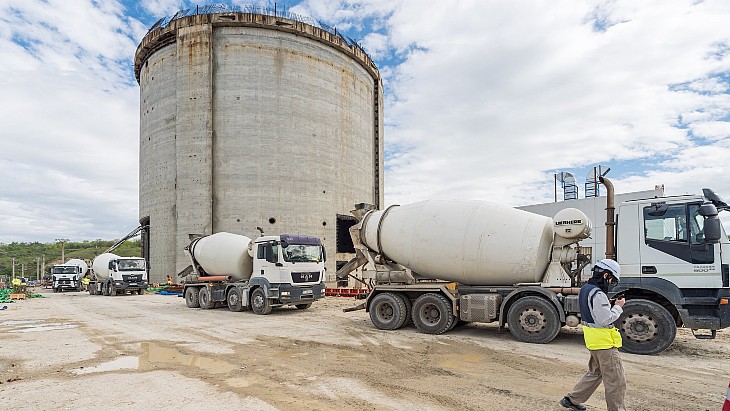
About 3470 cubic metres of concrete was used for the foundation, which the company says was the equivalent of about 380 concrete mixer truck-fulls, and was the most complex such operation since unit 2 was built.
The new waste facility is designed for the handling, processing and interim storage of waste, both from the refurbishment of unit 1 and the long-term commercial operation of both the plant’s units.
Cosmin Ghita, General Manager of Nuclearelectrica, said: "The pouring of the first concrete for the construction of the infrastructure required for the refurbishment of unit 1 holds a significance similar to that of the pouring of the first concrete during the construction of unit 1. After 30 years of operation at high nuclear safety standards and with world-class performance in terms of capacity factor, unit 1, through the refurbishment programme, will continue to operate for another 30 years starting in 2030. Another 30 years of energy security, 5 million MW produced annually, and 5 million tons of CO2 avoided annually - a strategic project for Romania's energy security."
Cernavoda is the only nuclear power plant in Romania and consists of two 650 MWe Candu reactors. Unit 1 went into commercial operation in 1996 and unit 2 in 2007.
The unit 1 refurbishment project began in 2017 and is currently in the second of three phases, in preparation for implementation. The project is scheduled to enter its third and final phase of development in 2027 with the shutdown of unit 1 for refurbishment.
Background
Candu units are pressurised heavy water reactors designed to operate for 30 years, with a further 30 years available subject to refurbishment. This includes the replacement of key reactor components such as steam generators, pressure tubes, calandria tubes and feeder tubes. It involves removing all the reactor's fuel and heavy water and isolating it from the rest of the power station before it is dismantled. Thousands of components, including those that are not accessible when the reactor is assembled, are inspected, and all 480 fuel channels and 960 feeder tubes are replaced during the high-precision rebuild.
In December 2024 Nuclearelectrica signed the engineering, procurement and construction contract for the estimated EUR1.9 billion (USD1.97 billion) refurbishment with a consortium of Korea Hydro & Nuclear Power, AtkinsRealis's Candu Energy, Canadian Commercial Corporation and Ansaldo Nucleare.
The civil construction works began in September 2025 after the company received approval from Romania's nuclear regulator (CNCAN) for the construction of the Intermediate Radioactive Waste Repository. The company said the expansion of the intermediate storage capacity of low and medium radioactive waste was a key part of sustaining long-term operation of the plant.

No comments:
Post a Comment