
Cuba Bets on Solar Power as Energy Crisis Deepens
- Cuba is facing a worsening energy crisis marked by chronic blackouts, fuel shortages, and aging energy infrastructure.
- The government is encouraging private-sector participation in energy and other strategic industries while expanding renewable energy capacity.
- Chinese-backed solar projects are central to Cuba’s plan to reduce fuel imports and increase renewable generation over the coming decades.
Cuba has been experiencing a worsening energy crisis for several years, which previously led it to rely heavily on Venezuela for its fuel. Following the United States’ intervention in Venezuela in February, the energy crisis has grown even worse, as Cubans face regular blackouts and the economy suffers.
Cuba requires about 100,000 barrels a day to power its grid and meet the regular transportation demands. It fulfils just 40 percent of this demand domestically. In January, the Trump administration imposed a fuel blockade on Cuba, which led to severe power outages and fuel shortages, exacerbating the energy crisis that had previously emerged due to years of underinvestment in Cuba’s energy infrastructure. This has had a knock-on effect on the country’s economy, as businesses face regular blackouts and the high cost of fuel prevents many from operating.
Cuba could previously meet its minimum energy demand by importing fuel from Venezuela. However, after the U.S. invaded Venezuela in February, it stopped all energy imports from Caracas to Havana. When Mexico quickly stepped in to fill the gap, Trump threatened any power that provided Cuba with fuel with high trade tariffs. President Trump signed an executive order that threatens tariffs on third parties looking to sell oil to Havana, and introduced U.S. measures to penalise companies that want to invest in Cuba.
In recent months, the Cuban government has introduced new regulations aimed at providing private sector actors with more opportunities, thereby loosening its long-standing policy of state centralism. In particular, the state is encouraging the private sector to invest in energy diversification, providing greater tax exemptions for the import of solar panels by any type of business.
The biggest shift to date took place in March, when the government introduced a new law for mixed limited liability companies, allowing private capital to merge with state companies for the first time. This is expected to spur greater private investment in industries historically controlled by the government, such as sugar and precious mineral mining.
In May, Cuba’s President Miguel Díaz-Canel said in a social media post that U.S. sanctions on the Caribbean island were “immoral, illegal, and criminal” after the U.S. imposed stricter sanctions on 11 Cuban officials and its main intelligence agency. Díaz-Canel said that Cuba would “continue to denounce, in the firmest and most energetic way possible, the genocidal siege that seeks to strangle our people.”
Earlier this month, CIA director John Ratcliffe visited Cuba. The message from the trip was that the United States had reiterated its offer of assistance to Cuba in exchange for “fundamental changes” to its communist political regime.
Trump has previously suggested that there may be a “friendly takeover” of Cuba and stated that Washington may set its sights on Cuba after the Iran war. Trump has also said that he thinks he will have the “honour” of “taking Cuba.” The U.S. President said this month that he intends to hold talks with Cuban officials, without offering more details.
In spite of repeated threats on trade by President Trump, the governments of Mexico and Uruguay sent humanitarian aid to Cuba in May, including food, medical supplies, and critical materials. Meanwhile, in the face of growing energy insecurity, the Cuban government is striving to achieve greater energy diversification to boost energy security and reduce its dependence on foreign powers for fuel.
Foreign Minister Bruno Rodríguez recently wrote on the X social media site, “Cuba is moving on with its energy transition program to achieve greater sovereignty in this sector, under the leadership of our Party and Government. It has been estimated that this year, the renewable energy coverage will increase to 15 percent and by the year 2030, this figure will rise to 24 percent. By the year 2035, renewable energies are estimated to cover 40 percent of the demand, which will make it possible to eliminate the import of fuels. According to this program, by the year 2050, renewable energies will cover 100 percent of the demand.”
Cuba is accelerating its green transition by developing new projects with China, which is a powerhouse in renewable energy. The two powers have established a deal to install 92 solar parks by 2028, bringing almost 2 GW of power online. This could provide enough electricity to power over 10 percent of Cuba’s households and reduce Havana’s reliance on fuel imports.
Cuba’s solar panel imports rose from a value of around $3 million in 2023 to $117 million in 2025, in a bid to meet the country’s energy demand as its fossil fuel infrastructure continues to fall into disrepair. Increasing Cuba’s solar energy capacity could help make the island nation more self-sustainable, which would reduce the impact of U.S. sanctions and oil price volatility on Havana. However, in the current state of crisis, it remains uncertain whether Cuba can endure the U.S. blockade long enough to achieve this aim.
By Felicity Bradstock for Oilprice.com
- Cuba is facing a worsening energy crisis marked by chronic blackouts, fuel shortages, and aging energy infrastructure.
- The government is encouraging private-sector participation in energy and other strategic industries while expanding renewable energy capacity.
- Chinese-backed solar projects are central to Cuba’s plan to reduce fuel imports and increase renewable generation over the coming decades.
Cuba has been experiencing a worsening energy crisis for several years, which previously led it to rely heavily on Venezuela for its fuel. Following the United States’ intervention in Venezuela in February, the energy crisis has grown even worse, as Cubans face regular blackouts and the economy suffers.
Cuba requires about 100,000 barrels a day to power its grid and meet the regular transportation demands. It fulfils just 40 percent of this demand domestically. In January, the Trump administration imposed a fuel blockade on Cuba, which led to severe power outages and fuel shortages, exacerbating the energy crisis that had previously emerged due to years of underinvestment in Cuba’s energy infrastructure. This has had a knock-on effect on the country’s economy, as businesses face regular blackouts and the high cost of fuel prevents many from operating.
Cuba could previously meet its minimum energy demand by importing fuel from Venezuela. However, after the U.S. invaded Venezuela in February, it stopped all energy imports from Caracas to Havana. When Mexico quickly stepped in to fill the gap, Trump threatened any power that provided Cuba with fuel with high trade tariffs. President Trump signed an executive order that threatens tariffs on third parties looking to sell oil to Havana, and introduced U.S. measures to penalise companies that want to invest in Cuba.
In recent months, the Cuban government has introduced new regulations aimed at providing private sector actors with more opportunities, thereby loosening its long-standing policy of state centralism. In particular, the state is encouraging the private sector to invest in energy diversification, providing greater tax exemptions for the import of solar panels by any type of business.
The biggest shift to date took place in March, when the government introduced a new law for mixed limited liability companies, allowing private capital to merge with state companies for the first time. This is expected to spur greater private investment in industries historically controlled by the government, such as sugar and precious mineral mining.
In May, Cuba’s President Miguel Díaz-Canel said in a social media post that U.S. sanctions on the Caribbean island were “immoral, illegal, and criminal” after the U.S. imposed stricter sanctions on 11 Cuban officials and its main intelligence agency. Díaz-Canel said that Cuba would “continue to denounce, in the firmest and most energetic way possible, the genocidal siege that seeks to strangle our people.”
Earlier this month, CIA director John Ratcliffe visited Cuba. The message from the trip was that the United States had reiterated its offer of assistance to Cuba in exchange for “fundamental changes” to its communist political regime.
Trump has previously suggested that there may be a “friendly takeover” of Cuba and stated that Washington may set its sights on Cuba after the Iran war. Trump has also said that he thinks he will have the “honour” of “taking Cuba.” The U.S. President said this month that he intends to hold talks with Cuban officials, without offering more details.
In spite of repeated threats on trade by President Trump, the governments of Mexico and Uruguay sent humanitarian aid to Cuba in May, including food, medical supplies, and critical materials. Meanwhile, in the face of growing energy insecurity, the Cuban government is striving to achieve greater energy diversification to boost energy security and reduce its dependence on foreign powers for fuel.
Foreign Minister Bruno Rodríguez recently wrote on the X social media site, “Cuba is moving on with its energy transition program to achieve greater sovereignty in this sector, under the leadership of our Party and Government. It has been estimated that this year, the renewable energy coverage will increase to 15 percent and by the year 2030, this figure will rise to 24 percent. By the year 2035, renewable energies are estimated to cover 40 percent of the demand, which will make it possible to eliminate the import of fuels. According to this program, by the year 2050, renewable energies will cover 100 percent of the demand.”
Cuba is accelerating its green transition by developing new projects with China, which is a powerhouse in renewable energy. The two powers have established a deal to install 92 solar parks by 2028, bringing almost 2 GW of power online. This could provide enough electricity to power over 10 percent of Cuba’s households and reduce Havana’s reliance on fuel imports.
Cuba’s solar panel imports rose from a value of around $3 million in 2023 to $117 million in 2025, in a bid to meet the country’s energy demand as its fossil fuel infrastructure continues to fall into disrepair. Increasing Cuba’s solar energy capacity could help make the island nation more self-sustainable, which would reduce the impact of U.S. sanctions and oil price volatility on Havana. However, in the current state of crisis, it remains uncertain whether Cuba can endure the U.S. blockade long enough to achieve this aim.
By Felicity Bradstock for Oilprice.com
Sanctioned Russian Tanker Carrying Diesel to Cuba Diverts to the South
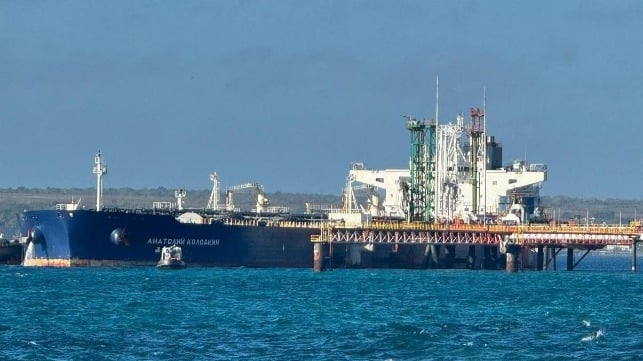
A sanctioned Russian-flag tanker that is loaded with a cargo of diesel appeared to divert south, possibly heading to South America after lingering in the Atlantic for a month. The product tanker Universal (50,923 dwt) was thought to be carrying a second relief shipment from Russia to the struggling island of Cuba.
Russian officials had said in March that they planned to send emergency shipments of fuel to Cuba as a sign of solidarity. “Russia does not intend to seek permission from other countries to supply its oil,” said Dmitry Birichevsky, MFA Director of the Department for Economic Cooperation.
The first shipment arrived on March 31 aboard the tanker Anatoly Kolodkin, after reports that Donald Trump said he was not concerned about the shipment. The tanker supplied 730,000 barrels of crude, but recently, Cuban officials admitted it had been quickly used and is now depleted. Russian officials had said a second shipment was close behind.
The tanker Universal, which is under sanctions from the U.S., UK, and EU, departed a Baltic terminal loaded with approximately 250,000 barrels of diesel fuel in early April. It was escorted through the English Channel by the frigate Admiral Grigorovich and then began the Atlantic crossing, apparently bound for Cuba. Its AIS signal, however, has said “for orders.”
Since mid-April, the vessel had been mysteriously holding in the middle of the Atlantic. It was approximately 1,000 miles from Cuba, and it was not attempted to proceed. Tracking services spotted that the tanker got back underway yesterday, May 27. It is making over 10 knots but turned to the southeast, sailing away from Cuba.
There was a similar situation earlier in the year when the Chinese-owned product tanker Sea Horse also appeared to be bound for Cuba carrying Russian fuel. The vessel stopped in the Atlantic while tensions were high with the United States actively turning away other tankers headed for Cuba. The Sea Horse, held in the Atlantic and appearing unready to challenge the U.S., ultimately turned south, heading to Trinidad and Venezuela.
While the U.S. may be continuing to challenge fuel shipments to the island, other relief ships are proceeding. A cargo ship arrived from Mexico carrying donated humanitarian aid, and last weekend, a Chinese general cargo ship arrived with a shipment of rice.
On May 1, the Trump administration issued an executive order targeting the assets of any foreign entity that assists the Cuban government. After that, two of the largest shippers, CMA CGM and Hapag-Lloyd, said that they were suspending bookings to Cuba. They cited the compliance risks of continuing to engage in Cuban trade.


No comments:
Post a Comment