Who is going to run out of men sooner and be forced to end the war: Russia or Ukraine?
Who is going to run out of men sooner and have to end the war? Russia or Ukraine? Much has been made of the slowdown of Russia’s volunteer recruitment drive which is now unable to replace the estimated 30,000 dead and wounded a month, but little reporting is devoted to the same problem that Ukraine is facing with its forced conscription problem.
It’s an important dynamic. Once the numbers fall too far armies tend to collapse. The psychology of a soldier is if say 3% of your compatriots die on the frontline then that is seen as an acceptable risk, but if as many as one in four are being killed at some point the soldier starts to believe death is inevitable and will try to leave.
There has been a spate of “Russia is losing the war” commentaries of late as the Armed Forces of Russia (AFR) battlefield progress has slowed to a standstill in the last month and has even reversed.
However, according to a note from Peter Turchin, the Project Leader at the Complexity Science Hub in Vienna, who developed a Attritional Warfare Model, or AWM (based on the Lanchester equations), the model suggests that the Russian forces continue to hold the advantage in the war in Ukraine and quantitative models of attritional warfare suggest it is the Armed Forces of Ukraine (AFU), not Russia, that may be approaching a critical manpower threshold.
"The AWM is quite straightforward–essentially, an accounting device. The key assumptions are (1) future dynamics of war materiel production by the contenders, (2) how materiel is translated into casualties, and (3) how the end point is determined," said in the original paper. "But the overall message is very clear. Once the war settled into the attrition phase (by the end of 2022), and it was clear that Western sanctions failed to shut down Russian productive capacity, the eventual outcome became, essentially, a mathematical certainty... ultimately, Russian victory."
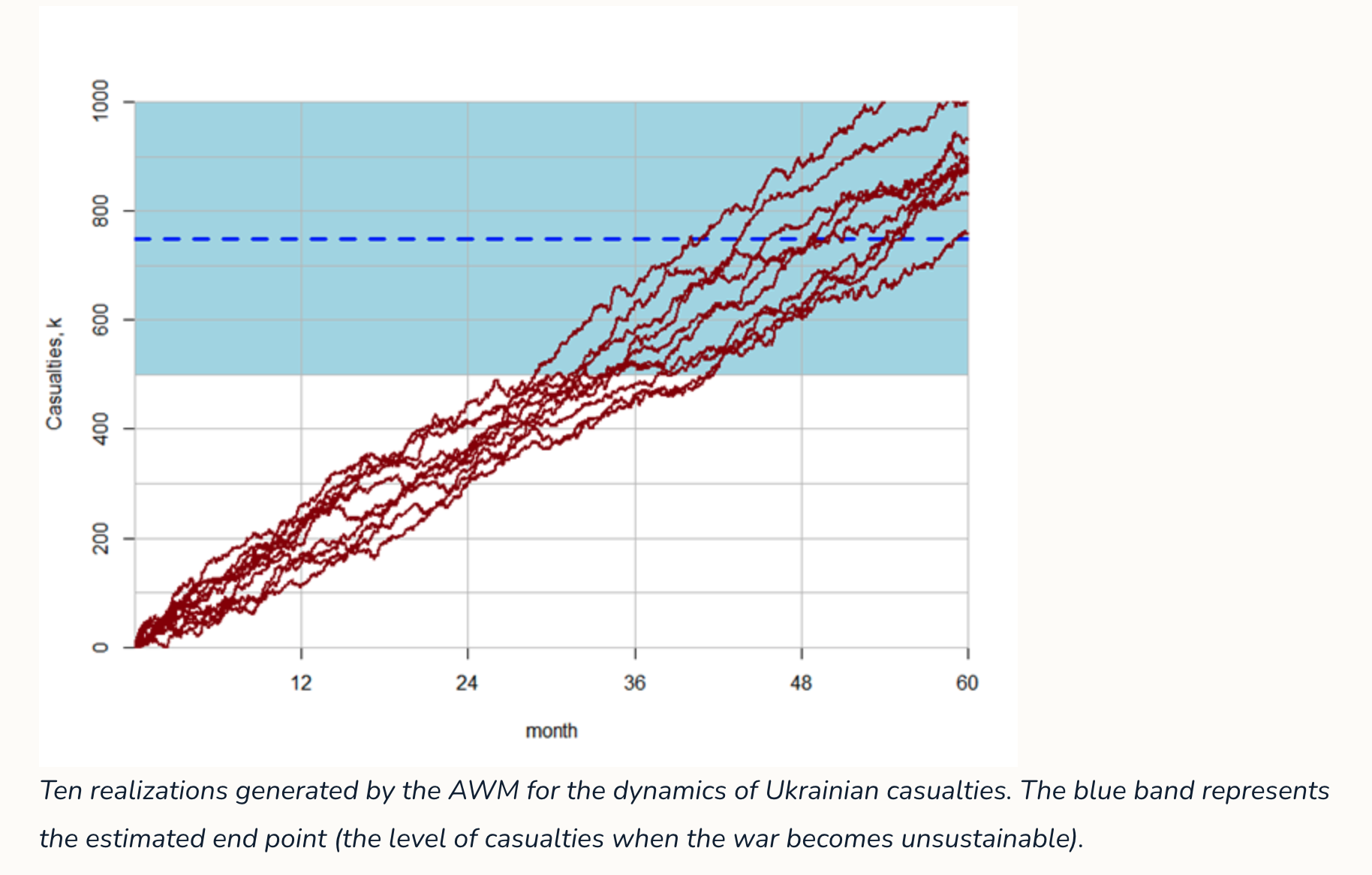
A simplified version of this argument is that Russia is bigger and has more people than Ukraine, so without effective sanctions eventually it will just steamroll Ukraine's resistance as it can fight for longer. Turchin points out that a black swan event, like drone innovation, could up-end this assumption, but so far there has been no major breakthrough to give either side a definitiave advnage after over four years of war.
Writing on May 21, Turchin argued that coverage of the conflict had been overshadowed by the escalating confrontation involving Iran, the US and Israel, while western commentary continued to portray the war as either stalemated or turning against Moscow.
“But quantitative models of attritional warfare say otherwise: Russia continues to dominate the battlefield and the eventual outcome, barring a Black Swan event, is inevitable defeat of Ukraine,” Turchin wrote.
Turchin said more recent analysis by Warwick Powell had reached broadly similar conclusions, although using different assumptions about the point at which Ukrainian military capacity would begin to collapse.
Powell’s model assumes “that the beginning of the end for Ukraine will happen when its army size declines below a certain threshold (0.65-0.73 of the initial size of 550,000)”.
“From that point, Ukrainian losses will accelerate and the full collapse will happen once the army size is below 50% of the prior peak,” Turchin wrote, adding that Powell’s model projected “the tipping point will happen in July-September”.
Of course a lot of uncertainty remains as the assumptions are dependent on variables that are difficult to measure, especially the growing role of drone warfare on the battlefield, which are increasingly replacing men. As IntelliNews reported, Ukraine has just introduced robo-soldiers, fully autonomous fighting robots, that have already successfully won one encounter with the AFR.
“What’s important is the casualty rate inflicted on the Ukrainian army by the Russians, and it doesn’t matter whether it’s a result of artillery, air bombing, or drones,” he wrote. Those numbers remain a closely guarded state secret.
Ukraine is struggling much harder to replenish troop numbers after more than four years of war than Russia is. Recent research shows with some confidence (based on budget spending on wages and bonuses) that Russia’s voluntary recruitment drive has fallen to some 20,000 per month, or around 70% of those that have been removed from the fighting.
There is no reliable official figure for Ukraine’s current monthly casualty or recruitment rate. Both Kyiv and Moscow tightly control casualty information, and outside estimates vary widely. Still, Ukraine is believed to be losing as many men as Russia, somewhere in the range of 20,000-35,000 total casualties per month in periods of heavy fighting. At the same time Ukraine is generally estimated to be recruiting or mobilising about 15,000-30,000 personnel per month – again on a par with Russia. However, those are forced recruits who are very reluctant to fight. Separately, Ukraine has reported at least 100,000 cases have been brought against deserters, the total number of which experts estimate to be around 250,000 – significantly higher than Russia’s problem with soldiers going AWOL.
Clearly Bankova is growing increasingly desperate to find fresh troops. Kyiv lowered the mobilisation age from 27 to 25 in 2024 and has intensified recruitment efforts, while European allies continue to pay lip service to the idea of ejecting male military age Ukrainian refugees sheltering in their countries, without taking any action. At home, footage of the increasingly violent snatch squads grabbing men from the street are widely circulating on social media and the violence of the reaction to the press gangs is also escalating.
An article by Branko Marcetic in Responsible Statecraft, reports a sharp rise in complaints against enlistment officers received by Ukraine’s human rights ombudsman, Dmytro Lubinets. Complaints rose from 18 in 2022 to 6,127 in 2025, while violent attacks against enlistment officers increased from five incidents in all of 2022 to 117 just during the first four months of 2026. At least three recruitment officers have already been killed by men resisting recruitment.
2022 — 18
2023 — 514
2024 — 3312
2025 — 6127
Source: Kyiv Independent
“Warwick estimates that (as of May 14) that on the Ukrainian side net daily loss rate is 900–1,700 units,” Turchin wrote, adding that Powell estimated Ukraine’s effective force had declined to between 320,000 and 380,000 personnel from a peak of 550,000.
“When will these pressures reach the breaking point?” Turchin asked. “Powell thinks by September of this year. But I would be much more cautious, because the nature of such dynamical processes resists precise predictions.” 380,000 personnel from a peak of 550,000.
“When will these pressures reach the breaking point?” Turchin asked. “Powell thinks by September of this year. But I would be much more cautious, because the nature of such dynamical processes resists precise predictions.”
Russian Veterans ‘Simply Don’t Fit Into Existing Political Machinery,’ Kremlin Has Concluded – OpEd
By Paul Goble
Despite Putin’s constant suggestions that veterans of his war in Ukraine represent “the nation’s new elite,” there are ever more signs that in the view of the Kremlin, these people “simply do not fit into the existing political machinery,” according to Olga Churakova, a journalist with the Important Stories portal.
As the 2026 Duma elections approach, she says, “the Russian authorities are as a result are wrestling with a dilemma: they need to bring war veterans into parliament” as Putin wants “without letting them coalesce into a genuine political force” that might challenge the Kremlin leader and his regime (istories.media/opinions/2026/05/19/ne-vremya-geroev/).
In fact, Churakova continues, “the political system itself has no idea what to do with the veterans” when it comes to making them part of the elite. Consequently, the Kremlin has scrapped plans to bring into the Duma as many as 150 veterans with insiders saying “you can’t bring people” in such numbers as “they are completely non-systemic.”
First, the Kremlin reduced the number of veterans it planned to have in the Duma to 50 to 70 and more recently, it has cut them back further to about 40. According to Churakova, “the prospect of a new bloc of military deputies clearly makes the Kremlin uneasy;” and the Presidential Administration is trying to figure out how to ensure it controls them.
One thing is clear, she continues, for the Kremlin, “the less consolidated this group remains, the easier it will be to manage them.” And there are other problems: “even at lower levels, the integration of veterans is already floundering” with many veteran-candidates having lost their primaries.
Moreover, “despite the high level of societal respect for war participants, there is no reliable public data indicating how this reverence translates into actual votes at the ballot box, Churakova says. As a result, “for political parties, running a veteran is a gamble that by no means guarantees victory.”
“All this is unfolding against the backdrop of rapidly deteriorating social sentiment,” she says, and so “the authorities are being forced to maneuver carefully: they are already purging radical deputies from the public sphere to avoid inflaming domestic tensions. As a result, “the prospect of introducing an unpredictable bloc of veterans suffering from PTSD into the new Duma looks quite risky.”
Churakova concludes: “The Russian authorities have backed themselves into a tight corner of their own making: these “war heroes” are desperately needed as ideological symbols, but they are far too dangerous to be empowered as real political actors.” This is leading the Kremlin to “lose face and quietly retreat from its declared principles.”
Putin Policies Sparking ‘Wave Of Separatism’ In Russian Oblasts Bordering Ukraine – OpEd
By Paul Goble
Vladimir Putin’s decision to appoint generals as the governors of Russian federal subjects shows that the Kremlin currently is no longer trying to suggest that all is well and instead is conducting a policy based on the war continuing for a long time and one in which the interests of these regions will be sacrificed to the war, Abbas Gallyamov says.
The former Putin speechwriter and now prominent Kremlin critic argues that this change is having the unexpected and unwelcome consequence of generating “a wave of separatism in Russian border regions” because the population there now feels as if it has been put at risk” (vot-tak.tv/93315500/kreml-militarizuet-regiony).
Throughout his time as Russian president, Putin has turned to generals, admirals and other siloviki to run Russia’s federal subjects and federal districts, only to discover that they were no less corrupt that the people they replaced and far more ineffective because they knew how to give orders but did not know how to mobilize the population to obey them.
As a result, Gallyamov says, Putin gave up on at least two occasions; but when he launched his expanded invasion of Ukraine, many observers expected him to appoint siloviki as governors. But because Putin wanted to downplay the war in the eyes of Russians, he has generally restricted this approach to the leaders of regions adjoining Ukraine.
For the first four years of the war, Putin “sought to avoid creating the impression of a wholesale militarization of political live and to maintain the illusion that nothing particularly alarming was taking place within the country.” Obviously, “the mass appointment of generals as governors would look like an admission Russia has shifted onto a full wartime footing.”
According to Gallyamov, “the most recent appointments thus appear to mark a turning point,” with Putin sending a general who fought in both Syria and Ukraine to head Belgorod and a civilian administrator who had headed the LPR has been dispatched to Bryansk,” a shift for which there is “a clear rationale.”
“Facing manpower shortages at eh front and a deepening budget deficit at home,” the commentator continues, “the Kremlin feels compelled to employ mechanisms other than financial incentives to recruit individuals willing to sign military contracts.” And naming those who have fought to high positions shows the Kremlin “isn’t joking” about making them an elite.
What this means, however, is that “one can no longer rule out the possibility that afte slr the collapse of the current region, a secessionist movement seeking to withdraw from the Russian Federation could emerge in that region,” perhaps in the shape of a Chernozem Federation or some other grouping.
A slogan for such a movement “practically writes itself,” Gallyamov suggests: “’Stop Bombing Voronezh.’” How popular this will be depends on the situation in Russia on the one hand and the brightness of Ukraine’s future “appear at that particular moment.” If the former is bad and the latter good, secession becomes likely.
“This last factor should not be underestimated,” he continues. “The successes achieved by the people of the neighboring country in their post-war reconstruction—and, even more so, their accession to the EU—when compounded by Russia’s own failures and problems, could create a new center of gravity for Russia’s border regions.”
He argues that “the logic would be starkly simple: “Look—the Ukrainians broke away from Russia, and now they have a brilliant future. We need to do the exact same thing.” The dismissal of a popular governor and his replacement by a military figure with a dubious reputation” will only make that outcome more likely.

No comments:
Post a Comment