Australia’s Bulwark Against Populism Is Cracking – OpEd

By Rebekah Barnett
The right-wing populist wave that broke over much of the democratic world with Brexit and the first Trump presidency in 2016 barely lapped at Australia’s shores. The island nation’s compulsory, preferential voting system and homogeneous, middle-management style politics formed a bulwark against the global tide. Now, that bulwark is starting to crack.
Over the weekend, the populist-right One Nation Party won its first seat in the federal House of Representatives in the Farrer by-election, ending nearly 80 years of unbroken Liberal–National rule in the southern New South Wales electorate.
One Nation’s David Farley took 39.45 percent of the primary vote, and 57.4 percent on a two-party preferred basis. Climate 200-backed independent Michelle Milthorpe took 28.4 percent, while the conservative Coalition parties, Liberals and Nationals, finished third and fourth with 12.4 percent and 9.7 percent, respectively. Labor did not contest the seat.
The federal win follows victory for One Nation in South Australia, with the minor party going from zero to seven seats; four in the lower house and three in the upper house.
It’s a stunning double act from a party that previously only held a small presence in the federal senate and a smattering of state seats, signalling that One Nation now poses a genuine electoral threat to the collapsing Coalition.
The Coalition has already taken notes from the Farrer beating, with shadow treasurer Tim Wilson talking tough on One Nation’s pet issue of immigration in the past few days.
One Nation’s Changing Fortunes
For nearly 30 years, One Nation has been a ‘cult of personality’ party, its wins and woes mostly driven by surges and dips in the fortunes of its abrasive but ‘fair dinkum’ founder and current leader Pauline Hanson, whose previous life as a fish and chip shop owner and tendency to stumble over her words provides salt-of-the-earth credentials.1
During the 2016 populist wave, the ‘common sense’ party secured four federal senate seats, its most impressive sweep to that point in time, but it was not able to break past that ceiling.
A few things changed that. After the Liberals suffered a humiliating election defeat in 2025, wealthy Australians started shifting their support from the Coalition to One Nation.
Supporters include Australia’s richest woman, billionaire mining magnate Gina Rinehart, and Sydney stockbroker Angus Aitken, who told Radio New Zealand last week,
“The biggest change I reckon you’ll see in the next 12 to 18 months is the groundswell of business and wealthy people supporting One Nation who have been frustrated with the Coalition.
“People are just sick of all the red tape and shit across their individual segments of business. They think this is the person and the party that’s going to cut through some of that.”
In December last year, former leader of the Nationals and deputy Prime Minister Barnaby Joyce defected to One Nation, gifting the party its first federal lower house seat and lending it the gravitas of a seasoned politician who has been in government.
Joyce cited concerns over the pursuit of renewable energy and Australia’s immigration policies as reasons for joining the party, giving voice to conservative voters who were no longer seeing their politics represented by the ‘Labor-lite’ Coalition.
One Nation wants to significantly reduce immigration and scrap net zero, which the party says is “destroying Australia” and is “pseudo-speak for global wealth transfer.”2Comparatively, the Coalition proposes moderate immigration reform and only formally abandoned net zero late last year, too little too late for many conservative voters.
Critics have also derided the Coalition for partnering with Labor in enacting some of the most draconian pandemic measures in the Western world, and for supporting rushed hate speech legislation in the wake of the Bondi massacre of 15 people at a Jewish holiday celebration in December.
Then in January of this year, polling revealed that One Nation had pulled ahead of the collapsing Coalition in the primary vote for the first time ever, at 22 percent compared to the Liberals’ 21 percent. Liberal leader Sussan Ley resigned, triggering the Farrer by-election and leading to One Nation’s first lower house win.
Anti-majors sentiment has bubbled for several election cycles now, but had failed to convert at the ballot box for three main reasons.
The first is Australia’s two-party preferred system. An alternative party has to consolidate a fair whack of the primary vote to benefit from preferences waterfalling to them. Otherwise, preferences go to the majors.
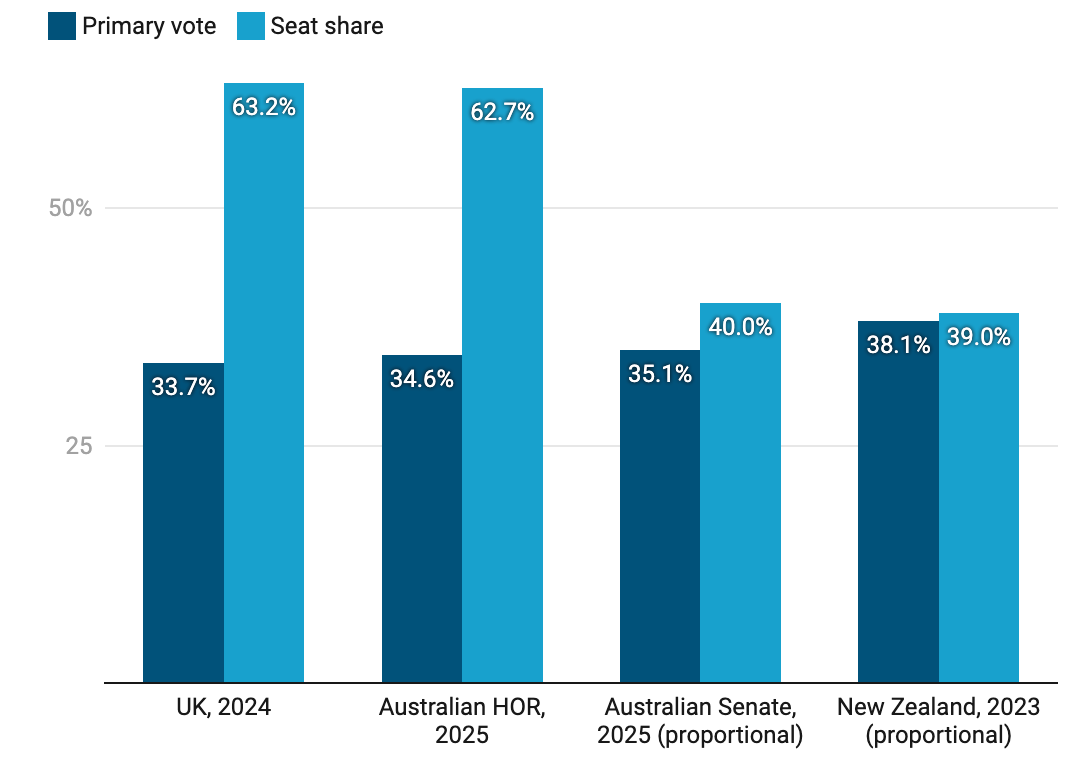
That’s why Labor was able to win a ‘landslide’ election victory in 2025 despite being led by a weak tea bag, taking two-thirds of lower house seats with only a third (34.5 percent) of the primary vote. The election before that, in 2022, Labor won with the lowest primary in almost a century, at 32.6 percent.
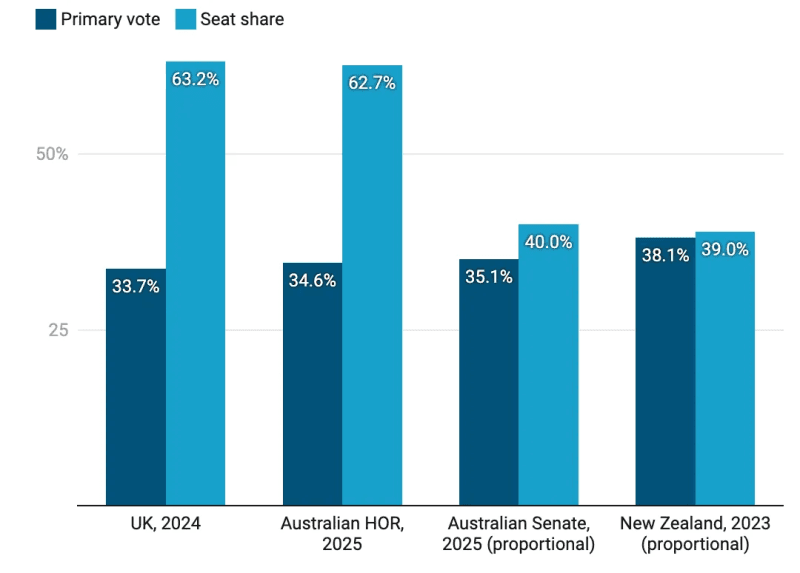
Campaigns like ‘Put the Majors Last,’ hoping to alchemise Covid-era discontent into political change, achieved very little when it came to ballots cast, despite idealistic content telling voters they could eject majors by preference-funnelling alone.
Outside of the Greens (Labor’s most reliable voting partner) and the Teal independents, in recent history small alternative parties have only managed to capture a few percent of the vote, with One Nation pulling five percent in 2022 and 6.4 percent in 2022.
It was astonishing, then, when One Nation garnered 22.9 percent of the primary vote in the recent South Australian election, and 39.45 percent in Farrer. If One Nation continues to pull a quarter of the primary vote or more, it will become a real threat to the majors, especially the Coalition.
The second reason is the lack of a viable, stable alternative. On the left, the Greens typically secure around 12 percent of the vote and have enough representation in both houses to make a reliable bargaining partner for Labor.
In the centre, the Climate 200-backed Teals upset the applecart in the past two federal elections, gutting the Coalition’s urban, affluent base with approximately 10 seats held, mostly in the lower house. But as the socially liberal and fiscally conservative Teals are nominally independents and not a formal party, their collective impact is to undermine the Coalition.
On the right, the alternative political scene is reactionary, fragmented, and underfunded. Serious alternatives, like the Libertarians or Gerard Rennick’s People First Party, get almost no cut-through in the media and have no track record in government.
One Nation typically attracts more votes than the other small right-wing parties, but as mentioned above, with only five to seven percent of the vote, it has been unable to break through.
The landslide Farrer victory consolidating high-profile donor support and the Joyce defection is being taken by some commentators to signal that One Nation is emerging as a viable right-wing option for co-governance in a conservative government.
Third, dirty tricks. The majors and their mates use all manner of tactics to suffocate the smaller parties, sometimes resorting to underhanded measures.
Former Liberal Prime Minister Tony Abbott played a key role in the legal pursuit of Hanson for electoral fraud, establishing the Australians for Honest Politics Trust to help bankroll civil court cases against the One Nation Party and Hanson herself. Hanson was convicted of electoral fraud, spending eleven weeks in prison before the conviction was overturned.
In another high-profile case, ‘preference whisperer’ Glenn Druery was secretly filmed admitting to setting up a fake Sack Dan Andrews party to split the alternative party vote and bolster the incumbent Dan Andrews Labor Government.
And in a move that appeared to be a bad-faith effort to strike out competition from small parties, Labor and the Coalition passed laws in August 2021 that tripled the membership requirement for federal party registration from 500 to 1,500 members and made changes to party name rules. This came into effect just months before the May 2022 federal election, meaning small parties had to quickly triple their registrations and some had to change their names, causing confusion.
That One Nation have been hit with dirty tricks yet remain standing and surging in the polls speaks to their resilience, and Hanson’s in particular.
Despite the obstacles, the timing and conditions for One Nation’s rise are just right.
For the past 40 or so years, Australians have been drifting away from the major parties in their allegiances, and they have become increasingly likely to switch teams if they feel another party has something better on offer.
In the 1950s through to the late eighties, the major parties typically attracted over 90 percent of the primary vote. By the 2025 federal election, just 66 percent of voters gave their first preference to Labor or the Coalition. Meanwhile, the share of Australians reporting no alignment with any political party has increased from 14 percent in 2010 to 25 percent in 2025.
This partisan dealignment has slowly eroded the majors’ primary votes, and the centre-right Coalition has been the first to crater. One Nation fills this vacuum, for now.
Institutional trust is also in decline. According to the TrustWatch report from April 2026, only 48 percent of Australians say they trust our national institutions, down from 55 percent last year. In such times, authenticity has caché, and for all its foibles, One Nation has plenty of authenticity. Notably, only 28 percent of One Nation supporters said they had institutional confidence.
Immigration is a pain point in Australia as it is in most Western democracies. The recent Islamic terror attack at Bondi has fuelled anti-Islam sentiment and renewed focus on immigration screening. One Nation has always had a strong position on immigration and keeping Islamic extremists out of the country, and they’re not afraid to say it.
During a cost of living crisis and housing shortage, the fact that One Nation eschews luxury belief politics for straight talk about the issues that economically vulnerable Australians care the most about is appealing.
One Nation has also proved adept at crafting campaigns for the social media era. Through a humorous South Park-style ‘Please Explain’ series — the title is borrowed from a 90s radio hit lampooning Hanson — an anti-woke film, and a pop song topping the Australian iTunes chart, the party has cultivated both viral momentum and a countercultural edge that is only amplified when opponents attempt to suppress it.
Looking Ahead
Latest national polling has One Nation coming in with 24 percent of the primary vote, second only to Labor (30 percent), and ahead of the Coalition (21 percent).
Polls are one thing: the ballot box is another. The South Australian election in March and now the federal by-election over the weekend mark an upheaval in Australian politics as One Nation’s popularity in the polls translates to actual votes.
If this trend continues, pollsters predict that One Nation could win 12 seats at the next election, enough to become a genuine force in parliament.
On Monday, One Nation MP Barnaby Joyce said that’s exactly what the party intends. On his press rounds after the historic Farrer win, Joyce said the party will target the traditional Labor stronghold of western Sydney next and rejected the idea of a coalition with the Nationals and Liberals, stating that One Nation wants to “go for government.”
ReferencesHanson was expelled from the party in 2002 due to internal divisions and in 2003 spent 11 weeks in jail after being found guilty of election fraud. The judgement was overturned, and Hanson then ran in several state and federal elections as leader of the United Australia Party and as an independent. She rejoined One Nation in 2013, becoming leader again the following year. After winning four seats in the 2016 federal election, Hanson secured an amendment in the party’s constitution to secure her spot as leader until she chooses to leave, and allowing her to choose her own successor.
Ironically, One Nation, which believes that net zero is a scam, now holds both lower house seats in prime wind and solar regions, called Renewable Energy Zones.
‘Seismic Shift’ Toward Australia Orbit Likely Under Solomon Islands’ New Prime Minister – Analysis
.jpg)
By RFA
By Charley Piringi and Eugene Whong
(RFA) — The Solomon Islands’ choice of longtime opposition leader Matthew Wale as its new prime minister could be a sign that a diplomatic shift toward Canberra is likely, while the Pacific island nation still engages moderately with Beijing, experts told Radio Free Asia.
Wale was sworn in on Friday after winning 26 out of 50 votes in parliament, edging out the 22 votes for Foreign Minister Peter Shanel Agovaka, and drawing to a conclusion months of political chaossurrounding Wale’s predecessor Jeremiah Manele, who last week was ousted in a no-confidence vote.
“Fellow Solomon Islanders, change is coming,” Wale said during his inaugural address.
The new prime minister takes office amid mounting geopolitical tension across the Indo-Pacific, and he will likely exercise more diplomatic caution with China, unlike the two prime ministers before him, Graeme Smith, associate professor at the Department of Pacific Affairs at The Australian National University, told RFA.
“I think it’s a pretty seismic shift in the diplomatic sense. It does bring the Solomons more back into kind of an Australian, and to a lesser extent U.S. orbit,” he said. “It’s certainly a development that will have, I think, pleased people in Canberra.”
Wale has been opposition leader for roughly seven years, dating back to the beginning of the fourth term of Manasseh Sogavare, during which it could be said that Honiara decisively entered into Beijing’s sphere of influence – in 2019 the Solomon Islands stopped recognizing Taiwan in favor of China, and in 2022 entered into a secretive controversial security pact with Beijing, which, at the time, Wale criticized as undermining the security of the country.
When Sogavare’s term was up in 2024, parliament chose his foreign minister Manele to succeed him, in what was largely seen as an extension of Sogavare’s pro-China stances.
Smith said that the switch to Wale likely would not vastly change relations with China, but “he certainly will be much more moderate in his language around Beijing and certainly far less enthusiastic than his two predecessors in both Manele and Sogavare.”
Wale during his speech described the current global climate as a difficult period shaped by geopolitical rivalry and economic uncertainty, pressures he said the Solomon Islands cannot escape.
“We take government at a difficult time given what is happening throughout the world,” Wale said. “We are not immune from the impacts of these geopolitical events.”
He pledged that his government would pursue disciplined and prudent management to guide the country through the challenges ahead.
Wale’s election reflects a broader struggle over the future foreign policy direction of the Solomon Islands, international relations scholar Alexander L. Vuving of the Hawaii-based Daniel K. Inouye Asia-Pacific Center for Security Studies, told RFA.
“For the people of Solomon Islands, the key concerns are economic and political issues within the country,” Vuving said. “But for the wider Indo-Pacific, the most important question is how the next government positions itself among the major powers.”
Wale vs. Agovaka
The political contest was widely interpreted as a choice between maintaining close ties with Beijing or recalibrating relations toward Australia and Western allies.
Agovaka, who had served as foreign minister under Manele but then led an exodus of lawmakers from the ruling coalition in defecting to the opposition in March, was widely estimated to have been the favorite to succeed him, especially after Manele endorsed him after his ouster
A vote for Agovaka therefore would have been seen as a vote to stay the course in maintaining close China ties, whereas a vote for Wale would favor a more cautious approach to China’s expanding security footprint while favoring stronger engagement with Australia and the United States, Vuving said.
“The election can turn Solomon Islands in a very different direction about how it positions itself among the major powers,” he said, adding that Wale’s victory was likely to be welcomed in Western capitals as evidence that China’s growing influence in the Pacific can still be challenged.
Smith acknowledged that Wale’s victory came as a surprise.
“He’s been opposition leader for seven years now, and I think a lot of people assumed that he’d missed his chance and this day would never come,” he said. “I think a lot of people I assumed it would be Agovaka that would get the job given that he was sort of the lead critic of Manele, and in many ways sort of was the main person pushing the no confidence motion.”
Smith said that Agovaka’s world view was much more pro-China, and that among parliament there is more support for China over Taiwan, pointing out that Wale’s coalition might not be very stable, as he won the “bare minimum” of 26 votes in a 50 seat parliament.
“Wale will be looking to get a few more numbers across and that may mean that he has to give a signal that he’s a bit more pro-China,” he said. “So he will not be stridently anti-China but he’ll certainly be less pro than Agovaka would have been.
Challenges ahead
Holding on to power could be difficult with such a slim majority, Joseph Foukona, a history professor at the University of Hawaii at Manoa, who hails from the Solomon Islands, told RFA.
“It’s going to be a challenge for him in terms of trying to continue to maintain the numbers on his side,”Foukona said. “If there’s any political disagreement or tensions within his group, we might see people moving or changing sides again.”
Smith said Wale will be under pressure to publicly release the details of the 2022 security agreement with Beijing, which he had been a huge critic of and which until now has been confidential, save for a leaked draft of the deal prior to its finalization. Wale might then push to revise parts of it, he said.
Foukona said that Wale would likely be more transparent than his predecessors, not just about the 2022 security pact, but also in other arenas.
“Often when he speaks he sort of emphasizes transparency and accountability and this is one area that we must see some changes in terms of going forward,” Foukona said of Wale. He said Wale’s government might put more resources into the country’s anti-corruption commission, and disclose details about international agreements signed by the previous government.
Strategic importance
Located in the South Pacific and relatively close to Australia, the Solomon Islands occupies maritime space considered important for regional security and trade routes. During World War II, the islands were a major battleground. Today, competition has shifted toward infrastructure, technology, and access to resources.
One major area of rivalry involves undersea telecommunications cables, which carry nearly all global internet traffic.
“The undersea cables have become critical infrastructure,” Vuving said. “China is trying to gain influence in that business, and that has triggered pushback from the United States and particularly Australia.”
The cables are part of a larger telecommunications infrastructure competition in the islands. Chinese technology giant Huawei recently completed the installation of more than 160 telecommunications towers across the country under a Chinese-funded project.
Vuving also said that the Solomons controls a vast Exclusive Economic Zone rich in fisheries and seabed minerals, including resources increasingly important for renewable energy technologies and artificial intelligence industries, but which the country lacks to capacity to exploit.
“Countries like the Solomon Islands need major powers with the capability to mine those minerals, and China is looking for that,” said Vuving, who said that China’s expansion in the Pacific has been gradual. He described China’s approach as “salami slicing.”
“You don’t see a big shift overnight,” Vuving explained. “Every day, they expand a little bit. After years, they gain huge influence and can lock people into those relationships.”
He said that regardless of who is in charge of the Solomons, the country would still have to balance influence by foreign powers.
“You’re small, and you’re playing the game with giants,” he said.“In that way, you’re very vulnerable.”
Vuving argued that the Solomon Islands must diversify its international partnerships to avoid overdependence on any single country, strengthening ties not only with China, Australia, and the United States, but also with partners such as Japan, India, France, the United Kingdom, New Zealand, and the Association of Southeast Asian Nations.
He said the long-term challenge for the Solomon Islands will be maintaining political independence while navigating relationships with competing global powers.
“The fate of great power competition may not be decided entirely in Solomon Islands,” Vuving said. “But for a small Pacific nation, it is extraordinary to find itself at the centre of such an important geopolitical contest.”

No comments:
Post a Comment