Europe’s AI defence revolution: who’s leading and what comes next?

Analysts told Euronews Next that Germany, France, Ukraine and the United Kingdom stand out as countries that have done the most for AI military integration so far.
Europe’s militaries are moving rapidly from experimenting with artificial intelligence (AI) to integrating it into core defence capabilities.
On Monday, Germany and Ukraine launched the “Brave Germany” programme, which will include approximately 5,000 joint AI-enabled medium-range strike drones.
The Berlin-Kyiv agreement is the latest example of accords, projects and deals struck throughout the continent to integrate AI systems into decision-making systems and weapons in Europe’s arsenal.
We take a closer look at what’s been done so far to integrate different forms of AI into military operations.
What AI already exists in Europe’s militaries?
European militaries have been using AI in their forces for human resources, logistics and maintenance support for the last 10 years, according to Laura Bruun, artificial intelligence researcher at the Stockholm International Peace Research Institute (SIPRI).
Around 2015, the technology matured enough that it “became a priority” for militaries across Europe to find a way to use them, according to Bruun.
“Very simple AI models can be used to optimise processes and, you know, say okay it’s faster if you take route B than route A, like how we use Google Maps,” she said.
AI investment is currently in one of two areas: semi-autonomous weapon systems that are enabled by AI and AI-enabled decision support systems, Bruun said.
The semi-automatic weapons have AI integrated in them, but there is always a human in the loop that “presses the button,” or makes the final decision, Bruun said.
AI-enabled decision support systems could cover “every kind of task where an AI helps you make a decision in warfare,” Bruun said.
For example, AI investments in Europe are going towards battle management, operational planning and tactical planning, according to Roy Lindelauf, professor of data science at the Netherlands Defence Academy.
Which countries are currently leading the way in Europe?
The countries leading the way on AI integration are France, Germany and the United Kingdom, according to Bruun.
These three countries have announced “huge contracts” with AI companies to accelerate its integration into targeting capabilities, she said.
For example, Germany’s Ministry of Defence signed a deal in 2023 with Helsing AI, a Munich-based defence company, to build the AI backbone in the Future Combat Air System (FCAS), Europe’s next-generation fighter jet.
Germany has also signed contracts with Helsing and weapons manufacturer Saab Germany to integrate AI into the Eurofighter’s electronic warfare system.
Another separate 269 million contract with Helsing will see the company produce loitering munitions or “kamikaze drones” to be integrated into the German and NATO militaries.
Meanwhile, the United Kingdom announced the Asgard programme in 2025, a digitally-enabled reconnaissance and strike network that combines sensors, decision-support tools and weapons to “improve decision-making and increase lethality.”
Also in the last year, the UK made a strategic partnership with US defence company Palantir, where the US company would invest up to £1.5 billion (€1.73 billion) into the country to help the government harness AI technologies.
The French stand out for their initiative to build “sovereign” AI military systems independent of the United States, Lindelauf said.
In January, the French government awarded a framework agreement to Mistral, the Paris-based AI company seen as Europe’s main competitor to American AI giants, ChatGPT and Anthropic’s Claude.
The agreement lets the armed forces and some public entities use Mistral’s AI models, software and services, according to Reuters. It builds on a cooperation agreement that the government signed with Mistral in 2025.
The European institutions are also working on AI integration, having selected several AI projects for European Defence Fund (EDF) allocation last month.
Among the projects in their latest funding round are the development of a “private, deployable, sustainable and efficient large language model” for states to use, a sovereign European AI support tool, and an AI-enabled artillery system.
Europe has some “well-thought-out” plans, but “what we need right now is to actually do it,” Lindelauf said.
“I’m sometimes worried … that our decision-making takes too much time,” he said. “The speed to roll it out might be hampered by the way we are organised.”
The Ukraine factor
Europe is largely taking from Ukraine’s playbook, Bruun said, as forces there have found many use cases for AI, such as intelligence, data analysis and situational awareness on the ground.
For example, Ukraine developed the Delta system, a digital battle management system powered by AI that combines trackers, radars, satellite providers and digital map platforms to help military officers make decisions.
The platform, developed in coordination with NATO, helps users track the location of friendly forces and identify enemy positions.
“[The system] not only combines huge amounts of different data streams, but also has the Ai layer doing the analysis on topic of that … and so I think that’s the noteworthy thing that we see in Ukraine right now,” Lindelauf said.
Ukrainian forces are also using loitering munitions, also known as “kamikaze drones,” that are drones where the navigation and target identification are automatic.
“They are not really autonomous weapons as such because you still have a commander that says, “Ok, strike,”” Bruun said. “The way we’ve seen AI used in Ukraine can give us a good sense of how also European states more broadly are looking into adopting AI.”
Ukraine is also cooperating with defence company Palantir on a project called "Brave1 Dataroom," which developed an AI that is based on combat data collected through the conflict with Russia, according to Reuters.
With Palantir, Ukraine also developed an AI system for detailed analysis of air strikes and that implements AI to handle large volumes of intelligence data, the report added.
European bodies are also working directly with Ukraine on AI defence uses. Last month, the European Commission announced project STRATUS to develop an AI-powered cyber defence system for drone swarms.
The project includes a Ukrainian subcontractor, which means the technology will be tested directly on the battlefield, the Commission said in a press release.
Bruun said there is a move towards some full-line automation in Ukraine, where they are testing munitions that can “finish the job,” if a military official loses contact with it, she said.
“I’ve read interviews from Ukrainian commanders saying that the human is a bottleneck in targeting decisions, so the more they can automate, the more resilient they are, the faster they can respond to the enemy,” she said.
Zelenskyy Meets Palantir CEO as Ukraine Doubles Down on AI Warfare
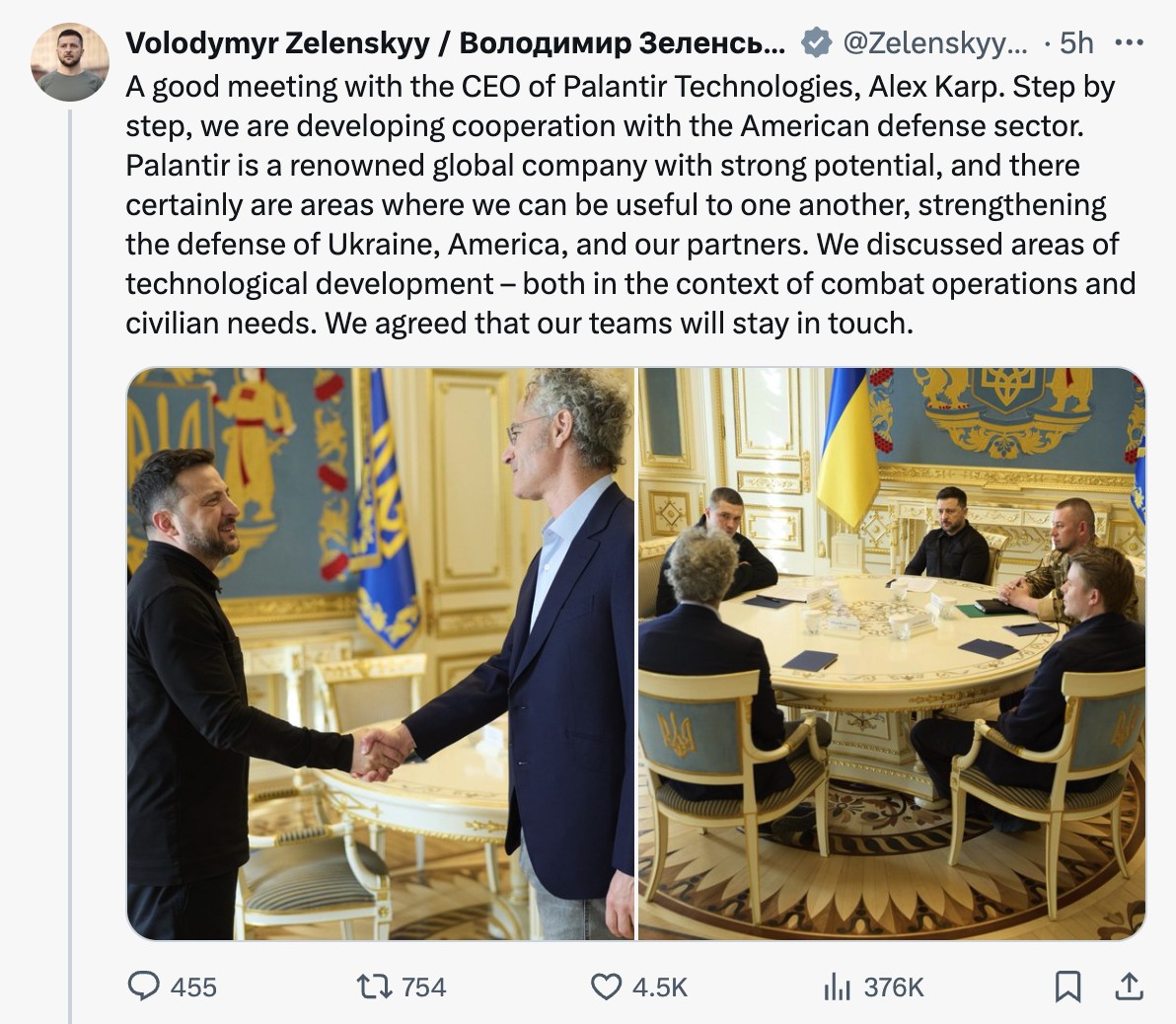
- Zelenskyy and Defense Minister Mykhailo Fedorov met Palantir CEO Alex Karp on Tuesday, expanding a partnership that now includes deep-strike planning and the Brave1 Dataroom AI platform.
- More than 100 Ukrainian defense companies are training over 80 AI models on real combat data to detect and intercept Russian drones, including Shahed-type UAVs Russia is producing at 400 a day.
- Palantir's footprint in Ukraine continues to grow even as scrutiny mounts. Switzerland's armed forces dropped Palantir in December over data-leak concerns flagged by an audit.
Ukrainian President Volodymyr Zelenskyy met with Palantir CEO Alex Karp on Tuesday as Kyiv pushes deeper into artificial intelligence to fight Russia, building on a months-old partnership that is already reshaping how Ukraine targets incoming drones and plans strikes inside Russian territory.
The meeting came as Ukraine's Defense Minister Mykhailo Fedorov, who took the role in January, said more than 100 companies are now training over 80 AI models to detect and intercept aerial targets through the Brave1 Dataroom, a secure platform Kyiv launched with Palantir earlier this year.
“Today, technology, AI, data analysis and the mathematics of warfare have a direct impact on the outcome on the battlefield,” Fedorov said on Telegram after meeting Karp.
Zelenskyy was more measured. “Palantir is a renowned global company with strong potential, and there certainly are areas where we can be useful to one another, strengthening the defense of Ukraine, America, and our partners,” he wrote on X.
The numbers explain the urgency. Ukrainian commander Oleksandr Syrskyi told lb.ua earlier this year that Russia can already produce more than 400 Shahed-type drones a day, with plans to scale toward 1,000. Manual interception cannot keep up. Brave1 Dataroom is designed to fix that, training algorithms on real combat footage that already includes visual and thermal datasets of Shahed strikes.
It is not only about defense. Fedorov said Palantir software has also been folded into Ukraine's deep-strike planning, the same long-range campaign that has hammered Russian energy infrastructure for the past 18 months. Ukrainian drones have hit Novorossiysk, Tuapse, and the 400,000 bpd Kirishi refinery in recent weeks, and crude deliveries to Russian refineries dropped to a 15-year low in 2025 as the strikes intensified.
Palantir has been embedded in Ukraine since June 2022, when Karp became the first Western CEO to visit Kyiv after the full-scale invasion. The company's MetaConstellation software has been used to fuse satellite, drone, and sensor data into a single targeting picture for nearly four years. Brave1 Dataroom is a step further. Palantir's software now sits underneath a dedicated AI training environment fed with battlefield data that, as Palantir EVP Louis Mosley put it at Davos in January, “no other country, sadly,” has access to.
The expanding role has not come without friction. Switzerland's armed forces ended their use of Palantir in December 2025 after an audit raised concerns that data could be leaked to U.S. government and intelligence agencies, concerns that have followed the company into the Ukrainian deployment.
For Palantir, the war remains the showcase. The company reported Q1 2026 revenue of $1.63 billion last week, up 85% year-over-year and the fastest growth since it went public. U.S. government revenue alone climbed 84%. Karp told CNBC he expects the U.S. business to double again in 2027.
Markets are still working through the valuation. PLTR is down 18% year-to-date despite blowout earnings. But the Ukraine work is exactly the kind of operational proof point investors and Pentagon buyers have been watching for years.
By Charles Kennedy for Oilprice.com

No comments:
Post a Comment