Brexit made careers, fortunes and media stars of its loudest advocates. Millions of others were left to pay the price. Yet the BBC's referendum documentary is more interested in another episode of posh-boy infighting than the people living with the consequences.
Gabrielle Pickard-Whitehead
JUNE 20, 2026

A front page on the Independent this week just about summed it up. Beneath images of Boris Johnson, Michael Gove and Nigel Farage, sat a damning verdict from Michael Heseltine: never have so few done so much damage to so many, while spending so much time blaming everyone but themselves.
Ten years on from the referendum campaign, one question hangs over Brexit: where’s the accountability?

Have its leading architects acknowledged the promises that went undelivered, the trade barriers they dismissed, or the economic costs borne by households across the country?
Of course not.
In fact, many have done rather well out of Brexit.
A 2019 Dispatches investigation found that, since the referendum, 12 MPs had earned more than £1 million between them from paid speeches on top of their parliamentary salaries. After leaving Downing Street, David Cameron received £120,000 for a Wall Street speech discussing Brexit, while Boris Johnson reportedly commands around £100,000 per appearance.
Some even profited from the economic turmoil Brexit created. Dispatches found that hedge funds had built substantial positions against British businesses in anticipation of disruption. Crispin Odey, a prominent Brexit supporter, reportedly made more than £200 million on referendum night as the pound collapsed. The programme also reported that Jacob Rees-Mogg could have earned up to £7 million through Somerset Capital Management, whose overseas investments benefited from sterling’s decline.
The media figures who championed Brexit have prospered too. They retain newspaper columns, television platforms and lucrative public profiles. Many still argue Brexit’s promised rewards are just around the corner.
Meanwhile, the people who paid the price rarely make the headlines.
That contrast is largely missing from the BBC’s recent two-part documentary on the referendum. Instead, viewers were taken back to the familiar spectacle of elite Tory infighting. The feud between David Cameron and Boris Johnson was presented almost as political theatre, a clash of ambition and ego among privileged men gambling with the country’s future. George Osborne even compared it to Game of Thrones.
At times, the tone bordered on the jovial. Yet there is nothing amusing about the consequences. Because while Brexit’s leading advocates built careers, fortunes and media platforms from the referendum campaign, millions of others were left to absorb the costs.
They are the real story.
The households paying more for food
One of the clearest impacts of Brexit has been on the cost of living. A 2025 study by the National Bureau of Economic Research found that, since the 2016 Leave vote, the UK economy has become 6 – 8 percent smaller than it otherwise would have been. Analysis by the House of Commons Library estimates that Brexit is costing the Treasury up to £90 billion a year in lost tax revenue and has reduced GDP per person by between £2,700 and £3,700.
Food prices have been particularly affected.
Britain imports around half of its food, with roughly 30 percent coming directly from the EU. By introducing customs checks, regulatory divergence and other non-tariff barriers, Brexit made importing food more expensive. Research from the Centre for Economic Performance at the London School of Economics found that Brexit added an average £210 to household food bills over the two years to the end of 2021, costing consumers a total of £5.8 billion.
And the burden has not been shared equally. The politicians who sold Brexit haven’t struggled to pay higher grocery bills but millions of households have.
Low-income households spend a greater proportion of their income on food than wealthier families. As a result, Brexit-related price increases have hit the poorest households hardest. What might represent an inconvenience for higher earners can mean impossible choices for families already struggling to make ends meet.
The young people who lost opportunities
While those who took away freedom of movement didn’t suffer, Brexit’s impact has fallen heavily on younger generations.
For decades, British young people enjoyed the right to live, work and study freely across Europe. Those opportunities were stripped away after Brexit. The UK’s departure from the Erasmus+ programme became one of the most visible symbols of that loss.
At the time, Boris Johnson insisted Erasmus was “extremely expensive” and promised its replacement, the Turing Scheme, would be both bigger and better while somehow costing less. Critics were unconvinced. The decision was described as a “travesty for poorer kids” because wealthier students would always retain the means to study abroad independently. The students most likely to benefit from structured exchange programmes were precisely those who stood to lose the most
.
The consequences have been felt by young Europeans too. Brexit removed domestic fee status for EU students, ended access to government-backed student loans and introduced costly visa requirements. According to the Migration Observatory, EU undergraduate enrolment in the UK fell by around 58 percent between 2020 and 2024, with many students choosing more affordable alternatives in countries such as the Netherlands and Germany.
In a welcome reversal, the UK and EU signed an agreement in April confirming Britain’s return to Erasmus+ from 2027. Right on cue, the Brexit-cheerleading media reacted with outrage, claiming Starmer had sold Britain by sucking up to Brussels. Yet the fact that the current Labour government has sought closer educational ties with Europe is itself an acknowledgement that something valuable was lost.
The NHS staff who left and the patients who paid the price
Perhaps nowhere is the gap between Brexit’s promises and reality more glaring than in the NHS.
The infamous red Brexit bus promised an extra £350 million a week for the NHS. Voters were told that money supposedly being sent to Brussels could instead be redirected to hospitals and patient care.
What we’ve now got is a post-Brexit NHS that’s a shadow of its former self. Following the referendum, migration from the EU and European Free Trade Association countries fell sharply. Recruitment from Europe effectively collapsed, while thousands of EU nurses working in Britain chose to leave.
The loss of these healthcare professionals worsened existing staffing shortages and placed additional strain on an already overstretched NHS.
Research from the University of Surrey found that Brexit-related reductions in nursing staff contributed to an estimated 1,485 additional deaths per year during the three years following the referendum.
“Brexit has had real life-or-death consequences for patients in our hospitals,” said Professor Giuseppe Moscelli, the study’s lead investigator.
You can bet that the people who promised £350 million a week for the NHS haven’t been forced to wait on ever-growing waiting lists,
The consequences have been felt by young Europeans too. Brexit removed domestic fee status for EU students, ended access to government-backed student loans and introduced costly visa requirements. According to the Migration Observatory, EU undergraduate enrolment in the UK fell by around 58 percent between 2020 and 2024, with many students choosing more affordable alternatives in countries such as the Netherlands and Germany.
In a welcome reversal, the UK and EU signed an agreement in April confirming Britain’s return to Erasmus+ from 2027. Right on cue, the Brexit-cheerleading media reacted with outrage, claiming Starmer had sold Britain by sucking up to Brussels. Yet the fact that the current Labour government has sought closer educational ties with Europe is itself an acknowledgement that something valuable was lost.
The NHS staff who left and the patients who paid the price
Perhaps nowhere is the gap between Brexit’s promises and reality more glaring than in the NHS.
The infamous red Brexit bus promised an extra £350 million a week for the NHS. Voters were told that money supposedly being sent to Brussels could instead be redirected to hospitals and patient care.
What we’ve now got is a post-Brexit NHS that’s a shadow of its former self. Following the referendum, migration from the EU and European Free Trade Association countries fell sharply. Recruitment from Europe effectively collapsed, while thousands of EU nurses working in Britain chose to leave.
The loss of these healthcare professionals worsened existing staffing shortages and placed additional strain on an already overstretched NHS.
Research from the University of Surrey found that Brexit-related reductions in nursing staff contributed to an estimated 1,485 additional deaths per year during the three years following the referendum.
“Brexit has had real life-or-death consequences for patients in our hospitals,” said Professor Giuseppe Moscelli, the study’s lead investigator.
You can bet that the people who promised £350 million a week for the NHS haven’t been forced to wait on ever-growing waiting lists,

Small businesses bear the costs while large firms go unscathed
Brexit’s advocates frequently spoke of freeing British businesses from unnecessary bureaucracy.
In practice, many of the costs have fallen most heavily on smaller firms.
A 2024 report by the Centre for Economic Performance (CEP) found that new post-Brexit trading arrangements reduced exports to the EU by around 30 percent for small businesses, while having little measurable effect on large exporters. Around 20,000 small firms stopped exporting goods to the EU altogether.
Large corporations generally possess the legal teams, compliance departments and financial resources needed to navigate new barriers. Small businesses often do not.
Once again, the burden fell disproportionately on those with the least capacity to absorb it.
The communities that lost funding
Brexit was also sold on the promise that domestic funding would replace money previously received through European programmes.
The Conservative Party’s 2019 manifesto pledged that the new UK Shared Prosperity Fund would match previous levels of EU structural funding.
Yet recent government data shows replacement funding has lagged behind previous EU support in real terms. Scotland, Wales and other regions that relied heavily on European development funds have experienced shortfalls.
Communities that had benefited from decades of investment in skills, training, regeneration and economic development found themselves receiving less than they had been promised.
Devolved nations faced major deficits. In 2022, the Scottish government reported a 60% shortfall compared to previous EU allocations.
“EU structural funds have made a real difference across the country, helping more people into work and delivering new skills through better training and support,” said then employment minister Richard Lochhead. “This welcome contribution from the EU has been eradicated by Brexit and the UK government’s replacement for EU funding has fallen far short in both the quality and quantity of what is required.”
The musicians who lost their livelihoods
Among Brexit’s least-discussed casualties are Britain’s musicians and creative professionals.
For decades, artists could tour Europe with relatively little bureaucracy. Brexit introduced new visa requirements, work permits and administrative costs that have made touring more difficult, particularly for independent performers.
In 2025, the Independent Society of Musicians warned Parliament that many artists have lost work as a direct result. Surveys suggest almost half of music professionals have experienced reduced opportunities in Europe since Brexit, while more than a quarter report having no EU work at all.
For established stars, these obstacles are manageable. For emerging artists and smaller touring acts, they can be career-crushing.
Yet another example of Brexit’s costs falling hardest on those without wealth, influence or institutional support.
The people missing from the story
The great irony of Brexit is that those who championed it most loudly have paid the smallest price for it.
A decade on, many of the politicians, financiers and media figures who drove the campaign remain wealthy, influential and highly visible. Some have even profited directly from the upheaval.
The people who absorbed the costs are far less likely to appear on television panels or newspaper front pages. They are the families paying more for essentials, the young people who lost opportunities, the patients waiting longer for treatment, the small business owners facing barriers they were told would not matter, and the musicians whose livelihoods became harder overnight.
They are the people who have actually lived with Brexit.
Yet they remain largely absent from the story told by those who sold it.
Brexit was never simply a Westminster drama. It reshaped millions of lives.
Ten years on, many of those who turned Brexit into a career still command the spotlight. The people who paid the price are still waiting to be heard. It’s not surprising then, that poll after poll now shows growing support for rejoining the EU, with recent polling suggesting Labour could receive a significant boost if it backed a second referendum on Britain’s membership.
The loudest voices sold Brexit. The quietest voices have had to live with it.
Ten years on, the case for rejoining grows stronger as campaigners gather for National Rejoin March 2026
For those marching through London today, the answer is clear: repairing relations with Europe is only the beginning. The ultimate goal remains rejoining the European Union.
Gabrielle Pickard-Whitehead
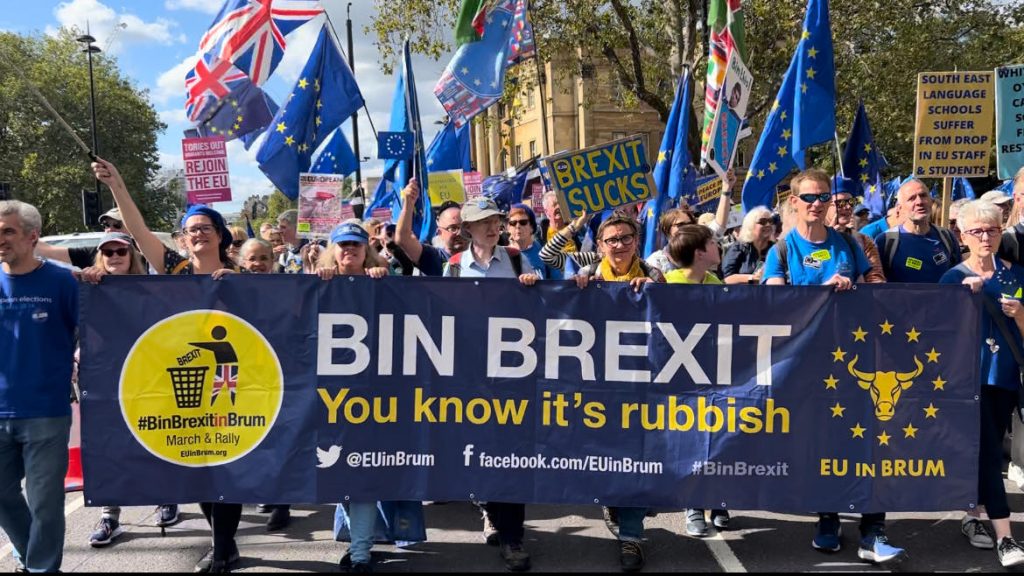
Pro-European campaigners are gathering in London today (June 20) for the National Rejoin March 2026, marking a decade since the referendum that took the UK out of the European Union.
Participants are assembling at Temple Underground Station at midday before marching to Parliament Square, where a rally will begin at 2.30pm.
Among the headline speakers are former Labour leader and former European Commission vice-president Neil Kinnock, Liberal Democrat MP Layla Moran, Green MEP Terry Reintke, lawyer and commentator Shola Mos-Shogbamimu, European Movement UK chair Mike Galsworthy, campaigner Femi Oluwole, and anti-Brexit activist Steve Bray.
Reflecting on the ten years since the referendum, Kinnock described Brexit as an “unmitigated economic and political disaster.”
“Ten years on, everybody knows that Brexit has been an unmitigated economic and political disaster with higher inflation, flattened wages and underfunded public services,” he said.
“If anything else had inflicted this much harm on our country, the demand for change would be irresistible.”
While welcoming the government’s recent efforts to improve relations with the EU, Kinnock argued that a more ambitious goal is required.
“We have to work to rejoin and restore economic strength and political influence over our future. It won’t be easy or quick. But it is essential in the national interest.”
Peter Corr, co-founder of the National Rejoin March, said the unstable global situation underlines the original purpose of European integration.
“In the world as it is now, being so dangerous, it’s so important we remember why the EU exists. It’s based on the simple idea that if countries are tied together in economics, trade and politics, it’s very unlikely they would ever go to war with each other again. The peace project was a response to the 2nd World War and has been successful to this day. We must bring it back together now.”
The last National Rejoin March took place in 2024, when tens of thousands of people travelled from across the UK, Europe and beyond to march from Park Lane to Parliament Square, demanding a route back into the European Union.
What makes this year’s anniversary particularly striking is that criticism of Brexit is no longer confined to traditionally pro-European voices. As the referendum’s tenth anniversary approached this week, even the Express, long nicknamed the “Brexpress” because of its enthusiastic support for Brexit, published a reader poll asking: “Would you vote for Brexit again?”
The accompanying article highlighted a series of uncomfortable economic realities. It cited research by economist Nicholas Bloom and the US National Bureau of Economic Research, which found that UK GDP per head is now between 6 and 8 percent lower than it would have been without Brexit. According to the study, the economic hit has been driven by long-term declines in business investment, productivity and private-sector employment. Business investment is estimated to be 12 – 18 percent lower than it would otherwise have been, while productivity and private-sector employment have both fallen by around 3 – 4 percent.
The fact that such findings are now being reported in a newspaper once synonymous with Brexit advocacy speaks to a wider change in public debate.
Ten years after the referendum, the argument is no longer about whether Brexit has imposed economic costs, but about what Britain should do in response.
For those marching through London today, the answer is clear: repairing relations with Europe is only the beginning. The ultimate goal remains rejoining the European Union.
For those marching through London today, the answer is clear: repairing relations with Europe is only the beginning. The ultimate goal remains rejoining the European Union.
Gabrielle Pickard-Whitehead
JUNE 20, 2026
Pro-European campaigners are gathering in London today (June 20) for the National Rejoin March 2026, marking a decade since the referendum that took the UK out of the European Union.
Participants are assembling at Temple Underground Station at midday before marching to Parliament Square, where a rally will begin at 2.30pm.
Among the headline speakers are former Labour leader and former European Commission vice-president Neil Kinnock, Liberal Democrat MP Layla Moran, Green MEP Terry Reintke, lawyer and commentator Shola Mos-Shogbamimu, European Movement UK chair Mike Galsworthy, campaigner Femi Oluwole, and anti-Brexit activist Steve Bray.
Reflecting on the ten years since the referendum, Kinnock described Brexit as an “unmitigated economic and political disaster.”
“Ten years on, everybody knows that Brexit has been an unmitigated economic and political disaster with higher inflation, flattened wages and underfunded public services,” he said.
“If anything else had inflicted this much harm on our country, the demand for change would be irresistible.”
While welcoming the government’s recent efforts to improve relations with the EU, Kinnock argued that a more ambitious goal is required.
“We have to work to rejoin and restore economic strength and political influence over our future. It won’t be easy or quick. But it is essential in the national interest.”
Peter Corr, co-founder of the National Rejoin March, said the unstable global situation underlines the original purpose of European integration.
“In the world as it is now, being so dangerous, it’s so important we remember why the EU exists. It’s based on the simple idea that if countries are tied together in economics, trade and politics, it’s very unlikely they would ever go to war with each other again. The peace project was a response to the 2nd World War and has been successful to this day. We must bring it back together now.”
The last National Rejoin March took place in 2024, when tens of thousands of people travelled from across the UK, Europe and beyond to march from Park Lane to Parliament Square, demanding a route back into the European Union.
What makes this year’s anniversary particularly striking is that criticism of Brexit is no longer confined to traditionally pro-European voices. As the referendum’s tenth anniversary approached this week, even the Express, long nicknamed the “Brexpress” because of its enthusiastic support for Brexit, published a reader poll asking: “Would you vote for Brexit again?”
The accompanying article highlighted a series of uncomfortable economic realities. It cited research by economist Nicholas Bloom and the US National Bureau of Economic Research, which found that UK GDP per head is now between 6 and 8 percent lower than it would have been without Brexit. According to the study, the economic hit has been driven by long-term declines in business investment, productivity and private-sector employment. Business investment is estimated to be 12 – 18 percent lower than it would otherwise have been, while productivity and private-sector employment have both fallen by around 3 – 4 percent.
The fact that such findings are now being reported in a newspaper once synonymous with Brexit advocacy speaks to a wider change in public debate.
Ten years after the referendum, the argument is no longer about whether Brexit has imposed economic costs, but about what Britain should do in response.
For those marching through London today, the answer is clear: repairing relations with Europe is only the beginning. The ultimate goal remains rejoining the European Union.
Gabrielle Pickard-Whitehead is author of Right-Wing Watch


No comments:
Post a Comment