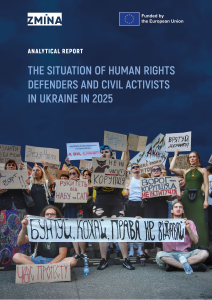
The Human Rights Centre ZMINA’s 2025 annual report documents another year in which Ukrainian civil society operated under simultaneous external and internal attack. The 170-page report covers anti-corruption activists, journalists, environmental defenders, LGBTIQ+ organisations, and the independent student movement, combining a case database, legislative analysis, and a sociological survey of 156 activists. [1]
Over 60% of the 178 documented cases originate in Russian aggression — killings, injuries, targeted strikes on civil society infrastructure. The remainder are the work of the Ukrainian state and the far right: surveillance, strategic lawsuits, smear campaigns, physical attacks, and the weaponisation of military conscription against individual activists. ZMINA’s conclusions are uncomfortable for those who wish to frame Ukraine’s democratic health as a simple function of Russian aggression alone. They are also incomplete: the report’s liberal framing excludes trade unions and labour activists entirely, and its treatment of systemic conscription abuses amounts to a footnote.
This review draws on ZMINA’s findings while situating them within the broader picture documented by Ukraine’s democratic socialist left — the movements fighting since 2022 on two fronts simultaneously: against Russian recolonisation and against the neoliberal state and far-right at home.
Contract killings organised by Russian intelligence claimed Demian Ganul in Odesa in March — a civic activist, former Right Sector security wing leader in Odesa (2014–2016), and subsequently a campaigner against corruption and illegal development, who had been convicted in absentia by a Moscow court in 2024. A fourth assassination attempt against Serhii Sternenko, volunteer and drone fundraiser and former head of Right Sector’s Odesa branch (2014–2017), followed in May in Kyiv. ZMINA is candid about both men’s far-right political histories; less so about Andrii Parubii, former Verkhovna Rada Speaker, who was shot dead in Lviv in August — described by ZMINA only by his institutional role, without noting his co-founding of the Social-National Party of Ukraine (later Svoboda). French photojournalist Antoni Lallican was killed and Ukrainian photographer Heorhii Ivanchenko lost a leg to a targeted FPV drone strike near Komyshuvakha in Donetsk region in October; both were wearing press markings and had been warned about drone activity in the area.
Volunteer centres, animal shelters, humanitarian warehouses, LGBTIQ+ offices, and the PEN Ukraine book warehouse were all struck. Across the year, 22 volunteers and activists were killed and 8 injured by Russian action; 4 media workers were killed and at least 9 injured.
The report also covers 66 documented cases of abuse by Ukrainian authorities and far-right activists. The dominant forms of pressure were intimidation and threats (14 cases), legally framed persecution including strategic lawsuits against public participation (SLAPPs) (11 cases), privacy violations through surveillance (10 cases), and smear campaigns conducted through anonymous Telegram channels (9 cases). ZMINA confirmed eight physical attacks on civic activists. The group’s survey of 156 activists found that nearly three quarters had encountered obstacles in their work and one in five experienced pressure regularly.
The NABU crisis and the cardboard protests
The central domestic human rights issue ZMINA highlighted in 2025 was the assault on Ukraine’s anti-corruption architecture. On 21 July, Security Service of Ukraine (SSU) officers conducted over 80 simultaneous searches at the homes of National Anti-Corruption Bureau of Ukraine (NABU) detectives, their relatives, and former colleagues — searches that NABU publicly stated were carried out without court warrants, with physical force, and with coerced password disclosure. The following day, the Verkhovna Rada adopted draft law No. 12414, which placed NABU and the Specialised Anti-Corruption Prosecutor’s Office (SAPO) under the authority of the Prosecutor General, ending their institutional independence. The vote was preceded by a ten-minute committee session held online, with key amendments introduced without comparative tables. [2]
What followed was the first mass protest since the start of the full-scale invasion. Nine thousand people gathered in Kyiv on 23 July; protests in Lviv, Kharkiv, Dnipro, Odesa, and fourteen other cities continued through to 30 July. Sotsialnyi Rukh (Social Movement) and Priama Diia (Direct Action) joined the protest in Ivan Franko Square, describing law No. 12414 as not merely a reform but a signal that "those in power want to bring the entire anti-corruption sector under their control and remove even the last vestiges of accountability." Sotsialnyi Rukh’s own account of the year, published in December, described the movement as having "joined mass protests numbering in the thousands, reminding people that the oligarchic system is doomed to corruption," adding that "workers’ rights are not a ’secondary issue’ but the foundation of national resilience." [3] The slogan they carried at the 30 July protest — "The minimum wage isn’t going up because someone at the top is stealing" — explicitly connected anti-corruption work to the wartime social contract.
The protests were followed by sustained retaliation. The State Bureau of Investigation (SBI) served a suspicion notice on Anti-Corruption Action Centre (AntAC) head Vitalii Shabunin for alleged military service evasion, imposed movement restrictions, and in December circulated intimate photographs taken from his seized phone via a Telegram channel linked to the original complainant in his case. AntAC’s executive director Daria Kaleniuk saw her husband unlawfully added to the military wanted list despite his legal exemption for caring for a child with a disability. The Vlasenko parliamentary Temporary Investigative Commission attempted to compel the appearance of DEJURE Foundation director Mykhailo Zhernakov and subjected former members of the Public Integrity Council — the civil society body overseeing judicial qualification — to adversarial questioning on the basis of a published opinion piece.
Nevertheless, the protests had some success. The EU, G7, and the Organisation for Economic Co-operation and Development (OECD) intervened publicly; the European Commissioner for Enlargement warned that NABU and SAPO independence is a condition of accession. On 31 July, the Verkhovna Rada voted 331 to 0 to restore the anti-corruption bodies’ autonomy.
Corruption, oligarchy, and the war effort
The left in Ukraine has long argued that suppressing anti-corruption oversight is not merely an abuse of democratic process but a direct impediment to the war effort. In March 2025 Sotsialnyi Rukh insisted that "the main obstacle to effectively mobilising resources" for defence is neoliberal policy that "prioritises private property above all else, encourages profiteering, and allows wealth to be accumulated by private individuals." [4] The organisation’s September 2025 congress declared that, in conditions where market mechanisms had collapsed, supporting sectors working for the common good — railways, healthcare, education — over private profit was not a political preference but a precondition of survival. [5]
The state crackdown on its own anti-corruption agencies came when NABU was actively investigating corruption in Ukrzaliznytsia (Ukrainian Railways) procurement and in the energy sector. The July raids targeted the NABU investigators of the schemes by which defence resources were being siphoned. According to Sotsialnyi Rukh member and historian Hanna Perekhoda, "the Ukrainian government, by maintaining its neoliberal logic, not only undermines the country’s economic sovereignty, but also jeopardises its social cohesion, a crucial condition for the survival of a society at war. The government is at a dead end. It is trying to wage total war against an imperialist power while clinging to the fantasy of a neoliberal economy. Founded on deeply individualistic social imaginaries and deregulated economies, it is simply not suited to defence needs that require united efforts at all levels of society,”
According to Sotsialnyi Rukh activist Oleksiy Vynohradiv "The elite, the politicians, the big businessmen, can leave the country if they want to, and start a new business. And the rest of the population only has obligations. There is a kind of breach of the social contract." [6]
There is a direct connection between the Ukrainian government’s obsession with oligarchic preservation and the failures in resisting Russian aggression since 2014. Ukraine’s oligarchic asset bases remain largely untouched; the country pays salaries and pensions from Western financial assistance rather than domestic tax revenues; and the wartime state, in protecting these interests through suppression of oversight, undermines the very solidarity on which resistance depends. [7]
The NABU episode illustrates in concentrated form what Sotsialnyi Rukh has been arguing throughout the war: a system that cannot tolerate accountability cannot mobilise its resources efficiently, and the population that bears the cost of that inefficiency in poverty and casualties is the same population that is asked to fight.
Pressure on trade unions
ZMINA’s definition of a civil activist — anyone acting to bring about socially significant change without personal gain — is in theory broad enough to encompass trade unionists acting in a civic capacity, but like other liberal CSOs, ZMINA’s monitoring practice excludes trade unions and labour activists. This highly political omission matters, because 2025 saw a campaign against Ukrainian organised labour that is as dangerous as the state interference in the work of anti-corruption agencies.
On 9 April 2025, Hryhorii Osovyi, the president of Ukraine’s biggest labour organisation, Federation of Trade Unions (FPU), was detained by security forces during a FPU conference. [8] The arrests came as the government, employers and labour organisations were locked in negotiations over Labour Code reform — a reform that, as Vitaliy Dudin has documented, has been a vehicle for neoliberal deregulation. [9] On 5 June 2025, the National Agency for Asset Management (ARMA) entered the House of Trade Unions on Maidan and ordered FPU staff out — a seizure that the Ukrainian socialist left has condemned while consistently criticising the FPU leadership’s accommodating posture on the Labour Code. Wartime legislation has meanwhile stripped workers of fundamental rights: Law No. 2136, adopted in 2022, prohibited strikes, reduced social guarantees, and cancelled key provisions of collective agreements. As Oleksandr Skiba documented in May 2025, territorial recruitment centres have compounded this by allegedly targeting union activists for mobilisation. [10]
On conscription abuses
Another politically motivated gap in the ZMINA report is its silence on conscription system abuses. ZMINA documents mobilisation being weaponised against individual civil society activists to silence them and others, and flags proposed legislation that would seal court decisions in conscription-related proceedings from public scrutiny. But the report does not cover systemic TCR (Territorial Centre of Recruitment and Social Support) abuses. These are numerous and serious enough to justify a whole chapter in any study of the Ukrainian civil rights picture. The Ombudsman’s office recorded a 333-fold increase in complaints about TCR conduct over the course of the war — from 18 to 6,127 — a figure ZMINA cites only in a legislative footnote.
The Ukrainian left has consistently named the problems: conscription without fixed service terms, without adequate rotation, and with the burden falling entirely on working-class men while wealthier Ukrainians purchase medical exemptions or maintain university registration to avoid the draft. Sotsialnyi Rukh’s October 2024 conference resolution called for "ending the uncertainty regarding the duration of military service, as it is a matter of elementary fairness" — demanding fixed service terms, salary protections for mobilised workers, and dignified compensation for the wounded. Its March 2025 ten-point programme linked these demands explicitly to the parallel demand that the war’s economic burden shift from working-class conscripts to oligarchic capital. The state refuses to tax the rich to fund the war, and relies instead on open-ended conscription of the poor. It uses the security apparatus against those who document either abuse. ZMINA, like most of the liberal CSOs, is silent. [11]
Progressive organisations and the far right
The ZMINA 2025 report does cover the multiple attacks on Priama Diia (Direct Action), the anarcho-syndicalist student trade union. In June 2025, activist Maksym Shumakov had his flat searched and his phone, laptop, and documents seized on grounds of alleged communist symbols on his Facebook page — a charge ZMINA found unsupported on inspection of his public posts. No suspicion notice had been served and no equipment returned as of April 2026. In July, a "Free School" summer event in Lviv was disrupted by far-right youth, and the venue administration subsequently threatened cancellation, citing Priama Diia’s described membership of "Marxists, anarchists and representatives of more exotic movements." In October 2025, a group with Right Sector links physically attacked a Priama Diia meeting at Ivan Franko National University in Lviv, using Nazi salutes, a gas canister, and a knife; proceedings were opened as hooliganism rather than obstruction of a civic organisation. SSU officers visited the educational institution of a female Priama Diia member and questioned staff about her political views, bank history, and family.
In April 2025, Priama Diia members observed that far-right groups show little interest in social demands — dormitories, canteens, wages — but reliably appear when progressive ’wedge’ issues arise, "on LGBTQIA+, for example." [12]
Harassment of LGBTIQ+ organisations was constant in 2025. KyivPride’s planned charitable event was displaced from its venue under police pressure, the Sunny Bunny queer cinema festival was attacked by Prava Molod (Right Youth), KharkivPride’s resource centre was vandalised, and events organised by NGO Insight were disrupted in both Lviv and Zaporizhzhia. In none of the documented cases were hate-motivated charges brought to court; investigations were systematically reclassified as hooliganism or domestic disputes. ZMINA’s survey found that LGBTIQ+ activists faced the broadest range of threats of any group, with 91% reporting online harassment and intimidation and 82% citing increased far-right activity. Investigations into hate crimes consistently failed to result in prosecutions.
USAID cuts and legislative risks
The abrupt cancellation of over 80% of United States Agency for International Development (USAID) programmes at the start of 2025 struck directly at the civil society sector. ZMINA cites one survey suggesting 75% of affected organisations are still seeking alternative resources, 25% anticipating staff reductions, and 12% suspending programmes or closing entirely. Regional legal aid, educational initiatives, and anti-disinformation work were among the casualties. The ZMINA report notes that the vacuum may provide space for external actors to exert influence through alternative funding channels, and that the structural dependency exposed by the USAID collapse points to the need for diversification towards local philanthropy and long-term institutional support rather than project-based grants — a position the Ukrainian left, with its emphasis on building domestic solidarity networks, has argued consistently.
Two laws adopted in 2025 drew significant civil society criticism. A law restricting access to the unified state register of court decisions removed cadastral numbers and precise property addresses from publicly searchable records — ostensibly for security but applied to all legal entities, not only defence-related ones, substantially impeding anti-corruption asset monitoring. Another law, on verified humanitarian organisations, introduced a status threshold disadvantaging small, local, or newly formed NGOs, with the Cabinet of Ministers granted broad discretion over criteria for granting and revoking status. Four draft laws remained under consideration, including proposals to introduce administrative liability for "identifying a lawyer with a client" — vague enough to criminalise investigative journalism covering court proceedings — and Civil Code amendments that would expand grounds for demanding retractions and blocking digital content, without anti-SLAPP safeguards.
Two fronts, one movement
The ZMINA report is a record of persecution and of persistence. The "cardboard protests" succeeded: a legislative reversal was achieved in ten days through street mobilisation and international pressure. Sotsialnyi Rukh, reflecting at the close of 2025, placed that victory alongside sustained work on workers’ rights, veteran support, and internal displacement — insisting that "due to aggressor pressure and the weakness of corrupt capitalism, the war may continue for a long time," and that under these conditions labour and social rights are not secondary concerns to be deferred until after the war, but the foundation of what Ukraine is being defended for. Priama Diia continued organising across university campuses despite repeated attacks, criminal proceedings, and SSU surveillance. KyivPride, KharkivPride, NGO Insight, NGO Bilkis, and the broader LGBTIQ+ movement kept organising, documenting, and filing complaints, even knowing those complaints would not be prosecuted.
ZMINA does not just write reports. The centre’s head of the board, Tetiana Pechonchyk, appeared publicly within 48 hours of the Shabunin photo leak to demand criminal proceedings for disclosure of pre-trial investigation data and violation of the right to privacy. The organisation published a joint statement signed by over 100 Ukrainian civil society organisations condemning the political use of the justice system.
As the ZMINA report shows, Ukraine’s democratic civil infrastructure is under strain. It has not collapsed. Ukrainian human rights organisations, the democratic socialist left, democratic soldiers’ organisations — Veteranka (the Women Veterans Movement) [13] and the NGO Ukrainian LGBT+ Military and Veterans for Equal Rights [14] — labour unions, the student movement, LGBTIQ+ activists, and environmental defenders, each face different forms of the same double pressure — from Russian recolonisation and from the neoliberal state and far-right.
5 June 2026
Source: ESSF
P.S.
If you like this article or have found it useful, please consider donating towards the work of International Viewpoint. Simply follow this link: Donate then enter an amount of your choice. One-off donations are very welcome. But regular donations by standing order are also vital to our continuing functioning. See the last paragraph of this article for our bank account details and take out a standing order. Thanks.
Footnotes
[1] The ZMINA annual report, The situation of human rights defenders and civil activists in Ukraine in 2025: Analytical report authored by Iryna Yuzyk, Khrystyna Roman, Diana Deputat, and Alona Martynchuk, and edited by Tetiana Pechonchyk and Onysiia Syniuk, Human Rights Centre ZMINA, Kyiv, 2026, only covers government-controlled Ukrainian territory. Available for download in English at: https://zmina.ua/wp-content/uploads/sites/2/2026/05/zvit_ga_eng_web.pdf
[2] On Ukraine’s anti-corruption protests, see Priama Diia (Direct Action), Sotsialnyi Rukh (Social Movement), and the European Network for Solidarity with Ukraine (ENSU/RESU), "Ukraine: anticorruption protests", Europe Solidaire Sans Frontières, 23 July 2025. Available at: https://www.europe-solidaire.org/spip.php?article75706
[3] Sotsialnyi Rukh (Social Movement) Ukraine, "A Year of Social Progress: Sotsialnyi Rukh’s Activities in 2025", Europe Solidaire Sans Frontières, 31 December 2025. Available at: http://www.europe-solidaire.org/spip.php?article77508
[4] Sotsialnyi Rukh (Social Movement) Ukraine, Programatic Statement "For Ukraine without oligarchs and occupiers!", Europe Solidaire Sans Frontières, 10 March 2025. Available at: http://www.europe-solidaire.org/spip.php?article74021
[5] Sotsialnyi Rukh (Social Movement) Ukraine, "Social Movement (Ukraine) Congress 27-28 September 2025", Europe Solidaire Sans Frontières, 30 September 2025. Available at: http://www.europe-solidaire.org/spip.php?article76429
[6] Francesca Barca, "Ukraine: War, inequality, neoliberalism: the challenges facing the Ukrainian left", 11 March 2025. Available at: http://www.europe-solidaire.org/spip.php?article74022
[7] Adam Novak, "The political economy of Ukraine’s war and the politics of a coming bad peace", Europe Solidaire Sans Frontières, May 2026. Available at: https://europe-solidaire.org/spip.php?article78849
[8] Adam Novak (with Interfax-Ukraine and KPU Ukraine), "Ukrainian labour leaders arrested under pressure from neoliberal parliamentarians", Europe Solidaire Sans Frontières, 11 April 2025. Available at: http://www.europe-solidaire.org/spip.php?article74454
[9] Vitaliy Dudin, "Ukraine: Trade Unions, Deregulation, and Social Dialogue: An Interview with Vitaliy Dudin", Europe Solidaire Sans Frontières. Available at: http://www.europe-solidaire.org/spip.php?article72639
[10] [Oleksandr Skiba, "Ukraine’s Trade Unions Face Wartime Crisis and Post-War Transformation", Europe Solidaire Sans Frontières, 28 May 2025. Available at: https://europe-solidaire.org/spip.php?article75166
[11] The Kharkiv Human Rights Protection Group (KhPG), founded in 1992 and rooted in the Ukrainian dissident tradition, takes a more rigorous approach to conscription rights than ZMINA. Its analysis of the 2024 mobilisation law explicitly names arbitrary TTsK conduct as current practice, documents procedural rights of draftees, and quotes its director Yevhen Zakharov describing the termination of consular services for men who have not updated their military registration as "a purely Soviet means of coercion." KhPG remains a mainstream civil liberties organisation and does not apply a class analysis to mobilisation — it does not name who evades and who bears the burden — but it at least frames conscription as a domain of individual rights requiring active protection. See: "Law on mobilization: The Kharkiv Human Rights Protection Group analysis," Denys Volokha and Mykola Komarovskyi, 31 May 2024, https://khpg.org/en/1608813722
[12] Priama Diia (Direct Action), "Ukraine: Rebuilding the student union Priama Diia (’Direct Action’)", Europe Solidaire Sans Frontières, 16 April 2025. Available at: http://www.europe-solidaire.org/spip.php?article74597
[13] Veteranka (the Women Veterans Movement; Rukh Veteranok) grew out of the 2015 "Invisible Battalion" campaign and was formally established in 2018. It campaigns for equal material, legal, and institutional conditions for women in the Armed Forces of Ukraine. See: https://uwvm.org.ua/en/
[14] The NGO "Ukrainian LGBT+ Military and Veterans for Equal Rights" (abbreviated as "Military LGBT+") was established in 2018. It campaigns for equal rights for LGBTIQ+ service members and veterans, including civil partnership recognition and anti-discrimination protection in the armed forces. Led since 2025 by Azovstal defender Oleksandr Demenko, with founder Viktor Pylypenko as deputy chair. See: https://www.lgbtmilitary.org.ua/en/
Adam Novak
Adam Novak is an editor of Europe Solidaire Sans Frontières (ESSF) and former coordinator of the European Network for Solidarity with Ukraine (ENSU/RESU).
Anti-militarism that forgets those under attack is no anti-militarism at all
Resolution for the June 19-21 Convention of Die Linke
Wednesday 17 June 2026, by Collective
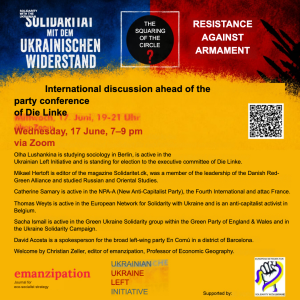
Manifesto for Signatories
Against the arms race as a profit-making machine. Against turning a blind eye to Russian imperialism. For a left-wing peace policy that integrates self-defense and social control. No weapons for profit, but weapons for those under attack. Peace means an end to aggression
Sign this manifesto if you want this voice to be heard at the Die Linke convention.
Ahead of the Potsdam Party Convention of Die Linke (June 19–21, 2026), leftists in solidarity with Ukraine are using this manifesto to take a stand on Motion G.26 “We Won’t Pay for Your Wars!”. Comrades, elected officials, and political organizations that support this position can sign on.
Launch phase: Initial signatures from several state associations have been received. Public names will follow after verification.
Privacy principle: The list remains internal during the launch phase. Only those who expressly consent will be named publicly.
I. What This Is About
A left-wing peace policy that forgets those under attack is no peace policy. Motion G.26 “We Won’t Pay for Your Wars!” has precisely this problem. Thus, a motion is before the federal party convention that aims to sharpen the party’s peace policy line in the name of rearmament, social cuts, and new wars.
Anyone reading it solely in the context of the German budget debate might easily mistake it for a consistent anti-militarist response. It opposes billion-euro programs for the military and armaments, Rheinmetall profits, and the normalization of war readiness, while advocating for conversion, school strikes, and counseling on conscientious objection.
We share this social diagnosis: Anyone who allocates more than 108 billion euros to defense spending in 2026 alone while simultaneously freezing the standard social welfare rate at 563 euros is waging class warfare from above. If Rheinmetall’s stock price has increased sixteenfold since 2022, that is not a market anomaly—it is a political decision. A left-wing party must fight against social cuts, arms profits, and the militarization of everyday life. But it must also honestly acknowledge that Germany has co-financed Putin’s aggressive power for years through cheap energy imports—even after the 2014 annexation of Crimea, even while Russian dissidents were being imprisoned.
But Motion G.26 does not speak in a vacuum. It comes after more than four years of Russia’s war of aggression against Ukraine and in the midst of a programmatic debate in which the party must decide whether it will continue to treat Eastern European security needs as a footnote. This is precisely where the problem lies: The motion addresses rearmament, profits, and war readiness, but it renders the attacked Ukraine and the threatened societies in Eastern Europe invisible and reduces Russian imperialism to a side issue. Attacked societies are not pawns to be moved between power blocs, but political subjects with their own history, their own social struggles, and their own right to self-determination.
That is why we are writing not from an academic distance, but as Eastern European leftists. We know what Putin’s “peace” means—and that is precisely why we do not want it. Motion G.26 draws three false conclusions from correct observations: a false history, a false symmetry, a false answer. This text is directed against that.
II. False History — The 1914 Trap
Motion G.26 invokes the SPD’s war credits of 1914. The SPD’s approval of the war credits was a political capitulation to nationalism and a truce among enemies—because it supported an imperialist aggression between imperialist powers. No one was liberated. Everyone was sacrificed.
But 2022 is not 1914. The reference to the war credits only works if military support today means the same thing as it did then: approval of the war waged by one’s own imperialist state. That is precisely not the case here. One side is defending itself. The other has attacked. Ukraine is not the German Empire. It is the republic under attack. The attack was an imperial decision against Ukraine’s self-determination.
Those who blur this distinction are not repeating the anti-war reflex of the Bolsheviks in 1914. They are repeating the mistake of those Moscow-loyal leftists who dismissed the Hungarian uprising in 1956 as “counterrevolutionary,” the Prague Spring in 1968 as “misguided,” and Georgia in 2008 as “provocative.” Each time, Moscow stood there with its tanks. Each time, a segment of the Western left showed sympathy. This is not our tradition.
Marx and Engels supported the Polish uprisings against the Tsarist Empire—not out of national romanticism, but because they understood the oppression of entire peoples as a shackle on democratic and socialist liberation. The International Brigades went to Spain in 1936—not “against both warring parties,” but against Franco. In Rojava, too, leftists have understood that self-defense against reactionary violence cannot be replaced by appeals. Anti-fascism is concrete. It chooses a side and accepts the risks that come with it. That is the tradition we are continuing.
III. False Symmetry — The Perpetrator Systematically Concealed
This distorted history also creates a false symmetry that runs throughout the entire text. The motion mentions Israel and the U.S. when it seeks to name aggressors. It does not mention what Russia has done. Not a word about Bucha, not a word about Mariupol, not a word about the Ukrainian children deported to Russia. Omission is also a stance. Anyone who does not call this war by its name has already half-accepted it.
Yet the motion speaks of “working people in Ukraine as well as in Russia”—as if both had the same choice. They did not. One side was invaded. The other side carried out the invasion. Symmetry between the aggressor and the attacked is not pacifism. It is complicity with the stronger party.
That is precisely why we must distinguish between the Russian state and the people who refuse to participate in this war. Solidarity with Russian deserters and conscientious objectors is not a substitute for or a counterweight to solidarity with Ukraine, but rather its antimilitarist corollary. A supposed “solidarity with Russia” that treats imprisoned Russian anti-war activists merely as a mirror image of Ukrainian suffering renders both invisible: state repression in Russia and the reality of everyday life in Ukraine under attack by bombs.
This weakness is not new to the party. In Crimea in 2014, in Syria, during the full-scale invasion in 2022, and in Gaza, Die Linke was too often too divided, too late, or too preoccupied with itself. This problem is also openly acknowledged in the current programmatic debate. But an admission that repeats the same gap in the next peace policy motion does not end the mistake. It only makes it more visible. And this gap specifically affects the Ukrainian, Russian, Belarusian, and Central European leftists in this party, whose political experience with the Kremlin predates the German debate about it.
IV. The Wrong Answer — No Weapons for Profit, but Weapons for the Attacked
This false symmetry gives rise to the wrong political answer. Yes, military spending is used to justify cuts to social services. Yes, Rheinmetall and other corporations turn war into a business model. Yes, the Left must not legitimize this profit machine. But it does not follow that military support for Ukraine is wrong. It follows that this support must not be left to the profit logic of the arms corporations.
The crucial distinction does not lie between “weapons” and “no weapons.” It lies between two ways of organizing security: as a private profit-making venture or as a democratically controlled public responsibility. Those who say, “No weapons, because Rheinmetall profits,” are leaving Ukraine to Russian imperialism and the security issue to the right-wing, the military, and corporations. Those who say, “More weapons, no matter the conditions,” turn every crisis into a free pass for extra profits, lack of transparency, and political blackmail. A left-wing response must reject both.
The question, then, is not whether societies under attack have the right to self-defense. They do. Anyone who takes the UN Charter seriously cannot pit its prohibition on the use of force against the right to self-defense of those under attack. The Erfurt Program places international law and the United Nations at the center of left-wing peace policy; this commitment must also apply to Article 51. The question is under what social conditions this self-defense is supported. Public funds must mean public conditions: open cost control, limits on windfall profits, parliamentary oversight, and public transparency regarding procurement and exports; cooling-off periods to prevent the revolving door between ministries and corporations; and rights to publicly funded technology. No blank check for Rheinmetall. No procurement policy that serves as a corporate subsidy program. Where the market fails—in ammunition, drone defense, spare parts, air defense components, and protective equipment—public forms of production and European procurement under democratic control are needed.
This also applies to conversion. Anyone who today merely says “conversion,” as if we were still living in the disarmament debates of the 1990s, is missing the point. In reality, we are also experiencing reverse conversion: civilian industrial capacities are being opened up for arms production. That is why any publicly funded expansion of military production requires worker participation, collective bargaining agreements, training, and a civilian transition plan. In this way, support for Ukraine does not become a contradiction to left-wing anti-militarist policy, but rather its litmus test: not fewer weapons for Ukraine, but less private leverage over weapons production. No weapons for profit. But weapons for those under attack.
V. What We Demand
What we expect from the motion is not less antimilitarism, but consistent antimilitarism. This critique does not lead to abstract declarations, but to concrete changes to the motion and the party’s programmatic line:
1. Clear recognition of Ukraine’s right to self-defense under Article 51 of the UN Charter. International law is indivisible—the UN Charter applies without double standards, against any aggressor. This entails political solidarity with societies under attack that are defending themselves against reactionary and imperialist violence, from Ukraine to Rojava.
2. Continuation of defensive arms deliveries to Ukraine—from democratically controlled production, with priority given to air defense and protective equipment, free from the private blackmailing power of arms corporations, and with a perspective for conversion for the post-war era. No weapons for profit. But weapons for those under attack.
3. Democratically coordinated arms production instead of a profit-driven sector—public conditionality, open cost control, public transparency, targeted public forms of production, and democratic firewalls against the lobbying power of arms corporations.
4. Binding co-determination on conversion in both directions—conversion councils with workers, unions, and local governments, collective bargaining agreements, training, and prospects for a return to civilian life for every publicly funded expansion of military production.
5. Protection and reception of Russian deserters and conscientious objectors — because the concrete antimilitarist consequence is not symmetry between states, but support for those who evade the army of aggression.
6. Antifascist security policy as the party’s programmatic line — neither subject to NATO logic nor to arms corporations, but also not pacifism of self-surrender. Rather, a Left that conceives of security from below: for tenants, for refugees, for societies under attack and threat.
VI. Who is speaking here
This manifesto is an intervention by the Network for Just Peace (NGF). Within the NGF, leftists in solidarity with Ukraine—with or without personal ties to Ukraine, Russia, and Eastern Europe—work together. We are united not by origin, but by a political stance. The Ukrainian Left Initiative (ULI) and the BAG Russian-Speaking Left (RL) have contributed this text through the NGF. It deliberately focuses on Ukrainian, Russian-speaking, and Eastern European experiences, because it is precisely these perspectives that are missing from Motion G.26.
The Ukrainian Left Initiative (ULI) brings to the NGF the perspective of leftists in Germany who are Ukrainian or in solidarity with Ukraine. Many of us know about Russia’s war of aggression not from television images, but from family histories, flight, political work, and contacts with trade unions, left-wing organizations, and social movements in Ukraine. We are fighting for solidarity with Ukraine that goes beyond the state: for military support for self-defense, for social and trade union reconstruction, for the rights of refugees, and against any right-wing co-optation of the Ukrainian issue.
The BAG Russian-Speaking Left (RL) brings to the NGF the perspective of Russian-speaking leftists who oppose Putin’s war, nationalism, and repression—in Russia, in exile, and among migrants in Germany. For us, being Russian-speaking is neither a political camp nor an excuse for imperialist nostalgia. Many of us are witnessing how Putin’s war is also dividing migrant communities here: those who oppose it are treated as traitors by the right and as disruptive elements by parts of the German left. We insist: solidarity with Russian deserters, conscientious objectors, and dissidents is part of solidarity with Ukraine, not against it.
We are not Atlanticists. We are not Putin apologists. This manifesto gives voice to what the German left has lacked for decades: an Eastern European voice from the left, supported by a network of solidarity. Precisely for this reason, we address all those who want a left-wing peace policy that sees those under attack. To ignore this voice—as Motion G.26 does—is not internationalist. It is ignorance with a leftist tinge.
VII. Conclusion
We will not pay for Rheinmetall’s profits. We will not pay for Merz’s rearmament fantasies. We will not pay for a policy that pits the welfare state against security.
But we will not let Ukraine pay either—with its cities, its children, its right to self-determination—so that a German Left Party consensus can maintain its simplistic slogan.
Solidarity is not symmetrical.
Anti-militarism is not looking the other way.
Peace is not the silence of the attacked.
Peace is the end of aggression.
Peace through self-determination—not peace through submission.
This is what we are fighting for at the federal party convention.
Anyone who shares this position—as a comrade, an initiative, a grassroots organization, or an elected official—is invited to co-sign this text, join the discussion, and fight alongside us at the Federal Party Convention.
Source: Ukraine Solidarity Campaign

No comments:
Post a Comment