Trump’s Attacks on Black Power and Freedom Show How Far We Still Have to Go
Thinking on the Black freedom struggle from June 19, 1865, to now, where do we collectively want to see ourselves next?
By George Yancy ,
June 18, 2026
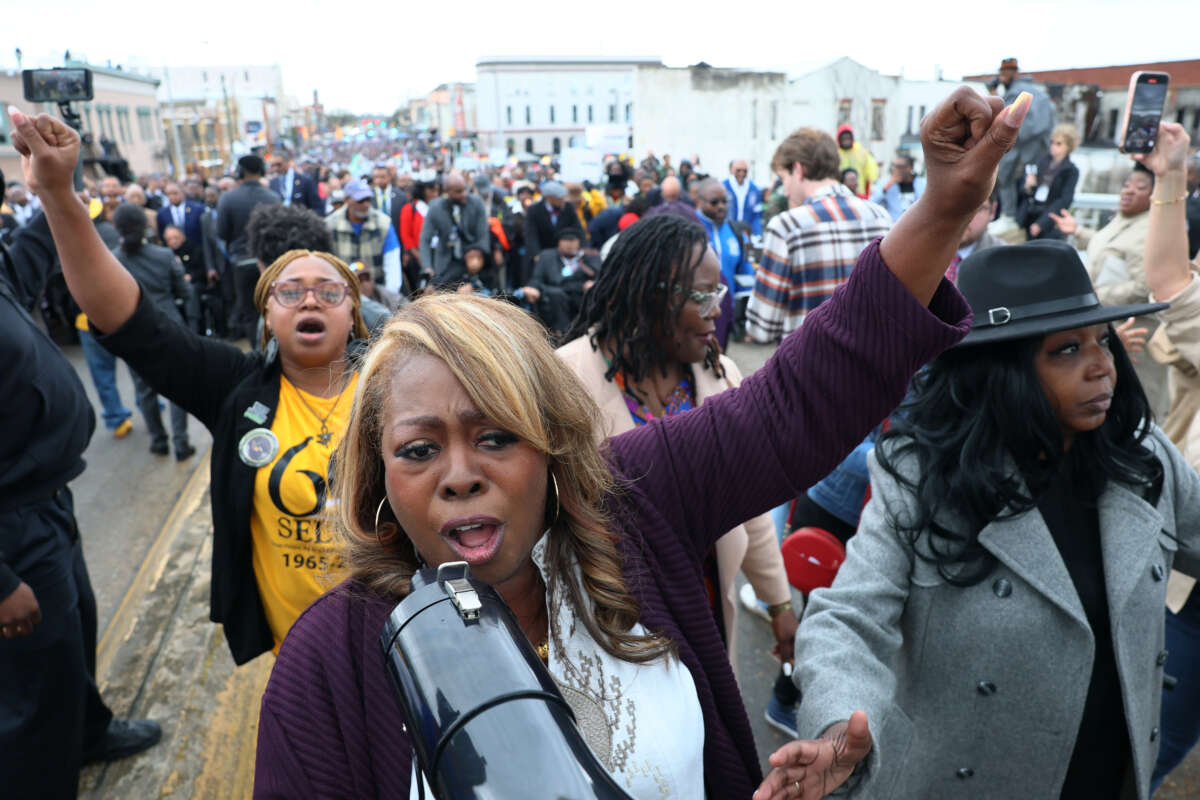
LaTosha Brown, co-founder of the voting rights group Black Voters Matter, leads people in a chant as they walk across Edmund Pettus Bridge as they commemorate the 60th anniversary of "Bloody Sunday" on March 9, 2025, in Selma, Alabama.Michael M. Santiago / Getty Images
Honest, paywall-free news is rare. Please support our boldly independent journalism with a donation of any size.
How should Juneteenth be understood, be celebrated, be remembered, given this moment of deep anti-democratic machinations and authoritarian/fascistic ambitions cultivated at the “highest” offices within this land? The tension between the sense of renewed freedom that Juneteenth engenders and the profound unfreedom that this country perpetuates is not lost on me. Indeed, as the 250th anniversary of this nation’s independence is on the horizon, on July 4, 2026, the tension screams of a biting contradiction that forces the observation that the Fourth of July was never meant for Black people. It is within the context of this tension and contradiction that I conducted this exclusive interview with Jeanelle K. Hope, who is an independent scholar and a lecturer at the University of California–Washington Center, and co-author of The Black Antifascist Tradition.
George Yancy: It is such a pleasure to be in conversation with you again, Jeanelle. I am particularly excited to talk with you about what Juneteenth means to you. But first I want to return to our previous discussion and connect it to the recent attacks on the Voting Rights Act. In our last exchange, you laid bare the historical dimensions, political commitments, and courageous spirit of the Black anti-fascist tradition. In that exchange, you argued that we must remember that “fascism attacks on all fronts, so we must develop a strategy that recognizes this.” As I reread your instructive and powerful words, I was reminded of the Supreme Court’s conservative majority decision, on April 29, 2026, in Louisiana v. Callais, which has been characterized as an evisceration of — or, at minimum, a significant weakening of — “Section 2 of the Voting Rights Act (VRA) and opened the door for states to enact discriminatory voting maps and laws.”
Justice Samuel Alito wrote in the majority opinion in Louisiana v. Callais that Section 2 of the Voting Rights Act imposes liability “only when circumstances give rise to a strong inference that intentional discrimination occurred.” This standard requires Black plaintiffs to demonstrate intentional racial discrimination. In her book Where Is Your Body?, critical race theorist Mari J. Matsuda critiques the concept of a narrow “linear, intent-based notion of causation” when it comes to racism, arguing that “if the effects of racism exist, that is cause for action.” My colleague, historian Carol Anderson, states: “Jim Crow was a political project designed to preserve racial hierarchy through law and the power structure that depended on it. When we see coordinated efforts to purge voters, centralize election control, dismantle the Voting Rights Act, and dilute Black political power, we should call it what it is.” Within the context of your important historical and political work, let’s call it what it is: the unabashed continuation of anti-Black fascism.

U.S. philosopher George Santayana warned, “Those who cannot remember the past are condemned to repeat it.” I would argue that the problem for Black people is not a failure to remember the past; rather, it is that the past is not past. We are witnessing the continuation of systems and practices that remind us, repeatedly, that we have no rights that the white state is bound to respect. In short, Black people continue to have their rights violated, their freedoms politically constrained, and their ontology, their being, rendered abject. Speak to how you see this latest attack on Black people’s voting power and freedom — which amounts to a form of civil death — as a manifestation of anti-Black fascism. For those who may not view it as such, what are they missing?
Jeanelle K. Hope: During this election season, we are seeing an all-out conspiracy to effectively roll back voting rights, which Black people have steadily fought for, with redistricting being the main strategy that has effectively sanctioned mass disenfranchisement. The efforts, largely taken up by Southern states, elucidate two major pillars of anti-Black fascism: anti-democracy and dual application of the law. The recent Louisiana v. Callais decision is another example of how the law is being weaponized to cement major objectives within the fascist project. It is evident that the primary goal of Southern state redistricting efforts, and gerrymandering, is to starkly dilute Black voting power, smashing any remaining illusion of democracy for Black people in Texas, Louisiana, Tennessee, Alabama…
The Black Anti-Fascist Tradition Recognized Fascism Didn’t Begin in Europe
Black anti-fascists have long warned about creeping fascism, from slavery to mass incarceration to ICE terror. By George Yancy , Truthout February 21, 2026
Honest, paywall-free news is rare. Please support our boldly independent journalism with a donation of any size.
How should Juneteenth be understood, be celebrated, be remembered, given this moment of deep anti-democratic machinations and authoritarian/fascistic ambitions cultivated at the “highest” offices within this land? The tension between the sense of renewed freedom that Juneteenth engenders and the profound unfreedom that this country perpetuates is not lost on me. Indeed, as the 250th anniversary of this nation’s independence is on the horizon, on July 4, 2026, the tension screams of a biting contradiction that forces the observation that the Fourth of July was never meant for Black people. It is within the context of this tension and contradiction that I conducted this exclusive interview with Jeanelle K. Hope, who is an independent scholar and a lecturer at the University of California–Washington Center, and co-author of The Black Antifascist Tradition.
George Yancy: It is such a pleasure to be in conversation with you again, Jeanelle. I am particularly excited to talk with you about what Juneteenth means to you. But first I want to return to our previous discussion and connect it to the recent attacks on the Voting Rights Act. In our last exchange, you laid bare the historical dimensions, political commitments, and courageous spirit of the Black anti-fascist tradition. In that exchange, you argued that we must remember that “fascism attacks on all fronts, so we must develop a strategy that recognizes this.” As I reread your instructive and powerful words, I was reminded of the Supreme Court’s conservative majority decision, on April 29, 2026, in Louisiana v. Callais, which has been characterized as an evisceration of — or, at minimum, a significant weakening of — “Section 2 of the Voting Rights Act (VRA) and opened the door for states to enact discriminatory voting maps and laws.”
Justice Samuel Alito wrote in the majority opinion in Louisiana v. Callais that Section 2 of the Voting Rights Act imposes liability “only when circumstances give rise to a strong inference that intentional discrimination occurred.” This standard requires Black plaintiffs to demonstrate intentional racial discrimination. In her book Where Is Your Body?, critical race theorist Mari J. Matsuda critiques the concept of a narrow “linear, intent-based notion of causation” when it comes to racism, arguing that “if the effects of racism exist, that is cause for action.” My colleague, historian Carol Anderson, states: “Jim Crow was a political project designed to preserve racial hierarchy through law and the power structure that depended on it. When we see coordinated efforts to purge voters, centralize election control, dismantle the Voting Rights Act, and dilute Black political power, we should call it what it is.” Within the context of your important historical and political work, let’s call it what it is: the unabashed continuation of anti-Black fascism.

U.S. philosopher George Santayana warned, “Those who cannot remember the past are condemned to repeat it.” I would argue that the problem for Black people is not a failure to remember the past; rather, it is that the past is not past. We are witnessing the continuation of systems and practices that remind us, repeatedly, that we have no rights that the white state is bound to respect. In short, Black people continue to have their rights violated, their freedoms politically constrained, and their ontology, their being, rendered abject. Speak to how you see this latest attack on Black people’s voting power and freedom — which amounts to a form of civil death — as a manifestation of anti-Black fascism. For those who may not view it as such, what are they missing?
Jeanelle K. Hope: During this election season, we are seeing an all-out conspiracy to effectively roll back voting rights, which Black people have steadily fought for, with redistricting being the main strategy that has effectively sanctioned mass disenfranchisement. The efforts, largely taken up by Southern states, elucidate two major pillars of anti-Black fascism: anti-democracy and dual application of the law. The recent Louisiana v. Callais decision is another example of how the law is being weaponized to cement major objectives within the fascist project. It is evident that the primary goal of Southern state redistricting efforts, and gerrymandering, is to starkly dilute Black voting power, smashing any remaining illusion of democracy for Black people in Texas, Louisiana, Tennessee, Alabama…
The Black Anti-Fascist Tradition Recognized Fascism Didn’t Begin in Europe
Black anti-fascists have long warned about creeping fascism, from slavery to mass incarceration to ICE terror. By George Yancy , Truthout February 21, 2026
As I shared in our last interview, the law is such an integral player in shaping fascism. Despite the liberal belief that the law will save us from fascism, what we are seeing unfold within the courts is the strategy of autocratic legalism — or the creeping dismantling of legal frameworks that have long aided democracy to bolster the consolidation of power for authoritarian and fascist regimes.
“What we are seeing unfold within the courts is the strategy of autocratic legalism — or the creeping dismantling of legal frameworks that have long aided democracy to bolster the consolidation of power for authoritarian and fascist regimes.”
The legal analyses of Matsuda, Derrick Bell, and Kimberlé Crenshaw have long served as sharp critiques of the law’s failure to recognize intersecting forms of oppression, systemic racism, and the upholding of a dual application of the law along racial lines. Moreover, they have been most vocal about the high, and shifting, burden of proof required by the courts when victims name racist and discriminatory actions as stymieing their life, liberty, and freedom. The core arguments of critical race scholars and lawyers can similarly be applied to the dismantling of the Voting Rights Act. The law has once again proven to not be a tool of justice, but a chisel to decide those that should and should not benefit from democracy.
For the last four years, critical race theory (CRT) has been vehemently attacked by far right and conservative-led school boards and think tanks, with history, English, and ethnic studies K-12 teachers and librarians also caught in the crosshairs. Perhaps it is CRT’s keen explication of U.S. law’s fascist and anti-democratic tendencies that was most threatening, not the thousands of books by Black authors that were banned in the name of CRT.
Living in the Washington, D.C., metro area and having been born and raised in California, it’s not lost on me that redistricting has also been adopted by Democratic-led states as a means of “fighting fire with fire” to “settle the score.” While it looks like California’s redistricting efforts are largely being upheld by the courts, the strategy, though blessed by a majority of voters, is dead in the water in Virginia. In a state where Black people comprise nearly 20 percent of the population and Northern Virginia is nearing “minority majority” status, you can’t unsee the glaring contradictions of the law that once again favors anti-Black fascism over justice.
In response to Virginia’s redistricting referendum, a member of Congress introduced the “Make DC Square Again Act” that would restore the District’s original boundaries for the sole purpose of disenfranchising Northern Virginians by leveraging Washington, D.C.’s lack of statehood. This bill and far right commentary (including the growing position of conservative women willing to give up their right to vote for a more conservative future) regarding redistricting lay bare that disenfranchisement is a priority for the modern American fascist project.
Just last year, Black historical associations and legal groups celebrated 60 years since the passage of the Voting Rights Act, a commemorative moment that felt quite hollow, considering how the legislation was being gutted. In this moment, we must wrestle with what to do over the next 60 years to regain ground lost and to transform what democracy looks like. Redistricting (from the Democrats and Republicans) is a race to the bottom, toward fascism. In the words of Audre Lorde, “the master’s tools will never dismantle the master’s house.” We must stop trying to meet the rise of the far right with the same fascist strategies dressed up in progressive and liberal language. The recent release of “Project 2029” (which leaves much to be desired), the Democrats’ supposed response to Project 2025, is another example of this. Fascism must be met with radical imagination and ambitious world-remaking — not with a reactionary policy framework that is always five steps behind. We must radically reimagine voting, elections (Election Day should be a national holiday), political parties (no more duopoly and get rid of dark money in elections), the Electoral College (how about just the popular vote), and much more.
I began with that recent major attack on the Voting Rights Act as a way of highlighting the deep sense of the tragicomic reality of Black life. As Black people, we constantly strive for freedom, empowerment, and joy. Yet, the viciousness of anti-Blackness forces us into various states of unfreedom, disempowerment, despair. When I think of Juneteenth, I think of the tragicomic. There was the brutality of American slavery, and yet there was that sense of celebration and elation “on June 19, 1865, when some 2,000 Union troops arrived in Galveston Bay, Texas. The army announced that the more than 250,000 enslaved black people in the state, were free by executive decree.” That joyous reality would only be followed by involuntary servitude through the criminalization of the Black body, the creation of Black Codes, convict leasing, and sharecropping. Add to this the reality of mass incarceration of Black people; disproportionate vulnerability to police and state violence; inequitable access to health care, housing, and education; disproportionately high poverty rates; and limited access to economic opportunities and growth. Given these realities, we find ourselves in what Saidiya Hartman terms “the afterlife of slavery” and what Christina Sharpe calls being in “the wake” — that is, that we are still mourning the effects of the transatlantic slave trade. How do you think about Juneteenth within the context of so much anti-Blackness; indeed, the continuation of anti-Black fascism?
There’s a bittersweetness to Juneteenth. On the one hand, there remains a level of excitement as the holiday moves into its sixth year of national recognition following decades of advocacy by people like Ms. Opal Lee. Yet, Juneteenth is probably the single most consequential American holiday as it forces us to truly grapple with the meaning of freedom in a more critical way than the Fourth of July. To borrow from Angela Davis, Juneteenth is a reminder that “freedom is a constant struggle,” and that the old seeds of slavery continue to germinate, taking root in many systems, institutions, and facets of modern Black life — from state-sanctioned violence and mass incarceration to varying structural inequalities.

“To borrow from Angela Davis, Juneteenth is a reminder that ‘freedom is a constant struggle,’ and that the old seeds of slavery continue to germinate, taking root in many systems.”
Juneteenth urges us to consider how we can work in the spirit of abolitionists to root out every seed of slavery. And as anti-Black fascism continues to evolve from its colonial and chattel slavery foundations to more sophisticated outcomes, the Juneteenth holiday demands that we reimagine what freedom fighting looks like. With our nation’s current march toward fascism, so many of our supposed freedoms are on the line — from voting rights and citizenship, freedom of speech, academic freedom, the freedom to protest, and beyond. Let the Juneteenth holiday serve as a reminder of the ever-shifting grounds of freedom.
Thus, celebrating Juneteenth must entail study, organizing, and dreaming. I hope that those celebrating Juneteenth engage in much-needed consciousness raising. Read. Not only about the history of slavery, abolition, and Juneteenth, but also more contemporary works that help elucidate slavery’s afterlives. Juneteenth is a communal event and holiday. So before firing up the barbeque, breaking out the seafood boil, or busting open a box of crabs, I hope folks sit with one another in critical reflection and discussion. We must all consider what freedom fighting looks like within our communities and strategize how to work together in those efforts. As Robin D.G. Kelley’s early work reminds us, for the enslaved and so many Black activists, freedom was only a dream. We must use the Juneteenth holiday to also dream of what new iterations of freedom look like — a freedom beyond anti-Black fascism.
“For the enslaved and so many Black activists, freedom was only a dream. We must use the Juneteenth holiday to also dream of what new iterations of freedom look like.”
Despite the bitterness of Juneteenth, it is Black joy that encompasses the sweetness of the holiday. It is a sweetness that extends to glasses of red drinks, plates of red velvet cake, and slices of watermelon. There is something especially sacred in commemorating Juneteenth through gathering, partaking in Black foodways, dancing, and laughing. I hope that we all revel in joy this Juneteenth.
Juneteenth will precede the 250th anniversary of this nation’s independence on July 4, 2026. I am reminded of the scathing critique by Frederick Douglass, where he writes, “What, to the American slave, is your 4th of July?I answer: a day that reveals to him, more than all other days in the year, the gross injustice and cruelty to which he is the constant victim. To him, your celebration is a sham.” As I celebrate Juneteenth, I’m simultaneously aware of the sham of this country’s “greatness” in relationship to the continued violent and dehumanizing logics of anti-Blackness. As this nation celebrates its 250th anniversary, Douglass’s truth-telling to this nation continues to hold: “Your boasted liberty, an unholy license;your national greatness, swelling vanity; your sounds of rejoicing are empty and heartless; your denunciations of tyrants, brass fronted impudence; your shouts of liberty and equality, hollow mockery.” Reading your work militates against perpetuating shams. There are times when living in bad faith — lying to ourselves — can feel easier than facing social and civil death. But willfully remaining ignorant will not stop anti-Black fascistic violence, just as remaining critically conscious will not, on its own, stop it either. Yet we still need to remain critically conscious. How do we do so, especially in the context of the upcoming 250th anniversary of this nation’s independence, a day which will be filled with praise, celebration, and, for me, deep hypocrisy? Talk about how necessary it is that we maintain a critical consciousness of this nation’s bloody history, pretense, and anti-Blackness.

The 250th anniversary of the nation’s independence has presented a unique narrative and branding (dare I say grifting) opportunity that has largely been used to support America’s march toward fascism. Living in the Washington, D.C., metro area, the thick veneer of patriotism and nationalism expressed via “America 250” and “Freedom 250” programming and branding is inescapable. Plans to celebrate this moment involve completely reshaping the cultural atmosphere and ethos of Washington, D.C. A few highlights include: the construction of a 250-foot arch (a Western architectural symbol of power and expansion) near Arlington National Cemetery, a mixed martial arts UFC fight recently held on the White House lawn (the event somehow ended with a racist and misogynist jab at former first lady Michelle Obama), the National Mall is currently being transformed into a “State Fair” (it should be noted that this “State Fair” is being held in a District long denied statehood), and a Grand Prix auto race is slated to take place around major monuments. Ironically, much of the National Mall is surrounded by tall fencing, making the space look more like a police state rather than the projected freedom playground. Furthermore, institutions and artists are being called to “promote American and Western values” in a manner that conveys “greatness,” “grandeur,” and “abundance,” while limiting discussions that underscore the very roots of the nation — colonialism, slavery, and Native American genocide. America 250 has effectively served as a narrative tool to reshape U.S. culture through far right politics, Christian nationalism, hypermasculinity, and fascism. The 250th anniversary of U.S. independence, especially under the current political climate, must be understood as a paradoxical moment to interrogate U.S. democracy and freedom, not a moment to lean into the cultural spectacle of “America 250” and “Freedom 250” branding.
With the residents of Washington, D.C., being forced to host all these events across their communities, I challenge folks to shift their gaze from America 250 to the renewed Free DC movement. Since the late 1700s, Washingtonians (who are predominantly Black) have been denied statehood, self-determination, and full participation in democracy — an enduring punishment for the District’s predominantly Black population that traces back to debates around slavery in the region. If we are to celebrate independence and freedom in the nation’s capital, why is it that the people who live year-round in the capital aren’t afforded the fundamental freedom of statehood?
I want to underscore that what UFC fighter Josh Hokit said about Michelle Obama was vile, ignorant, and racist. Given the importance of Juneteenth, I don’t want to end on a pessimistic note, even if pessimism is fully justified. James Baldwin, who was passionately dedicated to radically transforming this country through love — and by demanding that it look at itself in a disagreeable mirror and admit to the lie of its “innocence” — was still skeptical. In The Fire Next Time, he asks, “Do I really want to be integrated into a burning house?” It seems to me that if the house is burning, we have been locked in it — and never fully integrated — since the beginning of our arrival. Despite this, we have found ways of pushing back and talking back. We have been able to create, invent, love ourselves, find joy, and deploy our Black imaginations to think and be otherwise.
In your book The Black Antifascist Tradition, you stress the importance of abolition. In fact, I would argue that if the house has been burning for so long, then perhaps it is no longer habitable until the ashes have been swept away to allow for forms of clarity, insight, and wisdom that will begin with the kind of profound and mature love, as Baldwin understood it, that might function as the foundation for a radically new, unprecedented way of political belonging.
You don’t stop at abolition. You write, “The endpoint of abolition is not destruction but futurity.” You link abolition to Afrofuturism. How do you understand the creative dynamics of Afrofuturism? As you know, not all Black people will experience or celebrate Juneteenth with a sense of political exuberance or reflect on how we have made so much “progress.” I’m interested in how you think about Afrofuturism alongside abolition, because the latter suggests a radical future — something yet to come.
As mentioned earlier, in celebrating Juneteenth we must incorporate dreaming. When we dream, we can imagine futures that go beyond the status quo and reform. We place our future selves somewhere anew, with environments that are defined by our holistic well-being. With all that we know about the Black freedom struggle from June 19, 1865, to the present, where do we collectively (not individually) want to see ourselves next?Art and culture are often great avenues to explore this type of imagining and radical world-building. This is why fascism actively works to co-opt and control art, media, and cultural production.
There is no greater entry point to discussing the intersection of Black anti-fascism and Afrofuturism than the work of pioneering Afrofuturist writer Octavia Butler. Folks have long discussed how Parable of the Sower outlines the rise of fascism in the 21st century, but it is her follow-up work, Parable of the Talents, where Butler engages in this deeply Black anti-fascist world rebuilding. Beyond Butler, there are so many artists that are creating various forms of art and culture that help us dream of a new future. For example, I’m still sitting with Boots Riley’s film I Love Boosters and the vision he lays out for the future of organizing under technofascism. I’m similarly wrestling with Aleshea Harris’s disturbing yet liberating journey through a tale of Black women’s vengeance in Is God Is. Both films offer poignant meditations on Black futures and freedom, while not shying away from the pessimism of it all. I think it’s important to let art and culture — particularly independent, political, and Afrofuturist art — serve as a guiding light as we dream.
This article is licensed under Creative Commons (CC BY-NC-ND 4.0), and you are free to share and republish under the terms of the license.

George Yancy
George Yancy is the Samuel Candler Dobbs professor of philosophy at Emory University and a Montgomery fellow at Dartmouth College. He is also the University of Pennsylvania’s inaugural fellow in the Provost’s Distinguished Faculty Fellowship Program (2019-2020 academic year). He is the author, editor and co-editor of over 25 books, including Black Bodies, White Gazes; Look, A White; Backlash: What Happens When We Talk Honestly about Racism in America; and Across Black Spaces: Essays and Interviews from an American Philosopher published by Rowman & Littlefield in 2020. His most recent books include a collection of critical interviews entitled, Until Our Lungs Give Out: Conversations on Race, Justice, and the Future (Rowman & Littlefield, 2023), and a coedited book (with philosopher Bill Bywater) entitled, In Sheep’s Clothing: The Idolatry of White Christian Nationalism (Roman & Littlefield, 2024).

No comments:
Post a Comment