Emergency Loans Are Costing US Schools Millions — and Lining Wall Street Pockets
States’ political failures are causing a massive transfer of wealth from classrooms to the richest banks in the nation.
PublishedJune 19, 2026
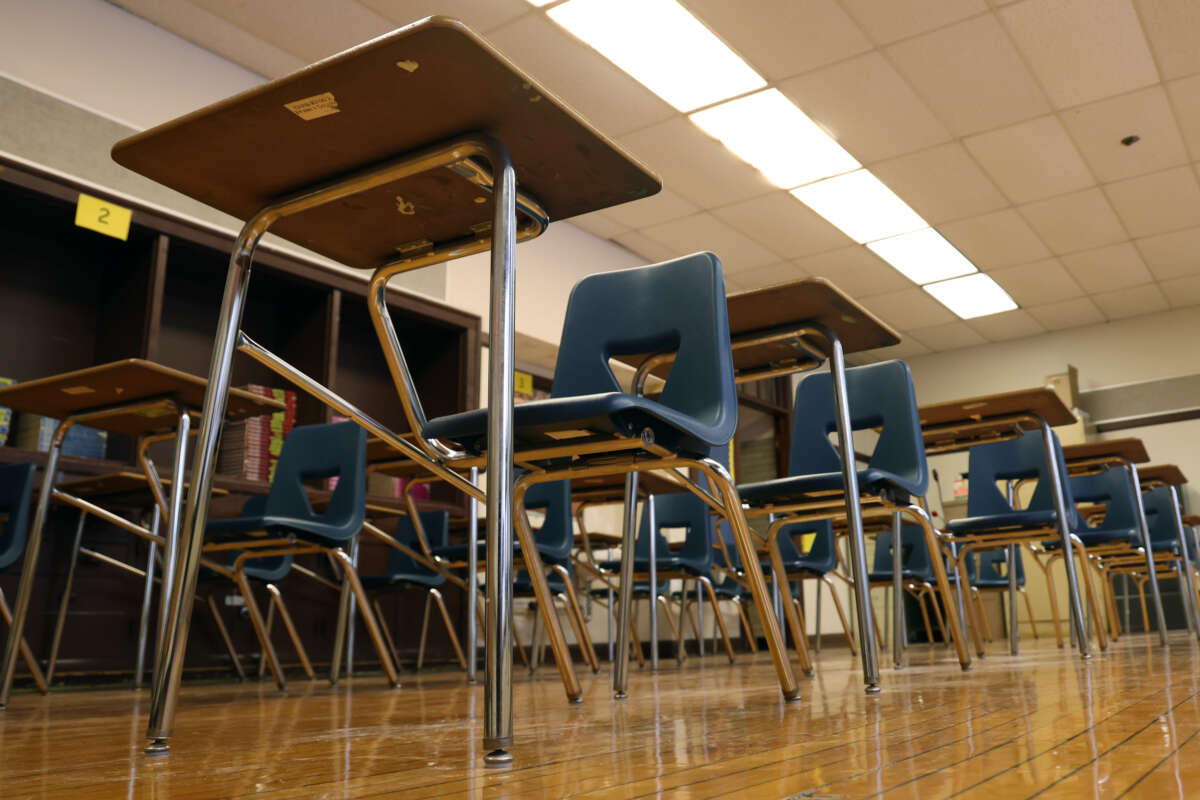
An empty Chicago Public Schools classroom is seen on December 15, 2025, in Chicago, Illinois.Antonio Perez / Chicago Tribune / Tribune News Service via Getty Images
In school districts from Pennsylvania to Illinois, Kentucky to West Virginia, state and local budget delays are putting the pinch on classrooms and costing districts tens of millions of dollars in additional borrowing fees — money going straight to Wall Street.
In effect, political failures like budget delays, faulty tax software programs, or just political impasses are forcing some of the poorest school districts to borrow money unnecessarily. It is a massive transfer of wealth out of our local classrooms directly to the richest banks and individuals in the nation.
The Problem Is Nationwide
In June, the Whitman-Hanson School District south of Boston had to issue $6 million in emergency loans to bridge a summer cash flow shortage. In May in Fayette County, Kentucky, that number was $110 million to bridge their shortfall. In Union Local School District in Belmont, Ohio, schools needed $2.6 million in emergency financing earlier this year. And in Cook County, home to Chicago’s public schools, districts across the county had to borrow tens of millions of dollars because the county had trouble collecting and distributing its property taxes.
In Cook County, the Palatine School District, for example, had to borrow $25 million to make up for the cash flow shortfall. That borrowing cost them $450,000 in interest and fees for Wall Street, and another estimated $700,000 in lost investments. That’s money that could have been spent in the classroom.
“We’ve done everything by the book,” said Mary Gorr, the superintendent for Mount Prospect School District, and we are “being forced to waste this significant amount of money on interest and emergency borrowing.” She told the Chicago Tribune, “[it] feels deeply unfair to our taxpayers and incredibly irresponsible of the county.”
A Philadelphia Story
While schools all over the United States face the problem of paying for emergency funding for their classrooms, there is no greater example of this fiscal and political crisis than what is happening in Philadelphia.
Political failures like budget delays, faulty tax software programs, or just political impasses are forcing some of the poorest school districts to borrow money unnecessarily.
The Philadelphia School District is one of the most chronically underfunded districts in the region, in one of the U.S.’s poorest major cities. The underfunding crisis in Pennsylvania is so acute that in 2023 a lawsuit from some of the poorest districts in the state provoked a Republican judge to rule Pennsylvania school funding unconstitutional, a violation of equal protection rights.
While there have been some efforts to address chronic underfunding, Philadelphia schools continue to suffer from a lack of resources. In the last month, the School District of Philadelphia faced another budget crisis that threatened to close 17 schools, losing 340 school-based jobs. After a regressive tax proposed by the city’s mayor, Cherelle Parker, failed to pass the city council, Parker found creative solutions to shore up school funding.
Taking money from the capital budget, the mayor has promised to stop the cuts. But the long-term source of these funds are still unidentified. In effect, the mayor’s budget is robbing Peter to pay Paul, taking from the schools’ already crumbling physical infrastructure to prevent the cuts. And uncertainty remains about what these budget moves will mean for the district long term.
Teachers or Bankers?
In the background to this crisis, just eight months ago, in the fall of 2025, the district was forced to pay tens of millions of dollars in interest and fees to Wall Street. These costs were incurred through no fault of the district but instead came from a Republican-created state budget impasse that suspended state payments to schools across the commonwealth for four months.
In the fall of 2025, Pennsylvania Republican legislators held hostage the state budget in the capital, Harrisburg. They were demanding cuts to social programs like public transit, limits on taxes, and to stop caps on greenhouse gas emissions. In the longest impasse in the state’s history, come September, the state still had no funding plan. Due in June, in 2025 Pennsylvania legislators couldn’t pass a budget until November.
That impasse left the Philly school district — and districts across the state — in a major bind. With the school year approaching, districts had expenses to meet: Teachers, staff, and paraprofessionals needed paychecks, instructional materials were due in classrooms, service contracts had deadlines.
Without money coming from the state, the School District of Philadelphia had to finance its operations through private lenders.
Without money coming from the state, the School District of Philadelphia had to finance its operations through private lenders. The school board approved up to $1.5 billion in “anticipation note” bonds — issuance to help the district meet its ongoing expenses on the promise of a future revenue stream.
The district didn’t use all of that allowance. In September, it sold more than $585 million in bonds and in November, on the eve of the resolution of the budget crisis, it sold another $146.6 million. With “yield rates” — the interest paid on the bonds — just over 3.4 percent, Philadelphia schools paid an estimated $25 million for the privilege of having the state cut off their payments. This was on top of the $200,000 paid to Wall Street for servicing the note sale in the first place.
In the view of School District of Philadelphia Chief Financial Officer Michael Herbstman, the estimated $25 million could fund close to 200 teacher positions.
In short, a fiscal crisis created by political failures at the state level cost Philadelphia schoolchildren tens of millions of dollars — money syphoned directly out of the poorest classrooms straight into the pockets of Wall Street financiers.
“It’s Unconscionable”
Philadelphia schools were not alone.
“This is not just a problem for the poorest school districts,” said Aaron Chapin, a middle school teacher and president of the state’s teacher’s union, the Pennsylvania State Education Association. By October it was “beginning to hurt students everywhere, in school districts large and small — rural, urban, and suburban.”
The Pennsylvania State Education Association estimated that 27 school districts across Pennsylvania had already taken or were “exploring” emergency financing measures. In Uniontown it was $5 million in anticipation note issues. The Central Fulton School District took out $7.1 million. Greater Johnstown and William Penn each sold $10 million in anticipation bonds. And a $35 million bond in Lancaster cost the district $200,000 in interest and service fees — funds that were never coming back.
“[It’s] unconscionable,” Northampton County Executive Lamont McClure told Spotlight PA. The state’s failure was “forcing the County to consider loans that will accrue interest we can never recoup.” On top of the estimated $25 million that Philadelphia forked over, Wall Street profits were easily in the tens of millions more when considering the impacts statewide.
Budget Politics
Nothing better signifies the profound dysfunction afflicting U.S. society than this episode, all too common in municipalities and states across the country.
A fiscal crisis created by political failures at the state level cost Philadelphia schoolchildren tens of millions of dollars — money syphoned directly out of the poorest classrooms straight into the pockets of Wall Street financiers.
In state houses from Augusta, Maine, to Salem, Oregon, legislators — Democrats and Republicans — routinely fail to reach budget agreements in time to avoid crisis. Currently, the state of North Carolina is nearly an entire year late on approving its budget. This is also true at the federal level, where national budget impasses have increased in both frequency and duration since 2000. In Pennsylvania, 13 of the last 20 budget cycles have resulted in significant delays, culminating in the longest: a four-and-a-half month shutdown in 2025. The 2026 federal shutdown of 43 days was also the longest, breaking the 34-day record from 2019.
The causes of this political crisis are complex. Primary blame must reside with a new breed of Republican politician, unbothered by the norms of liberal governance, constitutional obligation, or basic decorum. Enabled by a quiescent Democratic Party, they have discovered how to manipulate flaws in the federated constitutional system to create absolute political inertia, and in the case of government shutdowns, social collapse.
Solutions
There are immediate solutions to this problem. Currently, Pennsylvania has $7.7 billion in reserve, so-called “rainy day” funds that it could use to address the crisis. Democratic Gov. Josh Shapiro is already suggesting spending $4.7 billion of the funds to address a new, multibillion-dollar funding crisis that besets the state’s budget cycle yet again in 2026. Republicans are promising to block it. These “rainy day” funds could easily reimburse city and school debt service on emergency financing.
Another potential solution is to find new sources of revenue, and a spate of wealth taxes across the country are designed to do exactly that. Massachusetts is the most famous case here. In 2022 it passed the “Fair Share Amendment,” a millionaire tax that provides free community college tuition, free school meals, free regional buses, and other benefits.
And the trend is growing. In March, Washington State passed a “millionaires tax” that taxes the state’s richest residents to create $3.5 billion in additional revenue, much of which will go to the state’s schools. Another version is the California “billionaires tax” referendum going before voters in November. The California bill is a one-time 5 percent assessment on roughly 200 billionaire families in the state.
In Pennsylvania, outside of a small handful of lawmakers and progressive think tanks, no one is discussing a wealth tax. So Philadelphia students and districts across the state are forced to pay the costs created by the state from their political failure in 2025.
A Structural Problem
This political crisis, mostly fabricated by our two faltering parties, highlights a bigger fiscal problem that besets our system of governance — private finance. When politics fail and the richest don’t pay adequate taxes, it reveals how reliant our schools and cities are on debt from Wall Street.
The problem, however, is bigger than this new terrain of political failure-producing fiscal crisis.
Private finance of public policy gives Wall Street a veto over what happens in our society. As we’ve seen recently with Zohran Mamdani’s administration in New York City, rating agencies can downgrade municipal credit, markets can price social projects at exorbitant rates, and buyers can refuse to purchase the notes for projects they disagree with.
These big structural problems require big, structural solutions. In the short term, the state owes Philadelphia, not the other way around. The premium that Philadelphia school children paid for the problem created by state Republicans should be picked up by the state. In the longer term, finding public financing for public policy projects is necessary. Until then, we remain subject to Wall Street priorities.
In school districts from Pennsylvania to Illinois, Kentucky to West Virginia, state and local budget delays are putting the pinch on classrooms and costing districts tens of millions of dollars in additional borrowing fees — money going straight to Wall Street.
In effect, political failures like budget delays, faulty tax software programs, or just political impasses are forcing some of the poorest school districts to borrow money unnecessarily. It is a massive transfer of wealth out of our local classrooms directly to the richest banks and individuals in the nation.
The Problem Is Nationwide
In June, the Whitman-Hanson School District south of Boston had to issue $6 million in emergency loans to bridge a summer cash flow shortage. In May in Fayette County, Kentucky, that number was $110 million to bridge their shortfall. In Union Local School District in Belmont, Ohio, schools needed $2.6 million in emergency financing earlier this year. And in Cook County, home to Chicago’s public schools, districts across the county had to borrow tens of millions of dollars because the county had trouble collecting and distributing its property taxes.
In Cook County, the Palatine School District, for example, had to borrow $25 million to make up for the cash flow shortfall. That borrowing cost them $450,000 in interest and fees for Wall Street, and another estimated $700,000 in lost investments. That’s money that could have been spent in the classroom.
“We’ve done everything by the book,” said Mary Gorr, the superintendent for Mount Prospect School District, and we are “being forced to waste this significant amount of money on interest and emergency borrowing.” She told the Chicago Tribune, “[it] feels deeply unfair to our taxpayers and incredibly irresponsible of the county.”
A Philadelphia Story
While schools all over the United States face the problem of paying for emergency funding for their classrooms, there is no greater example of this fiscal and political crisis than what is happening in Philadelphia.
Political failures like budget delays, faulty tax software programs, or just political impasses are forcing some of the poorest school districts to borrow money unnecessarily.
The Philadelphia School District is one of the most chronically underfunded districts in the region, in one of the U.S.’s poorest major cities. The underfunding crisis in Pennsylvania is so acute that in 2023 a lawsuit from some of the poorest districts in the state provoked a Republican judge to rule Pennsylvania school funding unconstitutional, a violation of equal protection rights.
While there have been some efforts to address chronic underfunding, Philadelphia schools continue to suffer from a lack of resources. In the last month, the School District of Philadelphia faced another budget crisis that threatened to close 17 schools, losing 340 school-based jobs. After a regressive tax proposed by the city’s mayor, Cherelle Parker, failed to pass the city council, Parker found creative solutions to shore up school funding.
Taking money from the capital budget, the mayor has promised to stop the cuts. But the long-term source of these funds are still unidentified. In effect, the mayor’s budget is robbing Peter to pay Paul, taking from the schools’ already crumbling physical infrastructure to prevent the cuts. And uncertainty remains about what these budget moves will mean for the district long term.
Teachers or Bankers?
In the background to this crisis, just eight months ago, in the fall of 2025, the district was forced to pay tens of millions of dollars in interest and fees to Wall Street. These costs were incurred through no fault of the district but instead came from a Republican-created state budget impasse that suspended state payments to schools across the commonwealth for four months.
In the fall of 2025, Pennsylvania Republican legislators held hostage the state budget in the capital, Harrisburg. They were demanding cuts to social programs like public transit, limits on taxes, and to stop caps on greenhouse gas emissions. In the longest impasse in the state’s history, come September, the state still had no funding plan. Due in June, in 2025 Pennsylvania legislators couldn’t pass a budget until November.
That impasse left the Philly school district — and districts across the state — in a major bind. With the school year approaching, districts had expenses to meet: Teachers, staff, and paraprofessionals needed paychecks, instructional materials were due in classrooms, service contracts had deadlines.
Without money coming from the state, the School District of Philadelphia had to finance its operations through private lenders.
Without money coming from the state, the School District of Philadelphia had to finance its operations through private lenders. The school board approved up to $1.5 billion in “anticipation note” bonds — issuance to help the district meet its ongoing expenses on the promise of a future revenue stream.
The district didn’t use all of that allowance. In September, it sold more than $585 million in bonds and in November, on the eve of the resolution of the budget crisis, it sold another $146.6 million. With “yield rates” — the interest paid on the bonds — just over 3.4 percent, Philadelphia schools paid an estimated $25 million for the privilege of having the state cut off their payments. This was on top of the $200,000 paid to Wall Street for servicing the note sale in the first place.
In the view of School District of Philadelphia Chief Financial Officer Michael Herbstman, the estimated $25 million could fund close to 200 teacher positions.
In short, a fiscal crisis created by political failures at the state level cost Philadelphia schoolchildren tens of millions of dollars — money syphoned directly out of the poorest classrooms straight into the pockets of Wall Street financiers.
“It’s Unconscionable”
Philadelphia schools were not alone.
“This is not just a problem for the poorest school districts,” said Aaron Chapin, a middle school teacher and president of the state’s teacher’s union, the Pennsylvania State Education Association. By October it was “beginning to hurt students everywhere, in school districts large and small — rural, urban, and suburban.”
The Pennsylvania State Education Association estimated that 27 school districts across Pennsylvania had already taken or were “exploring” emergency financing measures. In Uniontown it was $5 million in anticipation note issues. The Central Fulton School District took out $7.1 million. Greater Johnstown and William Penn each sold $10 million in anticipation bonds. And a $35 million bond in Lancaster cost the district $200,000 in interest and service fees — funds that were never coming back.
“[It’s] unconscionable,” Northampton County Executive Lamont McClure told Spotlight PA. The state’s failure was “forcing the County to consider loans that will accrue interest we can never recoup.” On top of the estimated $25 million that Philadelphia forked over, Wall Street profits were easily in the tens of millions more when considering the impacts statewide.
Budget Politics
Nothing better signifies the profound dysfunction afflicting U.S. society than this episode, all too common in municipalities and states across the country.
A fiscal crisis created by political failures at the state level cost Philadelphia schoolchildren tens of millions of dollars — money syphoned directly out of the poorest classrooms straight into the pockets of Wall Street financiers.
In state houses from Augusta, Maine, to Salem, Oregon, legislators — Democrats and Republicans — routinely fail to reach budget agreements in time to avoid crisis. Currently, the state of North Carolina is nearly an entire year late on approving its budget. This is also true at the federal level, where national budget impasses have increased in both frequency and duration since 2000. In Pennsylvania, 13 of the last 20 budget cycles have resulted in significant delays, culminating in the longest: a four-and-a-half month shutdown in 2025. The 2026 federal shutdown of 43 days was also the longest, breaking the 34-day record from 2019.
The causes of this political crisis are complex. Primary blame must reside with a new breed of Republican politician, unbothered by the norms of liberal governance, constitutional obligation, or basic decorum. Enabled by a quiescent Democratic Party, they have discovered how to manipulate flaws in the federated constitutional system to create absolute political inertia, and in the case of government shutdowns, social collapse.
Solutions
There are immediate solutions to this problem. Currently, Pennsylvania has $7.7 billion in reserve, so-called “rainy day” funds that it could use to address the crisis. Democratic Gov. Josh Shapiro is already suggesting spending $4.7 billion of the funds to address a new, multibillion-dollar funding crisis that besets the state’s budget cycle yet again in 2026. Republicans are promising to block it. These “rainy day” funds could easily reimburse city and school debt service on emergency financing.
Another potential solution is to find new sources of revenue, and a spate of wealth taxes across the country are designed to do exactly that. Massachusetts is the most famous case here. In 2022 it passed the “Fair Share Amendment,” a millionaire tax that provides free community college tuition, free school meals, free regional buses, and other benefits.
And the trend is growing. In March, Washington State passed a “millionaires tax” that taxes the state’s richest residents to create $3.5 billion in additional revenue, much of which will go to the state’s schools. Another version is the California “billionaires tax” referendum going before voters in November. The California bill is a one-time 5 percent assessment on roughly 200 billionaire families in the state.
In Pennsylvania, outside of a small handful of lawmakers and progressive think tanks, no one is discussing a wealth tax. So Philadelphia students and districts across the state are forced to pay the costs created by the state from their political failure in 2025.
A Structural Problem
This political crisis, mostly fabricated by our two faltering parties, highlights a bigger fiscal problem that besets our system of governance — private finance. When politics fail and the richest don’t pay adequate taxes, it reveals how reliant our schools and cities are on debt from Wall Street.
The problem, however, is bigger than this new terrain of political failure-producing fiscal crisis.
Private finance of public policy gives Wall Street a veto over what happens in our society. As we’ve seen recently with Zohran Mamdani’s administration in New York City, rating agencies can downgrade municipal credit, markets can price social projects at exorbitant rates, and buyers can refuse to purchase the notes for projects they disagree with.
These big structural problems require big, structural solutions. In the short term, the state owes Philadelphia, not the other way around. The premium that Philadelphia school children paid for the problem created by state Republicans should be picked up by the state. In the longer term, finding public financing for public policy projects is necessary. Until then, we remain subject to Wall Street priorities.
Special thanks to David I. Backer for his help with this article.
This article is licensed under Creative Commons (CC BY-NC-ND 4.0), and you are free to share and republish under the terms of the license.

Michael Beyea Reagan
Michael Beyea Reagan is an assistant teaching professor at Rutgers University. He is the author of Intersectional Class Struggle: Theory and Practice, and a forthcoming cultural history of public finance. Find him on X/Twitter.

Jason Wozniak
Jason Wozniak is an associate professor at West Chester University and a member of the Debt Collective.

No comments:
Post a Comment