Showing posts sorted by relevance for query ANCIENT UKRAINE. Sort by date Show all posts

Tuesday, December 02, 2008

Ancient Ukraine

The Trypillian culture of neolithic people in the Ukraine gives further evidence for Maria Gimbutas theory of a matriarchical culture in the region of the Ukraine, Lithuania, and the Southern Blatics. It is important to note that the Trypillian design work on pottery is similar to that of the Celtic Bell Beaker peoples of Central Europe. Which became part of the later Celtic design of the trifoil. These were the early proto-communist societies that Marx and Engels refered to.
Mysteries of Ancient Ukraine: the Remarkable Trypilian Culture 5400-2700 BC Opens at ROM
Royal Ontario Museum (ROM) presents Mysteries of Ancient Ukraine: the Remarkable Trypilian Culture (5400 – 2700 BC), the world’s first large scale exhibition uncovering the secrets of this ancient society which existed in present day Ukraine 7,000 – 5,000 years ago. The mystery of this compelling and sophisticated culture, known for creating the largest settlements anywhere in the world at the time, only to inexplicably disappear, is illuminated through some 300 artifacts, many never before seen in North America. The exhibition is on display in the Museum’s 3rd floor Centre Block from Saturday, November 29, 2008 to Sunday, March 22, 2009.
Background: In 1896, during the great age of archaeological discoveries that unearthed Troy, Mycenae, Knossos and the many civilizations of Mesopotamia, archaeologist Vikenty Khvoika, a pioneer of Ukrainian archaeology, unearthed the remains of a prehistoric people near the village of Trypillia, and which means “three fields” in Ukrainian. This society is thought to have flourished in the forest-steppe region of present-day Ukraine, an area approximately 50,000 square kilometres from the upper Dniester River on the west to the mid-Dnipro River on the east. In addition to intriguing religious and cosmological beliefs, the Trypilians achieved a great degree of sophistication – not only were they expert farmers, herders and craftsmen, they excelled in pottery making, evident in the technical and artistic excellence of each piece on display. Equally compelling, the Trypilian culture may best be known for building two-storey houses and its giant settlements, burned to the ground every 60 to 80 years by the Trypilians themselves, prior to moving to a new location. Approximately 2,000 Trypilian sites have been found.
“In the century since their discovery, archaeologists have learned that the Trypilians were even more extraordinary than Khvoika imagined," explains exhibition curator, Dr. Krzysztof Ciuk of the ROM’s World Cultures Department. "It is uncertain why this culture disappeared. Trypilians may have been replaced by Indo-European peoples who expanded both east and west at this period or, perhaps, as the climate became drier and the forest-steppe gave way to steppe, the culture’s ecological equilibrium was stressed and a way of life was adopted to mirror their more technologically advanced neighbours.”
A sampling of artifacts, including one of Khvoika’s earthenware jars, dating to 3500 BC, its surface rich with incised curvilinear ornamentation, is on display. To place the Trypilian culture in context, The Neolithic Revolution examines the development of human societies in Europe from the end of the last Ice Age to the arrival of Copper Age cultures, including Trypilian. Other Neolithic cultures, such as the Halaf, from what is now known as northern Syria and south-eastern Turkey, and the Vinca from what is now known as modern Serbia, are juxtaposed, their artistic legacies having much in common. Here, visitors can study the earthenware portrait of a pensive male face, created by the Vinca approximately 7,500 years ago, and which bears striking similarity to the ‘realistic’ portraits of Trypillia.
Spirituality and Artistic Expression highlights various puzzling pieces of ceramic art made by the Trypilians - specifically anthropomorphic figurines (ranging from stylized to quasi-realistic) and containers decorated in various ways (incised, monochromatic, polychromatic). Found in many Neolithic cultures, the female figurines on display, with exaggerated feminine features, are believed by some scholars to represent a ‘great mother goddess’. Other ceramic objects, such as footed platforms, and enigmatic, hollow “binocular” pieces, attest to the spiritual and ritual life of the Trypilians.

When Prehistory Becomes History

As we were first learning about the ancient Trypillians during the early 20th century, the first evidence was also emerging that the Trypillians who lived on Ukrainian soil were related to the Sumerians of Mesopotamia.Anatoly Kyfishyn made the first solid connection between the two cultures when he deciphered pictograms on the so-called Stone Tomb in the south of Ukraine. These pictograms, chiseled into the walls of this unique artifact dating from 12,000 to 3,000 BC were samples of the early Sumerian writing. Ceramics created by the ancient Trypillians also bore Sumerian script, leaving no doubt that Sumerian writing originated with the Trypillyan civilization. The pictograms on the Stone Tomb clarify the origin of inscriptions made during the 12th to third millennium BC. So Sumerian writing, the first writing in the history of mankind, is a product of the development of a human civilization that for many thousands of years thrived in Europe and the Middle East.As soon as similarities between the two forms of writing became known, previous contradictions were explained.First, it became clear who brought a developed culture to the land between the Tigris and Euphrates. Second, scholars managed to discover traces of mass migration from Trypillia (also known as Koukoutenya) to the Middle East. The migration to Mesopotamia was probably due to climatic changes and demographic factors such as overpopulation, as the ancient technology of land cultivation and cattle-breeding required favorable climatic conditions and huge expanses of land. Finally, it was determined that the large Sumerian cities, including Ur, Uruk and Djamjet-Nasra were reflection of the huge Trypillian agrocities. Pre-Sumerians brought city-states and social structures characteristic of Trypillians to Mesopotamia. This structure, void of social, ethnic and tribal antagonisms, explains the extraordinary stability of both Sumerian and Trypillyan societies over long periods of time.Today, scholars are trying to explain the disappearance of the Trypillian civilization after 3,000 years.It is intriguing to think that the Trypillians may have been our ancestors. One hypothesis holds that the civilization dispersed after climate changes saw the mild, wet climate give way to drier weather at the beginning of the third millennium BC. The theory is that Trypillians scattered in different directions: to Ukraine's Polissya, the Carpathian region, the Middle East, Greece, Italy and even the British Isles. Ukrainian and foreign sources alike cite this theory.Ukrainians can feel a connection with the self-sufficient nation (or nations) that have lived on this land over time. It's easy to see similarities between traditional Ukrainian patterns and shapes on ancient Trypillian artifacts. Though perhaps a simple coincidence, it is no less enjoyable for modern residents of Ukraine, and contributes to their interest in genealogy.There is public interest in continued research of the Trypillian civilization and in establishing museums and cultural heritage parks. They want Ukrainian officials and the EU to draw attention to the necessity of this pre-historic research, making the Trypillian civilization a better known aspect of mankind's history.Historians remind us that history didn't begin with the Trypillians. A pre-Trypillian period could be as exciting. Hopefully, our future will broaden our knowledge about our mysterious and remote past.

Mysterious Neolithic People Made Optical Art

Discovery News ^ September 22, 2008 Rossella Lorenzi

Running until the end of October at the Palazzo della Cancelleria in the Vatican, the exhibition, "Cucuteni-Trypillia: A Great Civilization of Old Europe," introduces a mysterious Neolithic people who are now believed to have forged Europe's first civilization...Archaeologists have named them "Cucuteni-Trypillians" after the villages of Cucuteni, near Lasi, Romania and Trypillia, near Kiev, Ukraine, where the first discoveries of this ancient civilization were made more than 100 years ago.The excavated treasures -- fired clay statuettes and op art-like pottery dating from 5000 to 3000 B.C. -- immediately posed a riddle to archaeologists... "Despite recent extensive excavations, no cemetery has ever been found," Lacramioara Stratulat, director of the Moldova National Museum Complex of Iasi, told reporters at a news conference recently at the Vatican.Before their culture mysteriously faded, the Cucuteni-Trypillians had organized into large settlements. Predating the Sumerians and Egyptian settlements, these were basically proto-cities with buildings often arranged in concentric circles... in what is now Romania, Ukraine and Moldova.

The Trypilska Kultura - The Spiritual Birthplace of Ukraine?

My Trypillian Pysanky

History of jewellery in Ukraine

Trypillian Civilization 5400 - 2750 BC Study-Tour Overview


SEE:
Pyramid in Ukraine

The Monument Builders

Another Dirty Little Secret

Find blog posts, photos, events and more off-site about:
, , , , , , , , , ,


Wednesday, July 21, 2021

GREAT RUSSIAN IMPERIALIST REVISIONISM
On the Historical Unity of Russians and Ukrainians` (by Vladimir Putin)
UKRAINE IS THE RUS

Published: 21/07/2021


The President of the Russian Federation posted on the website of the Russian Presidential Administration an editorial about the relationship between Russians and Ukrainians. The editorial has sparked heated controversy, and many say it is just a warning that Russia believes Ukrainians are still Russians and will not allow Westerners to advance Ukraine's integration into NATO.


Below, in full, the editorial of the President of Russia:


”During the recent Direct Line, when I was asked about Russian-Ukrainian relations, I said that Russians and Ukrainians were one people – a single whole. These words were not driven by some short-term considerations or prompted by the current political context. It is what I have said on numerous occasions and what I firmly believe. I therefore feel it necessary to explain my position in detail and share my assessments of today's situation.

First of all, I would like to emphasize that the wall that has emerged in recent years between Russia and Ukraine, between the parts of what is essentially the same historical and spiritual space, to my mind is our great common misfortune and tragedy. These are, first and foremost, the consequences of our own mistakes made at different periods of time. But these are also the result of deliberate efforts by those forces that have always sought to undermine our unity. The formula they apply has been known from time immemorial – divide and rule. There is nothing new here. Hence the attempts to play on the ”national question“ and sow discord among people, the overarching goal being to divide and then to pit the parts of a single people against one another.

To have a better understanding of the present and look into the future, we need to turn to history. Certainly, it is impossible to cover in this article all the developments that have taken place over more than a thousand years. But I will focus on the key, pivotal moments that are important for us to remember, both in Russia and Ukraine.

Russians, Ukrainians, and Belarusians are all descendants of Ancient Rus, which was the largest state in Europe. Slavic and other tribes across the vast territory – from Ladoga, Novgorod, and Pskov to Kiev and Chernigov – were bound together by one language (which we now refer to as Old Russian), economic ties, the rule of the princes of the Rurik dynasty, and – after the baptism of Rus – the Orthodox faith. The spiritual choice made by St. Vladimir, who was both Prince of Novgorod and Grand Prince of Kiev, still largely determines our affinity today.

The throne of Kiev held a dominant position in Ancient Rus. This had been the custom since the late 9th century. The Tale of Bygone Years captured for posterity the words of Oleg the Prophet about Kiev, ”Let it be the mother of all Russian cities.“

Later, like other European states of that time, Ancient Rus faced a decline of central rule and fragmentation. At the same time, both the nobility and the common people perceived Rus as a common territory, as their homeland.

The fragmentation intensified after Batu Khan's devastating invasion, which ravaged many cities, including Kiev. The northeastern part of Rus fell under the control of the Golden Horde but retained limited sovereignty. The southern and western Russian lands largely became part of the Grand Duchy of Lithuania, which – most significantly – was referred to in historical records as the Grand Duchy of Lithuania and Russia.

Members of the princely and ”boyar“ clans would change service from one prince to another, feuding with each other but also making friendships and alliances. Voivode Bobrok of Volyn and the sons of Grand Duke of Lithuania Algirdas – Andrey of Polotsk and Dmitry of Bryansk – fought next to Grand Duke Dmitry Ivanovich of Moscow on the Kulikovo field. At the same time, Grand Duke of Lithuania Jogaila – son of the Princess of Tver – led his troops to join with Mamai. These are all pages of our shared history, reflecting its complex and multi-dimensional nature.

Most importantly, people both in the western and eastern Russian lands spoke the same language. Their faith was Orthodox. Up to the middle of the 15th century, the unified church government remained in place.

At a new stage of historical development, both Lithuanian Rus and Moscow Rus could have become the points of attraction and consolidation of the territories of Ancient Rus. It so happened that Moscow became the center of reunification, continuing the tradition of ancient Russian statehood. Moscow princes – the descendants of Prince Alexander Nevsky – cast off the foreign yoke and began gathering the Russian lands.

In the Grand Duchy of Lithuania, other processes were unfolding. In the 14th century, Lithuania's ruling elite converted to Catholicism. In the 16th century, it signed the Union of Lublin with the Kingdom of Poland to form the Polish–Lithuanian Commonwealth. The Polish Catholic nobility received considerable land holdings and privileges in the territory of Rus. In accordance with the 1596 Union of Brest, part of the western Russian Orthodox clergy submitted to the authority of the Pope. The process of Polonization and Latinization began, ousting Orthodoxy.

As a consequence, in the 16–17th centuries, the liberation movement of the Orthodox population was gaining strength in the Dnieper region. The events during the times of Hetman Bohdan Khmelnytsky became a turning point. His supporters struggled for autonomy from the Polish–Lithuanian Commonwealth.

In its 1649 appeal to the king of the Polish–Lithuanian Commonwealth, the Zaporizhian Host demanded that the rights of the Russian Orthodox population be respected, that the voivode of Kiev be Russian and of Greek faith, and that the persecution of the churches of God be stopped. But the Cossacks were not heard.

Bohdan Khmelnytsky then made appeals to Moscow, which were considered by the Zemsky Sobor. On 1 October 1653, members of the supreme representative body of the Russian state decided to support their brothers in faith and take them under patronage. In January 1654, the Pereyaslav Council confirmed that decision. Subsequently, the ambassadors of Bohdan Khmelnytsky and Moscow visited dozens of cities, including Kiev, whose populations swore allegiance to the Russian tsar. Incidentally, nothing of the kind happened at the conclusion of the Union of Lublin.

In a letter to Moscow in 1654, Bohdan Khmelnytsky thanked Tsar Aleksey Mikhaylovich for taking ”the whole Zaporizhian Host and the whole Russian Orthodox world under the strong and high hand of the Tsar“. It means that, in their appeals to both the Polish king and the Russian tsar, the Cossacks referred to and defined themselves as Russian Orthodox people.

Over the course of the protracted war between the Russian state and the Polish–Lithuanian Commonwealth, some of the hetmans, successors of Bohdan Khmelnytsky, would ”detach themselves“ from Moscow or seek support from Sweden, Poland, or Turkey. But, again, for the people, that was a war of liberation. It ended with the Truce of Andrusovo in 1667. The final outcome was sealed by the Treaty of Perpetual Peace in 1686. The Russian state incorporated the city of Kiev and the lands on the left bank of the Dnieper River, including Poltava region, Chernigov region, and Zaporozhye. Their inhabitants were reunited with the main part of the Russian Orthodox people. These territories were referred to as ”Malorossia“ (Little Russia).

The name ”Ukraine“ was used more often in the meaning of the Old Russian word ”okraina“ (periphery), which is found in written sources from the 12th century, referring to various border territories. And the word ”Ukrainian“, judging by archival documents, originally referred to frontier guards who protected the external borders.

On the right bank, which remained under the Polish–Lithuanian Commonwealth, the old orders were restored, and social and religious oppression intensified. On the contrary, the lands on the left bank, taken under the protection of the unified state, saw rapid development. People from the other bank of the Dnieper moved here en masse. They sought support from people who spoke the same language and had the same faith.

During the Great Northern War with Sweden, the people in Malorossia were not faced with a choice of whom to side with. Only a small portion of the Cossacks supported Mazepa's rebellion. People of all orders and degrees considered themselves Russian and Orthodox.

Cossack senior officers belonging to the nobility would reach the heights of political, diplomatic, and military careers in Russia. Graduates of Kiev-Mohyla Academy played a leading role in church life. This was also the case during the Hetmanate – an essentially autonomous state formation with a special internal structure – and later in the Russian Empire. Malorussians in many ways helped build a big common country – its statehood, culture, and science. They participated in the exploration and development of the Urals, Siberia, the Caucasus, and the Far East. Incidentally, during the Soviet period, natives of Ukraine held major, including the highest, posts in the leadership of the unified state. Suffice it to say that Nikita Khrushchev and Leonid Brezhnev, whose party biography was most closely associated with Ukraine, led the Communist Party of the Soviet Union (CPSU) for almost 30 years.

In the second half of the 18th century, following the wars with the Ottoman Empire, Russia incorporated Crimea and the lands of the Black Sea region, which became known as Novorossiya. They were populated by people from all of the Russian provinces. After the partitions of the Polish-Lithuanian Commonwealth, the Russian Empire regained the western Old Russian lands, with the exception of Galicia and Transcarpathia, which became part of the Austrian – and later Austro-Hungarian – Empire.

The incorporation of the western Russian lands into the single state was not merely the result of political and diplomatic decisions. It was underlain by the common faith, shared cultural traditions, and – I would like to emphasize it once again – language similarity. Thus, as early as the beginning of the 17th century, one of the hierarchs of the Uniate Church, Joseph Rutsky, communicated to Rome that people in Moscovia called Russians from the Polish-Lithuanian Commonwealth their brothers, that their written language was absolutely identical, and differences in the vernacular were insignificant. He drew an analogy with the residents of Rome and Bergamo. These are, as we know, the center and the north of modern Italy.

Many centuries of fragmentation and living within different states naturally brought about regional language peculiarities, resulting in the emergence of dialects. The vernacular enriched the literary language. Ivan Kotlyarevsky, Grigory Skovoroda, and Taras Shevchenko played a huge role here. Their works are our common literary and cultural heritage. Taras Shevchenko wrote poetry in the Ukrainian language, and prose mainly in Russian. The books of Nikolay Gogol, a Russian patriot and native of Poltavshchyna, are written in Russian, bristling with Malorussian folk sayings and motifs. How can this heritage be divided between Russia and Ukraine? And why do it?

The south-western lands of the Russian Empire, Malorussia and Novorossiya, and the Crimea developed as ethnically and religiously diverse entities. Crimean Tatars, Armenians, Greeks, Jews, Karaites, Krymchaks, Bulgarians, Poles, Serbs, Germans, and other peoples lived here. They all preserved their faith, traditions, and customs.

I am not going to idealise anything. We do know there were the Valuev Circular of 1863 an then the Ems Ukaz of 1876, which restricted the publication and importation of religious and socio-political literature in the Ukrainian language. But it is important to be mindful of the historical context. These decisions were taken against the backdrop of dramatic events in Poland and the desire of the leaders of the Polish national movement to exploit the ”Ukrainian issue“ to their own advantage. I should add that works of fiction, books of Ukrainian poetry and folk songs continued to be published. There is objective evidence that the Russian Empire was witnessing an active process of development of the Malorussian cultural identity within the greater Russian nation, which united the Velikorussians, the Malorussians and the Belorussians.

At the same time, the idea of Ukrainian people as a nation separate from the Russians started to form and gain ground among the Polish elite and a part of the Malorussian intelligentsia. Since there was no historical basis – and could not have been any, conclusions were substantiated by all sorts of concoctions, which went as far as to claim that the Ukrainians are the true Slavs and the Russians, the Muscovites, are not. Such ”hypotheses“ became increasingly used for political purposes as a tool of rivalry between European states.

Since the late 19th century, the Austro-Hungarian authorities had latched onto this narrative, using it as a counterbalance to the Polish national movement and pro-Muscovite sentiments in Galicia. During World War I, Vienna played a role in the formation of the so-called Legion of Ukrainian Sich Riflemen. Galicians suspected of sympathies with Orthodox Christianity and Russia were subjected to brutal repression and thrown into the concentration camps of Thalerhof and Terezin.

Further developments had to do with the collapse of European empires, the fierce civil war that broke out across the vast territory of the former Russian Empire, and foreign intervention.

After the February Revolution, in March 1917, the Central Rada was established in Kiev, intended to become the organ of supreme power. In November 1917, in its Third Universal, it declared the creation of the Ukrainian People's Republic (UPR) as part of Russia.

In December 1917, UPR representatives arrived in Brest-Litovsk, where Soviet Russia was negotiating with Germany and its allies. At a meeting on 10 January 1918, the head of the Ukrainian delegation read out a note proclaiming the independence of Ukraine. Subsequently, the Central Rada proclaimed Ukraine independent in its Fourth Universal.

The declared sovereignty did not last long. Just a few weeks later, Rada delegates signed a separate treaty with the German bloc countries. Germany and Austria-Hungary were at the time in a dire situation and needed Ukrainian bread and raw materials. In order to secure large-scale supplies, they obtained consent for sending their troops and technical staff to the UPR. In fact, this was used as a pretext for occupation.

For those who have today given up the full control of Ukraine to external forces, it would be instructive to remember that, back in 1918, such a decision proved fatal for the ruling regime in Kiev. With the direct involvement of the occupying forces, the Central Rada was overthrown and Hetman Pavlo Skoropadskyi was brought to power, proclaiming instead of the UPR the Ukrainian State, which was essentially under German protectorate.

In November 1918 – following the revolutionary events in Germany and Austria-Hungary – Pavlo Skoropadskyi, who had lost the support of German bayonets, took a different course, declaring that ”Ukraine is to take the lead in the formation of an All-Russian Federation“. However, the regime was soon changed again. It was now the time of the so-called Directorate.

In autumn 1918, Ukrainian nationalists proclaimed the West Ukrainian People's Republic (WUPR) and, in January 1919, announced its unification with the Ukrainian People's Republic. In July 1919, Ukrainian forces were crushed by Polish troops, and the territory of the former WUPR came under the Polish rule.

In April 1920, Symon Petliura (portrayed as one of the ”heroes“ in today's Ukraine) concluded secret conventions on behalf of the UPR Directorate, giving up – in exchange for military support – Galicia and Western Volhynia lands to Poland. In May 1920, Petliurites entered Kiev in a convoy of Polish military units. But not for long. As early as November 1920, following a truce between Poland and Soviet Russia, the remnants of Petliura's forces surrendered to those same Poles.

The example of the UPR shows that different kinds of quasi-state formations that emerged across the former Russian Empire at the time of the Civil War and turbulence were inherently unstable. Nationalists sought to create their own independent states, while leaders of the White movement advocated indivisible Russia. Many of the republics established by the Bolsheviks' supporters did not see themselves outside Russia either. Nevertheless, Bolshevik Party leaders sometimes basically drove them out of Soviet Russia for various reasons.

Thus, in early 1918, the Donetsk-Krivoy Rog Soviet Republic was proclaimed and asked Moscow to incorporate it into Soviet Russia. This was met with a refusal. During a meeting with the republic's leaders, Vladimir Lenin insisted that they act as part of Soviet Ukraine. On 15 March 1918, the Central Committee of the Russian Communist Party (Bolsheviks) directly ordered that delegates be sent to the Ukrainian Congress of Soviets, including from the Donetsk Basin, and that ”one government for all of Ukraine“ be created at the congress. The territories of the Donetsk-Krivoy Rog Soviet Republic later formed most of the regions of south-eastern Ukraine.

Under the 1921 Treaty of Riga, concluded between the Russian SFSR, the Ukrainian SSR and Poland, the western lands of the former Russian Empire were ceded to Poland. In the interwar period, the Polish government pursued an active resettlement policy, seeking to change the ethnic composition of the Eastern Borderlands – the Polish name for what is now Western Ukraine, Western Belarus and parts of Lithuania. The areas were subjected to harsh Polonisation, local culture and traditions suppressed. Later, during World War II, radical groups of Ukrainian nationalists used this as a pretext for terror not only against Polish, but also against Jewish and Russian populations.

In 1922, when the USSR was created, with the Ukrainian Soviet Socialist Republic becoming one of its founders, a rather fierce debate among the Bolshevik leaders resulted in the implementation of Lenin's plan to form a union state as a federation of equal republics. The right for the republics to freely secede from the Union was included in the text of the Declaration on the Creation of the Union of Soviet Socialist Republics and, subsequently, in the 1924 USSR Constitution. By doing so, the authors planted in the foundation of our statehood the most dangerous time bomb, which exploded the moment the safety mechanism provided by the leading role of the CPSU was gone, the party itself collapsing from within. A ”parade of sovereignties“ followed. On 8 December 1991, the so-called Belovezh Agreement on the Creation of the Commonwealth of Independent States was signed, stating that ”the USSR as a subject of international law and a geopolitical reality no longer existed.“ By the way, Ukraine never signed or ratified the CIS Charter adopted back in 1993.

In the 1920's-1930's, the Bolsheviks actively promoted the ”localization policy“, which took the form of Ukrainization in the Ukrainian SSR. Symbolically, as part of this policy and with consent of the Soviet authorities, Mikhail Grushevskiy, former chairman of Central Rada, one of the ideologists of Ukrainian nationalism, who at a certain period of time had been supported by Austria-Hungary, was returned to the USSR and was elected member of the Academy of Sciences.

The localization policy undoubtedly played a major role in the development and consolidation of the Ukrainian culture, language and identity. At the same time, under the guise of combating the so-called Russian great-power chauvinism, Ukrainization was often imposed on those who did not see themselves as Ukrainians. This Soviet national policy secured at the state level the provision on three separate Slavic peoples: Russian, Ukrainian and Belorussian, instead of the large Russian nation, a triune people comprising Velikorussians, Malorussians and Belorussians.

In 1939, the USSR regained the lands earlier seized by Poland. A major portion of these became part of the Soviet Ukraine. In 1940, the Ukrainian SSR incorporated part of Bessarabia, which had been occupied by Romania since 1918, as well as Northern Bukovina. In 1948, Zmeyiniy Island (Snake Island) in the Black Sea became part of Ukraine. In 1954, the Crimean Region of the RSFSR was given to the Ukrainian SSR, in gross violation of legal norms that were in force at the time.

I would like to dwell on the destiny of Carpathian Ruthenia, which became part of Czechoslovakia following the breakup of Austria-Hungary. Rusins made up a considerable share of local population. While this is hardly mentioned any longer, after the liberation of Transcarpathia by Soviet troops the congress of the Orthodox population of the region voted for the inclusion of Carpathian Ruthenia in the RSFSR or, as a separate Carpathian republic, in the USSR proper. Yet the choice of people was ignored. In summer 1945, the historical act of the reunification of Carpathian Ukraine ”with its ancient motherland, Ukraine“ – as The Pravda newspaper put it – was announced.

Therefore, modern Ukraine is entirely the product of the Soviet era. We know and remember well that it was shaped – for a significant part – on the lands of historical Russia. To make sure of that, it is enough to look at the boundaries of the lands reunited with the Russian state in the 17th century and the territory of the Ukrainian SSR when it left the Soviet Union.

The Bolsheviks treated the Russian people as inexhaustible material for their social experiments. They dreamt of a world revolution that would wipe out national states. That is why they were so generous in drawing borders and bestowing territorial gifts. It is no longer important what exactly the idea of the Bolshevik leaders who were chopping the country into pieces was. We can disagree about minor details, background and logics behind certain decisions. One fact is crystal clear: Russia was robbed, indeed.

When working on this article, I relied on open-source documents that contain well-known facts rather than on some secret records. The leaders of modern Ukraine and their external ”patrons“ prefer to overlook these facts. They do not miss a chance, however, both inside the country and abroad, to condemn ”the crimes of the Soviet regime,“ listing among them events with which neither the CPSU, nor the USSR, let alone modern Russia, have anything to do. At the same time, the Bolsheviks' efforts to detach from Russia its historical territories are not considered a crime. And we know why: if they brought about the weakening of Russia, our ill-wishes are happy with that.

Of course, inside the USSR, borders between republics were never seen as state borders; they were nominal within a single country, which, while featuring all the attributes of a federation, was highly centralized – this, again, was secured by the CPSU's leading role. But in 1991, all those territories, and, which is more important, people, found themselves abroad overnight, taken away, this time indeed, from their historical motherland.

What can be said to this? Things change: countries and communities are no exception. Of course, some part of a people in the process of its development, influenced by a number of reasons and historical circumstances, can become aware of itself as a separate nation at a certain moment. How should we treat that? There is only one answer: with respect!

You want to establish a state of your own: you are welcome! But what are the terms? I will recall the assessment given by one of the most prominent political figures of new Russia, first mayor of Saint Petersburg Anatoly Sobchak. As a legal expert who believed that every decision must be legitimate, in 1992, he shared the following opinion: the republics that were founders of the Union, having denounced the 1922 Union Treaty, must return to the boundaries they had had before joining the Soviet Union. All other territorial acquisitions are subject to discussion, negotiations, given that the ground has been revoked.

In other words, when you leave, take what you brought with you. This logic is hard to refute. I will just say that the Bolsheviks had embarked on reshaping boundaries even before the Soviet Union, manipulating with territories to their liking, in disregard of people's views.

The Russian Federation recognized the new geopolitical realities: and not only recognized, but, indeed, did a lot for Ukraine to establish itself as an independent country. Throughout the difficult 1990's and in the new millennium, we have provided considerable support to Ukraine. Whatever ”political arithmetic“ of its own Kiev may wish to apply, in 1991–2013, Ukraine's budget savings amounted to more than USD 82 billion, while today, it holds on to the mere USD 1.5 billion of Russian payments for gas transit to Europe. If economic ties between our countries had been retained, Ukraine would enjoy the benefit of tens of billions of dollars.

Ukraine and Russia have developed as a single economic system over decades and centuries. The profound cooperation we had 30 years ago is an example for the European Union to look up to. We are natural complementary economic partners. Such a close relationship can strengthen competitive advantages, increasing the potential of both countries.

Ukraine used to possess great potential, which included powerful infrastructure, gas transportation system, advanced shipbuilding, aviation, rocket and instrument engineering industries, as well as world-class scientific, design and engineering schools. Taking over this legacy and declaring independence, Ukrainian leaders promised that the Ukrainian economy would be one of the leading ones and the standard of living would be among the best in Europe.

Today, high-tech industrial giants that were once the pride of Ukraine and the entire Union, are sinking. Engineering output has dropped by 42 per cent over ten years. The scale of deindustrialization and overall economic degradation is visible in Ukraine's electricity production, which has seen a nearly two-time decrease in 30 years. Finally, according to IMF reports, in 2019, before the coronavirus pandemic broke out, Ukraine's GDP per capita had been below USD 4 thousand. This is less than in the Republic of Albania, the Republic of Moldova, or unrecognized Kosovo. Nowadays, Ukraine is Europe's poorest country.

Who is to blame for this? Is it the people of Ukraine's fault? Certainly not. It was the Ukrainian authorities who waisted and frittered away the achievements of many generations. We know how hardworking and talented the people of Ukraine are. They can achieve success and outstanding results with perseverance and determination. And these qualities, as well as their openness, innate optimism and hospitality have not gone. The feelings of millions of people who treat Russia not just well but with great affection, just as we feel about Ukraine, remain the same.

Until 2014, hundreds of agreements and joint projects were aimed at developing our economies, business and cultural ties, strengthening security, and solving common social and environmental problems. They brought tangible benefits to people – both in Russia and Ukraine. This is what we believed to be most important. And that is why we had a fruitful interaction with all, I emphasize, with all the leaders of Ukraine.

Even after the events in Kiev of 2014, I charged the Russian government to elaborate options for preserving and maintaining our economic ties within relevant ministries and agencies. However, there was and is still no mutual will to do the same. Nevertheless, Russia is still one of Ukraine's top three trading partners, and hundreds of thousands of Ukrainians are coming to us to work, and they find a welcome reception and support. So that what the ”aggressor state“ is.

When the USSR collapsed, many people in Russia and Ukraine sincerely believed and assumed that our close cultural, spiritual and economic ties would certainly last, as would the commonality of our people, who had always had a sense of unity at their core. However, events – at first gradually, and then more rapidly – started to move in a different direction.

In essence, Ukraine's ruling circles decided to justify their country's independence through the denial of its past, however, except for border issues. They began to mythologize and rewrite history, edit out everything that united us, and refer to the period when Ukraine was part of the Russian Empire and the Soviet Union as an occupation. The common tragedy of collectivization and famine of the early 1930s was portrayed as the genocide of the Ukrainian people.

Radicals and neo-Nazis were open and more and more insolent about their ambitions. They were indulged by both the official authorities and local oligarchs, who robbed the people of Ukraine and kept their stolen money in Western banks, ready to sell their motherland for the sake of preserving their capital. To this should be added the persistent weakness of state institutions and the position of a willing hostage to someone else's geopolitical will.

I recall that long ago, well before 2014, the U.S. and EU countries systematically and consistently pushed Ukraine to curtail and limit economic cooperation with Russia. We, as the largest trade and economic partner of Ukraine, suggested discussing the emerging problems in the Ukraine-Russia-EU format. But every time we were told that Russia had nothing to do with it and that the issue concerned only the EU and Ukraine. De facto Western countries rejected Russia's repeated calls for dialogue.

Step by step, Ukraine was dragged into a dangerous geopolitical game aimed at turning Ukraine into a barrier between Europe and Russia, a springboard against Russia. Inevitably, there came a time when the concept of ”Ukraine is not Russia“ was no longer an option. There was a need for the ”anti-Russia“ concept which we will never accept.

The owners of this project took as a basis the old groundwork of the Polish-Austrian ideologists to create an ”anti-Moscow Russia“. And there is no need to deceive anyone that this is being done in the interests of the people of Ukraine. The Polish-Lithuanian Commonwealth never needed Ukrainian culture, much less Cossack autonomy. In Austria-Hungary, historical Russian lands were mercilessly exploited and remained the poorest. The Nazis, abetted by collaborators from the OUN-UPA, did not need Ukraine, but a living space and slaves for Aryan overlords.

Nor were the interests of the Ukrainian people thought of in February 2014. The legitimate public discontent, caused by acute socio-economic problems, mistakes, and inconsistent actions of the authorities of the time, was simply cynically exploited. Western countries directly interfered in Ukraine's internal affairs and supported the coup. Radical nationalist groups served as its battering ram. Their slogans, ideology, and blatant aggressive Russophobia have to a large extent become defining elements of state policy in Ukraine.

All the things that united us and bring us together so far came under attack. First and foremost, the Russian language. Let me remind you that the new ”Maidan“ authorities first tried to repeal the law on state language policy. Then there was the law on the ”purification of power“, the law on education that virtually cut the Russian language out of the educational process.

Lastly, as early as May of this year, the current president introduced a bill on ”indigenous peoples“ to the Rada. Only those who constitute an ethnic minority and do not have their own state entity outside Ukraine are recognized as indigenous. The law has been passed. New seeds of discord have been sown. And this is happening in a country, as I have already noted, that is very complex in terms of its territorial, national and linguistic composition, and its history of formation.

There may be an argument: if you are talking about a single large nation, a triune nation, then what difference does it make who people consider themselves to be – Russians, Ukrainians, or Belarusians. I completely agree with this. Especially since the determination of nationality, particularly in mixed families, is the right of every individual, free to make his or her own choice.

But the fact is that the situation in Ukraine today is completely different because it involves a forced change of identity. And the most despicable thing is that the Russians in Ukraine are being forced not only to deny their roots, generations of their ancestors but also to believe that Russia is their enemy. It would not be an exaggeration to say that the path of forced assimilation, the formation of an ethnically pure Ukrainian state, aggressive towards Russia, is comparable in its consequences to the use of weapons of mass destruction against us. As a result of such a harsh and artificial division of Russians and Ukrainians, the Russian people in all may decrease by hundreds of thousands or even millions.

Our spiritual unity has also been attacked. As in the days of the Grand Duchy of Lithuania, a new ecclesiastical has been initiated. The secular authorities, making no secret of their political aims, have blatantly interfered in church life and brought things to a split, to the seizure of churches, the beating of priests and monks. Even extensive autonomy of the Ukrainian Orthodox Church while maintaining spiritual unity with the Moscow Patriarchate strongly displeases them. They have to destroy this prominent and centuries-old symbol of our kinship at all costs.

I think it is also natural that the representatives of Ukraine over and over again vote against the UN General Assembly resolution condemning the glorification of Nazism. Marches and torchlit processions in honor of remaining war criminals from the SS units take place under the protection of the official authorities. Mazepa, who betrayed everyone, Petliura, who paid for Polish patronage with Ukrainian lands, and Bandera, who collaborated with the Nazis, are ranked as national heroes. Everything is being done to erase from the memory of young generations the names of genuine patriots and victors, who have always been the pride of Ukraine.

For the Ukrainians who fought in the Red Army, in partisan units, the Great Patriotic War was indeed a patriotic war because they were defending their home, their great common Motherland. Over two thousand soldiers became Heroes of the Soviet Union. Among them are legendary pilot Ivan Kozhedub, fearless sniper, defender of Odessa and Sevastopol Lyudmila Pavlichenko, valiant guerrilla commander Sidor Kovpak. This indomitable generation fought, those people gave their lives for our future, for us. To forget their feat is to betray our grandfathers, mothers and fathers.

The anti-Russia project has been rejected by millions of Ukrainians. The people of Crimea and residents of Sevastopol made their historic choice. And people in the southeast peacefully tried to defend their stance. Yet, all of them, including children, were labeled as separatists and terrorists. They were threatened with ethnic cleansing and the use of military force. And the residents of Donetsk and Lugansk took up arms to defend their home, their language and their lives. Were they left any other choice after the riots that swept through the cities of Ukraine, after the horror and tragedy of 2 May 2014 in Odessa where Ukrainian neo-Nazis burned people alive making a new Khatyn out of it? The same massacre was ready to be carried out by the followers of Bandera in Crimea, Sevastopol, Donetsk and Lugansk. Even now they do not abandon such plans. They are biding their time. But their time will not come.

The coup d'état and the subsequent actions of the Kiev authorities inevitably provoked confrontation and civil war. The UN High Commissioner for Human Rights estimates that the total number of victims in the conflict in Donbas has exceeded 13,000. Among them are the elderly and children. These are terrible, irreparable losses.

Russia has done everything to stop fratricide. The Minsk agreements aimed at a peaceful settlement of the conflict in Donbas have been concluded. I am convinced that they still have no alternative. In any case, no one has withdrawn their signatures from the Minsk Package of Measures or from the relevant statements by the leaders of the Normandy format countries. No one has initiated a review of the United Nations Security Council resolution of 17 February 2015.

During official negotiations, especially after being reined in by Western partners, Ukraine's representatives regularly declare their ”full adherence“ to the Minsk agreements, but are in fact guided by a position of ”unacceptability“. They do not intend to seriously discuss either the special status of Donbas or safeguards for the people living there. They prefer to exploit the image of the ”victim of external aggression“ and peddle Russophobia. They arrange bloody provocations in Donbas. In short, they attract the attention of external patrons and masters by all means.

Apparently, and I am becoming more and more convinced of this: Kiev simply does not need Donbas. Why? Because, firstly, the inhabitants of these regions will never accept the order that they have tried and are trying to impose by force, blockade and threats. And secondly, the outcome of both Minsk‑1 and Minsk‑2 which give a real chance to peacefully restore the territorial integrity of Ukraine by coming to an agreement directly with the DPR and LPR with Russia, Germany and France as mediators, contradicts the entire logic of the anti-Russia project. And it can only be sustained by the constant cultivation of the image of an internal and external enemy. And I would add – under the protection and control of the Western powers.

This is what is actually happening. First of all, we are facing the creation of a climate of fear in Ukrainian society, aggressive rhetoric, indulging neo-Nazis and militarising the country. Along with that we are witnessing not just complete dependence but direct external control, including the supervision of the Ukrainian authorities, security services and armed forces by foreign advisers, military ”development“ of the territory of Ukraine and deployment of NATO infrastructure. It is no coincidence that the aforementioned flagrant law on ”indigenous peoples“ was adopted under the cover of large-scale NATO exercises in Ukraine.

This is also a disguise for the takeover of the rest of the Ukrainian economy and the exploitation of its natural resources. The sale of agricultural land is not far off, and it is obvious who will buy it up. From time to time, Ukraine is indeed given financial resources and loans, but under their own conditions and pursuing their own interests, with preferences and benefits for Western companies. By the way, who will pay these debts back? Apparently, it is assumed that this will have to be done not only by today's generation of Ukrainians but also by their children, grandchildren and probably great-grandchildren.

The Western authors of the anti-Russia project set up the Ukrainian political system in such a way that presidents, members of parliament and ministers would change but the attitude of separation from and enmity with Russia would remain. Reaching peace was the main election slogan of the incumbent president. He came to power with this. The promises turned out to be lies. Nothing has changed. And in some ways the situation in Ukraine and around Donbas has even degenerated.

In the anti-Russia project, there is no place either for a sovereign Ukraine or for the political forces that are trying to defend its real independence. Those who talk about reconciliation in Ukrainian society, about dialogue, about finding a way out of the current impasse are labelled as ”pro-Russian“ agents.

Again, for many people in Ukraine, the anti-Russia project is simply unacceptable. And there are millions of such people. But they are not allowed to raise their heads. They have had their legal opportunity to defend their point of view in fact taken away from them. They are intimidated, driven underground. Not only are they persecuted for their convictions, for the spoken word, for the open expression of their position, but they are also killed. Murderers, as a rule, go unpunished.

Today, the ”right“ patriot of Ukraine is only the one who hates Russia. Moreover, the entire Ukrainian statehood, as we understand it, is proposed to be further built exclusively on this idea. Hate and anger, as world history has repeatedly proved this, are a very shaky foundation for sovereignty, fraught with many serious risks and dire consequences.

All the subterfuges associated with the anti-Russia project are clear to us. And we will never allow our historical territories and people close to us living there to be used against Russia. And to those who will undertake such an attempt, I would like to say that this way they will destroy their own country.

The incumbent authorities in Ukraine like to refer to Western experience, seeing it as a model to follow. Just have a look at how Austria and Germany, the USA and Canada live next to each other. Close in ethnic composition, culture, in fact sharing one language, they remain sovereign states with their own interests, with their own foreign policy. But this does not prevent them from the closest integration or allied relations. They have very conditional, transparent borders. And when crossing them the citizens feel at home. They create families, study, work, do business. Incidentally, so do millions of those born in Ukraine who now live in Russia. We see them as our own close people.

Russia is open to dialogue with Ukraine and ready to discuss the most complex issues. But it is important for us to understand that our partner is defending its national interests but not serving someone else's, and is not a tool in someone else's hands to fight against us.

We respect the Ukrainian language and traditions. We respect Ukrainians' desire to see their country free, safe and prosperous.

I am confident that true sovereignty of Ukraine is possible only in partnership with Russia. Our spiritual, human and civilizational ties formed for centuries and have their origins in the same sources, they have been hardened by common trials, achievements and victories. Our kinship has been transmitted from generation to generation. It is in the hearts and the memory of people living in modern Russia and Ukraine, in the blood ties that unite millions of our families. Together we have always been and will be many times stronger and more successful. For we are one people.

Today, these words may be perceived by some people with hostility. They can be interpreted in many possible ways. Yet, many people will hear me. And I will say one thing – Russia has never been and will never be ”anti-Ukraine“. And what Ukraine will be – it is up to its citizens to decide.”

Saturday, January 28, 2023

UNESCO designates Ukraine's Odesa a World Heritage in Danger site


Wed, January 25, 2023 

PARIS (Reuters) -The United Nations' cultural agency, UNESCO, said on Wednesday that it had designated the historic centre of Odesa, a strategic port city on Ukraine's Black Sea coast, a World Heritage in Danger site.

Russia, which invaded Ukraine 11 months ago, denounced the designation, saying the only threat to Odesa came from the "nationalist regime in Ukraine".

The status, awarded by a UNESCO panel meeting in Paris, is designed to help protect Odesa's cultural heritage, which has been under threat since Russia's invasion, and enable access to financial and technical international aid.

Odesa has been bombed several times by Russia since its invasion of Ukraine on Feb. 24, 2022.

In July 2022, part of the large glass roof and windows of Odesa's Museum of Fine Arts, inaugurated in 1899, were destroyed.

In a statement, UNESCO Director General Audrey Azoulay said that Odesa, "free city, world city, legendary port" had made its mark on cinema, literature and the arts.

"As the war continues, this inscription reflects our collective determination to protect this city from greater destruction," Azoulay said.

Ukrainian President Volodymyr Zelenskiy said the decision "will help us protect our Odesa ... Russia is incapable of defending anything other than terror and strikes."

Earlier on Wednesday, UNESCO inscribed the Landmarks of the Ancient Kingdom of Saba, Marib in Yemen and Rachid Karami International Fair-Tripoli in Lebanon to its list of World Heritage in Danger sites.

RUSSIA: UKRAINE THE SOLE THREAT TO ODESA

Russia's Foreign Ministry said it had no quarrel with the decision to celebrate and protect Odesa's legacy.

"But this requires a clarification that the sole threat to the city's rich history stems from Ukraine's nationalist regime which systematically destroys monuments to the founders and defenders of Odesa," it said in a statement.

It cited in particular a monument to Russian Empress Catherine the Great - widely reputed to be the city's founder - that was dismantled by an order of city authorities last year.

The UNESCO debate over Odesa took hours as Russia unsuccessfully tried to have the vote postponed.

Founded in the final years of the 18th century, near the site of a captured Ottoman fortress, Odesa's location on the shores of the Black Sea allowed it to become one of the most important ports in the Russian empire.

Its status as a trading hub brought significant wealth and made it one of the most cosmopolitan cities in Eastern Europe.

The city's most famous historic sites include its Opera House, which became a symbol of resilience when it reopened in June 2022, and the giant stairway to the harbour, immortalised in Sergei Eisenstein's 1925 silent film Battleship Potemkin.

Although the city suffered significant damage in World War Two, its famed central grid square of low-rise 19th century buildings survived mostly intact.

Odesa was a key Ukrainian tourist hub before Russia's invasion. War changed all that, as the Black Sea became a battlezone. Sea mines still wash up near the city's shoreline.

(Reporting by Dominique Vidalon; Editing by Sharon Singleton and Himani Sarkar)


Ukraine's Odesa city put on UNESCO heritage in danger list


Sandbags block a street in front of the National Academic Theatre of Opera and Ballet building as a preparation for a possible Russian offensive, in Odesa, Ukraine, Thursday, March 24, 2022. The United Nations' cultural agency decided on Wednesday Jan.25, 2023 to add the historic center of Ukraine's Black Sea port city of Odesa to the list of World Heritage in danger. The decision was made at an extraordinary session of the World Heritage Committee in Paris. 
(AP Photo/Petros Giannakouris, File)

SYLVIE CORBET and ELAINE GANLEY
Wed, January 25, 2023

PARIS (AP) — The United Nations' cultural agency decided Wednesday to add the historic center of Ukraine’s Black Sea port city of Odesa to its list of endangered World Heritage sites, recognizing “the outstanding universal value of the site and the duty of all humanity to protect it.”

The decision was made at an extraordinary session of UNESCO's World Heritage Committee in Paris.

UNESCO Director-General Audrey Azoulay praised the move, saying the “legendary port that has left its mark in cinema, literature and the arts” was “thus placed under the reinforced protection of the international community."

“While the war is going on, this inscription embodies our collective determination to ensure that this city ... is preserved from further destruction," Azoulay added in a statement.

Russian forces have launched multiple artillery attacks and airstrikes on Odesa since invading Ukraine 11 months ago.

Ukrainian President Volodymyr Zelenskyy called on UNESCO in October to put Odesa on its World Heritage List, which recognizes places of “outstanding universal value.” The World Heritage Committee agreed Wednesday while also adding the city's historic center to its list of endangered sites.

Changes to the text proposed by Russia delayed the 21-member committee's vote. In the end, six delegates voted in favor, one voted no and 14 abstained.

Russian delegate Tatiana Dovgalenko lambasted the decision, asserting that local citizens had destroyed some Odesa monuments that were cited to justify the endangered designation.

“Today, we witnessed the funeral of the World Heritage Convention,” she said, adding that pressure prevailed and scientific objectivity “was shamefully violated.”

Ukrainian Culture Minister Oleksandr Tkachenko welcomed the vote's outcome, saying it would protect Odesa’s multicultural history.

“It’s a great historic day," he told reporters. "Definitively, Odesa is under danger due to Russia's full- scale invasion. ... I have very much hope that the umbrella of UNESCO can protect at least Odesa skies and Odesa itself from this barbaric attack of Russians.”

Ukraine is not a member of the UNESCO committee.

Under the 1972 UNESCO convention, ratified by both Ukraine and Russia, signatories undertake to “assist in the protection of the listed sites” and are “obliged to refrain from taking any deliberate measures” which might damage World Heritage sites.

Inclusion on the List of World Heritage in Danger is meant to “open access to emergency international assistance mechanisms, both technical and financial, to strengthen the protection of the property and help its rehabilitation,” according to UNESCO.

Before Wednesday's vote, Ukraine was home to seven World Heritage sites, including the St. Sophia Cathedral and related monastic buildings in the capital, Kyiv. To date, none were damaged by the war, although UNESCO noted damage to more than 230 cultural buildings in Ukraine.

Azoulay told reporters that Odesa’s status was examined under an “emergency procedure” amid the ongoing fighting. She said “precise satellite surveillance” was being used for the first time to monitor Ukraine's World Heritage sites.

On its website, UNESCO describes Odesa as the only city in Ukraine that has entirely preserved the urban structure of a multinational southern port town typical of the late 18th and-19th centuries.

Two other sites were Wednesday to the List of World Heritage in Danger: the Ancient Yemenite Kingdom of Saba and the Rachid Karami International Fair in Tripoli, Lebanon.

___

Follow the AP’s coverage of the war at https://apnews.com/hub/russia-ukraine

Saturday, January 03, 2026

The Russian idée fixe


The Russian Idée Fixe

First published at Counterpunch.

“Russia’s defensive war against NATO expansion” — a concept that has become almost axiomatic for many Western leftists. This concept conveniently serves both to rationalize Russia’s actions and to radicalize criticism of their own governments. But what role does Putin himself assign to the supposed NATO threat? A close reading of his key speeches reveals that Putin explicitly denies any danger of a NATO attack on Russia. Instead, all the ruler’s attention and passion are focused elsewhere — on the question of primordial ‘historical justice.’ Putin dusts off millennia-old chronicles, finding in them proof of his reactionary utopia, his imagined historical right to possess Ukraine. Let’s talk about the most underestimated cause of this war — ideological obsession. The Russian idée fixe.

1,300 kilometers. That’s how much longer Russia’s border with the NATO military bloc became in 2022 after two previously neutral countries — Sweden and Finland — joined the alliance. The Baltic Sea effectively turned into an internal sea of NATO. St. Petersburg, Russia’s northern capital, now lies just 148 kilometers from the border of a hostile bloc. What was Russia’s reaction? Did Putin issue a military ultimatum? Threaten a preemptive operation? Concentrate troops on the border? No. None of that happened.

Meanwhile, in the context of Ukraine, the NATO question keeps surfacing in Russian discourse. An even greater role is assigned to NATO in the discourse of the Western left. And this despite the fact that Ukraine was denied membership back in 2008. Germany, France, and many other states openly opposed Ukraine’s accession — when the veto of even one member is enough to block it. The very presence of Russia’s naval base in Sevastopol already made Ukraine’s accession to the alliance barely possible. After the annexation of Crimea and the outbreak of war in Donbas, Ukraine’s NATO membership became even more unthinkable — the existence of territorial disputes and ongoing conflicts automatically closes the alliance’s doors to any applicant.

It turns out that Russia’s northern neighbor joining NATO poses no threat to it — while Ukraine, which had no chance of membership, became the target of a full-scale invasion. How can this be explained? Let’s give the floor to Vladimir Putin himself.

Who is Mr. Ruric?

Let’s go back to February 2024. Moscow. After two years of boycotts by Western media, an American journalist arrives in Russia’s snow-covered capital to interview Vladimir Putin. That journalist is Tucker Carlson — a conservative blogger and supporter of Donald Trump. Skeptical of liberal media explanations for the reasons behind Russia’s invasion, he wants to hear firsthand what drove Putin to launch the largest land war in Europe since World War II. After all, the leader of the world’s biggest nuclear power couldn’t have sent tank columns toward a neighboring capital without serious reasons. Perhaps there was something that pushed Putin to make this difficult decision — something the Western audience doesn’t know? Moreover, Carlson already has his own guesses on the matter: most likely, it all comes down to the Democrats’ administration and their eastern NATO policy, which, he suspects, provoked Russia into this desperate move, leaving it no choice.

“On February 24, 2022, you addressed your country in your nationwide address when the conflict in Ukraine started and you said that you were acting because you had come to the conclusion that the United States through NATO might initiate a quote, ‘surprise attack on our country.” And to American ears that sounds paranoid. Tell us why you believe the United States might strike Russia out of the blue. How did you conclude that?” Tucker Carlson asks his first question.

The question is as precise as it is fair. After all, in the twenty-first century, no state can openly wage a war of conquest without framing it as defense against an external threat. Every aggressor — from Hitler to Netanyahu — has called their war forced, defensive, provoked from the outside, a response to danger facing the state and its citizens. And if Russia sees itself as defending, then surely it must have the strongest possible arguments for doing so. What was threatening Russia? What danger was Putin trying to prevent?

“It’s not that the United States was preparing to launch a surprise attack on Russia, I never said so. Putin deflects. “Are we having a talk show here, or a serious conversation? I will take only 30 seconds or one minute of your time to give you a brief historical background. Don’t you mind?”

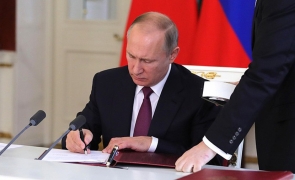
In an attempt to explain to the Western audience his true motives for attacking Ukraine, Putin delivers a 25-minute pseudo-historical lecture. From it, astonished Americans hear for the first time names like the ancient Rus’ prince Rurik, princes Oleg and Yaroslav the Wise, Mongol leaders Genghis Khan and Batu Khan, cossack hetman Bohdan Khmelnytsky, and Empress Catherine II. Putin speaks of the blood and spiritual unity of Ukrainians and Russians, calling them “one people.” He even tries to hand Carlson a stack of seventeenth-century archival letters supposedly proving that Ukrainians are inseparable from Russians.

Any efforts by Carlson to interrupt and return to the main question — what exactly threatened Russia in 2022? — fail. Putin keeps dragging the American back through the centuries, trying to explain how Russia’s enemies “artificially separated” Ukrainians from the one Russian people. All of this, Putin insists, must be understood in order to grasp the deeper causes of the invasion.

For half an hour, the Russian leader, referring to ancient chronicles and medieval charters, tries to convince the American that Ukrainian lands have belonged to Russia from time immemorial. The Ukrainian nation and its statehood, he argues, are artificial — a historical accident, an awkward mistake that it is now time to correct.

‘They want to attack Russia,’ ‘They want to destroy Russia,’ ‘The country faces a military invasion,’ ‘Our citizens could become victims of aggression,’ ‘Our internationally recognized territory is being seized’ — not a single one of these phrases was said, nor could it have been.

Putin himself admits: the Russian Federation as a state faced no threat. The danger loomed over another Russia — the mythological, thousand-year-old Russia encompassing broader “historical” lands. The Russian Federation within the borders of the former RSFSR, once outlined by the Bolsheviks, is merely a fragment of the former great Rus’ territory, including Belarus and Ukraine. The separation and ultimate departure of Ukraine from the imagined spiritual and political space of the “Russian World” — that is the threat Putin seeks to prevent. And at the end of the conversation, he states this to Carlson directly:

“The reunification [of one people] will happen. It never went anywhere,” Putin concludes confidently.

Right to Ukraine

Let’s ask ourselves: if the leader of a warring country delivers a lengthy lecture about the depths of history to explain his motives — does it matter to him? Yes, it does. Nothing matters more. “A serious conversation.”

Putin was given two hours of airtime to explain to the world that he isn’t a villain and is merely defending Russia from the NATO threat. Yet instead, he devotes the bulk of his airtime to what he sees as the most important thing — a primordialist justification of his supposed “right” to possess Ukraine.

What should we call this? An ideological obsession — an idée fixe.

Unlike the thousands of Western Marxists who insist that Russia faces a NATO threat, Putin himself claims nothing of the sort. On the contrary, he denies it outright. No one was planning — or is planning — to attack the Russian Federation. The reason for the war, Putin says, is the “unlawful,” “blasphemous,” and “historically criminal” removal of Russia’s mythical cradle — Kyiv and the surrounding southern Rus’ lands — from its sphere of influence.

Little wonder that Putin shows complete indifference toward Sweden and Finland joining NATO. The reason is simple: they do not belong to the imagined primordial space known as the “Russian World.” People there do not speak Russian; there are no ancient Rus’ churches, no sites of great battles, no sacred artifacts of nationalist mythology. The Finns can hardly be called “one people” with the Russians. But Ukraine is a different story — the possession of which is the idée fixe of Russian imperial nationalism, and of Vladimir Putin personally.

Indeed, the ruler of Russia does see the war as defensive. But in what sense? Simply put, he is not “defending” the Russian Federation within its 1991 borders, but rather the frontiers of an ancient Empire that, in his deepest conviction, were unlawfully and artificially torn away by enemies from the bosom of Russia’s thousand-year-year-old statehood.

Just as Zionist leaders firmly believe that their “right to Judea and Samaria is written in the Bible,” the Russian leadership has come to believe that its right to possess Ukraine is confirmed by the chronicles of Kyivan Rus’ and the letters of Bohdan Khmelnytsky.

For both Israel and Russia, the concept of international law is far too young and has not yet stood the test of time. The UN-based system of international law is only eighty years old; the European treaty on the inviolability of borders — barely fifty. What is this nonsense compared to millennia-old chronicles and sacred texts?

If international law humiliates Russia by denying its “legitimate claims” to the cradle of Russian civilization, then it must be bad international law! If it does not allow the return of historical lands, it serves Russia’s enemies. If it perpetuates the dismemberment of the once-unified Russian Empire, if it allows Ukrainians to leave the bosom of the “Russian World,” then following such law is not only harmful but criminal. This is roughly the logic of the Kremlin elders.

Few would doubt the deep ideological motives driving Israel’s leaders in their permanent war for territorial expansion. Why, then, do the international left refuse to see the similar ideological impulses behind Russia’s leadership?

To ignore how obsessed Putin is with the conquest of Ukraine requires an exceptional kind of blindness.

The concept of a divided people

Perhaps one interview isn’t enough to draw conclusions? Let us turn to Putin’s other key speeches and statements.

Six months before the invasion, in July 2021 — as the world was only beginning to recover from the pandemic and no one could imagine a coming full-scale war — Vladimir Putin published his infamous article “On the Historical Unity of Russians and Ukrainians.” In it, he for the first time laid out a comprehensive declaration of his commitment to the primordialist myth, preparing the ideological ground for his future invasion.

In this completely pseudo-scientific article, full of manipulations and false claims, Putin declares that Russians, Belarusians, and Ukrainians are not distinct nations but branches of one Russian people. The main idea running through the entire article is clear: Ukrainian identity was artificially constructed and nurtured by Russia’s enemies to split one people apart and pit its parts against each other.

Ukrainians are denied a separate national identity, their own statehood, and the ability to exercise sovereignty as they see fit. For the first time, Vladimir Putin systematically lays out his views on the proper world order: Ukraine must exist exclusively within the Russian “spiritual and political space.” Any attempt by Ukrainians to leave this sphere will be regarded as an infringement on the integrity of primordialist harmony.

What is this, if not a direct declaration of the ideological motives behind the war?

Some might say: “Perhaps this is just one of many statements. Surely there are others in which Putin pragmatically describes threats to Russia from Western imperialism.” No — Putin has written no other programmatic article. His piece “On the Historical Unity…” remains the sole and defining manifesto of the invasion.

Vladimir Putin repeated the same theses in his keynote speech on 21 February 2022, three days before the invasion began.

“Since ancient times, the inhabitants of the southwestern historical lands of Kyivan Rus’ called themselves Russians and Orthodox,” this is how he begins his yet another pseudo-historical excursus.

Exactly half of his speech is devoted to the ideological argument that Ukraine is an artificial state, created by the Bolsheviks. That Lenin’s criminal mistake in national policy resulted in the excision from the unified Russian Empire of an “ugly creature” — an independent Ukraine. And, apparently, it now falls to Vladimir Putin to correct this fateful mistake.

Yes, this speech also touches on the expansion of NATO’s military influence across Ukraine. But what matters is the context in which it is mentioned. The problem, from Putin’s perspective, is this: Ukraine’s coastal cities were conquered in the eighteenth century by Russian tsarist warlords at the cost of Russian soldiers’ blood, and therefore the presence of NATO bases there would be a mockery of the memory of heroic Russian colonisers.

For the sake of fairness, it should be noted that in two brief paragraphs, Vladimir Putin does mention a possible NATO threat to Russia’s internationally recognized territory. He warns that if the Americans deploy their missiles and strategic bombers in Ukraine, it would be a “knife to the throat.”

But… First, these brief passages are completely lost against the backdrop of his extensive primordialist justification for the war. If defending against a hypothetical NATO military aggression were truly the primary motive, it would clearly have been a higher priority. Second, the scenario of nuclear weapons being deployed in Ukraine and the Americans attacking the world’s largest nuclear power is utterly far-fetched — something Putin himself would acknowledge two years later in the Carlson interview cited above. Third, as already mentioned, when the “knife to the throat” came from Finland, Putin did… nothing!

What are we left with? Putin’s two main encyclicals on the invasion stand as pure distillations of ideology.

Core argument

Perhaps, after four years of war — after the enormous sacrifices made by the Ukrainian people in resisting the invasion, after Ukrainians have demonstrated through every action that they refuse to live under Russian rule — perhaps, after all this, Vladimir Putin has come down to a more pragmatic stance and abandoned his idée fixe of “reuniting the divided people”? No, he remains faithful to his reactionary utopia.

“I have said many times that I consider the Russian and Ukrainian peoples to be one people, in fact. In that sense, all of Ukraine is ours,” Putin declared in the summer of 2025.

That same summer, Donald Trump decided to lift Russia out of international isolation and invited Putin to a summit in Alaska. Offering fairly generous concessions, he hoped that the Russian leader, as a pragmatic politician, would strike a deal and make peace. But Trump was wrong. No deal took place. The FT describes the details of the closed-door meeting as follows:

Putin rejected the US offer of sanctions relief for a ceasefire, insisting the war would end only if Ukraine capitulated… The Russian president then delivered a rambling historical discursion spanning medieval princes such as Rurik of Novgorod and Yaroslav the Wise, along with the 17th century Cossack chieftain Bohdan Khmelnytsky — figures he often cites to support his claim Ukraine and Russia are one nation. Taken aback, Trump raised his voice several times and at one point threatened to walk out. He ultimately cut the meeting short and cancelled a planned lunch…

Let us just reiterate this point. At the very first talks since 2022 between the leaders of the world’s two largest nuclear powers, Vladimir Putin discusses with his counterpart not the ‘encirclement of Russia by NATO bases,’ not American nuclear weapons in Europe, not ‘Russia’s security concerns,’ not intermediate-range missiles or anti-missile defence — in short, none of the issues constantly cited by Western leftists when discussing Russia’s supposedly defensive war against NATO expansion.

No, Putin is preoccupied with entirely different matters. At a high-level meeting with the U.S. president, he invokes medieval legends as the most important argument for recognizing his “right to Ukraine.” Time and again, he launches into long lectures, hoping that Western leaders will finally understand the concept of “one people” rooted in deep antiquity and acknowledge his correctness.

If this isn’t ideological obsession, then what is?

Praxis

One could, of course, assume that this primordialist idée fixe of “reuniting a divided people” goes no further than Vladimir Putin’s quasi-historical lectures at public events — that in practice, Russia is merely acting pragmatically to eliminate external threats. But that is not the case. The ideological tenets of Russia’s reactionary utopia are being fully realized in the course of this war.

Within the past four years, Russia has been swept by a massive ideological campaign aimed at denying Ukraine’s very existence. Pupils in all Russian schools from first grade onwards now attend “Сonversations about important things” — weekly lessons in state chauvinist propaganda. In 2023, school textbooks were rewritten personally by Culture Minister Vladimir Medinsky — one of those exerting strong ideological influence on Putin — to describe Ukraine as an artificial formation created by the Bolsheviks. Dmitry Medvedev, a top official, publicly calls for Ukrainian independence to ‘disappear forever’ against the backdrop of a giant map showing two-thirds of Ukrainian lands annexed by Russia. Television propagandists like Vladimir Solovyov go far beyond simple denial of Ukraine, even calling for the destruction of Ukrainian megacities if their residents do not surrender to the Russian army and accept a Russian identity. Kremlin-linked ultraright philosopher Aleksandr Dugin calls Ukraine “a toxic stain on our territory,” arguing that after full occupation Ukrainian identity will have to be eradicated for decades to prevent its resurgence.

But the most telling embodiment of Vladimir Putin’s primordialist ideas is the policy pursued in the occupied territories. A 2025 UN Committee on Economic, Social and Cultural Rights report recognized a systematic campaign to wipe off Ukrainian cultural identity in the areas annexed by Russia:

… people in areas under the effective control of Russia continue to face severe restrictions in the realization of their right to take part in cultural life, including the right to use and teach minority languages, history and culture. [There’s] a large-scale campaign to systematically erase Ukrainian history, culture, cultural identity and language, rewriting historical curricula, and repressing local cultural symbols, as well as the general undermining of the linguistic identity of ethnic minorities in areas under the effective control of Russia.

But the core ideological work of eradicating Ukrainian identity is carried out among children from the occupied territories. The Ukrainian language has been removed from school curricula. Children who keep speaking Ukrainian are bullied and their parents pressured. Ukrainian teenagers are recruited into paramilitary groups that indoctrinate them with Russian chauvinism and hostility to Ukrainian identity. Moreover, an entire network of “military-patriotic” camps trains adolescents from the occupied areas in weapons handling, small-unit tactics, drone operation and battlefield medicine — preparing them to fight against Ukraine. The systematic practices of abduction, forced adoption and re-education of children from occupied zones led to the International Criminal Court issuing an arrest warrant for Vladimir Putin in 2023.

Are all of the above also supposed to be “provoked defensive measures against NATO’s external threat”? Of course not! What we are witnessing is a consistent policy of territorial expansion and ethnic assimilation of Ukrainians — the literal implementation of Putin’s “one people” doctrine.

Carthago delenda est

Marxists typically view ideological motives for war with suspicion, often resorting to economic determinism or pragmatic explanations, such as the currently popular theory of “offensive realism.”

Nevertheless, when we are dealing with a system in which the supreme ruler concentrates virtually unlimited power and possesses the world’s largest nuclear arsenal, his ideological obsessions become a crucial factor shaping reality.

A close example can be found in the aforementioned reactionary utopia of the Israeli far-right, which has undoubtedly served as the basis for the genocide in Gaza and permanent ethnic cleansing Ñ–n the West Bank. Few left-leaning observers would deny the significance of Zionist doctrines in shaping Middle Eastern politics.

So why is the primordialist ideology of Russian expansionism almost entirely ignored by leftist commentators? We can debate at length how Vladimir Putin came to his ideas, at what stage, and for what reasons they radicalized, turning into a driving force behind the war. But to deny their influence on material reality is to sin against the truth.

The left criticizes Eurocentrism. Yet they often fall into its trap themselves, preferring to believe that the elites of Western countries are solely to blame for every single problem in the world. This very assumption underlies the concept of “Russia’s defensive war against NATO expansion.” Such a Eurocentric view entirely strips Russia of agency, ignoring its own internal motives and aspirations.

Putin’s Russia is unquestionably an actor on the world stage. It does not merely respond to external challenges, but imposes its will. It has its own vision of the proper world order — its reactionary utopia. A central element of this utopia, the “one people,” is the subjugation of Ukraine and the radical reshaping of its citizens’ identities, a laboratory of which can be observed in the annexed territories.

The existence of a separate and unsubmissive Ukrainian nation became, for Vladimir Putin, a kind of “Carthage that must be destroyed” — the Russian idée fixe. Without grasping this fact, February 24, 2022 remains incomprehensible—as does the recurring enigmatic phrase about “eliminating the root causes of the conflict.”

Andriy Movchan is a Ukrainian left wing activist who was forced to leave Ukraine due to political persecution by the far-right. He now resides in Barcelona where he devotees himself to media activism, art and journalism. His work focuses on Soviet and post-Sovet context. He can be reached at andriyko22@gmail.com