Showing posts sorted by relevance for query CHILD LABOR. Sort by date Show all posts

Wednesday, July 13, 2022

A blockchain trial helps eliminate child labor (and safeguard education)

People all over the world enjoy sweets and desserts made from chocolate and cocoa after meals or during breaks from work. Few are aware that much of the cacao used in their production is harvested by children who are forced to work instead of attending school. JICA recently collaborated with Deloitte Tohmatsu Group in an initiative that used blockchain technology in an effort to eradicate child labor and safeguard children's educational opportunities. The project took place in Côte d'Ivoire in West Africa, where many children labor in support of the world's largest cocoa-producing country.
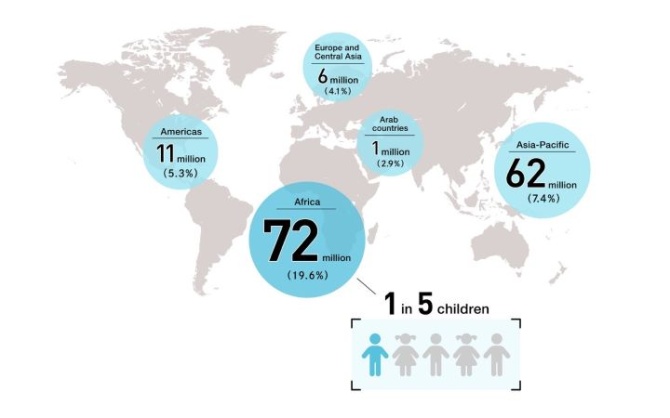
photoNumber of child laborers in each region. The figures in parentheses are the proportion of children who are laborers.

Child labor is on the rise in Africa: One in five is now involved.

The International Labor Organization (ILO) estimates that one in ten children are child laborers. In Africa, where child labor is most common, the rate is one in five. Seventy percent of the world's working children are engaged in the agricultural sector, which includes the production of cacao and coffee beans. Most of them are also engaged in domestic labor, helping their parents and not attending school. Because it deprives children of educational opportunities, child labor continues to be a global problem. Although it has been decreasing in the Asia-Pacific region, Latin America, and the Caribbean since 2016, it is actually increasing in Sub-Saharan Africa.

One of the major issues regarding child labor is that it prevents children from attending school. Depriving children of educational opportunities greatly limits their future access to jobs that provide sufficient income.

Côte d'Ivoire accounts for 43 percent of the world's cocoa production. It is reported that 38 percent of the country’s children between the ages of 5 and 17 who are raised in cocoa-producing households are engaged in child labor related to cocoa production.*1 There are multiple reasons for the proliferation of child labor. Côte d'Ivoire’s many small, family-owned farms rely on children for labor—a practice that has been passed down from generation to generation. Another major factor is that as consumers demand cheaper products, costs are shifted onto farmers, reducing their income. Of course, using children for the labor helps lower costs.
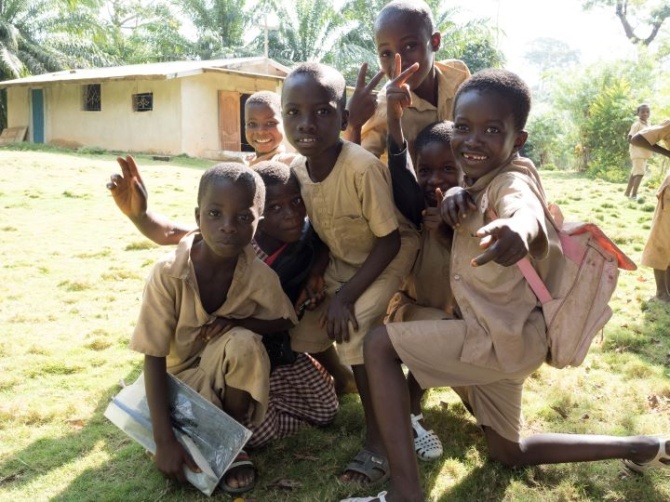
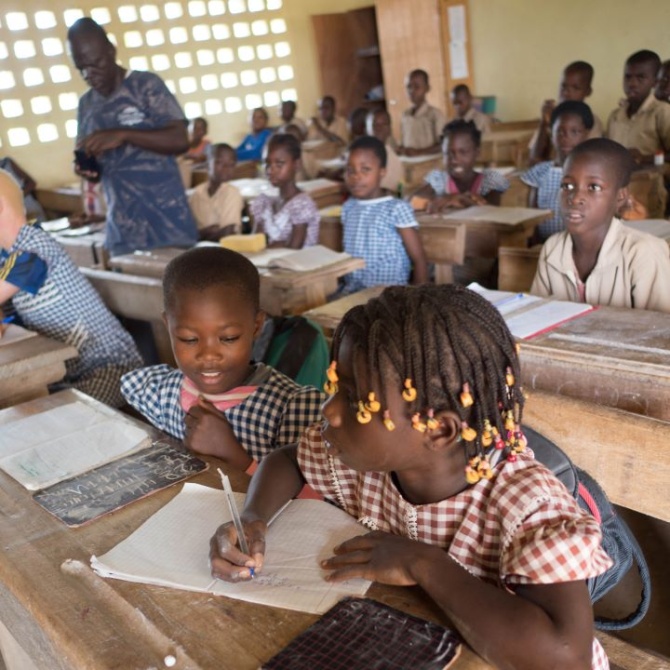
photoSchool children in the rural community of Gagnoa, south-central Côte d'Ivoire. The enrollment rate of primary school in Côte d'Ivoire’s largest city of Abidjan is 91.1 percent and the junior high school enrollment rate is 62.4 percent. In contrast, the enrollment rate in rural areas is lower: 74.1 percent for primary schools and 38.5 percent for junior high schools. (From Integrated regional survey on employment and the informal sector 2017)

photoChildren attending classes at the same school as above. The literacy rate among those aged 15 and older in Côte d'Ivoire has improved significantly, from an extremely low 43.9 percent in 2014 to 89.9 percent in 2019. However, many people in rural areas are still unable to read and write. (From UNESCO Institute of Statistics: http://uis.unesco.org/en/country/c)

The blockchain-based child labor deterrent system

In order to eliminate child labor, it is important to make the production process of cacao transparent. This makes buyers such as exporters, retailers, and consumers aware of issues related to production, including child labor and farmer poverty. Buyers who are aware of these problems can be encouraged to purchase sustainable cacao instead at a premium (incentive) price. Paying this premium to farmers who do not employ child laborers not only improves these farmers' incomes, but improves their future quality of life by liberating the children from work so that they can receive an education.
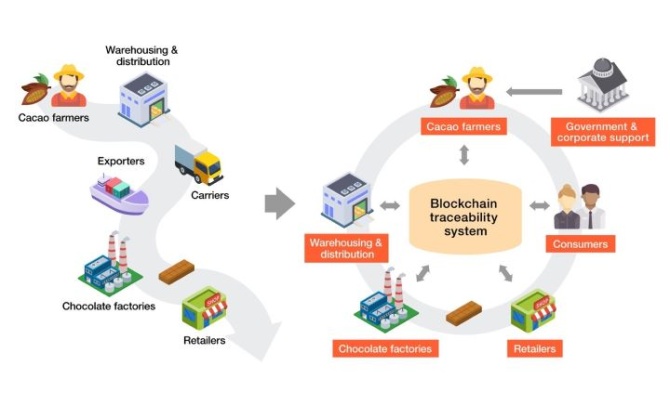
photoThe current supply chain (above left), in which information channels between producers (e.g. farmers) and buyers (e.g. retailers) are not interconnected. Information from the buyer side to the producer side is not traced, making it impossible for retailers, for example, to grasp the nature of problems in production areas. The goal is a circular supply chain (above right) in which producers and buyers share information in real time. Blockchain technology can be used to ensure traceability while preserving information.

JICA collaborated with Deloitte Tohmatsu Group for establishing a system for monitoring child labor by utilizing blockchain technology to make the current situation more transparent.

Blockchain technology allows many participants to share the same data, and protects the reliability of any information shared on this system. It is characterized by its high transparency and low cost of operation, as once registered, all the data is extremely difficult to alter and cannot be erased.

The project started as a trial demonstration in November 2021 in Gagnoa, a rural community 140 kilometers southwest of Yamoussoukro, the capital of Côte d’Ivoire. Participants include farmer-parents of children, members of farmer organizations, teachers and other school staff, and the monitoring team consisting of members of Beyond Beans, an NGO working to eradicate child labor practices in West Africa’s cocoa cultivation.

In the first step, school teachers input data of the attendance of the children into a database, while representatives from the farmer organizations also input information as to whether child labor was used on their farms. If two correlated entries did not match, the monitoring team interviewed both parties and conducted field visits before correcting the database entries. Then local traders paid premium prices for the cocoa beans produced by those farmers’ groups that had low rates of child labor and high rates of school attendance. Meanwhile, schools were rewarded for the accurate input of information in the form of maintenance and renovation of school facilities, improved school lunches, and educational materials.

As a further incentive, the project team provided cash or mobile funds to farmers’ organizations on behalf of the operators. Retailers and consumers did not take part in this demonstration experiment; however, the database will be accessible in the future through QR codes or other means attached to products, allowing buyers to instantly check the information registered with the database. By utilizing blockchain technology with a database, producers and buyers can share information with a high degree of assurance. The application of this blockchain system is also expected to expand in the future to provide information about financial services (such as payments and loans) that are available to farmers.
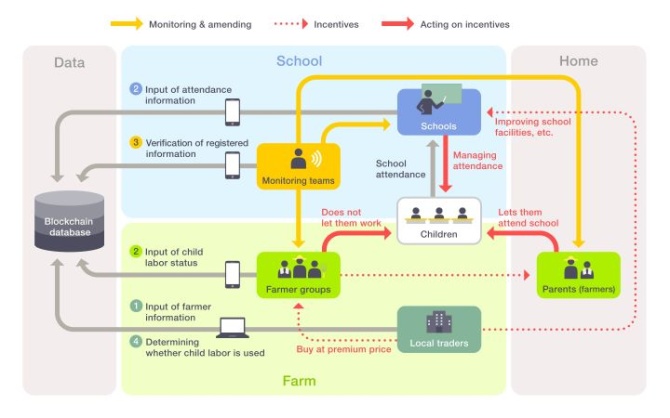
photoThe flow of data input and incentives in a blockchain system

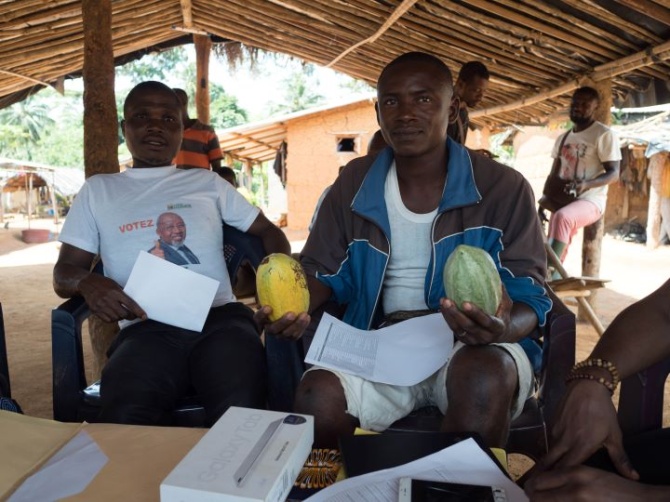
photoThe leader of a local farmers’ group (holding cacao nuts) receives a computer terminal in which data will be regularly input.

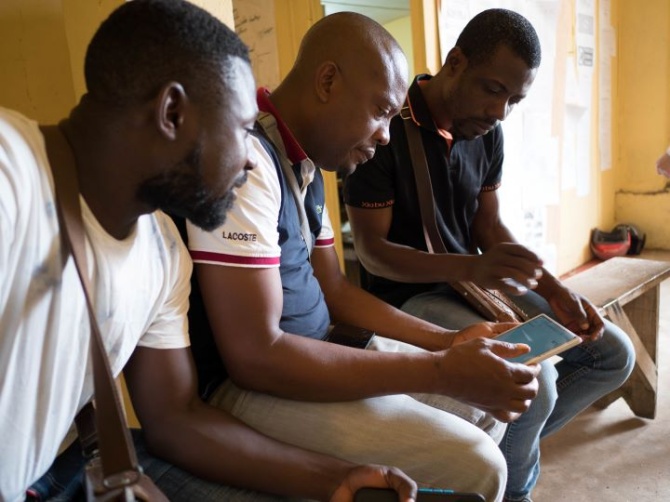
photoThe monitoring team checks information in the database using a terminal.

A successful demonstration: "We want our children to go to school."

ONO Miwa of Deloitte Tohmatsu Consulting was in charge of the field survey. “The farmers and schools we asked to cooperate with this experiment were very supportive,” she said. In addition to their curiosity about this novel idea, many of them were eager to see a decrease in child labor. Global awareness of child labor has been increasing. European and US companies involved in the chocolate business need to certify that they use cacao harvested without child labor, and they have been working on programs to eliminate child labor and to improve farmers' incomes. The government of Côte d’Ivoire is also aware of the problem, and is acting on measures such as the regular declaration of the status of child labor, as monitored by NGOs and local volunteers who patrol farmland areas. Prior to this demonstration, the farm management company that got involved was already implementing a program to stop child labor in the area, so awareness of this issue has spread among the farmers as well.

The results of the demonstration experiment proved the effectiveness of this system. The rate of involvement by farmer groups was 100 percent, whereas the involvement rate by schools reached 95.6 percent. When the registered data was inconsistent, the monitoring team interviewed the children and their parents, who confirmed that most inconsistencies were due to input or application errors. Child labor was revealed in three cases out of 2,366 applications (103 cases applications were not made due to the school's communications environment or excessive workload).

FUJINO Kojiro, Chief Representative of the JICA Côte d'Ivoire Office, was involved in the survey. “Our impression is that this system is viable from a technical standpoint,” he said. “We think this system will enhance the reliability of child labor reporting because it enables more efficient and accurate monitoring of child labor compared to conventional methods that rely on manpower.” He spoke about the needs of the community. “The truth is that farmers want to send their children to school, and their children want to go to school too,” he said. “Education is essential to improving their lives. Free of child labor, they can go to school. It's important to design incentives to achieve this.”
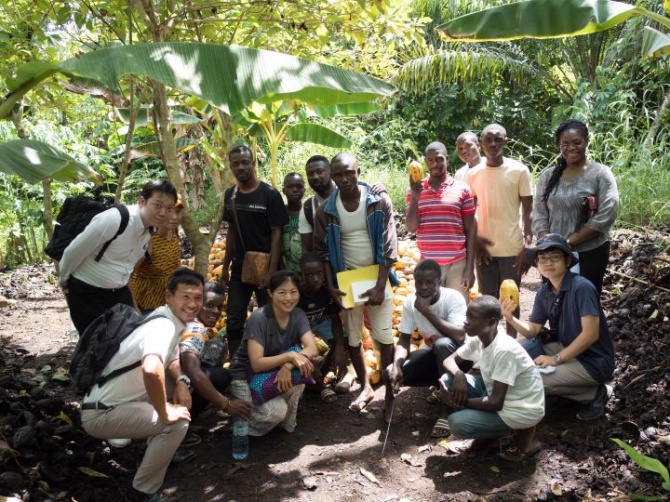
photoMs. Ono of Deloitte Tohmatsu Consulting (bottom row, third from left) poses with the research team and farmers who participated in the demonstration experiment.

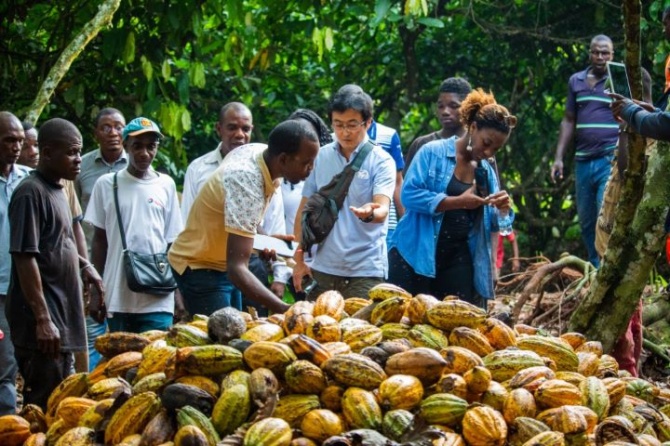
photoJICA’s Mr. Fujino (center) interviewing farmers who took part in the project.

Making the system sustainable

Certain issues were revealed in the process of this field survey. Some data were unable to be input on the application due to the communications environment. The application should be improved so that daily data can be input even in areas with a poor communication. In addition, in order to keep communities involved over time, it is important to provide incentives for farmers who do not use child labor to improve their income, for example, by ensuring their products are purchased at a premium price.

A consumer survey conducted in Japan at the same time as the demonstration revealed that teenagers are the demographic most interested in purchasing sustainable chocolate. The most commonly stated reason was to alleviate poverty and cooperate internationally (nearly 35 percent), followed by the desire to safeguard the rights of cacao producers (31 percent). These results indicate a high awareness of the desire for sustainable products among teenagers. Furthermore, there were people who are willing to spend 1.2 to 2 times as much for sustainable products. However, awareness of sustainability goals is low overall, so the need to raise consumer consciousness about production areas and to encourage consumers to purchase more sustainable products at premium prices remains. The proceeds gained through consumer purchases at premium prices will bolster farmers' incomes, protecting their children's educational opportunities, and creating a “chain of happiness.
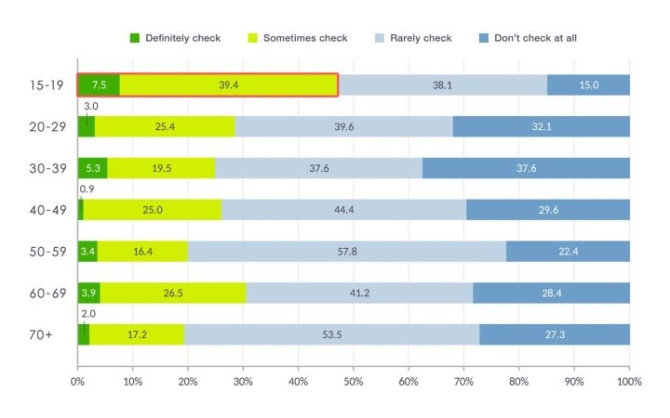
photoPercentages of sustainable chocolate buyers in Japan who check the sustainable certification mark at time of purchase, by age group. Nearly half of the teenagers surveyed said they check the mark before purchasing—a remarkably high ratio compared to other age groups. (From a web-based survey conducted from October 29 to November 1, 2021. This survey included at least 100 people in each age group; a total of 1,400 respondents)

Based on the results of the experiment, government agencies and companies in Côte d'Ivoire have expressed interest in this system as a new method of monitoring child labor, and are considering using it in other projects. It may be possible to use the system to build upon other programs to eliminate child labor and improve farmers' incomes, helping to achieve a sustainable, positive society where children do not have to engage in child labor and can attend school.

WAKABAYASHI Motoharu, Deputy General Director of JICA's Africa Department, spoke about using blockchain-based traceability systems more widely in the future.

“By recording the origin of mineral resources and timber and distributing products free of human rights issues and fraud, we can protect human rights, and we can also work together to prevent corruption by making administrative procedures transparent via the blockchain,” he said. “Technology is a crucial tool for overcoming many of Africa’s challenges. JICA intends to continue providing support by connecting social issues with technology."

Tuesday, March 26, 2024

Kids as young as 14 were found working at a Tennessee factory that makes lawn mower parts


Laura Strickler
Tue, March 26, 2024 


Immigrant children as young as 14 were found working illegally amid dangerous heavy equipment at a Tennessee firm that makes parts for lawn mowers sold by John Deere and other companies, according to Labor Department officials.

The company, Tuff Torq, was fined nearly $300,000 for hiring 10 children. As part of a consent agreement with the federal government, the company is also required to set aside $1.5 million to help the children who were illegally employed. Ryan Pott, general counsel for Tuff Torq’s majority owner, the Japanese firm Yanmar, acknowledged the violations to NBC News.

“The department will not tolerate companies profiting on the backs of children employed unlawfully in dangerous occupations,” said Seema Nanda, the department’s chief legal officer, whose office obtained the consent judgment against Tuff Torq. “Tuff Torq has agreed to disgorge profits, which will go to the benefit of the children. This sends a clear message: putting children in harm’s way in the workplace is not only illegal, but also comes with significant financial consequences.”

Tuff Torq Corporation (Google)

The Labor Department did not specify what work the children were doing. But Labor official Juan Coria said what his investigative team found in Tuff Torq’s “very busy” Morristown manufacturing plant was “astonishing.”

Coria, southeast regional administrator for the Labor Department’s Wage and Hour Division, described an environment that he says caused anxiety among his investigators who witnessed children as young as 14 working late at night at the 24-hour manufacturing facility amid power-driven equipment that was being moved around the plant.

Pott, the general counsel for Tuff Torq’s majority owner, said the child workers were temporary and were not hired directly by Tuff Torq. He said they used fake names and false credentials to obtain jobs through a temporary staffing agency, and said Tuff Torq is “transitioning” away from doing business with the staffing company.

“Tuff Torq is dedicated to ensuring that their products and services are produced under ethical conditions, with a strong emphasis on fair labor practices, and Tuff Torq is further strengthening our relevant training and compliance programs,” said Pott. “We are also actively engaging with our suppliers to reinforce our expectations regarding ethical labor practices and collaborate with them on implementing our updated policies.”

According to the Labor Department, within 30 days Tuff Torq must also hang signs at every entrance to the plant that say, “Stop! You must be at least 18 years of age to enter and work in this building.”

Nanda said through such agreements the agency is sending a message to the company and its whole community of suppliers and contractors. “They will look at their supply chain meaning their contractors, their staffing agencies, and make sure that they are doing these things as well.”

John Deere did not respond to a request for comment.

Labor officials say their investigation into the company began almost a year ago, in spring 2023, and investigators visited the facility multiple times. Officials declined to say what sparked the investigation.

The Labor Department has prioritized child labor enforcement since last spring amid a 152% increase in children found to be illegally employed since 2018, according to department figures.

This article was originally published on NBCNews.com

Tennessee parts supplier for John Deere, Yamaha fined for illegally employing children. What to know


Keenan Thomas, Knoxville News Sentinel

Updated Tue, March 26, 2024

The U.S. Department of Labor’s Office of the Solicitor is cracking down on Morristown manufacturer Tuff Torq Corporation for illegally employing children as young as 14-years-old.

Tuff Torq will pay a $296,951 penalty after the department's Wage and Hour Division confirmed several children worked for the outdoor power equipment parts manufacturer. Additionally, Tuff Torq will set aside $1.5 million from profits made during the kids' employment, which will go to the kids illegally employed.

The department received the federal consent judgement to hold Tuff Torq Corporation accountable and make sure the company complies with federal child labor laws.

“Even one child working in a dangerous environment is too many,” Wage and Hour Division administrator Jessica Looman said in a press release. “Over the past year, we have seen an alarming increase in child labor violations, and these violations put children in harm’s way. With this agreement, we are ensuring Tuff Torq takes immediate and significant steps to stop the illegal employment of children. When employers fail to meet their obligations, we will act swiftly to hold them accountable and protect children.”

U.S. Department of Labor headquarters
How many kids did Tuff Torq Corporation employ illegally?

The department determined that 10 kids illegally worked for Tuff Torq under opressive child labor conditions.

The Wage and Hour Division began probing in 2023, but received proof of the unlawful work Jan. 23, 2024. On that day, investigators witnessed a child operating a "power-driven hoisting apparatus" like a forklift. Workers under 18 are prohibited from operating this type of machinery.

The department filed the action against Tuff Torq Corporation March 22, 2024, in the U.S. District Court for the Eastern District of Tennessee at Greeneville.
What does Tuff Torq Corporation say about the Department of Labor findings?

Yanmar Group, who owns Tuff Torq Corporation, emailed a statement to Knox News.

Yanmar states that "Tuff Torq did not directly hire and employ the individuals" and that the minors were provided through a "temporary workforce staffing agency."

Yanmar adds the employees used fake idenentification and names during the hiring process through the agency.

"Tuff Torq is dedicated to ensuring that their products and services are produced under ethical conditions, with a strong emphasis on fair labor practices, and Tuff Torq is further strengthening our relevant training and compliance programs," Yanmar spokesperson Ryan Pott said in the email. "We are also actively engaging with our suppliers to reinforce our expectations regarding ethical labor practices and collaborate with them on implementing our updated policies."
What else will Tuff Torq Corporation have to do under the judgement?

Tuff Torq Corporation will stop employing children and comply with federal child labor laws moving forward. In addition to the penalty and payments, Tuff Torq Corporation agrees to do the following:

Work with community organizations to regularly train staff, managers and contractors


Create a tip line for anonymous reporting of child labor and other Fair Labor Standards Act (FLSA) violations


Allow unplanned and warrantless searches of the Tuff Torq Corporation facility for three years


Abstain from creating new contracts with staffing agencies or contractors with FLSA violations


Require contractors to disclose violations and hiring protocols before entering into contracts
What does Tuff Torq Corporation work in?

The manufacturer supplies power equipment parts for companies like John Deere, Toro and Yamaha. Tuff Torq Corporation invests in new technology, tests products and provides electric alternatives.

Tuff Torq Corporation operates at 5943 Commerce Blvd. in Morristown.
What are Tennessee's child labor laws?

Tennessee's Child Labor Act protects minors between the ages of 14 and 17 as they enter into the workforce. Protections under this act include hours working, types of jobs and exceptions for Work Based Learning Programs.

A few off-limits jobs and hazardous environments for workers under 18 include manufacturing establishments, meat packing, demolition and operation of power-driven hoisting apparatuses.

The Child Labor Act includes rules for hours minors can work throughout the week. Kids 14 and 15 can only work three hours a day during school days after 7 a.m. but before 7 p.m. for a total of 18 hours a week. When school isn't in session, minors can work up to eight hours a day between 6 a.m.-9 p.m. for up to 40 hours a week.

For kids 16 and 17, the rules are a little more flexibile as long as minors aren't working during classes and only between 6 a.m.-10 p.m. They can get a parental slip signed to work up until midnight, but only for a three days a week between Sunday and Thursday.

Minors also get a mandatory 30 minute break for every six hours of work in a day.
How many child labor violations has the U.S. Department of Labor investigated?

The department investigated 955 cases with child labor violations in 2023. This included 5,792 children nationwide with 502 of those kids employed in either violation or hazardous conditions.

As a result, the department assessed employers for more than $8 million in civil money penalties.

This article originally appeared on Knoxville News Sentinel: Tennessee parts supplier for John Deere fined for employing children


Manufacturing company ordered to turn over $1.5M in profits for child labor violations

LAURA ROMERO
Mon, March 25, 2024 

Manufacturing company ordered to turn over $1.5M in profits for child labor violations

A Tennessee parts manufacturer for major companies including John Deere and Yamaha has been ordered to turn over $1.5 million in profits after the Department of Labor found children employed in dangerous jobs.

"The U.S. Department of Labor's Office of the Solicitor has obtained a federal consent judgment that requires a Morristown manufacturer of outdoor power equipment components for major companies including John Deere, Toro and Yamaha to stop employing children illegally and to follow federal child labor laws in the future," the Labor Department said in a statement Monday.

The $1.5 million that the company, Tuff Torq, will have to turn over will be used to compensate victims, department officials said.

MORE: Labor Department cites meatpacking cleaning company for 'oppressive child labor' practices

The company was also fined $296,951 for subjecting "10 children to oppressive child labor," according to the department.

During their probe, investigators said they obtained clear evidence when they "observed a child operating a power-driven hoisting apparatus, an occupation prohibited for workers under the age of 18."

"The DOL did identify temporary workforce employees at the Tuff Torq facility that were subject to child labor violations," an attorney for Tuff Torq said in a statement. "The temporary workforce employees were provided to and placed at Tuff Torq by a temporary workforce staffing agency. Tuff Torq did not directly hire and employ the individuals. The violations investigation revealed that the temporary employees identified as child labor violations had utilized fake names and credentials in the staffing agency hiring process."

PHOTO: Tuff Torq Corporation in Morristown, Tenn. (Google Maps Street View)

"Tuff Torq is dedicated to ensuring that their products and services are produced under ethical conditions, with a strong emphasis on fair labor practices, and Tuff Torq is further strengthening our relevant training and compliance programs," the attorney said.

"Even one child working in a dangerous environment is too many," said Jessica Looman of the Labor Department's Wage and Hour Division. "Over the past year, we have seen an alarming increase in child labor violations, and these violations put children in harm's way."

Last year, the Labor Department investigated 955 cases of child labor violations, involving 5,792 children nationwide, including 502 children employed in violation of hazardous occupation standards.

Manufacturing company ordered to turn over $1.5M in profits for child labor violations originally appeared on abcnews.go.com


Thursday, August 24, 2023

Biden admin to fund $4M study linking climate change to child labor, trafficking in Nepal, grant docs show

Danielle Wallace
Wed, August 23, 2023 

The Biden administration is funding a $4 million project to determine a connection between child labor and climate change in the South Asian country of Nepal.

The U.S. Department of Labor on Monday announced the availability of $4 million in federal taxpayer dollars to be released through its Bureau of International Labor Affairs (ILAB) "to fund a technical assistance project in Nepal to increase the responsiveness of local communities to child labor and/or forced labor in the context of a changing climate." Interested parities have until Oct. 9 to apply for the massive grant, and award decisions are expected to be announced by the end of December.

One of the desired outcomes is "increased understanding of the link between climate change and vulnerability to child labor and/or forced labor risks," while another is "increased implementation of child-centered, gender-sensitive and socially inclusive climate adaptation initiatives," according to documents released on the federal government's grant website.

The Labor Department said applicants must propose strategies "based on a gender equity and social inclusion analysis to identify potential barriers of access to and control of resources and decision-making faced by men, women, boys and girls from diverse backgrounds and underrepresented populations, and how these barriers will be overcome by the project."

President Biden's Department of Labor is aiming to fund a $4 million study linking climate change to child labor in Nepal.

"Locally-led" climate change strategy, according to the grant details, should be collaborative with the Nepalese government to address the "priorities of climate-vulnerable populations, such as children, women, indigenous populations, and other disadvantaged groups."

"While further research is needed on the link between climate change and child labor and forced labor, there is evidence of climate change increasing vulnerability to labor exploitation and trafficking, gender-based violence and trafficking of women and girls, child labor, and forced labor and trafficking," the grant documents say.

Rep. Mike Johnson, R-La., who sits on the House Judiciary Committee, is among critics who ripped the Biden administration for shelling out $4 million toward this study.

"The Biden administration’s priorities are simply absurd," Johnson told the Washington Examiner. "While 5.8 million Americans are out of work, Biden’s DOL is spending money to investigate how 'a changing climate in Nepal' impacts child labor?!?"

Students hold a poster to mark the World Day Against Child Labor in Kathmandu, Nepal, June 12, 2022. (Getty Images)

"This failed, woke approach to governance is destroying our country," he added.

Fox News reached out to the Department of Labor for comment on the grant and the GOP criticism but they did not immediately respond.

Kathleen Sgamma, president of Western Energy Alliance, an energy and public lands trade group with 200 member companies, told the Examiner the Biden administration is trying to use climate change as an "explanation for everything" instead of offering viable solutions to lift the Nepalese people from poverty.

"One way to do that is by helping them access more reliable, affordable energy in the form of oil, natural gas, and coal, which would actually reduce the poverty that causes families to have to rely on child labor," Sgamma said. "A convoluted study about climate change does nothing to lift families out of poverty and free children to go to school instead of work in sweatshops."


In recent years, the number of children working in the brick kilns of Nepal has boomed after the 2015 earthquake and the COVID-19 pandemic, Getty reported.

"The real irony is that misguided climate change policies in the West that favor intermittent solar energy over reliable fossil fuels are actually directly leading to slave labor in China, where solar panels are made by enslaved Uyghurs," Sgamma added.

Tax forms show Thea Lee, deputy undersecretary and leader of ILAB, which will distribute the grant funding, served as president of the progressive Economic Policy Institute think tank between 2018 and 2021 and has also sat on the board of the Congressional Progressive Caucus Center, the Examiner reported.

The Labor Department said Nepal ranks 10th on the list of countries most at risk of climate change, according to the Global Climate Risk Index 2021. The World Bank estimates that 80% of Nepal’s population faces "climate-related peril," according to the grant details.

Nepal also has pernicious rates of child labor and forced labor, the Labor Department said, estimating 1.1 million children are in child labor, 222,493 of whom are in hazardous work and 85% are working in agriculture. Agri

Monday, February 27, 2023

U.S. announces plan to reverse rising 'scourge' of illegal child labor
By Sheri Walsh

Labor Secretary Marty Walsh, along with the Department of Health and Human Services, announced a new interagency task force Monday to end "Child Labor Exploitation," following a 69% increase in illegal child labor in the United States over the last five years. 
File photo by Bonnie Cash/UPI | License Photo

Feb. 27 (UPI) -- The Biden administration is taking new steps to end illegal child labor, following a 69% increase in the number of children employed illegally by U.S. companies over the last five years.

The Departments of Labor, Health and Human Services announced a new interagency task force on "Child Labor Exploitation" on Monday, in addition to a national enforcement initiative on child labor.

"We see everyday the scourge of child labor in this country, and we have a legal and moral obligation to take every step in our power to prevent it," said Secretary of Labor Marty Walsh.

"Too often, companies look the other way and claim that their staffing agency, or their subcontractor or supplier, is responsible," Walsh added. "Everyone has a responsibility here."

RELATEDCompany pays $1.5 million for breaking child labor laws in 8 states, Labor Department says

The Labor Department also announced plans to hold all employers accountable to ensure child labor is removed from supply chains. Many of the children are migrants from Latin America, who fled violence and poverty, and do not have a parent in the United States.

"Every child in this country, regardless of their circumstance, deserves protection and care as we would expect for our own child," said Health and Human Services Secretary Xavier Becerra.

"At HHS, we will continue to do our part to protect the safety and well-being of unaccompanied children by providing them appropriate care while they are in our custody, placing them in the custody of parents, relatives and other appropriate sponsors after vetting and conducting post-release services including safety and well-being calls," Becerra added.

Earlier this month, the Labor Department announced $1.5 million in civil penalties against Packers Sanitation Services for violating child labor laws in eight states.

The department said the company employed more than 102 children between the ages of 13 and 17 "in hazardous occupations and had them working overnight shifts at 13 meat processing facilities in eight states."

The Labor Department said it currently has more than 600 child labor investigations underway throughout the country.

In addition to the new task force and enforcement initiative, the administration also wants mandated follow-up calls for unaccompanied children who report safety concerns, expanded post-release services, increased funding and new training materials to educate unaccompanied children on their rights.

The Labor Department is also calling on Congress to increase penalties for child labor violations, which are currently $15,138 per child. The department argues the penalties are not high enough to deter large companies, while urging Congress to add protections for those who report child labor law violations.

"This is not a 19th century problem -- this is a today problem," Walsh said. "We need Congress to come to the table, we need states to come to the table. This is a problem that will take all of us to stop."

Sunday, January 25, 2026

FORWARD TO THE PAST

The U.S. Retreat on Child Labor Enforcement is Putting Children in Danger


 January 23, 2026

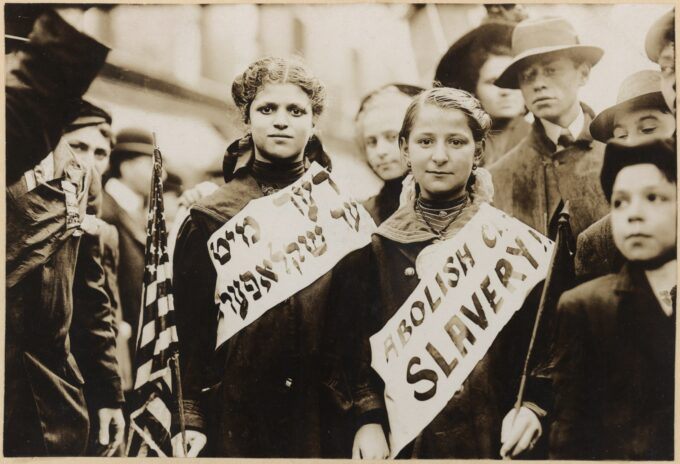
Two girls protesting child labour (by calling it child slavery) in the 1909 New York City Labor Day parade – Public Domain

Just when America needs stronger child labor protections, the Trump administration is seemingly abandoning enforcement altogether. A disturbing new analysis from Good Jobs First reveals that enforcement cases for a range of workplace violations declined by 97 percent last year.

And a review by the Child Labor Coalition found just two press releases about child labor enforcement in the year since President Trump was inaugurated on January 20, 2025 — compared to two per month in the last two years under Biden.

This retreat comes at a perilous moment. According to the Economic Policy Institute, 28 states across the nation introduced bills to weaken child labor protections in recent years. This follows a 283 percent increase in child labor violations between 2015 and 2023, creating a perfect storm that leaves young workers dangerously exposed.

This isn’t bureaucratic negligence — it’s the systematic gutting of worker protections.

In spring 2025, the Trump administration identified 21 offices for closure within the Labor Department’s Wage and Hour Division — and is slashing staff at the agency responsible for enforcing federal child labor laws. Even before the current administration took office, there was just one inspector for every 202,000 workers.

As members of the House Committee on Education and Workforce warned the department last year, these cuts extend “an open invitation for employers to ignore workplace hazards, force miners to breathe toxic dust, staff children on overnight shifts at meatpacking plants or other dangerous jobsites, discriminate against workers, and steal workers’ wages without fear of any accountability.”

Federal enforcement sets a floor beneath which no state can fall. When that floor disappears, states can either strengthen their own enforcement with limited resources or allow violations to multiply unchecked. And unfortunately, that floor is dropping as several states have chosen to roll back their existing protections.

The consequences of weak enforcement are already visible in states like Iowa and California, where inadequate oversight has allowed dangerous child labor practices to flourish.

In Iowa, the legislature egregiously weakened child labor protections in 2023. An investigation by Common Good Iowaconcluded that state investigators conducted only 77 child labor investigations in 2024, including one involving the death of a 17-year-old who was crushed by a utility vehicle while performing prohibited tasks without supervision.

Yet despite these cases, investigators issued just four civil monetary penalties totaling just $36,350 — a pittance that is unlikely to deter violations.

California’s agricultural sector presents an equally troubling picture, with enforcement agencies that are understaffed and lacking in capacity. A recent investigation by Capital & Main, documented in the Los Angeles Times, found “vast areas of California’s agricultural heartlands have gone years without worksite inspections by the front-line state agency charged with protecting underage workers.”

The investigation documented young farmworkers exposed to toxic pesticides that caused burning eyes and skin rashes, often working without adequate shade or water breaks, and earning below minimum wage.

Yet over eight years, “state officials issued just 27 citations for child labor violations, even though thousands of agricultural businesses operate in California. More than 90 percent of the fines were never collected.”

The actions of the Trump administration will make the situation worse. In addition to the lack of federal labor enforcement, Trump’s immigration crackdown increases the risks of farmworkers speaking up about brutal labor conditions.

There’s an alternative to this race to the bottom where businesses exploit children.

Congress needs to pass the bipartisan Justice for Exploited Children Act that would introduce a minimum monetary penalty for guilty parties and increase penalties overall. Two other bills, the Children Don’t Belong on Tobacco Farms Act and the Children’s Act for Responsible Employment and Farm Safety, would help close gaps that exclude farmworker children from basic protections.

Meanwhile, states need to increase child labor protections, not gut them. Several states, both red and blue, passed laws strengthening child labor protections in recent years — including Illinois, Colorado, Minnesota, Oregon, Virginia, and Utah.
We need elected officials to build on this progress. Children nationwide deserve nothing less.

Todd Larsen is the Executive Co-Director of Green America. Reid Maki is the Coordinator of the Child Labor Coalition.