Showing posts sorted by relevance for query HINDUISM IS FASCISM. Sort by date Show all posts

Tuesday, May 24, 2022

India

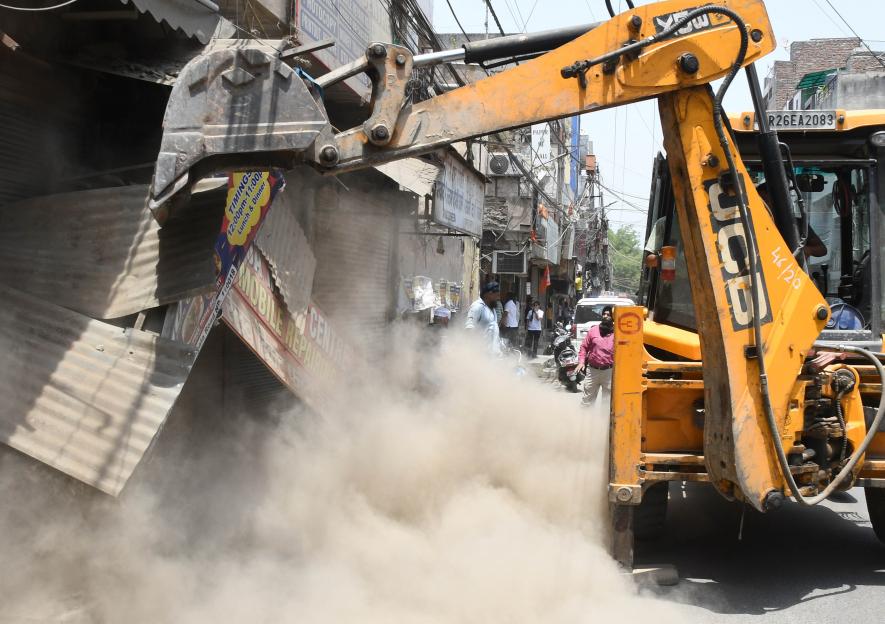
Bulldozer is a Sign Hindutva is Flat

The author searches for meanings in the symbol of a bulldozer as they are unleashed on the streets of India to demolish all in their path.

Brahma Prakash
24 May 2022

Image Courtesy: Tribune India

Like my ideologue, John Berger, I keep looking for a figurative image to understand the art and ideology of our time. For some time now, I have been searching for a complex definition of Hindutva: Its possible grey areas. Its coated meanings. Its teeth hidden in the tongue and belly like a bulldozer itself. I was looking for a figurative image that captures its dynamite power. Its unbridled emotions. Its automobility. I looked for a body and machine that captured its muscle and movement. Its muscular politics.

I was trying to understand the electric power of Hindutva that makes the words viral and puts the body in a trance. Perhaps an installation work of Hindutva that instils the fear of aligning aesthetics and anaesthesia together. I was looking for an artefact. An object that has cultic and exhibitory values but can equally cut the body like the swords of the Ram Navami procession. I was looking for an image that brings artillery and artefact together. Music and terror together. Slogan and silence together. Fun and violence together. I was looking for a toy of Hindutva that steals the love and instils the violence in children’s minds, like the toy gun culture of the US empire. I was looking for the object that rolls all these things together in one bundle like a bulldozer itself.

The figurative image for the Hindutva that I have found is that of a bulldozer—moving and bulldozing. It was open, out there, in body and spirit, politics and procession, sign and sensation, mobs and automobility, manhood and machinehood. It is a device that becomes biopolitical as well as geopolitical in its domination. It moves to demolish; it moves to displace; it moves to dominate. It moves to decimate. It moves to dismiss any prospect of dialogue. It moves to move the earth where one stands. It moves to create a new site for the settlers at the expense of the livelihood of the others.

In India, the bulldozer does not remain a machine. It has become an artefact now. It has entered the popular psyche. There is a massive demand for bulldozers. People are offering it as wedding and birthday gifts. There is massive demand for bulldozer toys. A report says bulldozer pichkaris sold like cakes in Banaras during Holi. There are popular songs and music tracks dedicated to the device. The media is full of news and views of it. Leaders are trying to name themselves after it—bulldozer baba, bulldozer mama, brother bulldozer, and so on. Bulldozer is a new bull of Indian politics. In a medicine shop in Bihar, a young man was asking for a bulldozer (condom). I checked. In fact, there is a JCB condom. Its promotion says, “It restores the confidence and relieves you of the inferiority complex.” Clearly, the bulldozer is a sign of the insecurity of Hindutva masculinity.

FLATNESS OF HINDUTVA

I soon realised that Hindutva doesn’t hold complexity. It simply cannot. It is not interested in complex seeing. Perhaps we do not need a complex definition for Hindutva. Bulldozer is a sign that Hindutva is flat. It wants to excavate everything; the soil that nurtures the soul, the food that nourishes the body, and the home that gives us a sense of belonging. It wants to dig out everything. It plans to smoothen out history. It wants to cut down the raising hands. It wants to roll down the raising heads. It wants to make everything flat and transparent, going with the agenda of neo-liberal politics. For Hindutva, everything is an exhibition, from faith and religion to nationalism. It is a remarkable show of politics on a spectacular level. How will we know unless you show? It is a neo-liberal formation of Hinduism in destructive form. Some say the bulldozer brings development.

Of course, there is a difference between Hinduism and Hindutva. But not in the way the liberals want to show us; Hinduism is good, Hindutva is bad. The differences lie in the ways they disclose themselves. Hinduism maintains pretensions, Hindutva is flat. One is ceremonial, the other is a show. When it comes to caste hierarchy, let us be brutes; if Hinduism is cunning, Hindutva is crude. What Hinduism does with its’ accommodating ideology’, Hindutva does it by othering! What lower castes were to Hinduism, Muslims are to the Hindutva. One maintains its ideology through hegemony; the other wants to maintain it by brute force symbolised by the bulldozer. Hate remains the common, and so the hierarchy.

One cannot hide by saying Hindutva is dangerous for Hinduism. In fact, Hindutva has given a new lease of life to Hinduism, which was facing a crisis from its lower castes. Check the geography. Hinduism has expanded its territory. The expansion becomes only possible through the ideology of Hindutva. The Hindutva of today is the Hinduism of tomorrow. What we are facing is the normalisation of Hindutva ideology as Hinduism. Hindutva is a general manifestation of Hinduism in a neo-liberal regime. We can say that Hindutva is not an aberration. It is the religion in its true Sanatani sense.

One cannot hide by saying Hindutva is inspired by western ideology; it has its Indian roots too. Did we forget its history: how dissenters were punished, women were burnt, and Buddhism was crushed in its own land? What we are witnessing is new but not so new. Do we believe that the hatred we see today was made in seven or ten years? It has been accumulating for years and is outpouring now. It has found its opportune time and moment.

The bulldozer is a sign that Hindutva is flat! Made of iron, its heart is flattened, and its eyes are flattening. It sees nothing. It hears nothing. It wants to make everything flat. It believes in the uniformity of all. The most insidious thing Hindutva does with life and culture is make everything flat. It sees things in black and white—you are a Hindu or a Muslim. You are nationals or anti-nationals. You are with Us or against Us. Its art, rhetoric, epics and sculptures typically follow and fall on this line. It makes everything flat. Have you seen the Bollywood movie? The Kashmir Files? In the movie, politics falls flat, and so does difference, without addressing the gaps. See the sheer flatness of the Statue of Unity, the world’s tallest monument, standing in front of the Narmada; it is spectacular. It asks for the gaze but does not unveil. It does not gape. It remains straight. Nothing is better than a bulldozer to represent this art of Hindutva. Flat. Brute. Massive. A spectacular machine. It does not hide anything. It does not have revealing power. Flatness becomes its clarion call. The art of bulldozer has a flatness of aesthetics. It reminds us of futurism—the art of the fascists.

If Hinduism is represented by the figure of a Brahmin with a ponytail, Hindutva reminds me of the figure of Brahmarakshas. In many folk narratives, the figure is shown as a huge but mean figure. It is a scary figure with horns and tentacles on his head and a ponytail. He hangs upside down on a tree. Like a bulldozer, the figure has a swishing tail, carnivore teeth and sharp nails. Despite their differences, Brahmins, Brahmarakshas and bulldozers keep looking for sacrifices. Sometimes they capture the mind. Sometimes they rip apart the body; sometimes, they rip apart the land.

BULLDOZER, TOO, HAS A HISTORY


The deployment of bulldozers against the minorities might be new in India, but it has a long genocidal history. Before the bulldozer came into the world, ‘bulldozer’ was the term deployed to intimidate Black people in parts of the United States. Bulldozing was used to describe intimidation by violent and unlawful means. The lawlessness of the bulldozer is not new, nor is the violence inscribed in the term. In the United States of the 1870s, the term “bulldose” was used for administering a large and efficient dose of any medicine or punishment.

The first recorded use of the term goes back to 1876, when its meaning and chilling effect were there but not yet the machine. Ahead of the US presidential election of 1876, Black American voters were on the receiving end of severe beatings and lashings for participating in their rights in the form of “bulldose”—“a dose fit for a bull”. They would be thrashed, whipped and often lynched. “Many were bulldosed into silence,” writes Andy Hollandbeck in In a Word: The Racist Origins of ‘Bulldozer’. He also writes that bulldozing got a clear meaning, ‘to coerce or restrain by use of force’. The invention of the massive machine made the term more concrete. Bulldozer brought the figurative image of its powerful meaning: using brute force.

The arrival of the bulldozer in India is not a coincidence; it symbolises the ideology of the time. The bulldozer does not move much, but it marks the genocidal connection beyond geographical boundaries. It was there against the Blacks in the United States. It is there in China against the minorities. It is used in Palestine by Israeli authorities. It has been at the centre of indigenous and ethnic displacement across the world. In this regard, Pranay Samajula writes, “The fact that bulldozers have cropped up in both India and Israel as a chilling symbol of state repression itself is common to both cases: in both India and Israel, the far-right regimes that govern the two countries share a common vision of an ethnic-majoritarian apartheid state, and willing to go to extreme lengths to realise that vision.”


Long before the demolitions and displacements in Delhi and Madhya Pradesh, Israeli authorities deployed it against Palestinians in massive ways. The machine came, carrying legacy and meaning, and so did the chilling memories and effect. What is this connection between unknown territories? We are not sure if Indian authorities have learnt from white or Jewish supremacists, but their genocidal connection is clear. Their bulldozing connection is clear. So clear is its brutality of power and the flatness of its aesthetics.

Brahma Prakash is Assistant Professor of Theatre and Performance Studies at the School of Arts and Aesthetics, Jawaharlal Nehru University, New Delhi. The views are personal.

Monday, December 01, 2008

Worth Reading After Mubai

Found this excellent post, long but worth the read. Especially in light of this weeks fascist attack in Mubai, which revealed an incompetant and ineffective security state in India. And again the focus was a centre of world capital, a business centre, the countries capital, and home of the Indian bourgoise, a major centre of tourism, just like New York was. And Mubai like the Twin Towers has been a repeated target of fascists.
This article was published after 9/11.

THE SHOCK OF RECOGNITION: Looking at Hamerquist’s ‘Fascism and Anti-Fascism’ by J. Sakai
Fascism is rapidly becoming a large political problem for anti-authoritarians, but perhaps moving up so close to pass us that it’s in our blind spot. Fascism is too familiar to us, in one sense. We’ve heard so much about the Nazis, the Holocaust and World War II, it seems like we must already know about fascism. And Nazi-era fascism is like all around us still, ever-present because Western capitalism has never given fascism up. As many have noticed, eurofascism even crushed has had a pervasive presence not only in politics, armies and intelligence agencies, but in the arts, pop culture, in fashion and films, on sexuality. For years thousands of youth in America and Europe have been fighting out the question of fascism in bars and the music scene, as a persistent fascist element in the skinhead subculture has been squashed and driven out by anti-racist youth–but come back and spread like an oil slick in the subterranean watertable. It feels so familiar to us now even though we haven’t actually understood it.
While the scholarly debates about “classic” 1920-30s eurofascism only increase–and journalists like Martin Lee in his best-selling book, The Beast Reawakens, have sounded the alarm about eurofascism’s renewed popularity –existing radical theory on fascism is a dusty relic that’s anything but radical. And it’s euro-centric as hell. Some still say fascism is just extreme white racism. For years many have even argued that no one who wasn’t white could even be a fascist. That it was a unique idea that only could lodge in the brains of one race! Others repeat the disastrous 1920s European belief that fascism was just “a tool of the ruling class”, violent thugs in comic opera uniforms doing repression for their capitalist masters. Often, both views overlap, being held simultaneously. So we ‘know’ fascism but really we don’t know it yet. Once reclothed, not spouting old fascist European political philosophy (but the same program and the class politics in other cultural forms—such as cooked-up religious ideology), fascism walks right by us and we don’t recognize it at first.
As fascism is becoming a global trend, it’s surprising how little attention it has gotten in our revolutionary studies. Into this unusual vacuum steps Don Hamerquist’s Fascism and Anti-Fascism.(2) This is an original theoretical paper that has in its background not only study but fighting fascists and racists on the streets.
In this discussion of Hamerquist’s paper we underline three main points about fascism:- That it is arising not from simple poverty or economic depression, but from the spreading zone of today’s protracted capitalist crisis beyond either reform or normal repression;
- That as fascism is moving from margin to populist mainstream, it still has a defined class character as an ‘extraordinary’ revolutionary movement of men from the lower middle classes and the declassed;
- That the critical turning point now for fascism is not just in Europe. With the failure of State socialism and national liberation parties in the capitalist periphery, in the Third World, the far right including fascism is grasping at the leadership of mass anti-colonialism.
Fascism has shown that it can gather mass support. In many nations the far right, including fascism, has become a popular oppositional force to the new globalized imperialism. In many countries the far right has replaced the left as the main political opposition. It doesn’t get more critical than this. This stands the old leftist notion about fascism on its head. It isn’t just about some other country. Without a serious revolutionary analysis of fascism we can’t understand, locate or combat it right here. And if you don’t think that’s a serious problem, you’ve got your back turned to what’s incoming.

The modern islamic rightists, who began in 1927-28 with the founding of Egypt’s Muslim Brotherhood, took religious ideological form but were started as a political movement against British neo-colonial domination. They were backed not by workers or peasants but by the middle-class bazaar merchants and traders. The core of the islamic rightists from the beginning were not theologians but young men who had middle-class educations as scientists and technicians (like today’s Mohammad Atta who supposedly led the 911 attacks), and who used assassinations and trade boycotts. One trend within this broader islamist political movement developed fascist politics and a definite fascist class agenda. The fact that everything is explained in religious ideological terms doesn’t change the fact that their program and class strategy fit fascism perfectly. Perhaps that’s the real “fundamentalism” that they have.(5)
Throughout the Muslim world, from Saudi Arabia to Egypt to Turkey to Pakistan, Western imperialism has helped maintain militarized neo-colonial regimes that have looted and deadended society. They have destroyed local subsistance economies of self-production for use in favor of globalized export-import economies. The number of the declassed, those without any regular relationship to economic production and distribution, keeps growing. The lower-middle classes keep losing their small plots of land, their small market businesses, their toehold in the educated professions. These are men who are threatened with the loss of everything that defined them, including the ability of patriarchs to own households of women and children.
This is the class basis of today’s pan-islamic fascism, which demands a complete reversal of fortune. Revolutions where today’s Muslim elites shall be in the prisons or the gutter and the warriors of fascism shall be the new class ruling over the palaces, mosques and markets. They are more than national in scope just as all revolutionary movements have been. Because they are in a fluid war of undergrounds and exile, striking from abroad, of retreating from savage military repression in one nation to concentrate on breakthroughs in another nation. And to them, the world citadel of globalization in New York was not an innocent civilian target but a fortress of an amoral enemy.
The key thing about them isn’t that they’re following some old book. It’s that they’re fighting for State power just like everyone else in the capitalist sinkhole. They upfront want to rule, to not work but get affluent and powerful as special classes alongside the bourgeoisie, to hold everyone else underfoot by raw police power. Whether it’s christianity or islam or whatever they claim to be following, these are definitely political movements.


SEE:
terror state/state terror
The Spectacle of War on Terror
The War Against The Metropolis
War and the Market State
World On Fire-Who Sells The Matches
India Is Now A Capitalist State

Hinduism Is Fascism
Unemployment Breeds Terrorism

Find blog posts, photos, events and more off-site about:
, , , , , , , , , , , , , , ,
, , , , , , , , , , , , , , , , , , , , ,

Saturday, September 02, 2023

Making Sense of Hindutva

Hindutva may have proclaimed the supremacy of all things traditional, but it makes no room for diversity, dynamism, dilemmas, and doubt. Such has never been the only Indian way.


By Devdutt Pattanaik
September 01, 2023

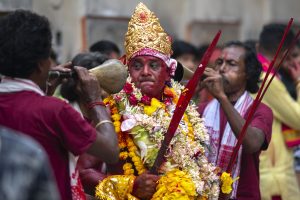
Local musicians blow horns as a Hindu priest, face smeared with color and sacrificial blood, performs rituals during the Deodhani festival at the Kamakhya Hindu temple in Guwahati, India, Saturday, Aug. 19, 2023.
Credit: AP Photo/Anupam Nath

Hindutva can easily be seen as an Indian version of a global movement of men, by men, for men. It reclaims their masculinity and combines religion with nationalism. It can be lumped together with the resurging Orthodox Christianity in post-communist Russia or the Evangelical Christianity sweeping neoliberal America. The enemy in all these cases is both external and internal – anyone who challenges an imagined glorious traditional history, where men played the dominant role, where women knew their place, and all things queer (now articulated as LGBTQ+) existed in shadows and footnotes.

But, with Hindutva, there is one additional challenge: an understanding of Hinduism itself. And the problem is structural.

Hinduism is structurally very different from the monotheistic religions that inform the global discourse. Judaism, Christianity, and Islam are based on ideas such as God, God’s Law, Judgement Day, and the Apocalypse. Hinduism is based on ideas such as infinity, timelessness, rebirth, and caste. As a result, the word “evil” cannot be translated into any Indian language. And the definitive article “the” does not exist in any Indian language either.

There arises a further complication given the fact that even the “modern” concept of the secular nation-state is structurally the same as monotheistic religions. An all-powerful state replaces an all-powerful God. The constitution replaces God’s Law. Traitors replace heretics. Nationalism is submission. Democracy is the ritual to choose the divine messenger who will enforce God’s Law.

Even science follows the structure of monotheistic religions. While it replaces faith with doubt and miracles with measurement, it insists on pursing and presenting “the” truth, like evangelists of yore. So, science and monotheistic religions remain at loggerheads. Only now scientists are being challenged by those who insist feelings are as important as facts. As a result, defining a woman has now become a national crisis in the United States as everyone scrambles for “the” truth. Ontology, not epistemology.

Indians, not just Hindus, have learnt over the centuries that the point of diversity is to work with diverse truths, which make sense to diverse communities. The opposite of equality is not inequality; it is diversity. The opposite of diversity is standardization. Standardization makes things efficient. Diversity, unfortunately, is inefficient.


Do Australian Politicians Know the Difference Between Hinduism and Hindutva?


Engagement with the growing Hindu community is essential for Australian politicians, but there is an obvious tightrope to walk.


By Grant Wyeth
May 17, 2022

As a highly multicultural society, Australian election campaigns require politicians to actively connect with the country’s array of community groups. This is overwhelmingly a positive phenomenon, yet Australian politicians are generally a socially awkward group, and often lack the cultural sophistication to be able to engage meaningfully with Australia’s multicultural communities. The under-representation of minority communities in Australia’s parliament also limits the necessary knowledge political parties require to connect with minority groups, but also be attentive to any overseas political issues they may be walking blindly into.

The lack of knowledge about Indian politics in particular has become apparent during this election campaign. Indians are Australia’s fastest growing group, and as a result are becoming a critical community to seek support from during elections. However, in recent weeks, in their attempts to do so, both Prime Minister Scott Morrison and the opposition leader, Anthony Albanese, have unwittingly allowed themselves to be used for domestic Indian political purposes.

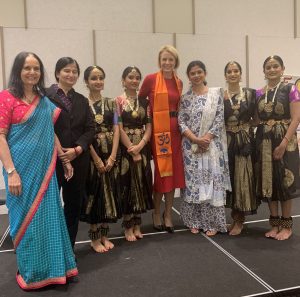
In early May, Albanese and Shadow Home Affairs Minister Kristina Keneally attended a function at the Hindu Council of Australia, and last week Morrison and Immigration Minister Alex Hawke attended an event hosted by the same organization. During these events all four allowed themselves to be draped in scarves of the Vishva Hindu Parishad (VHP), unaware that they were not simply wearing a religious symbol as a show of respect to their hosts, but instead wearing a highly political symbol of a group they should in no way be seen to implicitly endorse.

The Vishva Hindu Parishad (VHP) are the religious wing of the Sangh Parivar, the umbrella name for a collection of Hindu nationalist organizations that includes its paramilitary wing, the Rashtriya Swayamsevak Sangh (RSS), and its political wing, the Bharatiya Janata Party (BJP), India’s ruling party — all of which are organized around the ideology of Hindutva. While the VHP may in name be the Sangh Parivar’s religious wing, they — in particular the VHP’s own youth organization, the Bajrang Dal — are also often its vigilante wing.

The VHP have been the primary driver of communal violence in India over the past few decades, including the destruction of the Babri Mosque in 1992 and the Gujarat riots in 2002. Vigilante violence against Muslims, Dalits, and Sikhs in India has increased dramatically since the BJP took power in 2014, often with the government’s tacit approval. This violence is part of a collective political project by the Sangh Parivar to construct a new Indian state, one that has animosity toward the country’s minorities as its organizing principle.

This is critical to understand for Australian politicians as the BJP and its sister organizations have actively sought to cultivate an intimate relationship with the Indian diaspora. For the most part these are people who cannot vote in Indian elections, but they serve an ideological and financial purpose. The Sangh Parivar is not simply an organization that wishes to govern the Indian state — the BJP would be a stand-alone political party were this the case. It wants something more from people than just votes; it wants minds and souls (and often fists). This makes transnational reach an essential component of the movement.

Australia has already seen a serious example of this reach with an attack on a group of Sikh men in a Sydney suburb early last year. Providing a blunt illustration of the nature of the Hindutva movement, when a man convicted of the assaults was released after six months in custody he received a hero’s welcome upon his return to India. At the time the immigration minister tweeted, “Attempts to undermine Australia’s social cohesion will not be tolerated.” Yet he obviously didn’t learn the lessons from this incident when he allowed himself to wear the VHP’s insignia last week.

The added complexity for Australian politicians is that Canberra is actively seeking to build a much stronger and more intimate relationship with India. Yet as the BJP has become the country’s dominant political party – and looks like it is now entrenched in this position – the ability to differentiate between the state and its ruling party is becoming more difficult, especially as the Sangh Parivar continues to capture the state. 

Australian politicians need to be able to distinguish between Hinduism and Hindutva – Hindutva is a political ideology that seeks to remake Hinduism into an identity rather than a religion, an identity that is based on hostility toward other groups, mostly Muslims, but also Dalits, Sikhs, and Christians. There is an obvious tightrope to walk here for Australian politicians, as engagement with the growing Hindu community is essential and should be encouraged. Yet this will require a keen awareness of when politicians are being co-opted into causes that they should be keeping themselves well clear of.


Defying Deification: Indian Politicians as Hindu Gods

Don’t believe the hype; worshiping Indian leaders is not common.

By Krzysztof Iwanek
February 01, 2019

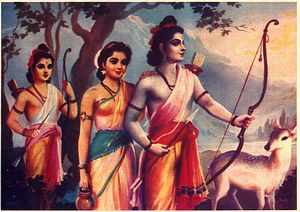
Two posters caught the attention of the Indian media in January this year, and each happened to portray a sibling from the same political family. One – a badly photoshopped merger – showed the god Rama’s torso, complete with a quiver hanging from his back, but with the face of a political leader, Rahul Gandhi, superimposed on the deity’s head. The other posters compared Priyanka Gandhi, Rahul’s sister and also a politician, to goddess Durga, a deity that represents the feminine cosmic power in the universe. One of those posters was a double reference: Priyanka Gandhi is the granddaughter of Indira Gandhi, the famous prime minister of India who had been, if very seldom, portrayed as Durga herself. Thus, somebody chose to portray Priyanka Gandhi as not only the reincarnation of Indira Gandhi but, by default, also Durga’s coming to this earth.

There are more such instances. There is a temple dedicated to the deceased Indira Gandhi in central India, and worship there continued at least as of 2017. The same Rahul Gandhi was also portrayed as Rama on posters a year ago. At that time he was shown aiming a bow at his political rival, Prime Minister Narendra Modi, who was likened to the demon Ravana, a mythological figure whom Rama killed. Like Ravana, Modi was portrayed with 10 heads, his face copied into each of them. No nuances here – our leader is a god, their leader is the king of demons.

Ironically, Rahul and Priyanka Gandhi represent the Indian National Congress, a party usually perceived as the socialist and secular power, the biggest alternative to the Bharatiya Janata Party (BJP). The BJP is now led by Modi and his associates – and is currently ruling India. It is this party that is more often accused of arousing religious sentiments and more often refers to Hindu traditions. The ground reality, however, shows the Congress and the BJP are not as far from each other as many would like to think.

But the BJP has had its share of district-level deifications as well. During the 2014 elections, a chant often raised in favor of Modi was a remake of a religious mantra that worships the god Shiva (“Har Har Modi” instead of “Har Har Mahadev”). Local party members from the holy Hindu city of Varanasi – a constituency where Modi was fighting elections at that time – even changed the words of a Sanskrit prayer, putting “Modi” instead of “Devi” (Goddess). Moreover, just like Indira Gandhi, Modi was also supposed to have a temple built for him in Meerut (though I do not know how this story has ended).
y of the week, and developing stories to watch across the Asia-Pacific.GET THE 

The same, perhaps even more rarely, may happen to politicians of other parties as well. A member of the All India Trinamool Congress – the party now ruling West Bengal – once suggested that its members should wear the picture of the undisputed party leader, Mamata Banerjee, as a lucky charm against the evil magic of their political rivals (the communists).

All of these, however, are scattered and regional instances and we should not read too much into them. Religion and politics are obviously intertwined in many ways in India – as they are in many places. But this does not mean that Indian politicians are often portrayed as gods and that this is the national trend.

These occurrences can perhaps be explained by looking at the nature of Hinduism. First of all, it is not a centralized religion with a hierarchical clergy and a strict doctrine, like the Roman Catholic Church. The actions of the people who established an Indira Gandhi temple or those who planned to found a Narendra Modi temple were not authorized by any central institution, and there was no such decisive apex body they could have asked anyway. Many, if not most, Hindu priests would perhaps disapprove of such acts. I do not have any survey at hand to prove this but there have been instances of highly respected Hindu figures criticizing such deifications. Media pundits may sometimes raise the hype but the orthodox pandits are not really behind all of this.

These initiatives are usually not even endorsed by the central party leadership. Most of these deifying posters and slogans were prepared by regional party workers, or others. It is the local tribal community that worships Indira Gandhi in central India. When Rahul Gandhi was depicted as Rama fighting the “Ravana Modi,” the Congress leadership pointed out that the posters were “unofficial” (but did not reject them). When Modi’s name was included in a Sanskrit prayer, the state president of the BJP criticized this and declared that it should not have been done. Modi himself, while very much focused on building and sustaining his image, spoke against the cult-like adoration of people (vyakti-puja). Such deifications happen because the district-level gung-ho party activists may sometimes go to extremes to make their efforts noticed and their voices heard.

Second, with no centralized and strict doctrine to go by, Hinduism is a collection of many different cults and traditions which do not have to be – and often are not – coherent. Or, to put it differently: In the 19th century, when the image of Hinduism in the West had been established, the benchmark for any religion as defined in Europe was the Roman Catholic Church. This is the only reason why Hinduism was and is described as “a less organized” and “less centralized” religion – in comparison only, by arbitrarily using Christianity (and Catholicism in particular) as the yardstick for all religions. Many examples of local Hindu cults may be challenged with completely different instances from other regions but this does not negate them or make them less true or genuine. It is the same on the political level. There is historical evidence that in some marginal cases Mahatma Gandhi was worshiped like a near-god or a saintly figure. Nowadays, a fringe radical party, Hindu Mahasabha, has established a temple where Gandhi’s killer, Nathuram Godse, is believed to be worshiped. Once again, neither of these cults are authorized by established religious figures nor must they be perceived as representing the same religious tradition (or any tradition). Defining and understanding Hinduism is certainly not arrived at by stamping each tradition with a “Hindu cult” brand.

Third, some of the deities of Hinduism live “closer” to men. Holy men are often worshiped as gods and some deities were believed to have descended to Earth in various myths (such as those about Vishnu’s avatars). This is perhaps why it is easier for some politicians to bandwagon behind these religious traditions by trying to deify party leaders.

While there should be no hype around these attempts, they do confirm the significant role of Hinduism in modern Indian society and as a rallying force in the country’s politics.

https://thediplomat.com/


Friday, May 24, 2019

LA REVUE GAUCHE - Left Comment: Hinduism Is Fascism

LA REVUE GAUCHE - Left Comment: Hinduism Is Fascism: Modern Hinduism is fascism and racism. It is the origin of what we would call modern Fascism. Based on a religious caste system that is Aryan

MODI WON RE-ELECTION WITH A LANDSLIDE AND HIS PAST YEAR OF ROUSING COMMUNALIST VIOLENCE AND SECTARIANISM, WITH WAR SKIRMISHES WITH PAKISTAN LED TO THAT MY BLOG POST ON HINDUTVA, THE ORIGIN OF THE BJP AND MODI http://tinyurl.com/y2ndmrsm

Friday, November 24, 2023

NOW A FULL FASCIST MOVEMENT
World Hindu Congress renounces 'Hinduism', embraces 'Hindutva', 'Hindu Dharm'

The third World Hindu Congress (WHC) adopted a declaration asserting that the word Hindutva was more accurate and renounced the word Hinduism as it includes the gamut of all that the word 'Hindu' implies.

HINDUTVA IS FASCISM HINDUISM IS ARYANISM


RSS chief Mohan Bhagwat addressing the World Hindu Congress. (Screengrab)


Press Trust of India
Bangkok,UPDATED: Nov 25, 2023
Posted By: Chingkheinganbi Mayengbam


The World Hindu Congress on Friday renounced the word Hinduism, contending that the term reflected oppressive and discriminatory and embraced Hindutva and Hindu Dharma to refer to the "eternal" religion.

The third World Hindu Congress (WHC) adopted a declaration here asserting that the word Hindutva was more accurate as it includes the gamut of all that the word 'Hindu' implies.

"In the term “Hindu Dharma”, the first word, i.e, 'Hindu' is an unbounded word. It signifies all that is Sanatan or Eternal. And then there is Dharma, which means 'That, which sustains'," read the declaration adopted at the end of the first day of deliberations of the WHC.


It said that in contrast, Hinduism is totally different because it is suffixed with an “ism”, which is a term defined as an oppressive and discriminatory attitude or belief.

"It is for such reasons that many of our elders preferred the term "Hindutva” over Hinduism as the former is a more accurate term since it includes the gamut (spectrum) of all that the word “Hindu” implies. We agree with them and should do the same," the declaration read.

The assertion in the declaration came against the backdrop of a row that erupted after DMK leaders made certain controversial remarks about Sanatan Dharma at a symposium with the theme 'Abolition of Sanatana'.


The declaration said that Hindutva was not a complicated word and simply meant Hindu-ness.

"Others have used the alternative “Sanatan Dharma”, often abbreviated as “Sanatan”. Here the term “Sanatan” works as an adjective indicating Hindu Dharma’s eternal nature," it said.


The declaration noted that many academicians and intellectuals portray Hindutva as the antithesis of Hindu Dharma, out of ignorance.

"But most are anti-Hindutva because of their visceral hatred and biases against Hindu Dharma. Many politicians driven by political agendas and personal prejudices have also joined that group, and are criticizing Sanatan Dharma, or Sanatan with increasing regularity and vitriol," it added.

The WHC condemned such attacks and urged Hindus worldwide to unite to overcome those who are engaging in such bigotry and emerge victorious.

Earlier, addressing the inaugural session of the WHC, RSS chief Mohan Bhagwat said India will show the path of happiness and satisfaction to the world which is stumbling from experiments with materialism, communism and capitalism.

He appealed to Hindus across the world to reach out to each other and connect with the world together.

"We have to reach out, connect with every Hindu. And Hindus together will connect everybody in the world. As Hindus are connected in more numbers, the process of connecting with the world has also started," Bhagwat said at the gathering of thinkers, activists, leaders, and entrepreneurs, from across the world.

The quadrennial event began with the blowing of the conch by Swami Vigyanananda, the founder and global chairman of the World Hindu Foundation with delegates from over 60 countries participating in the three-day event.

Spiritual leader Mata Amritanandmayi Devi, Vishva Hindu Parishad (VHP) General Secretary Milind Parande, WHC organising committee chair Susheel Saraff, Bharat Sevashram Sangh Working President Swami Purnatmanand, Hinduism Today-USA Publisher Satguru Bodhinatha Veylanswami among others.

Published By:
chingkheinganbi mayengbam
Published On:
Nov 25, 2023

Friday, May 20, 2022

ARYAN SUPREMACISTS
Hindu extremists target Muslim sites in India, even Taj Mahal


The Gyanvapi mosque is in Hindu nationalists' crosshairs after claims circulated that a representation of Shiva was found there
 (AFP/Sanjay KANOJIA)

Abhaya SRIVASTAVA
Fri, May 20, 2022

Thirty years after mobs demolished a historic mosque in Ayodhya, triggering a wave of sectarian bloodshed that saw thousands killed, fundamentalist Indian Hindu groups are eyeing other Muslim sites -- even the world-famous Taj Mahal.

Emboldened under Hindu nationalist Prime Minister Narendra Modi, aided by courts and fuelled by social media, the fringe groups believe the sites were built on top of Hindu temples, which they consider representations of India's "true" religion.

Currently most in danger is the centuries-old Gyanvapi mosque in Varanasi, one of the world's oldest continually inhabited cities, where Hindus are cremated by the Ganges.

Last week reports claimed a leaked court-mandated survey of the mosque had discovered a shivalinga, a phallic representation of the Hindu god Shiva, at the site.

"This means that is the site of a temple," government minister Kaushal Kishore, a member of Modi's BJP party, told local media, saying that Hindus should now pray there.

Muslims have already been banned from performing ablutions in the water tank where the alleged relic -- mosque authorities say it is a fountain -- was found.

- Religious riots -

The fear now is that the Islamic place of worship will go the way of the Ayodhya mosque, which Hindu groups believe was built on the birthplace of Ram, another deity.

The frenzied destruction of the 450-year-old building in 1992 sparked religious riots in which more than 2,000 people died, most of them Muslims, who number 200 million in India.

The demolition was also a seminal moment for Hindutva -- Hindu supremacy -- paving the way for Modi's rise to power in 2014.

The movement's core tenet has long been that Hinduism is India's original religion, and that everything else -- from the Mughals, originally from Central Asia, to the British -- is alien.

Some groups have even set their sights on UNESCO world heritage site the Taj Mahal, India's best-known monument attracting millions of visitors every year.

Despite no credible evidence, they believe that the 17th-century mausoleum was built by Mughal emperor Shah Jahan on the site of a Shiva shrine.

"It was destroyed by Mughal invaders so that a mosque could be built there," Sanjay Jat, spokesman for the hardline organisation Hindu Mahasabha, told AFP.

This month a court petition was filed by a member of Modi's party trying to force India's archaeological body, the ASI, to open up 20 rooms inside, believing they contained Hindu idols.

The ASI said there were no such idols and the court summarily dismissed the petition.

But it was not the first such case -- and it is unlikely to be the last.

"I will continue to fight for this till my death," Jat said.

"We respect the courts but if needed we will demolish the Taj and prove the existence of a temple there."

- 'Gospel truth' -

Audrey Truschke, an associate professor of South Asian history with Rutgers University, said the claims about the Taj Mahal are "about as reasonable as the proposals that the Earth is flat".

"So far as I can discern, there is not a coherent theory about the Taj Mahal at play here so much as a frenzied and fragile nationalist pride that does not allow anything non-Hindu to be Indian and demands to erase Muslim parts of Indian heritage," she told AFP.

But while the demolition of the Taj Mahal remains -- for now, at least -- a pipe-dream of the fundamentalists, other sites are also in the crosshairs.

They include the Shahi Idgah mosque in Mathura, built by the Mughal emperor Aurangzeb after he attacked the city and destroyed its temples in 1670.

The mosque is next to a later temple built on what is believed to be the birthplace of the Hindu god Krishna.

On Thursday a court agreed to hear a lawsuit demanding the removal of the mosque, one of a slew of similar petitions.

Police in the northern city have been put on alert.

Another is Delhi's Qutub Minar, a 13th-century minaret and victory tower built by the Mamluk dynasty, also from Central Asia.

Some Hindu groups believe it was constructed by a Hindu king and that the complex housed more than 25 temples.

Such claims were born of a "very sparse" knowledge of the past, historian Rana Safvi told AFP.

Instead, a "sense of victimhood" was being fuelled by social media misinformation, she said, "making them believe it's the gospel truth".

abh-ash/stu/slb/smw/je


Sunday, October 15, 2006

Hinduism Is Fascism

Modern Hinduism is fascism and racism. It is the origin of what we would call modern Fascism. Based on a religious caste system that is Aryan in origin, it divides up the world into three castes, warriors, priests, merchants, and in a slave class; the Dalit's or Untouchables. India Caste System Discriminates

The influence of Hindu Fascism on the Occult is well documented. Especially in the racialist constructs of Madame Blavatsky and her Theosophical movement. It is the concept of the Secret Chiefs, of higher beings who contact select humans, usually Caucasian Europeans, while relegating other 'races' of humanity to lesser rungs in the celestial hierarchies. Hence the belief in reincarnation, karma, dharma, etc. gets interepreted as the need for these lesser races to evolve to be accepted into the divine prescence fo the Secret Chiefs.

Later Aryan racialists would look at India as the home of the purist of the Aryan social constructs, that is the caste system, which they equated with the Indo-European peoples and as dating back to the orginal Aryan/Germanic expansion into the region. Savtri Devil, Hitlers Priestess was such a Indo-Aryan revivalist. The underlying construct of Hinduism is of whiteness/light verus black/darkness, which appealed to the Aryan racialists.


Dalit: The Black Untouchables of India
Originally published in India under the title Apartheid in India, V.T. Rajshekar's passionate work on the plight of the Indian Dalits was first introduced to North American readers through the publication of DALIT: The Black Untouchables of India in 1987. This book is the first to provide a Dalit view of the roots and continuing factors of the gross oppression of the world's largest minority (over 150 million people) through a 3,000 year history of conquest, slavery, apartheid and worse. Rajshekar offers a penetrating, often startling overview of the role of Brahminism and the Indian caste system in embedding the notion of "untouchability" in Hindu culture, tracing the origins of the caste system to an elaborate system of political control in the guise of religion, imposed by Aryan invaders from the north on a conquered aboriginal/Dravidian civilization of African descent. He exposes the almost unimaginable social indignities which continue to be imposed upon so-called untouchables to this very day, with the complicity of the political, criminal justice, media and education systems. Under Rajshekar's incisive critique, the much-vaunted image of Indian nonviolence shatters. Even India's world-celebrated apostle of pacificsm emerges in less saintly guise; in seeking to ensure Hindu numerical domination in India's new political democracy, Mahatma Gandhi advocated assimilating those whom Hindu scriptures defined as outcastes (untouchables) into the lowest Hindu caste, rather than accede to their demand for a separate electorate. Rajshekar further questions whether the Brahminist socio-political concepts so developed in turn influenced the formation of the modern Nazi doctrine of Aryan supremacy, placing the roots of Nazism deep in Indian history.


At the Culture and the State Conference at the U of A three years ago there was a concurrent conference of Dalit's from across North America. It was organized by my comrade John Ames. It was there I picked up their materials denonucing Hinduism as Racism and Fascism. These texts advocated a secular socialist humanist perspective on the Dalit struggle against the feudalist religion and politics of Hinduism.


Many Dalit groups, taking their cue from civil liberties organizations, ignore much of the economic ground for untouchability. Communist leader Brinda Karat notes that “only Communist inspired movements, enabled by the active participation of Dalits, have led to concrete gains against casteism.” In West Bengal, she shows, the Communist government initiated land reform that now forms “the backbone of Dalit self-respect and dignity in the State.”Badges of Color

Dalit Voice - The Voice of the Persecuted Nationalities Denied Human Rights
Dalit Voice was the first Indian journal to expose this closely guarded secret and shock the outside world and make history. That is how Dalit Voice has become the organ of the entire deprived destitutes of India, the original home of racism. Started in 1981 by V.T. Rajshekar, its Editor and founder, Dalit Voice, the English fortnightly, has become the country's most powerful "Voice of the Persecuted Nationalities Denied Human Rights". A veteran journalist, formerly of the Indian Express, powerful and fearless writer, V.T. Rajshekar, had to face the wrath of the ruling class, arrested many times, several jail sentences, passport impounded and subjected to total media boycott.


The Dalits are not only literal shit collectors in India they are also the largest group of workers in the service sector including government and the public sector. The political activism of the Dalits has been to unite in unions, broad based populist political parties, movements for womens rights, etc. to confront the Hindu Caste State in India.


Dalit Rising

Ghettoised Indians of the gutter society, eternally condemned. Not anymore, writes Amit Sengupta. The uprising is not a revolution, but it is no less

Buddha Smiles: Mass-conversion of dalits to Buddhism, November 4, 2001 Delhi
The sun of self-respect has burst into flame Let it burn up these castes!
Smash, Break, Destroy These walls of hatred
Crush to smithereens this aeons-old school of blindness Rise, O People!
Marathi song, anti-caste movement, 1970s


In other words, five thousand years and more after, almost 60 years after ‘Independence’, dalits in India are a priori condemned, even before they are born. Even after they die when they are buried in separate village graveyards. Even when they become educated or employed, within or outside the politics of half-fake affirmative action.

Unlike in Punjab, with plus 30 percent dalit population, many of them economically well-off, not dependent on land, where Kanshiram begun his first mobilisation. The dalit-sufi secular traditions (they control dargahs) are as strong here, as is the old Ghadarite-Leftist-radical traditions — be it during the freedom struggle, or in the great sacrifices made against terrorism. The Mansa and Talhan movements are examples of organised dalit reassertion: political and ideological (see story).

In Bant Singh Inquilabi’s amputated limbs, lies the epic story of a nation defiled, like his raped daughter in Mansa. But the truth is that this ‘invisible nation’ is refusing to accept its fatedness anymore. As in Gohana in Haryana, in Bhojpur in Bihar, Ghatkopar in Mumbai, Talhan in Punjab, this rising is rising like a wave on a full moon night. It’s only that we only want to see the dark side of the moon.


The Politics of the Caste System and the Practice of Untouchability

The Hindu religious belief that" ALL HUMAN BEINGS ARE NOT BORN EQUAL" is deeply entrenched in the psyche of the upper-caste Hindus, leading them to see themselves as a superior race destined to rule and the out-castes (the Untouchables or Dalits) an inferior race born only to serve. This system, which has resulted in the destitution of millions of people due to racial discrimination, has not changed one iota after 50 years of Indian independence.


"For the ills which the Untouchables are suffering, if they are not as much advertised as those of the Jews, and are not less real. Nor arc the means and the methods of suppression used by the Hindus against the Untouchables less effective because they are less bloody than the ways which the Nazis have adopted against the Jews. The Anti-Semitism of the Nazis against the Jews is no way different in ideology and in effect from the Sanatanism of the Hindus against the Untouchables.The world owes a duty to the Untouchables as it does to all suppressed people to break their shackles and set them free."

Dr. B.R. Ambedkar in a preface to his book,

"Gandhi and the Emancipation of Untouchables" - 1st September 1943

Man who redefined Dalit politics- The Times of India

October, 10, 2006

NEW DELHI: Kanshi Ram, the Dalit icon who changed the political landscape of north India, was cremated as per Buddhist rituals at a funeral conducted by his political legatee, Mayawati, after Delhi High Court turned down the plea of his family for staying the last rites.

For a man who single-handedly turned the politics of North India on its head by thrusting Dalits as a factor in the regional power-play, Kanshi Ram's end was rather sedate, passing away on Monday, at 72, after being confined to bed for almost four years.

As in life, Kanshi Ram, in death, did not miss to shock his main haters — the urban middle classes — as he pulled the subaltern in droves on to the Capital's roads, throwing them off gear in sweltering heat.

Post-independence, Kanshi Ram redefined Dalit politics in the idiom of defiance. Hailing from a Ramdasiya Sikh family of Ropar and employed as a research assistant in a defence ministry lab, he resigned over the right of Dalit staff to get leave to celebrate Ambedkar and Valmiki jayantis.

What unfolded was a long-drawn mobilisation of Dalits, which changed political faultlines of the Hindi belt, marked by rebellious rhetoric and neat networking.

Kanshi Ram first targeted the better-off among Dalits, who had benefited from job quota. The result was the birth in 1978 of the Backwards and Minority Communities Employees Federation (BAMCEF), the first countrywide network of government employees from these categories.

APPRAISAL

KANSHI RAM

The Dalit Chanakya

If Ambedkar was theory, Kanshi Ram was practice. Roaring practice.

RAMNARAYAN RAWAT

Magazine | Oct 23, 2006

The dalit in India - caste and social class

THE dalit or "Untouchable" is a government servant, the teacher in a state school, a politician. He is generally never a member of the higher judiciary, an eminent lawyer, industrialist or journalist. His freedom operates in designated enclaves: in politics and in the administrative posts he acquires because of state policy. But in areas of contemporary social exchange and culture, his "Untouchability" becomes his only definition. The right to pray to a Hindu god has always been a high caste privilege. Intricacy of religious ritual is directly proportionate to social status. The dalit has been formally excluded from religion, from education, and is a pariah in the entire sanctified universe of the "dvija." (1)

Unlike racial minorities, the dalit is physically indistinguishable from upper castes, yet metaphorically and literally, the dalit has been a "shit bearer" for three millennia, toiling at the very bottom of the Hindu caste hierarchy. The word "pariah" itself comes from a dalit caste of southern India, the paRaiyar, "those of the drum" (paRai) or the "leather people" (Dumont, 1980: 54).


Barbaric Assault on Bant Singh (AIALA Leader)
Petition to Prime Minister of India


We the undersigned condemn the savage and barbaric assault by powerful Congress-backed Jat landlords which has left Bant Singh, Dalit leader of the Mazdoor Mukti Morcha (All-India Agrarian Labour Association) in Mansa, Punjab, with both hands and one leg amputated. Further we note that this criminal attack was planned in retaliation for Bant Singh̢۪s sustained campaign against caste and gender based power and violence, and in particular, his struggle to bring his minor daughter̢۪s rapists to justice. We stand by Bant Singh and his family in the face of this unspeakable tragedy and we believe passionately that such atrocities cannot be acceptable in 21st century India.


Dalit Religious Conversion

A Struggle for Humanist Liberation Theology

The development of Buddhist and Christian conversions as a political force for change is key to the Dalit philosophy. Rather than being absorbed into their new religion, the Dalit's use religious conversion to counter the hegemonic cultural domination of Hinduism. In that they adapt their new religious affiliations to meet their needs, ironically which are based on a humanistic and secular view of the world that oppresses them.

Low-caste Hindus mourning
Despite advances, India's lowest Hindu castes remain downtrodden
Tens of thousands of people are due to attend a mass conversion ceremony in India at which large numbers of low-caste Hindus will become Buddhists.

The ceremony in the central city of Nagpur is part of a protest against the injustices of India's caste system.

By becoming Buddhists low-caste Hindus, or Dalits, can escape the prejudice and discrimination they normally face.

The ceremony marks the 50th anniversary of the adoption of Buddhism by the scholar Bhimrao Ramji Ambedkar.

He was the first prominent Dalit - or Untouchable as they were formerly called - to urge low-caste Indians to embrace Buddhism.

Similar mass conversions are taking place this month in many other parts of India.

Several states governed by the Hindu nationalist party, the BJP, have introduced laws to make such conversions more difficult.

Dalit Theology-

Dalit-liberative hermeneutics is scientific and praxis-oriented.

The Travancore Pulaya mass conversion movement to Anglicanism in the latter half of 19th century was an expression of social protest. For thousands these conversions were protests heralding exit from the inhumanity of the caste system. These oppressed also saw the doors opening for them as a way out of the misery with the success of the anti-slave campaign championed by the missionaries.

Guru Ghasidas

Guru Ghasidas according to delivers of the Satnami panth was born on 18th December 1756 and died at the age of eighty in 1836. He was born in village Girodhpuri in Raipur district in a dalit family. Ghasidas was born in a socio-political milieu of misrule, loot and plunder. The Marath the local had started behaving as Kings. Ghasidas underwent the exploitative experiences specific to dalit communities, which helped him the hierarchical and exploitative nature of social dynamics in a caste-ridden society. From an early age, he started rejecting social inequity and to understand the problems faced by his community and to find solutions, he traveled extensively in Chhattisgarh.

Ghasids was unlettered like his fellow dalits. He deeply resented the harsh treatment to his brotherhood', and continued searching for solutions but was unable to find the right answer. In search of the right path he decided to go to Jaganath Puri and on his way at Sarangarh attained true knowledge. It is said that he announced satnam and returned to Giordh.On his return, he stopped working as a farm worker and became engrossed in Tapasya. After spending six months in Sonakhan forests doing tapasya Ghasidas returned and formulated path-breading principles of a new egalitarian social order. The Satnam Panth is said to be based on these principles formulated by Ghasidas.


Dissident Sects & Anti-Caste Movements:

Both Vedic ritualism and gnosis [supremacy of Brahmans] were bound to be called in question by the common people. The popular discontent found expression in dissident sects like Jainism (540-468 B.C.) and Buddhism (563-483 B.C.). There is no doubt that Jainism and Buddhism were the first attacks or revolts in general against the caste system.

Lord Buddha initiated a radical critique of contemporary religion and society. He was forthright in repudiating the caste system and the notion of ritual purity associated with it. One of his famous sayings runs like this:

No Brahmin is such by birth,

No outcaste is such by birth.

An outcaste is such by his deeds,

A Brahmin is such by his deeds.”

From out of the struggle between Vedic religion and heterodox movements like Jainism and Buddhism was born what is today called Hinduism, which reached its golden age in the Gupta period (300-700 A.D.). Many factors were responsible for this new development. Brahminism succeeded in integrating within itself popular religions. Popular deities were absorbed into the Vedic pantheon through a process of identification or subordination. Even Buddha was given the status of a vishnuite incarnation.

Dalit poems and sayings on evil brahminic system

Tell a Slave is a Slave!

Surely and invariably he will rebel!

For most of times Slaves know not they are Slaves!

Always they only keep enjoying and relishing their Slavery!

They say that had been their lives generations after generations!

That too over the many many millenniums!

Slogging in the fields and mines for the landlords!

Taking just a pittance in return and still be proud and happy!

Listen to this! This is what the landlords, who had raped butchered killed otherwise murdered in cold-blood, and burnt SC&ST Dalits say –

We had all along for generations employed them paid them given them grains, fed them and looked after them! Now they had forgotten all that, to believe in the Govt, go for Education, seek Govt Employment, trust the Parties, run behind the Party Workers, follow the useless Leaders, pin their Hopes on the meaningless Govt Programmes, lean on the fake NGOs, and repose faith in all those stupid Activists! And, they have turned against us, we who have been feeding them for Generations! We can’t understand this! Hence we had to teach them a Lesson! Discipline them! Put them in their Places! They are like our Children! They are our Responsibility! And in fact it is our Duty to Discipline them, and bring them back to the right path – their old ways!

That is it. The Landlords want now to reclaim the SCs&STs, bring them back under their total and tight control, and keep them in their fold, as in the good old days! The old bondage and slavery!

Yes, it is true! Many SC&ST Dalits still toil as Slaves to crude cheap landlords and goons! They don’t realise their status and slavery. They don’t know that the World had changed!

One need not be surprised or feel shocked by this ignorance, and lack of knowledge or realisation of the World. After all they are poor rural labourers of backward feudal areas! But even the educated and employed SC&ST Dalits are not aware of all their Dues and Rights! In fact the depth of their ignorance is shocking! If the Dalits’ Knowledge of Dalit Issues are so shallow, what can we say of others understandings of Dalit Problems! It is for this reason that any writings on Dalit Issues, and Dalit Views have to be in so much of, perhaps what appears to be too detailed! That includes Dalit Poetry on Dalit Issues and Problems! Hence, the Prose like Poetry, or Prose rendering of Poetry! That may not matter, but that also so inevitable!

Dalit Womens Struggles

The oppression of women is a double burden in slave societies, and amongst the Dalit's women have played an important role in linking their struggles with that of being Dalits and women. It has created a syncratic feminism that is reflected in the movement regardless of their religious affiliations. Again emphasising the humanist nature of Dalit relgious conversion.

Ruth Manorama, voice of Dalits
Ruth Manorama is a women's rights activist well known for her contribution in mainstreaming Dalit issues. Herself from the Dalit community, she has helped throw the spotlight on the precarious situation of Dalit women in India. She calls them "Dalits among the Dalits." A peacewomen profile from the Women's Feature Service and Sangat.

DALIT WOMEN: The Triple Oppression of Dalit Women in Nepal

Terai Dalit Women - Violation of Political Rights

Attacks on Dalit Women: A Pattern of Impunity - Broken People ...

FEMINIST DALIT ORGANIZATION

Dalit Women Literature Review

Dalit Feminism By M. Swathy Margaret

EMPOWER DALIT WOMEN OF NEPAL is a small human rights organization for Dalit women, the “untouchable” women on the lower rungs of Nepal’s caste hierarchy.


Five pledges for dalit shakti

By Freny Manecksha

Print this articleE-mail to a friendTell us what you feel


Martin Macwan’s Dalit Shakti Kendra in Gujarat provides vocational training to dalit youth. More importantly, it gives them a sense of identity


It began as a small agitation in Ranpur, Dhanduka taluka, Gujarat. Women of a particular dalit sub-caste, who still performed the menial task of manual scavenging despite legislation against it, had asked the panchayat for new brooms but were refused on grounds that there was no budget for it.

This was a seminal moment for Martin Macwan, a dalit activist who had set up the Navsarjan Trust in 1989 against scavenging. “What totally devastated me was that they were not agitating against the practice. They were merely begging the panchayat to give them more brooms to prevent their hands from being soiled with shit. They didn’t dream of eliminating scavenging.” (Mari Marcel Thekaekara in Endless Filth, Saga of the Bhangees)


Globalization and the Dalit

The Green Revolution in India as well as the later developments around GMO's etc. have had a disproportionate negative impact on the Dalit's agricultural communities. Modernization and industrialization have not benefited these peasant economies, as much as chaining the Dalits to their landlords.

Free Trade – A war against Dalits & Adivasis

Dalits and Adivasis have never been the part of the conventional trade systems. Today they are faced with the horrible hostility of trade and market policies. In recent times trade entered the scene on mass scale through the principles of globalisation, liberalisation and privatisation. Mega industrial production still plays the key role in all trade deal not only at the national level but also at the international level.

Industrialisation, which made a colourful and dreamy entry, is turning out to be the worst form of human development. The steady economic growth of industries with active support from the state machinery is directly proportional to the unchecked exploitation of masses. Most of them belong to marginalized communities such as Dalits, Adivasis, women, working class, etc. Though during the independence struggle “land to the tillers” and “factory to the workers” prominently came on to the national agenda, nowhere in India had we witnessed the later one being implemented in the post independence era. Resultant displacement, migration, repercussion of workers, loss of land and livelihood, pilfering state revenue, forest resources, etc. has outgrown to monstrous level.

This has amplified particularly with WTO taking the centre stage of all sorts of trade related agreements and transactions at the international level. Trade is no longer buying and selling of goods and services but it encompasses issues like Intellectual Property Rights. With this the global market has wide open for exploration and exploitation of resources under the aegis of free trade. Industrialised nations found their tools to maintain supremacy on world trade. Prophets of trade and commerce argue that free trade maximises world economic output. This is what is considered to be progress. But what we have been witnessing with the Dalits and Adivasis in India is diametrically opposite to these claims.


Dalit woman shows the way to better yields


Dalit Academic Perspectives

A Dalit Bibliography

558, February 2006, Dalit Perspectives

Seminars and Workshops of Deshkal Society | Seminars on Dalit


Dalit Resources

Nepal Dalit Info

CounterCurrents.org Dalit Issues Home Page

Dalit Freedom Network: Abolish Caste, Now and Forever

Dalit foundation - Accelerating change for equality

Dalit Welfare Organisation (DWO)

Dalit Human Rights

Punjab Dalit Solidarity-A blog

National Campaign on Dalit Human Rights (NCDHR)

The Bhopal Dalit Declaration

International Dalit Solidarity Network

Formed in March 2000, the International Dalit Solidarity Network (IDSN) is a network of national solidarity networks, groups from affected countries and international organisations concerned about caste discrimination and similar forms of discrimination based on work and descent.

IDSN campaigns against caste-based discrimination, as experienced by the dalits of South Asia to the Buraku people of Japan, the sab (low caste) groups of Somalia, the occupational caste people in West Africa and others.

The work of IDSN involves encouraging the United Nations, the European Union and other bodies to recognise that over 260 million people continue to be treated as outcasts and less than human and that caste-based discrimination must be regarded as a central human rights concern. IDSN insists on international recognition that "Dalit Rights are Human Rights" inasmuch as all human beings are born with the same inalienable rights.

IDSN brings together organisations, institutions and individuals concerned with caste-based discrimination and aims to link grassroots priorities with international mechanisms and institutions to make an effective contribution to the liberation of those affected by caste discrimination.


More than 260 million people worldwide continue to suffer under what is often a hidden apartheid of segregation, exclusion, modern day slavery and other extreme forms of discrimination, exploitation and violence.


See:

India


Find blog posts, photos, events and more off-site about:
, , , , , , , , , , , , , , , ,