Ukraine targets St Petersburg as flagship economic forum opens in Russia
The incident comes a day after Russia launched a massive drone and missile barrage at Ukraine, killing at least 23 people.
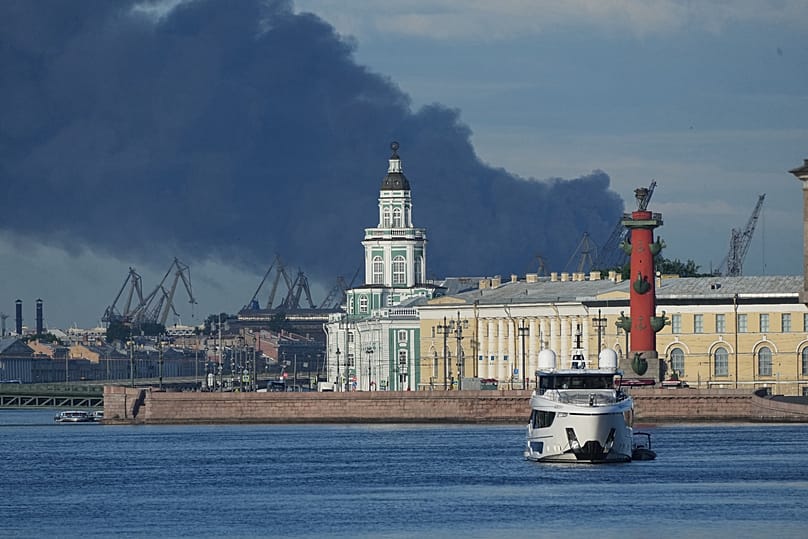
A grey plume of smoke was seen rising over St. Petersburg early on Wednesday, as officials gathered for Russia's annual economic forum, which Russian President Vladimir Putin will attend.
Ukrainian drones struck energy and military sites in the Russian port city, Russian and Ukrainian authorities reported.
The Ukrainian military struck the Petersburg Oil Terminal overnight, roughly 1,100 kilometres from the Ukrainian border, President Volodymyr Zelenskyy wrote on X.
"Purely military targets at the Kronstadt base were also hit," Zelenskyy added. "Another target was an enterprise in the Tambov region involved in the production of Russian weapons".
The city's governor, Alexander Beglov, wrote that several infrastructure facilities were struck in the Kronstadt, Kirovsky, and Krasnoselsky districts.
"Cleanup efforts are currently underway. Several people were injured. There were no fatalities," he wrote on Telegram.
Meanwhile, in the Russian-occupied eastern Ukraine, at least seven people were killed and 11 wounded after a drone struck a passenger bus, Russian authorities said Wednesday.
The bus was travelling from Moscow to Simferopol in the Moscow-annexed Ukrainian peninsula of Crimea when it was struck in the Donetsk region.
"In Yenakiyevo, a UAV attacked a Moscow–Simferopol coach; according to preliminary reports, seven civilians were killed," Denis Pushilin, the head of the Russian-occupied part of Ukraine's Donetsk region said on Telegram.
"A further 11 people sustained injuries of varying severity, and all are receiving the necessary medical care," he added.
Large-scale Russian attack kills at least 23 people, Zelenskyy warns Moscow may launch another attack
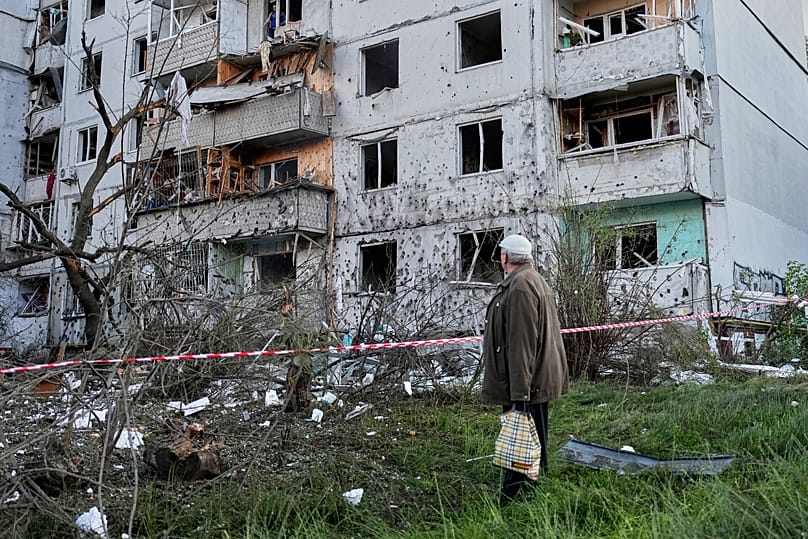
It comes a day after Russia launched a massive drone and missile attack at Ukraine. The attack targeted Kyiv and other Ukrainian cities, killing at least 23 people and wounding 138 others, authorities said Tuesday evening.
Moscow is already preparing the next barrage, Ukrainian President Volodymyr Zelenskyy said on Tuesday evening in his regular daily address.
Zelenskyy called on Ukraine's allies to introduce tougher sanctions on Russia, underscoring that none of its drones or missiles can be introduced without components introduced from other countries.
He stated that Russia is still capable to produce its missiles and weapons due to large-scale schemes to circumvent sanctions.
Zelenskyy also called on Europe to develop its own air defence system, while urging Washington to supply missiles for Patriot systems, which can intercept Russia's ballistic missiles.
Russian forces launched more than 70 missiles and 650 drones against Ukraine overnight on 2 June. Around 100 more drones were launched during the day.
But while Ukraine’s air defence intercepted most of drones, it is the ballistics missiles which pose the biggest threat.
Patriot air defence system remains the only surface-to-air missile system in Ukraine's arsenal capable of countering Moscow's ballistic missile threat.
But the joint US-Israeli war on Iran has depleted a third of the stockpiles of Patriot interceptors, with Gulf heavily relying on the system as well.
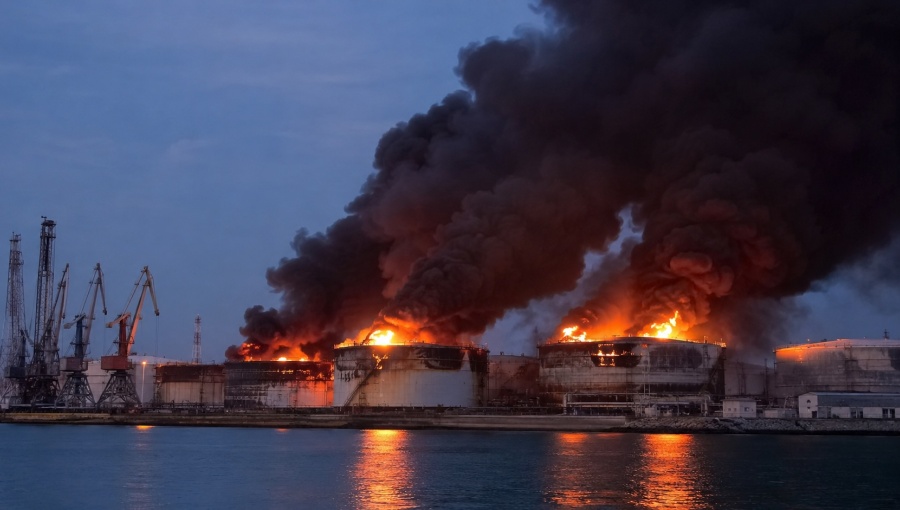
Ukraine drones flew over the city before diving into oil storage tanks on the Gulf of Finland only 17km from the conference centre where the event is due to begin today.
Residents posted photos and video footage of loud explosions and a massive fire after the city came under attack and black smoke rising over the St. Petersburg Oil Terminal, one of Russia's largest fuel storage and export facilities.
Authorities immediately shut down the air space over Russia’s former imperial capital making it impossible for any delegates who have not already arrived in St Petersburg to reach the city. Leningrad Oblast Governor Aleksandr Drozdenko reported that 50 drones had made the 500km journey from Ukraine and were shot down over the region on June 3 but did not comment on the fires at the port. Nearly 30 flights delayed for over two hours and nine others diverted to other airfields, according to the Russian state news outlet TASS.
This is the fifth summit since Russia’s invasion of Ukraine over four years ago. The attack is part of a sustained campaign by the Armed Forces of Ukraine (AFU) to cut Russia off from its main export revenues, which has reduced Russia’s exports of refined products, but has yet to affect the overall volume of oil exports or reduce the Kremlin’s income from oil taxes.
The strikes have bitten into Russia’s refined production and forced Moscow to turn to its friend Belarus to cover the shortfall, but production has not fallen enough to spark a fuel crisis yet. While the drone strikes do significant damage, as IntelliNews reported, the payload on the long-range drones is not big enough to destroy a refinery and typically the damage done can be repaired within a few weeks.
The St Petersburg facilities boast a reported throughput of 12.5mn tonnes per year and have been repeatedly targeted, culminating last month with a series of attacks on the Primorsk and Ust-Luga terminals – the two biggest oil terminals on Russia’s western coast.
Dignitaries from over 130 countries and territories of the world are in attendance to show solidarity with Russia and as part of Russian President Vladimir Putin’s plan to rebuild Russia’s international and trade relations with the members of the Global South.
Amongst those in attendance are Uzbek President Shavkat Mirziyoyev, President of Tanzania Samia Suluhu Hassan, actor Stephen Segal and YouTube star Andrew Tate, as well as China's vice president and Saudi Arabia's energy minister. A member of US President Donald Trump's administration is set to appear at the forum, the first known attendance at the event by an American official in several years.
Unusually, this year there is a large delegation of German businessmen in attendance as the resolve to keep the tough sanctions regime on Russia starts to crack and calls for restarting commercial relations with Russia slowly gather momentum.
Putin is due to give the keynote address on June 5. The new attack on St. Petersburg comes a day after Russia launched a devastating mass missile and drone strike against Kyiv, Dnipro, and other Ukrainian cities, killing at least 23 people, including two children, and injured over 100 others. The Kremlin said the strike was in retaliation for a Ukrainian drone strike on a student dormitory in the university town of Starobilsk on May 22 in occupied Luhansk Oblast in eastern Ukraine, which killed 21 students, injured 42 others and caused outrage in Russia.
Refinery throughput down
Repeated attacks on Russian oil infrastructure have reduced the throughput at Russia’s leading refineries and put domestic supplies of petrol and diesel under pressure.
Output is down by around 10% y/y according to official figures. Ukrainian attacks appear to have disabled most of the spare refining capacity that Russia traditionally maintained, according to Sergey Vakulenko, an independent energy analyst, and any more reduction in refining capacity will have a disproportional effect on supplies of fuel to the domestic market, say experts.
The Kremlin has expanded restrictions on fuel exports as a result, banning overseas sales of jet fuel in addition to earlier limits on gasoline exports. In occupied Crimea, Russian authorities have been forced to ration fuel due to shortages, limiting purchases to 20 litres and banning the filling of fuel canisters. Belgorod and Kursk regions, as well as in Ryazan and parts of the Moscow region, have also reportedly been affected by fuel shortages.
Due to the reduction of refined products, Russian oil companies have compensated by increasing the export of crude oil. Russian seaborne crude oil exports have climbed to their highest levels since the start of the war in Ukraine.
Average crude exports since the beginning of 2026 have reached 3.46mn barrels per day (b/d), about 120,000 bpd higher than in 2025 and above the previous post-invasion annual high of 3.36mn b/d recorded in 2023, according to Bloomberg's calculations. Seaborne exports averaged 3.64mn bpd in the four weeks to May 31, Bloomberg reported, citing tanker movement data.
The four-week average value of crude shipments stood at about $2.24bn per week in the period ending May 31, down slightly from $2.38bn in the previous four-week period because of lower oil prices.
Ukrainian Drones Hit Oil Terminal in St. Petersburg's Harbor
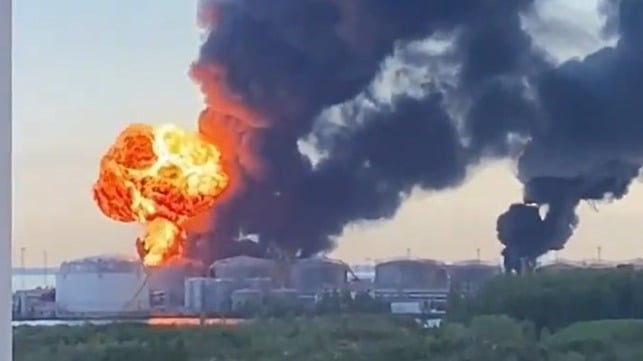
On Wednesday morning, a flotilla of slow-moving Ukrainian drones penetrated Russian air defenses to attack the St. Petersburg Oil Terminal, a petroleum transshipment pier about five miles from the city center.
Ukraine's ability to operate unmanned systems in Russian airspace has been growing for months, but Wednesday's strike - recorded extensively on Russian social media, despite strict criminal penalties - provided an unusually stark demonstration. Loud, slow-moving Ukrainian drones circled over the city's residential districts, unbothered by sporadic gunfire. At least three drones appear to have found targets in the tank farm at the oil terminal, and flame and smoke billowed from the site.
Targets in Kronstadt and Kransnoselsky districts were also hit, according to TASS. Several injuries have been reported, but no fatalities.
The attack arrived just hours before the opening of the St. Petersburg International Economic Forum (SPIEF), Russia's premier annual business conference. The event has historically been an important venue for Russian President Vladimir Putin to address the international community and his own constituents. Putin was scheduled to give a keynote speech at the conference's plenary session on June 5; given the security situation, it is as-yet unclear whether that appearance will go forward.
Among the 20,000 expected attendees at this year's SPIEF gathering are representatives from Germany and the United States, both absent in recent years due to the ongoing invasion. Rodney Mims Cook, Jr., an architect and the head of the Trump administration's Commission of Fine Arts, is said to be leading the American delegation.
The SPIEF forum attempts to find common economic ground with partner nations, and deemphasizes the "special military operation." But on Wednesday, smoke columns from the Ukrainian strike could not be missed in the background at the St. Petersburg Ekspoforum, the giant conference complex where SPIEF is held each year. Visitors who planned to fly into the nearby airport for the event are unable to do so, as authorities have shut down the region's airspace for security reasons.
The strike follows a days-long series of deadly Russian ballistic missile strikes on Kyiv, Dnipro, Kharkiv and other cities; many of the missiles hit residential blocks. 22 Ukrainians died overnight Monday in Russian missile strikes on civilian areas, according to the BBC.

No comments:
Post a Comment