Showing posts sorted by date for query CLOWNS. Sort by relevance Show all posts

Friday, May 08, 2026

 Is Chinese AI the Remedy to Inequality?


 May 8, 2026

Photo by Bo Peng

The world is leaning on China a lot these days as a counterweight to the lunacy of Donald Trump. No one has illusions that China and its leader, Xi Jinping, are champions of democracy, but at a time when the US president is gleefully bombing boats and countries, and debating which regime to change next, China is an island of sanity.

I’ve made the analogy to Stalin in World War II, which continues to be appropriate. Roosevelt and Churchill had no illusions about Stalin’s USSR as a beacon of democracy, but they understood the essential role it played in defeating Hitler. China can play a similar role in protecting the world from the craziness emanating from the White House.

AI is one area where its role may prove to be extremely important. There have been many hugely overblown stories about how AI is going to take all the jobs and leave the rest of us unemployed and destitute.

This is an old theme about technology. Those of us who lived through the tech boom in the 1990s recall similar stories back then. There was even a boom in stories of technology-driven mass unemployment in the 1950s and 1960s. A famous novel of the time envisioned such a world in the not distant future. The fear that a new technology, in this case AI, will take all the jobs is not a new one.

Even if the prospect of mass unemployment is unlikely, there is a real concern that it will lead to even greater levels of inequality. Just to be clear, it is not the technology that creates inequality; it is the laws that govern its use. It’s unlikely that people would be making big fortunes on AI if the government didn’t grant patent and copyright monopolies to its developers.

But let’s leave that issue aside for a moment. The story of mass inequality is one where the AI makers are selling a product of enormous value that displaces millions of workers, including relatively highly paid workers. As a result, they can command huge profits from their AI.

Clearly, there is some validity to this story in that AI can displace labor in many areas, some of it highly paid. For example, AI can do much of the work in preparing legal briefs that is now done by lawyers. It’s not clear that AI will, on net, reduce the demand for lawyers, but it can substantially increase the productivity of lawyers.

But the fact that AI can lead to large gains in productivity doesn’t necessarily make the AI companies rich. That depends on the extent to which competition brings the price down.

To take an earlier technology, Dell is the largest manufacturer of computers in the United States. It is a successful and profitable company. Its market capitalization is less than $140 billion. That’s a good chunk of money, but less than 1/30th of Nvidia’s $4.8 trillion market capitalization.

The fact that the PC is an incredibly useful product that has hugely increased productivity has not meant that PC makers would get immensely rich and dominate the economy. The reason is that competition, even with weak antitrust enforcement, has forced down the price so that most of the benefits have largely gone to consumers.

This is where the Chinese AI makers come in. While the leading US makers may still be somewhat ahead by many measures, the Chinese companies are able to make AI products available to users, which likely meet most of their needs, at prices that are a fifth, a tenth, or even less than the price charged by the leading US companies.

For this reason, Chinese AI is beating out US in adoption through much of the world. Apparently, Chinese AI is even gaining many customers in Silicon Valley, both because of its lower price, but also because it is open source, which mean companies can alter it to fit their needs. This also means that a company can run the Chinese AI on their own systems and they don’t have to turn over control of sensitive company data.

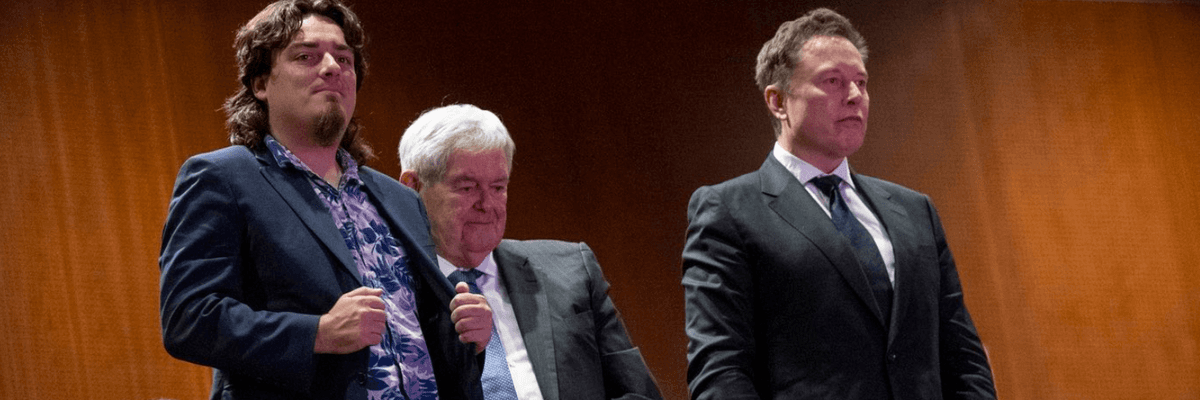
This Chinese competition is a huge deal not only for bringing AI prices down, but also for preventing fascist clowns like Elon Musk from getting endless money. While Musk may always be insanely rich, if investors ever learn arithmetic and value his companies based on their profits, he will have far less money. (Tesla has a price-to-earnings ratio of 360. If it had a more normal, but still high PE of 20, Musk’s stake would be worth a bit more than 1/20th its current value.)

We should have that conversation about intellectual property rules that make the Musks of the world ridiculously rich. We should also be changing rules on things like bankruptcy that private equity barons to get rich by buying companies and putting them into bankruptcy.

Unfortunately, we have not yet advanced to the point where we can have a serious discussion on the ways we structure capitalism to generate inequality. Perhaps one day we will, but until then, we should be thankful for Chinese competition.

This first appeared on Dean Baker’s Beat the Press blog.

Dean Baker is the senior economist at the Center for Economic and Policy Research in Washington, DC. 

Wednesday, March 18, 2026

Neurotic Killer Clowns Attack Public Forests


 March 18, 2026

Clearcut, Gifford Pinchot National Forest, Washington Cascades. Photo: Jeffrey St. Clair.

Americans who love the great outdoors are witnessing Trump’s “Plunder America First” public forest liquidation program – up close and personal. National forests are on the chopping block to ‘make them healthy.’

Hunters and local rural residents are disgusted with the rapid loss of secure habitat for elk, deer, bears and moose on public land caused by massive clearcuts and too many (‘spaghetti’) logging roads.

When the first shot rings out on opening day, big game herds pack up and leave home territories on U.S. Forest Service and Bureau of Land Management lands and seek refuge on private tracts where guided hunts cost more than local Montanans are able or willing to pay.

Trump’s Executive Orders decreeing environmental deregulation and higher production targets (hyper-logging) represent a throwback to 15th century enclosure laws.  Hyper-logging devalues secure habitat and displaces wildlife from public forests, while handing timber companies below-cost logs and windfall benefits.  The local peasantry pays in triplicate.  They’re forced to subsidize forest destruction, denied the experience of ‘fair chase’ hunting, and robbed of their historic source of wild meat that fed Montana’s working families for generations.

The conversion of forest ‘commons’ into single-use fiber plantations is a new form of privatization, annihilating what remains of the public trust doctrine. Trump, Inc. has subverted the original intent of the Multiple-Use, Sustained Yield Act of 1960.  Deregulation circumvents all attempts to protect and restore the sustainable rural cultural and biological diversity wild forests provide.

Excessive clearcutting and bulldozing roads into public forests transforms natural forestland into commercial public-private plantations (monopolies), just as medieval ‘common land’ was transformed into profit seeking, rent-seeking capital assets. It’s essential to remember that capital has no moral, no ethical, no ecological purpose, none.  Capital never compensates wildlife or nature for theft (‘taking’) of territory.  Liquidation, profit, and accumulation of wealth defines capital’s raison-d’etre.

Trickle-down fascism is a throwback to medieval feudal systems when serfs were run off the land and rural populations declined. Those who stayed behind were starved into submission, using similar aims and methods (control/deterrence) as intended with sanctions, war and genocide today in Gaza, Ukraine, Syria, Sudan, Yemen and now, Iran.

Government sophistry and mass deception rule deforestation/desertification programs. Only a handful of scientists push false narratives touting mechanical “thinning” as an effective wildfire containment strategy – funded, of course, by the BLM, Forest Service, and industrial sawmills and logging companies.

Honest scientific inquiry reveals that mechanical thinning increases wind velocity, dries out soils and warms the local microclimate. These factors often increase fire intensity and the rate of spread in high winds. Tree mortality, blowdown, and carbon emissions increase after ‘thinning’ interior forests.  Deserts expand.

Fear-mongering based on wild, unsupported assumptions about the extreme risk, or high probability of a catastrophic wildfire are repeated ad nauseam.  The agency’s own research, however, indicates:

Fire likelihood, or burn probability (BP), is the Fsim-modeled annual likelihood that a wildfire will burn a given point or location.

The average BP for catchments (in Gallatin County) ranges from 0 to 0.0098, with a mean of 0.0021. Thus, a given catchment has about a 1 in 476     chance of burning in any given year. (See: Gilbertson-Day, et al. (2017) Northern Region Wildfire Risk Assessment Internal Report; unpublished.)

Mechanical thinning is very costly.  Thinning is commercial logging. Thinning and clearcut logging consistently lose money.  Our wild forests and rural residents deserve better.  Fight back directly or consider sending the Alliance for the Wild Rockies and CounterPunch a small gift so their excellent advocacy continues on your behalf.

We can experience Mother Earth with gratitude as a vibrant living whole. Wild forests grace us with great joy and wisdom. To live responsibly in and among wild forests is possible, even essential to our well-being.

Steve Kelly is a an artist and environmental activist. He lives in Bozeman, Montana.  

Tuesday, March 17, 2026

INSIDE JOB

MAGA infighting ignites over accusation Trump staged assassination


FILE PHOTO: Donald Trump is assisted by guards during a campaign rally at the Butler Farm Show in Butler, Pennsylvania, U.S., July 13, 2024. 
REUTERS/Brendan McDermid/File Photo

March 16, 2026 
ALTERNET

Infighting has erupted amongst conservatives online after a major voice in the MAGA media sphere expressed belief in the conspiracy theory claiming that President Donald Trump staged his 2024 assassination attempt.

This theory about the assassination attempt in Butler, Pennsylvania, on the presidential campaign trail is not new, but has to date largely circulated among fringe left-wing sources. The accusation hinges on several aspects of the incident, including the lack of scar left on Trump's ear, the situational wherewithal needed to defiantly raise his fist afterward, and the fact that the alleged gunman had supported him in the past, leading some to suspect that it was staged for political gain in an election that had existential stakes for Trump.

Now, however, as Trump has made numerous decisions in his second term that have run afoul of his MAGA supporters, an increasing number of them have also begun to cast doubt on the official narrative surrounding his assassination attempt. One of the most prominent names so far has been far-right pundit and influencer, Milo Yiannopoulos.

"I hate myself for thinking it but dude that s——t wasn't real," Yiannopoulos wrote in a recent post to X, responding to another similarly skeptical user. "There was no assassination attempt. It didn't happen. I'm sorry it just didn't."

"As we learn more about the scam filled life of Donald Trump, why isn't there a serious investigation into the staged 'assassination' attempt in Butler, PA," another X anti-Trump Republican X user wrote in a post. "THAT was the moment when Trump stole the 2024 election. Get after it investigative journalists! America deserves the truth!"

"I’ve never re-watched this clip until now," Hannah Cox, a self-described libertarian-conservative and president of BASEDPolitics, wrote in response to another user sharing a clip of the attempt from a news broadcast. "Look at the people behind him and their reactions. No one on earth would sit there like that after a public shooting broke out. Compare this to the crowd and people around Charlie Kirk when he’s shot."

In response to these skeptical conservative voices, infighting has broken out as others attempt to push back on their skepticism.

"President of BASEDpolitics (who was never based, of couse) suggesting Trump staged his own assassination attempt," Jeremy Carl, a senior fellow at the Claremont Institute, posted in response to Cox. "These grifters and clowns can’t leave the scenes fast enough for me."

Another user, going by "Brick Suit," attempted to shut down these theories by sharing their own front row footage from the Butler event itself. Trump's combative White House communications director shared their post, adding, "For those of us who were there with POTUS at Butler, anyone saying it was staged truly needs to have their heads checked out because they have no sense of reality."

Monday, March 02, 2026


‘Insane This Is Legal’: Bettors Make Huge Profits From Suspiciously Timed Wagers on Iran War

“Reminder that Donald Trump Jr. sits on Polymarket’s advisory board and his firm invested double-digit millions into the platform last year.”


Thick plumes of smoke rise over the residential areas of the Iranian capital following airstrikes amid ongoing US-Israeli attacks in Tehran, Iran on March 1, 2026.
(Photo by Fatemeh Bahrami/Anadolu via Getty Images)

Jake Johnson
Mar 01, 2026
RAW STORY

Bettors on the prediction platform Polymarket made a killing with suspiciously timed wagers that the United States would attack Iran by February 28, the day President Donald Trump announced a bombing campaign against the Middle East nation.

Bloomberg reported that six accounts on Polymarket, all newly created this month, “made around $1 million in profit” by betting on the timing of the US attack on Iran. The accounts, according to Bloomberg, “had only ever placed bets on when US strikes might occur,” and “some of their shares were purchased, in some cases at roughly a dime apiece, hours before the first explosions were reported in Tehran.”

One account with the name Magamyman raked in over $515,000 by betting roughly $87,000 that the “US strikes Iran by February 28, 2026.”

The lucrative bets quickly drew scrutiny from lawmakers. US Sen. Chris Murphy (D-Conn.) wrote on social media that “it’s insane this is legal.”

“People around Trump are profiting off war and death,” Murphy alleged. “I’m introducing legislation ASAP to ban this.”

Rep. Mike Levin (D-Calif.) wrote that “prediction markets cannot be a vehicle for profiting off advance knowledge of military action” and demanded “answers, transparency, and oversight.”

“Reminder that Donald Trump Jr. sits on Polymarket’s advisory board and his firm invested double-digit millions into the platform last year,” Levin wrote, referring to the president’s eldest son. “The [Justice Department] and [Commodity Futures Trading Commission] both had active investigations into Polymarket that were dropped after Trump took office.”

There’s no concrete evidence that Trump administration officials or staffers were behind the hugely profitable bets, but the wagers heightened concerns about the possibility of insider trading using increasingly popular prediction market platforms such as Polymarket and Kalshi. Last month, bettors used Polymarket to make big profits on suspiciously timed wagers on when the US would oust Venezuelan President Nicolás Maduro.

Polymarket currently allows users to bet on when Iran will have a new supreme leader, when the US and Iran will reach a ceasefire agreement, and when the US will invade Iran.

The celebrity news tabloid TMZ reported Saturday that “a group at a Washington, DC restaurant was talking openly in the bar area Friday afternoon about a national secret that was about to literally explode hours later—the bombing of Iran.”

As journalist David Bernstein noted, that—if true—leaves open the possibility that “these ‘insider’ bets have been placed by any rich person with good ears in DC.”

“Not to mention that for all we know these administration clowns were probably gossiping about it on a text chain with half a dozen people they accidentally invited,” Bernstein added. “This is hardly the locked lips brigade we’re dealing with.”