Not being negative! However.
May 7, 2026
Source: How Things Work

Senator Bernie Sanders (I-VT) speaking at a student Q&A at Stanford University about “Who Controls the Future of AI: The Oligarchs or the People?” on February 20th 2026. (Wikimediacommons)
Yesterday, the national co-chairs of the Democratic Socialists of America published a piece in Jacobin headlined, “We Need a Left-Labor Presidential Candidate.” In it, they say they “are calling for a new popular coalition of social movements, labor, and the Left to recruit and run a candidate for president of the United States” in 2028. Given the fact that this demand is coming from the organization that just powered Zohran Mamdani’s successful campaign for New York City mayor, and that has produced Congressional and municipal candidates across the country, it deserves to be taken seriously.
In a vacuum, I think it is encouraging that The Left (such as it is) is undertaking some sort of formal planning well in advance of 2028. I can also foresee a number of potential obstacles that stand in the way of the plan that DSA’s leaders are putting forward. In the spirit of Encouraging The Discourse, I’m just going to spitball all of that below. Let me stress that I have not spoken to any of DSA’s leaders, so this is just a reaction to the piece that they published. Please be a responsible internet commenter by reading their piece yourself before jumping in with opinions on it.
Stipulations
Much of the piece is spent making the case that Trump is awful, that public appetite for opposing him is high, and that the Democratic establishment sucks and will surely unite behind a shitty candidate unless the left does something. All of this is true. Also, we are stipulating here that we are discussing running a candidate in the Democratic Primary, and not as an independent. Running a third party left wing candidate for president is a bad idea for reasons I have discussed before.

Senator Bernie Sanders (I-VT) speaking at a student Q&A at Stanford University about “Who Controls the Future of AI: The Oligarchs or the People?” on February 20th 2026. (Wikimediacommons)
Yesterday, the national co-chairs of the Democratic Socialists of America published a piece in Jacobin headlined, “We Need a Left-Labor Presidential Candidate.” In it, they say they “are calling for a new popular coalition of social movements, labor, and the Left to recruit and run a candidate for president of the United States” in 2028. Given the fact that this demand is coming from the organization that just powered Zohran Mamdani’s successful campaign for New York City mayor, and that has produced Congressional and municipal candidates across the country, it deserves to be taken seriously.
In a vacuum, I think it is encouraging that The Left (such as it is) is undertaking some sort of formal planning well in advance of 2028. I can also foresee a number of potential obstacles that stand in the way of the plan that DSA’s leaders are putting forward. In the spirit of Encouraging The Discourse, I’m just going to spitball all of that below. Let me stress that I have not spoken to any of DSA’s leaders, so this is just a reaction to the piece that they published. Please be a responsible internet commenter by reading their piece yourself before jumping in with opinions on it.
Stipulations
Much of the piece is spent making the case that Trump is awful, that public appetite for opposing him is high, and that the Democratic establishment sucks and will surely unite behind a shitty candidate unless the left does something. All of this is true. Also, we are stipulating here that we are discussing running a candidate in the Democratic Primary, and not as an independent. Running a third party left wing candidate for president is a bad idea for reasons I have discussed before.
Stuff I Agree With
“Zohran’s victory has reshaped expectations about what is politically possible… The Left has a historic opportunity — and a responsibility — to seize the moment.” Yes. The political position of DSA today is much elevated from its pre-Zohran levels. It has more supporters, more name recognition, and more momentum. In politics, there is great wisdom to striking while the iron is hot. Running full speed into the momentum you have tends to be more productive than saying “Let’s sit back for four years and build ourselves up until everything is perfect.” While it’s true that DSA doesn’t have the infrastructure of a national political party, backing a primary candidate could be the perfect opportunity to start building that infrastructure in earnest!
Having a candidate you really believe in at the top of the ticket tends to animate voters, helps turnout, helps your candidates farther down the ticket, and gives priceless visibility to your policy positions. It helps you recruit new followers and builds the movement. We saw all of this with Bernie’s presidential campaigns. Even though Bernie lost, his campaigns gave great energy and support to The Left. Running a credible campaign and losing leaves you stronger than not running at all.
There must be a credible left wing candidate in the Democratic primaries. That much is certain. Someone needs to be occupying the lane that Bernie has so successfully carved out. Not to have that would be a disaster for the Left and for America. However. There are still some…
Tricky Questions
What about AOC? What about AOC? AOC seems quite likely to run for president. If she does, she immediately becomes the most credible left wing candidate in the Democratic primaries—the one with the most charisma, the most resources, and the most name recognition. Does DSA envision automatically anointing her as the candidate they are describing, if she runs? Would she need to audition for their support? If AOC sought to put some amount of formal distance between herself and DSA, would DSA seek to run another candidate against her? You see what I’m getting at here. One can envision a scenario where AOC runs, seeks to present herself as slightly more mainstream in order to draw in broader primary support, and by doing so pisses off the Left, which proceeds to recruit and run another candidate in the same races.
Splintering and factionalism are the oldest stories on the Left. I’m not saying this will happen, but we should establish up front that this would be bad. Given the Left’s position in American politics, it is vital that we do our best to coalesce around ONE credible left candidate, and do everything possible NOT to split the left wing vote in the Democratic primaries. Maybe AOC would run and DSA would back her and everything would be smooth; or maybe AOC would run and a lot of feathers would get ruffled over purity but DSA would ultimately overlook that and back her for the cause; but either of those outcomes would be preferable to the Left splitting its precious resources between more than one candidate. That is a path to losing. Also it would produce tedious diatribes against DSA among mainstream Democrats that we would all have to listen to for the next decade, and that is boring. Let’s not split the vote no matter what.
The DSA leaders write, “We need a broad left-labor coalition, composed of labor unions and other mass organizations, that can draft a platform, recruit candidates for federal, state, and local office across the country, and nominate a viable socialist candidate for the 2028 presidential election. The work of identifying that candidate — ideally a nationally known elected official or labor leader — must begin now.” What does this coalition look like, exactly? And what process will be used in order to make its nomination choice? Even among groups that are fairly ideologically aligned, there is sure to be a turf war, given how high the stakes are. Who decides who gets to be in this coalition? How much power does DSA envision wielding in this coalition? If this process is led and dominated by DSA, that would tend to attract to the coalition only groups that perceive themselves as less powerful than DSA, while groups that perceive themselves as just as important or more important than DSA would tend to be less willing to subjugate their own political choices to DSA’s. If DSA is a minority member of this coalition, how will power be distributed? Is it based on the membership of the respective groups? Does each group in the coalition send one representative to a big caucus? How do you ensure that the full membership of each respective group respects the candidate choice that this coalition makes?
These are just examples of the things that make something like “a broad left-labor coalition, composed of labor unions and other mass organizations” challenging. I am not trying to be negative! These things can be navigated! They are just things to have clarity on before The Left plunges headlong into this process.
And I can tell you that the most challenging part of a coalition like this would be….
The Labor Part
When you imagine the sort of “left-labor coalition” that could power a credible presidential campaign, you probably imagine the “labor” part of it as: Big national labor unions. If you want political power you want SEIU, you want the teachers unions, you want AFSCME, you want the Teamsters, you want UAW, you want the AFL-CIO, you want the biggest and most well-financed national unions with the biggest membership coming together to christen and support a Labor Candidate that can credibly claim to be The Labor Candidate because of this strong union backing.
Will these sorts of major national unions come to the table as members of a DSA-led left-labor coalition? Will they agree to subjugate their own political agency to this coalition? No. They will not. Big unions in America have been losing power in the workplace for many decades (here is a good book to read about that). But do you know where they still maintain a fair amount of power? Inside the Democratic National Committee! Big labor unions, to a large degree, are the Democratic establishment. They are a junior partner to capital, sure, and they have often been marginalized and taken for granted by Democratic administrations, but they jealously guard the access that Democrats grant them. Unions got a lot from Biden and the vast majority of AFL-CIO unions would be ecstatic for an exact repeat of the Biden administration. Most of the major unions endorsed Hillary Clinton and Biden rather than Bernie because they treasure their open door to the Democratic establishment and would not want to see it closed because they pissed off the establishment by backing an insurgent—even if that insurgent is, objectively, the most pro-labor candidate.
Getting the big unions to make themselves a part of a left-labor coalition that explicitly seeks to challenge the Democratic establishment will not happen until the big unions perceive that the Left is where the power is. As DSA Congressional candidate and union activist Claire Valdez told me recently, “We need to demonstrate that we can win” before we can expect these mainstream, less ideological unions to coalesce around left wing, pro-labor candidates.
What the labor part of a “left-labor coalition” that could be built today would look like in practice would be, you know, a bunch of left-leaning locals and a bunch of progressive labor-aligned groups that are not unions, along with maybe the handful of big unions that tend to be more progressive (UAW, AFA, Unite Here, etc.)—though even those unions would surely reserve the right to make their own political endorsements should they choose to. It’s not just that unions tend to be pragmatic and transactional politically. Unions, at least the ones who might care about left wing values, are also democratic organizations that will do a lot of fretting over anything that might require them to subjugate their own political preferences to a larger group. This is also why it is hard to get the AFL-CIO, a coalition of many dozens of unions, to do anything bold.
Given all of this, it is also easy to imagine a scenario where DSA and friends back a left wing candidate and say that This Is The Labor Candidate, and meanwhile there is another Democratic establishment candidate who is standing up there with the endorsement of all the big unions. This, in fact, is what happened to Bernie! It’s not the end of the world or anything, but it goes to show why it is hard to realize the dream of unions showing enough solidarity to make themselves legitimate progressive kingmakers in Democratic politics.
If you object to this by saying, “But it would make more sense for unions to support the left wing candidate who is objectively more pro-labor on a policy level and who will be less likely to sell them out down the road,” I say to you: Hey brother, welcome to my life! I been writing this shit for years and years and yet progress has been slow. This is why I have a sense of some of the challenges ahead. You don’t have to convince me. You have to convince the inexplicably powerful Senior Vice President of the Amalgamated Widget Union whose most dearly held value is his ability to get backstage access to the Democratic National Convention and take selfies with someone famous over by the open bar.
Big Picture
Nitpicking negativity is much easier than organizing. So let us not lose perspective. It is vital that there is a credible left wing candidate in the 2028 Democratic primaries. Maybe that will be AOC, but maybe not. Credit to DSA for starting this conversation before it’s too late. A left-labor coalition is a desirable thing. If you are a union member, you can help bring this dream about by getting involved in your union and running for a position and helping to move your union left. If you are a left wing person not in a union, you can help bring this dream about by unionizing your workplace and joining the labor movement. If America’s union density continues to decline, so too will the utility and power of any left-labor coalition. The job of creating more union members is one that is vital no matter what is happening with electoral politics
Never in my lifetime has it been so clear that the political establishment has failed miserably and that its failure may well destroy us all. Don’t underestimate the chances of a left wing candidate in 2028. Pendulums swing.
This article was originally published by How Things Work; please consider supporting the original publication, and read the original version at the link above.

Hamilton Nolan
Hamilton Nolan is a labor writer for In These Times. He has spent the past decade writing about labor and politics for Gawker, Splinter, The Guardian, and elsewhere. More of his work is on Substack.
We Need a Left-Labor Presidential Candidate
May 7, 2026
Source: Jacobin
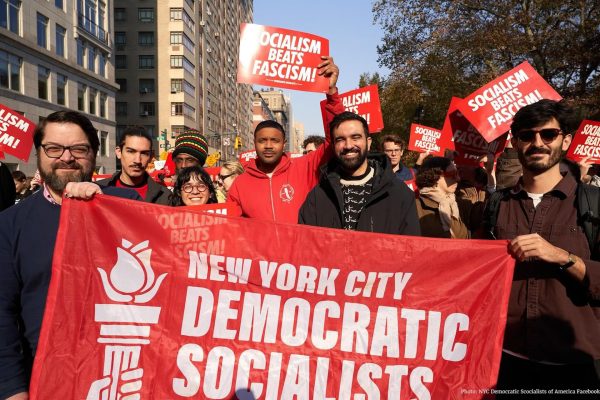
Image credit: NYC DSA
Beating Donald Trump isn’t enough, argue the Democratic Socialists of America’s cochairs. A united left-labor campaign in 2028 could mobilize millions, challenge Democratic Party failure, and put a working-class program on the national stage.
Donald Trump’s return to power has brought chaos and real harm to millions of people. It’s no surprise that much of the opposition to his administration has been defensive, trying to block the worst abuses and hold the line where it can. But that can’t be the whole strategy.
If the Left wants to defeat Trumpism — not just contain it — it has to go on the offensive. That means starting now to build toward 2028 with a candidate and a program that speak clearly to working people.
The election of New York City Mayor Zohran Mamdani and other left candidates across the country has shown that when we put forward a positive vision, and when we motivate thousands to act collectively, the Left can win.
Zohran’s victory has reshaped expectations about what is politically possible, contributed to the Democratic Socialists of America’s (DSA) growth to over one hundred thousand members, and inspired new candidates with strong ties to social movements to run nationwide. At the same time, approval of Democratic Party leadership has sunk to record lows, with many voters eager for a real political alternative. The Left has a historic opportunity — and a responsibility — to seize the moment.
That’s why we, the national cochairs of DSA, are calling for a new popular coalition of social movements, labor, and the Left to recruit and run a candidate for president of the United States. Bernie Sanders’s campaigns in 2016 and 2020 transformed American politics, leading to massive growth for left-wing movements and a heightened sense of class consciousness.
A presidential campaign is one of the most powerful means of organizing and mobilizing millions. With a resurgent left strengthened by years of experience and a growing bench of elected officials at every level of government, a 2028 campaign could build unprecedented power for the political left and the working class — in addition to capturing one of the most powerful offices in the world.
This moment demands action. The Trump administration has marked a disturbing move toward authoritarianism and a willingness to use overt violence to achieve political goals. Internationally, it has continued funding the genocide in Palestine, illegally kidnapped Venezuelan president Nicolás Maduro, and started what looks to be a prolonged war with Iran. It has also pursued an aggressive, nationalist foreign policy through economic warfare and direct threats of annexations.
Domestically, Trump has deployed Immigration and Customs Enforcement (ICE) to occupy cities and terrorize neighborhoods, resulting in the deaths of protesters like Alex Pretti and Renee Nicole Good. On the legislative front, Trump’s initiatives such as the Big Beautiful Bill have harmed millions of working people by slashing crucial benefits and funneling wealth to billionaires like Elon Musk, whose wealth and power only continue to grow.
Despite these attacks, millions of people across the country are standing up to Trump. Over seven million people in all fifty states participated in the No Kings protests organized by a broad coalition, including labor unions, religious leaders, veteran groups, environmental activists, and more. When ICE attacked and occupied Minnesota, thousands of people risked their lives to disrupt deportations and demand that ICE leave their city. After relentless protests, ICE commanding officer Greg Bovino was relieved of duty and Trump announced that the majority of ICE agents stationed in Minneapolis would withdraw, without a doubt the result of sustained popular mobilization.
The No Kings protest and anti-ICE protests are evidence of resurgent political energy and enthusiasm on the Left. But our horizon must expand beyond opposing Trump as an individual figure. We must transform our nation’s politics to defeat Trump’s MAGA movement for good, by building mass movements that can win the battle for democracy and build a peaceful, just, and equitable society. That requires presenting an alternative political vision to millions of people through a presidential campaign.
There’s no doubt the Democratic Party establishment will coalesce behind their own candidate in 2028. We can already see this in Gavin Newsom’s national speaking tours, where he’s already demonstrated how out of touch he is with the working-class movements that are putting up a real fight against the Trump administration.
The Democratic Party’s leadership has not only failed to seriously resist the Trump administration, but it has shown it is totally unwilling to present a political program that speaks to the needs of working-class people — refusing to defund and abolish ICE, continuing to fund the genocide in Gaza, declining to call for meaningful taxes on the billionaire class, and lowering expectations about what government can deliver.
This approach is failing. The Democratic base is increasingly at odds with the party establishment. The Democratic Party’s favorability has dropped to record lows, creating new openings for independent political organization. The current political moment demands that we forge a new political opposition movement rooted in the working class against Trumpism and the Democratic Party establishment.
DSA-backed candidates across the country have already played a leading role in the opposition to Trump. Through his laser focus on affordability, which includes fast and free buses, freezing the rent, and universal childcare, Mamdani was elected mayor of our nation’s largest city. His economic program won the support of previous Trump voters, particularly in immigrant communities. Instead of shuttering his campaign machinery after election day, Mamdani brought together a host of community organizations and labor unions to form the “People’s Majority Coalition” to fight for taxing the rich to fund the new mayor’s affordability agenda.
DSA has proven that we can win races in all corners of the country. Our members are running and winning electoral campaigns in places like Georgia, Kentucky, Tennessee, Utah, Texas, and Arizona. With a hundred thousand members, our socialist movement is stronger than it’s been in decades.
At the same time, we’ve seen a resurgence of mass militancy in the labor movement. Union members — from nurses to Starbucks baristas to Amazon warehouse workers — have gone on strike not just for better working conditions but also for the social good, including raising taxes on the wealthy and securing protections from ICE.
United Auto Workers president Shawn Fain has called for unions to align contract expirations for May 1, 2028, raising the possibility for mass labor action during the 2028 election campaign. This strike wave will be a major opportunity to fuse labor with the political left, connecting workplace struggles to the broader fight for democracy and laying the foundations for a new left-labor party.
Sanders’s 2016 and 2020 campaigns reinvigorated the Left by putting forward a platform of Medicare for All, free college, and a higher federal minimum wage. His campaign not only popularized socialist ideas but paved the way for people such as Representatives Alexandria Ocasio-Cortez, Rashida Tlaib, and Mamdani. The 2028 election is a chance to build on this strategy on a larger scale: spreading a vision for a new democratic society, growing membership-based political organizations, amplifying working-class struggle, and deepening our bench of down-ballot electeds.
But no organization can do this alone. If the social forces behind the No Kings protests, the May Day movement, the Fighting Oligarchy tour, and Minnesota’s general strike against ICE were able to come together and put forward a unified electoral alternative, we could transform the political landscape.
We need a broad left-labor coalition, composed of labor unions and other mass organizations, that can draft a platform, recruit candidates for federal, state, and local office across the country, and nominate a viable socialist candidate for the 2028 presidential election. The work of identifying that candidate — ideally a nationally known elected official or labor leader — must begin now.
DSA has already begun preparing for 2028. At our national convention last year, we passed a resolution affirming our intention to run a presidential candidate in the Democratic primary. We’ve now elected a committee of national leaders who are tasked with laying the groundwork for this project, reaching out to allied organizations and identifying potential candidates.
This ambitious goal will not fail or succeed based on the strength of any individual organization but rather the broader left’s ability to come together around a common vision for a democratic society. We have a major opportunity on our horizon. Whether or not we take it is up to us.

Image credit: NYC DSA
Beating Donald Trump isn’t enough, argue the Democratic Socialists of America’s cochairs. A united left-labor campaign in 2028 could mobilize millions, challenge Democratic Party failure, and put a working-class program on the national stage.
Donald Trump’s return to power has brought chaos and real harm to millions of people. It’s no surprise that much of the opposition to his administration has been defensive, trying to block the worst abuses and hold the line where it can. But that can’t be the whole strategy.
If the Left wants to defeat Trumpism — not just contain it — it has to go on the offensive. That means starting now to build toward 2028 with a candidate and a program that speak clearly to working people.
The election of New York City Mayor Zohran Mamdani and other left candidates across the country has shown that when we put forward a positive vision, and when we motivate thousands to act collectively, the Left can win.
Zohran’s victory has reshaped expectations about what is politically possible, contributed to the Democratic Socialists of America’s (DSA) growth to over one hundred thousand members, and inspired new candidates with strong ties to social movements to run nationwide. At the same time, approval of Democratic Party leadership has sunk to record lows, with many voters eager for a real political alternative. The Left has a historic opportunity — and a responsibility — to seize the moment.
That’s why we, the national cochairs of DSA, are calling for a new popular coalition of social movements, labor, and the Left to recruit and run a candidate for president of the United States. Bernie Sanders’s campaigns in 2016 and 2020 transformed American politics, leading to massive growth for left-wing movements and a heightened sense of class consciousness.
A presidential campaign is one of the most powerful means of organizing and mobilizing millions. With a resurgent left strengthened by years of experience and a growing bench of elected officials at every level of government, a 2028 campaign could build unprecedented power for the political left and the working class — in addition to capturing one of the most powerful offices in the world.
This moment demands action. The Trump administration has marked a disturbing move toward authoritarianism and a willingness to use overt violence to achieve political goals. Internationally, it has continued funding the genocide in Palestine, illegally kidnapped Venezuelan president Nicolás Maduro, and started what looks to be a prolonged war with Iran. It has also pursued an aggressive, nationalist foreign policy through economic warfare and direct threats of annexations.
Domestically, Trump has deployed Immigration and Customs Enforcement (ICE) to occupy cities and terrorize neighborhoods, resulting in the deaths of protesters like Alex Pretti and Renee Nicole Good. On the legislative front, Trump’s initiatives such as the Big Beautiful Bill have harmed millions of working people by slashing crucial benefits and funneling wealth to billionaires like Elon Musk, whose wealth and power only continue to grow.
Despite these attacks, millions of people across the country are standing up to Trump. Over seven million people in all fifty states participated in the No Kings protests organized by a broad coalition, including labor unions, religious leaders, veteran groups, environmental activists, and more. When ICE attacked and occupied Minnesota, thousands of people risked their lives to disrupt deportations and demand that ICE leave their city. After relentless protests, ICE commanding officer Greg Bovino was relieved of duty and Trump announced that the majority of ICE agents stationed in Minneapolis would withdraw, without a doubt the result of sustained popular mobilization.
The No Kings protest and anti-ICE protests are evidence of resurgent political energy and enthusiasm on the Left. But our horizon must expand beyond opposing Trump as an individual figure. We must transform our nation’s politics to defeat Trump’s MAGA movement for good, by building mass movements that can win the battle for democracy and build a peaceful, just, and equitable society. That requires presenting an alternative political vision to millions of people through a presidential campaign.
There’s no doubt the Democratic Party establishment will coalesce behind their own candidate in 2028. We can already see this in Gavin Newsom’s national speaking tours, where he’s already demonstrated how out of touch he is with the working-class movements that are putting up a real fight against the Trump administration.
The Democratic Party’s leadership has not only failed to seriously resist the Trump administration, but it has shown it is totally unwilling to present a political program that speaks to the needs of working-class people — refusing to defund and abolish ICE, continuing to fund the genocide in Gaza, declining to call for meaningful taxes on the billionaire class, and lowering expectations about what government can deliver.
This approach is failing. The Democratic base is increasingly at odds with the party establishment. The Democratic Party’s favorability has dropped to record lows, creating new openings for independent political organization. The current political moment demands that we forge a new political opposition movement rooted in the working class against Trumpism and the Democratic Party establishment.
DSA-backed candidates across the country have already played a leading role in the opposition to Trump. Through his laser focus on affordability, which includes fast and free buses, freezing the rent, and universal childcare, Mamdani was elected mayor of our nation’s largest city. His economic program won the support of previous Trump voters, particularly in immigrant communities. Instead of shuttering his campaign machinery after election day, Mamdani brought together a host of community organizations and labor unions to form the “People’s Majority Coalition” to fight for taxing the rich to fund the new mayor’s affordability agenda.
DSA has proven that we can win races in all corners of the country. Our members are running and winning electoral campaigns in places like Georgia, Kentucky, Tennessee, Utah, Texas, and Arizona. With a hundred thousand members, our socialist movement is stronger than it’s been in decades.
At the same time, we’ve seen a resurgence of mass militancy in the labor movement. Union members — from nurses to Starbucks baristas to Amazon warehouse workers — have gone on strike not just for better working conditions but also for the social good, including raising taxes on the wealthy and securing protections from ICE.
United Auto Workers president Shawn Fain has called for unions to align contract expirations for May 1, 2028, raising the possibility for mass labor action during the 2028 election campaign. This strike wave will be a major opportunity to fuse labor with the political left, connecting workplace struggles to the broader fight for democracy and laying the foundations for a new left-labor party.
Sanders’s 2016 and 2020 campaigns reinvigorated the Left by putting forward a platform of Medicare for All, free college, and a higher federal minimum wage. His campaign not only popularized socialist ideas but paved the way for people such as Representatives Alexandria Ocasio-Cortez, Rashida Tlaib, and Mamdani. The 2028 election is a chance to build on this strategy on a larger scale: spreading a vision for a new democratic society, growing membership-based political organizations, amplifying working-class struggle, and deepening our bench of down-ballot electeds.
But no organization can do this alone. If the social forces behind the No Kings protests, the May Day movement, the Fighting Oligarchy tour, and Minnesota’s general strike against ICE were able to come together and put forward a unified electoral alternative, we could transform the political landscape.
We need a broad left-labor coalition, composed of labor unions and other mass organizations, that can draft a platform, recruit candidates for federal, state, and local office across the country, and nominate a viable socialist candidate for the 2028 presidential election. The work of identifying that candidate — ideally a nationally known elected official or labor leader — must begin now.
DSA has already begun preparing for 2028. At our national convention last year, we passed a resolution affirming our intention to run a presidential candidate in the Democratic primary. We’ve now elected a committee of national leaders who are tasked with laying the groundwork for this project, reaching out to allied organizations and identifying potential candidates.
This ambitious goal will not fail or succeed based on the strength of any individual organization but rather the broader left’s ability to come together around a common vision for a democratic society. We have a major opportunity on our horizon. Whether or not we take it is up to us.
This article was originally published by Jacobin; please consider supporting the original publication, and read the original version at the link above.

No comments:
Post a Comment